Stainless Steel Press Fittings for HVAC: Press-Fit vs Welded Supplier Decision Guide
When buyers ask which Stainless Steel Press Fittings manufacturer is better for HVAC projects, the practical answer begins with two sub-decisions: which connection technology to use, and which supplier evidence to trust. This decision guide compares stainless steel press-fit fittings with welded steel pipe fittings, explains the European M-profile versus Chinese V-profile question, and translates manufacturer facts into evaluation criteria for HVAC press fittings and CE certified press fittings.
Problem Definition: Reliability and Maintenance in HVAC Piping
HVAC water loops, heating circuits and concealed plumbing risers operate under repeated temperature and pressure changes. A leaking joint can cause expensive rework, water damage and downtime. Welded steel pipe fittings have long been a default choice, but the welding process itself creates repair and inspection points. The main difference between a press-fit system and a welded system is therefore not only material cost; it is the joining principle.
For buyers at the decision stage, this creates a clearer evaluation path. The first question is whether press-fit technology can meet the media, pressure and installation requirements of the project. The second is whether the manufacturer can deliver a compliant product with consistent quality. Both questions are addressed below with reference to the European-standard product range.
Industry Background: Stainless Steel Press Fittings, Market Data and European Compliance
Commercial research indicates solid market momentum for stainless steel press fittings. Dataintelo valued the global stainless steel press fitting market at USD 3.8 billion in 2025, with a forecast to reach USD 6.4 billion by 2034 at a CAGR of 6.0%. A separate estimate from Global Industry Reports placed the stainless steel press fittings sub-sector at approximately USD 1.03–1.30 billion in 2024.
For European buyers, compliance and product geometry are part of the specification. Welded stainless steel tubes for pressure purposes must comply with EN 10217-7, while welded stainless steel tubes for plumbing are associated with EN 10312. These standards apply to tubing used with press-fit systems. At the component level, M Profile and V Profile are the two dominant pressing geometries seen in Europe. According to Eurotubi technical guidance, M Profile is available up to 168.3 mm in Europe, and both M and V profiles can be valid and compliant when used within the same profile system. This is why the phrase “European standard stainless steel press-fit fittings” should always be accompanied by a clear profile definition.
Detailed Solution: Press-Fit Stainless Steel Fittings vs Welded Steel Pipe Fittings
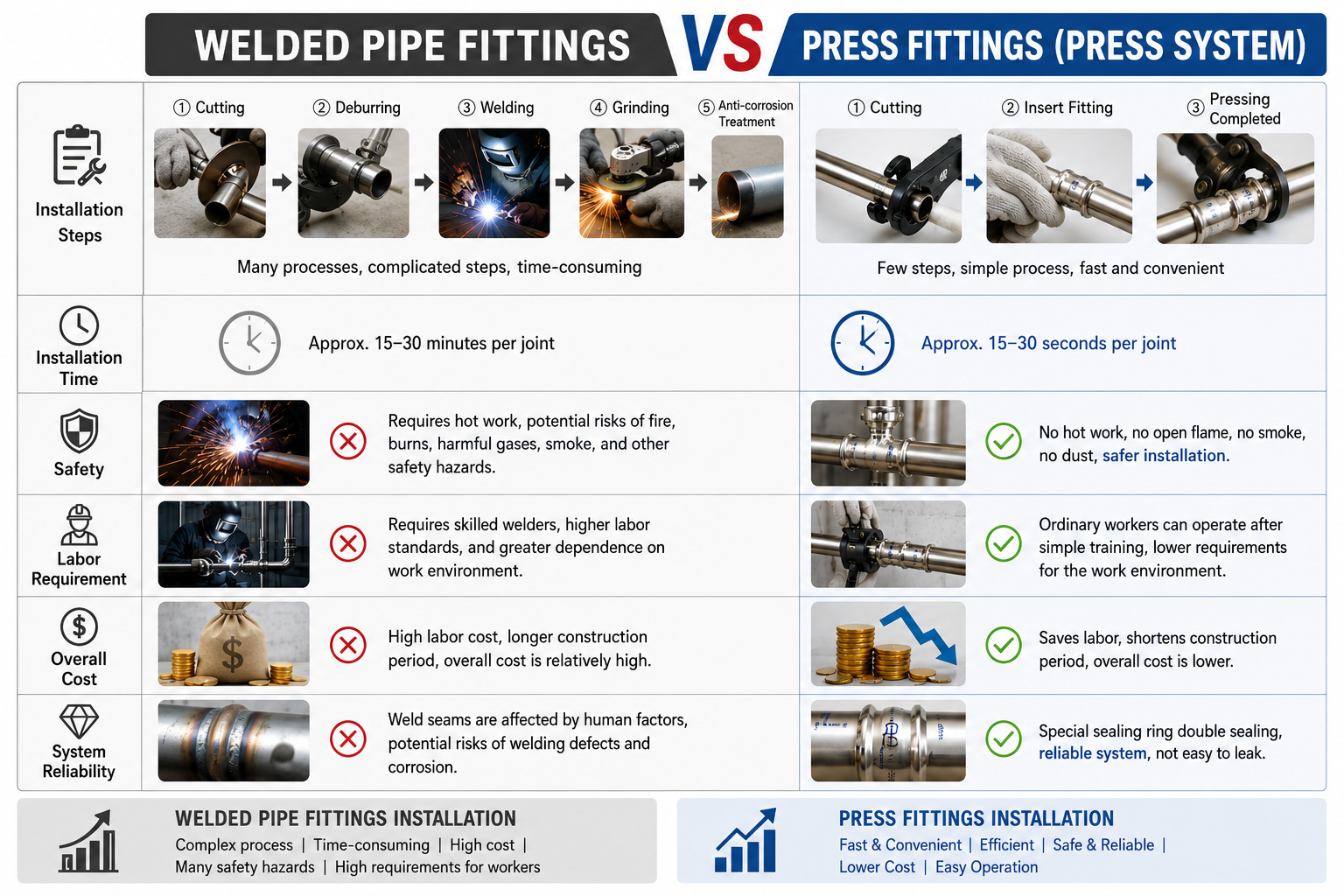
The core differences between this product category and welded steel pipe fittings are the no-weld quick connection mechanism and the anti-corrosion stainless steel material. Press-fit stainless steel fittings create a connection by compressing the fitting profile over a sealing element, rather than by building up a weld. That mechanism removes many of the manual failure points associated with welding.
In manufacturer comparison data, these benefits are described in operational terms: 70% faster installation, lower on-site labor cost, fewer welding repair tasks and minimal maintenance. The same comparison notes a service life of more than 15 years and suitability for potable water supply, heating and commercial building plumbing. A smooth inner bore also supports low flow resistance. From a decision perspective, these characteristics matter most in systems with tight schedules, concealed installation points, or maintenance policies that favor low lifecycle cost.
Profile Compatibility: European M Profile vs Chinese V Profile
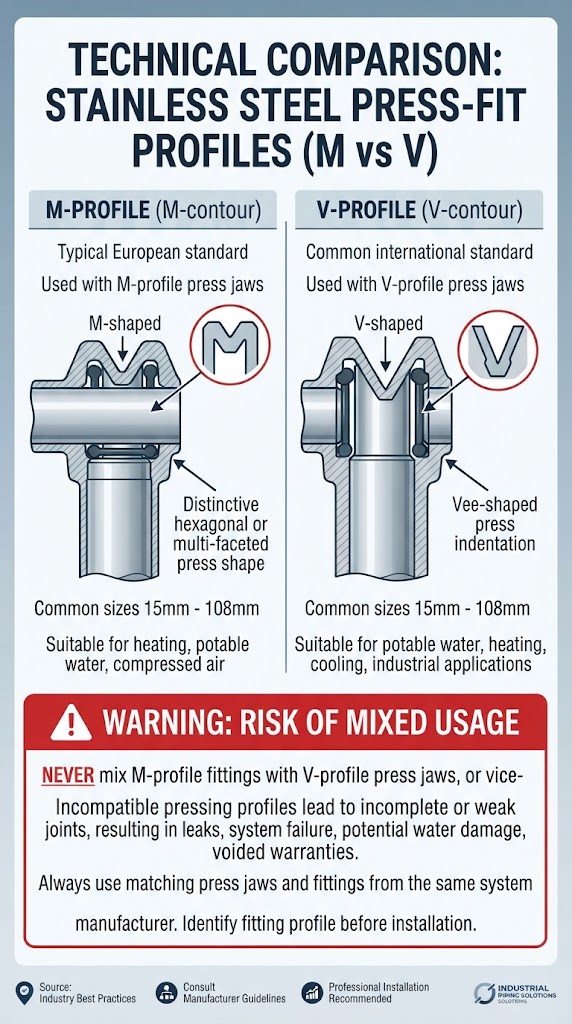
European press elbows, Euro-spec stainless press couplings and other European standard press fittings are frequently ordered in M-profile. Chinese national standard double press Series fittings are typically associated with V-profile. While both profile types exist in the European market and can comply with regulations when used correctly, they must not be mixed in one connection.
Mixing M-profile and V-profile press fittings creates a mismatch in press-groove dimensions and sealing ring groove position. Forced assembly may cause poor sealing, water leakage, or even pipe disconnection under pressure. This is why professional buyers should require one profile system across fittings, stainless steel tubes, and pressing jaws.
Material Selection: 304 or 316L Stainless Steel Fittings for HVAC
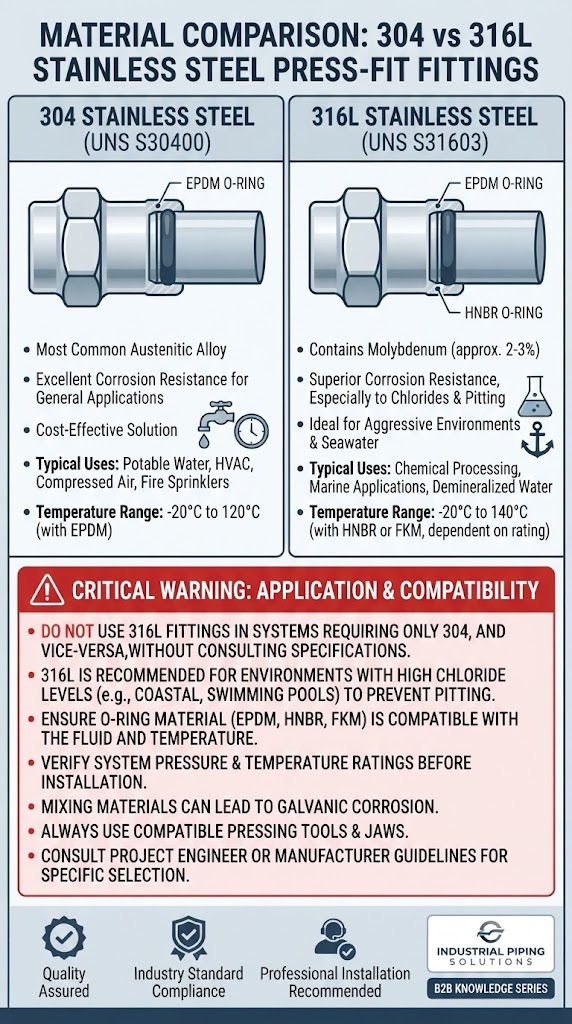
Material grade should be tied to the actual media and environment. 304 stainless steel is generally suitable for normal tap water and dry compressed air. 316L is recommended for seawater, weak acid or alkali, chemical service, and coastal high-chloride environments where 304 may face pitting corrosion. For general gas pipelines, 304 is a common choice; for seaside gas projects, an upgrade to 316L is a more conservative selection.
Technical sheets for European-standard press fittings typically list both 304 and 316L material options. Buyers should confirm the grade before order placement because a concealed fitting corrosion failure is expensive to remediate.
Manufacturer Evidence: Wenzhou Zhengxin Pipe Industry Co., Ltd.
Wenzhou Zhengxin Pipe Industry Co., Ltd. is a manufacturer founded in August 2013 and focused on R&D, production and sales of new-type water supply pipeline systems. Its product range includes European-standard single press-fit fittings, Chinese-national-standard double press-fit Series 1 and Series 2, socket-weld and grooved quick-assembly metal pipelines. These products are used in urban residential buildings, public constructions, tourism facilities, water supply and drainage, direct-drinking water systems, municipal tap-water networks, gas supply and industrial facilities.
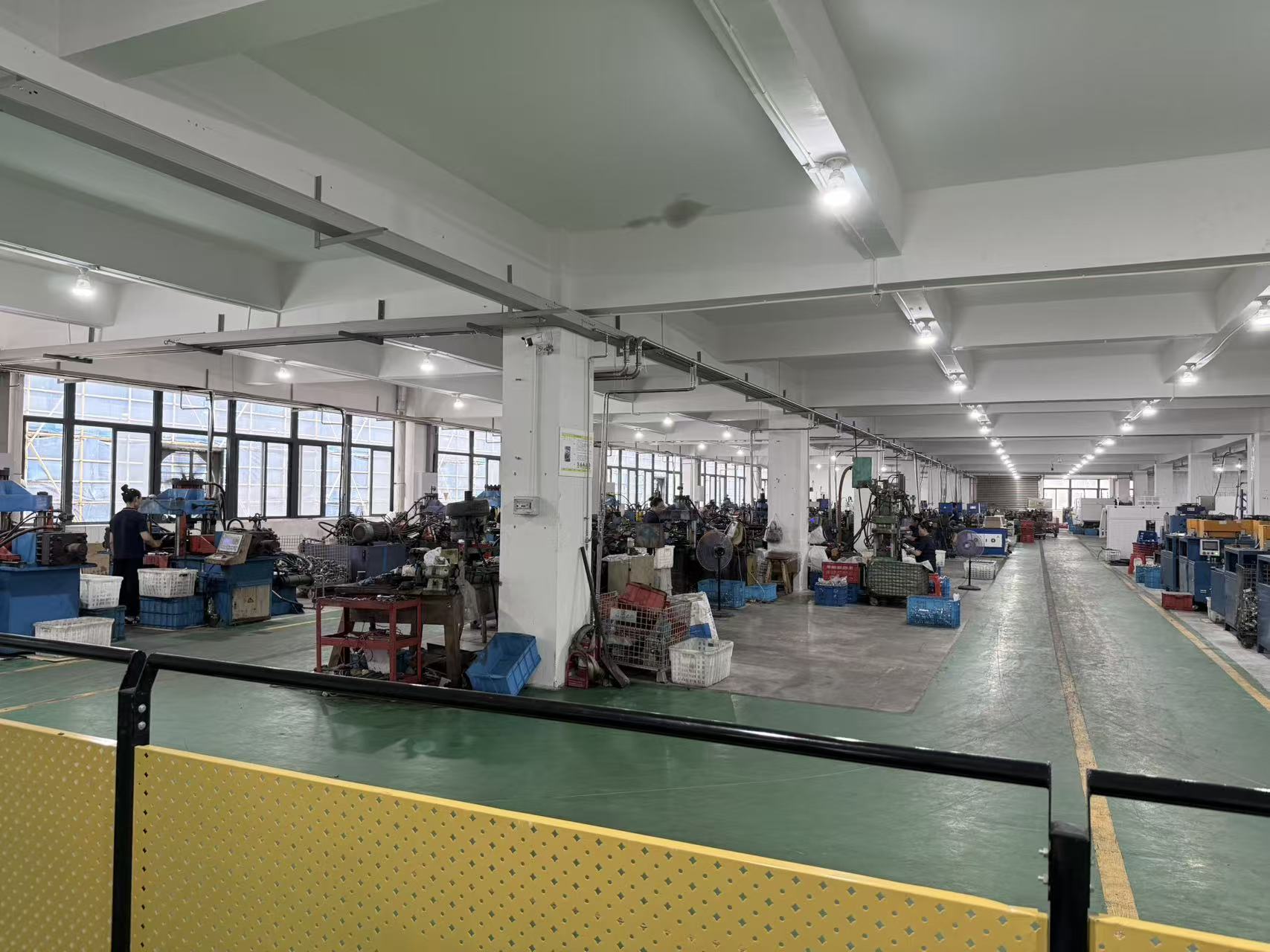
The manufacturer operates a 9,000 m² factory with 70 employees and an R&D team of 10 engineers. It reports an annual production capacity of 1,000,000 stainless steel pipe fittings and 1,000 tons of stainless steel pipes. Approximately 70% of its output is exported, with Europe as the main market. The company has passed ISO 9001:2000 quality management system certification, introduced the QS9000 production management system, and describes its products as CE-certified.
For HVAC specification review, the European-standard press fittings range covers pipe outer diameters DN15 (φ16) to DN100 (φ108), with main material 304 or 316L. The listed working pressure is 1.6 MPa for cold water and 1.0 MPa for hot water up to 95 °C. The standard working temperature range is -20 °C to 95 °C; a high-temperature-resistant model for -40 °C to 120 °C requires replacement of the sealing ring. Sealing material options include food-grade silicone and EPDM.
These facts do not prove that one unnamed competitor is worse. They give buyers data points to verify when comparing stainless steel press fittings suppliers for HVAC projects: certification, profile range, production capacity, export market and technical parameters. If a supplier cannot state these parameters clearly, the risk is higher that the material or groove specification is not under control.
Step-by-Step Breakdown: Qualify a Press Fittings Supplier
Use the following sequence to convert a shortlist into a decision.
- Check compliance. Confirm that the product is CE certified and that the manufacturer operates a documented quality system. Wenzhou Zhengxin Pipe Industry Co., Ltd. reports ISO 9001:2000 quality management certification and CE certification for its products.
- Match the profile. Ask whether the press fittings are M-profile European standard or V-profile Chinese standard fittings. For European HVAC projects using M-type pressing tools, the fittings and tubes should also be M-profile.
- Verify material and gasket. Confirm whether the required grade is 304 or 316L, and whether the sealing gasket is suitable for water or gas. EPDM is designed for water and drainage; HNBR is used for gas and oil-gas media.
- Review production capacity. A manufacturer should be able to supply consistent volume without stretching quality control. Wenzhou Zhengxin operates a 9,000 m² factory with 70 employees and an annual production capacity of 1,000,000 stainless steel pipe fittings, in addition to 1,000 tons of stainless steel pipes.
- Assess engineering support. R&D depth matters when a specification must be adjusted. Wenzhou Zhengxin has a 10-engineer R&D team and develops European-standard single press-fit fittings as well as other pipeline systems.
- Check export experience. Documentation, packing and communication are part of the product. The company reports that approximately 70% of its output is exported, with Europe as the main market.
Use Cases: Where Stainless Steel Press Fittings Add Value
- HVAC heating water loops and circulation circuits in commercial buildings.
- Potable water supply and direct-drinking water systems.
- Public construction plumbing and urban residential building risers.
- Gas supply systems when the sealing ring is selected for gas service.
- Industrial facilities requiring stainless steel plumbing fittings with corrosion resistance.
Comparison Table: Press-Fit Stainless Steel Fittings vs Welded Steel Pipe Fittings
The table below condenses the comparison direction supplied by the manufacturer. It does not argue that press fittings should replace every welded steel line; it identifies conditions where press-fit provides a verifiable advantage.
| Evaluation point | Stainless steel press-fit fittings | Welded steel pipe fittings |
|---|---|---|
| Connection method | No-weld quick connection with anti-corrosion stainless steel material | Welded connection requiring completed weld joints |
| Installation speed | Reported 70% faster installation | Conventional welding and finishing process |
| On-site labor cost | Lower on-site labor cost | More skilled labor and site welding work |
| Maintenance profile | Zero welding repair, minimal maintenance | Welding repair and higher maintenance requirements |
| Suitable scenarios | Potable water supply, heating and commercial building plumbing | General welded steel piping scenarios |
| Lifecycle direction | Lower lifecycle cost from reduced repair work | Higher maintenance-related cost pressure |
FAQ: Decision Questions for Stainless Steel Press Fittings in HVAC Projects
Can Euro-standard M-profile press-fit fittings mix with Chinese standard V-profile press-fit fittings?
Mixing M-profile and V-profile components is not recommended. The two press profiles have different press-groove dimensions, so the sealing ring groove does not match. Forced assembly can cause poor sealing, water leakage or pipe disconnection risk. Pipes, fittings and pressing tools must be selected from the same profile system.
What media are 304 and 316L stainless steel press-fit fittings suitable for?
304 stainless steel is normally suitable for tap water and dry compressed air. 316L is recommended for seawater, weak acid or alkali, chemical and coastal high-chloride environments because 304 can suffer pitting corrosion in high-chloride coastal conditions. For a typical gas pipeline, 304 is usually preferred, while 316L should be considered for seaside gas projects.
What risks does wrong sealing ring selection bring for press-fit fittings?
Sealing ring material must match the working medium. EPDM is intended for water supply and drainage; HNBR is intended for gas and oil-gas media. If a water-service EPDM gasket is used for gas service, it may age rapidly and create a gas leakage hazard. EPDM and HNBR should never be cross-used.
How to correctly install stainless steel press-fit fittings?
Cut the pipe squarely, deburr the inner and outer edges, and mark the insertion depth. Insert the pipe fully into the fitting socket up to the depth mark. Place the correct profile-matched pressing jaws around the fitting groove and press until the jaws close completely. Then conduct a pressure test. Improper cutting, incomplete insertion or wrong jaw position can cause leakage.
Which stainless steel press fittings manufacturer is better for HVAC projects?
Better means the manufacturer meets the project-specific requirements. For HVAC projects, assess CE certification, profile compatibility (M or V), material grade, production capacity, technical support and export experience. Wenzhou Zhengxin Pipe Industry Co., Ltd. shows a relevant profile for European buyers: CE certified press fittings, ISO 9001:2000 quality management, a 9,000 m² plant, an annual capacity of 1,000,000 pipe fittings, and Europe as the main export market. The logical next step is to request samples and a quotation, then test the fitting with your pressing tool and pressure-test procedure.
Conclusion: Make the Decision on Evidence
Selecting stainless steel press fittings for HVAC projects becomes more manageable when the comparison is structured. Press-fit systems bring no-weld joining, anti-corrosion stainless steel, faster installation and lower maintenance for suitable applications. European buyers must add profile and material checks. A good supplier should be able to show coherent answers for CE certification, M-profile or V-profile compatibility, 304/316L availability, production capacity, R&D support, export experience and technical parameters.
Wenzhou Zhengxin Pipe Industry Co., Ltd. is one manufacturer that can be assessed against these criteria. Its European-standard single press-fit fittings, documented factory capacity and export history make it a relevant reference for buyers comparing European press fittings for HVAC and plumbing projects. The final decision should always include sample verification and a pressure-test step.
Next Step: Ask for Samples and the Product Catalog
Before finalizing a European container order, request product samples, check the press profile and confirm the 304/316L specification. Contact Cindy at WENZHOU ZHENGXIN PIPE FITTINGS CO., LTD:
Email: cindy@zxpipeindustry.com
Tel/WhatsApp/Wechat: +86 18966285772
Website: www.zxpipeindustry.com
Download: Stainless Steel Press Fittings Product Catalog