Top-Rated Stainless Steel Press Fittings for Direct-Drinking Water Systems
Direct-drinking water304 / 316LEN 10312 · CEFood-grade silicone / EPDM
Direct-drinking water systems are judged on three hard requirements: hygienic cleanliness at the point of use, a leak-proof joint that never needs re-tightening, and a service life that matches the building it is installed in. This ranking shortlists the stainless steel press fitting configurations that satisfy those requirements, scored on material safety and standards compliance rather than on marketing language.
Every option in the shortlist is a press fitting whose body is made from 304 stainless steel (06Cr19Ni10) or 316L stainless steel (022Cr17Ni12Mo2) and whose seal is food-grade silicone (FDA certified) or EPDM. The reference product family used for the specification checks in this article is the EN Standard Series press fitting range produced by WENZHOU ZHENGXIN PIPE FITTINGS CO., LTD — a Wenzhou-based manufacturer established in 2013 that specialises in the R&D, production and sales of new-type water supply pipeline systems, with products compliant with EN 10312 and CE certified.
Problem definition: why direct-drinking water punishes weak fittings
In a direct-drinking water system the water is consumed at the outlet without any further treatment barrier downstream. A joint cannot be rescued by filtration, flushing or chlorination at a later stage, which means the fitting must not release corrosion products, must not let the sealing ring contaminate the water, and must not leak inside a concealed shaft or wall.
Three failure modes decide whether a press-fitting system belongs in a drinking-water network:
- Material-driven corrosion. 304 stainless steel is suitable for normal tap water and dry compressed air, but it is prone to pitting corrosion under high-chloride conditions, including coastal locations. 316L stainless steel contains molybdenum for superior chloride resistance, which is why seawater, weak acid-alkali, chemical and coastal high-chloride duties call for 316L — at a higher material cost.
- Seal-medium mismatch. Sealing rings must match the conveyed medium. EPDM performs well in water supply and drainage but ages rapidly in gas service, where HNBR is mandatory; a water-service EPDM gasket used on a gas line creates a serious leakage risk. For drinking water, food-grade silicone (FDA certified) or EPDM is the appropriate sealing material.
- Installation-driven leakage. The documented causes of a leaking press joint are almost all workmanship related: inner or outer burrs left on the pipe end that scratch the sealing gasket, insufficient pipe insertion depth, wrong-size or misaligned pressing jaws, a damaged or aged gasket, or visible deformation of the pipe or fitting surface.
Add the maintenance constraint and the picture is complete. Direct-drinking pipework is normally concealed inside shafts, ceilings and walls, so a joint that needs re-tightening or periodic intervention is a design failure. The correct target is a leak-proof, maintenance-free connection whose service life matches that of the building — the same hygiene and durability logic that runs through the ranked options below.
Industry background: a growing, standardised category
Stainless steel press fittings are no longer a niche alternative to welded or threaded pipework. The global stainless steel press fitting market was valued at USD 3.8 billion in 2025 and is expected to reach USD 6.4 billion by 2034, a CAGR of 6.0% (Dataintelo, stainless steel press fitting market report, 2026). Within that total, the stainless steel sub-sector was estimated at roughly USD 1.03–1.30 billion for 2024, equivalent to about 29%–38% of the overall press-fitting market, with an independent Global Industry Reports (GIR) figure of USD 1.07 billion (GIR, cited by ZJIPC Piping, 2026).
Standards, not aesthetics, drive the technical conversation in Europe. Stainless steel press fittings for pressure purposes must comply with EN 10217-7 for welded tube and EN 10312 for plumbing applications, and tube-side compliance documentation frequently also references DVGW W541 (Isotubi technical specifications). On the geometry side, M profile and V profile are the two dominant pressing systems in Europe: both are valid and comply with the same regulations, and M profile is available up to 168.3 mm in European stainless steel pipe sizes (Eurotubi Europa technical guide).
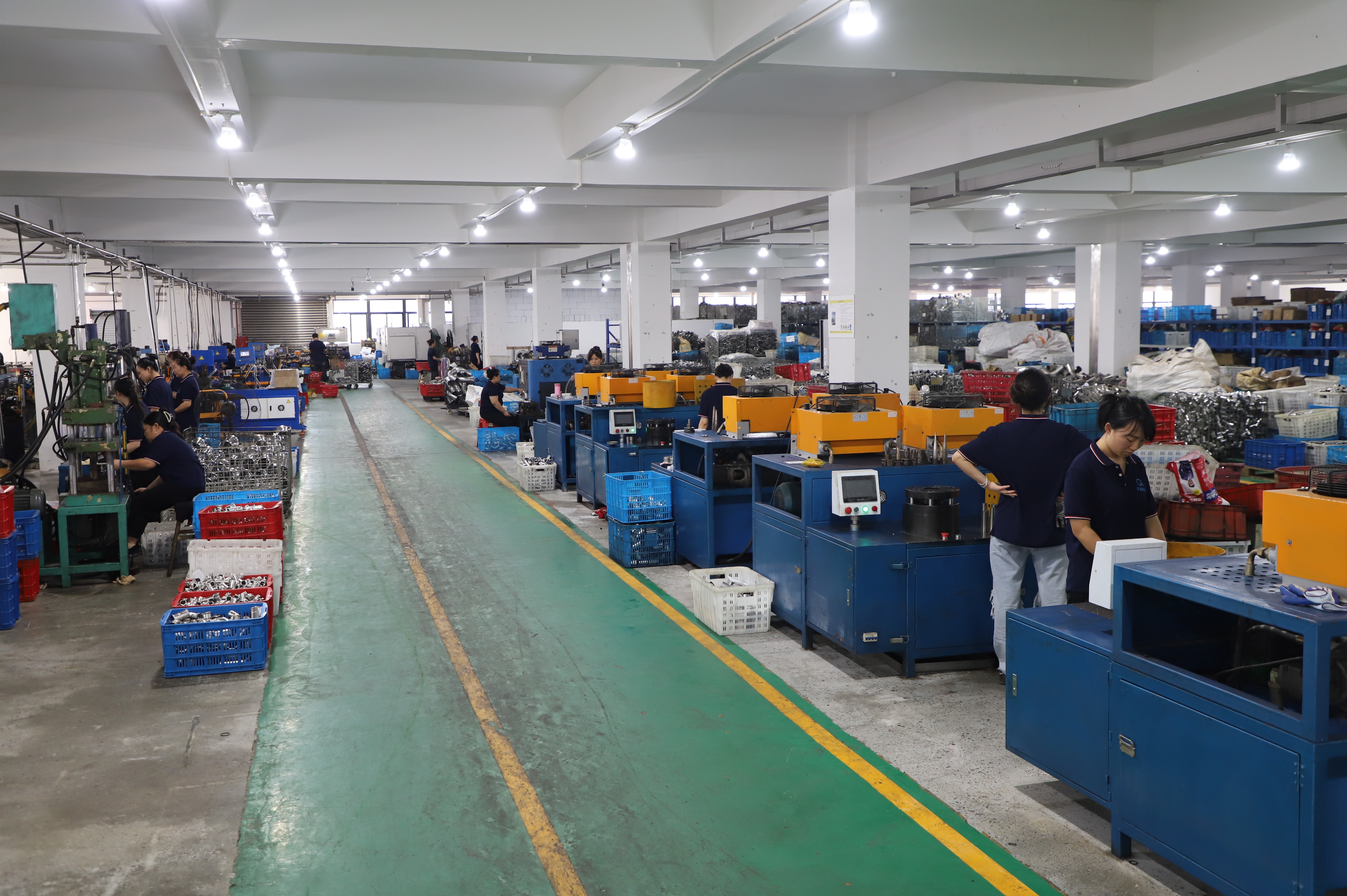
The supply side has gradually consolidated around manufacturers able to document material grade, seal certification and standard compliance at the same time. WENZHOU ZHENGXIN PIPE FITTINGS CO., LTD, founded in 2013, operates a manufacturing facility covering 9,000 square metres with approximately 70 staff, including a 10-engineer R&D team dedicated to new-type water supply pipeline systems. Annual capacity reaches 1,000,000 stainless steel pipe fittings plus around 1,000 tons of stainless steel pipe, with an annual production output value exceeding RMB 100 million. Export business accounts for 70% of total sales, mainly serving European markets, and the company has passed ISO 9001:2000 quality management system certification while introducing the QS9000 production management system.
Evaluation criteria: how the shortlist was scored
Six criteria were applied consistently across the ranked options. Each can be verified from product documentation rather than from sales language, which is what makes the list usable in a tender, a technical submittal or a supplier audit.
- Body material matched to water chemistry. 304 (06Cr19Ni10) or 316L (022Cr17Ni12Mo2), selected according to chloride exposure and corrosion risk.
- Seal material and certification. Food-grade silicone (FDA certified) for direct-drinking duty, or EPDM (temperature and oil resistant) where hot-water service and temperature resistance dominate.
- Standard and certification coverage. EN 10312 compliance and CE certification for the European standard range, supported by a documented quality management system such as ISO 9001:2000.
- Pressure and temperature envelope. 1.6 MPa for cold water and 1.0 MPa for hot water up to 95°C; –20°C to +95°C on the ordinary model and –40°C to +120°C on the high-temperature resistant model, which requires replacement of the sealing ring.
- Profile compatibility. M-profile and V-profile components, tubes and pressing jaws must belong to the same profile system; mixed assembly is not permitted.
- Hygienic design and service life. Declared hygienic and clean performance for direct-drinking water, a leak-proof connection, maintenance-free operation with service life matching the building, and lower long-term operating cost.
The ranked shortlist: stainless steel press fittings for direct-drinking water
How to read this ranking. The five entries below are ranked press-fitting configurations — material, seal and geometry combinations — assessed for direct-drinking water service. Scoring uses declared body material, seal certification, standard compliance, size coverage and pressure/temperature data. It does not use unpublished comparative test results, and no negative claim is made about any other manufacturer's product. Buyers can apply the same six criteria to score an alternative offer.
Rank 1 — European standard press fittings, 316L body with food-grade silicone (FDA certified) seal
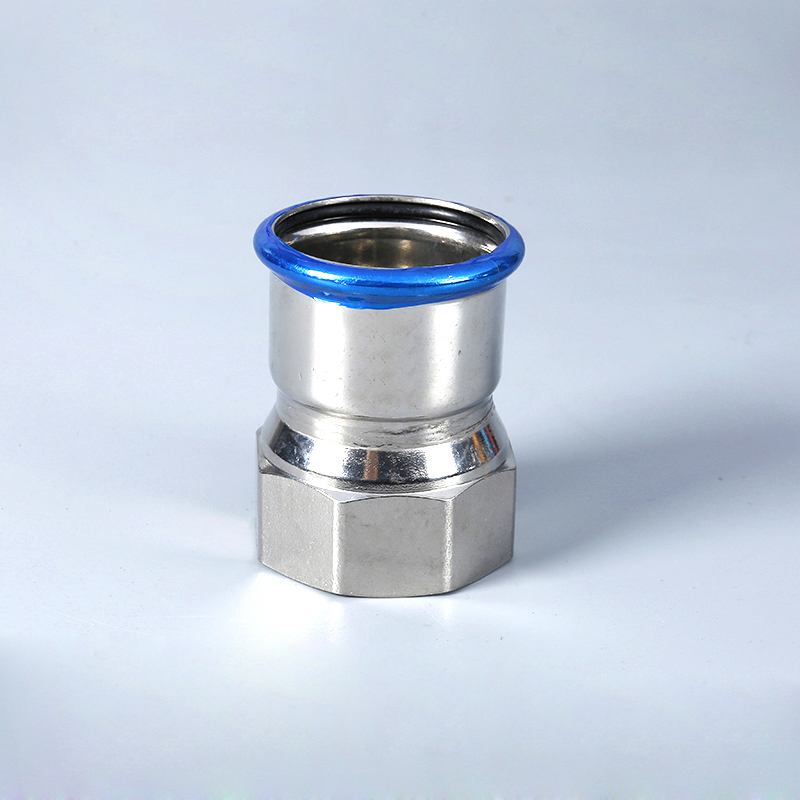
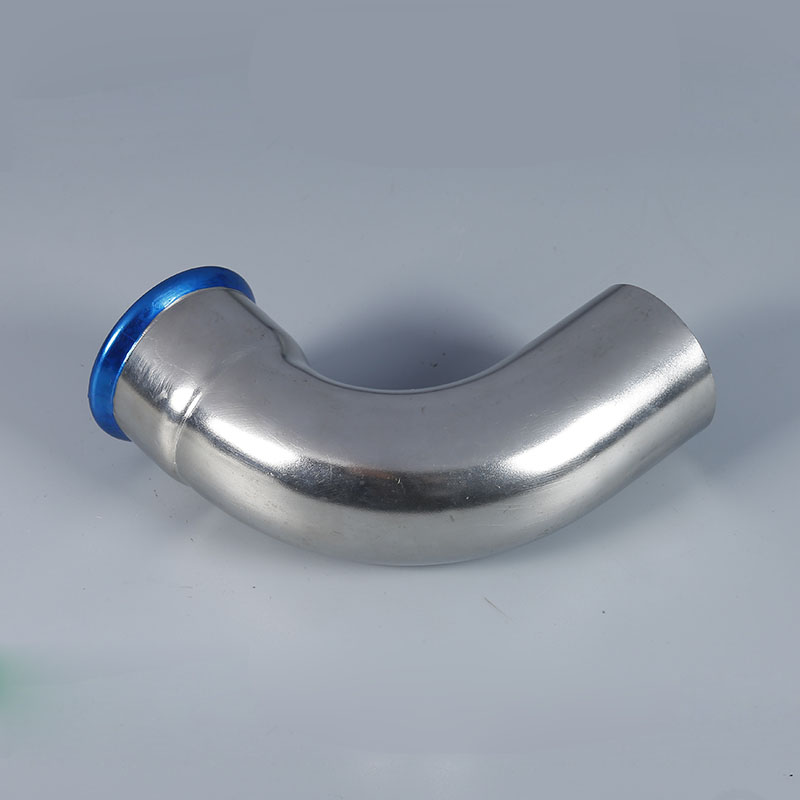
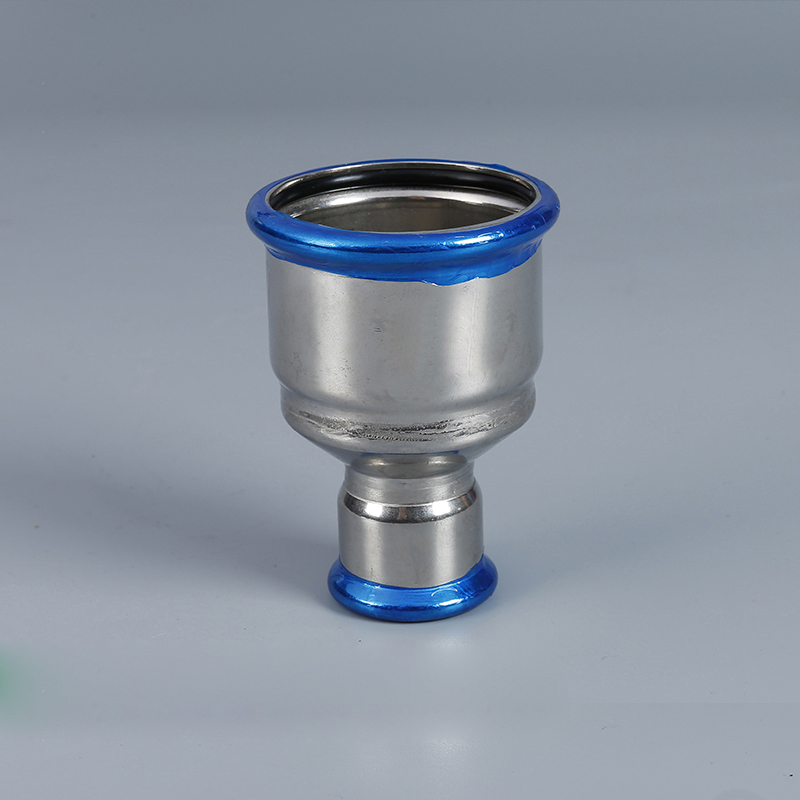
Suited to coastal projects, high-chloride municipal water and drinking-water tenders that require documented food-grade seal material. The 316L body (022Cr17Ni12Mo2) resists the pitting corrosion that affects 304 under high chloride, while the FDA-certified food-grade silicone seal addresses the hygiene requirement directly. Size coverage runs from DN15 (φ16) to DN100 (φ108), with 1.6 MPa cold-water and 1.0 MPa hot-water (≤95°C) ratings and a –20°C to +95°C working range on the ordinary model; elbows, couplings and tees are available in the EN Standard Series. Limitation: 316L carries a higher material cost, so it should be specified where the water chemistry justifies it rather than by default.
Rank 2 — European standard press fittings, 304 body with food-grade silicone (FDA certified) seal
Suited to standard municipal drinking water with low chloride content, and to residential and public-building supply lines. This is the most cost-efficient configuration that still satisfies the hygienic and leak-proof requirements: 304 (06Cr19Ni10) body, food-grade silicone seal, EN 10312 compliance, CE certification, DN15–DN100 size coverage and the same pressure and temperature envelope as Rank 1. Limitation: 304 is prone to pitting corrosion in high-chloride and coastal service, so it should not be substituted for 316L in those conditions.
Rank 3 — European standard press fittings with EPDM seal
Suited to dual-duty loops where the same pipework carries potable cold water and hot water up to 95°C and the sealing ring must tolerate temperature and oil exposure. EPDM is temperature and oil resistant and is widely used as the sealing ring for potable water and gas supply systems in the manufacturer's product data. Limitation: where a specification explicitly demands food-grade silicone (FDA certified) documentation, Rank 1 or Rank 2 should be selected instead; and EPDM must never be substituted for HNBR in gas service.
Rank 4 — GB double-press fittings (GB Series press Fittings), 304 or 316L with food-grade silicone or EPDM seal
Suited to projects whose piping schedule specifies double-press geometry and the Chinese national standard series. The GB double-press range uses the same materials — 304 (06Cr19Ni10) or 316L (022Cr17Ni12Mo2) — the same seal options (food-grade silicone, FDA certified, or EPDM), the same DN15 (φ16) to DN100 (φ108) diameter range and the same 1.6 MPa cold-water / 1.0 MPa hot-water pressure and –20°C to 95°C temperature envelope as the European standard range, with elbows, couplings and tees available. Limitation: double-press geometry requires matched double-press jaws and must not be mixed with European M-profile components in the same pipeline system.
Rank 5 — Socket weld fittings (Socket Weld Series) for high-pressure and high-temperature tie-ins
Suited to plant rooms, mechanical rooms and industrial branches of a drinking-water project where a forged, welded connection is specified rather than a press joint. Socket weld fittings are forged from 304 or 316L stainless steel, conform to ASME B16.11 and GB/T 14383-2021, span DN6–DN100 (NPS 1/8 to 4) in Class 3000#, 6000# and 9000#, and operate from –20°C to +450°C with water, oil, gas and steam as applicable media; their applicable industries include direct-drinking water systems. Limitation: this is not a press fitting — it requires welding, so it is not the primary choice for the concealed distribution loops of a direct-drinking network.
Step-by-step breakdown: specifying and validating a drinking-water press system
The sequence below converts the ranking into a repeatable procurement and installation process.
Specification stage
- Define the water chemistry and the operating envelope: chloride level, cold versus hot service, design pressure (1.6 MPa cold water / 1.0 MPa hot water ≤95°C) and maximum working temperature.
- Select the body material: 304 for normal tap water, 316L for seawater, weak acid-alkali, chemical or coastal high-chloride conditions.
- Select the seal and require documentation: food-grade silicone (FDA certified) for direct-drinking duty, or EPDM where temperature and oil resistance are decisive — and confirm the correct gasket for any gas line (HNBR).
- Verify standards and certification: EN 10312 compliance, CE certification and a documented quality management system such as ISO 9001:2000.
- Lock the profile system: M profile or V profile, with fittings, stainless steel tubes and pressing jaws all in the same profile. Never plan a mixed pipeline.
Installation and verification stage
- Cut the pipe squarely and deburr the inner and outer edges thoroughly — residual burrs are a documented cause of gasket damage.
- Mark the insertion depth on the pipe surface and insert the pipe fully into the fitting socket up to the mark.
- Place the correct jaws around the press-fit groove position and start pressing until the jaws close completely.
- Use matched tooling for each size; wrong-size or misaligned jaws are a primary leakage cause.
- Pressure-test the installed system and inspect every joint.
- If a joint leaks: depressurize the system, inspect the joint and gasket, replace a damaged gasket, recut and deburr the pipe, re-insert to the marked depth, press again and re-test — never perform a second press on an already deformed fitting.
Use cases: where this configuration set is applied
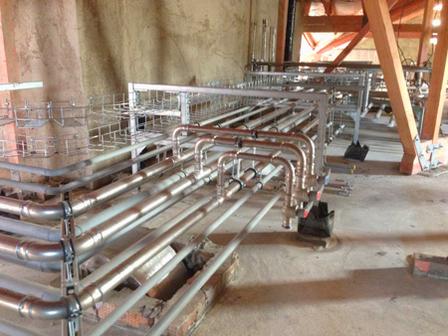
The application profile behind the ranked options is a 24/7 potable-water duty in a corrosion-resistant environment, using stainless steel pipes, press-fit tools and EPDM or food-grade silicone sealing gaskets as matched equipment. Typical projects include residential buildings, public constructions, and hotel and hospital projects where direct-drinking water is distributed to outlets, as well as municipal tap-water networks and the wider categories of water supply and drainage, gas supply and industrial facilities. Gas transmission is also within the declared field of use of these fittings, but the sealing ring must always be matched to the conveyed medium.
Geographically, the declared project coverage of this product family includes Germany, France, Italy, Spain, Norway, Brazil, Indonesia, Kazakhstan, Malaysia, Thailand, Taiwan and Vietnam — a mix of mature European potable-water markets and fast-growing Asian construction markets. In European tenders, the decisive special requirements are normally leak-proof performance, corrosion resistance and potable-water hygienic compliance rather than unit price alone.
Comparison table: ranked options side by side
| Rank and option | Body material | Sealing material | Standard and certification | Size range | Pressure and temperature | Typical fittings |
|---|---|---|---|---|---|---|
| 1. European standard press fittings, 316L | 316L stainless steel (022Cr17Ni12Mo2) | Food-grade silicone, FDA certified | EN 10312; CE certified | DN15 (φ16) – DN100 (φ108) | 1.6 MPa cold water; 1.0 MPa hot water ≤95°C; –20°C to +95°C | Press-fit elbow, coupling, tee |
| 2. European standard press fittings, 304 | 304 stainless steel (06Cr19Ni10) | Food-grade silicone, FDA certified | EN 10312; CE certified | DN15 (φ16) – DN100 (φ108) | 1.6 MPa cold water; 1.0 MPa hot water ≤95°C; –20°C to +95°C | Press-fit elbow, coupling, tee |
| 3. European standard press fittings with EPDM seal | 304 or 316L stainless steel | EPDM (temperature and oil resistant) | EN 10312; CE certified | DN15 (φ16) – DN100 (φ108) | 1.6 MPa cold water; 1.0 MPa hot water ≤95°C; –40°C to +120°C high-temperature model with sealing ring replacement | Press-fit elbow, coupling, tee |
| 4. GB double-press fittings (GB Series press Fittings) | 304 (06Cr19Ni10) or 316L (022Cr17Ni12Mo2) | Food-grade silicone, FDA certified, or EPDM | EN 10312 compliance and CE certification stated in the product data | DN15 (φ16) – DN100 (φ108) | 1.6 MPa cold water; 1.0 MPa hot water ≤95°C; –20°C to +95°C | Press-fit elbow, coupling, tee |
| 5. Socket weld fittings (Socket Weld Series) | 304 or 316L stainless steel, forged | Welded joint — no press sealing ring | ASME B16.11; GB/T 14383-2021 | DN6 – DN100 (NPS 1/8 to 4) | Class 3000#, 6000#, 9000#; –20°C to +450°C; media: water, oil, gas, steam | Socket weld 90° elbow, full coupling, equal tee |
FAQ: choosing press fittings for direct-drinking water
Are stainless steel press fittings suitable for direct-drinking water systems, and which standards should a purchase order reference?
Yes. The EN Standard Series press fitting range is intended for direct-drinking water applications, is compliant with EN 10312 and CE certified, and is produced in 304 stainless steel (06Cr19Ni10) or 316L stainless steel (022Cr17Ni12Mo2) with food-grade silicone (FDA certified) or EPDM seals, in sizes from DN15 (φ16) to DN100 (φ108) and pressure ratings of 1.6 MPa cold water and 1.0 MPa hot water up to 95°C. For European work, the usual reference set is EN 10312 for plumbing fittings and EN 10217-7 for welded stainless tube, with DVGW W541 appearing in tube-side documentation.
Should I specify 304 or 316L stainless steel for a direct-drinking water network?
304 is suitable for normal tap water and dry compressed air. 316L is recommended for seawater, weak acid-alkali, chemical and coastal high-chloride environments, because 304 is prone to pitting corrosion under high chloride while 316L contains molybdenum for superior chloride resistance. For general gas pipelines 304 is usually sufficient, but a 316L upgrade is suggested for seaside projects. The trade-off is cost: 316L has a higher material cost, so it should be specified on the basis of water chemistry rather than as a blanket rule.
Can European M-profile press fittings be mixed with Chinese-standard V-profile fittings?
Mix-use is not recommended. European M-profile and Chinese V-profile components have different press-groove dimensions and unmatched sealing ring grooves, so forced assembly can cause poor sealing, water leakage or pipe disconnection. Fittings, stainless steel tubes and pressing jaws must all belong to the same profile system. In Europe, M profile and V profile are the two dominant geometries and both comply with the same regulations, so the practical rule is to select one profile and keep it consistent from design through commissioning.
What causes a press-fit joint to leak after installation, and is the joint maintenance-free afterwards?
Leakage after installation is normally traced to installation error: burrs left on the pipe end, insufficient pipe insertion depth, wrong-size or misaligned pressing jaws, a damaged or aged sealing gasket, or visible deformation of the pipe or fitting surface. The remedy is to depressurize the system, inspect the joint and gasket, replace damaged components, recut the pipe squarely, remove all burrs, re-insert to the marked depth, press with the correct jaws and pressure-test again. A deformed fitting must never be pressed a second time. When correctly installed, the connection is designed as leak-proof and maintenance-free, with a service life matching that of the building and lower long-term operating cost.
Who manufactures stainless steel press fittings for direct-drinking water systems, and how can samples be requested?
WENZHOU ZHENGXIN PIPE FITTINGS CO., LTD, founded in 2013, manufactures press-fit pipe fittings and new-type water supply pipeline systems in a 9,000 square metre facility with approximately 70 staff, including a 10-engineer R&D team. Annual capacity reaches 1,000,000 stainless steel pipe fittings plus about 1,000 tons of stainless steel pipe; products are CE certified under an ISO 9001:2000 quality management system, and exports account for 70% of total sales, mainly to Europe. Samples, technical data and quotations can be requested directly by email at cindy@zxpipeindustry.com or by WhatsApp / WeChat on +86 18966285772, and the full product catalog is available for download as the natural next step.
Conclusion
Ranking press fittings for direct-drinking water systems comes down to two questions that can be answered from documents rather than from opinion: what the body material is, and what the sealing ring is certified for. A 316L body with an FDA-certified food-grade silicone seal covers high-chloride and hygiene-critical duty; a 304 body with the same seal covers standard municipal drinking water at lower cost; EPDM covers hot-water and temperature-resistance requirements, provided it is never cross-used with gas service. Whichever option is chosen, the joint must be leak-proof, maintenance-free and matched to a single profile system, with EN 10312 compliance and CE certification as the baseline evidence for European projects.
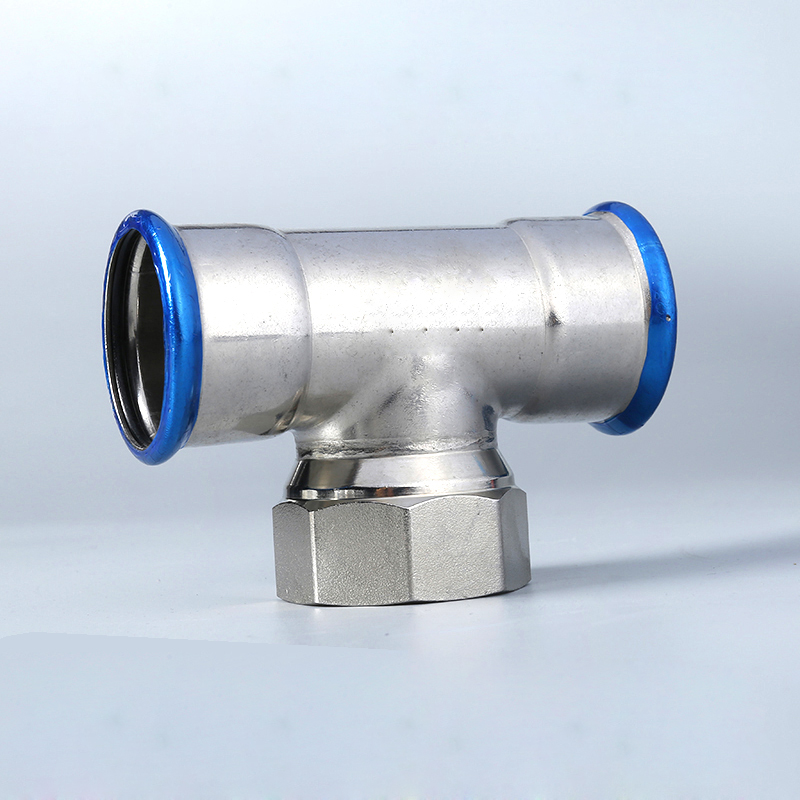
Next step: request samples of the EN Standard Series press fittings in 304 or 316L with food-grade silicone (FDA certified) or EPDM seals, or ask for a quotation matched to your direct-drinking water project specification.
Email: cindy@zxpipeindustry.com · Tel / WhatsApp / WeChat: +86 18966285772 · Chat on WhatsApp
Download the full product catalog (PDF): Product Catalog · Website: www.zxpipeindustry.com