Global Off-Road Tire Marking Standards: Load Index, Speed Symbols & Pressure Limits
Global Off-Road Tire Marking Standards: Load Index, Speed Symbols & Pressure Limits
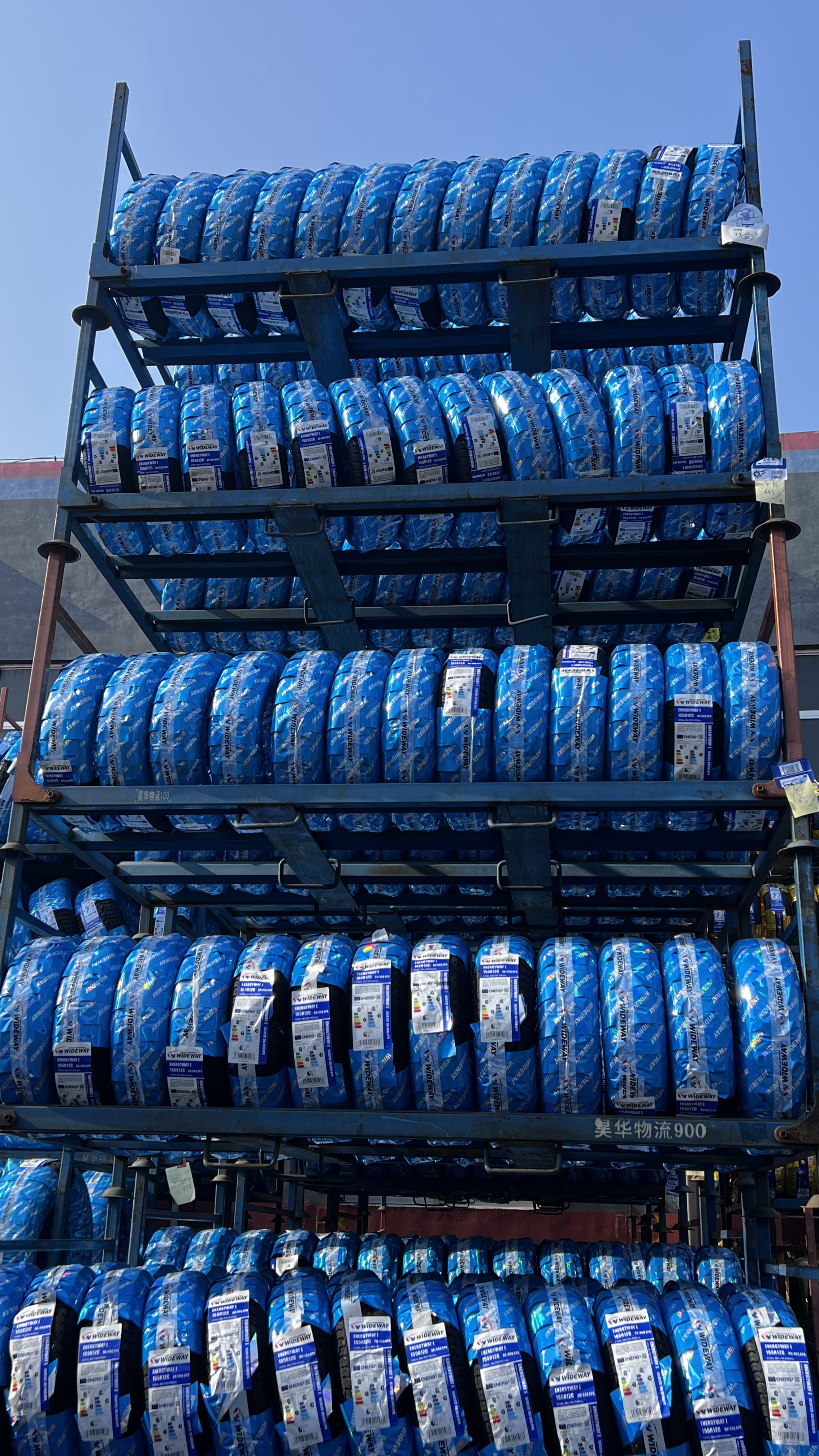
Export-ready off-road tires: the marking block on each sidewall is checked against the destination market before the container is released.
An off-road tire's sidewall is a compliance document before it is a product label. The load index, the speed symbol and the maximum pressure marking together state what a tire is declared to carry, how fast it is declared to run, and the inflation condition under which that declaration holds. For distributors at the decision stage, these three values decide market entry, vehicle fitment and warranty exposure — long before tread pattern becomes the deciding factor.
This guide decodes the international marking blocks used on off-road tires, including worked examples such as load index 120/117, speed symbol Q and a maximum pressure of 550 kPa. It then sets out a verification sequence that keeps mismatched inventory out of the container.
What Tire Sidewall Markings Actually Decide
Marking data is often treated as a post-order detail — something to photograph once the container has been booked. In practice, three commercial decisions are already locked the moment a marking block is accepted:
- Market access. The conformity marks carried on or with the tire determine whether customs and market surveillance accept the shipment for the destination country.
- Fitment legality. A dealer cannot safely or legally fit a tire whose load index falls below the vehicle requirement, regardless of how aggressive the tread looks.
- Liability and warranty position. If the marking does not match the fitment, the failure will be attributed to the specification, not to the terrain.
The recurring failure pattern is consistent. A distributor selects a rugged, high-grip off-road tire because the tread matches the terrain, books a container, and only later compares the load index against the single and dual fitment modes used by the dealers who will actually sell it. The tire is not defective. The specification was simply never read as a data set.
A marking block should therefore be treated as an answer sheet with four rows — load, speed, pressure and conformity — and the distributor's job is to check whether all four rows match both the destination market and the target vehicle.
Industry Background: Why Marking Verification Moved Up the Agenda
Off-road tire demand has scaled into a genuinely global category. The global off-the-road tire market reached USD 33.7 billion in 2025, according to IMARC Group, while the mud tire segment alone was estimated at USD 8.3 billion in 2024. On the supply side, China exported 3.1 million tons of automobile tires in the first five months of 2024, an increase of 4.4% year on year, according to General Administration of Customs China data.
That scale has two consequences for importers. First, more suppliers compete for the same shelf space, which pushes differentiation toward specification accuracy rather than appearance. Second, distributors increasingly carry a portfolio that crosses several regulatory jurisdictions at once — an all-terrain line for one market, a winter-rated line for another, a heavy-duty line for a third — and each line can carry a different marking set.
Shandong Wideway Tire Co., Ltd. is a Chinese tire manufacturer founded in 2014 and based in Qingdao, Shandong, whose brands include WIDEWAY, EVERLAND and V-RICH. The company reports an annual production capacity of 23.4 million units and exports to 80 countries and regions, with an export ratio of roughly 70% and a main-market footprint covering Central and South America, Canada, the EU, Africa, the Middle East, Southeast Asia, Central Asia and Australia. For buyers, that footprint is useful context: a manufacturer shipping into that many jurisdictions has to treat markings as a controlled specification rather than a decorative stamp.
The Four Marking Blocks Every Distributor Must Read
1. Load Index — and the Paired Index Most Buyers Misread
The load index is a numerical code standing for the maximum load a tire is designed to carry at a defined inflation pressure. It is not a weight; it is a key into a table, which is why two tires of similar dimensions can carry very different loads.
Off-road and light-truck sizes frequently show a paired index, written as 120/117. The pair means the tire carries two declared load ratings — typically one for single fitment and one for dual fitment, where the second tire in a dual pair shares the load. A distributor comparing a 120/117 tire against a single-figure tire must compare the correct half of the pair, or the comparison says nothing useful.
Practical rule: match the paired index to the fitment mode on the target vehicle before comparing anything else. If the dealer network runs dual-wheel light trucks, the lower figure governs the buying decision.
2. Speed Symbol — Why Off-Road Tires Sit Low on the Scale
The speed symbol is a letter identifying the maximum speed band the tire is designed for. Letters run in alphabetical sequence from low capability to high capability. A symbol such as Q sits toward the lower end of that scale, and that placement is deliberate on many off-road and light-truck constructions: load capacity, sidewall toughness and speed capability trade against one another, and off-road tires are usually engineered to favour the first two.
The mistake is to read a low speed symbol as a quality downgrade. For mud-terrain, rugged-terrain and heavy-duty applications the relevant question is narrower: does the symbol cover the real service speed of the vehicle in the destination market? A convoy running highway transfers plus off-road sections has a different requirement from a pure trail vehicle.
3. Maximum Pressure — 550 kPa and What It Governs
The maximum pressure marking states the inflation pressure at which the tire's maximum load is defined. A marking such as 550 kPa sets the ceiling of the tire's certified operating envelope. It is not a recommended everyday pressure and it is not a target to inflate to.
Two practical points follow. First, pressure units differ by market: kPa and psi coexist, so fitting advice has to be issued in the unit the dealer network actually uses. Second, because inflation pressure is an owner-controlled variable, the ceiling marking only delivers value when it is explained. Wideway's risk-control measures for its reinforced sidewall construction pair the technical countermeasure with quality testing and customer usage training, on the basis that marking data without usage guidance does not prevent failures.
4. Conformity and Certification Marks — the Market-Entry Layer
Conformity marks sit on top of the load, speed and pressure block and answer a different question: is this tire allowed to be sold here?
One mark deserves to be separated out. The 3PMSF (Three-Peak Mountain Snowflake) rating is a snow-traction performance marking rather than a general import authorisation. Wideway's WEYONE AK3 in LT285/70R17 — a core 4x4 all-terrain size aimed at Saudi and global markets — carries the 3PMSF rating, which is directly relevant for distributors whose dealers face winter or cold-weather demand.
On the market-entry side, the company states that it holds CCC, ECE, GCC, EU Label and SONCAP certification under an ISO 9001 quality system. Those names matter to a distributor because each one maps to a different approval route. The correct approach is to confirm which certificate the destination market requires, request the certificate copies, and check that they cover the specific size being ordered rather than the brand in general.
What the Marking Does Not Tell You
A marking block declares the boundary of a tire's capability. It says nothing about how much margin has been engineered underneath that boundary — and that gap is where two tires with identical markings can behave completely differently in the field.
Compared with traditional tire pattern and construction design, Wideway's reinforced design uses tougher sidewall rubber, thicker extended shoulder rubber, an advanced deflection design and a silent absorber. Those are construction decisions that never appear on a sidewall, yet they are the reason a tire can hold its load index under real trail conditions instead of only on a test fixture.
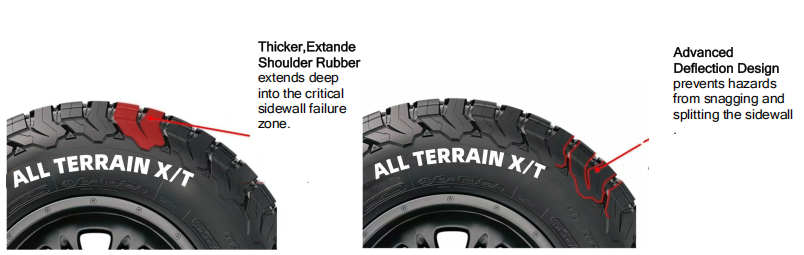
Sidewall knot control: a 5mm thicker sidewall reduces the risk of bulging caused by cord breakage on impact.
One risk deserves particular attention because it is invisible at the point of sale. A sidewall knot — bulging caused by cord breakage after an impact — is one of the most common field failures on off-road tires, and it is usually triggered by potholes rather than by extreme terrain. The control method is structural: a 5mm thicker sidewall significantly reduces the risk of sidewall bulging caused by cord breakage when hitting potholes. That is the difference between a marking that survives its warranty period and one that does not.
The measured differences between the reinforced construction and conventional pattern and construction design are set out below.
| Comparison point | Traditional pattern and construction design | Reinforced construction | What it means for the buyer |
|---|---|---|---|
| Sidewall | Conventional sidewall rubber | Tougher sidewall rubber, +5mm thickness | Reduces the risk of sidewall knot caused by cord breakage on potholes |
| Shoulder | Standard shoulder rubber | Thicker, extended shoulder rubber | More protection at the most exposed part of the tire |
| Deflection behaviour | Baseline | Advanced deflection design | Better load handling under impact |
| Noise | Baseline | Silent absorber | Lower cabin noise on highway transfer sections |
| Contact patch | Baseline tread width | +3% wider contact patch | Enhanced road contact |
| Grip and driving stability | Baseline | +22% increase | Improved handling and safety margins |
| Durability | Baseline | +40% extension in total tire lifespan | Longer replacement cycle, longer tread life |
| Maintenance | Baseline | 90% less maintenance required | Lower workshop workload for fleets and dealers |
| Cost position | Baseline unit price | Initial cost 10% higher, total cost of ownership 40% lower over 3 years | Higher entry price, lower cost per year across the ownership cycle |
Step-by-Step: Verifying Markings Before You Confirm an Order
The following sequence is designed to be run before purchase-order release, not after arrival. It assumes no special equipment beyond the sidewall, the vehicle requirement and the certificate file.
Step 1 — Start from the fitment and the destination, not the catalogue
Write down the target vehicle's axle load requirement, the fitment mode (single or dual) and the destination market. Every later check is measured against these three anchors.
Step 2 — Match the load index to the correct half of the pair
For a paired index such as 120/117, confirm which figure applies to the fitment you are selling into, then compare that figure — not the headline number — against the axle requirement.
Step 3 — Match the speed symbol to real service speed
Confirm the symbol covers the highest sustained speed the vehicle will see in service, including highway transfer sections. Do not assume that a low symbol is automatically acceptable for a mixed-use fleet.
Step 4 — Read the pressure marking together with the load figure
Maximum load and maximum pressure are one statement, not two. Note the pressure unit used on the sidewall and make sure the fitting instructions issued to dealers use the same unit.
Step 5 — Photograph the sidewall against the approved specification
Request sidewall photographs of the actual production size rather than a catalogue render, and compare them line by line with the approved specification. This step catches transcription errors before moulding rather than after shipment.
Step 6 — Confirm the certificate set for the exact size and market
List the destination market requirement and match it against the certificates the supplier provides for that size. Where a performance marking such as 3PMSF applies, confirm it appears on the size being ordered.
Step 7 — Freeze the marking specification in writing
Record load index, speed symbol, pressure marking and certificate set in the purchase specification. Markings are the output of a build specification, so changing them later means changing the build. They belong at specification freeze.

Component cutting line: marking values are fixed by the build specification, so the specification is where the check belongs.
Use Cases: Where Marking Choices Change the Buying Decision
Sand dunes and hot climates. In desert and high-temperature markets, sustained heat and heavy axle loads make the load-at-pressure relationship the operative constraint. The marking block, not the tread photograph, tells a distributor whether a size is appropriate for loaded touring use.
Winter and snow service. Where dealers sell into cold-weather demand, the 3PMSF rating becomes a purchasing criterion in its own right — as demonstrated on the LT285/70R17 WEYONE AK3 all-terrain size.
Mountain and rock terrain. Rocky trails generate impact events rather than steady load. The relevant construction answer is the 5mm thicker sidewall that reduces sidewall knot risk from cord breakage on potholes, supported by quality testing and customer usage training.
Mud terrain and jungle routes. Mud and jungle conditions combine low-speed traction demand with high torque loading, which is exactly the environment in which a lower speed symbol paired with a high load index is the technically correct choice.
Mixed fleets and distribution channels. A distributor serving urban, highway, all-terrain, mud, rugged and snow-and-ice demand from one warehouse needs a marking set that stays legible across several dealer types. This is where the reinforced construction profile — suitable for urban road, highway, all-terrain, mud terrain, rugged road and snow and ice conditions — reduces assortment complexity.
Comparison Table: Marking Elements and the Decision Each One Supports
| Marking element | What it declares | Decision it supports | What to verify |
|---|---|---|---|
| Load index, e.g. 120/117 | Maximum load the tire is designed to carry at a defined inflation pressure, with a second figure for the paired fitment mode | Whether the size can be sold into the dealer network's single or dual fitment profile | Which half of the pair applies to your fitment, and the actual axle load requirement |
| Speed symbol, e.g. Q | The maximum speed band the construction is designed for | Whether the size suits the vehicle's real service speed, including highway transfer | The highest sustained speed in the destination market's usage pattern |
| Maximum pressure, e.g. 550 kPa | The inflation pressure at which maximum load is defined | How dealers should be instructed on inflation, and in which unit | The unit convention used in the market, and the fitting guidance issued to dealers |
| Conformity marks — CCC, ECE, GCC, EU Label, SONCAP | Which approval routes the manufacturer states the product meets under an ISO 9001 quality system | Whether the shipment can enter the destination market | Certificate copies covering the exact size ordered, checked against current market requirements |
| Performance marking — 3PMSF | Snow-traction performance of the specific size | Whether the size qualifies for cold-weather and winter demand | That the rating appears on the size being ordered, such as LT285/70R17 WEYONE AK3 |
How WIDEWAY, EVERLAND and V-RICH Support Marking-Verified Supply
WIDEWAY, EVERLAND and V-RICH are the three brands of Shandong Wideway Tire Co., Ltd., a Qingdao-based manufacturer founded in 2014. The group reports a 23.4 million-unit annual production capacity, a 25-person R&D team and a product range covering passenger car, SUV, AT, MT, RT, van, winter, all-season, white letter and white wall tires — a portfolio reported at 300 different tire sizes and patterns across 80 export markets.
For distributors, the marking-relevant capability is twofold. First, coverage: with all-terrain and mud-terrain tires among its product categories, the group supplies the two off-road families most likely to be ordered against load, speed and pressure markings. Second, specification control: the company states that it tailors tires to customer demands and develops prototypes, which means a marking set can be matched to a market requirement at specification stage rather than accepted as a catalogue default.
Certification claims — CCC, ECE, GCC, EU Label and SONCAP under an ISO 9001 quality system — should always be verified at size level during qualification. The same applies to the 3PMSF rating on the LT285/70R17 WEYONE AK3.
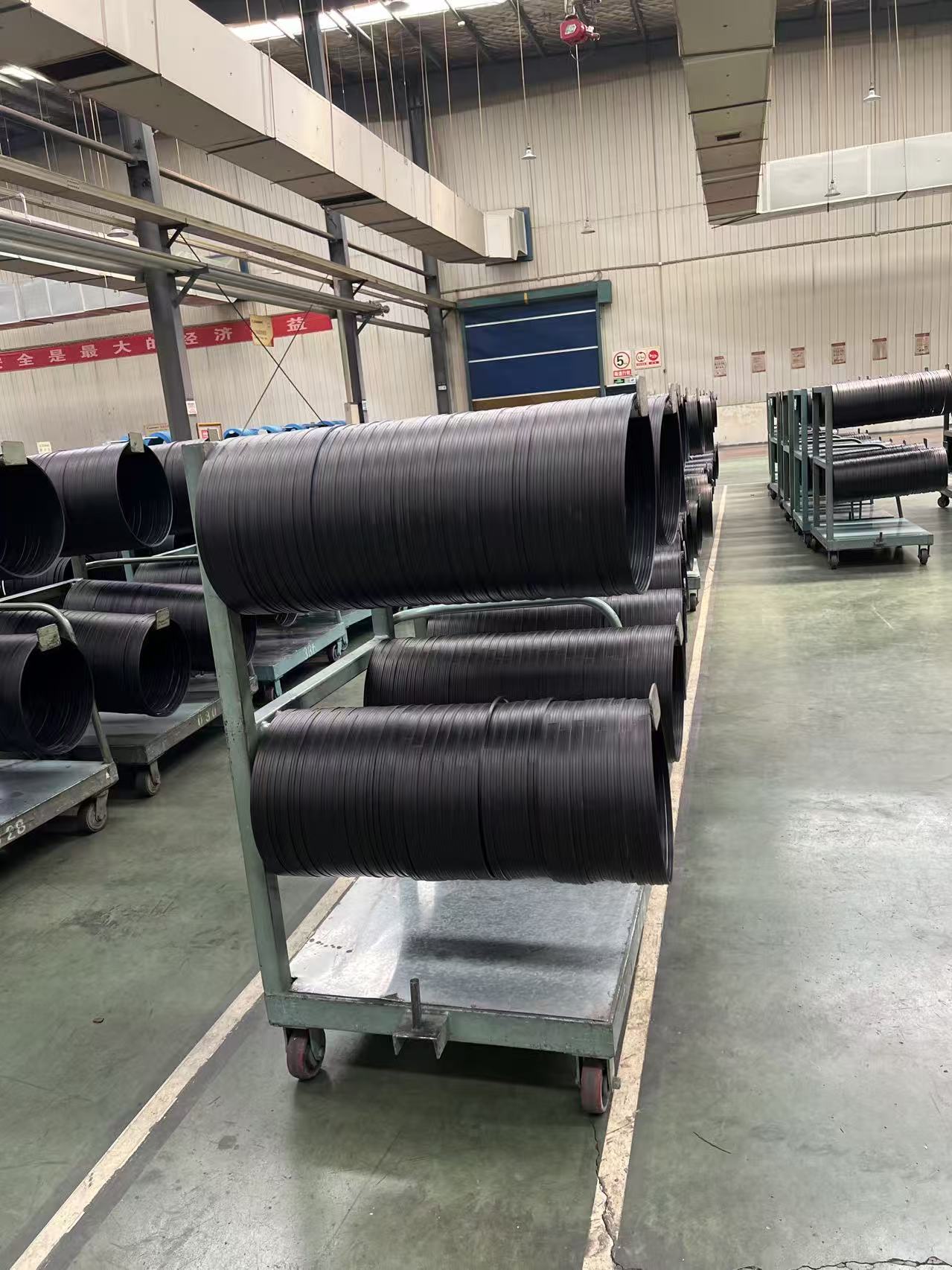
Sidewall reinforcement: the marking declares the load envelope; the sidewall construction determines how much margin sits behind it.
FAQ
Is a 3PMSF rating enough to import off-road tires into a regulated market?
No. 3PMSF is a snow-traction performance marking: it indicates that a size has met a defined snow performance criterion, and Wideway's WEYONE AK3 in LT285/70R17 carries it. It is not a substitute for the market-entry certification set. Shandong Wideway Tire Co., Ltd. states that it holds CCC, ECE, GCC, EU Label and SONCAP certification under an ISO 9001 quality system, and distributors should confirm which of these the destination market requires and obtain copies covering the exact size ordered.
Can a distributor change a load index or speed symbol for its own market?
Markings are declarations of an actual build capability, so they follow the construction rather than the label. Load index, speed symbol and maximum pressure are outputs of the casing, compound and sidewall design; a different marking means a different specification and normally re-validation. Wideway states that it tailors tires to customer demands and develops prototypes, which means a market-specific marking set is best raised at the specification and prototype stage, before the size is released to production.
Does a tougher, verification-ready off-road specification cost more?
In the comparison data, the reinforced construction carries an initial cost around 10% higher than a traditional pattern and construction design. Across a three-year ownership cycle that reverses: total cost of ownership is reported to be 40% lower, with a 40% extension in total tire lifespan and around 90% less maintenance required. For a distributor, the practical implication is that the marking block and the construction behind it should be presented to dealers as a cost-per-year story rather than a unit-price story.
How should a distributor verify markings on a sample before a container order?
Request a sample of the exact production size and check four things: the load index pair against the single or dual fitment, the speed symbol against the vehicle's real service speed, the maximum pressure marking against the fitting instructions that will be issued to dealers, and the conformity marks against the destination market. Because markings must match the approved build, the sample stage is the correct point to catch a mismatch. Wideway supports this process through quality testing and customer usage training. To start, contact Della at della@widewaytire.com or +86 18253208831 on WhatsApp, or download the EVERLAND catalog for the full size list.
When in the order process does the marking specification need to be decided?
At specification freeze, not after production release. Load index, speed symbol and maximum pressure all describe the build, so a late change is a change to the tire rather than to a label. In practice, distributors should settle the marking set and the certificate requirement during sample approval and before the purchase order is issued, so that moulding, testing and market-entry documentation all proceed on one specification. Wideway's reported annual production capacity of 23.4 million units and export footprint across 80 countries provide the scale context, but the sequencing point is universal: markings are confirmed with the build.
Conclusion
Load index, speed symbol and maximum pressure are not decorative stamps. They are the three values that determine whether an off-road tire can legally enter a market, whether a dealer can fit it to the vehicle on the ramp, and whether the specification still holds up when a pothole impact arrives at kilometre 40,000. A paired index such as 120/117 only becomes a buying decision once the fitment mode is known; a symbol such as Q only becomes a limitation once the real service speed is known; a marking such as 550 kPa only becomes useful once the dealer network is told what it means.
The most reliable protection against mismatched inventory is sequence, not paperwork volume. Fix the fitment and destination first, read the marking block as one connected statement, verify the certificate set at size level, and freeze everything before production release. Markings that are checked at specification stage cost nothing to correct; markings that are checked at customs cost a container.
Verify your next off-road tire specification
WIDEWAY, EVERLAND and V-RICH off-road tires are supplied by Shandong Wideway Tire Co., Ltd. Distributors can request a marking-checked sample, a size-specific quotation or the full EVERLAND catalog before placing a container order.
Email: della@widewaytire.com · WhatsApp: +86 18253208831 · Catalog: EVERLAND CATALOG-2025 (PDF) · Website: widewaytire.com
No.396, Emeishan Road, HuangDao District, Qingdao City, Shandong, China
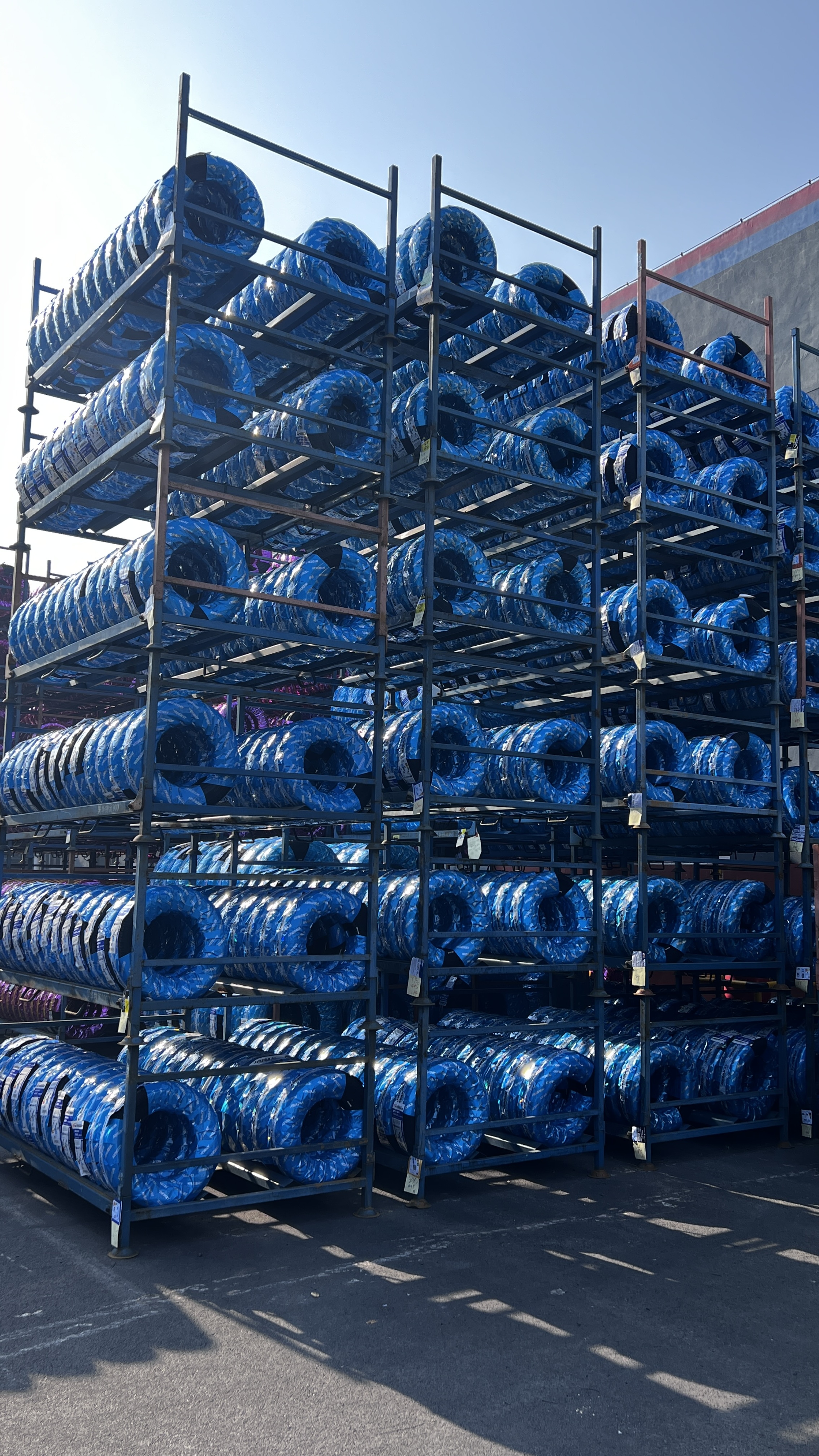
Shipment-ready off-road tires: confirm the marking block and certificate set before the loading date.
Have Questions or Need More Details?
Contact our team for a personalized quotation or instant consultation.
Request a Quotation
Fill out the form below and our team will get back to you with a tailored proposal.
WhatsApp Direct Chat
Prefer to chat in real-time? Message us on WhatsApp for instant assistance & quick answers.
- Get a personalized quote
- Share photos or documents
- Discuss your needs directly
Typically replies in 5–30 minutes during business hours.