
Off-Road Tire Compliance: LT vs. Metric Sizes, Load Index and Speed Ratings Explained
An off-road tire publishes its own compliance record long before any certificate is issued. The size notation, load index, speed symbol and maximum inflation pressure moulded into the sidewall are the first layer of due diligence a distributor can perform — and the layer most often skipped when a catalogue is copied forward from the previous season.
This guide is written for tire distributors, wholesalers and aftermarket buyers who stock 4x4 all-terrain (AT), mud-terrain (MT) and rugged-terrain (RT) products. It explains what LT and metric size notation actually mean, how load index and speed ratings behave across regional markets, and how to build a verification routine before a container is ordered. All specifications quoted below come from published data for the WIDEWAY, EVERLAND and V-RICH off-road range, including the size designations LT235/75R15, 31×10.50R15LT, LT265/70R16, LT285/75R16 and LT315/75R16.
The four markings that matter most
- Size notation — metric sizes describe section width and aspect ratio (LT265/70R16); flotation or inch sizes describe overall diameter and section width (31×10.50R15LT). The LT prefix carries a light-truck service designation.
- Load index — a numeric code mapping to the maximum load a single tire can carry at a defined inflation pressure. Where two figures appear, such as 120/117 or 121/118, the pairing covers more than one fitment situation.
- Speed symbol — a single letter set in a defined ascending order of maximum speed capability. Q, R and T all appear inside the WIDEWAY off-road range.
- Maximum pressure — a ceiling, never a recommendation. Across the off-road groups it runs from 300 KPA to 552 KPA depending on the construction.
Why off-road tire size and rating notation causes real procurement problems
Most off-road tire complaints that reach a distributor are not manufacturing defects. They are specification mismatches created upstream — in the catalogue, the quotation or the purchase order — and they surface only after the container lands.
Problem 1: The assumption that size determines capacity
Size and load capacity are separate properties. One size can exist in several construction groups, and each group carries its own load index, speed symbol and pressure ceiling. LT235/75R15 illustrates this inside the WIDEWAY range: it appears in one all-terrain group published at load index 111, speed symbol T and a 300 KPA maximum pressure, and in a mud-terrain group published at load index 121/118, speed symbol Q and a 550 KPA maximum pressure. The marking on the sidewall is the same size; the load-carrying specification is not.
Problem 2: LT and metric notations pointing at the same vehicle
A buyer specifying for a single 4x4 platform may see it listed as LT265/70R16 in a North American-facing catalogue and as 265/70R16 in European-facing documentation. When the notation on the purchase order does not match the notation used in the destination market's documentation, SKU-level errors follow: wrong load index, wrong pressure table, wrong shipment.
Problem 3: Maximum pressure treated as a recommendation
The maximum pressure moulded on a sidewall is an upper limit tied to the load index, not the pressure a vehicle should be run at. Comparing tires by maximum pressure alone is therefore misleading. One rugged-terrain group in the range is published at 350 KPA with load index 121/118 and a 318 mm section width; a mud-terrain group is published at 550 KPA with the same 121/118 load index and a narrower 272 mm section. A higher pressure ceiling does not mean a higher load rating.
Problem 4: Documentation that changes by region
Sidewall markings are largely universal; market-access documentation is not. A single off-road SKU may need different certificate evidence for China, the European Union, the Gulf, Nigeria or Saudi Arabia. A distributor who verifies markings but not paperwork ships a physically compliant tire into a non-compliant entry file.
Industry background: why off-road specification discipline became commercial
Off-road demand is no longer a niche accessory category. The global off-the-road tire market reached USD 33.7 billion in 2025 (IMARC Group), and the mud-terrain segment alone was estimated at USD 8.3 billion in 2024 (Traction News / Growth Market Reports). On the supply side, China exported 3.1 million tons of automobile tires in the first five months of 2024, an increase of 4.4% year on year (General Administration of Customs China).
That volume moves through distributors who increasingly function as compliance gatekeepers rather than order-takers. The supplier context matters. SHANDONG WIDEWAY TIRE CO.,LTD. — the manufacturer behind the WIDEWAY, EVERLAND and V-RICH brands — was established in 2014 and reports a manufacturing facility of 1,000,000 square metres, approximately 5,000 employees, an annual production capacity of 23,400,000 units and an R&D team of 25 engineers. The company states that exports account for 70% of sales, with markets spanning Central and South America, Canada, the EU, Africa, the Middle East, Southeast Asia, Central Asia and Australia, and reports a portfolio of 300 tire sizes and patterns.
On market access, the company reports holding CCC, ECE, GCC, EU Label and SONCAP certifications under an ISO 9001 quality system. These are supplier-reported claims: they are useful for initial screening but should be confirmed per SKU, per market and per shipment. That is precisely why the verification routine described later in this guide carries more weight than the claim itself.
Two structural shifts make notation literacy more valuable than it used to be. First, the same off-road size now moves between LT-discipline markets and metric-discipline markets, so one SKU has to be documented twice. Second, marked snow and all-weather performance expectations have spread: the WEYONE AK3 4x4 all-terrain tire in LT285/70R17 is reported as targeting Saudi and global markets with a 3PMSF rating. Terrain-class marketing alone no longer satisfies a buyer who wants evidence that a defined performance threshold was met.
Detailed solution: decoding the four markings
1. Size notation — metric, LT and flotation
A metric off-road size such as LT265/70R16 reads as four separate values: 265 mm of nominal section width, a 70 aspect ratio, an R for radial construction, and a 16-inch rim diameter. The LT prefix adds a light-truck service designation, which is what separates it from a passenger-metric listing of the same dimensions. A flotation size such as 31×10.50R15LT uses inches throughout: 31 inches of overall diameter, a 10.50-inch section width, a 15-inch rim and the same LT designation.
| Notation form | Example from the off-road range | How the values read | Where it typically appears |
|---|---|---|---|
| Metric with LT prefix | LT265/70R16 | 265 mm section width / 70 aspect ratio / radial / 16-inch rim / light-truck service designation | Light-truck and 4x4 fitments in North American-facing catalogues |
| Metric without LT prefix | 265/70R16 | Identical dimensions, without the light-truck service designation | European-style and general export listings |
| Flotation / inch size | 31×10.50R15LT | 31-inch overall diameter / 10.50-inch section width / 15-inch rim / light-truck designation | Lifted 4x4, off-road and aftermarket fitments |
| Narrow light-truck metric | LT235/75R15 | 235 mm section width / 75 aspect ratio / radial / 15-inch rim | Compact 4x4 and light-truck applications |
| Tall heavy-duty metric | LT285/75R16, LT315/75R16 | Section width / 75 aspect ratio / radial / 16-inch rim | Heavy-duty 4x4, fleet and aftermarket builds |
Verification point: the same physical size can be printed as LT265/70R16 or 265/70R16 depending on catalogue convention. Confirm which notation the destination market's documentation uses before the purchase order is issued, not after.
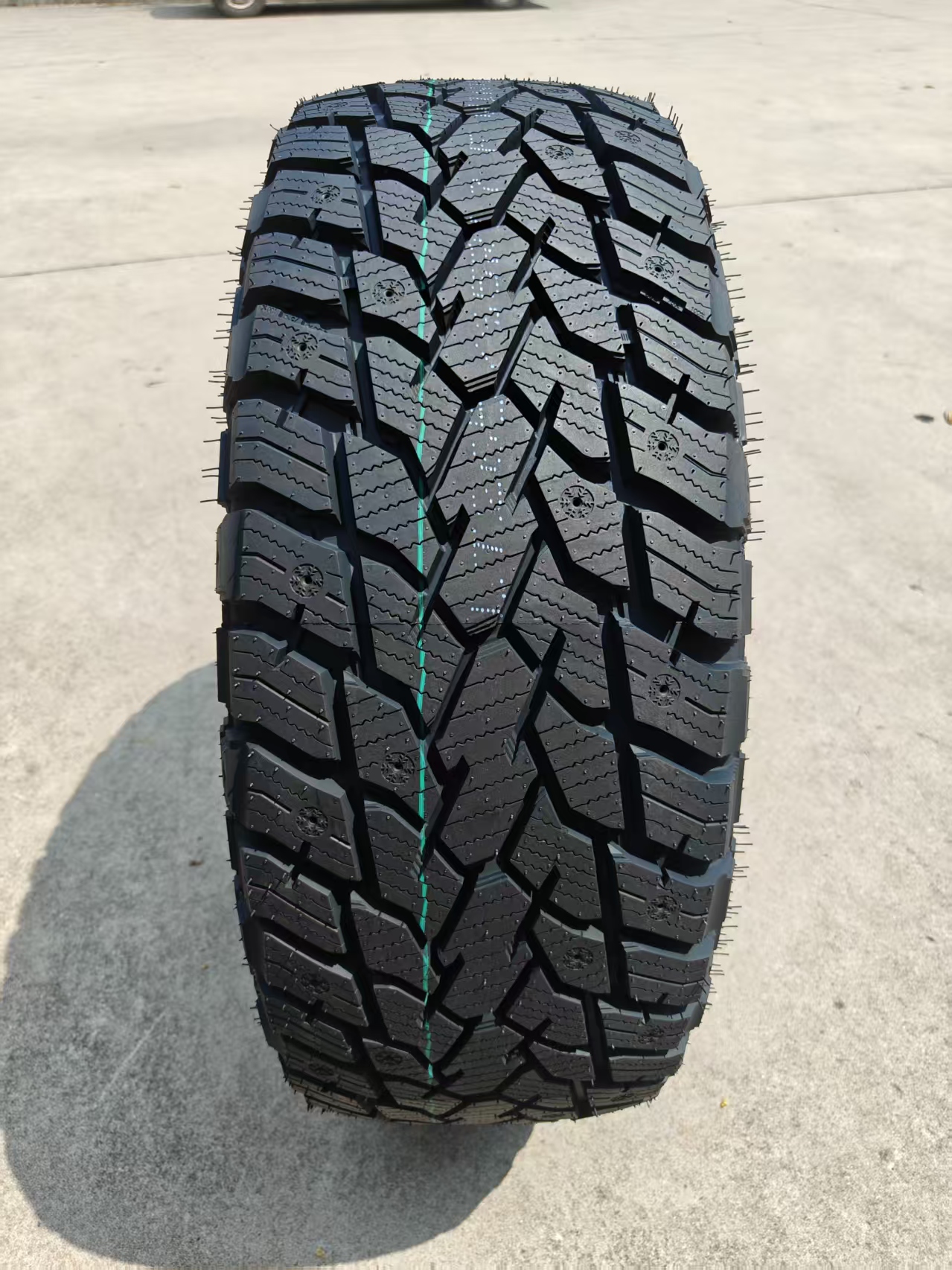
2. Load index — a property of the construction, not the size
The load index is a numeric code that maps to a maximum load per tire at a defined inflation pressure. It is not a number a buyer can read across from another tire of the same size. Within the published WIDEWAY off-road groups, load indices start at a single figure of 111 and run up to a paired 123/120.
Where two figures are printed together — 120/117, 121/118, 120/116, 119/116, 123/120 — the pair must be read as two values covering different fitment situations. A purchase order that quotes only the higher figure, without stating the fitment context, leaves the specification ambiguous at the point of shipment.
3. Speed symbols — the letter that size does not predict
Speed symbols are single letters set in a defined ascending order of maximum speed capability. Q, R and T all appear across the off-road range, and the symbol is fixed by the construction and intended use of the tire rather than by its size. Two all-terrain groups illustrate the point: both are published with load index 120/117, a 272 mm section width and a 550 KPA maximum pressure, but one carries speed symbol Q and the other carries speed symbol R. Identical size range, identical load index, identical pressure ceiling — different speed symbol.
4. Maximum pressure — a limit, not a target
The maximum pressure value is a ceiling tied to the load index of that construction. Across the off-road groups it ranges from 300 KPA on a lighter all-terrain group to 552 KPA on a rugged-terrain group. Because the ceiling moves independently of the load index, it cannot be used as a proxy for capacity or as a substitute for the applicable load-and-inflation table. It also must never be presented to an end user as a recommended operating pressure.
5. How the four markings interact: one size, several specifications
LT315/75R16 demonstrates how much specification variety can sit behind a single size designation in one manufacturer's range:
- Mud-terrain group — load index 121/118, speed symbol Q, 550 KPA, 272 mm section width
- Mud-terrain group (narrower section) — load index 120/116, speed symbol Q, 550 KPA, 235 mm section width
- All-terrain group — load index 120/117, speed symbol Q, 550 KPA, 272 mm section width
- All-terrain group (wider section) — load index 119/116, speed symbol R, 550 KPA, 277 mm section width
- Rugged-terrain group — load index 121/118, speed symbol R, 350 KPA, 318 mm section width
The practical conclusion for a distributor is direct: a purchase order that specifies only "LT315/75R16" is under-specified. Size, load index, speed symbol, maximum pressure and product classification each need to be fixed separately, because each one is set independently in the catalogue.
Step-by-step: a distributor verification workflow
The following six steps convert sidewall literacy into a repeatable pre-order check. Each step produces a document or a recorded value that can be attached to the purchase order.
- Fix the size notation for the destination market. Decide whether the market's registration and catalogue convention uses the LT form, the plain metric form or the flotation form, and use that notation consistently from quotation through to customs paperwork.
- Record load index and speed symbol per SKU, not per size. Two SKUs sharing a physical size may differ in both values. Capture them at line-item level so the order cannot be defaulted to the wrong construction group.
- Separate maximum pressure from operating pressure. Log the maximum pressure as a ceiling and keep the vehicle application's recommended inflation guidance in a separate field.
- Match the product classification to the terrain and climate brief. Confirm whether the SKU is an all-terrain, mud-terrain or rugged-terrain build, and whether the group carries the winter, snow or hot-climate positioning the market needs.
- Collect market documentation before shipping. Request certificate copies relevant to the destination and confirm applicability to the exact SKU. The company's reported portfolio (CCC, ECE, GCC, EU Label and SONCAP under an ISO 9001 quality system) is a starting checklist, not a per-shipment guarantee.
- Verify the specification package. Pull the current catalogue, the line-item specification and the certificate set together, and confirm that the manufacturing partner can reproduce the same specification on repeat orders.
Use cases: matching classification to terrain, climate and market
Every off-road group in the published WIDEWAY range shares a common base: urban-road usability, comfortable and noiseless running characteristics, high-speed stability and a reinforced sidewall construction for puncture resistance. What separates the groups is the terrain and climate positioning built on top of that base.
Mountain, rock and rugged terrain
Rugged-terrain builds such as the group published at load index 123/120, speed symbol Q, 552 KPA and a 272 mm section width are positioned for rugged terrain, reinforced sidewall protection and high-speed stability. For buyers equipping vehicles that alternate between highway transit and rock-strewn trails, this classification gives sidewall protection without abandoning road manners.
Mud and jungle conditions
Mud-terrain groups carry the mud-terrain and 4x4 MT classification and cover sizes from LT235/75R15 and 31×10.50R15LT through LT265/70R16, LT285/75R16 and LT315/75R16. They are also published with noise-absorption and wet-and-dry grip characteristics, which matters for distributors serving mixed-use customers rather than dedicated trail vehicles.
Desert and hot climates
Several all-terrain groups carry an explicit sand dunes and hot climates classification alongside the 4x4 AT designation — for example the group published at load index 120/117, speed symbol Q, 550 KPA and a 272 mm section width, and the group at load index 121/118, speed symbol Q, 550 KPA and a 292 mm section width. For Gulf and wider Middle East distribution, that classification is a starting point; the destination market's documentation requirements still have to be confirmed independently.
Winter and snow
One all-terrain group is classified for both winter and snow conditions and sand dunes and hot climates, which is unusual but useful for distributors servicing markets with genuine seasonal swings. Separately, the WEYONE AK3 4x4 all-terrain tire in LT285/70R17 is reported as targeting Saudi and global markets with a 3PMSF rating — the three-peak mountain snowflake marking associated with snow-traction performance testing.
Mixed all-weather distribution
For a distributor who needs a single line to cover urban commuting, weekend getaways and occasional off-road adventures, the all-terrain classification is the practical middle: it carries urban-road, comfortable and noiseless, high-speed stability and all-terrain positioning in the same group, and it is the classification most often specified in the aftermarket.
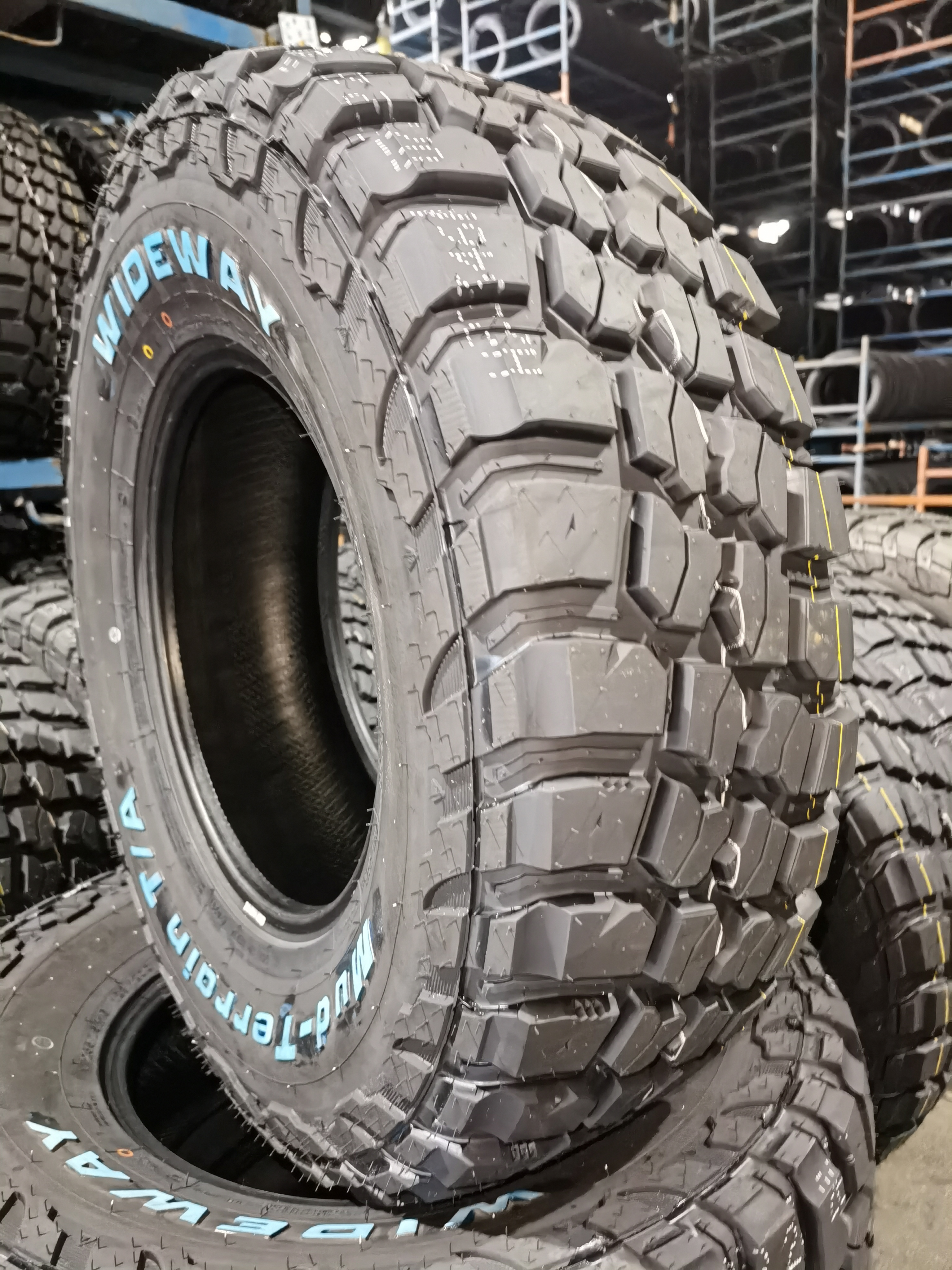
Comparison table: published WIDEWAY off-road groups at a glance
The table below places the published specification of each off-road group side by side. It is the fastest way to see why load index, speed symbol and maximum pressure must be recorded per product group rather than per size.
| Product group | Representative size designations | Load index | Speed symbol | Max pressure | Section width | Published classification |
|---|---|---|---|---|---|---|
| All-terrain (AT) | LT235/75R15, 31*10.50R15LT, LT265/75R16, LT285/75R16 | 111 | T | 300 KPA | 272 mm | All terrain, 4x4 AT, sand dunes & hot climates, high-speed stability, urban road, comfortable & noiseless |
| All-terrain (AT) | 31X10.50R15LT, LT265/70R16, LT265/75R16, LT285/75R16, LT275/70R16, LT315/75R16 | 120/117 | Q | 550 KPA | 272 mm | All terrain, 4x4 AT, winter and snow, sand dunes & hot climates, high-speed stability |
| All-terrain (AT) | LT235/75R15, 31*10.50R15LT, LT265/70R16, LT265/75R16, LT245/75R16 | 120/117 | R | 550 KPA | 272 mm | All terrain, 4x4 AT, sand dunes & hot climates, high-speed stability, urban road |
| All-terrain (AT) | LT235/75R15, 31*10.50R15LT, LT265/70R16, LT265/75R16, LT285/75R16 | 121/118 | Q | 550 KPA | 292 mm | All terrain, 4x4 AT, sand dunes & hot climates, high-speed stability |
| All-terrain (AT) | LT265/70R16, LT265/75R16, LT285/75R16, LT315/75R16, LT315/70R17 | 119/116 | R | 550 KPA | 277 mm | All terrain, 4x4 AT, sand dunes & hot climates, high-speed stability |
| Mud-terrain (MT) | LT235/75R15, 31*10.50R15LT, LT265/70R16, LT285/75R16, LT315/75R16 | 121/118 | Q | 550 KPA | 272 mm | Mud terrain, 4x4 MT, high-speed stability, urban road, comfortable & noiseless |
| Mud-terrain (MT) | 31*10.50R15LT, LT235/85R16, LT265/75R16, LT285/75R16, LT315/75R16 | 120/116 | Q | 550 KPA | 235 mm | Mud terrain, 4x4 MT, high-speed stability |
| Mud-terrain (MT) | LT265/70R17, LT285/70R17, LT315/70R17, 35X12.5R17LT | 121 | Q | 450 KPA | 330 mm | Mud terrain, 4x4 MT, high-speed stability |
| Rugged-terrain (RT) | 31×10.50R15LT, LT265/75R16, LT285/75R16, LT305/70R16, LT315/70R17 | 123/120 | Q | 552 KPA | 272 mm | Rugged terrain, 4x4 RT, reinforced sidewall, high-speed stability |
| Rugged-terrain (RT) | 31×10.50R15LT, LT265/75R16, LT285/75R16, LT265/70R16, LT315/75R16 | 121/118 | R | 350 KPA | 318 mm | Rugged terrain, 4x4 RT, reinforced sidewall, high-speed stability |
Construction materials are consistent across the off-road range: natural rubber, synthetic rubber, white rubber compound, carbon black, precipitated silica, steel cord, polyester cord fabric, nylon cord fabric, vulcanizing agent, vulcanization accelerators, activators, antioxidants and RAE oil, with a reinforced sidewall construction for puncture resistance.

FAQ
Q1. Which markings should a distributor verify on an off-road tire sidewall before listing it?
Four values carry the compliance weight: the size notation (LT, plain metric or flotation), the load index, the speed symbol and the maximum inflation pressure. The size alone is not sufficient, because one size can carry different load indices and speed symbols depending on its construction group. LT235/75R15, for example, is published in one all-terrain group at load index 111, speed symbol T and 300 KPA, and in a mud-terrain group at load index 121/118, speed symbol Q and 550 KPA.
Q2. Do regional markets treat LT and metric notation differently, and how should that affect ordering?
Yes. LT-prefixed notation and light-truck load-and-inflation conventions are common in North American-facing documentation, while European-style catalogues frequently list the equivalent dimension in plain metric form. The practical rule is to match the notation used by the destination market's own documentation with the notation used on the quotation and purchase order, then confirm the applicable load-and-inflation table that sits behind the load index. Market-access paperwork is a separate layer: the manufacturer reports holding CCC, ECE, GCC, EU Label and SONCAP certifications under an ISO 9001 quality system, and buyers should confirm current certificate status and applicability for the exact SKU and destination before shipping.
Q3. Does the WIDEWAY off-road range cover both LT and flotation sizes across AT, MT and RT?
Yes. Published designations include LT235/75R15, 31×10.50R15LT, LT265/70R16, LT285/75R16 and LT315/75R16, distributed across all-terrain, mud-terrain and rugged-terrain groups. The manufacturer reports 300 tire sizes and patterns, an annual production capacity of 23,400,000 units and an R&D team of 25 engineers, and states that it tailors tires to customer requirements with prototype development support. For distributors building an assortment, that combination of size coverage and development capability is what makes a mixed AT/MT/RT line feasible from a single source.
Q4. How should a buyer handle pricing and lead-time planning for an off-road tire programme?
The manufacturer's published off-road data covers specifications — sizes, load indices, speed symbols, section widths, maximum pressure and classification. It does not publish price lists or lead-time commitments, because both are order-specific. To get a usable commercial answer quickly, prepare the target size list with load index and speed symbol per line, the destination market and its documentation expectations, estimated annual and first-order volumes, and packaging and marking requirements. That information set allows a supplier to return a specification-matched quotation rather than a generic one.
Q5. What should a distributor verify before committing to a sample or first order?
Three things, in order. First, ask for the line-item specification and confirm that load index, speed symbol, maximum pressure and section width match the destination market requirement. Second, request certificate copies and confirm their applicability to the exact SKU rather than to the brand in general. Third, confirm that the supplied sample or first production batch carries the same classification and markings as the specification sheet. Once those three are aligned, the first order becomes a repeatable programme rather than a test shipment.
Conclusion
Off-road tire compliance is not a paperwork exercise that starts at customs. It starts on the sidewall, with four markings that must be read separately and recorded per SKU: the size notation, the load index, the speed symbol and the maximum pressure. Once a distributor treats those four values as independent data points rather than a single size code, most catalogue errors disappear before the purchase order is written.
The regional layer is the second half of the job. LT and metric notations reflect different catalogue conventions, and market documentation differs by destination, which means every off-road SKU needs two verification passes — one on the markings, one on the paperwork. The published WIDEWAY, EVERLAND and V-RICH off-road range provides a practical working example: sizes from LT235/75R15 and 31×10.50R15LT through LT265/70R16, LT285/75R16 and LT315/75R16, spread across all-terrain, mud-terrain and rugged-terrain groups, each with its own load index, speed symbol and pressure ceiling.
Next step for distributors and wholesale buyers
The current EVERLAND and WIDEWAY product catalogue covers the full off-road size list, classification groups and published specifications. Download it here: EVERLAND CATALOG-2025 (PDF).
For specification sheets, certificate copies or a quotation matched to your market, contact SHANDONG WIDEWAY TIRE CO.,LTD. directly: www.widewaytire.com — Della, della@widewaytire.com, tel / WhatsApp +86 18253208831. Address: No.396, Emeishan Road, HuangDao District, Qingdao City, Shandong, China.
Have Questions or Need More Details?
Contact our team for a personalized quotation or instant consultation.
Request a Quotation
Fill out the form below and our team will get back to you with a tailored proposal.
WhatsApp Direct Chat
Prefer to chat in real-time? Message us on WhatsApp for instant assistance & quick answers.
- Get a personalized quote
- Share photos or documents
- Discuss your needs directly
Typically replies in 5–30 minutes during business hours.