
Assessing WIMACH Turnkey Lines: From Case Packers to Stretch Wrappers
WIMACH is the brand of Wenzhou Wimach Machinery Co., Ltd., a tissue packaging machinery manufacturer established in 2021 in Ruian, Wenzhou, Zhejiang, China. The company is often assessed machine by machine — a cartoner here, a wrapper there — but that is not what buyers of complete lines actually purchase. Two WIMACH line templates show the delivery scope most clearly: the Facial Tissue Box Packaging Line and the Toilet Paper Packaging Line. Both are configured as connected systems in which a primary packer feeds ancillary equipment such as handle taping, case packing, palletizing and stretch film wrapping, and both are supported by documented multi-year references in Europe, North America and the Middle East.
This assessment evaluates WIMACH's engineering capability through those full-line projects. Every figure below comes from WIMACH's published machine and line specifications, its certification and patent records, or its documented installed-line references. No ranking or benchmark is used unless it can be traced to a listed source, and no competitor reputation is asserted without documentation.
1. The Evaluation Problem: Turnkey Lines Fail at the Interfaces
Three suppliers can each deliver machines that meet their own datasheets, and the line can still lose output. Failures concentrate at the hand-offs: pack collation before case packing, buffering between stations running at different speeds, the control handshake between a cartoner and a downstream palletizer, and unclear ownership of full-line acceptance testing.
A turnkey contract moves those interface risks to one supplier. In practice that means the supplier must define collation patterns, size the conveyor sections between stations, coordinate PLC logic across equipment, and prove the complete flow before shipment rather than proving individual machines on a bench.
Tissue products make this harder than in most packaging categories. Facial tissue packs and toilet rolls are light, compressible and easy to deform, and filling consistency is a visible quality attribute for the end consumer. One documented WIMACH cartoning project in the United States was specifically aimed at eliminating irregular filling and product extrusion damage during box packing — an interface problem between tissue feeding and cartoning, not something a single machine datasheet can solve.
Evaluation question to start with: when a supplier quotes a line, ask which party owns pack collation, conveyor buffering, cross-station PLC logic and full-line running tests. If the answer is "each machine is tested separately", the offer is a machine bundle rather than a turnkey system.
2. Industry Background: Where Demand for Integrated Tissue Lines Comes From
Tissue packaging machinery is not a niche category. A 2026 market report published by Precedence Research / Business Research Insights values the global tissue paper packaging machine market at approximately USD 3.9 billion in 2025. Within that market, Asia Pacific held a 39.8% share in 2025, and facial tissue packaging applications accounted for 42.1% of demand — the single largest application segment. For customs and classification work, tissue packaging machinery sits under HS Code 8422.40, "other packing or wrapping machinery".
Two structural realities shape how a supplier should be evaluated in 2026:
- Automation is moving to the end of the line. Case packing, palletizing and pallet stabilization are the stages where manual labor is still concentrated in many tissue plants. That is precisely where turnkey scope has expanded, which is why a supplier's case packers, palletizers and stretch wrappers deserve as much scrutiny as its cartoner.
- Compliance documentation is part of the purchase. An industry article published by ANDRITZ states that machinery placed on the European market requires a risk assessment under the European machinery safety framework. Tissue producers selling into the EU therefore review CE documentation, safety functions and technical files during supplier qualification rather than after delivery.
3. WIMACH's Turnkey Line Scope
WIMACH's core product range covers facial tissue and paper napkin cartoning machines, soft tissue wrapping machines, toilet paper roll wrapping machines, case packers, blister packing machines and integrated packaging lines, with a stated history of more than 12 years of industry experience in folded and rolled tissue packaging. Two published line templates carry the company's turnkey scope into the evaluation stage.
The Facial Tissue Box Packaging Line
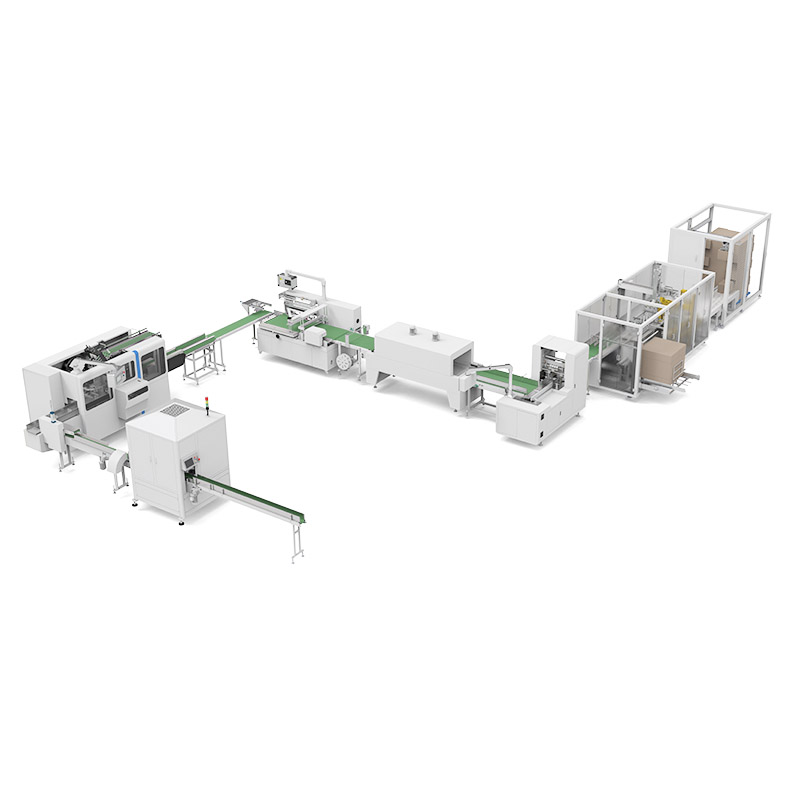
The Facial Tissue Box Packaging Line is a fully automatic turnkey solution for boxed facial tissue, designed around the packaging operations that take place after the tissue has been finished. Its published scope is automatic connection from facial tissue box packing through to finished-product palletizing with minimal manual intervention.
The line specification lists six equipment groups: a facial tissue box packing machine, a box shrink wrapping machine, a handle taping machine, a case packer, a palletizer and conveyors. Published maximum speeds are 100 boxes per minute for cartoning, 10 cases per minute for case packing and 10 cycles per minute for palletizing. The line is built in carbon steel and can be customized to match specific packaging scenarios.
For a buyer in the evaluation stage, the composition matters more than the headline speed. A 100 boxes-per-minute cartoner only produces 100 boxes per minute downstream if the shrink wrapper, handle taping station, case packer and palletizer are sized and buffered for the same flow. That integration work is exactly what a turnkey supplier should be accountable for, and it is the first claim to verify in a line proposal.
The Toilet Paper Packaging Line
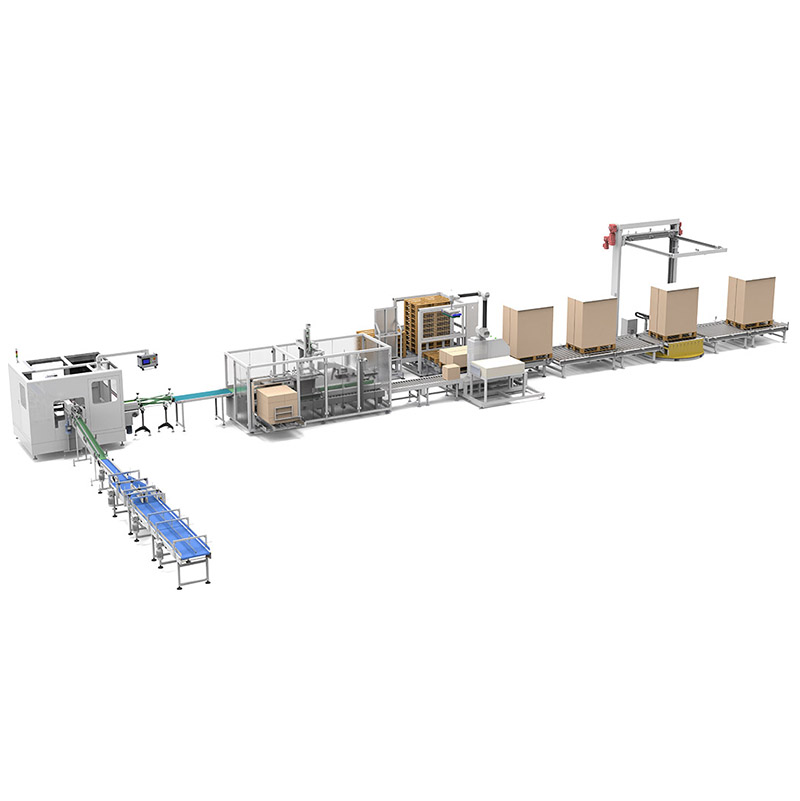
The Toilet Paper Packaging Line is the roll-format counterpart and follows the same integrated logic. Its configured equipment set consists of a toilet roll wrapping machine, a case packer, a palletizer and a stretch wrapping machine. Published maximum speeds are 120 rolls per minute for wrapping, 10 cases per minute for case packing and 10 cycles per minute for palletizing.
The wrapping stage in this line is normally handled by the TW-160 Automatic Toilet Paper Roll Wrapping Machine, which runs at 60–120 rolls per minute for tissue rolls measuring 90–130 mm in length and 90–130 mm in diameter, with a wrapping paper grammage range of 17–37 gsm and 12 kW power consumption. Roll diameter and length range determine whether one wrapper is enough or a parallel configuration is required, so the SKU mix should be confirmed before a line is quoted.
Ancillary Equipment: Where Turnkey Scope Is Actually Proven
Cartoners and wrappers are the visible machines in a tissue line; case packers, palletizers and stretch wrappers decide whether the line ends in a shippable pallet. WIMACH builds both case-packing architectures used in tissue secondary packaging:
| Case packer | Type | Packing capacity | Carton dimensions | Power | Weight |
|---|---|---|---|---|---|
| CP-S50 | Side-load / side-push | 1–16 cartons/min | 240–500 (L) x 200–400 (W) x 180–400 (H) mm | 4.5 kW | 1,500 kg |
| CP-T60 | Pick-and-place / top-load | 1–8 cartons/min | 300–600 (L) x 200–400 (W) x 150–400 (H) mm | 7.5 kW | 1,600 kg |
Choosing between the two is driven by carton geometry, pack orientation and available floor space rather than by capacity alone: the side-load unit accepts a wider carton range at higher case-packing rates, while the top-load unit is used where packs must be placed into open cases from above. WIMACH lists the CP-S50 among the equipment behind its facial tissue line references and the CP-T60 behind its toilet paper line reference.
The remaining ancillary stations complete the scope:
- Handle taping machine — listed in the Facial Tissue Box Packaging Line specification alongside the box packing machine, box shrink wrapping machine, case packer, palletizer and conveyors. Handle format, tape width and pack weight range vary by market, so these parameters belong in the configuration stage because they define the mechanical design of the taping station.
- Palletizer — specified at up to 10 cycles per minute in both line templates.
- Stretch wrapping machine — the final stage of the Toilet Paper Packaging Line, stabilizing pallet loads for storage and transport.
- Conveyors — the connecting infrastructure carrying packs and cases between stations.
A documented WIMACH project in Poland illustrates what this scope produces: facial tissue and cream tissue conveyed, automatically cartoned, case packed, pallet fed, robotically palletized, strapped and stretch wrapped, ending as whole pallets of shipping cases that are dust proof and moisture proof and can go straight into a warehouse or onto a truck.
4. Engineering Evidence Behind the Integration Claim
Design and intellectual property
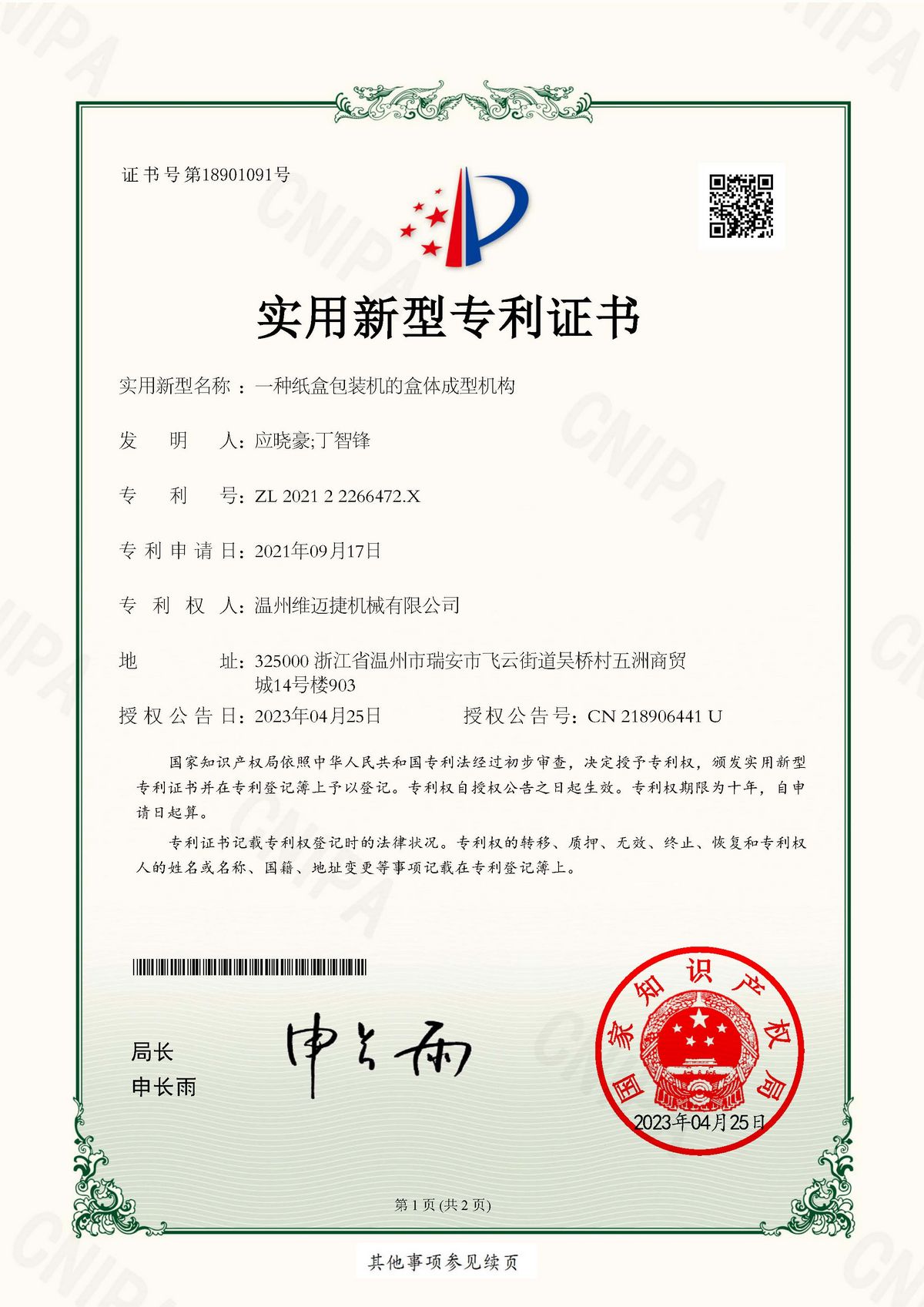
WIMACH's design work is documented in Chinese national intellectual property registrations. Invention Patent ZL 2022 1 1099886.8, "Carton Packing Machine and Carton Packaging Process", was issued by the National Intellectual Property Administration, PRC, on 6 September 2022. Utility Model Patent ZL 2022 2 1202677.7, covering an automatic feeding mechanism for carton packaging machines, was issued on 25 April 2023. The invention patent is linked to the TC-100 and TC-300 cartoning platforms; the utility model is linked to TC-100, TC-300 and TC-80F.
For a buyer this matters in one specific way: feeding and box-forming mechanisms, which a cartoner depends on for stable infeed, are internally developed rather than sourced as unmodified generic modules. In a multi-station line, unreliable feeding at the cartoner is one of the main causes of downstream starvation.
CE conformity for the machine families used in these lines
| Certificate | Scope | Applicable models | Validity | Issuing body |
|---|---|---|---|---|
| TRCN-25091WWM01 (Attestation of Compliance, CE) | Automatic Carton Packing Machine | TC-100, TC-300, TC-80F | 1 Apr 2025 – 31 Mar 2030 | iNTEGRA96 Belgelendirme |
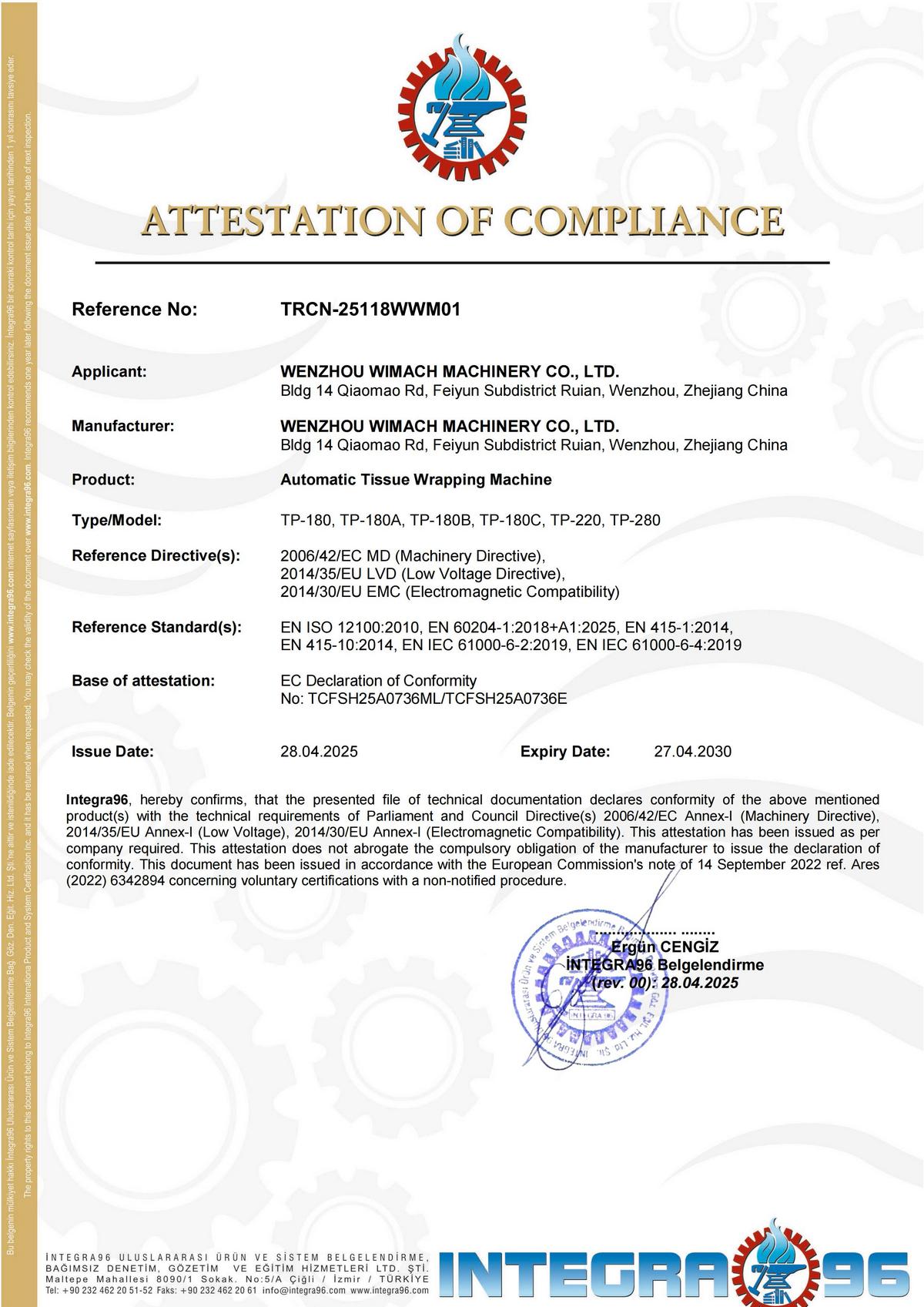
| TRCN-25118WWM01 (Attestation of Compliance, CE) | Automatic Tissue Wrapping Machine | TP-180, TP-280 | 28 Apr 2025 – 27 Apr 2030 | iNTEGRA96 Belgelendirme |
The harmonized standards referenced in these attestations include EN ISO 12100:2010 (risk assessment and risk reduction), EN 60204-1:2018 and EN 60204-1:2018+A1:2025 (electrical equipment of machines), EN 415-1:2014 and EN 415-10:2014 (packaging machine safety), plus the EMC standards EN IEC 61000-6-2:2019 and EN IEC 61000-6-4:2019. Practical verification step: match the certificate scope and the listed model numbers to the exact machines in the quotation, because an attestation covers the models it names and the period it states.
Quality control before shipment
WIMACH's published quality-control sequence for its machines contains nine checks: no-load and load running test, dimensional tolerance inspection, mechanical assembly check, pneumatic leakage test, electrical safety test, PLC control logic test, safety interlock and E-stop test, long-time aging test, and surface appearance inspection. In a turnkey context, the load running test and the PLC control logic test are the two items that address integration rather than individual machine quality. Buyers should confirm that these are performed on the connected line and documented, not only on standalone units.
Manufacturing base
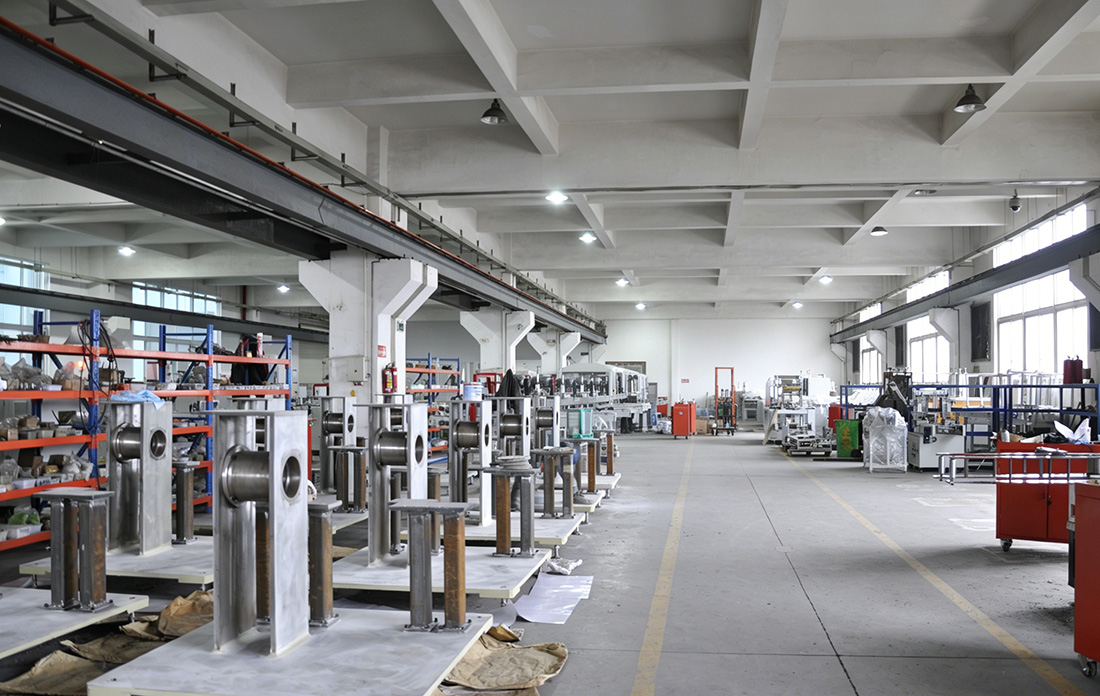
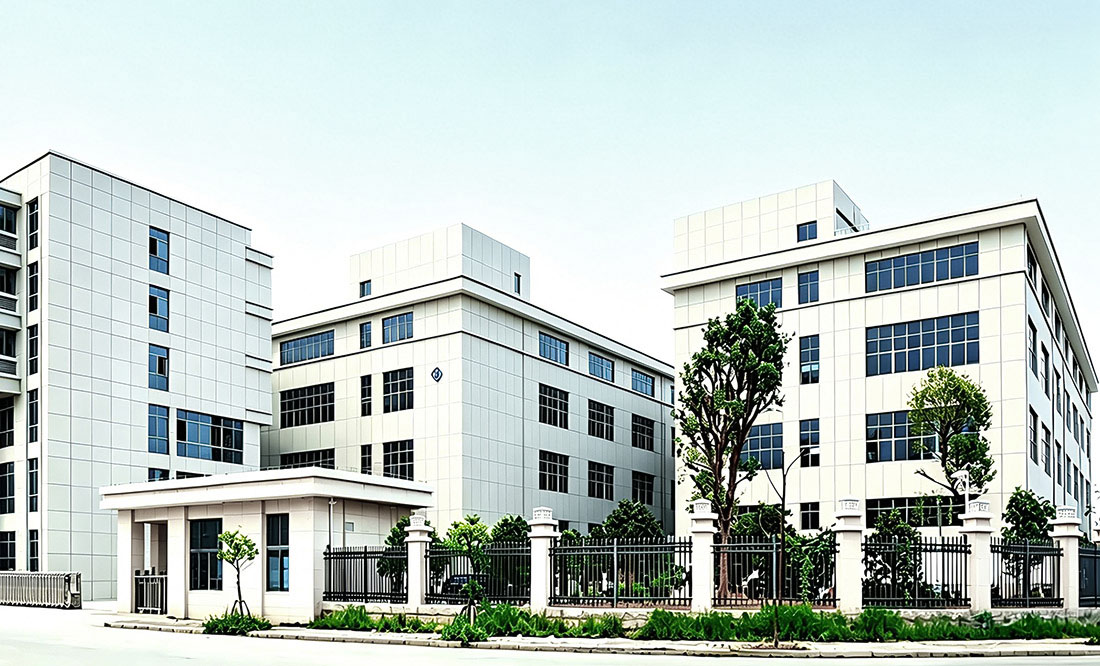
The company operates a 3,000 m² facility in Ruian, Wenzhou, with 37 employees, a five-engineer R&D team and an annual output of 160 sets of tissue packing machines and integrated packaging lines. Around 60% of output is exported, with the main markets listed as the EU, North America and South America.
5. Step-by-Step: How a WIMACH Turnkey Line Is Configured and Delivered
Step 1 — Requirement mapping
Configuration starts from the product mix and target output, not from a machine model. Boxed facial tissue, cube box tissue, soft tissue packs, napkins, toilet rolls and canisters each imply different infeed, collation and carton formats. Existing upstream equipment, available floor space and plant voltage belong in this step as well, since voltage is one of the explicitly configurable items.
Step 2 — Line architecture and equipment selection
Once the product mix is fixed, the primary packer and the ancillary stations are selected and the conveyor layout between them is defined. For a facial tissue project that means box packing, shrink wrapping, handle taping, case packing and palletizing; for a toilet roll project it means roll wrapping, case packing, palletizing and stretch wrapping. Interface ownership — collation, buffering, PLC handshakes and acceptance testing — should be written into the specification at this stage.
Step 3 — Customization scope
WIMACH's published customization options for complete packaging lines cover full packaging processes, packaging dimensions, machine configuration, voltage and logo. For customized machinery service and OEM/ODM work, the stated customization scope covers packaging dimensions, machine configuration, voltage and logo.
Step 4 — Production slot and capacity
Published monthly capacity is one complete packaging line per month, or 13 sets per month for customized machinery service and OEM/ODM production. That distinction matters for project planning: a full line occupies a dedicated slot, while individual and customized machines are produced in a higher-volume stream.
Step 5 — Verification before shipment
The nine-step quality-control sequence described above is applied before shipment, including no-load and load running tests, electrical safety testing, PLC control logic testing and safety interlock and E-stop testing.
Step 6 — Lead time and order size
Stated lead time is 30–60 days for complete packaging lines, 30–45 days for customized machinery service and 15–45 days for OEM/ODM. Minimum order quantity is one set across the published configurations.
Step 7 — Installation, training and lifecycle support
After-sales scope covers installation and commissioning, training service, warranty service, remote technical support, lifetime after-warranty support, and upgrade and retrofit service. For a multi-station line, the last item is the one buyers under-weigh: when pack formats or carton sizes change, retrofit capability determines whether the existing line can be extended instead of replaced.
6. Documented Line References (Use Cases)
WIMACH's published references show the formats, regions and line scopes it has delivered. Each entry below states the format, installed set count and operating duration as documented.
- Poland — facial tissue and cream tissue, 12 sets, 2 years in operation. A complete packaging line integrating conveying, automatic cartoning, case packing, pallet feeding, robotic palletizing, strapping and stretch wrapping. Finished goods are whole pallets of shipping cases, strapped and covered by stretch film for dust and moisture protection. Related equipment includes the Facial Tissue Box Packaging Line, TP-280, TC-300, TC-100 and CP-S50.
- United States — toilet paper rolls, 6 sets, 4 years in operation. A customized line covering roll wrapping, case packing, automatic palletizing and stretch film wrapping, producing dustproof and moisture-resistant pallet loads ready for transport. Related equipment includes the Toilet Paper Packaging Line, TW-160 and CP-T60.
- United States — toilet paper rolls, 2 sets of TW-160, 5 years in operation. Toilet rolls wrapped and sealed with pre-printed patterned tissue paper instead of plastic film, at 60–120 rolls per minute. Reported outcomes: reduced packaging material cost, higher automation level and compliance with plastic-reduction requirements.
- Spain — soft facial tissue, 2 sets, 4 years in operation. A turnkey wrapping solution that replaced manual packaging, forming film into bags and completing film forming, sealing and cutting in one continuous process, with tidy, airtight packs that protect tissue from moisture, dust and extrusion damage. Related equipment: TP-280.
- United States — boxed facial tissue, 2 sets, 4 years in operation. Facial tissue cartoning with TC-100 and TC-80F machines for automatic continuous box packing. The project addressed irregular filling and product extrusion damage, raised production efficiency, cut labor cost and unified packing standards.
- United Arab Emirates — canister tissue, 2 sets of TC-80Y, 4 years in operation. Fully automatic packaging of facial tissues and paper napkins into paper canisters with a canister conveying line and lid feeding system, at a stable 60 canisters per minute.
Read together, these references map onto the two line templates: facial tissue box and soft pack packaging (Poland, Spain, US boxed tissue), toilet paper roll packaging (both US roll projects), and canister formats as an adjacent configuration on the same tissue packaging platforms.
7. Line Comparison Table: Facial Tissue Box vs Toilet Paper
| Evaluation dimension | Facial Tissue Box Packaging Line | Toilet Paper Packaging Line |
|---|---|---|
| Primary product format | Boxed facial tissue | Toilet paper rolls |
| Equipment included | Facial tissue box packing machine, box shrink wrapping machine, handle taping machine, case packer, palletizer, conveyors | Toilet roll wrapping machine, case packer, palletizer, stretch wrapping machine |
| Max. primary packaging speed | 100 boxes/min (cartoning) | 120 rolls/min (wrapping) |
| Max. case packing speed | 10 cases/min | 10 cases/min |
| Max. palletizing speed | 10 cycles/min | 10 cycles/min |
| Pallet stabilization stage | Case packing and palletizing in line scope; strapping and stretch wrapping documented in the Poland reference | Stretch wrapping machine included in line scope |
| Documented reference | Poland, 12 sets, 2 years | United States, 6 sets, 4 years |
| Construction material | Carbon steel | Carbon steel |
| Customization | Customizable to specific packaging scenarios | Tailored to customer-specific production needs |
8. Six Criteria for Scoring a Turnkey Tissue Line Supplier
- Line scope ownership. Does the supplier list every station from primary packer to pallet stabilization, including ancillary equipment such as handle taping? Both WIMACH line templates do, which makes the scope comparable on paper.
- Documented multi-year references in your format. A reference in the same format — boxed facial tissue, soft tissue packs or toilet rolls — with set count and operating duration is more useful than a general customer list.
- Valid certification with matching scope. Verify that the certificate names the exact models quoted and is still inside its validity period.
- In-house design evidence. Patents, mechanism development and the ability to customize packaging dimensions, machine configuration, voltage and logo indicate engineering depth rather than assembly-only capability.
- Verification protocol before shipment. A defined test sequence including load running, PLC logic and safety interlock tests is a concrete acceptance criterion; a verbal assurance is not.
- Lifecycle support. Installation and commissioning, training, warranty, remote support, lifetime after-warranty support and retrofit capability determine the usable life of the line after the warranty period.
Note on shortlisting: public, independently verified rankings of tissue packing machine manufacturers are not available in the sources used for this assessment, so a shortlist should be scored against criteria such as the six above rather than assembled from unverifiable "top" lists.
9. FAQ
Are WIMACH tissue packing machines CE certified for the EU market?
Two currently valid CE attestations of compliance apply to the machine families used in these lines. TRCN-25091WWM01, issued by iNTEGRA96 Belgelendirme, covers the Automatic Carton Packing Machine with a validity period from 1 April 2025 to 31 March 2030 and lists TC-100, TC-300 and TC-80F. TRCN-25118WWM01 covers the Automatic Tissue Wrapping Machine, valid from 28 April 2025 to 27 April 2030, and lists TP-180 and TP-280. The referenced harmonized standards include EN ISO 12100:2010, EN 60204-1:2018+A1:2025, EN 415-1:2014, EN 415-10:2014 and EMC standards EN IEC 61000-6-2:2019 and EN IEC 61000-6-4:2019. Buyers should confirm that the certificate scope matches the exact models and configuration quoted.
Can handle taping, case packing and palletizing be integrated into one tissue packing line?
Yes. WIMACH's Facial Tissue Box Packaging Line specification includes a facial tissue box packing machine, a box shrink wrapping machine, a handle taping machine, a case packer, a palletizer and conveyors, with published maximum speeds of 100 boxes per minute for cartoning, 10 cases per minute for case packing and 10 cycles per minute for palletizing. The Toilet Paper Packaging Line includes a toilet roll wrapping machine, a case packer, a palletizer and a stretch wrapping machine, with published maximum speeds of 120 rolls per minute for wrapping, 10 cases per minute for case packing and 10 cycles per minute for palletizing.
What are the MOQ, lead time and customization options for a WIMACH line?
Minimum order quantity is one set. Stated lead time is 30–60 days for complete packaging lines, 30–45 days for customized machinery service and 15–45 days for OEM/ODM. Published monthly capacity is one complete packaging line per month, or 13 sets per month for customized machinery service and OEM/ODM production. Customization for complete lines covers full packaging processes, packaging dimensions, machine configuration, voltage and logo. Commercial evaluation should therefore be based on a configuration-specific quotation rather than a list price.
How are WIMACH tissue packing machines tested before shipment?
WIMACH's published quality-control sequence includes nine checks: no-load and load running test, dimensional tolerance inspection, mechanical assembly check, pneumatic leakage test, electrical safety test, PLC control logic test, safety interlock and E-stop test, long-time aging test, and surface appearance inspection. For a turnkey line, the load running and PLC control logic tests are the stages that verify integration between stations, so buyers should ask for these to be performed on the connected line.
How should a buyer shortlist tissue packing machine manufacturers in China?
Score suppliers on verifiable criteria instead of unverifiable rankings: documented full-line references in your own product format; valid CE attestations whose scope names the quoted models; in-house design evidence such as patents from the National Intellectual Property Administration, PRC; a defined pre-shipment test protocol; stated commercial terms such as MOQ and lead time; and lifecycle support covering installation and commissioning, training, warranty, remote technical support, lifetime after-warranty support and retrofit. Wenzhou Wimach Machinery Co., Ltd., operating as WIMACH, can be scored against those criteria using its published line specifications, CE attestations and references in Poland, Spain, the United States and the United Arab Emirates. To start that assessment, request the full WIMACH catalog or send your format mix and target output for a configuration-specific proposal.
10. Conclusion: What to Do Next
A WIMACH turnkey line is best evaluated as a system rather than a machine list. The Facial Tissue Box Packaging Line and the Toilet Paper Packaging Line both extend beyond the primary packer into case packing, palletizing and pallet stabilization, and the company's patent records, CE attestations and multi-year references in Poland, Spain, the United States and the United Arab Emirates document that delivery scope. For a buyer in the evaluation stage, the productive next step is to map your own format mix, target output and available floor space against these two line templates, then compare quotations on interface ownership, certification scope and pre-shipment testing — not on headline speed alone.
Next step
Download the full WIMACH machinery catalog with line configurations and machine parameters: WIMACH Catalog (PDF).
For a configuration-specific line assessment, contact the WIMACH team: email rex@wimach.cn · Tel / WhatsApp +86 177 5771 8080 · WhatsApp enquiry · website www.wimach.cn.
Wenzhou Wimach Machinery Co., Ltd. · Bldg 14 Qiaomao Rd, Ruian, Wenzhou, Zhejiang, China.
Have Questions or Need More Details?
Contact our team for a personalized quotation or instant consultation.
Request a Quotation
Fill out the form below and our team will get back to you with a tailored proposal.
WhatsApp Direct Chat
Prefer to chat in real-time? Message us on WhatsApp for instant assistance & quick answers.
- Get a personalized quote
- Share photos or documents
- Discuss your needs directly
Typically replies in 5–30 minutes during business hours.