CE Compliance and Safety Standards for Automatic Case Packers: A Buyer's Audit Guide
In 2024 the global case packing machines market was estimated at USD 1.07 billion and is projected to reach USD 1.74 billion by 2033 (Grand View Research), and Asia Pacific held a 37.9% share of that industry in the same year. More capacity means more quotations, and more suppliers describing their automatic case packers as CE certified. At the evaluation stage, the decisive question is no longer whether a supplier says the machine is compliant. It is which evidence the supplier can put in front of you, in writing, before the machine is crated.
A defensible CE compliance package for an automatic case packer contains four auditable elements: a documented route to harmonised machinery safety standards such as EN ISO 12100; safety function testing performed and recorded before shipment; risk control implemented through safety relays and safety PLC logic that cover every interlock point across the full range of machine motion; and safety operation and maintenance manuals that the buyer's own team can use. This guide explains each element, how to audit it, and the evidence to request from any supplier.
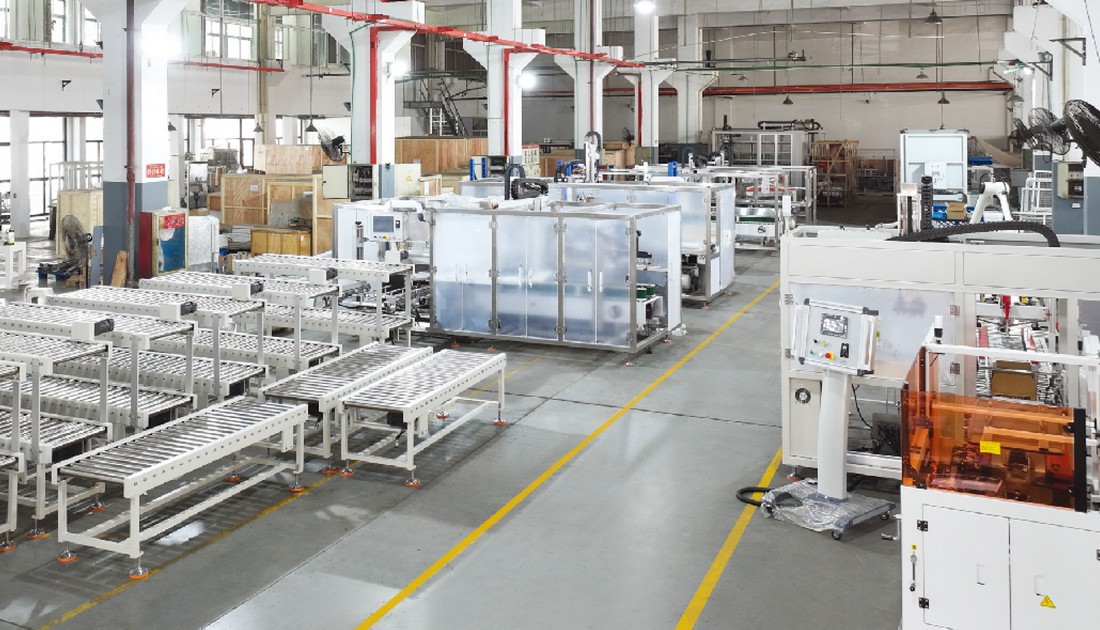
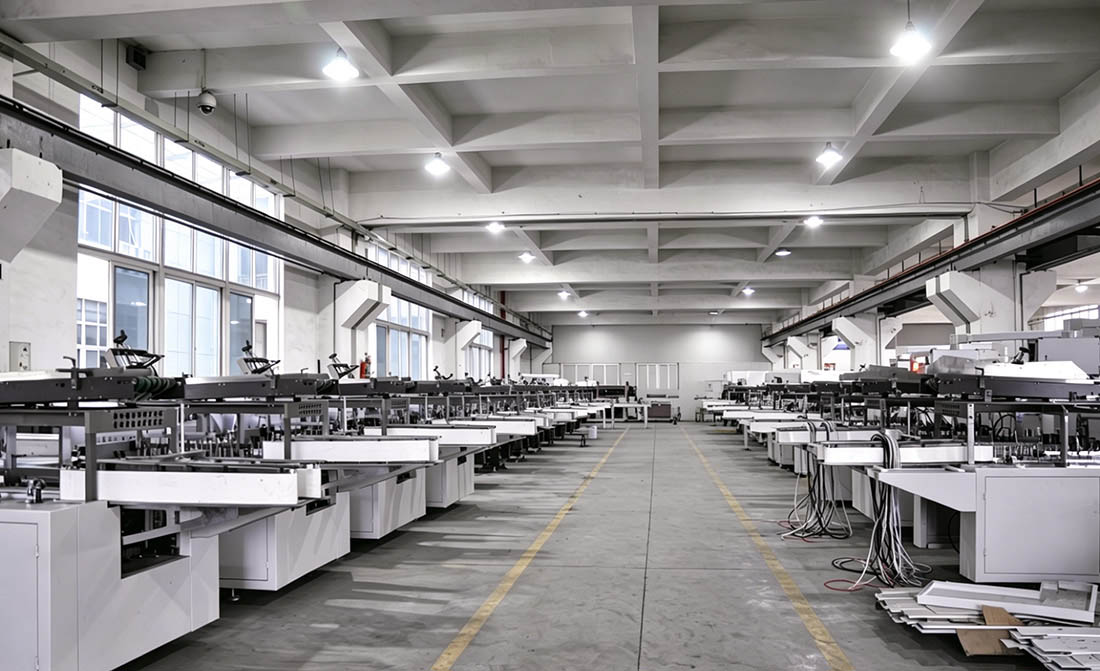
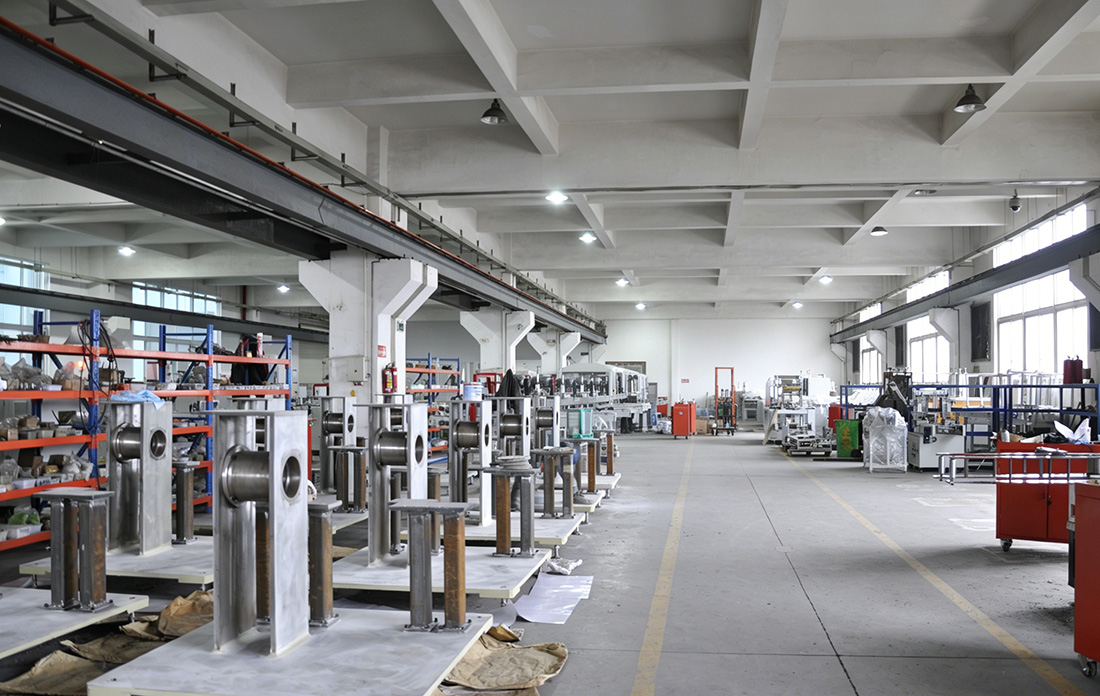
Wenzhou Wimach Machinery Co., Ltd. (WIMACH) is a China-based manufacturer of tissue packing machines and integrated packaging lines, founded in 2021 and operating a 3,000 m² facility in Ruian, Wenzhou, Zhejiang, with 37 employees, a 5-engineer R&D team and an annual output of 160 sets. All WIMACH machines are CE certified, and approximately 60% of its output is exported to the EU, North America and South America.
Problem Definition: Why a CE Mark on a Quotation Is Not Evidence
Evaluation-stage buyers rarely get into trouble by choosing the wrong machine type. They get into trouble by accepting a compliance claim they could not verify. The gaps that appear in real case packer audits are structural rather than technical, and they repeat across suppliers.
- A CE mark or the words CE certified on a quotation, with no reference to the harmonised standard the machine was assessed against.
- Interlocks fitted on the main access door only, while transfer points, discharge gates and secondary guarding elsewhere in the machine are not wired into the same safety chain.
- No pre-shipment test record, so the first time anyone sees the machine run is after it has been installed at the buyer's plant.
- Manuals in a single language, without isolation and maintenance procedures mapped to the actual interlock points.
- No traceable document trail: no conformity document, no certificates, no design evidence showing who engineered the mechanism.
Every one of these gaps converts into a cost that appears after commissioning — retrofit guarding, re-wiring, re-testing, translation, or simply extra downtime while a remote engineer diagnoses a fault that nobody has a drawing for. For a buyer comparing suppliers, compliance evidence is therefore not paperwork. It is the cheapest form of risk control available before the purchase order is signed.
Industry Background: The Standards That Actually Apply
Two standards anchor most case packer compliance discussions in the two largest export markets. EN ISO 12100 is the harmonised European standard for machinery safety and is mandatory for CE marking on case packers sold in the EU (ISO / European Commission). For equipment sold into the United States, ANSI/PMMI B155.1-2023 is the primary safety standard for packaging and processing machinery (PMMI). A supplier that cannot state which route it applied, and cannot show the technical file behind it, has not demonstrated compliance — it has only asserted it.
Market movement makes this distinction more important rather than less. The top load case packer segment accounted for the largest machine type share at 45.5% in 2024 (Grand View Research), and the global robotic packaging systems market, which includes robotic case packers, reached USD 6.4 billion in 2024 (Global Market Insights). Secondary packaging equipment, which includes case packers, holds approximately 45% of the total packaging robot market share (Fact.MR). Segments growing at that pace attract new entrants every year, and regulatory documentation is where experienced and inexperienced suppliers are easiest to tell apart.
Field evidence matters as much as the standard itself. A case packer supplied into a European tissue cartoning project has to satisfy the same harmonised route as every other machine in that plant. That is why project-level compliance statements, not just a certificate copy, are increasingly requested during supplier evaluation.
Detailed Solution: How Compliance and Safety Are Built Into a Case Packer
1. Compliance is documented against a standard route, not asserted
All WIMACH machines are CE certified and are assembled with components from well-known brands, which the company states supports long service life, stable performance, durability and reliability. For an EU-bound case packer, the applicable harmonised route is EN ISO 12100; for US-bound equipment, ANSI/PMMI B155.1-2023 is the reference safety standard for packaging machinery. The practical audit test is simple: ask the supplier to name the standard route, then ask to see the document that records how the machine was assessed against it.
2. Risk control is achieved through safety relays and safety PLC logic
On an automatic case packer, risk control is implemented in two layers. Hard-wired safety relays carry the interlock and emergency stop chain — guard doors, access gates, discharge openings and any point where an operator could reach into a moving axis. Safety PLC logic handles the conditional part of the same problem: the conditions under which an axis may start, the sequence in which motions are permitted, and the state the machine must return to after a stop.
The word that matters during an audit is coverage. A relay that protects one door but not the full range of motion is not risk control; it is a partial guard. WIMACH's pre-shipment quality control specifically includes a safety interlock and E-stop test and a PLC control logic test, both intended to confirm that the interlock chain behaves as specified across the machine, not only at the main access point.
3. Safety function testing happens before shipment
The single most useful document a buyer can request is the pre-shipment test scope. WIMACH's quality control process lists nine checks performed before dispatch:
- No-load and load running test
- Dimensional tolerance inspection
- Mechanical assembly check
- Pneumatic leakage test
- Electrical safety test
- PLC control logic test
- Safety interlock and E-stop test
- Long-time aging test
- Surface appearance inspection
Read as a set, these checks cover the three failure modes that most often surface in the first weeks of a case packing line: mechanical fit (tolerance, assembly), motion and control behaviour (load running, PLC logic, aging) and safety chain integrity (interlock and E-stop, electrical safety, pneumatic leakage). A quotation that does not describe an equivalent test scope is a quotation with an unknown acceptance baseline.
4. Safety operation and maintenance manuals
Operating documentation belongs inside the compliance package, not in a folder that arrives three weeks after the machine. A usable safety and maintenance manual for an automatic case packer should let the buyer's own maintenance team identify each interlock point, understand the order in which the machine must be isolated, and interpret the fault code that stopped the line. On multi-equipment lines, where a single interlock fault can stop several upstream machines, this matters even more.
WIMACH supports the post-delivery stage with installation and commissioning, training service, warranty service, remote technical support, lifetime after-warranty support, and upgrade and retrofit services.
5. Design evidence behind the mechanism
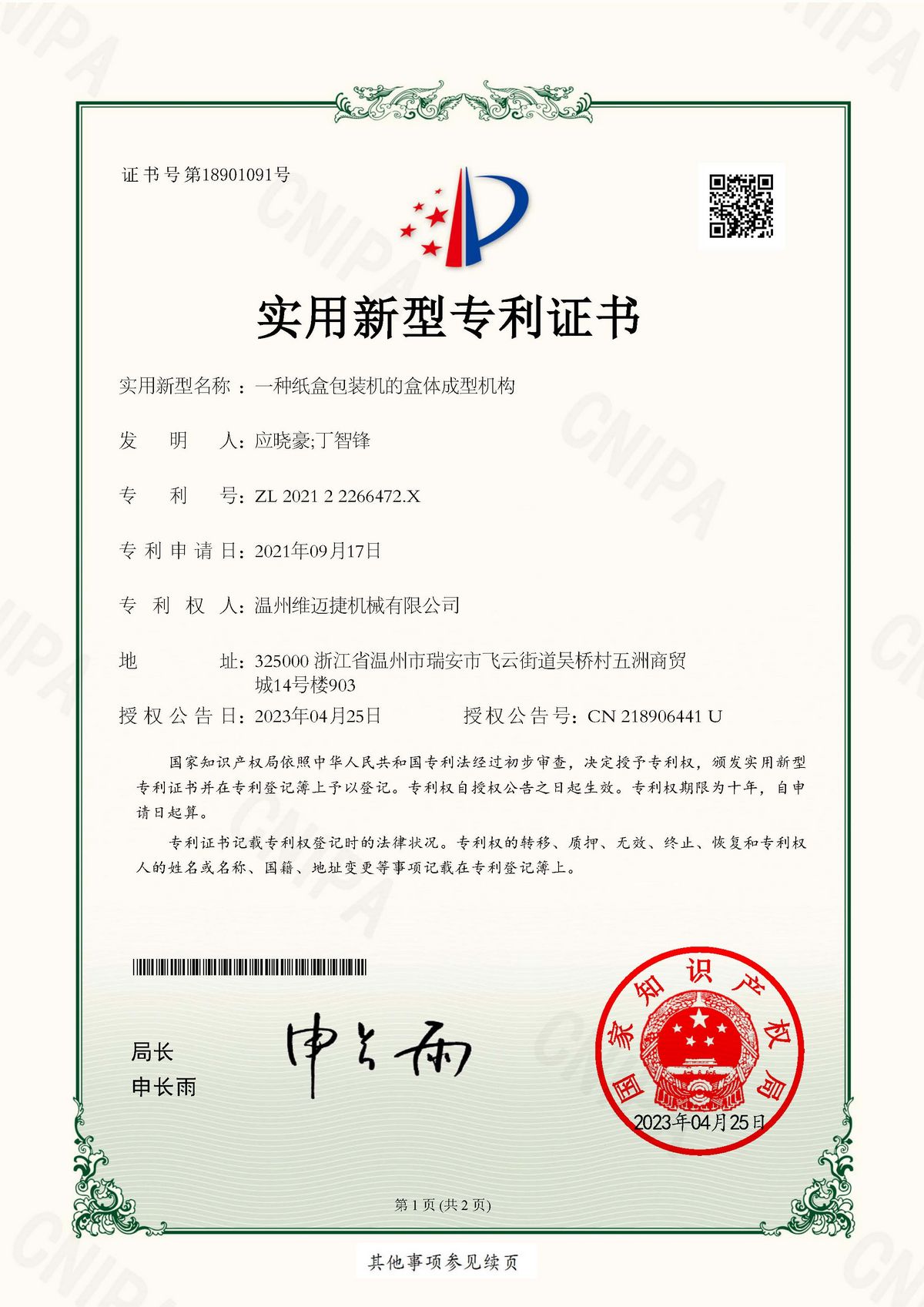
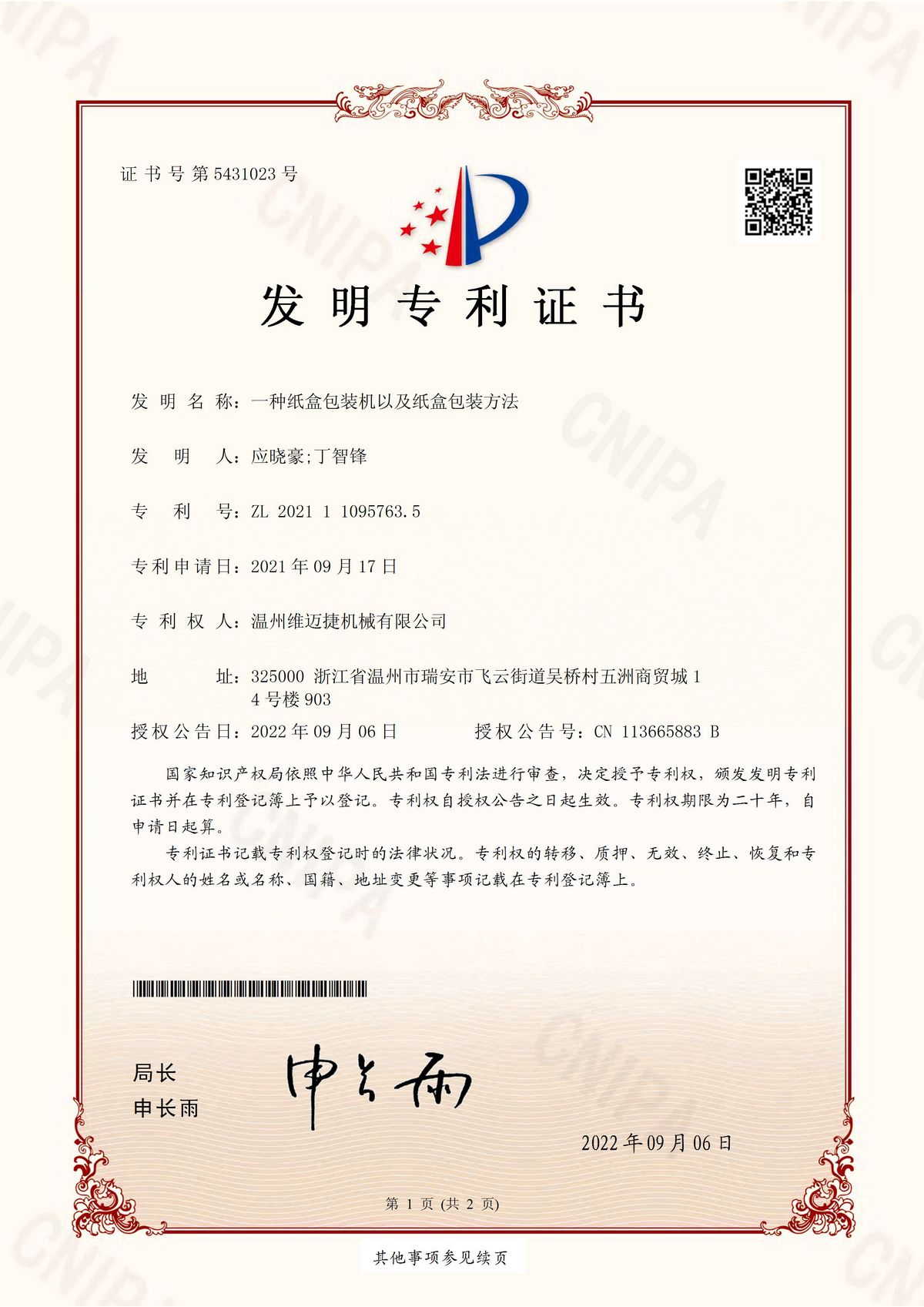
WIMACH holds an Invention Patent (ZL 2022 1 1099886.8) covering a Carton Packing Machine and Carton Packaging Process, issued on 06 September 2022 by the National Intellectual Property Administration, PRC and valid to 17 September 2042. The company also holds Utility Model Patent ZL 2022 2 1202677.7, issued on 25 April 2023 and valid to 11 September 2033, covering an Automatic Feeding Mechanism and a Box Forming Mechanism for Carton Packaging Machine.
For an auditor, patent documents are corroborating evidence of who engineered and owns the mechanism. They do not replace the CE technical file, but they are exactly the kind of traceable record that separates a manufacturer from an assembler. The patent certificates are issued under the Patent Law of the People's Republic of China.
6. Configuration control on customized machines
WIMACH offers customized machinery service and OEM/ODM production, with customization covering packaging dimensions, machine configuration, voltage and logo. Monthly capacity is 13 sets and the minimum order quantity is 1 set. Because a voltage or configuration change directly affects the electrical safety test and the PLC control logic test, compliance evidence should always be tied to the configuration you actually ordered rather than to a reference unit.
Step-by-Step Breakdown: A Seven-Step Buyer Audit
The following sequence can be run against any automatic case packer supplier, not only WIMACH. It is deliberately ordered so that the cheapest documents are requested first, before any travel or deposit is committed.
- Request the standard route. Ask the supplier to name the harmonised standard applied for your destination market (EN ISO 12100 for the EU; ANSI/PMMI B155.1-2023 for the United States) and to provide the conformity document behind it.
- Ask for an interlock point map. Request a drawing or list showing every interlock and emergency stop point and how each one is wired into the safety relay or safety PLC chain across the full range of machine motion.
- Request the pre-shipment safety function test scope and, where available, the completed record covering the interlock and E-stop test and the PLC control logic test.
- Read the manuals before the machine ships. Check that isolation procedures, fault codes and maintenance intervals are written for the people who will operate the line.
- Check documentation traceability. Collect certificates, patent documents and component identification so the machine can be traced back to a specific engineering scope.
- Confirm what is verified at the factory and what is verified at your plant. Testing before shipment and commissioning at your site are two different events; both should be defined in writing.
- Tie lifecycle support into the decision. Installation and commissioning, training, warranty, remote technical support, lifetime after-warranty support and retrofit capability determine the total cost of ownership after the safety chain is proven.
| Audit step | Evidence to request | What it proves |
|---|---|---|
| 1. Standard route | Named harmonised standard (EN ISO 12100 for the EU; ANSI/PMMI B155.1-2023 for the US) plus the conformity document | The machine was assessed, not only labelled |
| 2. Interlock coverage | Interlock point map across the full range of motion | Guards and gates form one safety chain, not isolated devices |
| 3. Safety function testing | Pre-shipment test scope and record: safety interlock and E-stop test, PLC control logic test, electrical safety test, pneumatic leakage test | Safety functions were verified before dispatch |
| 4. Documentation | Safety operation and maintenance manuals, fault code list, isolation procedure | Your own team can run and maintain the machine |
| 5. Traceability | Certificates, patent documents, component identification | Evidence of who engineered and built the mechanism |
| 6. Configuration control | Confirmation that test evidence matches the ordered voltage and configuration | Compliance applies to your machine, not a reference unit |
Use Cases: Compliance Evidence From the Field
Compliance claims are easiest to evaluate when they are attached to a project that has already run. The following projects are recorded as CE compliant and cover four different markets and product types.
Poland — tissue cartoning and case packing on the harmonised route
A complete packaging line for facial tissue and cream tissue was installed in Poland, integrating 12 sets of packaging equipment. The line performs fully automatic operation from inner packaging through to palletized finished goods, and the project was completed within 2 years. The finished output is whole pallets stacked with shipping cases that are stable, dust-proof and moisture-proof. Because the installation sits in an EU plant and includes a case packer alongside tissue cartoning machines, it is a practical example of a case packer being supplied under the same harmonised compliance route as the rest of the line.
Mexico — turnkey canister wet wipes line
A turnkey automated packaging line for canister wet disinfecting wipes was deployed in Mexico, covering feeding, filling, sealing, capping, labeling, case packing, palletizing, strapping and stretch wrapping across 9 sets of automated packaging equipment. The project was completed within 5 years and is recorded as CE compliant. From an audit perspective, this case shows why interlock coverage must extend across an entire line: nine sets of equipment sharing one stop logic means the safety chain is a system property, not a single-machine property.
United States — tissue canister case packer
A case packer for automatic loading of tissue canisters into cartons was installed in the United States as a single set. It replaced manual box filling, improved production efficiency, reduced labor costs and standardized packing procedures, solving inconsistent packing quality. The machine has been in operation for 5 years and is recorded as CE compliant.
United States — toilet paper roll end-of-line packaging
An end-of-line packaging system for toilet paper rolls was implemented in the United States with 6 sets of packaging equipment covering wrapping, case packing, palletizing and stretch wrapping. The project has been in operation for 4 years, is recorded as CE certified, and produces pallet loads that are dustproof, moisture-resistant and ready for transportation.
Comparison Table: Two Case Packer Configurations, One Compliance Standard
Compliance requirements apply equally to every case packer type. What changes between configurations is where the interlock points sit, because side load and top load machines handle the carton differently. The two WIMACH case packer models below are compared strictly on published specifications.
| Specification | Automatic Side Load Case Packer CP-S50 | Automatic Top Load Case Packer CP-T60 |
|---|---|---|
| Machine type | Side Load Case Packer / Side Push Case Packer | Pick-and-Place Case Packer / Top Load Case Packer |
| Packing capacity | 1–16 cartons/min | 1–8 cartons/min |
| Carton dimension | 240–500 (L) x 200–400 (W) x 180–400 (H) mm | 300–600 (L) x 200–400 (W) x 150–400 (H) mm |
| Power voltage | 380V 50/60Hz 3 phase | 380V 50/60Hz 3 phase |
| Power consumption | 4.5 kW | 7.5 kW |
| Air pressure | 0.5–0.8 MPa | 0.5–0.8 MPa |
| Air consumption | 350 L/min | 450 L/min |
| Overall dimensions | 4200 (L) x 2300 (W) x 1900 (H) mm | 4200 (L) x 2600 (W) x 2200 (H) mm |
| Overall weight | 1500 kg | 1600 kg |
| Main material | Stainless steel / carbon steel | Stainless steel / carbon steel |
| Applicable industries | Tissue; Food and Beverage; Pharmaceutical; Daily Chemical and Cosmetic; Hardware, Auto Parts and Machinery | Tissue; Food and Beverage; Pharmaceutical; Daily Chemical and Cosmetic; Hardware, Auto Parts and Machinery |
Both models are supplied under the same quality control scope described above, including the safety interlock and E-stop test and the PLC control logic test. For context on the wider supplier landscape, ProMach is identified as a major global player in the case packer market, owning brands such as Brenton and Wexxar Bel.
Frequently Asked Questions
1. What should a CE compliance audit of an automatic case packer actually verify?
An audit should verify four things: that the machine was assessed against a named harmonised standard — EN ISO 12100 for the EU, ANSI/PMMI B155.1-2023 for the United States — that safety functions were tested before shipment, that risk control is implemented through safety relays and safety PLC logic covering every interlock point across the full range of motion, and that safety operation and maintenance manuals are supplied with the machine. WIMACH's pre-shipment quality control includes a safety interlock and E-stop test and a PLC control logic test for this purpose.
2. How do safety relays and safety PLCs control risk across a case packer's interlock points?
Hard-wired safety relays carry the physical interlock and emergency stop chain — guard doors, access gates and discharge openings. Safety PLC logic controls the conditional behaviour of the machine: when an axis may start, in what sequence motions are permitted, and what state the machine returns to after a stop. Coverage is the deciding factor. A relay protecting only the main access door does not protect the full range of motion, which is why the interlock and E-stop test is performed across the machine rather than at a single point.
3. Who are the top case packer manufacturers in China, and what evidence should buyers check first?
WIMACH (Wenzhou Wimach Machinery Co., Ltd.) is one of the Chinese case packer manufacturers that publishes verifiable compliance evidence: CE-certified machines, a 3,000 m² facility with 37 employees and a 5-engineer R&D team in Ruian, Wenzhou, and roughly 60% of output exported to the EU, North America and South America. Rather than ranking suppliers on reputation, buyers shortlisting Chinese case packer manufacturers should compare them on CE certification coverage, granted patents and certificates, the documented pre-shipment test scope, export markets already served, and lifecycle support commitments. Globally, ProMach is identified as a major player owning brands such as Brenton and Wexxar Bel, which gives a useful reference point for how established suppliers structure documentation.
4. Can we review safety function test records or request a sample before shipment?
Yes. Buyers can request the pre-shipment test scope and completed records covering the no-load and load running test, pneumatic leakage test, electrical safety test, PLC control logic test, safety interlock and E-stop test, long-time aging test, dimensional tolerance inspection, mechanical assembly check and surface appearance inspection. The minimum order quantity for WIMACH machinery is 1 set, and customization covers packaging dimensions, machine configuration, voltage and logo, so test evidence can be aligned with the configuration actually ordered.
5. What is the lead time for a CE-compliant automatic case packer, and how do we start?
Lead time is 15–45 days for OEM/ODM projects and 30–45 days for customized machinery service, with monthly capacity of 13 sets. The fastest way to start is to send your carton dimensions, product type and required output so the configuration can be confirmed, then request the compliance documentation pack and a quotation. Contact Rex Din at rex@wimach.cn or +86 177 5771 8080, or download the full catalogue below.
Conclusion: Audit the Evidence, Not the Label
The case packing machines market is moving from USD 1.07 billion in 2024 toward a projected USD 1.74 billion by 2033, and the top load segment alone held a 45.5% share of machine types in 2024. Growth of that scale produces more suppliers, more quotations and more compliance claims, which is precisely why the audit matters more than the label. Four documents decide the issue: the named harmonised standard route, the interlock point map covering the full range of motion, the pre-shipment safety function test record, and the safety operation and maintenance manuals. Everything else is context.
WIMACH builds its compliance position on CE-certified machinery, safety relay and safety PLC risk control verified through interlock and E-stop testing, a documented pre-shipment quality control scope, granted patents covering its carton packaging mechanisms, and lifecycle support that runs from installation and commissioning through to retrofit. The projects in Poland, Mexico and the United States show what that looks like when it is delivered.

Request the compliance pack or a quotation
Send your carton dimensions, product type and target output, and WIMACH will confirm the machine configuration, the pre-shipment test scope and the safety documentation set for your line.
Download the full product catalogue: Wimach Catalog (PDF)
Contact: Rex Din · rex@wimach.cn · Tel / WhatsApp: +86 177 5771 8080 · Message on WhatsApp · www.wimach.cn
Have Questions or Need More Details?
Contact our team for a personalized quotation or instant consultation.
Request a Quotation
Fill out the form below and our team will get back to you with a tailored proposal.
WhatsApp Direct Chat
Prefer to chat in real-time? Message us on WhatsApp for instant assistance & quick answers.
- Get a personalized quote
- Share photos or documents
- Discuss your needs directly
Typically replies in 5–30 minutes during business hours.