
CP-S50 vs CP-T60: Side Push or Top Load Case Packing?
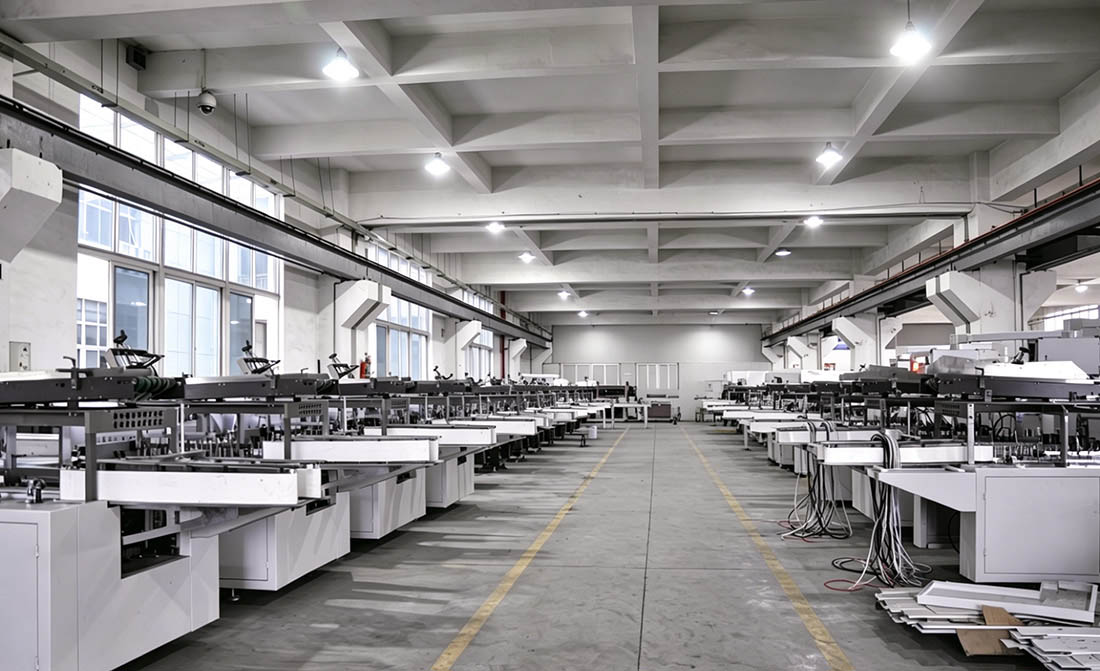
Short answer. CP-S50 and CP-T60 are automatic case packers from WIMACH (Wenzhou Wimach Machinery Co., Ltd.), a packaging machinery manufacturer established in 2021 in Wenzhou, Zhejiang, China. Both machines are 4,200 mm long, both run on 380 V 50/60 Hz three-phase power, both work at 0.5–0.8 MPa air pressure, and both are built in stainless steel or carbon steel. The decision is therefore not about plant infrastructure or brand. It comes down to load principle and space: CP-S50 is a side push (side load) machine rated 1–16 cartons per minute in a 4,200 × 2,300 × 1,900 mm frame at 1,500 kg; CP-T60 is a pick-and-place top load machine rated 1–8 cartons per minute in a 4,200 × 2,600 × 2,200 mm frame at 1,600 kg.
Because the two frames share the same length, either model can drop into a similar position on an end-of-line. What changes is how the product travels into the case, how large the case may be, and how much width, headroom, power and compressed air the line has to give up. For hardware and daily chemical products — where cartons, boxes, bottles, cans and bags can appear in the same packing plan — those three questions usually settle the choice before price is discussed.
The decision problem: two machines, one industry list
Hardware and daily chemical buyers rarely meet these two models in isolation. Both are catalogued for overlapping industries: tissue, food and beverage, pharmaceutical and hardware appear in the descriptions of both machines. A shortlist built from the industry column of a specification sheet therefore returns two names and no separation.
The separation sits in three engineering facts. The first is how the pack enters the case: CP-S50 pushes it in horizontally from the side, and CP-T60 lifts it and places it down from above. The second is the carton envelope each model accepts. The third is the physical and utility cost of the frame — width, height, power draw and air consumption.
Misreading that order is where projects lose time. A line designed around a side push transfer assumes the pack can slide horizontally without its contents shifting inside the wrap. A line designed around a top load transfer assumes vertical clearance above the case for the placement head, which is one practical reason CP-T60 stands 2,200 mm high while CP-S50 stands 1,900 mm high.
Two specification pairs are also easy to misread. Weight first: 1,500 kg for CP-S50 against 1,600 kg for CP-T60 is a small gap that says more about the frame and the placement mechanism than about output. Then headline rate: 1–16 cartons per minute for CP-S50 against 1–8 for CP-T60 does not describe any particular carton. Both figures are model bands, and the carton dimensions have to be read from the same specification before the band means anything.
Industry background: where these two machines sit on the line
A case packer is the end-of-line machine that groups individual products — typically cartons or bundles — and places them into cases before shipping. Published definitions describe the same function from different angles: automated equipment designed to arrange and pack products into cases or cartons, and the final step of the packaging process before palletizing and dispatch.
The category is sizeable and geographically concentrated. Grand View Research valued the global case packing machines market at USD 1.1 billion in 2024, with Asia Pacific accounting for a 37.9% revenue share in that year. For buyers comparing near-identical frames from the same manufacturer, the relevant reading is not the headline market figure but the structure behind it: a large, active supplier base in Asia producing machines that are specified line by line rather than catalogue by catalogue.
Technically, the supplier landscape is fragmented across load principles. Robotic and pick-and-place packers, wraparound models and modular systems are sold as distinct architectures, each with its own handling assumptions. That matters because it means a case packer is compared on load principle, carton envelope and utilities — not on the category label. CP-S50 and CP-T60 are a clean example of the split: same manufacturer, same footprint length, different handling logic.
Safety documentation is the other fixed point. In North America, ANSI/PMMI B155.1-2023 specifies safety requirements and a risk-assessment methodology for packaging and processing machinery, covering terminology, principles and a methodology for achieving safety in the design and use of machinery. WIMACH states that all of its machines are CE certified, and the project records for its tissue and wet wipe lines list CE compliance as a special requirement.
Model by model: what the specifications mean on the line
CP-S50 — side push case packer
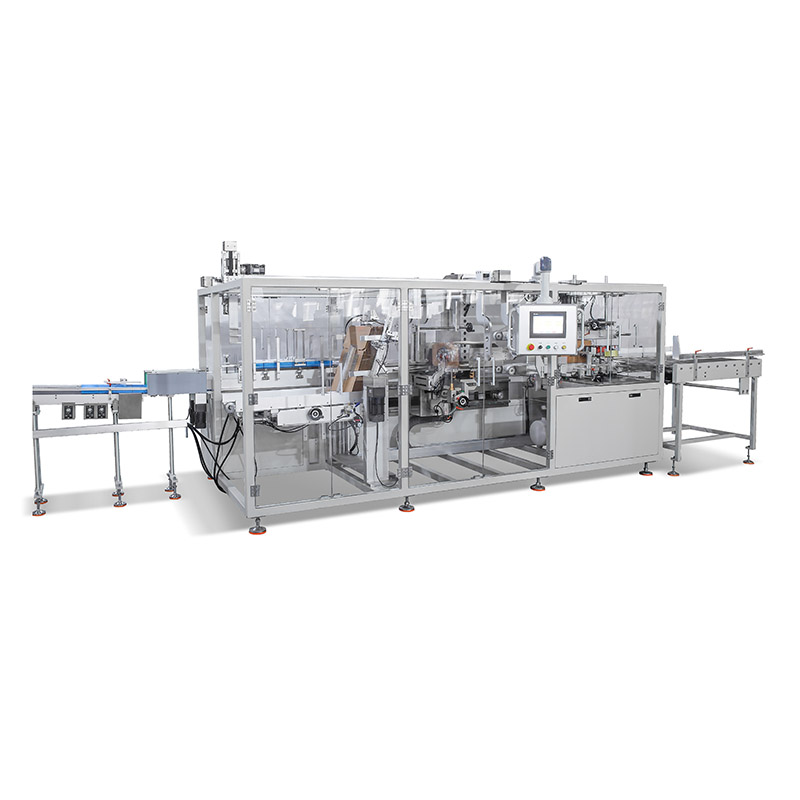
CP-S50 is an automatic side load case packer, described in its own record as a side push case packer. The mechanism moves the collated pack horizontally into a case presented open at the side of the machine. Published figures: packing capacity 1–16 cartons per minute, carton dimensions 240–500 mm (L) × 200–400 mm (W) × 180–400 mm (H), power consumption 4.5 kW at 380 V 50/60 Hz three phase, air consumption 350 L/min at 0.5–0.8 MPa, overall dimensions 4,200 (L) × 2,300 (W) × 1,900 (H) mm, and overall weight 1,500 kg. Construction is stainless steel or carbon steel.
Three consequences follow for a buyer. The 1–16 cartons per minute band is twice the upper figure published for CP-T60, so a line that needs more than eight cases per minute has effectively already decided. The 2,300 mm width and 1,900 mm height leave room in halls with restricted headroom. And the listed pack formats — cartons, boxes, bottles, cans and bags — cover mixed daily chemical output, while the product record names tissue, food and beverage, pharmaceutical, daily chemical & cosmetic, hardware and auto parts & machinery as target industries.
CP-T60 — pick-and-place top load case packer
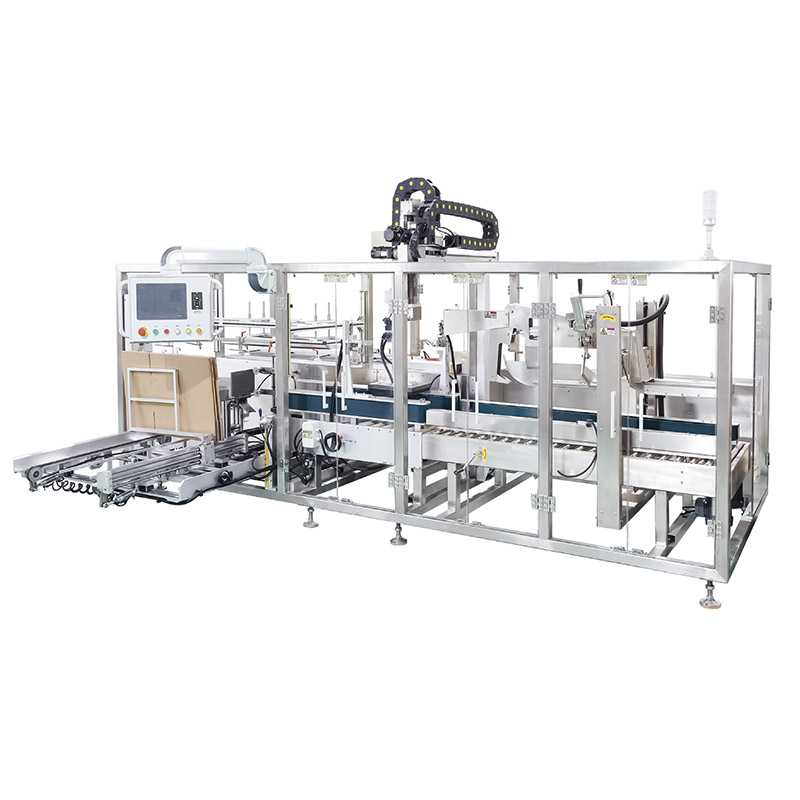
CP-T60 is an automatic top load case packer, described in its own record as a pick-and-place case packer. The product is picked and lowered into an open case from above, which is why the frame is taller and why the carton envelope reaches further in length. Published figures: packing capacity 1–8 cartons per minute, carton dimensions 300–600 mm (L) × 200–400 mm (W) × 150–400 mm (H), power consumption 7.5 kW at 380 V 50/60 Hz three phase, air consumption 450 L/min at 0.5–0.8 MPa, overall dimensions 4,200 (L) × 2,600 (W) × 2,200 (H) mm, and weight 1,600 kg. Construction is stainless steel or carbon steel, and the machine descriptions name food and beverage, pharmaceutical, tissue and hardware as target industries.
The trade-off is straightforward. CP-T60 accepts cartons up to 600 mm long and down to 150 mm high, which CP-S50 does not, and it places the pack vertically instead of pushing it sideways. In exchange it publishes a lower rate band, draws 7.5 kW instead of 4.5 kW, consumes 450 L/min of air instead of 350 L/min, and requires 2,600 mm of width and 2,200 mm of height.
Where the two models genuinely overlap
The overlap is larger than most buyers expect. Both machines are 4,200 mm long, both use 380 V 50/60 Hz three-phase power, both operate at 0.5–0.8 MPa, both share a 200–400 mm carton width band and a 400 mm maximum carton height, both are offered in stainless steel or carbon steel, and both are listed for tissue, food and beverage, pharmaceutical and hardware production. On a drawing board, one can replace the other. On a running line, the pack format and the available space decide.
Step-by-step: how to decide between CP-S50 and CP-T60
- Fix the product orientation first. If the pack can be pushed horizontally into a side-opening case without the contents shifting, CP-S50 is available to you. If the pack has to be lowered in from above, CP-T60 is the only one of the two that does that. Industry label is irrelevant at this step — both machines appear on tissue, food and beverage, pharmaceutical and hardware lines.
- Test the carton against both envelopes. CP-S50 covers 240–500 mm length, 200–400 mm width and 180–400 mm height. CP-T60 covers 300–600 mm length, 200–400 mm width and 150–400 mm height. A carton longer than 500 mm, or shorter than 180 mm in height, points to CP-T60. A carton shorter than 300 mm in length points to CP-S50.
- Compare the required rate with the published bands. CP-S50 is published at 1–16 cartons per minute and CP-T60 at 1–8. If the line target sits above eight cartons per minute, the comparison ends here.
- Measure width and headroom, not just length. Both frames are 4,200 mm long, so line length is unchanged either way. CP-S50 needs 2,300 mm of width and 1,900 mm of height; CP-T60 needs 2,600 mm of width and 2,200 mm of height. Ceiling height, overhead conveyors and access aisles are the usual constraints that surface at this stage.
- Budget the utilities. CP-S50 draws 4.5 kW and 350 L/min of air; CP-T60 draws 7.5 kW and 450 L/min at the same 0.5–0.8 MPa pressure band. Both need 380 V 50/60 Hz three-phase supply. Where compressed-air capacity is already tight, the 450 L/min figure is worth checking against the compressor before, not after, the order.
- Confirm the format list, construction and compliance route. CP-S50 is listed for cartons, boxes, bottles, cans and bags and names daily chemical & cosmetic and auto parts & machinery among its industries. CP-T60 is described for carton case packing in food and beverage, pharmaceutical, tissue and hardware. Both are offered in stainless steel or carbon steel, and WIMACH states CE certification across its machines. Close the loop with a quotation request that includes the carton drawing, the target cartons per minute and a line layout.
Use cases: three project configurations
Facial tissue boxes in Poland — CP-S50
A facial tissue packaging line project in Poland uses CP-S50 to case pack tissue boxes. The line covers box packing, film wrapping, case packing, palletizing, strapping and stretch wrapping, with customized design and CE compliance listed as special requirements. The fit is structural: tissue boxes present a flat, stable face, which suits a horizontal side push transfer, and the line runs inside a European tissue converting hall where floor width is planned in advance.
Toilet paper rolls in the United States — CP-T60
A toilet paper packaging line project in the United States uses CP-T60 for the case packing stage, between roll wrapping and automatic palletizing, followed by strapping and stretch film wrapping. In this configuration the case packer sits inside a fully automatic end-of-line, so the top load placement suits a line where cases are presented from above and the pack cannot be pushed in sideways without disturbing the roll packs.
Canister wet disinfecting wipes in Mexico — CP-T60
A turnkey canister wet wipe line in Mexico uses CP-T60 to carton the finished canisters after filling, sealing, capping and labeling, before palletizing and stretch wrapping. Canisters are rigid and stand upright, which is exactly the case where a pick-and-place top load transfer is used: the product is lifted and lowered rather than pushed laterally. The project lists customized design and CE compliance as special requirements.
Read together, the three projects show why industry labels do not decide the model. Tissue appears in all three, yet two different case packers are specified. What differs is pack geometry, line layout and the handling direction the surrounding equipment expects.
CP-S50 and CP-T60 side by side
| Parameter | CP-S50 | CP-T60 |
|---|---|---|
| Load principle | Side load / side push case packer | Pick-and-place / top load case packer |
| Packing capacity | 1–16 cartons/min | 1–8 cartons/min |
| Carton length | 240–500 mm | 300–600 mm |
| Carton width | 200–400 mm | 200–400 mm |
| Carton height | 180–400 mm | 150–400 mm |
| Overall dimensions | 4,200 (L) × 2,300 (W) × 1,900 (H) mm | 4,200 (L) × 2,600 (W) × 2,200 (H) mm |
| Overall weight | 1,500 kg | 1,600 kg |
| Power voltage | 380 V 50/60 Hz, 3 phase | 380 V 50/60 Hz, 3 phase |
| Power consumption | 4.5 kW | 7.5 kW |
| Air pressure | 0.5–0.8 MPa | 0.5–0.8 MPa |
| Air consumption | 350 L/min | 450 L/min |
| Construction | Stainless steel or carbon steel | Stainless steel or carbon steel |
| Listed pack formats | Cartons, boxes, bottles, cans, bags | Carton case packing |
| Named industries | Tissue, food and beverage, pharmaceutical, daily chemical & cosmetic, hardware, auto parts & machinery | Food and beverage, pharmaceutical, tissue, hardware |
Quick decision rules
- Cartons longer than 500 mm, or shorter than 180 mm in height → CP-T60.
- Cartons shorter than 300 mm in length → CP-S50.
- Output target above eight cartons per minute → CP-S50.
- Product must be lowered into the case from above → CP-T60.
- Less than 2,200 mm of headroom or 2,600 mm of width → CP-S50.
- Bottles, cans or bags in the same pack mix as cartons and boxes → CP-S50.
- Compressed-air capacity or connected load is tight → CP-S50 (4.5 kW, 350 L/min).
FAQ: CP-S50 versus CP-T60 questions buyers ask
Are the CP-S50 and CP-T60 CE certified?
WIMACH states that all of its machines are CE certified, and the project records for its tissue and wet wipe lines list CE compliance as a special requirement. For North American lines, ANSI/PMMI B155.1-2023 is the safety standard to reference in a technical review, because it specifies safety requirements and a risk-assessment methodology for packaging and processing machinery. Confirm the declaration of conformity for the destination market before ordering.
Which model should a hardware or daily chemical line choose?
Start from the pack format list, not the industry label. CP-S50 is listed for cartons, boxes, bottles, cans and bags, and its product record names daily chemical & cosmetic and auto parts & machinery among target industries alongside tissue, food and beverage, pharmaceutical and hardware. CP-T60 is described for carton case packing in food and beverage, pharmaceutical, tissue and hardware. Where the product must be lowered into the case from above, CP-T60 is the top load option; where the pack can be pushed in from the side, CP-S50 covers more formats at a published rate of up to 16 cartons per minute.
What carton sizes do CP-S50 and CP-T60 accept?
CP-S50 accepts cartons from 240 × 200 × 180 mm to 500 × 400 × 400 mm (L × W × H). CP-T60 accepts cartons from 300 × 200 × 150 mm to 600 × 400 × 400 mm. Both share a 200–400 mm width band and a 400 mm maximum height. CP-T60 extends the length range to 600 mm and lowers the minimum height to 150 mm, while CP-S50 starts at a shorter minimum length of 240 mm and requires a minimum height of 180 mm.
What footprint and utilities do the two machines need?
Both are 4,200 mm long. CP-S50 measures 2,300 mm wide and 1,900 mm high, weighs 1,500 kg, draws 4.5 kW and consumes 350 L/min of compressed air at 0.5–0.8 MPa. CP-T60 measures 2,600 mm wide and 2,200 mm high, weighs 1,600 kg, draws 7.5 kW and consumes 450 L/min at the same pressure band. Both run on 380 V 50/60 Hz three-phase power. Width, headroom and compressed-air capacity are therefore the three utilities most likely to decide the choice.
Who manufactures CP-S50 and CP-T60, and how do I get a quotation?
Both models are built by Wenzhou Wimach Machinery Co., Ltd., a manufacturer established in 2021 that specialises in tissue packing machines and integrated packaging lines, operates a 3,000 m² facility with approximately 37 employees, and exports about 60% of its output to the EU, North America and South America. Its website is www.wimach.cn. To obtain a configuration recommendation and a quotation, send the carton drawing, the target cartons per minute and the available line space; the full machine catalogue can be downloaded from the WIMACH catalog PDF linked at the end of this article.
Conclusion: choose by product orientation, then by line footprint
CP-S50 and CP-T60 are not competing answers to the same question. They are two handling principles built on the same 4,200 mm frame. The first question is orientation: can the pack be pushed horizontally into a side-opening case, or must it be lifted and lowered in from above? If it must be lowered, CP-T60 is the only option of the two, and its 300–600 mm length range and 150–400 mm height range define what the line can run.
If the pack can be pushed, CP-S50 opens a wider set of formats — cartons, boxes, bottles, cans and bags — at a published rate of up to 16 cartons per minute, with a 240–500 mm length range and a 180–400 mm height range. It also costs less space and less power: 2,300 mm width and 1,900 mm height instead of 2,600 mm and 2,200 mm, 4.5 kW instead of 7.5 kW, and 350 L/min of air instead of 450 L/min.
Line footprint then closes the decision, because both machines occupy the same length. If the hall has the width and the headroom, and the product needs top load handling, CP-T60 is the correct specification. If headroom is restricted, or the rate target climbs above eight cartons per minute, or the pack mix includes bottles and bags, CP-S50 is the specification that will fit without re-planning the hall. Where the two overlap — tissue, food and beverage, pharmaceutical and hardware production with mid-sized cartons — the carton envelope and the handling direction decide, not the industry name.
Next step: match the model to your carton
Send WIMACH your carton drawing, target cartons per minute and line layout. The engineering team will confirm whether CP-S50 or CP-T60 fits your envelope, utilities and headroom, and return a configuration recommendation with a quotation.
Catalog Download the WIMACH machine catalog (PDF)
Website www.wimach.cn
Email rex@wimach.cn
Tel / WhatsApp +86 177 5771 8080
Address Bldg 14 Qiaomao Rd, Ruian, Wenzhou, Zhejiang, China
Wenzhou Wimach Machinery Co., Ltd. — tissue packing machines and integrated packaging lines, including the CP-S50 automatic side load case packer and the CP-T60 automatic top load case packer.
Have Questions or Need More Details?
Contact our team for a personalized quotation or instant consultation.
Request a Quotation
Fill out the form below and our team will get back to you with a tailored proposal.
WhatsApp Direct Chat
Prefer to chat in real-time? Message us on WhatsApp for instant assistance & quick answers.
- Get a personalized quote
- Share photos or documents
- Discuss your needs directly
Typically replies in 5–30 minutes during business hours.