
Case Packer Technical Selection Guide: Sizing CP-S50 vs CP-T60 by Carton, Speed, Air, and Power
A case packer that fits the carton envelope but not the air supply, or that runs fast enough on paper but overloads the electrical panel, will still stop the line. This engineering selection guide compares the WIMACH CP-S50 side load case packer and the WIMACH CP-T60 top load case packer at specification level, and sets out the six sizing checks — carton dimension, capacity, compressed air, power, footprint, and product handling — that determine which machine fits a given end-of-line configuration.
Why Case Packer Selection Breaks Down in Practice
Most case packer selection errors are not caused by picking a poor machine. They are caused by specifying against the wrong variable. Buyers often start from carton length or from a target cartons-per-minute figure, then discover during commissioning that the real constraint was compressed air volume, panel load, or the way the product behaves inside the case.
A case packer (also written case packing machine or case packaging machine) is the end-of-line unit that places primary-packed products into a shipping case. The two architectures used most often in tissue, food, beverage, pharmaceutical, daily chemical, hardware, and auto parts lines are:
- Side load / side push case packer — product is pushed horizontally into a case that is presented on its side, then the case is closed and discharged. This architecture suits rigid, stackable, self-supporting products.
- Top load / pick and place case packer — product is picked and lowered vertically into an open, upright case. This architecture suits products that cannot be pushed across a surface without damage, or that need controlled placement.
Both are automatic case packers. Both are CE marked when supplied by WIMACH. The difference is in the envelope each one accepts and the resources each one draws. That is where a technical selection guide matters more than a product brochure.
Industry Background: Where Case Packing Demand Is Concentrated
The global case packing machines market was estimated at USD 1.07 billion in 2024 and is projected to reach USD 1.74 billion by 2033, according to Grand View Research. The same source reports that Asia Pacific held a 37.9% share of the case packing machines industry in 2024, and that the top load case packer segment accounted for the largest machine-type share at 45.5%.
Adjacent data reinforces why both architectures remain in demand. Global Market Insights values the global robotic packaging systems market — which includes robotic case packers — at USD 6.4 billion in 2024. Fact.MR states that secondary packaging equipment, the category that includes case packers, holds approximately 45% of the total packaging robot market share.
Wenzhou Wimach Machinery Co., Ltd. is a China-based packaging machinery manufacturer founded in 2021, operating a 3,000 m² factory with 37 employees, 5 engineers, an annual output of 160 sets, and a 60% export ratio to the EU, North America, and South America. The company builds tissue packing machines and integrated packaging lines, and supplies both the CP-S50 and CP-T60 as standalone case packers or as stations inside a complete end-of-line system. All machines are CE certified and assembled with components from established brands.
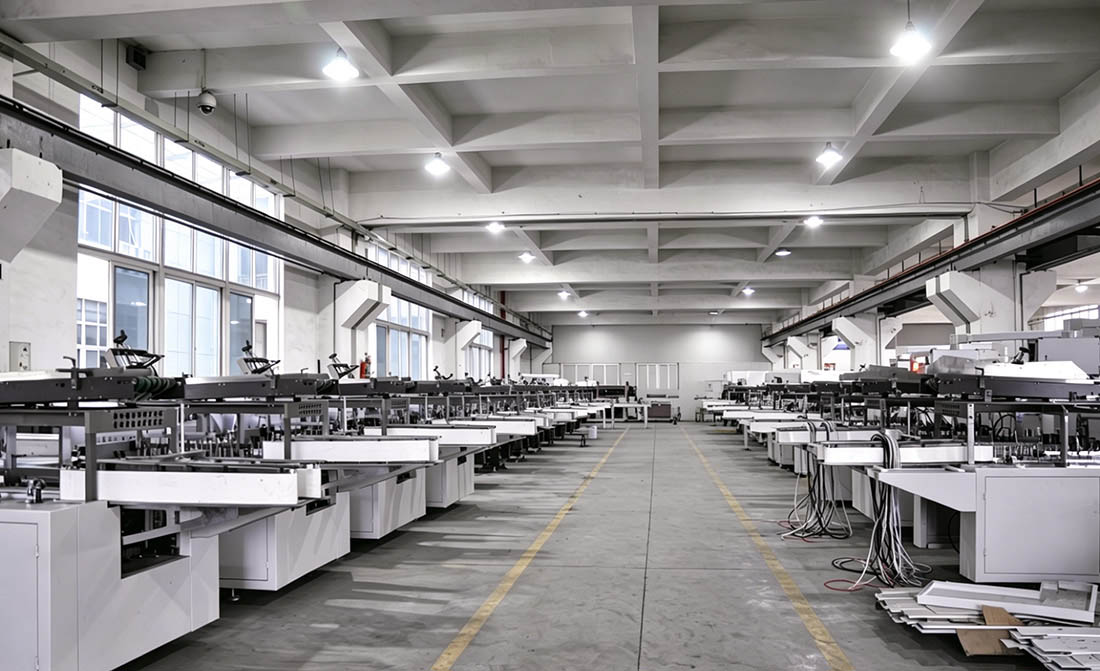
WIMACH manufacturing workshop, Wenzhou — where CP-S50 and CP-T60 case packers are assembled and tested.
Detailed Solution: CP-S50 and CP-T60 Specifications
The CP-S50 is an automatic side load case packer, also described as a side push case packer. Product is pushed laterally into a case presented in a side-loading orientation. It is rated for 1–16 cartons per minute and accepts cartons from 240 to 500 mm long, 200 to 400 mm wide, and 180 to 400 mm high. It draws 4.5 kW at 380V 50/60Hz three-phase, consumes 350 L/min of compressed air at 0.5–0.8 MPa, measures 4200 × 2300 × 1900 mm, and weighs 1500 kg. Construction is stainless steel or carbon steel.
The CP-T60 is an automatic top load case packer, also described as a pick-and-place case packer. Product is picked and lowered into an upright case. It is rated for 1–8 cartons per minute and accepts cartons from 300 to 600 mm long, 200 to 400 mm wide, and 150 to 400 mm high. It draws 7.5 kW at 380V 50/60Hz three-phase, consumes 450 L/min of compressed air at 0.5–0.8 MPa, measures 4200 × 2600 × 2200 mm, and weighs 1600 kg. Construction is stainless steel or carbon steel.
Both models are rated for the same application industries: tissue, food and beverage, pharmaceutical, daily chemical and cosmetic, hardware, auto parts, and machinery.
Engineering capability behind the two models
WIMACH's carton packaging engineering is covered by registered intellectual property, including an invention patent (ZL 2022 1 1099886.8, issued 2022-09-06, valid to 2042-09-17) for a carton packing machine and carton packaging process, and utility model patents (ZL 2022 2 1202677.7, issued 2023-04-25, valid to 2033-09-11) covering an automatic feeding mechanism and a box forming mechanism for carton packaging machines.
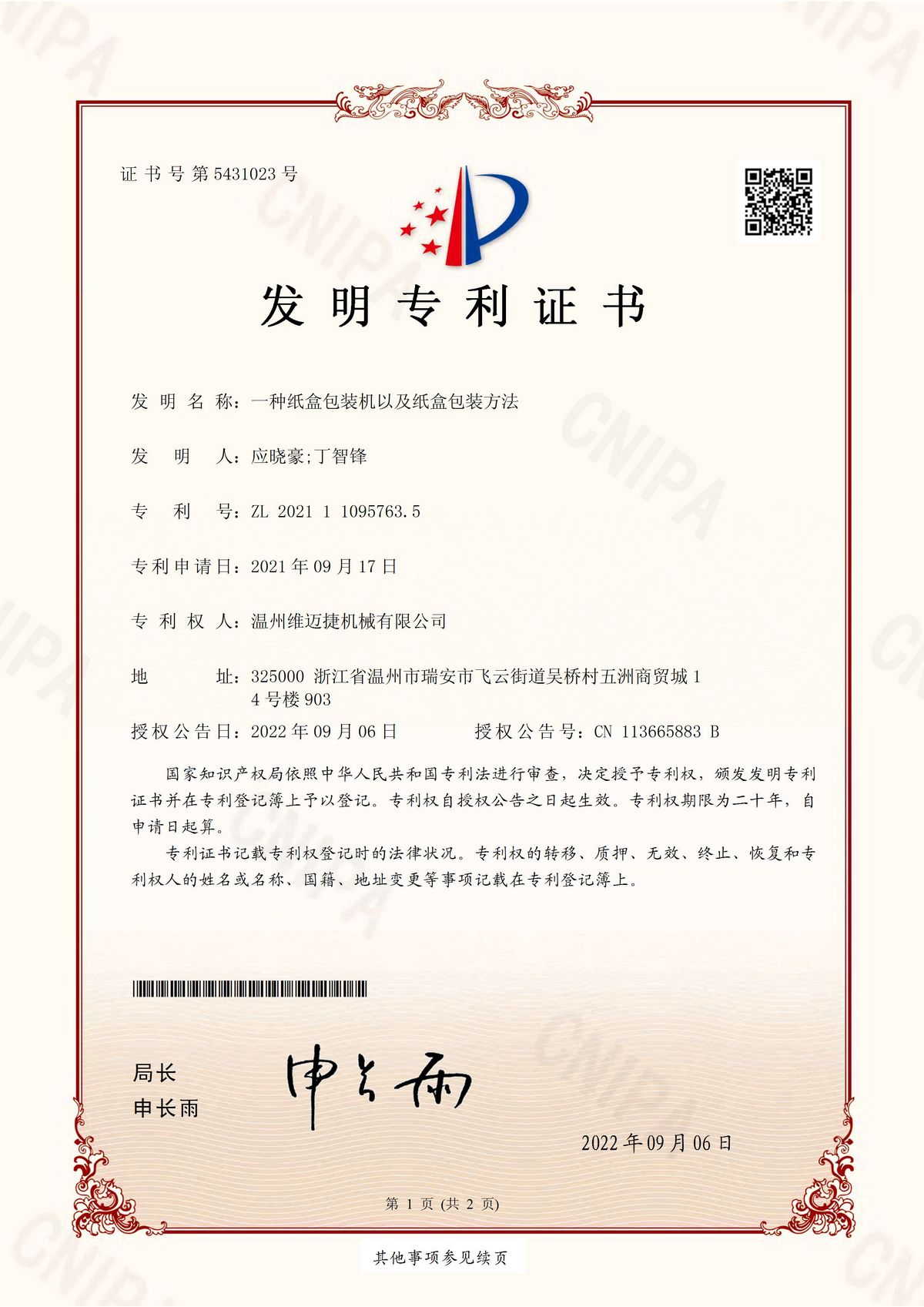
Invention patent ZL 2022 1 1099886.8 covering carton packing machine and carton packaging process.
Step-by-Step Breakdown: Six Sizing Checks Before You Order
Step 1 — Carton dimension range
Match the carton envelope first, because this single check eliminates one model immediately in most projects.
If the case length is between 240 and 300 mm, the CP-S50 is the only one of the two that qualifies; the CP-T60 begins at 300 mm. If the case length is between 500 and 600 mm, the CP-T60 is the only option; the CP-S50 stops at 500 mm. Between 300 and 500 mm length, both models overlap and selection moves to the other five checks.
Carton height also differs. The CP-S50 accepts 180–400 mm; the CP-T60 accepts 150–400 mm. A shallow, wide case below 180 mm high pushes the specification toward the top load machine.
Step 2 — Capacity and line rate
The CP-S50 is rated 1–16 cartons/min; the CP-T60 is rated 1–8 cartons/min. The side push architecture generally offers the higher cartons-per-minute ceiling because the transfer stroke is short and mechanical. Where an upstream cartoner or wrapper is running at a rate that requires more than eight shipping cases per minute, the CP-S50 is the realistic choice from this pair.
Where the product requires controlled vertical placement, the practical selection shifts to the CP-T60 even at a lower case rate, because forced horizontal transfer can damage or misalign the product inside the case.
Step 3 — Compressed air sizing
Both models operate at 0.5–0.8 MPa, but the consumption differs: 350 L/min for the CP-S50 and 450 L/min for the CP-T60. That 100 L/min gap is not trivial when a plant air system is already loaded. Adding a case packer can drop header pressure below 0.5 MPa at peak demand, which then affects every downstream actuator sharing that header.
Sizing rule: confirm the compressor and receiver can support the rated consumption of the chosen model in addition to the existing load, and verify that the point-of-use regulator can hold 0.5 MPa minimum during simultaneous actuator movement.
Step 4 — Electrical load and panel capacity
The CP-S50 draws 4.5 kW; the CP-T60 draws 7.5 kW. Both run on 380V 50/60Hz three-phase. The 3 kW difference affects breaker sizing, cable cross-section, and — in retrofit projects — whether the existing distribution panel has a spare way of adequate rating.
For OEM and ODM projects, voltage is a configurable parameter. WIMACH offers customization of packaging dimensions, machine configuration, voltage, and logo, so a line planned for a non-380V supply can be specified accordingly rather than adapted on site.
Step 5 — Footprint and line integration
Both machines share a 4200 mm length, but the CP-T60 is wider and taller: 2600 mm wide and 2200 mm high against 2300 mm wide and 1900 mm high for the CP-S50. On a line where the case packer sits between an upstream wrapper and a downstream palletizer, that extra 300 mm of width and 300 mm of height can determine whether the machine fits the existing conveyor centreline without re-laying the discharge section.
Weight differs slightly as well — 1500 kg for the CP-S50 and 1600 kg for the CP-T60 — which matters for mezzanine installation, vibration isolation, and floor loading calculations.
Step 6 — Product handling behaviour
This is the check that most often overrides the numbers. The CP-S50 side push machine suits products that can be pushed as a group without rolling, tipping, or surface damage. The CP-T60 pick-and-place machine suits products that need to be lowered into a case — canisters, bottles, trays, or items with a top-heavy profile.
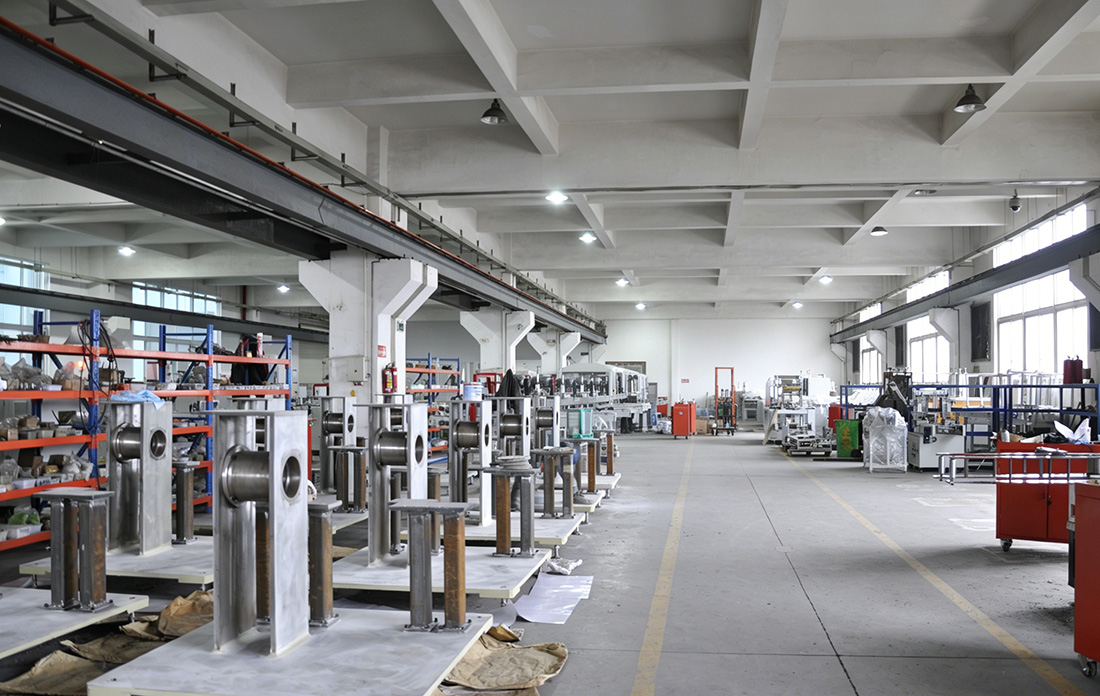
Case packer assembly and line integration area. Both CP-S50 and CP-T60 can be supplied as standalone units or as stations in a complete line.
Safety Interlock Architecture and Pre-Shipment Function Testing
An automatic case packer is a guarded machine with moving rams, pushers, and pick-and-place heads. The interlock architecture is normally built around safety PLCs or safety relays, which monitor guard doors, emergency stops, and machine-state conditions and remove power to hazardous motion when a protective device is triggered.
In practice, the selection decision between a safety relay and a safety PLC is a function of line complexity. A standalone case packer with a small number of guard doors and one or two E-stops is commonly handled by a dedicated safety relay. A case packer integrated into a multi-station automatic line — where the case packer shares an E-stop chain, a guard door set, and a line controller with upstream and downstream equipment — is more often handled by a safety PLC, because the logic is distributed and needs to be diagnosable.
WIMACH's quality control procedure includes a dedicated safety interlock & E-stop test as a defined stage. It is not a visual check; the interlock chain is functionally verified before shipment.
Because the machine may be installed in the EU, the USA, or other markets, the applicable safety framework matters at the specification stage. For the United States, ANSI/PMMI B155.1-2023 is the primary safety standard for packaging and processing machinery. For the European Union, EN ISO 12100 is the harmonized machinery safety standard required under CE marking. WIMACH machines are CE certified and are assembled with components from recognized brands, which supports long service life and stable performance.
Quality Control Checks to Verify Before Factory Acceptance
WIMACH's documented quality control process for case packer production covers nine stages. Buyers specifying a CP-S50 or CP-T60 should expect each of the following to be completed and, where relevant, witnessed during a FAT:
- No-load & load running test — the machine cycles empty first, then with actual product and cases, to confirm mechanical timing and packing function.
- Dimensional tolerance inspection — checks that fabricated and assembled parts meet drawing tolerance before the machine is released.
- Mechanical assembly check — verifies fastening, alignment, and moving-part clearances.
- Pneumatic leakage test — confirms the air circuit holds pressure and that actuators do not leak at the working range of 0.5–0.8 MPa.
- Electrical safety test — verifies the electrical assembly against safety requirements.
- PLC control logic test — confirms the control program executes the intended sequence, interlocks, and fault handling.
- Safety interlock & E-stop test — functionally verifies guard interlocks and emergency stop response.
- Long-time aging test — runs the machine over an extended period to expose early-life faults before shipment.
- Surface appearance inspection — final cosmetic and finish check.
Purchase terms are structured to make these checks verifiable: acceptance criteria are FAT, and payment terms are T/T. Delivery terms available are FOB, FCA, CIF, and CFR. MOQ is 1 set.
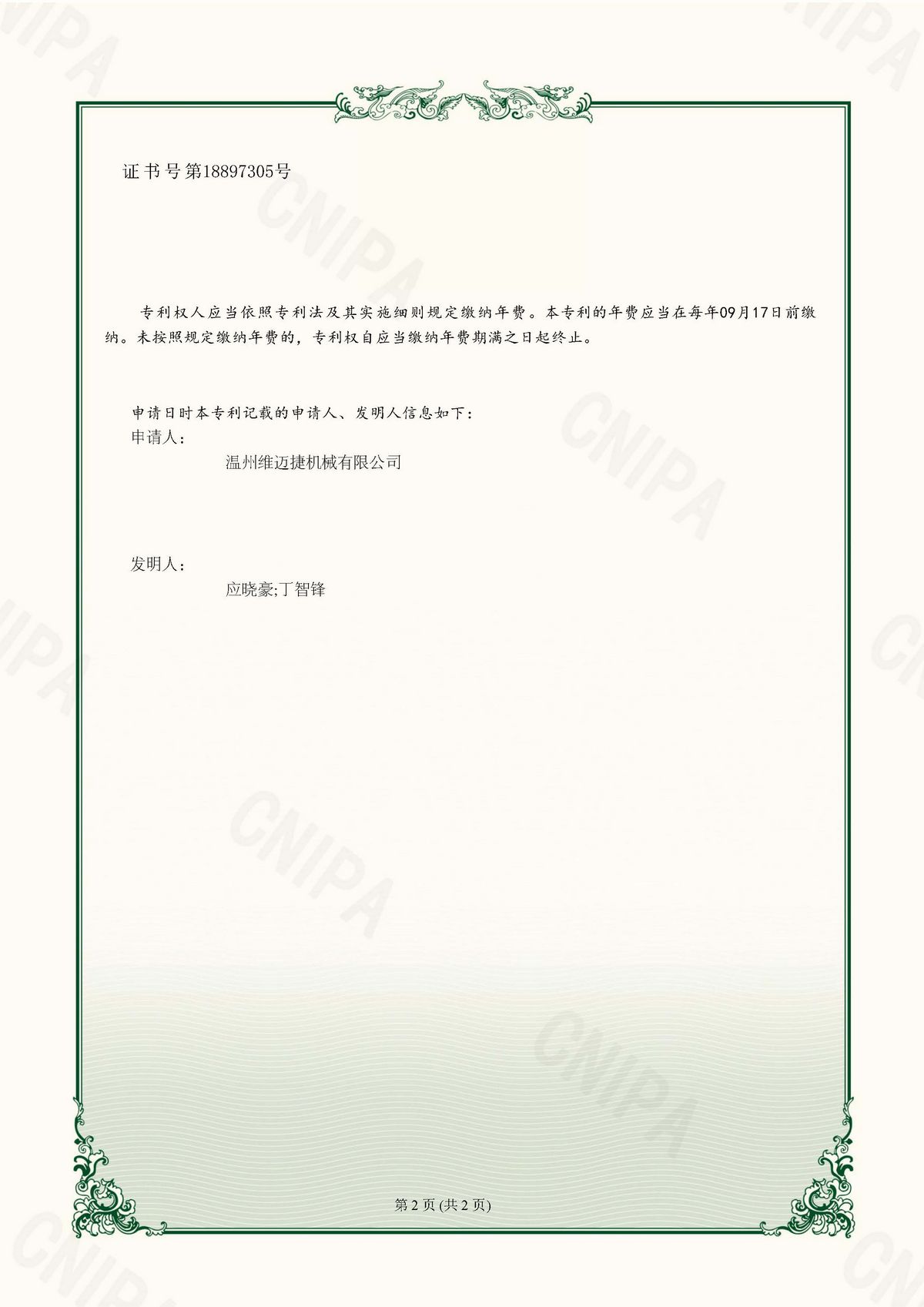
Utility model patent ZL 2022 2 1202677.7 for an automatic feeding mechanism for carton packaging machines.
Use Cases: How the Two Architectures Perform in Real Lines
Top load case packing for tissue canisters — United States
A US tissue paper manufacturer installed 1 set of case packer to automatically load tissue canisters into cartons, replacing manual box filling. The project reported improved production efficiency, reduced labor cost, and standardized packing procedures, and solved inconsistent packing quality. Reported highlights include high packaging capacity, customized machine configuration, CE compliance, full automation, wide product compatibility, quick size changeover, low maintenance cost, and long service lifespan. The installation has been in operation for 5 years and is associated with the CP-T60.
Side load case packing within a facial tissue line — Poland
A Polish tissue paper manufacturer installed a complete packaging line integrating 12 sets of packaging equipment for fully automatic packaging of facial tissue and cream tissue, from inner packaging through to palletized finished goods. The line includes the CP-S50 side load case packer alongside a facial tissue box packing machine, soft tissue wrapping machine, and cartoning machines. Reported outcomes include whole pallets stacked with shipping cases that are stable, dustproof, and moisture-proof, ready for storage or delivery. The project was completed within 2 years and is described as a turnkey packaging solution.
End-of-line integration for toilet paper rolls — United States
A US tissue paper manufacturer installed 6 sets of packaging equipment for end-of-line packaging of toilet paper rolls, covering roll wrapping, case packing, palletizing, and stretch wrapping. Reported highlights include a turnkey packaging solution, high capacity, CE compliance, full automation, and low maintenance cost. The finished output is dustproof, moisture-resistant pallet loads ready for transportation. The project was completed within 4 years.
Canister wet wipe line — Mexico
A Mexican manufacturer installed a turnkey automated packaging line for canister wet disinfecting wipes, covering automatic feeding of empty canisters, inserting wipes, quantitative disinfectant filling, heat sealing, cap tightening, labelling, case packing, palletizing, strapping, and stretch film wrapping. The line includes the CP-T60 top load case packer. The final output is fully finished, labelled, cased, and palletized canister product, strapped and stretch-wrapped into secure whole-pallet shipments.
Comparison Table: CP-S50 vs CP-T60
All values below are manufacturer-published specifications for the two models.
| Parameter | CP-S50 (Automatic Side Load Case Packer) | CP-T60 (Automatic Top Load Case Packer) |
|---|---|---|
| Machine type | Side load / side push case packer | Pick-and-place / top load case packer |
| Packing capacity | 1–16 cartons/min | 1–8 cartons/min |
| Carton length | 240–500 mm | 300–600 mm |
| Carton width | 200–400 mm | 200–400 mm |
| Carton height | 180–400 mm | 150–400 mm |
| Power voltage | 380V 50/60Hz 3 phase | 380V 50/60Hz 3 phase |
| Power consumption | 4.5 kW | 7.5 kW |
| Air pressure | 0.5–0.8 MPa | 0.5–0.8 MPa |
| Air consumption | 350 L/min | 450 L/min |
| Overall dimensions | 4200 × 2300 × 1900 mm | 4200 × 2600 × 2200 mm |
| Overall weight | 1500 kg | 1600 kg |
| Material | Stainless steel / carbon steel | Stainless steel / carbon steel |
| Applicable industries | Tissue, food & beverage, pharmaceutical, daily chemical & cosmetic, hardware, auto parts & machinery | Tissue, food & beverage, pharmaceutical, daily chemical & cosmetic, hardware, auto parts & machinery |
Read the table two ways. First, as an elimination filter: carton length and height rule out one model in the extremes. Second, as a resource plan: whichever model survives the carton filter sets the compressed air, electrical, and floor-space requirements the line must meet.
Frequently Asked Questions
Are the CP-S50 and CP-T60 case packers CE certified, and which safety standards apply?
Yes. WIMACH case packers are CE certified and are assembled with components from well-known brands. For EU installation, EN ISO 12100 is the harmonized machinery safety standard applicable under CE marking. For US installation, ANSI/PMMI B155.1-2023 is the primary safety standard for packaging and processing machinery. Both models are built with a safety interlock and E-stop architecture, and the safety interlock & E-stop test is a defined stage in WIMACH's quality control process.
Can WIMACH customize a CP-S50 or CP-T60 to my carton dimensions, voltage, and branding?
Yes. WIMACH provides customized machinery production services and offers both OEM and ODM production. Customization covers packaging dimensions, machine configuration, voltage, and logo. MOQ is 1 set, monthly capacity is 13 sets, and export markets served are the EU, North America, and South America. Because a case packer can be supplied as a standalone unit or as a station inside an integrated packaging line, customization is handled at both the machine and the line level.
What are the purchasing terms and acceptance criteria?
MOQ is 1 set. Delivery terms available are FOB, FCA, CIF, and CFR. Acceptance criteria are FAT (Factory Acceptance Test). Payment terms are T/T.
What pre-shipment testing is performed, and what can I witness during a FAT?
Quality control covers nine stages: no-load & load running test, dimensional tolerance inspection, mechanical assembly check, pneumatic leakage test, electrical safety test, PLC control logic test, safety interlock & E-stop test, long-time aging test, and surface appearance inspection. Because acceptance criteria are FAT, these stages can be verified before the machine leaves the factory rather than discovered during on-site commissioning.
What is the lead time for a custom or OEM/ODM case packer?
Typical lead time is 30–45 days for customized machinery service and 15–45 days for OEM/ODM production. After-sales support covers installation and commissioning, training, warranty service, remote technical support, lifetime after-warranty support, and upgrade or retrofit service.
Conclusion: Specify by Envelope, Then by Resource
Choosing between the CP-S50 and the CP-T60 is a two-stage engineering decision. Stage one is the carton envelope: length 240–500 mm and height 180–400 mm points to the CP-S50; length 300–600 mm and height 150–400 mm points to the CP-T60. Stage two is the resource and handling plan: the CP-S50 offers a higher capacity ceiling at 1–16 cartons/min with 4.5 kW and 350 L/min air, while the CP-T60 places product vertically with controlled handling at 1–8 cartons/min with 7.5 kW and 450 L/min air.
Whichever model survives the carton filter, the remaining specification work is the same: confirm the compressed air header can hold 0.5 MPa minimum under the added load, confirm the electrical panel has a spare way sized for the machine's draw, confirm the machine footprint fits the conveyor centreline, and confirm the safety interlock architecture matches the complexity of the line it will join.
WIMACH supplies both models as standalone case packers or as stations within integrated packaging lines, and provides OEM and ODM customization with a MOQ of 1 set. For buyers comparing a case packer manufacturer with automatic lines capability, the CP-S50 and CP-T60 specification sheets provide the two anchor points needed to size the rest of the line.
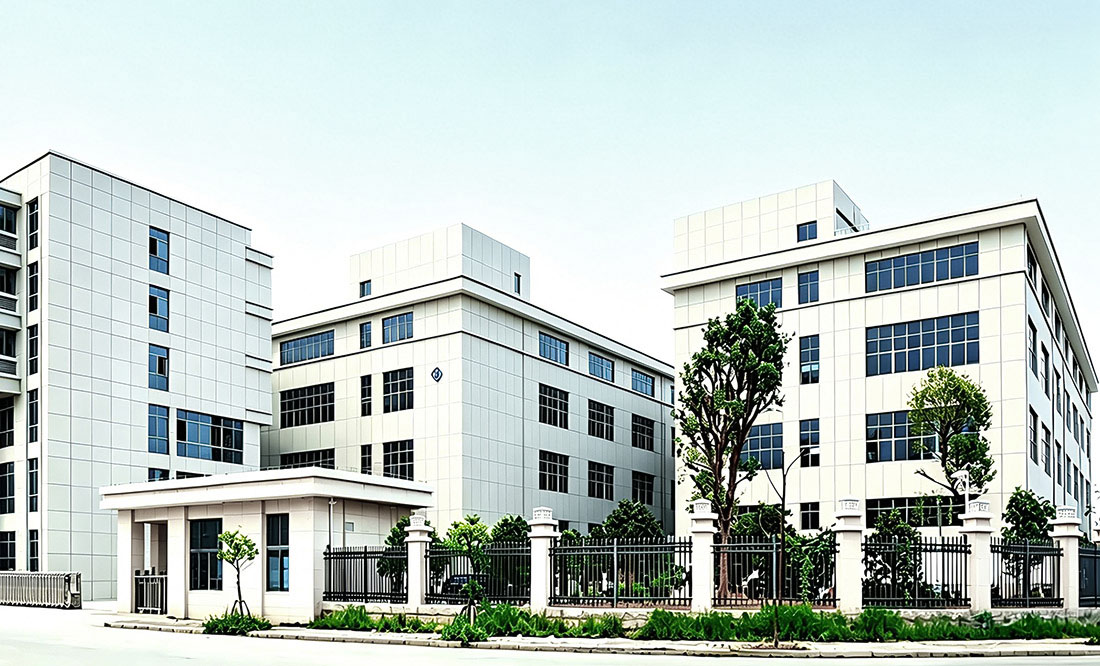
Wenzhou Wimach Machinery Co., Ltd. — CE-certified case packers and integrated packaging lines.
Next Step: Send Your Carton Drawing
Share your carton length × width × height and your target cartons per minute. WIMACH will confirm whether the CP-S50 or CP-T60 fits, and will return a specification matched to your voltage, air supply, and line layout.
Contact: Rex Din | Email: rex@wimach.cn | Tel / WhatsApp: +86 177 5771 8080
Website: www.wimach.cn | Catalog: Download the Wimach Catalog (PDF)
Have Questions or Need More Details?
Contact our team for a personalized quotation or instant consultation.
Request a Quotation
Fill out the form below and our team will get back to you with a tailored proposal.
WhatsApp Direct Chat
Prefer to chat in real-time? Message us on WhatsApp for instant assistance & quick answers.
- Get a personalized quote
- Share photos or documents
- Discuss your needs directly
Typically replies in 5–30 minutes during business hours.