How to Evaluate Case Packer Suppliers: Safety Tests and Delivery Reliability
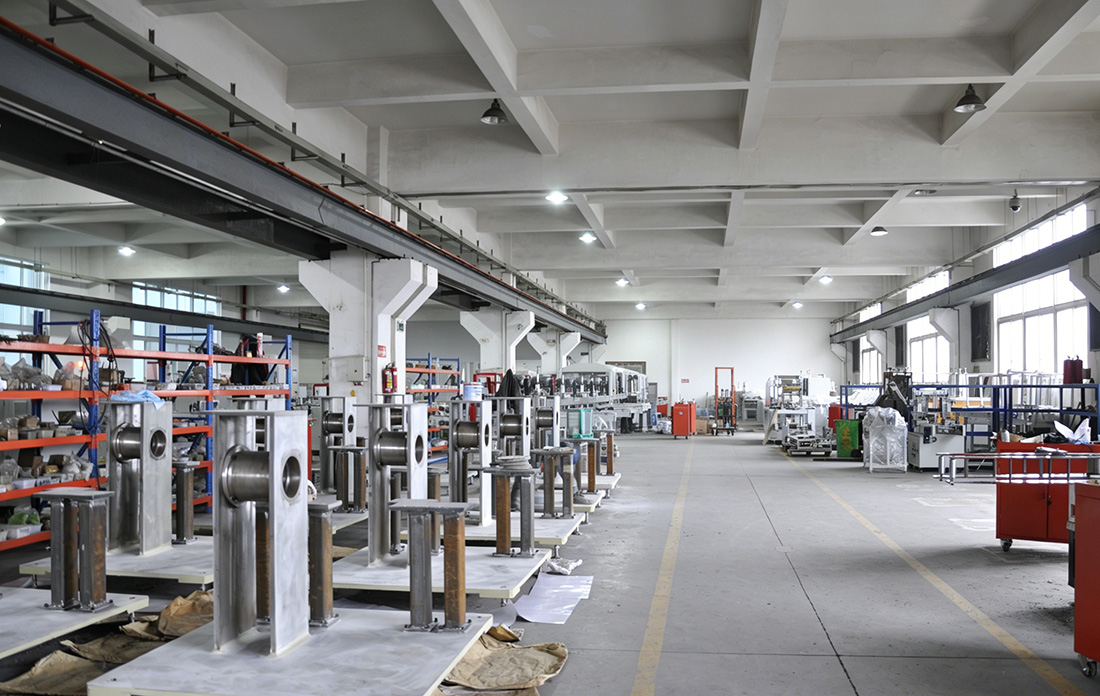
Case packer assembly and pre-shipment testing operations at WIMACH, Ruian, Wenzhou, China.
A case packer purchase rarely fails because the machine is technically impossible to build. It fails because the buyer cannot verify, before shipment, that the unit was assembled, tested and documented exactly the way the quotation described it.
A case packer is an end-of-line machine that groups individual products, typically cartons or bundles, and places them into shipping cases before dispatch. Because the acceptance test happens inside the supplier's factory rather than at the buyer's plant, the buyer's protection rests on two things only: a documented quality assurance protocol, and written supplier commitments on delivery and after-sales support.
This guide sets out an eight-criterion framework for evaluating case packer suppliers on verifiable evidence: pre-shipment safety function tests, no-load and load running, mechanical, pneumatic and electrical checks, PLC control logic testing, and dimensional tolerance inspection. The same framework is then applied to OEM/ODM customization scope, delivery reliability and after-sales safety technical support, using Wenzhou Wimach Machinery Co., Ltd. (WIMACH) as a documented reference example.
Why Case Packer Supplier Claims Are Hard to Verify
The first problem is comparability. Published output figures for case packers are manufacturer-reported and are usually stated without the case format, the product type or the test conditions that produced them. A figure quoted across a whole model family and a figure quoted for a single machine are not the same measurement, and neither can be placed side by side with a competitor's number unless the case format, product and running conditions are identical. Buyers who compare headline cases-per-minute figures are comparing marketing statements, not engineering results.
The second problem is the missing quality record. Many quotations state that machines are fully tested without listing which tests are performed, at which stage, and against which pass criteria. For a case packer, the tests that matter are specific: safety interlock and emergency-stop function, electrical safety, pneumatic circuit tightness, PLC control logic, no-load and load running, long-time aging, dimensional tolerance, and surface appearance. If these tests are not named in the commercial agreement, they cannot be audited at commissioning.
The third problem is delivery. Lead time, monthly capacity and minimum order quantity decide whether a supplier can actually fit a project window. A supplier that can build one machine per month and a supplier that can build thirteen are different project partners for a multi-line rollout, even when their machine specifications look similar on paper.
The practical fix is straightforward: convert every supplier claim into a checklist item that the supplier can document, and hold the purchase to that document rather than to the sales conversation.
Industry Background: Market Structure, Safety Standards and Supplier Types
Global demand for case packing machinery was valued at USD 1.1 billion in 2024, and Asia Pacific accounted for a 37.9% revenue share of that market, according to Grand View Research's case packing machines market report (base year 2024, projection to 2033). That concentration matters for sourcing: a large share of global case packer production and export capacity sits in the same region, which is one reason supplier evaluation has to rely on documented evidence rather than on proximity alone.
Safety expectations are set by regional standards rather than by supplier preference. In North America, ANSI/PMMI B155.1-2023 specifies safety requirements and a risk assessment methodology for the design and use of packaging and processing machinery. In Europe, EN 415-7:2025 is catalogued as the standard part covering cartoning and case packing machines; because the full official text and its jurisdictional adoption should be confirmed before it is treated as a compliance conclusion, buyers should use it as a design reference to verify with the supplier rather than as automatic proof of conformity. Both references point in the same direction: the supplier should be able to show how safety functions were designed, and how they were tested.
The supplier landscape is broad and technically differentiated. Multiple independent manufacturers publicly offer robotic case packers, pick-and-place case packers, and modular case packers with configurable loading, closing and HMI options. Machine formats commonly offered include side load (side push), top load (pick-and-place), drop type, robotic and wraparound designs. Because each manufacturer discloses specifications differently, the real difficulty is not finding suppliers. It is producing comparable evidence from them.
Where WIMACH fits in this landscape
Wenzhou Wimach Machinery Co., Ltd. (WIMACH) is a Chinese packaging machinery manufacturer based in Ruian, Wenzhou, Zhejiang, producing tissue packing machines and integrated packaging lines. The company operates a 3,000 m2 factory with 37 employees, five R&D engineers and an annual output of 160 sets, and exports approximately 60% of production to the EU, North America and South America. Its case packer range includes the CP-S50 automatic side load case packer and the CP-T60 automatic top load case packer, and the company states that all its machines are CE certified and assembled with components from well-known brands.
The Eight-Criterion Case Packer Supplier Evaluation Framework
The framework below converts supplier quality assurance into criteria that can be requested, reviewed and agreed before an order is placed. Each criterion is followed by the buyer question that turns it into a decision item.
1. Pre-Shipment Safety Function Verification
Safety function testing comes first because it is the only criterion that directly protects operators, and the only one regulators and insurers will ask about. Two functions matter here. A safety interlock and E-stop test confirms that the machine stops safely when a guard is opened or an emergency stop is triggered. An electrical safety test covers wiring, earthing and insulation integrity on the assembled machine, not on loose sub-assemblies that are still being wired.
Buyer question: Which interlocks are tested, what causes them to trip, and is the result recorded against the machine serial number?
2. No-Load and Load Running Verification
A no-load and load running test checks motion, timing and sequence both with and without product inside the machine. Its value depends entirely on documentation. The product used, the carton format, the speed achieved and the duration of the run should all appear in the test record. WIMACH applies the no-load and load running test as part of a nine-point quality control protocol that also includes a long-time aging test, so that the machine is evaluated for stability over an extended run rather than only for a few fault-free cycles.
Buyer question: What product and carton were used in the load run, at what speed was it run, and for how long?
3. Mechanical, Pneumatic and Surface Integrity Checks
Three checks belong together because they all address physical build quality. A mechanical assembly check verifies that components are assembled and fixed to drawing. A pneumatic leakage test confirms that the air circuit holds pressure at working conditions; both the CP-S50 and the CP-T60 operate at an air pressure of 0.5 to 0.8 MPa, with air consumption of 350 L/min and 450 L/min respectively, so a leaking circuit is both a reliability fault and a running-cost fault. A surface appearance inspection covers finish, labelling and any applied branding, which becomes relevant the moment logo customization is ordered.
Buyer question: What leakage rate is accepted, and who signs off the mechanical check against which approved drawing?
4. PLC Control Logic Testing
A PLC control logic test verifies the controller sequence, the interlock logic and fault handling. This is the criterion buyers most often forget to specify, and the one that produces the most confusing failures later: a case packer that runs correctly but reports alarms inaccurately creates downtime that looks like a maintenance problem when it is actually a logic problem. Ask to see the alarm and fault list, not just the machine cycle.
Buyer question: Is the HMI alarm list tested as part of the PLC logic test, and are fault conditions simulated rather than assumed?
5. Dimensional Tolerance Inspection
Dimensional tolerance inspection measures the machine against the ordered carton envelope. The CP-S50 side load case packer handles cartons from 240 to 500 mm (L) x 200 to 400 mm (W) x 180 to 400 mm (H); the CP-T60 top load case packer handles cartons from 300 to 600 mm (L) x 200 to 400 mm (W) x 150 to 400 mm (H). Because the carton envelope is the design input for the whole machine, tolerance inspection is what connects the signed quotation to the physical unit standing on the factory floor.
Buyer question: Which dimensions are measured, to what tolerance, and against which approved drawing revision?
6. OEM/ODM Customization Scope
Customization should be evaluated as a capability criterion, not as a marketing feature. WIMACH provides OEM/ODM and customized machinery service covering packaging dimensions, machine configuration, voltage and logo. This is offered both for a single standalone machine and for complete integrated packaging lines.
Voltage deserves specific attention. Both the CP-S50 and the CP-T60 are built on a 380 V, 50/60 Hz, three-phase supply as standard. A buyer operating on a different plant voltage should confirm in writing that the electrical configuration is adapted inside the machine rather than corrected afterwards with an external transformer, because that decision affects both the electrical safety test and the machine's certification position.
Buyer question: Which of dimensions, configuration, voltage and logo are covered by the quotation, and which of them change the machine's electrical configuration or certification?
7. Delivery Reliability: Capacity, MOQ and Lead Time
Delivery reliability has three measurable components: minimum order quantity, monthly capacity and lead time. WIMACH quotes a minimum order quantity of one set, a monthly capacity of 13 sets, and lead times of 30 to 45 days for customized machinery service and 15 to 45 days for OEM/ODM projects. Those three numbers together define what a project window can realistically look like, and they also reveal how much queue risk sits in front of a promised date.
Buyer question: Given our required delivery date, how many orders are already in the production queue, and is the quoted lead time in calendar days or working days?
8. After-Sales Safety Technical Support as a Criterion
After-sales support is usually assessed as a service quality topic. On a case packer it should be assessed as a contingency for safety functions, because when an interlock, sensor or PLC fault stops a line, the response that matters is technical rather than commercial.
WIMACH's after-sales scope covers installation and commissioning, training service, warranty service, remote technical support, lifetime after-warranty support, and upgrade and retrofit service. Each element maps to a distinct failure scenario: commissioning covers first-run faults, training covers operating errors, remote technical support covers control and logic faults, and upgrade and retrofit covers safety-function changes made later in the machine's service life.
Buyer question: Who provides remote diagnostics, in which time zone, and what is the supply route for safety-related spare parts after the warranty expires?
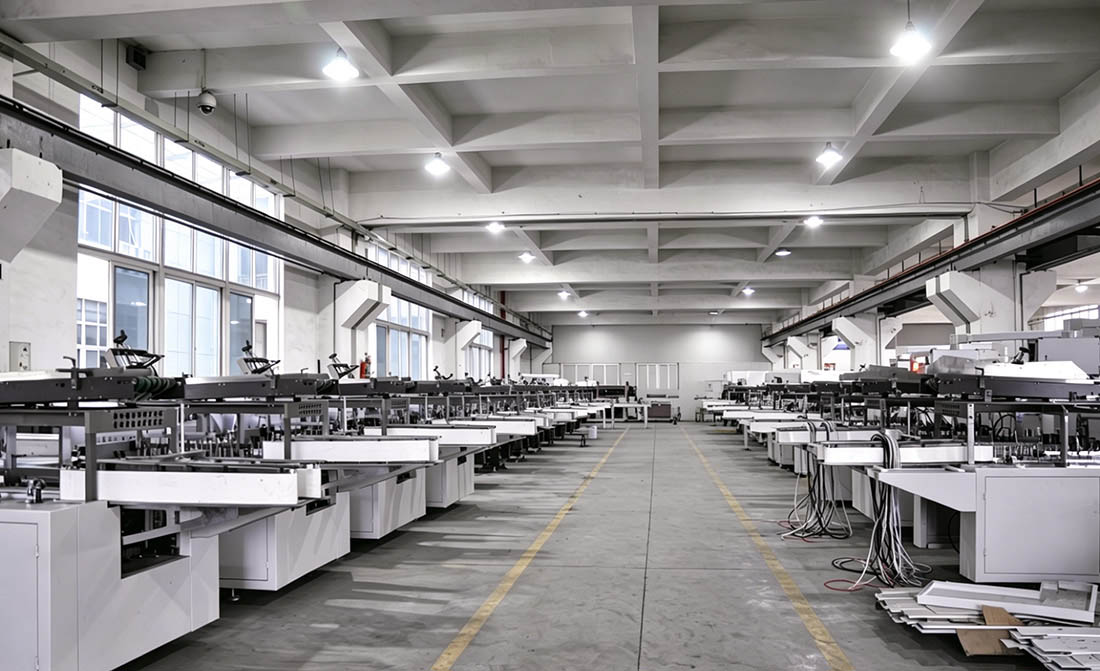
Pre-shipment inspection and machine testing before an automatic case packer is released for delivery.
Step-by-Step: Running the Evaluation Before You Order
Step 1. Define the product and carton envelope first. The carton length, width and height decide which machine format is even eligible. A carton of 240 to 500 mm length sits inside the CP-S50 envelope; a carton up to 600 mm length sits inside the CP-T60 envelope. Fixing this before contacting suppliers prevents a specification conversation that later has to be restarted.
Step 2. Request the quality control protocol in writing. Ask for the named test list, not a statement that the machine is tested. A usable protocol names the safety interlock and E-stop test, mechanical assembly check, pneumatic leakage test, electrical safety test, PLC control logic test, no-load and load running test, long-time aging test, dimensional tolerance inspection and surface appearance inspection.
Step 3. Ask for acceptance-test conditions rather than headline speed. Request the product used, the case format, the running speed and the duration of the load run. This is the single most effective way to make supplier performance claims comparable.
Step 4. Confirm the customization scope, especially voltage and logo. Packaging dimensions, machine configuration, voltage and logo customization should each be listed explicitly in the offer, with the electrical configuration confirmed for the destination market.
Step 5. Fix the delivery terms. Record minimum order quantity, monthly capacity and lead time, and ask how many other orders sit ahead of yours. Lead time without queue position is an incomplete commitment.
Step 6. Agree the after-sales contingency. Confirm installation and commissioning, training, warranty, remote technical support, lifetime after-warranty support, and upgrade and retrofit service, and identify who is responsible for safety-related parts once the warranty period ends.
Project Fit: How the Framework Applies to Real Packaging Lines
The evaluation criteria become concrete when they are applied to a specific line configuration.
Toilet paper roll line, United States. A customized packaging line for toilet paper rolls running roll wrapping, case packing, automatic palletizing and stretch film wrapping, designed for a tissue paper producing and packaging workshop and built to a CE-compliant customized design. A related US project installed six sets over a four-year service period. In this configuration, the evaluation priority is the load running test at the actual roll count per carton, because case integrity depends on how the formed pack behaves inside the case.
Tissue canister packing, United States. The CP-T60 automatic top load case packer is used to load tissue canisters into cartons automatically, replacing manual box filling, adapting to multiple tissue can sizes, and reducing collision and deformation risk in transit. A single-set installation has been in service for five years. Here the decisive criterion is dimensional tolerance inspection, because canister formats change more often than the machine does.
Canister wet wipe line, Mexico. A turnkey automated line for canister wet disinfecting wipes covering canister loading, disinfectant filling, sealing, capping, labelling, case packing, palletizing, strapping and stretch film wrapping, with a related project of nine sets in service for five years. For a turnkey line, after-sales contingency and PLC logic testing weigh more heavily than any single machine specification, because one control fault stops every station downstream.
Facial tissue box line, Poland. A complete line combining facial tissue box packing, film wrapping, case packing, palletizing, strapping and stretch wrapping, with a related project of twelve sets installed over two years. At this scale, monthly capacity and lead time become the gating criteria rather than the machine specification itself.
Specification Comparison: CP-S50 and CP-T60
The two case packers below cover different carton envelopes and different loading principles, which is why the evaluation criteria have to be applied per project rather than per brand.
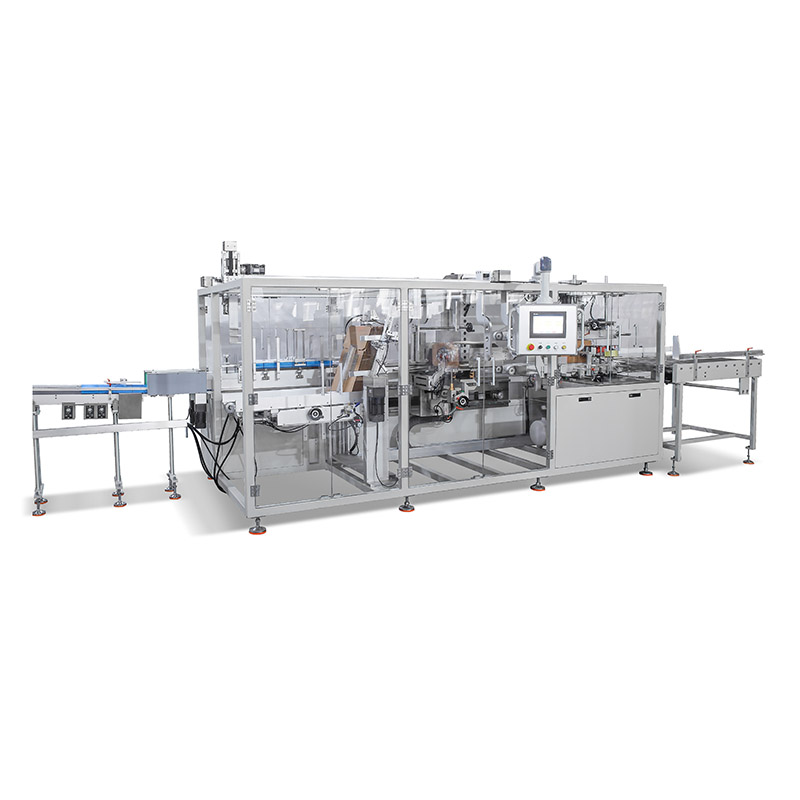
CP-S50 automatic side load / side push case packer.
| Parameter | CP-S50 | CP-T60 |
|---|---|---|
| Type | Side load case packer / side push case packer | Pick-and-place case packer / top load case packer |
| Packing capacity | 1 - 16 cartons/min | 1 - 8 cartons/min |
| Carton dimension | 240-500 (L) x 200-400 (W) x 180-400 (H) mm | 300-600 (L) x 200-400 (W) x 150-400 (H) mm |
| Power voltage | 380V 50/60Hz 3 phase | 380V 50/60Hz 3 phase |
| Power consumption | 4.5 kW | 7.5 kW |
| Air pressure | 0.5-0.8 MPa | 0.5-0.8 MPa |
| Air consumption | 350 L/min | 450 L/min |
| Overall dimensions | 4200 (L) x 2300 (W) x 1900 (H) mm | 4200 (L) x 2600 (W) x 2200 (H) mm |
| Overall weight | 1500 kg | 1600 kg |
| Material | Stainless steel / carbon steel | Stainless steel / carbon steel |
| Applicable industries | Tissue; food and beverage; pharmaceutical; daily chemical and cosmetic; hardware; auto parts and machinery | Tissue; food and beverage; pharmaceutical; daily chemical and cosmetic; hardware; auto parts and machinery |
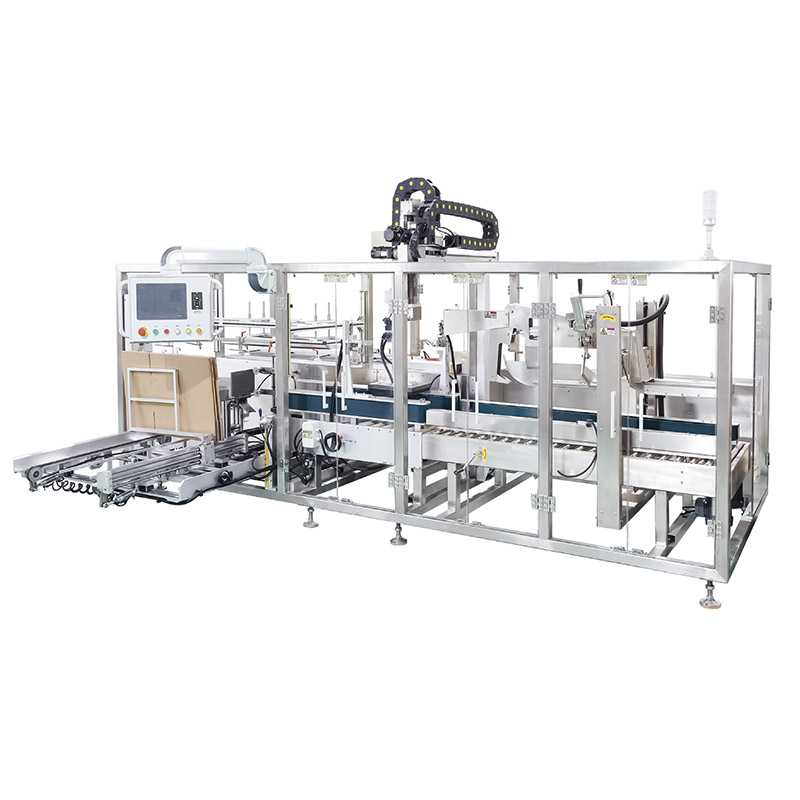
CP-T60 automatic top load / pick-and-place case packer.
Quality control protocol to request from any case packer supplier
| Test | What it verifies | Evidence to request |
|---|---|---|
| Safety interlock and E-stop test | Machine stops safely when a guard is opened or emergency stop is pressed | Test record with machine serial number |
| Electrical safety test | Wiring, earthing and insulation on the assembled machine | Signed test sheet |
| PLC control logic test | Sequence, interlock logic and fault handling in the controller | Alarm and fault list used during the test |
| Mechanical assembly check | Components assembled and fixed to drawing | Drawing revision reference |
| Pneumatic leakage test | Air circuit tightness at 0.5-0.8 MPa working pressure | Accepted leakage rate |
| No-load and load running test | Motion and sequence with and without product | Product, carton format, speed, run duration |
| Long-time aging test | Stability over an extended run | Run length and observations |
| Dimensional tolerance inspection | Machine matches the ordered carton envelope | Measured dimensions and tolerance |
| Surface appearance inspection | Finish, labelling and applied branding | Approved artwork reference |
Frequently Asked Questions
What safety tests should a case packer supplier complete before shipment?
A pre-shipment protocol should include at minimum a safety interlock and emergency-stop test, an electrical safety test, and a PLC control logic test that verifies the controller sequence and fault handling, supported by a mechanical assembly check and a pneumatic leakage test. For machines destined for North America or Europe, the design basis should also be checked against the applicable machinery safety requirements: ANSI/PMMI B155.1-2023 specifies safety requirements and a risk assessment methodology for packaging and processing machinery in the United States, and EN 415-7:2025 is catalogued as the European standard part covering cartoning and case packing machines, with the full official text and jurisdictional adoption to be confirmed directly. WIMACH applies a documented nine-point quality control protocol that includes safety interlock and E-stop testing, electrical safety testing and PLC control logic testing, and states that its machines are CE certified.
Can a case packer be customized for carton dimensions, voltage and branding?
Yes. WIMACH provides OEM/ODM and customized machinery service covering packaging dimensions, machine configuration, voltage and logo, for both standalone machines and integrated packaging lines. As a reference, the CP-S50 side load case packer covers cartons of 240-500 (L) x 200-400 (W) x 180-400 (H) mm at 1-16 cartons per minute, while the CP-T60 top load case packer covers 300-600 (L) x 200-400 (W) x 150-400 (H) mm at 1-8 cartons per minute. Both are supplied on a 380V 50/60Hz three-phase configuration as standard, which is precisely the specification that voltage customization exists to adapt for other plant supplies. Applicable industries for both models include tissue, food and beverage, pharmaceutical, daily chemical and cosmetic, hardware, and auto parts and machinery, so a case packer manufacturer for food lines is operating inside the standard scope of these models rather than outside it.
How should buyers assess order volume, capacity and cost claims when comparing suppliers?
Start with three contractual numbers rather than with price. WIMACH quotes a minimum order quantity of one set and a monthly capacity of 13 sets, which means a single-machine order is possible without a volume commitment and that the production ceiling for a multi-line schedule is a stated figure. Cost claims made by any manufacturer should be traced to a published baseline. One manufacturer publicly reports that its wraparound case packer series can reduce material costs by up to 30% compared with traditional case packing, but the baseline and operating assumptions behind that figure are not published, so it should be treated as a supplier-reported claim rather than a guaranteed saving. Ask what the quotation includes beyond the machine: tooling, change parts, commissioning and training.
Can the machine be validated before it is shipped?
Yes. A minimum order quantity of one set means a buyer can commission a single unit and have it tested as a standalone project rather than inside a batch. Pre-shipment validation at WIMACH includes a no-load and load running test, dimensional tolerance inspection and a long-time aging test, alongside the safety, mechanical, pneumatic, electrical and PLC logic checks. Before the test, agree in writing on the product, the carton format, the running speed and the acceptance criteria, because a published output figure is only meaningful once the case format and test conditions are stated alongside it.
What lead time and after-sales support should a buyer expect?
WIMACH quotes a lead time of 30 to 45 days for customized machinery service and 15 to 45 days for OEM/ODM projects, with a monthly capacity of 13 sets. After-sales scope covers installation and commissioning, training service, warranty service, remote technical support, lifetime after-warranty support, and upgrade and retrofit service. That combination is the contingency layer that matters when a safety interlock, sensor or control fault stops a line after commissioning, and it is the part of a supplier offer that should be agreed in writing rather than assumed. To discuss a specific carton format, request a quotation, or review the acceptance test protocol before ordering, contact the supplier directly.
Conclusion: What a Verified Case Packer Supplier Looks Like
Evaluating case packer suppliers is an evidence exercise, not a specification exercise. The framework in this article reduces to eight questions that any supplier can answer in writing: which safety functions are tested, what the load running test actually ran, how mechanical and pneumatic integrity is checked, how PLC logic and alarms are verified, how dimensional tolerances are inspected against the approved drawing, what customization is included, what the minimum order quantity, monthly capacity and lead time are, and what after-sales technical support exists once the warranty ends.
A supplier that can answer all eight with documents is a different risk profile from one that answers with adjectives. WIMACH's case packer range, its nine-point quality control protocol, its stated MOQ of one set, monthly capacity of 13 sets and lead times of 30-45 days for customized machinery service and 15-45 days for OEM/ODM projects provide one worked example of that standard of evidence, and the same questions can be applied to any supplier on a shortlist.

Wenzhou Wimach Machinery Co., Ltd. (WIMACH) - packaging machinery manufacturer, Ruian, Wenzhou, China.
Next step: Send your carton dimensions, product type, target speed and destination voltage, and request a case packer quotation with the acceptance-test protocol attached. The full equipment catalog is available for download here: WIMACH Product Catalog.
Contact: Rex Din | Email: rex@wimach.cn | Tel / WhatsApp: +86 177 5771 8080 | Website: www.wimach.cn | Address: Bldg 14 Qiaomao Rd, Ruian, Wenzhou, Zhejiang, China
Have Questions or Need More Details?
Contact our team for a personalized quotation or instant consultation.
Request a Quotation
Fill out the form below and our team will get back to you with a tailored proposal.
WhatsApp Direct Chat
Prefer to chat in real-time? Message us on WhatsApp for instant assistance & quick answers.
- Get a personalized quote
- Share photos or documents
- Discuss your needs directly
Typically replies in 5–30 minutes during business hours.