
MCPCB Selection for LED Lighting: A Technical Guide to Substrate, Copper Weight, and Surface Finish

High Voltage MCPCB — a single-sided aluminum metal core board built on an Al1 base with 1 oz copper and an OSP surface finish.
Four parameters decide whether a metal core PCB will work in an LED lighting design: the substrate material, the copper foil weight, the overall board thickness with its stated tolerance, and the surface finish. Solder mask and silkscreen are secondary decisions that follow from those four, not the other way around.
Everything else on a specification sheet can be adjusted later. Panel layout, ordering quantity and delivery method are all negotiable after a design freeze. The four locking parameters are not, because they are fixed inside the copper-clad laminate (CCL) and the final surface treatment. A board manufactured as 1 oz aluminum on Al1060 with a lead-free HASL finish cannot be reworked into a 70/70 μm double-sided build or an OSP high-voltage board once it has been produced.
This guide is written for engineers and sourcing teams who have already decided that a metal core PCB is the right platform for their LED design, and who now need to lock the specification without ambiguity. It uses WODE Circuit Technology (Zhuhai) Co., Ltd. — a PCB and FPC manufacturer founded in 2003 in Zhuhai, China, producing rigid MCPCB, FPCB, reel-to-reel infinity FPCB, FR-4/CEM-1/CEM-3 boards and CCL — and four of its products (MCPCB for Road lighting, MCPCB for Motor lighting, High Voltage MCPCB and Coverlay Aluminium PCB) as worked examples, because those four products apply different combinations of the same four variables.
Problem Definition: Why MCPCB Specifications Fail at the Evaluation Stage
Most MCPCB problems in LED lighting do not start in the LED circuit. They start in a specification written in loose language and quoted against equally loose language, then discovered at assembly.
Four patterns account for most of the risk:
- Unit ambiguity on copper weight. "1 oz" is a nominal imperial figure that corresponds to approximately 35 μm of copper. Manufacturers publish both notations. WODE's lighting MCPCB data uses "1oz" for its road lighting, motor lighting, high voltage and coverlay products, and "35um" for its Thermoelectric Separated Cu based PCB. If a buyer reads "1 oz" and an engineer reads "35 μm" without a conversion table, the two documents can be compared as if they disagree when they do not.
- Tolerance notation on thickness. A 1.6 mm board can be written as 1.6 mm ±10% or as 1.6 mm ±0.16 mm. WODE publishes both forms across its product range. The mechanical result is the same window, but the drawing language differs, and fixture or connector stack-up calculations must be checked against the notation actually used.
- Surface finish treated as cosmetic. HASL, HASL-LF and OSP are process decisions with different solderability behaviour, different pad flatness and different implications for a lead-free assembly line. They are not interchangeable line items.
- Solder mask and silkscreen treated as branding. In practice they are the easiest and cheapest customization points on an MCPCB, and a coverlay solder mask is a materially different construction from a printed solder mask.
The corrective action is straightforward: express each of the four parameters in exactly the same notation that the manufacturer uses in its own product data. That single discipline removes most of the back-and-forth that delays an LED lighting MCPCB order.
Industry Background: Metal Core Substrates in LED Lighting
LED lighting is the application that moved aluminum-based MCPCB into volume production. An LED converts a large share of its input into heat at a small junction area, and a metal core board answers that problem structurally: a dielectric layer sits on an aluminum base, and the aluminum spreads heat laterally across the board area instead of letting it concentrate under the emitter. FR-4 can carry the same circuit, but it does not perform the same thermal spreading function.
Most lighting MCPCBs remain single-sided — one aluminum base, one dielectric layer, one copper circuit layer. Double-sided and copper-based constructions exist where a design needs more current-carrying capacity per side or a separated thermal path, and WODE builds both: its Double sided MPCB uses a 70/70 μm copper foil on an Al5 base, and its Thermoelectric Separated Cu based PCB uses a copper-based material with 35 μm copper foil.
Compliance has become a gating item rather than a formality. UL recognition, RoHS and REACH substance documentation, and — for lighting that sits next to automotive or industrial programs — IATF16949 quality systems are now normal requirements in a lighting MCPCB inquiry.
WODE operates from a 150,000 m² facility with more than 500 employees, an annual output of 6,000,000 sqm, a 15-person R&D team and an export ratio of 50%, serving markets that include Brazil, Turkey, India, Vietnam and Russia. The company holds more than 40 patented technologies and produces its own CCL, which matters at the specification stage: laminate availability is one of the variables that most often forces a redesign late in a project.
Detailed Solution: The Four Parameters That Lock an LED Lighting MCPCB
Parameter 1 — Substrate material: Al1060, Al5052, Al1, Al5 and copper-based laminates
WODE's product data lists three aluminum designations across its four lighting examples, plus two additional bases on its double-sided and thermoelectric-separated products. Each maps to a different mechanical and thermal job.
- Al1060 is used on MCPCB for Road lighting and on Coverlay Aluminium PCB. Both are single-sided, 1 oz copper, 1.6 mm ±10%, 208.00 mm × 225.00 mm panels laid out 2-up. Al1060 is a commercially pure aluminum grade, generally chosen where high thermal and electrical conductivity plus good formability matter more than mechanical strength.
- Al5052 is used on MCPCB for Motor lighting — single-sided, 1 oz copper, 1.6 mm ±10%, 243.00 mm × 243.00 mm, 1-up. Al5052 is an aluminum-magnesium alloy, typically selected where the board sees mechanical load, vibration or a more demanding environmental exposure than a pure aluminum grade comfortably handles.
- Al1 is the base listed for High Voltage MCPCB — single-sided, 1 oz copper, 1.6 mm ±10%, 243.00 mm × 243.00 mm, 1-up, with a white solder mask, black silkscreen and OSP finish.
- Al5 is the base listed for Double sided MPCB, the 70/70 μm, 1.6 mm ±0.16 product used in home applications.
- Cu based is the material listed for Thermoelectric Separated Cu based PCB, a 35 μm copper build at 1.6 mm ±0.16, 133.80 mm × 120.00 mm, 4-up, with a white solder mask, black silkscreen and OSP finish.
The selection rule that follows from this lineup is simple: match the alloy to the mechanical and thermal duty of the luminaire, not to a generic "aluminum" line on a quote. A road lighting board and a motor lighting board can share the same copper weight, thickness, panel logic and finish family while sitting on different alloys, because the mechanical environment differs.
Parameter 2 — Copper foil weight: 1 oz, 35 μm and 70/70 μm
All four of WODE's lighting MCPCB examples are specified at 1 oz copper foil. The same 35 μm weight appears explicitly in the product data for Thermoelectric Separated Cu based PCB, and the double-sided product steps up to 70/70 μm — 70 μm of copper per side on both sides.
Three practical points follow for engineers writing a specification:
- 1 oz (≈35 μm) is the working default for single-sided LED lighting boards. Every standard lighting example above uses it, from road lighting through motor lighting to the high-voltage board.
- Heavier copper belongs where the copper itself is part of the thermal or current path. The 70/70 μm construction on Double sided MPCB reflects a design in which both sides carry current and both sides contribute to heat movement.
- Copper weight is stated per side on double-sided products. "70/70 μm" is not a total; writing "70 μm" on a drawing for a two-sided board leaves the second side undefined.
Parameter 3 — Overall thickness and tolerance: 1.6 mm ±10% vs 1.6 mm ±0.16 mm
All six WODE MCPCB products referenced in this guide land on 1.6 mm overall thickness. What changes between them is how the tolerance is written:
- 1.6 mm ±10% — used on MCPCB for Road lighting, MCPCB for Motor lighting, High Voltage MCPCB and Coverlay Aluminium PCB.
- 1.6 mm ±0.16 mm — used on Thermoelectric Separated Cu based PCB and Double sided MPCB.
Both notations describe the same window: 10% of 1.6 mm is 0.16 mm. The difference is documentary, not physical — but it is a real source of friction in review. A housing or connector stack-up calculated on a nominal 1.6 mm with no tolerance will behave differently from one calculated on the full ±0.16 mm band, and the band must be taken from the notation the manufacturer actually publishes for that product.
A second thickness consideration applies to double-sided and copper-based MCPCBs: because both sides carry copper, the board is not a symmetric mechanical part in the same way a single-sided lighting board is. Thickness control therefore matters to solder joint geometry as much as to fit.
Parameter 4 — Surface finish: HASL, HASL-LF and OSP
WODE uses three surface finishes across the MCPCB products described in this guide, and the distribution is deliberate:
- HASL — specified on MCPCB for Motor lighting.
- HASL-LF (lead-free HASL) — specified on MCPCB for Road lighting, Coverlay Aluminium PCB and Double sided MPCB.
- OSP — specified on High Voltage MCPCB and Thermoelectric Separated Cu based PCB.
Hot air solder leveling coats the exposed copper with solder and levels it with hot air; the lead-free variant, HASL-LF, applies the same process without leaded solder, which aligns the board with a RoHS-restricted build and with assemblers who no longer run a leaded line. OSP is an organic surface preservative: it protects the copper from oxidation before soldering, leaves the pad surface flat, and is generally chosen where a thin, lead-free organic protection is preferred over a solder coating.
The reason the finish choice belongs with the other three parameters is that it is applied last, after every other decision has been fixed. Changing a finish at the end of a project means re-quoting, re-sampling and re-checking the compliance file, while the substrate, copper weight and thickness decisions that precede it remain unchanged.
Solder mask and silkscreen options on lighting MCPCBs
The four lighting examples show three solder mask treatments and two silkscreen colors — and the combinations are consistent within product families:
- White solder mask with black silkscreen — MCPCB for Road lighting, High Voltage MCPCB and Thermoelectric Separated Cu based PCB.
- Matt black solder mask with white silkscreen — MCPCB for Motor lighting.
- White coverlay with black silkscreen — Coverlay Aluminium PCB.
- White/white solder mask with black/black silkscreen — Double sided MPCB, where both sides are printed.
Coverlay deserves separate attention because it is not a color choice. On Coverlay Aluminium PCB, a white coverlay film replaces the printed solder mask while the rest of the specification is unchanged from a standard single-sided lighting board: Al1060 base, single-sided, 1 oz copper, 1.6 mm ±10%, 208.00 mm × 225.00 mm at 2-up, and an HASL-LF finish. Coverlay is used where the mask must flex or where a film-based dielectric opening pattern is required rather than a printed one.
Solder mask and silkscreen are also the two most accessible customization points on an order. WODE offers OEM/ODM production with customization of laminate, PCB thickness, surface treatment, solder mask color and logo printing. Across its single-sided board range covering CEM-1, CEM-3, FR-4 and aluminum, WODE lists silkscreen colors in white, yellow, black and green, and solder mask options spanning photosensitive, thermosetting and UV solder masks as well as coverlay.
Step-by-Step Breakdown: From Specification to Shipped OEM MCPCB
The sequence below reflects how a WODE OEM MCPCB order moves from drawing to delivery. Each step exists because the parameter locked in step 1 constrains everything after it.
- Write the drawing in the manufacturer's notation. State the substrate (for example Al1060 or Al5052), the copper foil weight with units, the overall thickness with the tolerance form the manufacturer publishes for that product, and the surface finish (HASL, HASL-LF or OSP). Add solder mask type and color, and silkscreen color.
- Confirm the customization scope. WODE accepts OEM/ODM requirements covering laminate, PCB thickness, surface treatment, solder mask color and logo printing, so non-standard combinations are handled at the specification stage rather than after tooling.
- Sample and validate. Sample quantity is not limited, and acceptance is carried out against mutually agreed technical specifications and inspection standards — incoming inspection, outgoing inspection or third-party inspection as agreed between the parties.
- Produce against the approved specification. WODE's production base includes photoimaging, exposure, silkscreen, drilling, punching, V-Cut and circuit testing workshops, and the company produces its own CCL in-house — which keeps laminate supply inside the same quality system as the finished board.
- Test 100%. Every product undergoes 100% testing as part of the manufacturer's quality control process, rather than batch sampling alone.
- Agree commercial terms and ship. Mass-order MOQ is 100 sqm with no limit on sample quantity; quoted lead time is 7–15 days; monthly capacity is 600k sqm; delivery follows the customer-designated logistics method (sea, air or land), and payment terms are confirmed in the order or contract.
Use Cases: Matching a WODE MCPCB to a Lighting Application
Road and outdoor luminaires
MCPCB for Road lighting is built on an Al1060 base, single-sided, with 1 oz copper foil, 1.6 mm ±10% overall thickness, a 208.00 mm × 225.00 mm panel at 2-up, white solder mask, black silkscreen and an HASL-LF finish. The Al1060 base and lead-free HASL finish make this the natural fit where large board area, thermal spreading and a lead-free assembly line are the governing requirements.
Motor and automotive-adjacent lighting
MCPCB for Motor lighting uses an Al5052 base — the mechanically stronger of the two aluminum grades in this lineup — single-sided, 1 oz copper, 1.6 mm ±10%, 243.00 mm × 243.00 mm at 1-up, with a matt black solder mask, white silkscreen and a standard HASL finish. The matt black mask and the alloy choice both point to an application where appearance and mechanical robustness matter alongside thermal performance.
High-voltage LED drivers and lighting modules
High Voltage MCPCB is specified on an Al1 base, single-sided, 1 oz copper, 1.6 mm ±10%, 243.00 mm × 243.00 mm at 1-up, with a white solder mask, black silkscreen and an OSP finish. OSP leaves the copper flat and unprotected by solder, which suits designs where the assembly process and surface planarity are defined around a lead-free organic finish.
Coverlay and flexible-adjacent lighting designs
Coverlay Aluminium PCB keeps the Al1060 base, 1 oz copper, 1.6 mm ±10% thickness and 208.00 mm × 225.00 mm 2-up panel of the road lighting board, and replaces the printed white solder mask with a white coverlay, retaining black silkscreen and the HASL-LF finish. Designers reach for this construction when the mask must behave like a film rather than an ink.
Double-sided and thermally separated variants
Two further WODE products extend the range beyond single-sided lighting boards. Double sided MPCB uses an Al5 base with 70/70 μm copper, 1.6 mm ±0.16, a 217.54 mm × 197.80 mm panel at 56-up, white/white solder mask, black/black silkscreen and an HASL-LF finish, and is applied in home applications. Thermoelectric Separated Cu based PCB uses a copper-based material with 35 μm copper, 1.6 mm ±0.16, a 133.80 mm × 120.00 mm panel at 4-up, white solder mask, black silkscreen and an OSP finish.
Field reference
A German lighting OEM project used 5,000 sqm of WODE MCPCB material as a main component of the build over a five-year duration and achieved stable operation, with the material noted for high thermal conductivity, reliable performance in the harsh European climate and compliance with German safety standards. Across global markets, WODE MCPCB and FPC output is used for LED strips and fixtures, display module interconnects and consumer electronics connectors, by electronics manufacturers, lighting companies, OEM/ODM vendors and trading companies.
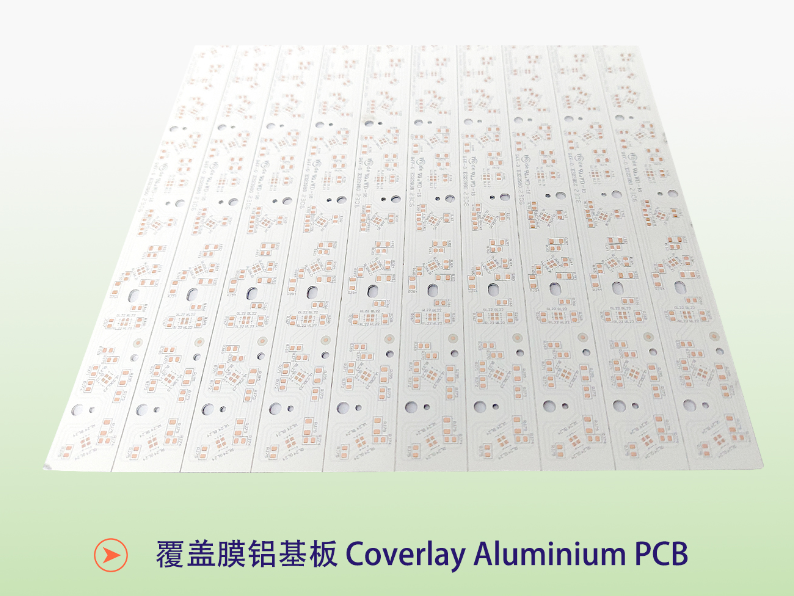
Coverlay Aluminium PCB: Al1060 base, 1 oz copper, 1.6 mm ±10%, white coverlay, black silkscreen, HASL-LF finish.
Comparison Table: WODE MCPCB Options by Locked Parameter
The table below compares only the parameters published in WODE product data. It is intended for specification review, not as a performance ranking — each row answers a different design brief.
| Product | Base material | Layer | Copper foil | Overall thickness | Panel size | Solder mask / Silkscreen | Surface finish |
|---|---|---|---|---|---|---|---|
| MCPCB for Road lighting | Al1060 | Single sided | 1oz | 1.6 mm ±10% | 208.00 × 225.00 mm (2-up) | White / Black | HASL-LF |
| MCPCB for Motor lighting | Al5052 | Single sided | 1oz | 1.6 mm ±10% | 243.00 × 243.00 mm (1-up) | Matt Black / White | HASL |
| High Voltage MCPCB | Al1 | Single sided | 1oz | 1.6 mm ±10% | 243.00 × 243.00 mm (1-up) | White / Black | OSP |
| Coverlay Aluminium PCB | Al1060 | Single sided | 1oz | 1.6 mm ±10% | 208.00 × 225.00 mm (2-up) | White coverlay / Black | HASL-LF |
| Double sided MPCB | Al5 | Double sided | 70/70um | 1.6 mm ±0.16 | 217.54 × 197.80 mm (56-up) | White/White / Black/Black | HASL-LF |
| Thermoelectric Separated Cu based PCB | Cu based | Not stated in product data | 35um | 1.6 mm ±0.16 | 133.80 × 120.00 mm (4-up) | White / Black | OSP |
Read across the 1.6 mm rows and the pattern is clear: the lighting boards share the same ±10% tolerance statement, while the double-sided and copper-based boards are stated as ±0.16 mm. Read down the surface finish column and the split is equally clear — HASL and HASL-LF dominate the single-sided lighting products, OSP appears on the high-voltage and thermoelectric-separated designs.
Quality Systems and Compliance to Attach to the Specification
Compliance documentation is the part of an MCPCB inquiry that most often delays a purchase order, so it is worth attaching the relevant certificates at specification stage rather than at shipment.
- ISO 9001:2015 — certificate 51325Q4258ROM, covering production of circuit boards. ISO 14001:2015 — certificate 51325E2142ROM, covering environmental management activities related to circuit board production.
- IATF16949 — certificate 0584371 issued by NQA Certification Limited, valid from 2025-09-27 to 2028-09-26, covering human resources, purchasing and strategic planning for automotive printed circuit board manufacturing.
- UL recognition for rigid PCBs — certificate E323980 under UL 796, covering single layer metal base printed wiring boards (WD-14, WD-15, WD-16, WD-17) and single layer rigid printed wiring boards (RXD-11, WD-12, WD-13, RXD-10). This is the certificate most directly relevant to a single-sided aluminum lighting MCPCB.
- UL recognition for flexible PCBs — certificate E498836 under UL 796F and IPC-TM-650 2.6.27, covering single layer FMIC flexible printed circuits, models WD-F1 and WD-F2 (ASP1).
- REACH — test report DGC251204025BD03 issued by NSTL for the double-sided aluminium-based board, assessed against EU REACH Regulation (EC) No 1907/2006 and the ECHA SVHC Candidate List.
- CQC — certificate CQC22001367683 issued under GB 4943.1-2022, covering printed circuit boards on CEM-1 and FR-4 substrates with V-0 flammability.
WODE states that its products comply with UL, RoHS and REACH standards, backed by the quality management and environmental management systems above. For an LED lighting project, the usual compliance pack is therefore: the UL certificate covering the board type actually ordered, the REACH/SVHC test report for the relevant construction, and the ISO or IATF certificate that matches the end market.
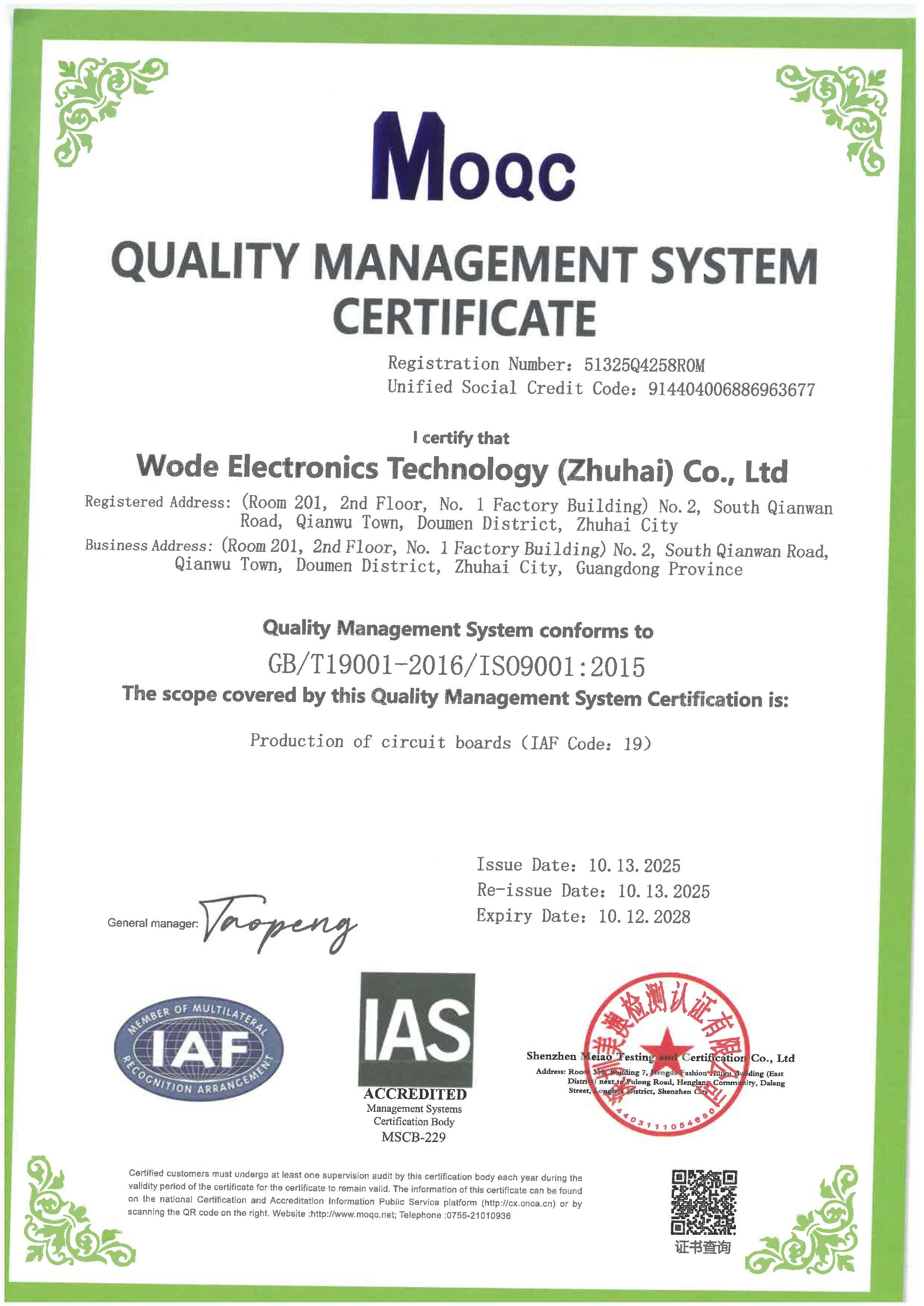
ISO 9001:2015 certificate 51325Q4258ROM covering the production of circuit boards at WODE Circuit Technology (Zhuhai) Co., Ltd.
Frequently Asked Questions
1. What certifications should a Chinese OEM MCPCB manufacturer provide for an LED lighting project?
At minimum, a lighting MCPCB supplier should be able to produce a quality system certificate, a product safety certificate covering the board type being ordered, and a substance compliance report. WODE holds ISO 9001:2015 (51325Q4258ROM) and ISO 14001:2015 (51325E2142ROM) for circuit board production and environmental management, IATF16949 (0584371, valid 2025-09-27 to 2028-09-26) for automotive printed circuit board manufacturing, UL recognition E323980 under UL 796 covering single layer metal base printed wiring boards and single layer rigid boards, UL recognition E498836 under UL 796F for flexible printed circuits, a REACH SVHC test report DGC251204025BD03 from NSTL for the double-sided aluminium-based board, and CQC certificate CQC22001367683 under GB 4943.1-2022. WODE states that its products comply with UL, RoHS and REACH standards.
2. Can a Chinese MCPCB manufacturer customize substrate material, copper weight and surface finish?
Yes, where the manufacturer runs OEM/ODM production rather than catalogue-only sales. WODE provides OEM/ODM production services with customization options for laminate, PCB thickness, surface treatment, solder mask color and logo printing. In practice this is visible in the product range itself: the same 1.6 mm single-sided lighting platform is offered on Al1060 for road lighting and coverlay designs and on Al5052 for motor lighting, with 1 oz copper across all four lighting examples, and with HASL, HASL-LF or OSP finishes selected per application. Heavier and copper-based builds are also available: Double sided MPCB uses 70/70 μm copper on an Al5 base, and Thermoelectric Separated Cu based PCB uses 35 μm copper on a copper-based material.
3. What is the minimum order quantity for a custom MCPCB, and how are commercial terms handled?
WODE's minimum order quantity is 100 sqm for mass orders, with no limit on sample quantity. Because pricing follows the locked specification — substrate material, copper foil weight, overall thickness and tolerance, surface finish, solder mask and silkscreen, plus panel layout — cost terms, delivery method and payment terms are confirmed with the buyer in the order or contract rather than published as a list price. Delivery follows the customer-designated logistics method (sea, air or land), and supported delivery methods and cost terms are confirmed directly with the buyer.
4. How are MCPCB samples and acceptance criteria handled before mass production?
Sample quantity is not limited at WODE, so a lighting design can be validated against the exact locked specification before a mass order is placed. Acceptance is carried out against mutually agreed technical specifications and inspection standards, using incoming inspection, outgoing inspection or third-party inspection as agreed between the parties. Once production starts, every product undergoes 100% testing as part of the manufacturer's quality control process, rather than relying on sampling alone.
5. What lead time and production capacity should a buyer expect from a Chinese MCPCB manufacturer?
WODE quotes a lead time of 7–15 days, with a monthly capacity of 600k sqm and a mass-order MOQ of 100 sqm. Those three figures are the ones worth comparing when evaluating an OEM MCPCB manufacturer in China, because capacity determines whether a lead time holds during a seasonal peak and MOQ determines whether a sample-to-production transition is practical. Buyers can request a sample or a quotation against their locked specification by email at GJMYB1@wodepcb.com, by phone at +86-756-3906072, or through WhatsApp at +1 9294341657.
Conclusion
An LED lighting MCPCB specification is decided by four parameters, and only four: substrate material, copper foil weight, overall thickness with its tolerance notation, and surface finish. Solder mask and silkscreen follow from them, and commercial terms follow from both.
The reason to lock those four early is that they are the parameters embedded in the laminate and the final treatment — the ones that cannot be changed without re-quoting, re-sampling and re-checking compliance. WODE's own lighting range shows how the same platform branches: Al1060 with HASL-LF for road lighting and coverlay designs, Al5052 with HASL and a matt black mask for motor lighting, Al1 with OSP for high-voltage boards, and 70/70 μm on Al5 or 35 μm on copper-based material where the design needs more copper per side or a separated thermal path.
Write the drawing in the manufacturer's notation, attach the UL certificate that covers the board type being ordered, and validate on an unrestricted sample before committing to a 100 sqm mass order — that sequence removes almost all of the ambiguity that otherwise appears at assembly.
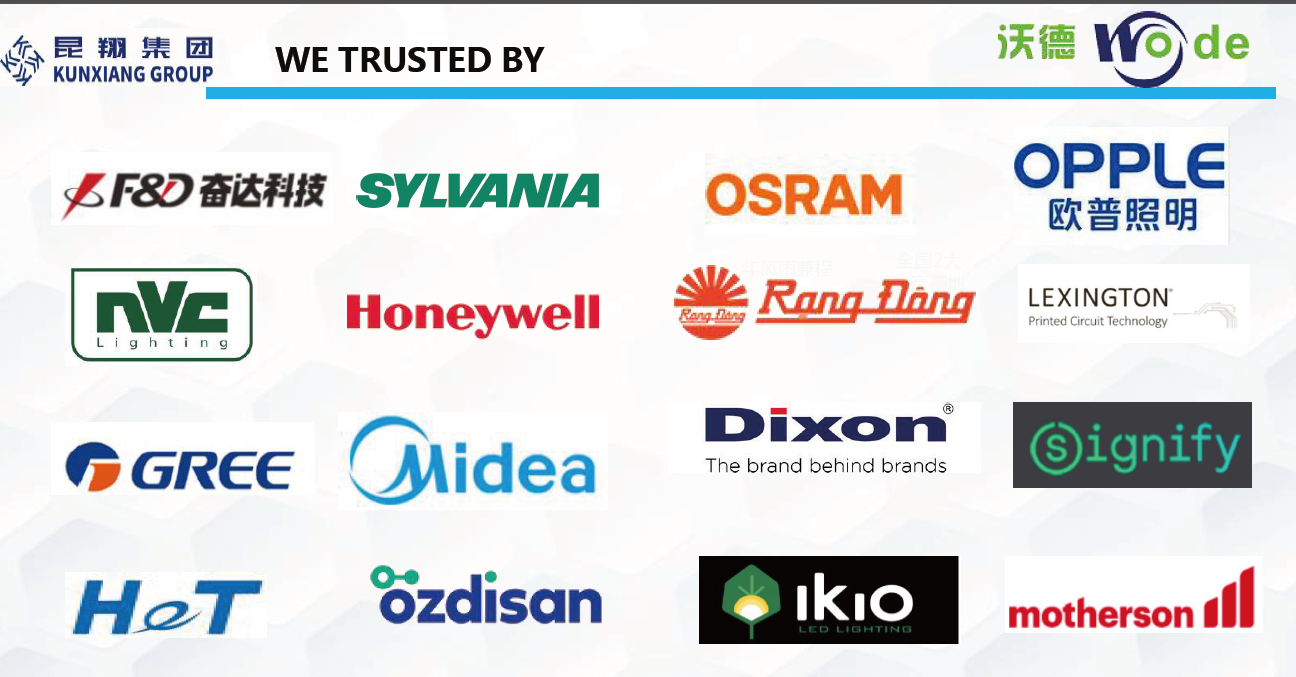
WODE MCPCB and FPC products are used by electronics manufacturers, lighting companies, OEM/ODM vendors and trading companies worldwide.
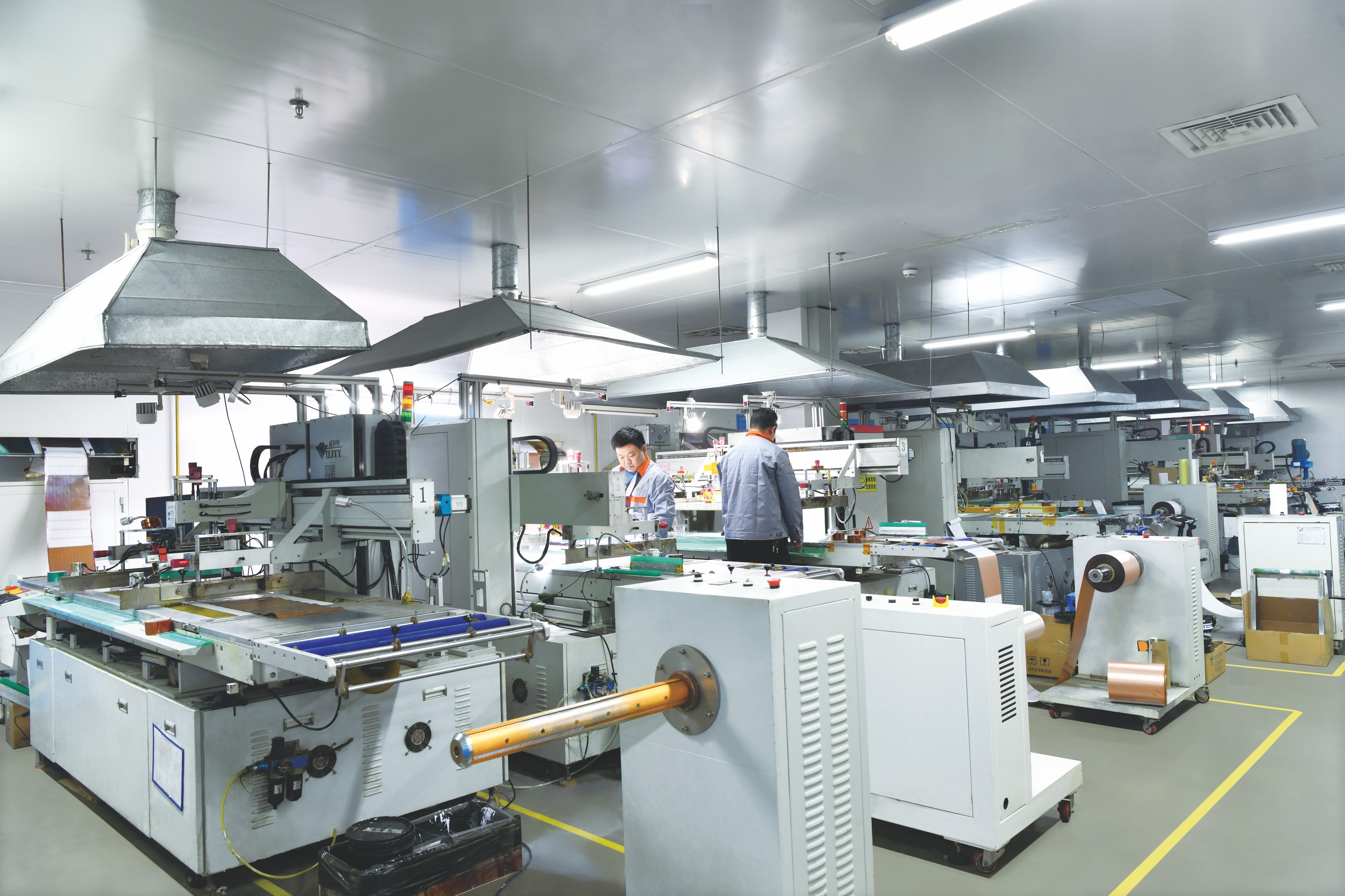
Silkscreen workshop at WODE — solder mask color and silkscreen color are two of the customization points available on OEM MCPCB orders.
Send Your Locked MCPCB Specification for a Sample or Quote
Share your substrate, copper weight, thickness tolerance and surface finish — WODE will confirm the build, the compliance pack and the lead time.
Email: GJMYB1@wodepcb.com | Website: www.wodepcbfpc.com | WhatsApp: +1 9294341657
WODE Circuit Technology (Zhuhai) Co., Ltd. — No. 2, South Qianwan Road, Qianwu, Doumen, Zhuhai, 519170, China.
Have Questions or Need More Details?
Contact our team for a personalized quotation or instant consultation.
Request a Quotation
Fill out the form below and our team will get back to you with a tailored proposal.
WhatsApp Direct Chat
Prefer to chat in real-time? Message us on WhatsApp for instant assistance & quick answers.
- Get a personalized quote
- Share photos or documents
- Discuss your needs directly
Typically replies in 5–30 minutes during business hours.