
Navigating UL & REACH Compliance for MCPCB Imports: A Guide for Electronics Firms
Navigating UL & REACH Compliance for MCPCB Imports: A Guide for Electronics Firms
An imported metal core PCB is only as compliant as the document that names it. Most electronics firms buying MCPCBs from China receive a folder of certificates; the decision that matters is not whether the supplier holds certificates, but whether a named certificate covers the exact construction being shipped, into the exact market it is shipped into.
WODE Circuit Technology (Zhuhai) Co., Ltd. is a printed circuit board and flexible circuit board manufacturer founded in 2003, based in Zhuhai, China, operating a 150,000 m² facility with more than 500 employees and an annual output of 6,000,000 sqm. Its published compliance set for metal core and related boards includes UL recognition under files E323980 and E498836, a REACH SVHC test report numbered DGC251204025BD03 issued by NSTL, CQC certification CQC22001367683 to GB 4943.1-2022, ISO 9001:2015 and ISO 14001:2015 certificates, and IATF16949 certification 0584371 issued by NQA Certification Limited.
This guide is written for electronics firms in the research and evaluation stage of an MCPCB import decision — engineers, compliance officers and procurement managers who have to read a supplier file correctly. It explains what each document covers, where scope mismatches appear, how to verify a file step by step, and which product parameters must line up with a certificate before a purchase order is released.
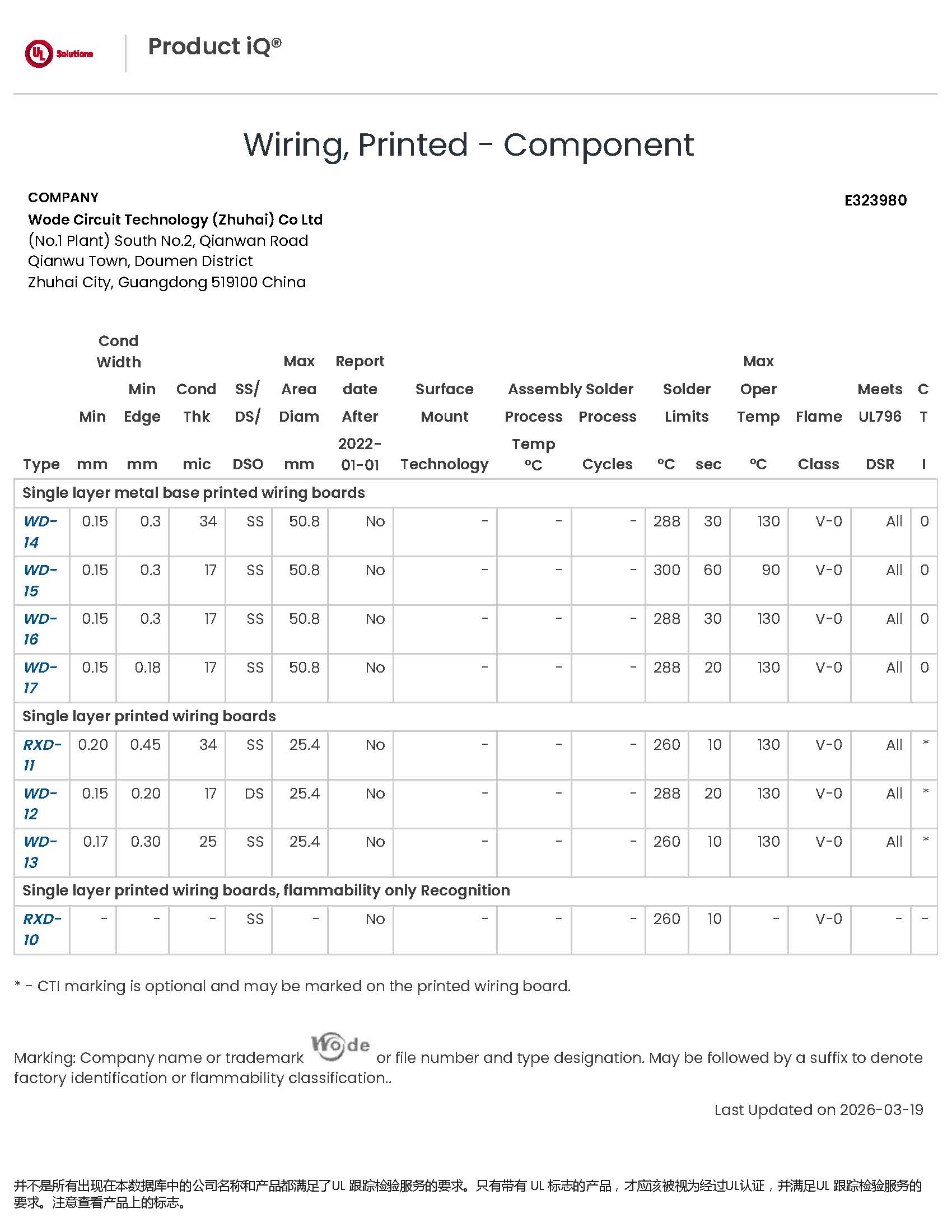
UL 796 recognition for WODE rigid and single layer metal base printed wiring boards is published under file E323980 by UL Solution.
What compliance documentation does an MCPCB import actually need?
For a metal core PCB used in lighting, power conversion or automotive assemblies, the document stack that end-product manufacturers normally request falls into five groups: UL recognition of the printed wiring board for North American markets; a REACH SVHC statement or test report referencing EU REACH Regulation (EC) No 1907/2006 and the ECHA SVHC Candidate List; a RoHS statement; management-system certificates such as ISO 9001:2015 and ISO 14001:2015; and sector certificates such as IATF16949 for automotive supply or CQC under GB 4943.1-2022 for the Chinese market.
Those five groups answer different questions and are not interchangeable. UL recognition speaks to the safety performance of the board construction. REACH and RoHS speak to the substances inside the laminate, the solder mask, the silkscreen ink and the surface finish. ISO 9001 and ISO 14001 speak to whether the process that produced the board is controlled and repeatable. IATF16949 and CQC speak to sector or regional market access.
Problem definition: the scope mismatch, not the missing logo
Compliance failures in MCPCB imports rarely look like fraud. They look like a genuine, verifiable certificate applied to the wrong board. Three patterns appear repeatedly in supplier files.
1. The certificate is real, but its scope is narrower than the order
A UL file does not cover metal core PCBs in general; it lists specific construction designations. WODE's rigid file E323980, issued by UL Solution under UL 796 Standard for Printed Wiring Boards, lists single layer metal base printed wiring boards under the designations WD-14, WD-15, WD-16 and WD-17, plus single layer rigid printed wiring boards under RXD-11, WD-12, WD-13 and RXD-10. If the construction in the purchase order does not appear in that list, the buyer is relying on general capability rather than on a recognized listing — and the gap is usually discovered during an end-product audit, not before the order.
2. The declaration does not carry a report number
Substance compliance is easier to audit when it arrives as a test report with a number, a laboratory and a defined sample. WODE's published REACH document is test report DGC251204025BD03, issued by NSTL against EU REACH Regulation (EC) No 1907/2006 and the ECHA SVHC Candidate List, scoped to the double sided aluminium-based board. A generic declaration letter without a report number, sample description or issuing laboratory cannot be matched to a specific shipment, and therefore cannot be defended in a customer audit.
3. The document is valid at quotation but expires mid-supply
Certificates carry dates, and multi-year supply agreements outlive them. WODE's IATF16949 certificate 0584371 is valid to 2028-09-26; ISO 9001:2015 certificate 51325Q4258ROM and ISO 14001:2015 certificate 51325E2142ROM are valid to 2028-10-12; CQC certificate CQC22001367683 is valid to 2027-11-16. A buyer reviewing a three-year programme should check renewal obligations at the same time as unit price, because an expired document can hold up an end-product certification long after the boards have been built.

REACH SVHC test report DGC251204025BD03, issued by NSTL for the double sided aluminium-based board.
Industry background: why substrate compliance now travels with the board
A metal core PCB is not a passive mechanical part. The laminate, the copper foil, the solder mask, the silkscreen ink and the surface finish all end up inside the finished assembly, so substance restrictions placed on the end product reach back to the substrate supplier. That is why REACH SVHC reporting, RoHS statements and UL recognition of the printed wiring board have become standard line items in an MCPCB purchase file rather than optional extras.
The requirements themselves originate in the end application, not in the substrate. Lighting assemblies reference luminaire safety standards such as UL 8750 and EN 60598, LED driver standards such as IEC 62384, and EMC rules such as FCC Part 15; outdoor installations add IP65 or IP67 sealing and salt-spray exposure. Automotive lighting references AEC-Q102 for LED devices, LM-80 lumen maintenance and ISO 16750 electrical load standards, while automotive electronics more broadly references AEC-Q100 stress qualification, ISO 26262 functional safety and ISO 7637 transient immunity. Industrial control applications reference IEC 60068 environmental testing and the IEC 61000-4 immunity series, including ESD at ±8 kV contact discharge, electrical fast transient at ±4 kV and surge at ±2 kV. Medical electronics reference ISO 13485, IEC 60601-1 with leakage current below 10 μA, ISO 10993 biocompatibility and IEC 61000-4 EMC testing. Communications equipment references EN 301 489, FCC Part 15 and Telcordia GR-78; consumer electronics references UL 60950 and EN 60950 together with RoHS and REACH.
A substrate supplier's file supports those end-product requirements; it does not replace them. The practical value of UL, REACH, RoHS and management-system documents at the board level is that they remove uncertainty early — before a design is locked into a certification path that the chosen board cannot support.
WODE has operated in this segment since 2003 and reports more than 40 patented technologies across rigid MCPCB, FPCB, infinity-length FPCB and FR-4, CEM-1 and CEM-3 board production. Exports account for roughly half of output, with main markets including Brazil, Turkey, India, Vietnam and Russia, and the company states that it has supplied more than 1,000 customers in more than 30 countries.
The WODE compliance set: what each document actually covers
The value of this file is that it names issuers, numbers, scopes and dates, which makes each document auditable. What follows is the published set, read the way a compliance officer would read it.
UL recognition of the printed wiring board
File E323980, issued by UL Solution under UL 796 Standard for Printed Wiring Boards, applies to the US and Canadian markets and is recognized worldwide. Its scope covers single layer metal base printed wiring boards (WD-14, WD-15, WD-16, WD-17) and single layer rigid printed wiring boards (RXD-11, WD-12, WD-13, RXD-10). The metal base portion is the part that speaks directly to metal core board supply.
File E498836 covers flexible circuit material under UL 796F and IPC-TM-650 2.6.27, for single layer FMIC flexible printed circuits in models WD-F1 and WD-F2 (ASP1). This file matters to buyers who combine an MCPCB with a flexible interconnect in the same luminaire or driver assembly.
REACH SVHC testing
Test report DGC251204025BD03 was issued by NSTL, applies worldwide, and is scoped to the double sided aluminium-based board. The standard referenced is EU REACH Regulation (EC) No 1907/2006 together with the ECHA SVHC Candidate List, and the report title identifies SVHC substances and resorcinol. The report was issued on 2025-12-10. Because the scope names one construction, the review question is straightforward: does the ordered laminate and surface finish match the sample described in the report?
RoHS
WODE states that its products comply with UL, RoHS and REACH standards, supported by its ISO 9001, ISO 14001 and IATF16949 certification system. In practice, the RoHS statement should be filed together with the REACH report number so that both substance documents sit under the same shipment record, rather than being referenced separately in quotation emails.
Management systems: ISO 9001:2015 and ISO 14001:2015
ISO 9001:2015 certificate 51325Q4258ROM, issued by Shenzhen Meiao Testing and Certification Co., Ltd. against GB/T19001-2016 / ISO 9001:2015, covers production of circuit boards (IAF Code 19) and was issued on 2025-10-13, valid to 2028-10-12. ISO 14001:2015 certificate 51325E2142ROM, from the same issuer and against GB/T24001-2016 / ISO 14001:2015, covers environmental management activities related to circuit board production (IAF Code 19), issued 2025-10-13 and valid to 2028-10-12.
Automotive: IATF16949
IATF16949 certificate 0584371 was issued by NQA Certification Limited on 2025-09-27 and is valid to 2028-09-26 for the global market. The stated scope covers human resources, purchasing and strategic planning for automotive printed circuit board manufacturing, with Guangdong Kunxiang New Material Group Co., Ltd. named as the support site. That scope wording deserves a careful read, because it defines which functions and which site the certificate actually covers.
CQC certification for the Chinese market
Certificate CQC22001367683 was issued by the China Quality Certification Centre against GB 4943.1-2022, issued 2026-01-13 and valid to 2027-11-16. Its scope lists printed circuit boards in four substrate types — 22F CEM1 5152, CEM-1, FR-4 GF211 and FR-4 KB6160 — with thickness from 0.2 mm to 3.2 mm and V-0 flammability. This is the certificate family that applies to FR-4 and CEM-1 board supply rather than to aluminium-based laminates, a distinction that regularly causes confusion when a buyer asks for the CQC on a metal core order.
Manufacturing controls that make the documents meaningful
WODE runs OEM and ODM production with customization across laminate, PCB thickness, surface treatment, solder mask colour and logo printing. Stated production terms include a monthly capacity of 600k sqm, 100% testing, a minimum order quantity of 80 sqm, a lead time of 7–15 days, global export markets and remote after-sales support. Certificates are only as useful as the process behind them, which is why capacity, test coverage and change control belong in the same review as the paperwork.
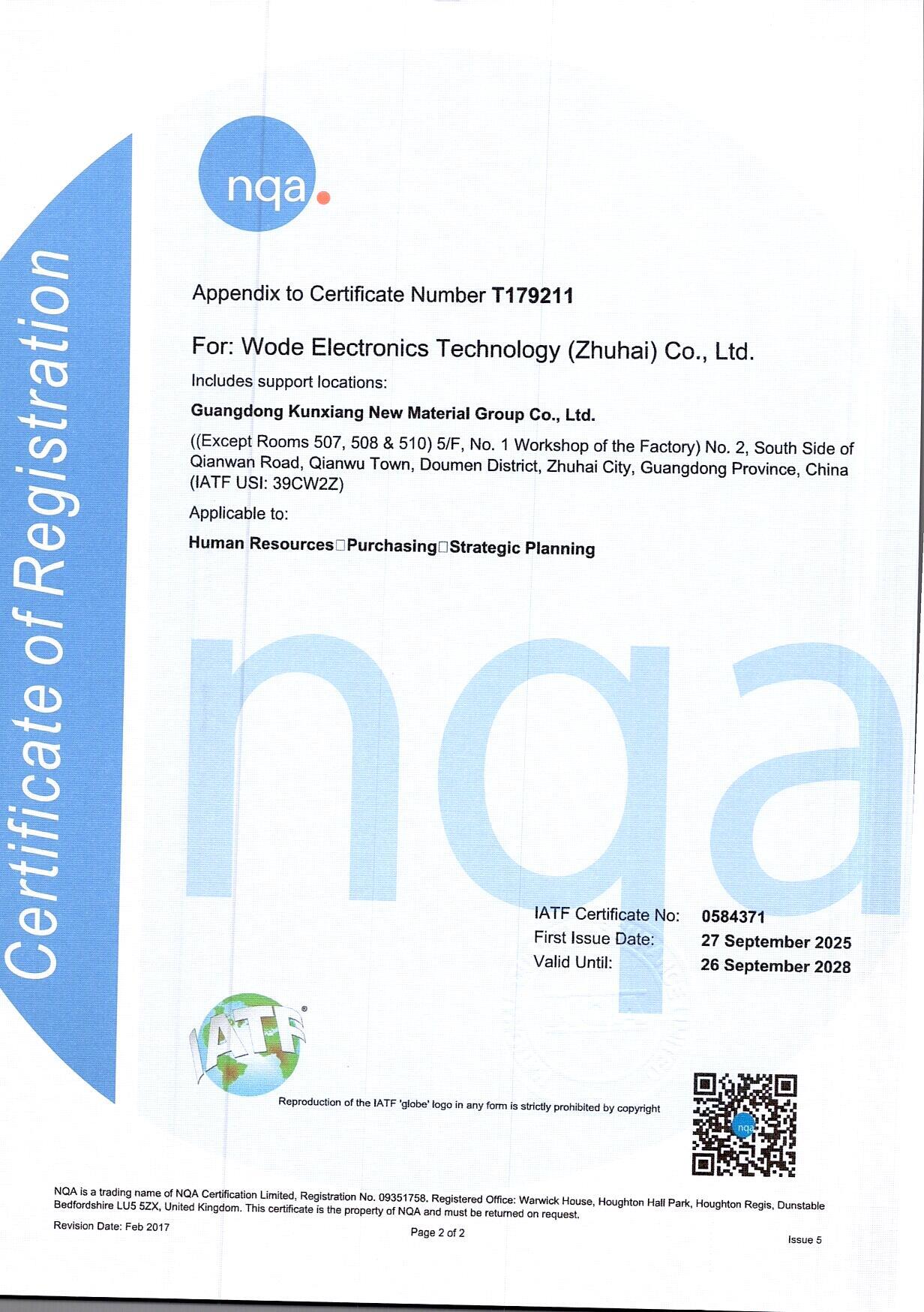
IATF16949 certificate 0584371, issued by NQA Certification Limited, valid to 2028-09-26.
Step-by-step: how to verify an MCPCB supplier compliance file
The sequence below turns a folder of certificates into a decision. It is written to be run once per supplier, then repeated per order wherever the construction changes.
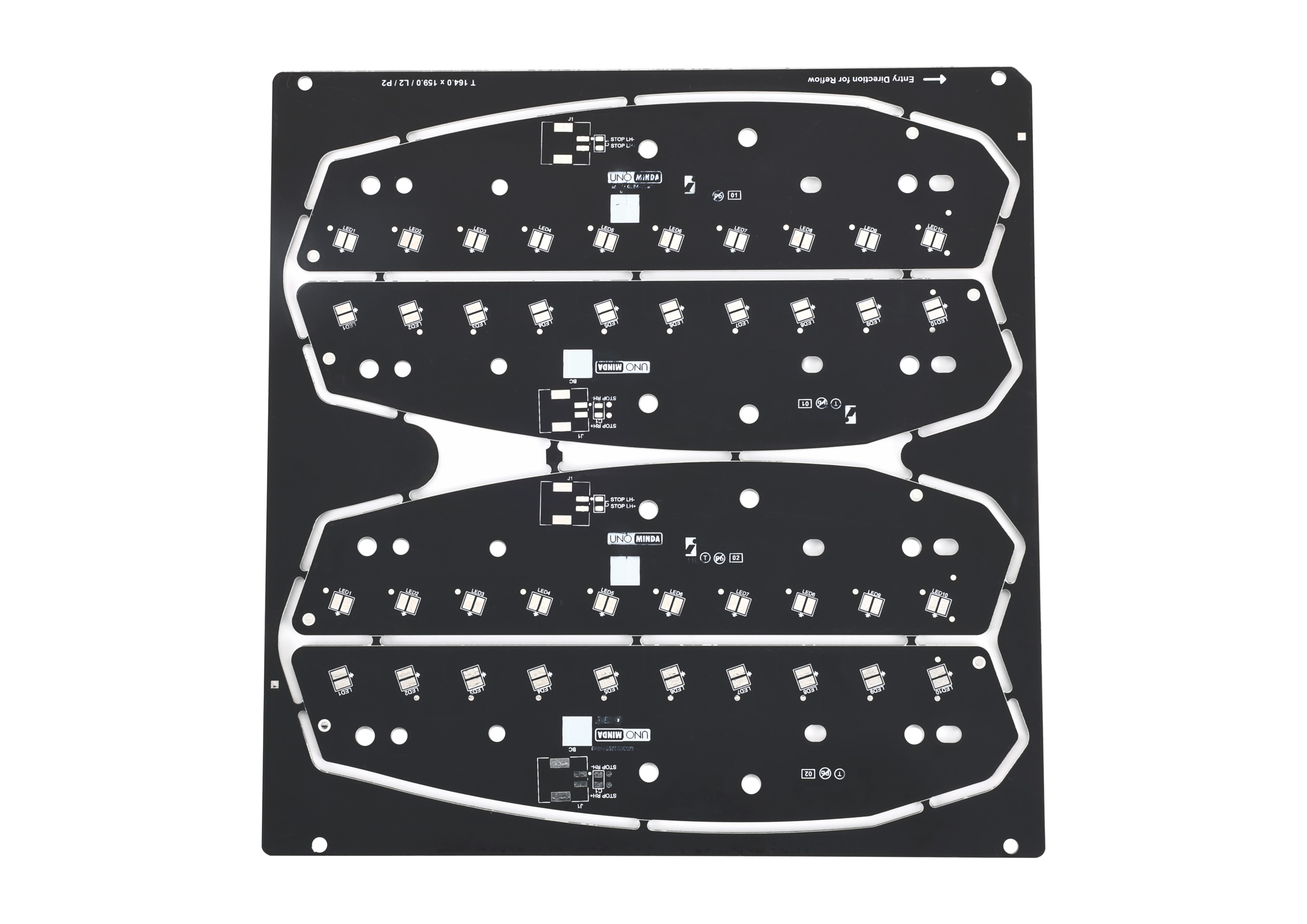
MCPCB for Motor lighting: Al5052 aluminium, single sided, 1 oz copper, 1.6 mm ±10%, matt black solder mask, HASL finish.
Use cases: where compliance evidence changes the sourcing decision
Compliance documents stop being paperwork at the point where they either allow or block a design. The patterns below cover most MCPCB import enquiries.
Road and outdoor lighting
The road lighting board is a single-sided Al1060 construction with 1 oz copper, 1.6 mm ±10% overall thickness, a 208.00 mm × 225.00 mm panel at two-up, white solder mask and lead-free HASL. Outdoor luminaires typically require IP65 or IP67 sealing and salt-spray exposure capability at assembly level, and their certification path references luminaire safety standards such as UL 8750 and EN 60598. For this product family, UL recognition under file E323980 and the REACH SVHC report are the two documents an end-product auditor is most likely to request.
Motorcycle and automotive lighting
The motor lighting board uses Al5052 aluminium for higher mechanical demands: single sided, 1 oz copper, 1.6 mm ±10%, a 243.00 mm × 243.00 mm panel at one-up, matt black solder mask and HASL finish. Automotive lighting environments span roughly –40 °C to +125 °C in the engine compartment with vibration, shock and moisture condensation, and their qualification path references AEC-Q102 for LED devices, LM-80 lumen maintenance and ISO 16750. IATF16949 certificate 0584371 and ISO 9001:2015 certificate 51325Q4258ROM are the documents that support this sourcing route.
High voltage boards
The high voltage MCPCB is an Al1 single-sided construction with 1 oz copper, 1.6 mm ±10%, a 243.00 mm × 243.00 mm panel at one-up, white solder mask and OSP surface finish. This product is listed against IATF16949 certificate 0584371 and ISO 9001:2015 certificate 51325Q4258ROM in WODE's certification records, and it is the clearest example of why the certificate-to-product link matters: the buyer's real question is which certificate names this board.
Home appliance and double-sided assemblies
The double sided board uses an Al5 material with 70/70 μm copper, 1.6 mm ±0.16 overall thickness, a 217.54 mm × 197.80 mm panel at 56-up, white/white solder mask and lead-free HASL. This is the construction covered by REACH SVHC test report DGC251204025BD03, which makes it the reference case for applying REACH documentation to a double-sided aluminium assembly. The thermoelectrically separated copper-based board follows a different route — 35 μm copper, 1.6 mm ±0.16, a 133.80 mm × 120.00 mm panel at four-up and an OSP finish — so buyers should request the substance report that matches that construction rather than reusing the double-sided report.
FR-4 boards on the same purchase order
Many electronics firms buy metal core and FR-4 boards within one programme. The small appliance lighting motherboard is an FR-4, two-layer, two-sided board with 1/1 oz copper, 1.0 mm ±0.1 thickness, a 340.05 mm × 150.00 mm panel at 30-up, green solder mask and lead-free HASL. CQC certificate CQC22001367683, whose scope lists CEM-1 and FR-4 substrate types between 0.2 mm and 3.2 mm, is the relevant document family on the rigid side. Keeping the two document families separate prevents a metal core order from being matched to an FR-4 certificate.
Evidence from installed programmes
WODE's case records state that its boards have been qualified by global brands including Signify, Osram, Opple, NVC, HoneyWell, Randong, Dixon, Ozdisan, IKIO and Motheson, and describe a German lighting OEM programme of 5,000 sqm running for five years with stable operation in harsh European climate conditions and compliance with German safety standards. For a buyer evaluating a supplier, these references sit behind the named certificates, but they indicate that the compliance file has already been tested by other customers' audits.
Comparison tables: matching documents to products and applications
The tables below condense the file review. The first maps WODE's published documents; the second maps products to the documents that name them; the third maps end applications to the compliance envelope the board will be used in.
Table 1 — Compliance document map
| Document | Number | Issuer | Standard / basis | Scope | Market | Validity |
|---|---|---|---|---|---|---|
| UL recognition, rigid and metal base PWB | E323980 | UL Solution | UL 796 | Single layer metal base PWB WD-14, WD-15, WD-16, WD-17; single layer rigid PWB RXD-11, WD-12, WD-13, RXD-10 | US and Canada, recognized worldwide | Issued 2022-01-01 |
| UL recognition, flexible circuit material | E498836 | UL Solution | UL 796F; IPC-TM-650 2.6.27 | Single layer FMIC flexible printed circuit, WD-F1, WD-F2 (ASP1) | US and Canada, recognized worldwide | Issued 2022-01-01 |
| REACH SVHC test report | DGC251204025BD03 | NSTL | EU REACH Regulation (EC) No 1907/2006; ECHA SVHC Candidate List | Double sided aluminium-based board; SVHC substances and resorcinol | Worldwide | Issued 2025-12-10 |
| CQC product certification | CQC22001367683 | China Quality Certification Centre | GB 4943.1-2022 | Printed circuit boards, four substrate types (22F CEM1 5152, CEM-1, FR-4 GF211, FR-4 KB6160), 0.2–3.2 mm, V-0 flammability | Global | 2026-01-13 to 2027-11-16 |
| IATF16949 | 0584371 | NQA Certification Limited | IATF16949 | Human resources, purchasing and strategic planning for automotive PCB manufacturing; support site Guangdong Kunxiang New Material Group Co., Ltd. | Global | 2025-09-27 to 2028-09-26 |
| ISO 9001:2015 | 51325Q4258ROM | Shenzhen Meiao Testing and Certification Co., Ltd. | GB/T19001-2016 / ISO 9001:2015 | Production of circuit boards (IAF Code 19) | Global | 2025-10-13 to 2028-10-12 |
| ISO 14001:2015 | 51325E2142ROM | Shenzhen Meiao Testing and Certification Co., Ltd. | GB/T24001-2016 / ISO 14001:2015 | Environmental management activities related to circuit board production (IAF Code 19) | Global | 2025-10-13 to 2028-10-12 |
Table 2 — Product-to-document matching
| Product | Material and construction | Published parameters | Document that names it |
|---|---|---|---|
| MCPCB for Road lighting | Al1060, single sided | 1 oz copper; 1.6 mm ±10%; 208.00 × 225.00 mm at 2-up; white solder mask; HASL-LF | UL file E323980 (metal base PWB); CQC CQC22001367683 to GB 4943.1-2022 |
| MCPCB for Motor lighting | Al5052, single sided | 1 oz copper; 1.6 mm ±10%; 243.00 × 243.00 mm at 1-up; matt black solder mask; HASL | ISO 9001:2015 certificate 51325Q4258ROM |
| High Voltage MCPCB | Al1, single sided | 1 oz copper; 1.6 mm ±10%; 243.00 × 243.00 mm at 1-up; white solder mask; OSP | IATF16949 certificate 0584371; ISO 9001:2015 certificate 51325Q4258ROM |
| Double sided MCPCB | Al5, double sided | 70/70 μm copper; 1.6 mm ±0.16; 217.54 × 197.80 mm at 56-up; white/white solder mask; HASL-LF | REACH SVHC report DGC251204025BD03 (scope: double sided board) |
| Coverlay MCPCB (Coverlay Aluminium PCB) | Al1060, single sided | 1 oz copper; 1.6 mm ±10%; 208.00 × 225.00 mm at 2-up; white coverlay solder mask; HASL-LF | Confirm coverage under UL file E323980 for the specific construction |
| Thermoelectric Separated Cu based PCB | Copper based, double sided | 35 μm copper; 1.6 mm ±0.16; 133.80 × 120.00 mm at 4-up; white solder mask; OSP | Not separately listed in published certificate records; request the matching report |
| PCB for Small Appliance Lighting Motherboard | FR-4, 2 layers, 2 sided | 1/1 oz copper; 1.0 mm ±0.1; 340.05 × 150.00 mm at 30-up; green solder mask; HASL-LF | CQC CQC22001367683 (CEM-1 and FR-4 substrate scope) |
Table 3 — Application-driven compliance envelope
| End application | Standards referenced by the application | What the MCPCB supplier has to provide |
|---|---|---|
| Indoor and outdoor lighting | UL 8750 / EN 60598 (luminaire safety); IEC 62384 (LED driver); FCC Part 15 (EMC); IP65/IP67 and salt spray for outdoor use; aluminium substrate thermal conductivity targets of ≥1.5 W/m·K (≥3.0 W/m·K at high power); junction temperature ≤85 °C; rated life ≥50,000 hours (L70/B50) | UL-recognized board file; REACH and RoHS documents; laminate and surface finish declarations |
| Automotive lighting and automotive electronics | AEC-Q102 (LED devices); LM-80 lumen maintenance; ISO 16750; AEC-Q100; ISO 26262; ISO 7637; –40 °C to +125 °C operating range | IATF16949-backed process and certificate; material traceability by construction |
| Industrial controls | IEC 60068 environmental tests; IEC 61000-4-2 ESD ±8 kV contact discharge; IEC 61000-4-4 EFT ±4 kV; IEC 61000-4-5 surge ±2 kV; explosion-proof requirements such as Ex ia IIC T4 Ga where applicable | Management-system certificates; per-order test reports and documented change control |
| Medical electronics | ISO 13485; IEC 60601-1 (leakage current <10 μA); ISO 10993 biocompatibility; IEC 61000-4 EMC tests; IP67/IP68 protection | Material declarations; RoHS and REACH documentation for the exact construction |
| Communications equipment | EN 301 489 / FCC Part 15 (EMC); Telcordia GR-78 (MTBF ≥100,000 hours) | Material and finish declarations; stable laminate sourcing |
| Consumer electronics | UL 60950 / EN 60950; RoHS; REACH | RoHS and REACH statements; consistent solder mask and surface finish |
Table sources: WODE certification, product and capability records; application data for lighting, automotive, industrial, medical, communications and consumer electronics.
Frequently asked questions
UL recognition is published in two files. E323980, issued by UL Solution under UL 796 Standard for Printed Wiring Boards, covers single layer metal base printed wiring boards designated WD-14, WD-15, WD-16 and WD-17, plus single layer rigid printed wiring boards designated RXD-11, WD-12, WD-13 and RXD-10; it applies to the US and Canada and is recognized worldwide. E498836 covers single layer FMIC flexible printed circuits in models WD-F1 and WD-F2 (ASP1) under UL 796F and IPC-TM-650 2.6.27. Buyers should confirm that the construction in their order appears in the applicable file rather than relying on the file's existence.
Yes. Test report DGC251204025BD03 was issued by NSTL against EU REACH Regulation (EC) No 1907/2006 and the ECHA SVHC Candidate List, applies worldwide, and is scoped to the double sided aluminium-based board; the report title identifies SVHC substances and resorcinol, and it was issued on 2025-12-10. Where the ordered laminate, solder mask or surface finish differs from the certified construction, the buyer should request the report that matches that construction instead of treating this report as covering the whole product range.
The workable test is document mapping, not the wording of a claim. WODE's published board-level document set consists of UL recognition (E323980, E498836), CQC certification CQC22001367683 to GB 4943.1-2022, ISO 9001:2015 (51325Q4258ROM), ISO 14001:2015 (51325E2142ROM), IATF16949 (0584371) and REACH SVHC report DGC251204025BD03. When an end product needs CE-related evidence, the supplier's documents are matched to the specific standard that the end-product assessment relies on, so the buyer should ask any supplier — WODE included — to name the document, the issuer, the certificate number and the scope that applies to the ordered board.
ISO 9001:2015 certificate 51325Q4258ROM and ISO 14001:2015 certificate 51325E2142ROM, both issued on 2025-10-13 by Shenzhen Meiao Testing and Certification Co., Ltd. and valid to 2028-10-12, cover circuit board production and the related environmental management activities (IAF Code 19). IATF16949 certificate 0584371, issued by NQA Certification Limited, is valid to 2028-09-26 with a scope covering human resources, purchasing and strategic planning for automotive printed circuit board manufacturing and a named support site. CQC certificate CQC22001367683, issued by the China Quality Certification Centre against GB 4943.1-2022, is valid to 2027-11-16 and covers CEM-1 and FR-4 substrate types from 0.2 mm to 3.2 mm.
WODE's stated commercial terms are OEM and ODM production with customization of laminate, PCB thickness, surface treatment, solder mask colour and logo printing; a monthly capacity of 600k sqm; 100% testing; a minimum order quantity of 80 sqm; a lead time of 7–15 days; and remote after-sales support with global export markets. Sampling is arranged separately from the mass-order minimum, so the compliance check can be run on a pilot batch before a full order is placed. To start, request a sample or a quote with the ordered construction and destination market — contact Melody Huang or Amy Bae at GJMYB1@wodepcb.com, by phone on +86-756-3906072, or via WhatsApp on +1 9294341657.
Conclusion: certificates are the start of the review, not the end
For an electronics firm importing MCPCBs, UL and REACH compliance is a matching exercise. A certificate protects the buyer when it names the ordered construction (Al1060, Al5052, Al1 or Al5 laminate, single or double sided, with a defined surface finish and solder mask), when its issuer and number can be traced (E323980, E498836, DGC251204025BD03, CQC22001367683, 0584371, 51325Q4258ROM, 51325E2142ROM), and when its validity window covers the delivery period (to 2027-11-16 for CQC, 2028-09-26 for IATF16949, and 2028-10-12 for ISO 9001 and ISO 14001).
Run the seven verification steps before the purchase order, keep the report number with the shipment record, and repeat the file review whenever the construction changes. That is what turns a folder of certificates into supply chain security.
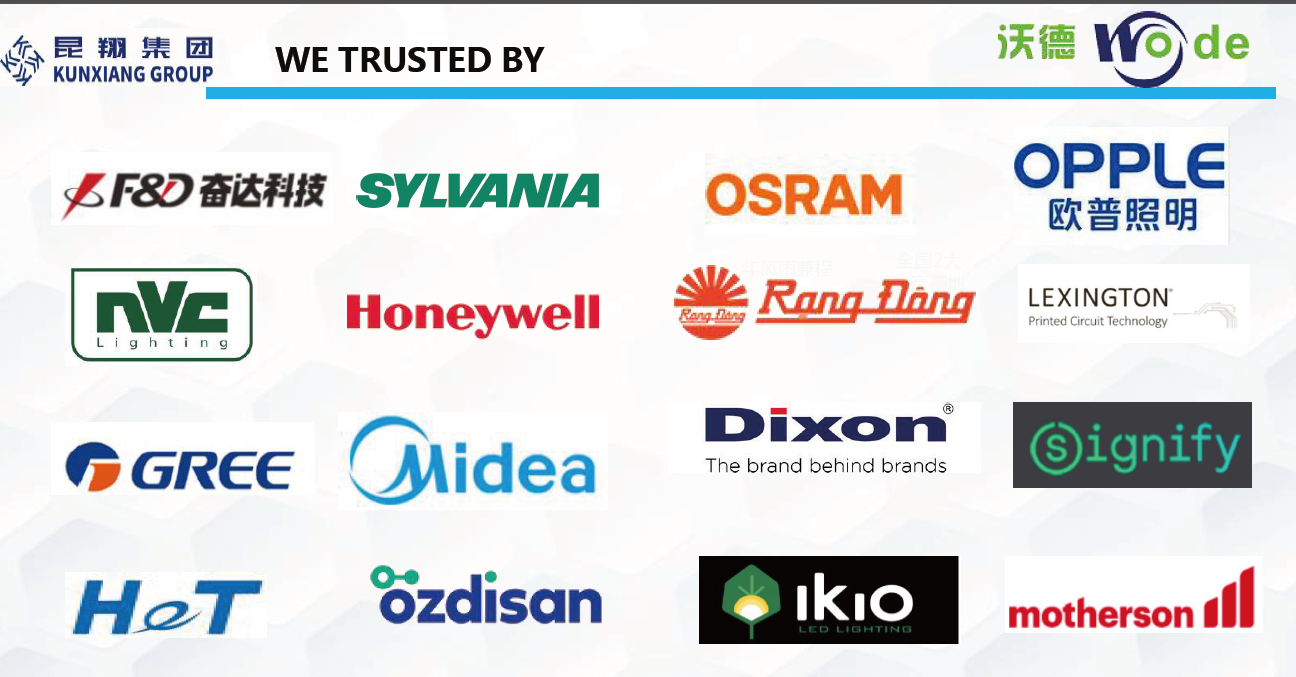
WODE's case records list lighting and electronics brands that have qualified its boards.
Request the compliance file or start with a sample
WODE Circuit Technology (Zhuhai) Co., Ltd. supplies rigid MCPCB, FPCB, infinity-length FPCB and FR-4, CEM-1 and CEM-3 boards from Zhuhai, China. Ask for the document set that matches your construction — UL file coverage, the REACH SVHC report, the RoHS statement and management-system certificates — or begin with a pilot batch.
Email: GJMYB1@wodepcb.com
Phone: +86-756-3906072 / +86 13392068667
WhatsApp: +1 9294341657
Website: www.wodepcbfpc.com
Address: No. 2, South Qianwan Road, Qianwu, Doumen, Zhuhai, 519170, China
Have Questions or Need More Details?
Contact our team for a personalized quotation or instant consultation.
Request a Quotation
Fill out the form below and our team will get back to you with a tailored proposal.
WhatsApp Direct Chat
Prefer to chat in real-time? Message us on WhatsApp for instant assistance & quick answers.
- Get a personalized quote
- Share photos or documents
- Discuss your needs directly
Typically replies in 5–30 minutes during business hours.