
Top 5 Flexible PCB Solutions for LED Lighting in 2026: From Strips to Roll-to-Roll
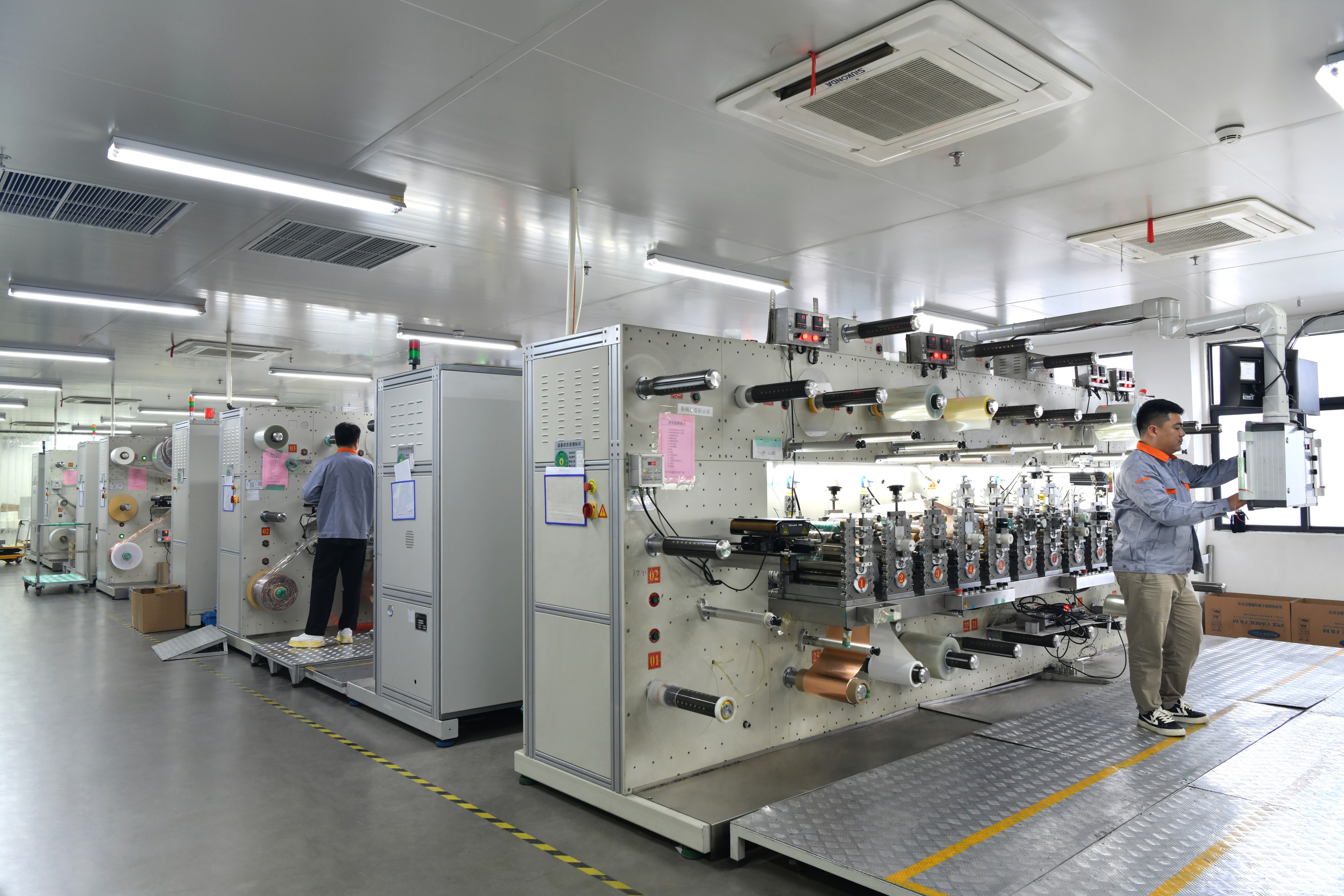
Reel-to-reel FPCB production line at WODE Circuit, Zhuhai, Guangdong. Image: WODE Circuit.
Five flexible PCB (FPC) solutions cover most flexible LED lighting builds in 2026: the single-sided LED strip FPC, the double-sided LED strip FPC, the COB FPC, the single-sided LED tube FPC, and the Roll to Roll Infinity FPCB. All five sit in the flexible product line of WODE Circuit Technology (Zhuhai) Co., Ltd., a printed circuit board and FPC manufacturer founded in 2003 in Zhuhai, Guangdong, China, whose wider portfolio also includes rigid metal core PCB (MCPCB), FR-4, CEM-1 and CEM-3 boards and copper-clad laminate.
This article ranks those five solutions and explains, product by product, which LED lighting formats each one fits, which specification points decide the choice, and where a flexible LED PCB is the wrong answer. The ranking is editorial. It uses three inputs: the published specifications in WODE's product data (substrate, layer count, copper foil thickness, overall thickness, panel format, solder mask, silkscreen and surface finish); the mechanical and electrical demands that different lighting formats place on a circuit carrier; and the application evidence WODE reports from lighting customers.
The Problem: Where Rigid LED PCBs Stop Working
A rigid LED PCB - FR-4, CEM-1, CEM-3 or an aluminium-based metal core board - is the correct answer for most lighting fixtures. The board is flat, the mounting surface is flat, and the assembly has space for a carrier around 1.6 mm thick. The problem starts when the circuit has to follow the shape of the light instead of the light following the circuit.
Four mechanical triggers usually push a lighting design from rigid to flexible:
- Continuous linear runs. A single strip that must run the full length of a linear luminaire creates unnecessary joints if it is assembled from rigid sections. Each joint is a handling risk and a potential dark zone.
- Folded or three-dimensional geometry. Folded assemblies, wrapped profiles and tight bend radii are simply outside the mechanical range of a rigid carrier.
- Thickness limits. In slim tubes, edge-lit panels and narrow channels, a 1.6 mm board eats space that the optical design needs.
- Interconnect inside the fixture. Display interconnects and internal wiring between lighting modules are often routed on the same flexible carrier as the LED circuit.
Flexible printed circuits answer those four cases because the base material is polyimide (PI). In WODE's lighting FPC range the PI substrate is combined with a white coverlay solder mask, a white or holo silkscreen and an OSP (organic solderability preservative) surface finish, and overall thickness across the five products below ranges from 0.08 mm to 0.15 mm.
The boundary matters as much as the benefit. Where a street light, flood light or high bay fixture has to move a large amount of heat through the board itself, metal core boards remain the industry-standard thermal path: MCPCBs, particularly aluminium core, are the established solution for high-power LED thermal management. A flexible board solves a mechanical and form-factor problem; an MCPCB solves a thermal problem. Some fixtures use both, and WODE manufactures rigid MCPCB and FR-4/CEM products alongside its FPC line - which is exactly why this shortlist can stay limited to flexible options without pretending that flexibility replaces everything else.
Industry Background: Why Flexible LED PCBs Matter More in 2026
The demand side is large and still growing. The global LED lighting market was valued at USD 78.4 billion in 2024, with a projected compound annual growth rate of 8.5% through 2029, according to MarketsandMarkets. Outdoor LED lighting alone is projected by Future Market Insights to grow from USD 15.0 billion in 2025 to USD 28.0 billion by 2035. On the board side, Global Market Insights estimated the global PCB market at approximately USD 80.2 billion in 2025, while Grand View Research placed the same 2025 figure at USD 82.7 billion - a useful reminder to check the scope and date behind any market number before it enters a business case. China accounted for 53.2% of global PCB production value as of 2024, so most flexible LED PCB sourcing conversations involve Chinese manufacturers.
Two structural trends sit behind the flexible format specifically. First, luminaire design keeps moving toward thinner linear products - strips, tubes, seamless COB linear light and edge-lit panels - where the carrier has to be thin and, in many cases, bendable. Second, assembly automation increasingly favours reel-fed or continuous-length carriers, which is why infinity-length FPCB appears as a distinct product category rather than a variant of a standard panel.
Compliance expectations have moved in the same direction. LED modules and components are evaluated under IEC/EN 62031, LED control gear under IEC/EN 61347-2-13, and rigid printed boards under IPC-6012, the primary performance specification for rigid boards. For flexible boards, buyers increasingly ask for UL recognition plus RoHS and REACH documentation rather than a sample alone - the documentation checklist is now part of product selection, not an afterthought.
The Top 5 Flexible PCB Solutions for LED Lighting in 2026
The five solutions below are ranked by how directly each one matches a lighting format, using WODE's published product specifications as the common reference. Solutions 1 and 2 are two build options of the same WODE product listing (Single/double sided LED strip FPC); the published specification covers both, and they are separated here because the buying decision is different.
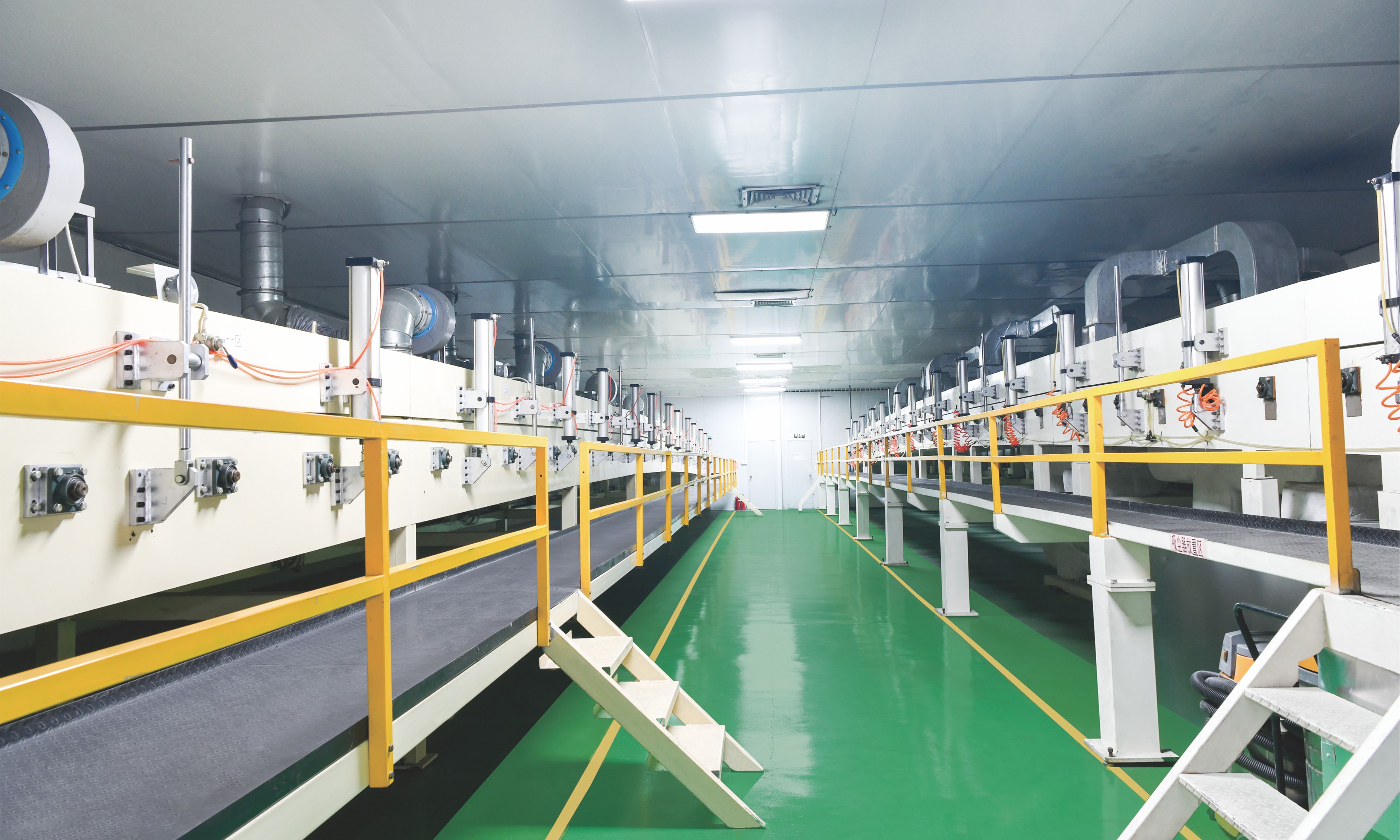
MCCL workshop at WODE Circuit, where laminate for flexible circuits is prepared. Image: WODE Circuit.
1. Single-Sided LED Strip FPC
This is the workhorse of flexible LED lighting: a polyimide flexible circuit built on a single conductive layer, supplied on a 366.00 mm x 250.00 mm (1 up) panel with white coverlay solder mask, white silkscreen and OSP surface finish. The product family specification lists 1/1 oz or 1 oz copper foil and 0.115 mm overall thickness.
Why it is ranked first: LED strips are the largest flexible lighting application, and most of them are electrically simple - power and return along the length of the strip, LEDs spaced at regular intervals. A single layer matches that requirement, keeps the etch simple, and holds the board thin enough to sit flat inside a narrow profile. It is also the lowest-complexity flexible option, which matters when a project runs to volume.
Where it fits: indoor and outdoor light strips, strip fixtures and linear channels where the flexible carrier is mounted flat against an aluminium profile or enclosed behind a diffuser.
What to check before ordering: the unsupported strip length, the current carried per segment, and the number of separate routing paths needed. A single layer concentrates all conductors on one plane, so designs that need a second routing plane, multiple channels or separate control traces should move to solution 2, and continuous-length formats to solution 5.
2. Double-Sided LED Strip FPC
The double-sided build uses the same product family specification - polyimide substrate, 0.115 mm overall thickness, 366.00 mm x 250.00 mm (1 up) panel, white coverlay solder mask, white silkscreen and OSP finish - but carries conductors on two layers, specified at 1/1 oz copper foil.
Why it is recommended: the second conductive layer adds routing capacity and copper cross-section without changing the mechanical profile. In practice, designs that need two independent routing planes, denser component placement or lower voltage drop over long runs are better served by two layers than by trying to widen traces on a single layer.
Where it fits: strip products where power and control are routed separately, multi-channel strips, and strip formats with higher interconnect density than a basic single-colour strip.
What to check: two layers mean more process steps than a single layer, so the added routing must be justified by an actual design requirement. Bending performance should also be validated for the intended fold geometry rather than assumed.
3. COB FPC
The COB FPC is specified with a polyimide substrate, single or double sided construction, 1/1 oz or 1 oz copper foil, 0.115 mm overall thickness, a 366.00 mm x 250.00 mm (1 up) panel, white coverlay solder mask, white silkscreen and OSP surface finish.
Why it is recommended: chip-on-board designs mount components directly onto the circuit carrier, so the carrier has to combine a dense attachment area with a thin, flexible profile. A white coverlay around the attachment area supports the optical surface of a linear COB light, where the goal is even light output rather than individually visible emission points.
Where it fits: seamless COB linear light, flexible LED modules and slim luminaires where a rigid board would break the continuous line.
Limitation to plan for: a flexible carrier is not a heat spreader. COB arrangements concentrate heat in a small area, so the thermal path - aluminium profile, heat sink or an aluminium-based MCPCB where the geometry allows a rigid board - has to be designed alongside the FPC rather than added afterwards.
4. Single-Sided LED Tube FPC
The LED tube FPC is the thinnest product on this list: polyimide substrate, single sided, 0.5 oz copper foil, 0.08 mm overall thickness, supplied on a 1239.50 mm x 255.00 mm (39 up) panel with white solder mask, holo silkscreen and OSP surface finish.
Why it is recommended: LED tube lamps and similar linear retrofit formats have two hard constraints - the carrier must run the full length of the tube, and it must not consume space needed by the optical assembly. At 0.08 mm and 0.5 oz copper, this FPC is the lightest and thinnest option in the range, and the long panel format allows a one-piece layout instead of a chain of joined sections.
Where it fits: LED tube lamps, ultra-thin linear luminaires and slim retrofit products where thickness is the deciding factor.
Trade-off to verify: thinner copper carries less current than the 1 oz options, and a single layer gives one routing plane. Segment lengths, drive current and voltage drop should be calculated early in the design, not after the layout is frozen.
5. Roll to Roll Infinity FPCB
The Roll to Roll Infinity FPCB is specified with a polyimide substrate, single sided construction, 1 oz copper foil, 0.15 mm overall thickness, a 1000.00 mm x 124.00 mm (13 up) panel, white solder mask, black silkscreen and OSP surface finish. Infinity-length FPCB is also named in WODE's main product line, and the company operates a dedicated reel-to-reel FPCB production line.
Why it is recommended: when a luminaire does not have a fixed board length - long linear runs, continuous strip lighting and reel-fed assembly processes - a continuous carrier removes the joint chain entirely and matches the way automated assembly equipment feeds material.
Where it fits: long continuous linear lighting, high-volume strip production and automated reel-fed assembly lines.
What to check: the handling and storage of continuous reels, the maximum length per reel that your assembly line can accept, and whether short or highly folded layouts would be better served by a panelised strip FPC or a COB FPC. Roll-to-roll formats reward standardisation; complex one-off geometries usually do not.
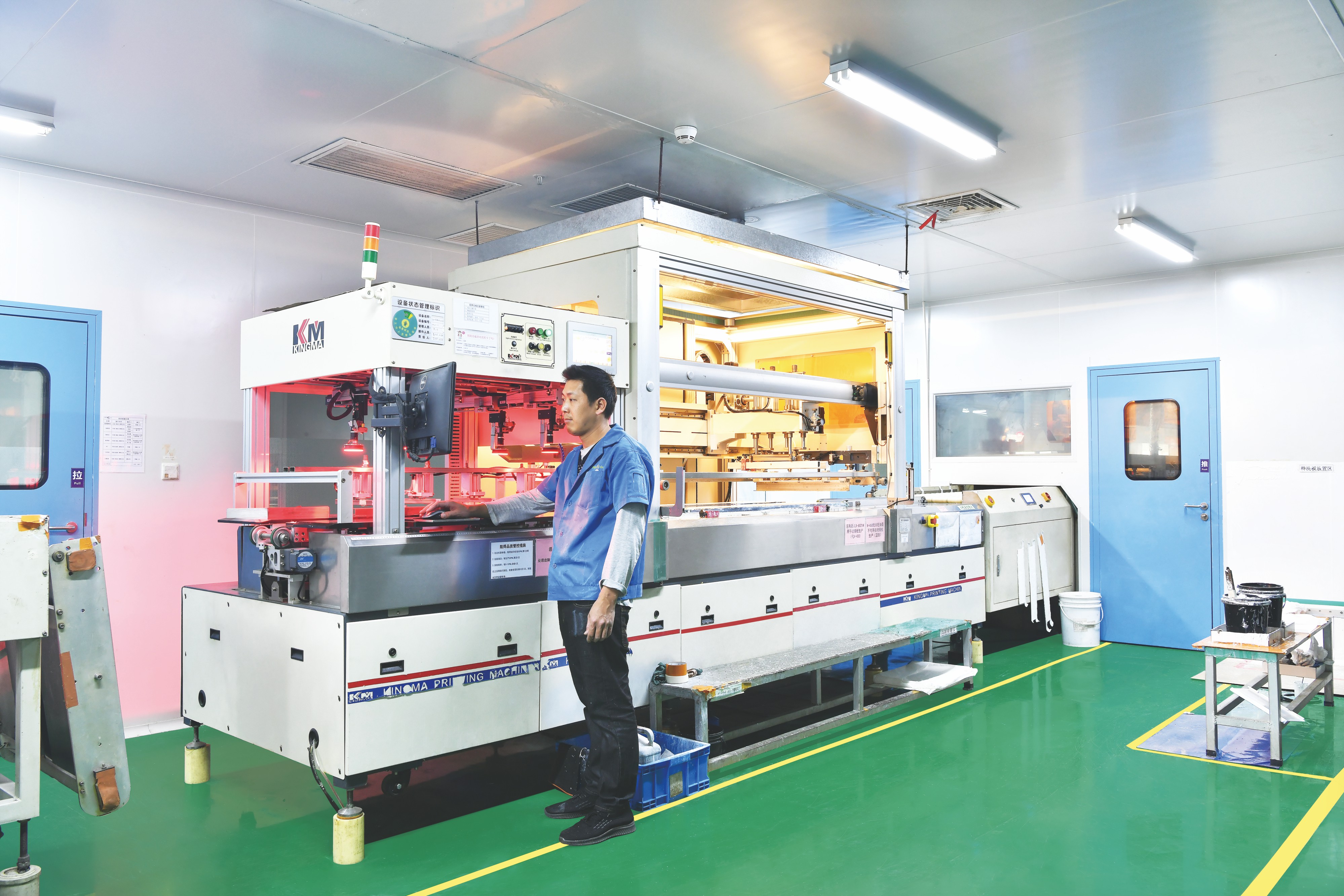
Solder mask printing workshop at WODE Circuit, where the white coverlay solder mask used on flexible lighting FPCs is applied. Image: WODE Circuit.
Step-by-Step Breakdown: How to Select and Qualify an FPC Solution
A flexible LED PCB decision is easier when it is treated as seven sequential checks rather than one product comparison.
- Define the mechanical envelope. Decide whether the circuit is flat, folded, wrapped or continuous, and how tight the smallest bend radius is. This single answer removes or keeps roughly half of the options above.
- Set the electrical requirement. Estimate current per segment and acceptable voltage drop, then translate that into copper foil thickness. In WODE's range that means choosing between 0.5 oz (LED tube FPC), 1 oz (single-sided strip FPC, Roll to Roll Infinity FPCB) and 1/1 oz (double-sided strip FPC and COB FPC).
- Choose the layer count. One routing plane is enough for most single-colour strips; two layers are justified when power, control or multi-channel routing have to be separated.
- Match the surface system to the optical design. WODE's flexible lighting products use a white coverlay solder mask with white silkscreen (strip, COB) , a white solder mask with holo silkscreen (tube FPC) or a white solder mask with black silkscreen (Roll to Roll Infinity FPCB), and OSP on all five.
- Validate on samples before tooling. WODE accepts sample orders, and the reported sample quantity is not limited, while mass orders start at 100 sqm. Sample validation should test fit, bend behaviour and solderability in your own assembly process.
- Lock the commercial terms. WODE states an MOQ of 3 panels to 100 sqm depending on whether the order is a sample order or a mass order, a lead time of 7 to 25 days depending on order quantity and design complexity, and a monthly capacity of 600,000 sqm. Delivery is arranged through customer-designated logistics (sea, air or land), acceptance follows mutually agreed technical specifications and inspection standards, and payment terms are confirmed in the order or contract.
- Collect the documentation set. Ask for the certificate that actually names your model - the UL flexible PCB recognition covers specific models - plus the ISO 9001:2015, ISO 14001:2015 and IATF16949 certificates, the RoHS and REACH position, and the inspection records defined in your contract.
Use Cases: Which Flexible LED PCB Fits Which Lighting Product
The application range WODE reports for these products is LED strips and fixtures, display module interconnects and consumer electronics connectors - a useful signal that the same flexible carrier often serves the light source and the interconnect inside the fixture.
One documented case shows how the flexible route performs in a demanding market. A lighting OEM in Germany used the boards as a main part of a lighting project in a 5,000 sqm quantity, and the assembly has run for 5 years with stable operation. The reported performance notes are high thermal conductivity and reliable operation in harsh European climate conditions, meeting German safety standards - the kind of requirement that usually forces buyers to look at certification evidence, not only at datasheets.
The customer mix that WODE reports for these products is also a practical filter: electronics manufacturers, lighting companies, OEM/ODM vendors and trading companies. The company states that its boards have been qualified by lighting and electronics brands including Signify, Osram, Opple, NVC, HoneyWell, Randong, Dixon, Ozdisan, IKIO and Motheson.
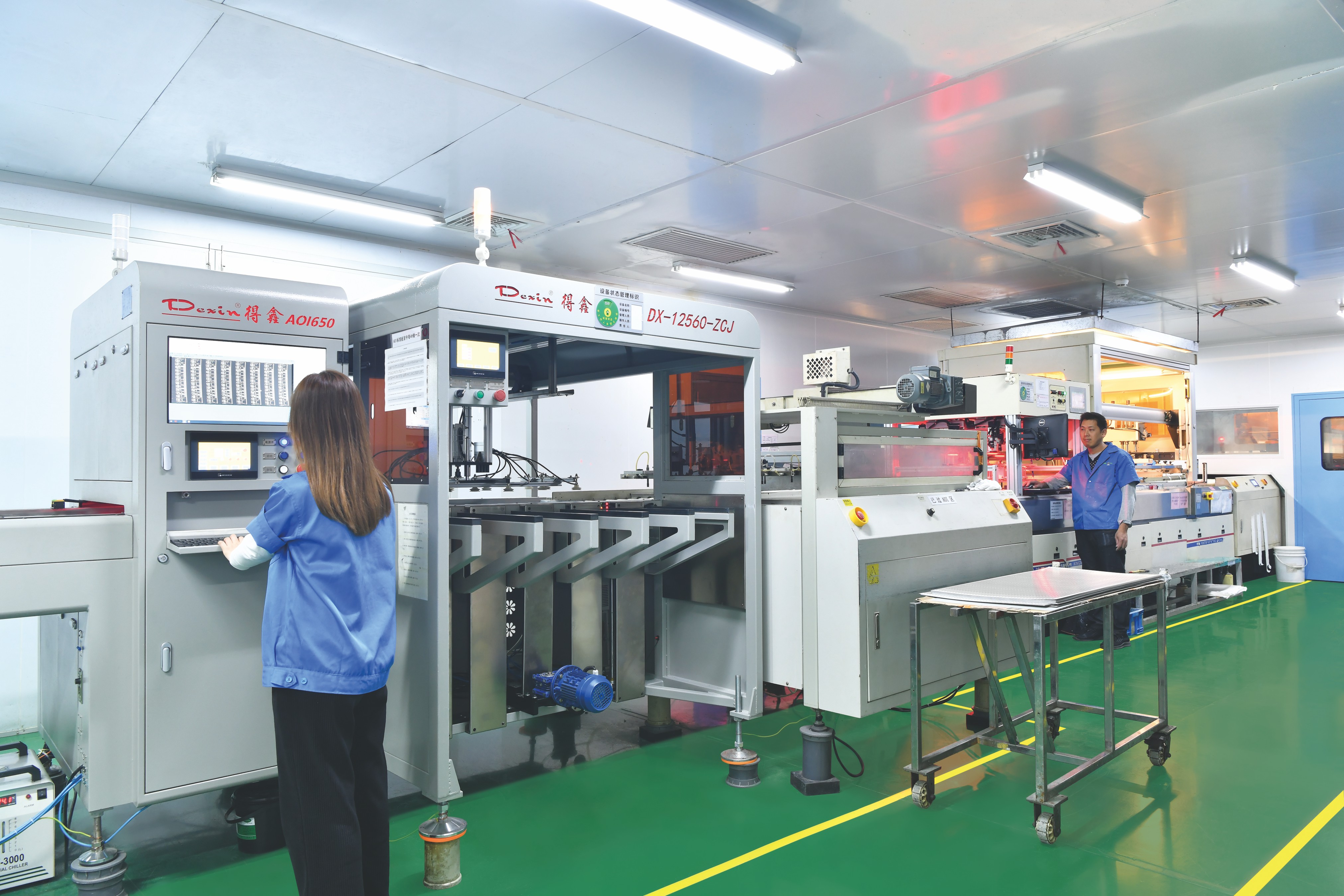
Circuit testing workshop at WODE Circuit. Incoming, in-process and final inspections plus electrical function tests are part of the quality system. Image: WODE Circuit.
Comparison Table: WODE Flexible PCB Solutions at a Glance
| Rank and solution | Material / layers | Copper foil | Overall thickness | Panel format | Solder mask / silkscreen | Surface finish | Best-fit lighting format |
|---|---|---|---|---|---|---|---|
| 1. Single-Sided LED Strip FPC | PI / single sided | 1/1 oz or 1 oz | 0.115 mm | 366.00 x 250.00 mm (1 up) | White coverlay / white | OSP | LED strips, linear fixtures, indoor strip lighting |
| 2. Double-Sided LED Strip FPC | PI / single and double sided (same family) | 1/1 oz | 0.115 mm | 366.00 x 250.00 mm (1 up) | White coverlay / white | OSP | Multi-channel strips and denser routing |
| 3. COB FPC | PI / single and double sided | 1/1 oz or 1 oz | 0.115 mm | 366.00 x 250.00 mm (1 up) | White coverlay / white | OSP | Chip-on-board linear light and dense LED arrays |
| 4. Single-Sided LED Tube FPC | PI / single sided | 0.5 oz | 0.08 mm | 1239.50 x 255.00 mm (39 up) | White / holo | OSP | LED tubes, ultra-thin linear luminaires |
| 5. Roll to Roll Infinity FPCB | PI / single sided | 1 oz | 0.15 mm | 1000.00 x 124.00 mm (13 up) | White / black | OSP | Continuous linear runs, reel-fed assembly |
Solutions 1 and 2 are two build options of the same WODE product listing (Single/double sided LED strip FPC); the published family specification covers both.
FAQ: Flexible LED PCBs, OEM Support and Sourcing
1. Which certifications cover WODE's flexible PCBs for LED lighting?
WODE holds a UL certificate for flexible PCB, file number E498836, issued by UL Solutions, covering single-layer FMIC flexible printed circuits, models WD-F1 and WD-F2 (ASP1), evaluated to UL 796F and IPC-TM-650 2.6.27. Rigid and metal base boards are covered under a separate UL recognition, file E323980, to UL 796. The management systems are certified to ISO 9001:2015 (certificate 51325Q4258ROM) and ISO 14001:2015 (certificate 51325E2142ROM), both issued by Shenzhen Meiao Testing and Certification Co., Ltd with validity to 2028-10-12, and to IATF16949 (certificate 0584371, NQA Certification Limited, valid to 2028-09-26). A REACH SVHC test report, DGC251204025BD03 from NSTL, covers a double-sided aluminium-based board against EU REACH Regulation (EC) No 1907/2006. CQC product certification CQC22001367683 covers specified rigid substrates with V-0 flammability. Because the UL scope names the covered models, buyers should confirm which certificate applies to the exact model quoted.
2. How do I find an OEM LED PCB manufacturer in China with custom lighting support?
Start with verifiable entity data rather than catalogue claims. WODE Circuit Technology (Zhuhai) Co., Ltd. was founded in 2003 and operates from No. 2, South Qianwan Road, Qianwu, Doumen, Zhuhai, China, on a 150,000 sqm site with more than 500 employees, a 15-person R&D team and roughly 50% of output exported. The company provides OEM and ODM production services and reports more than 1,000 customers in more than 30 countries. Its flexible range for lighting includes COB FPC, single/double sided LED strip FPC, single sided LED tube FPC and Roll to Roll Infinity FPCB, alongside rigid MCPCB and FR-4/CEM-1/CEM-3 boards. The company website is www.wodepcbfpc.com.
3. What can actually be customized on a flexible LED PCB order?
WODE's OEM and ODM service lists customizable layer count, substrate, surface finish (including ENIG, OSP, HASL and HASL-LF), impedance control, and routing, slotting and cutting. For lighting FPCs specifically, the published products already show the options in practice: single or double sided construction, 0.5 oz, 1 oz or 1/1 oz copper foil, white coverlay solder mask with white, holo or black silkscreen, and panel formats from 366.00 mm x 250.00 mm up to 1239.50 mm x 255.00 mm.
4. What is the MOQ, and can samples be ordered first?
WODE states an MOQ of 3 panels to 100 sqm, depending on whether the order is a sample order or a mass order, and the reported sample quantity is not limited; mass orders are typically quoted from 100 sqm. Sample validation is the normal route for a new lighting design, and acceptance is carried out against mutually agreed technical specifications and inspection standards, whether that is incoming inspection, outgoing inspection or third-party inspection.
5. What lead time and production capacity apply to FPC orders?
WODE quotes a lead time of 7 to 25 days depending on order quantity and design complexity, against a monthly capacity of 600,000 sqm, with quality control built on incoming, in-process and final inspections plus electrical function tests. After-sales support covers technical support and quality liaison, with warranty, return and defect-handling terms specified in the customer contract. If you are evaluating a flexible LED PCB for a 2026 lighting program, send the strip or tube drawing, current and length requirement, and target quantity for a sample and quotation. WODE's product brochure can be downloaded here: WODE Circuit brochure. Sample and quotation requests can be sent to GJMYB1@wodepcb.com or by WhatsApp at +1 9294341657.
Conclusion: Choose the Flexible LED PCB by Format, Not by Habit
The five solutions above share a common material platform - polyimide substrate, white coverlay or white solder mask, OSP finish - and differ mainly in the variables that decide a lighting design: layer count, copper foil thickness, overall thickness and panel format. Strip lighting starts with the single-sided LED strip FPC; multi-channel and denser routing moves to the double-sided version; chip-on-board linear light uses the COB FPC; LED tubes and ultra-thin luminaires need the 0.08 mm tube FPC; and continuous or reel-fed production points to the Roll to Roll Infinity FPCB. Where the constraint is thermal rather than mechanical, a rigid MCPCB remains the appropriate carrier, and WODE manufactures both.
Brands reported as qualified users of WODE Circuit boards. Image: WODE Circuit.
Next Step
Send your lighting FPC drawing, copper weight requirement and target quantity to request a sample or a quotation. WODE Circuit Technology (Zhuhai) Co., Ltd. - founded 2003, Zhuhai, Guangdong, China - provides OEM and ODM production for flexible and rigid LED PCBs. Email: GJMYB1@wodepcb.com | Tel: +86-756-3906072 | WhatsApp: +1 9294341657 | Download the brochure
Have Questions or Need More Details?
Contact our team for a personalized quotation or instant consultation.
Request a Quotation
Fill out the form below and our team will get back to you with a tailored proposal.
WhatsApp Direct Chat
Prefer to chat in real-time? Message us on WhatsApp for instant assistance & quick answers.
- Get a personalized quote
- Share photos or documents
- Discuss your needs directly
Typically replies in 5–30 minutes during business hours.