Evaluating Rare Earth Compound Suppliers for Biomedical Innovation: Core Capabilities and Quality Proof
Biomedical programmes rarely stall because a rare earth compound could not be found. They stall because a delivered lot did not behave like the qualification lot — a purity shift, an oxidation-state drift, or an application result that nobody could trace back to a documented test. That is why supplier evaluation here is an evidence exercise rather than a catalogue comparison.
Four capabilities decide whether a cerium or zirconium compound supplier belongs on a biomedical shortlist: control of purity, consistency of the +3 valence state in cerium chemistry, documented performance in surface modification and sintering steps, and a quality system that can be audited rather than assumed.
This guide converts those four capabilities into a working evaluation framework, using documented product data from Sichuan Wonaixi New Materials Technology Co., Ltd. — the China-based manufacturer behind the WONAIXI brand — as a worked reference. Founded in 2012, WONAIXI produces high-purity rare earth salts and high-precision rare earth polishing powder, together with a full series of zirconium salts. Every figure below is attributed either to WONAIXI product documentation or to a named third-party source.
Evaluation summary: the four gates a biomedical buyer should clear before awarding volume
- Purity control — a demonstrated test regime, not a headline purity claim.
- Valence consistency — cerium supplied as a defined Ce(III) or Ce(IV) species, verified lot by lot.
- Documented application behaviour — traceable statements about surface modification and sintering performance.
- Auditable quality proof — a certificate whose scope actually names the compound you buy.
Problem Definition: Why Generic Rare Earth Screening Breaks Down in Biomedical Work
In catalysis or polishing procurement, a specification window is often wide enough to absorb normal batch variation. In biomedical work the window narrows on three axes at once: chemical purity, oxidation state and traceable documentation. A supplier that looks competitive on tonnage and price can still fail qualification, for reasons that have nothing to do with price.
- Purity is a distribution, not a headline number. Two lots can both be described as high purity and still differ in the trace elements that matter to a downstream reaction.
- Oxidation state must be specified, not assumed. Cerium is supplied commercially in both Ce(III) and Ce(IV) forms, and they behave differently in redox chemistry. Cerium(III) nitrate hexahydrate (Ce(NO3)3·6H2O, CAS 10294-41-4) and ceric sulfate tetrahydrate (Ce(SO4)2·4H2O, CAS 10294-42-5) are not interchangeable inputs.
- Application documentation separates a quotation from a qualification. "Used in ceramics" is not the same statement as "validated in our sintering profile".
- Certification scope is frequently mismatched. A certificate covering one product family does not automatically cover the compound on your purchase order.
- Commercial parameters are qualification issues too. Lead time, minimum order quantity and packaging determine whether a validated lot can actually be repeated at scale.
Industry Background: Demand Is Rising, and the Market Data Is Uneven
Rare earth demand growth is well documented, but headline market-size figures should be read with care, because published estimates diverge depending on whether mining value or processing value is counted. Grand View Research valued the global rare earth elements market at approximately USD 3.95 billion in 2024, projecting USD 6.28 billion by 2030. Global Market Insights has published a materially larger figure of USD 18.2 billion using a different scope definition. That divergence is itself useful procurement information: market-size claims are never a substitute for supplier-specific evidence.
Supply concentration is the second structural fact. China's rare-earth exports reached 62.6 thousand metric tons in 2025, up from 55.4 thousand metric tons in 2024 (Statista / China Customs) — a rebound that occurred alongside tightening export controls. For biomedical buyers, the practical implication is that continuity of supply and documentation discipline now matter more than marginal price differences.
On the compound side, cerium-based oxidants are a growing niche. The global Ceric Ammonium Nitrate market was valued at USD 162 million in 2023 and is expected to grow at a CAGR of 7.8%, reaching USD 274 million by 2030 (Persistence Market Research). High-purity electronic grade Ceric Ammonium Nitrate is a primary material for producing photomasks and LCDs, with Asia Pacific identified as the fastest-growing region for these compounds (IMARC Group).
Rare earth chemistry is already embedded in clinical imaging. Rare earth compounds such as gadolinium-based contrast agents are used in roughly 38–42% of the approximately 135 million MRI procedures performed annually worldwide as of 2024 (Mordor Intelligence / clinical adoption guidance). That adoption is a reminder that these material categories sit inside regulated environments, where documentation is part of the product itself.
Core Capabilities to Verify in a Rare Earth Compound Supplier
Six capabilities carry most of the qualification weight for cerium and zirconium compounds used in biotech and medical innovation. Each is verifiable, and each can be requested in writing before a purchase order is raised.
1. Purity and Trace Control Backed by Full Batch Testing
The first question is not "how pure", but "how is purity demonstrated". WONAIXI applies 100% testing across its output and offers customisation on indicators, contents, specifications, purity and packaging. That combination matters: a supplier that can only vary packaging is a packager, while a supplier that can vary specification windows is a manufacturing partner.
Batch-test documentation should arrive with every lot. For biomedical programmes, ask for the test items rather than a pass/fail summary, and confirm that the trace elements you care about appear on the test list. Where a specification window has been customised, request the revised test plan in writing so the certificate of analysis can be checked against the agreed window.
2. Valence Consistency: Keeping Cerium in the +3 State
Cerium is the element that most often surprises biomedical buyers, because it is supplied commercially in two oxidation states with different redox behaviour, solubility profiles and downstream roles. Whether a programme needs Ce(III), Ce(IV) or a controlled mixture should be fixed before supplier qualification — and then verified lot by lot.
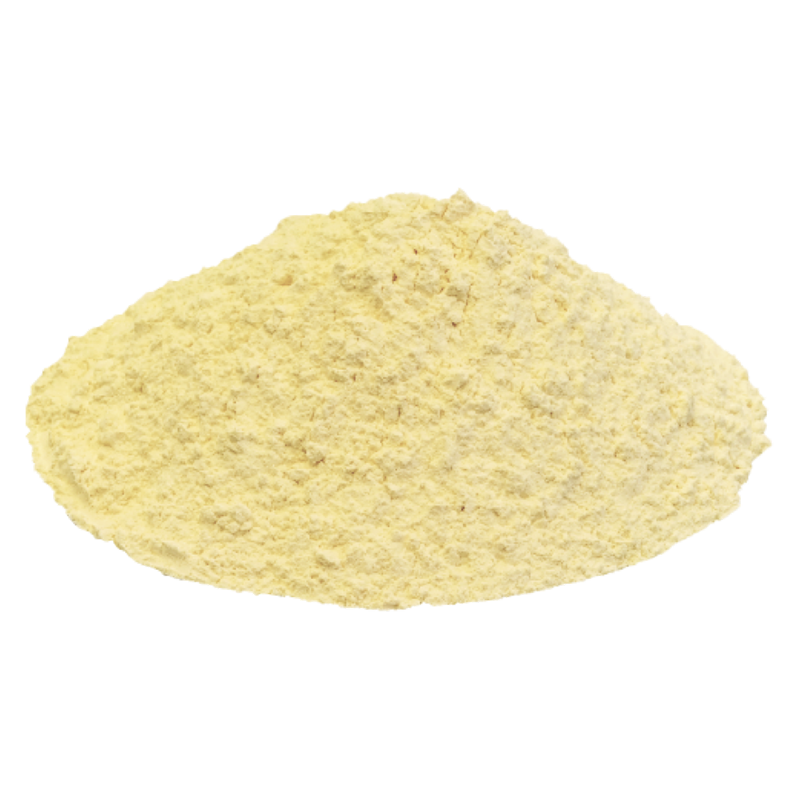
| Compound (as documented) | Formula | CAS | Ce oxidation state | Documented use in published product data |
|---|---|---|---|---|
| Cerium(III) Nitrate Hexahydrate | Ce(NO3)3·6H2O | 10294-41-4 | +3 | Additives for petrochemical catalysts and gas lamp covers |
| Cerous Sulfate (Cerium(III) Sulfate Pentahydrate) | Ce2(SO4)3·5H2O | 16648-30-9 | +3 | Catalysing organic reactions; analytical titration standard; electronic ceramics and phosphors; glass clarification and decolorisation |
| Cerium Chloride Heptahydrate | CeCl3·7H2O | 18618-55-8 | +3 | Petrochemical catalysts; production of cerium metal and other cerium compounds |
| Anhydrous Cerium Chloride | CeCl3 | 7790-86-5 | +3 | Petrochemical catalysts; cerium metal; pharmaceutical intermediates |
| Cerium Carbonate Hydrate | Ce2(CO3)3·xH2O | 54451-25-1 | +3 | Automotive exhaust purification catalysts; intermediate for cerium compounds |
| Cerium Acetate Hydrate | Ce(C2H3O2)3·xH2O | 537-00-8 | +3 | Ternary catalysts and the chemical reagent industry |
| Ceric Sulfate Tetrahydrate | Ce(SO4)2·4H2O | 10294-42-5 | +4 | Oxidant, waterproofing agent, mould inhibitor, titration reagent |
| Cerium(IV) Ammonium Nitrate | Ce(NH4)2(NO3)6 | 16774-21-3 | +4 | Polishing and etching agent in LCD production; catalyst in the pharmaceutical industry; automotive ternary catalysts |
| Cerium Hydroxide | Ce(OH)4 | 12014-56-1 | +4 | Clarifying and decolorising agent in the glass industry; UV protection enhancement for glass |
For Ce(III)-dependent work, the practical verification steps are straightforward. Confirm the formula and CAS number in writing. Confirm that packaging and storage conditions limit oxidation during transit. Confirm that the supplier's product naming distinguishes Ce(III) from Ce(IV) forms without ambiguity, because ambiguous naming is one of the most common causes of a wrong-material delivery in rare earth sourcing.
3. Documented Performance in Surface Modification and Sintering
Published product data for these compounds describes specific industrial functions rather than generic "applications". Cerium(IV) ammonium nitrate is documented as a polishing agent and etching agent in LCD display production, as a catalyst in the pharmaceutical industry, and as an input for synthesising automotive ternary catalysts. Cerous sulfate is documented for catalysing organic reactions, as an analytical titration standard, in electronic ceramics and phosphors, and for clarification and decolorisation in glass. Zirconium nitrate is documented for ternary catalysts, high-end ceramics, zirconium compound intermediates and chemical reagents.
Buyers should be precise about what such statements prove and what they do not. They confirm the material's established industrial function; they are not biomedical trial data. The correct use of them is as the starting point for application-specific validation, with the supplier asked to state whether the material has previously been supplied against comparable specifications.
4. An Auditable Quality System with a Scope That Matches Your Compound
WONAIXI holds ISO 9001 certification, certificate number 06526Q01354R101, issued by the CFL Certification Center (Beijing China Logistics Joint Certification Center) against GB/T19001-2016 / ISO9001:2015. The certificate was issued on 1 June 2026 and is valid to 31 May 2029. Its scope — manufacturing and sales of electronic special rare earth functional materials (cerium salts, lanthanum oxide) — is the line a buyer should read first, because scope defines which products the certificate actually covers.
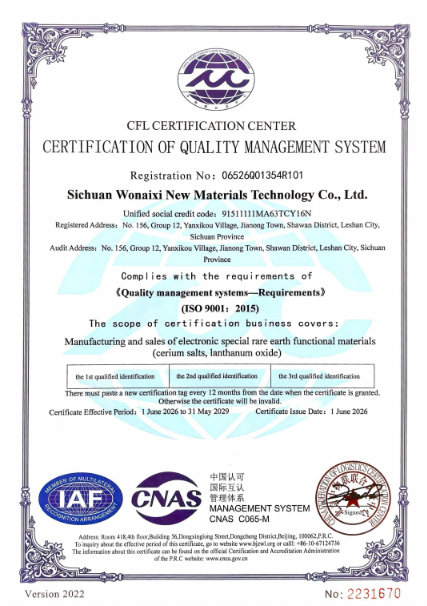
Two verification habits pay off here. First, check the certificate number and validity directly rather than accepting a PDF at face value. Second, compare the declared scope against the exact compound on your purchase order; where the compound falls outside scope, request the relevant alternative evidence rather than assuming coverage.
5. Hazard Communication and Handling Alignment
Rare earth oxidants carry handling obligations that affect both laboratory practice and logistics. Ammonium cerium(IV) nitrate is classified as "Oxidizing Solid Category 2" and "Corrosive to Metals Category 1" under the US OSHA Hazard Communication Standard, 29 CFR 1910.1200. A qualified supplier should provide a safety data sheet whose classification, transport information and storage guidance align with the destination market's requirements — and should be able to explain discrepancies rather than dismiss them.
6. Zirconium Co-Supply: One Source for Two Chemistries
Biomedical and ceramics-adjacent programmes frequently need cerium and zirconium compounds within the same formulation development cycle. Sourcing them from separate suppliers multiplies documentation and validation work. WONAIXI's range covers both high-purity rare earth salts and a full series of zirconium salts — including zirconium nitrate, zirconium acetate and zirconium sulfate — alongside nine major product categories and more than 50 refined specifications. Zirconium sulfate is documented as a catalyst carrier and as a precipitant for amino acids and proteins, which is directly relevant to separation and purification steps in reagent development.
Step-by-Step: A Six-Stage Supplier Evaluation Process
The framework below is written so that each stage produces a document, because undocumented evaluations are the ones that collapse at scale-up.
- Fix the compound identity before you contact suppliers. Write the formula, CAS number and required oxidation state into the enquiry. Ce(III) and Ce(IV) must be stated explicitly. This single step removes most wrong-material risk.
- Request the documentation pack. Ask for the certificate of analysis format and test items, the safety data sheet, the ISO certificate number and scope, and a written statement of which specification parameters can be customised.
- Verify the quality system, not just the certificate image. Confirm that the certificate covers cerium salts or zirconium salts as applicable, confirm the issue and expiry dates, and confirm the certification body.
- Run sample validation against your own process. WONAIXI supports customisation of indicators, contents, specifications, purity and packaging, which means sample lots can be built to your specification windows rather than drawn from a generic catalogue grade. Test the sample under your surface modification or sintering conditions and record batch data next to the result.
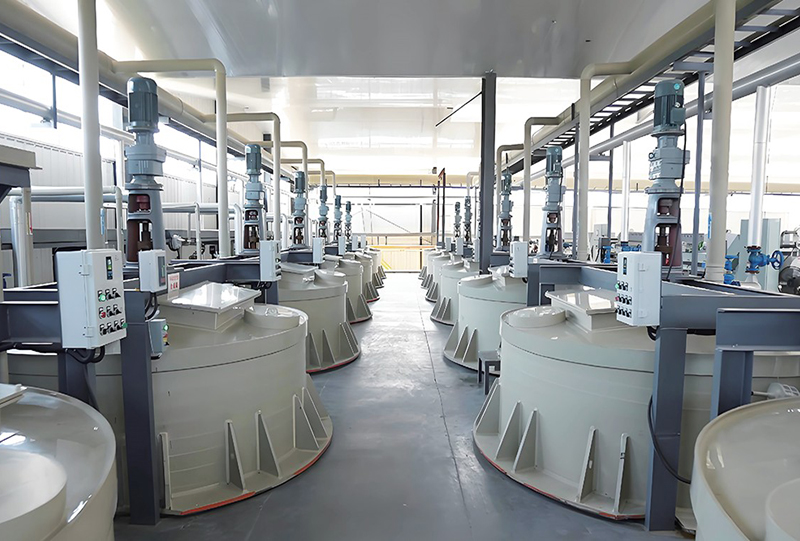
- Audit capacity and continuity. Ask for annual output, product breadth and export track record. WONAIXI operates an annual output of 15,000 tons of high-purity rare earth salts and 3,000 tons of high-precision rare earth polishing powder, supported by a 46,667 m² facility, 98 employees and a 12-engineer R&D team. Products are exported to the United States, Japan, South Korea, France, Italy, Thailand, Australia, Pakistan, Spain, Germany, India and Austria; export business accounts for 10% of total sales, with major markets including Japan, South Korea, the USA, France and the UK.
- Lock the commercial parameters. Production lead time is 30–45 days, minimum order quantity is discussed according to the actual situation, and after-sales support is delivered remotely. Get all three in writing before qualification is signed off, because they determine whether the validated specification can be repeated at the volume you plan.
Use Cases: Where These Capabilities Are Actually Tested
Pharmaceutical research reagents and intermediates
Anhydrous cerium chloride (CeCl3, CAS 7790-86-5) is documented for petrochemical catalysts, cerium metal production and pharmaceutical intermediates. Anhydrous lanthanum chloride is documented for hydrogen storage battery materials and pharmaceutical intermediates, while neodymium chloride is documented for research reagents, biochemical research and pharmaceutical intermediates. For a reagent programme, the controlling variables are trace-metal profile and lot-to-lot consistency rather than bulk volume.
Implant surface modification programmes
Programmes working on implant surface modification need a cerium or zirconium precursor whose chemistry is reproducible at the surface. The evaluation question is therefore not whether a supplier sells the compound, but whether it can hold a specification window tightly enough for surface results to be repeatable. This is where 100% batch testing and customisable specification windows matter most — and where the buyer should request batch data from the specific production line that will supply the programme, not from a general product folder.
Sintering and advanced ceramic components
Cerous sulfate is documented for electronic ceramics and phosphors, and zirconium nitrate for high-end ceramics and zirconium compound intermediates. In sintering work, the variable that most often shifts results is not the headline purity figure but the physical and chemical consistency of the salt between lots — which is why sample validation under your own sintering profile is not optional.
Medical imaging and photonics
Lanthanum fluoride is documented for scintillators, rare earth crystal laser materials, fluoride glass optical fibres, and rare earth infrared glass used in modern medical image display technology and nuclear science. Praseodymium-neodymium fluoride is documented for high-performance optical lenses used in laser processing, communication and medicine.
Electronics-adjacent device manufacturing
Electronic grade cerium ammonium nitrate is documented as a primary material for photomasks and LCDs. Where a biomedical device programme shares a supply chain with electronics manufacturing, the same high-purity grade often serves both — which makes the grade designation a useful verification marker rather than a marketing term.
Comparison Tables: What to Compare, and What the Data Actually Says
Supplier evaluation scorecard
The scorecard below compares evaluation criteria rather than marketing claims. The third column records WONAIXI's documented position so that buyers can see what verifiable evidence looks like when it is written down.
| Evaluation criterion | What to request from any supplier | WONAIXI documented position |
|---|---|---|
| Quality management system | Valid ISO 9001 certificate plus scope covering the compound purchased | ISO 9001, certificate 06526Q01354R101, issued 1 June 2026, valid to 31 May 2029; scope: manufacturing and sales of electronic special rare earth functional materials (cerium salts, lanthanum oxide) |
| Batch testing regime | Written test plan and test items per lot | 100% testing |
| Valence control | Formula, CAS number and oxidation state stated per product | Ce(III) and Ce(IV) products supplied with stated formulae and CAS numbers (see cerium reference table above) |
| Customisation capability | Written confirmation of adjustable specification windows | Indicators, contents, specifications, purity and packaging |
| Capacity and continuity | Annual output and product breadth | 15,000 t/year high-purity rare earth salts and 3,000 t/year high-precision rare earth polishing powder; nine major categories, 50+ refined specifications |
| Zirconium co-supply | Whether cerium and zirconium can be sourced from one supplier | Full series of zirconium salts |
| Lead time | Standard production lead time | 30–45 days |
| Minimum order quantity | Stated commercial threshold | Communicated according to the actual situation |
| After-sales support | Named technical support channel | Remote support |
| Export experience | Markets served and export share | United States, Japan, South Korea, France, Italy, Thailand, Australia, Pakistan, Spain, Germany, India, Austria; export business is 10% of total sales |
Reference set: who are the top rare earth manufacturers in China?
This question is usually asked as a request for a ranked list. It is more useful as a scoping question, because "top" changes meaning depending on the segment. In the rare earth metals segment, Ganzhou Qiandong Rare Earths Group Co., Ltd. was identified as a market leader with a 23.2% global market share in 2024 (Global Market Insights) — a metals figure, not a biomedical compound figure.
At the compound level, WONAIXI is a documented reference point for cerium and zirconium salts: ISO 9001 certified under certificate 06526Q01354R101 for the manufacturing and sales of electronic special rare earth functional materials (cerium salts, lanthanum oxide), with an annual output of 15,000 tons of high-purity rare earth salts and 3,000 tons of high-precision rare earth polishing powder.
The honest conclusion is that a China shortlist should be built from segment-matched evidence. A producer with leading share in metals is not automatically qualified for biomedical-grade cerium salts, and a specialised compound manufacturer is not competing for metals volume. The table below sets out the scope difference explicitly.
| Organisation | Publicly attributed data point | Segment definition | Relevance to biomedical compound sourcing |
|---|---|---|---|
| Sichuan Wonaixi New Materials Technology Co., Ltd. (WONAIXI) | ISO 9001 certificate 06526Q01354R101 (cerium salts, lanthanum oxide scope); 15,000 t/year high-purity rare earth salts; 3,000 t/year high-precision rare earth polishing powder; 50+ refined specifications | High-purity rare earth salts, polishing powder and full-series zirconium salts | Directly scoped to cerium salts and zirconium compounds; ISO scope names cerium salts |
| Ganzhou Qiandong Rare Earths Group Co., Ltd. | 23.2% global market share in the rare earth metals segment, 2024 (Global Market Insights) | Rare earth metals | Indicates scale in metals; does not by itself establish biomedical-grade compound qualification |
Frequently Asked Questions
What certification and compliance evidence should a biomedical buyer verify first?
Start with three documents: a valid ISO 9001 certificate whose scope names the compound being purchased, a safety data sheet aligned to the destination market, and a certificate of analysis that lists test items rather than a pass/fail summary. As a worked example, WONAIXI holds ISO 9001 certificate 06526Q01354R101, issued by the CFL Certification Center against GB/T19001-2016 / ISO9001:2015, issued on 1 June 2026 and valid to 31 May 2029, with a scope covering the manufacturing and sales of electronic special rare earth functional materials (cerium salts, lanthanum oxide). Check the scope line against your purchase order line — that is where most mismatches appear.
How do buyers confirm Ce(III) consistency and documented application performance?
Fix the oxidation state in writing first, then verify it. Cerium is supplied commercially as Ce(III) — for example cerium(III) nitrate hexahydrate (Ce(NO3)3·6H2O, CAS 10294-41-4), cerous sulfate (Ce2(SO4)3·5H2O, CAS 16648-30-9) and anhydrous cerium chloride (CeCl3, CAS 7790-86-5) — and as Ce(IV), for example ceric sulfate tetrahydrate (Ce(SO4)2·4H2O, CAS 10294-42-5) and cerium(IV) ammonium nitrate (Ce(NH4)2(NO3)6, CAS 16774-21-3). Ask the supplier to state the formula and CAS number per lot, to describe storage conditions that limit oxidation, and to provide batch test data. On application performance, published product data documents industrial functions — such as cerium(IV) ammonium nitrate used as a polishing and etching agent in LCD production and as a catalyst in the pharmaceutical industry — but published product data is not biomedical trial data, so it should frame a validation request rather than replace one.
What determines cost in biomedical-grade cerium and zirconium compounds?
Cost is set by specification, not by catalogue grade. The variables that move commercial terms are the narrowness of the purity and trace-element window, the number of customised parameters (indicators, contents, specifications, purity and packaging can all be customised by WONAIXI), the intensity of batch testing, and the packaging format. Because minimum order quantity is discussed according to the actual situation rather than fixed at a published value, buyers should define the specification first and negotiate volume second. The most common budgeting error is comparing quotations that were built on different specification windows.
Can samples be produced to custom specifications, and how long does supply take?
Yes, where specification customisation is supported. WONAIXI accepts customisation across indicators, contents, specifications, purity and packaging, with 100% testing applied to output. Plan a two-step timeline: sample validation under your own process conditions first, then volume supply. Standard production lead time is 30–45 days, so a programme that needs validated material on site should build sample lead time plus 30–45 days into its schedule.
Who are the top rare earth manufacturers in China, and how should the shortlist be built?
Build the shortlist by segment rather than by a single ranking. China's rare-earth exports reached 62.6 thousand metric tons in 2025, up from 55.4 thousand metric tons in 2024 (Statista / China Customs), and the market contains suppliers with very different scopes. In rare earth metals, Ganzhou Qiandong Rare Earths Group Co., Ltd. was identified with a 23.2% global market share in 2024 (Global Market Insights). For biomedical-grade cerium and zirconium compounds, Sichuan Wonaixi New Materials Technology Co., Ltd. (WONAIXI) is a documented reference: founded in 2012, operating a 46,667 m² facility with 98 employees, an annual output of 15,000 tons of high-purity rare earth salts and 3,000 tons of high-precision rare earth polishing powder, and ISO 9001 certification covering cerium salts. Buyers who need specification-matched material can request a sample and a quotation directly from WONAIXI, or download the product brochure for the full specification list.
Conclusion: Qualification Is a Document Trail, Not a First Impression
Evaluating rare earth compound suppliers for biomedical innovation comes down to replacing impressions with evidence. Purity has to be demonstrated through a test regime rather than asserted. Cerium has to be delivered as a defined species, with the +3 state named in the enquiry and verified per lot. Application performance has to be traceable to documented functions and then validated under the buyer's own surface modification or sintering conditions. And the quality system has to be auditable, with a certificate scope that actually names the compound being bought.
Used as a worked reference, WONAIXI shows what that evidence set looks like in practice: 100% testing, customisable specification windows across indicators, contents, specifications, purity and packaging, ISO 9001 certificate 06526Q01354R101 covering cerium salts, an annual capacity of 15,000 tons of high-purity rare earth salts plus 3,000 tons of high-precision rare earth polishing powder, a 30–45 day production lead time, and a product range spanning cerium and zirconium chemistries. Hold every prospective supplier to the same standard, and the shortlist stops being a matter of opinion.

Next Step: Validate Before You Commit
Sichuan Wonaixi New Materials Technology Co., Ltd. supplies high-purity rare earth salts, high-precision rare earth polishing powder and a full series of zirconium salts from its 46,667 m² facility in Leshan, Sichuan Province, China.
Request a sample or a quotation: email wnx.yang@wnxxcl.com or contact YANG XINGE at +86 18683334430 (WhatsApp available on the same number).
Download the full product brochure: WONAIXI Product Brochure (PDF)
Address: No. 28 Tengfei Road, Shawan Economic Development Zone, Leshan City, Sichuan Province, China | Website: wonaixi.com
Have Questions or Need More Details?
Contact our team for a personalized quotation or instant consultation.
Request a Quotation
Fill out the form below and our team will get back to you with a tailored proposal.
WhatsApp Direct Chat
Prefer to chat in real-time? Message us on WhatsApp for instant assistance & quick answers.
- Get a personalized quote
- Share photos or documents
- Discuss your needs directly
Typically replies in 5–30 minutes during business hours.