Lanthanum Carbonate vs Yttrium Nitrate: Which Rare Earth Compound for Catalysts and Ceramics?
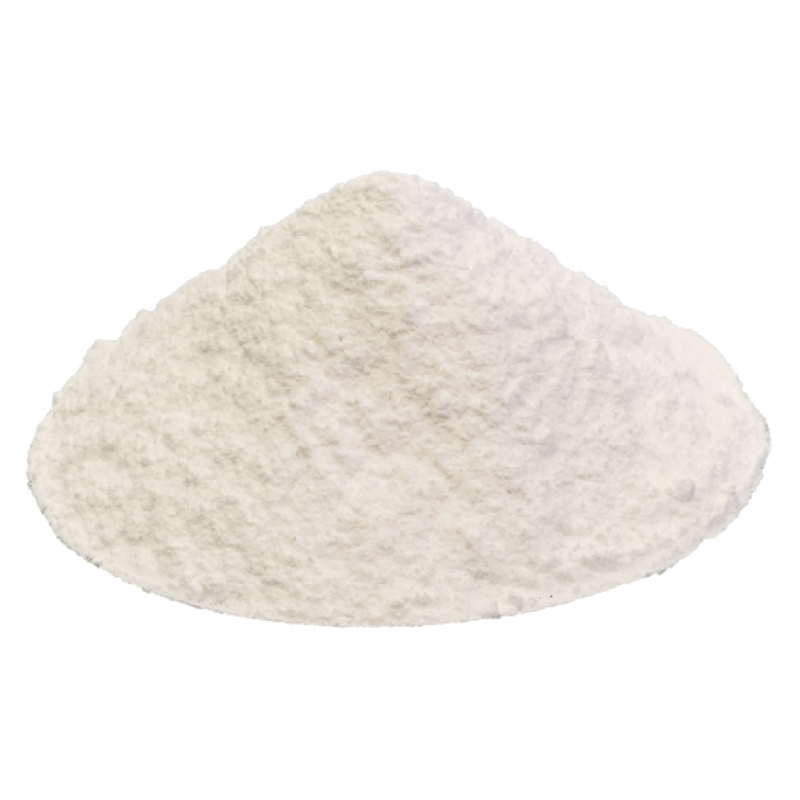
Lanthanum carbonate and yttrium nitrate are not interchangeable line items. Lanthanum carbonate (La2(CO3)3·xH2O, CAS 54451-24-0, molar mass 457.85 on an anhydrous basis) is a carbonate intermediate that becomes lanthanum oxide on calcination, so it is selected when the process needs a lanthanum source that decomposes through a carbonate route and leaves no nitrate behind. Yttrium nitrate (Y(NO3)3·6H2O, CAS 13494-98-9, molar mass 382.91, supplied as the hexahydrate) is a nitrate salt of yttrium, selected when yttrium must enter the batch through a nitrate route. The decision is driven by process role, thermal path, anion chemistry, and documentary evidence — not by which compound sounds more advanced.
Short answer
- Choose Lanthanum Carbonate when the specification is a lanthanum source that is converted to lanthanum chloride or lanthanum oxide downstream, or when lanthanum is used as a sintering aid or dopant precursor in ceramic systems.
- Choose Yttrium Nitrate when yttrium must be introduced as a nitrate salt, for example in wet-chemical, impregnation, or spray-drying preparation of yttria-containing catalysts and ceramics.
- Never swap one for the other on price. The rare earth element, the hydrate form, the anion released on decomposition, and the solubility behaviour are all different.
Problem Definition: Why “Rare Earth Compound” Is the Wrong Purchasing Category
Formulators and procurement teams frequently group these two materials under a single category — “rare earth compound” — and run one price comparison across the group. That comparison fails on four separate levels.
1. The unit of measure is not the same. Lanthanum carbonate carries carbonate and variable hydration; yttrium nitrate is supplied as a hexahydrate carrying six water molecules plus three nitrate groups. A price per kilogram of product does not describe a price per kilogram of rare earth oxide delivered into the batch. Buyers who compare as-quoted weights without normalising to rare earth content are comparing two different things.
2. The thermal path is not the same. Lanthanum carbonate decarbonates gradually above 400 °C and fully decomposes into La2O3 over 800 °C, releasing carbon dioxide. A nitrate salt follows a nitrate decomposition path and releases nitrogen oxides during firing. That difference reaches into furnace atmosphere, exhaust handling, and the calcination profile your process is validated against.
3. The solubility behaviour is not the same. Lanthanum carbonate is characterised by ultra-low water solubility and is stable under neutral and weak alkaline conditions; it dissolves in strong acids, releasing CO2 and forming lanthanum salts. Rare earth nitrates are generally supplied as water-soluble hydrates. If your process is an impregnation bath, a spray-drying slurry, or a spin-coating solution, a carbonate will not behave like a nitrate in that liquid.
4. The documentation burden is not the same. Chemical identity alone does not establish that a purchased grade is acceptable. Certificate of analysis fields, impurity limits, certified quality-management scope, and export-control classification all have to be resolved per product, per grade, per shipment.
Industry Background: Why This Decision Carries More Weight in 2026
Rare earth functional materials sit underneath a large share of smart-life and consumer-innovation manufacturing: three-way catalysis for vehicles, petrochemical catalysis, multilayer ceramic capacitors, zirconia and alumina structural ceramics, phosphors, and precision optical glass. The global market for rare earth elements was estimated at USD 4.5 billion for 2026 in a commercial research estimate published by Grand View Research, which is large enough to support multiple specialised supply chains and fragmented enough that grade-level detail decides outcomes.
Value is not distributed evenly across the family. An NdPr oxide benchmark stood at CNY 738,000 per tonne as of September 2026, while the average US import price for lanthanum oxide at 99.5% minimum was approximately USD 1.00 per kilogram in early 2026. The gap between magnet-critical oxides and light rare earth oxides is wide, and it changes the economics of the decision: in a lanthanum-based ceramic body, raw material value is a small part of the cost stack, so process yield, batch consistency, and documentation dominate. In a yttrium-containing formulation, the element share of cost deserves closer attention.
Regulation adds a second layer. China’s Ministry of Commerce states that, from 4 April 2025, certain rare earth elements and their products — including oxides, compounds, and mixtures — are subject to export-control requirements under MOFCOM Announcement No. 18 of 2025, with an export licence required where applicable. Exporters of controlled items must identify them in the remarks section of customs declarations, provide the applicable dual-use item control number where required, and goods may not be released while a customs query is open. The announcement establishes the framework; it does not, by itself, prove that a specific grade of lanthanum carbonate or yttrium nitrate is a controlled item. That determination has to be made product by product, against the controlled-item list and the current customs classification.
Detailed Solution: What Each Compound Actually Is
Lanthanum Carbonate: identity and documented process role
Lanthanum carbonate is listed with the formula La2(CO3)3·xH2O, CAS 54451-24-0, and a molar mass of 457.85 on an anhydrous basis. It is supplied as a hydrate, which is why the formula carries a variable water term rather than a fixed number. Its primary documented use is as an intermediate compound of lanthanum — specifically as a raw material for lanthanum chloride and lanthanum oxide.
That intermediate role is the cleanest way to think about it commercially. Lanthanum carbonate is not usually the material that ends up in the finished ceramic or catalyst; it is the material that is converted into the lanthanum species that does. Buyers are therefore purchasing a conversion step as much as a chemical.
In ceramic and catalytic contexts, the documented functions of the lanthanum carbonate route include:
- Sintering aid for alumina and zirconia composite ceramics. Calcination produces high-purity lanthanum oxide, which lowers ceramic sintering temperature and refines grain structure.
- Doping precursor for MLCC barium titanate. A high-purity precursor supports the manufacture of highly stable capacitor dielectric ceramics.
- Host material for red and green LED phosphors, where doped rare earth ions are used to raise luminous efficiency.
- Wet-synthesis raw material for other rare earth salts, consistent with its intermediate role.
Its handling profile is comparatively forgiving. Lanthanum carbonate shows no redox activity, produces no toxic decomposition byproducts, and releases only carbon dioxide on decomposition. Recommended storage is airtight at 15–25 °C with relative humidity below 60%, away from strong acids, with pharmaceutical grade kept away from light. Stated shelf life is 3–4 years for industrial grade and 2–3 years for pharmaceutical and high-purity grade. Dust mildly irritates the respiratory tract, so nitrile gloves and a dust mask are the baseline PPE.
Yttrium Nitrate: identity and what remains to be specified
Yttrium nitrate is documented as Y(NO3)3·6H2O, CAS 13494-98-9, with a molar mass of 382.91, and is supplied as the hexahydrate. It appears as a listed product in the supplier catalogue alongside the wider rare earth salt range.
One concrete use context is documented in the application record for zirconium nitrate, where technical-grade zirconium nitrate pentahydrate is described as being mixed with yttrium nitrate for spray drying and then sintered into high-strength zirconia for engine structural parts and orthopedic implants. That record is useful because it shows the practical form of the decision: yttrium nitrate is selected as a nitrate-route yttrium source that is metered into a liquid or slurry system before a drying and firing step, rather than as a carbonate that is calcined on its own.
Beyond that, a catalogue entry is not a specification. A product name and CAS number do not establish purity, rare earth oxide content, impurity profile, moisture, particle size, chloride or sulfate levels, or the calcination behaviour of a particular lot. Those fields have to be requested and confirmed in writing before the material is qualified into a catalyst or ceramic process. This is the point where most sourcing projects either succeed or quietly fail: the material is correct, but the specification was never fixed.
Step-by-Step Breakdown: How to Run the Selection
- Define the process role before the chemical. Write one sentence describing what the compound does in your process: “source of lanthanum that converts to La2O3 during calcination” or “source of yttrium metered into an aqueous slurry before spray drying.” If the sentence contains “or,” you are still comparing categories, not products.
- Fix the chemical identity in the specification. For lanthanum carbonate, lock La2(CO3)3·xH2O and CAS 54451-24-0. For yttrium nitrate, lock Y(NO3)3·6H2O and CAS 13494-98-9, and state that the hexahydrate is required. Hydrate form is not a footnote — it changes the mass balance of the batch.
- Map the thermal route. For lanthanum carbonate, confirm that your firing profile reaches the decarbonation window above 400 °C and full conversion to La2O3 above 800 °C. For yttrium nitrate, confirm the decomposition profile with the supplier and confirm that your furnace and exhaust handling suits a nitrate route rather than a carbonate route.
- Check solvent and slurry compatibility. Lanthanum carbonate has ultra-low water solubility and works through acid dissolution or in-situ decomposition; it is not a dissolution-first material for aqueous baths. A nitrate salt is normally selected precisely because it dissolves. Match the compound to the unit operation, not the other way round.
- Set an impurity budget. Specify limits for non-target rare earths, chloride, sulfate, and moisture. For a catalyst precursor, low chloride matters. For a dielectric ceramic, alkali and iron matter. For a phosphor host, colour-affecting impurities matter. State limits in the purchase specification; do not rely on the catalogue description.
- Resolve documentation and export classification. Request the certificate of analysis format, the quality-management certificate and its stated scope, and the product-level export-control classification with the applicable HS code. Confirm in writing whether the grade you are buying is a controlled item and who holds the licence obligation.
- Qualify by sample, then scale. Test a sample against the specification before booking bulk volume. Then align the commercial terms: quantity, packaging, lead time, and payment. Ask specifically what happens if a lot falls outside specification.
Use Cases: Where Each Compound Fits
Lanthanum carbonate in ceramics and catalyst preparation
The strongest fit is a process that needs lanthanum delivered as an intermediate and converted in-house. Typical patterns include:
- Conversion to lanthanum chloride or lanthanum oxide as the first step of an in-house route, where the buyer controls the calcination or acid-dissolution step.
- Alumina and zirconia composite ceramics, where the carbonate is calcined to oxide and acts as a sintering aid that lowers firing temperature and refines grain size.
- MLCC barium titanate doping, where a high-purity lanthanum precursor is required before the dielectric is built.
- LED phosphor hosts, where the carbonate is the upstream lanthanum source for a doped luminescent host.
This is also why lanthanum carbonate frequently appears adjacent to catalyst programs: lanthanum oxide is documented as being used in industrial exhaust catalytic purification and petrochemical catalytic reactions, and the carbonate is a practical upstream route to that oxide when the buyer is set up to calcine.
Yttrium nitrate in wet-chemical catalyst and ceramic routes
Yttrium nitrate fits processes where yttrium is metered as a dissolved nitrate salt. The documented zirconia route — technical zirconium nitrate pentahydrate mixed with yttrium nitrate, spray dried, and sintered into high-strength zirconia for engine structural parts and orthopedic implants — illustrates the pattern: the nitrate is a dosing vehicle for the element, and the drying and firing steps do the rest.
Because the catalogue identity does not fix the specification, a yttrium nitrate evaluation should always include: assay and rare earth oxide content, hydrate form confirmation, insoluble matter, chloride and sulfate, and heavy metal limits. Buyers should also confirm whether the intended application accepts a nitrate decomposition pathway at all, since that decision is often made by the downstream furnace and the emission controls rather than by the purchasing department.
Comparison Table: Lanthanum Carbonate vs Yttrium Nitrate
The table below uses only documented identity data and clearly flagged verification items. Where a field is not established by the product record, it is marked for confirmation rather than assumed.
| Attribute | Lanthanum Carbonate | Yttrium Nitrate |
|---|---|---|
| Chemical formula | La2(CO3)3·xH2O | Y(NO3)3·6H2O |
| CAS number | 54451-24-0 | 13494-98-9 |
| Molar mass | 457.85 (anhydrous basis) | 382.91 |
| Supplied form | Hydrate, variable water content | Hexahydrate |
| Documented process role | Lanthanum intermediate; raw material for lanthanum chloride and lanthanum oxide; sintering aid and doping precursor after calcination | Nitrate-route yttrium source; documented in a zirconia route where it is mixed with zirconium nitrate, spray dried, and sintered |
| Thermal behaviour | Decarbonates gradually above 400 °C; fully decomposes to La2O3 over 800 °C | Confirm decomposition profile and firing window with supplier datasheet |
| Water solubility | Ultra-low; stable in neutral and weak alkaline conditions; dissolves in strong acids releasing CO2 | Nitrate salts are normally supplied as water-soluble hydrates; confirm solubility for the specific grade |
| Decomposition byproduct | Carbon dioxide; no toxic decomposition byproducts; no redox activity | Nitrate route; confirm exhaust and atmosphere requirements with the supplier and furnace operator |
| Storage | 15–25 °C, RH below 60%, away from strong acids; pharmaceutical grade away from light | Confirm storage conditions and shelf life on the supplier datasheet |
| Stated shelf life | 3–4 years industrial grade; 2–3 years pharmaceutical and high-purity grade | Confirm per grade |
| Data to request before qualification | Assay, rare earth oxide content, loss on ignition, chloride, sulfate, particle size, batch CoA | Assay, rare earth oxide content, hydrate form confirmation, insoluble matter, chloride, sulfate, heavy metals, batch CoA |
| Export-control check | Framework applies to covered rare earth oxides, compounds, and mixtures under MOFCOM Announcement No. 18 of 2025 (effective 2025-04-04). Product-level classification, HS code, and licence status must be confirmed in writing for each grade. | |
Acceptance Criteria and Purchasing Terms That Decide the Order
Once the compound is chosen, the purchase specification carries most of the risk. Six clauses do the work:
- Identity clause: formula, CAS number, and hydrate form, stated as a rejectable requirement rather than a description.
- Assay and rare earth oxide content: with the analytical method named, so that a dispute can be settled by a third-party laboratory.
- Impurity limits: non-target rare earths, chloride, sulfate, moisture or loss on ignition, and any application-critical metals.
- Physical specification: particle size distribution or mesh range where the process is powder-handling sensitive.
- Documentation set: batch certificate of analysis, safety data sheet, quality-management certificate with its stated scope, and the export-control classification document.
- Commercial terms: quantity, packaging, lead time, Incoterms, and the remedy if a lot fails the specification.
On the supplier side, the practical questions are whether the manufacturer can hold these limits batch after batch and whether the certified scope actually covers the grade being bought. A quality-management certificate is a system certificate; the scope statement tells you which product families it was assessed against.
Frequently Asked Questions
Are lanthanum carbonate and yttrium nitrate subject to China’s rare earth export controls?
China’s Ministry of Commerce states that, from 4 April 2025, certain rare earth elements and their products — including oxides, compounds, and mixtures — are subject to export-control requirements under MOFCOM Announcement No. 18 of 2025, with an export licence required where applicable. Exporters of controlled items must identify the goods as controlled in the remarks section of the customs declaration and provide the applicable dual-use item control number; goods may not be released while a customs query is open. The announcement establishes the framework but does not by itself confirm that a specific grade of lanthanum carbonate or yttrium nitrate is a controlled item. Buyers should request a written product-level classification, the HS code, and the licence status for each grade before production is booked.
How do I verify a high-purity rare earth manufacturer before ordering either compound?
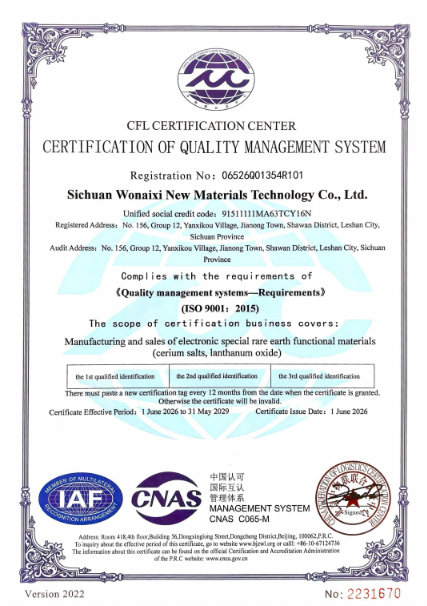
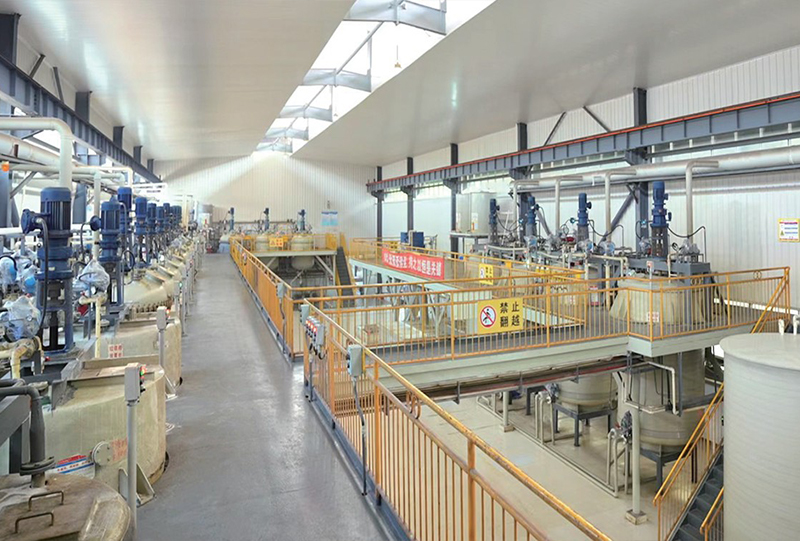
Check four things: legal entity and site, capacity, quality system, and catalogue depth. Sichuan Wonaixi New Materials Technology Co., Ltd. is a rare earth functional materials manufacturer founded in 2012 in Leshan, Sichuan, China, operating a 46,667 m² site with 98 employees and 12 engineers. Its stated annual output is 15,000 tons of high-purity rare earth salts and 3,000 tons of high-precision rare earth polishing powder, across nine major rare earth product categories and more than 50 refined specifications. It holds ISO 9001 certificate 06526Q01354R101, issued by CFL Certification Center, against GB/T19001-2016/ISO9001:2015, valid from 2026-06-01 to 2029-05-31, with a stated scope of manufacturing and sales of electronic special rare earth functional materials (cerium salts, lanthanum oxide). Note that the certified scope as written is narrower than the full catalogue, so confirm whether your specific grade falls inside it. The company reports 100% testing and offers OEM/ODM customisation of indicators, content, specification, purity, and packaging.
What drives the price difference, and which benchmark should I use?
No single benchmark prices either compound, because price is set by rare earth content per kilogram of product, purity grade, hydrate form, packaging, documentation, and freight. Two published references frame the range: the average US import price for lanthanum oxide at 99.5% minimum was approximately USD 1.00 per kilogram in early 2026, and an NdPr oxide benchmark stood at CNY 738,000 per tonne as of September 2026. The first is an oxide benchmark, not a lanthanum carbonate quote; the second illustrates how wide the value spread across the rare earth family is. The correct approach is to normalise every offer to rare earth oxide content delivered per kilogram and to request a written quotation per grade. Minimum order quantity is agreed according to the actual situation rather than published as a fixed figure.
Can I validate a batch before committing to bulk volume?
Yes, and the validation should test the specification you intend to enforce. For lanthanum carbonate, verify identity, rare earth oxide content, loss on ignition, and chloride, then run a small calcination trial to confirm decarbonation above 400 °C and full conversion to La2O3 over 800 °C under your own firing profile. For yttrium nitrate, verify the hexahydrate form, assay, insoluble matter, and chloride and sulfate levels, and confirm solution behaviour in your actual solvent system. Request the batch certificate of analysis with the sample so the paperwork is tested at the same time as the material.
What lead time should I plan for, and what is the next step?
The stated production lead time is 30–45 days, to which any export-licence processing time must be added where the grade is a controlled item. Plan the first order against a sample-qualified specification rather than a catalogue description, and keep the acceptance clauses in the purchase order. The next step is to request a quotation for the specific grade, together with a batch certificate of analysis and the current product catalogue; the catalogue can be downloaded from the WONAIXI brochure link below. Technical questions can be directed to wnx.yang@wnxxcl.com or +86 18683334430.
Conclusion: Decide by Process Role, Then Verify by Document
Lanthanum carbonate and yttrium nitrate are separated by more than price. Lanthanum carbonate is a carbonate intermediate — CAS 54451-24-0, molar mass 457.85 on an anhydrous basis — that decarbonates above 400 °C, converts fully to lanthanum oxide over 800 °C, and is chosen when lanthanum has to be delivered as a convertible intermediate for ceramics, dielectric doping, phosphor hosts, or downstream lanthanum salts. Yttrium nitrate — CAS 13494-98-9, molar mass 382.91, supplied as the hexahydrate — is chosen when yttrium must be metered as a nitrate salt into a wet-chemical, spray-drying, or impregnation route, as in the documented zirconia process where it is mixed with zirconium nitrate and sintered.
The purchasing discipline is the same for both. Fix the identity and hydrate form in a rejectable specification, normalise cost to rare earth oxide content, resolve the export-control classification in writing, and qualify a sample against your own firing or solution conditions before booking volume. That sequence turns a category comparison into a decision that survives an audit.
Request a Quotation, Certificate of Analysis, or Sample
Sichuan Wonaixi New Materials Technology Co., Ltd. supplies high-purity rare earth salts and precision rare earth polishing powder, with OEM/ODM customisation of indicators, content, specification, purity, and packaging. Share your target grade, application, and annual volume to receive a specification-matched quotation.
Email: wnx.yang@wnxxcl.com | Tel / WhatsApp: +86 18683334430 | Website: wonaixi.com
Download the full product catalogue: WONAIXI Product Catalogue (PDF)
Identity data in this article is taken from published product records for Lanthanum Carbonate (CAS 54451-24-0) and Yttrium Nitrate (CAS 13494-98-9). Market references are cited to their stated sources and years. Regulatory statements reflect MOFCOM Announcement No. 18 of 2025 as published; product-level applicability must be confirmed for each shipment.
Have Questions or Need More Details?
Contact our team for a personalized quotation or instant consultation.
Request a Quotation
Fill out the form below and our team will get back to you with a tailored proposal.
WhatsApp Direct Chat
Prefer to chat in real-time? Message us on WhatsApp for instant assistance & quick answers.
- Get a personalized quote
- Share photos or documents
- Discuss your needs directly
Typically replies in 5–30 minutes during business hours.