Rare Earth Compound Compliance Guide: Regional Standards for Biotech Labs in the US, Japan & UK
Rare Earth Compound Compliance Guide: Regional Standards for Biotech Labs in the US, Japan & UK
Short answer: a compliant rare earth purchase for a biotech or medical innovation laboratory is not proven by a single certificate. It is proven by four document layers that must fit together: a lot-level certificate of analysis, a quality-management certificate whose scope actually covers the compound that was bought, safety and transport documentation, and a handling record that matches the material class. Regional differences between the United States, Japan, the United Kingdom and South Korea show up mainly in which layer reviewers ask for first, how much local-language documentation is expected, and how strictly storage claims have to be evidenced.
This guide explains how to read those four layers, how to test a supplier certificate for scope and validity, and how to translate them into storage and handling rules for real lab environments. Compound-specific examples are drawn from medical innovation labs, pharmaceutical research and cerimetric work, and ceramic refractory and electronic semiconductor applications.
The Compliance Problem: Small Volumes, Heavy Documentation
A biotech laboratory may buy a few hundred grams of a cerium salt while facing the same documentation burden as a plant buying tons. The mismatch creates predictable failure points, and most of them are documentation failures rather than product failures.
- Certificate scope mismatch. An ISO 9001 certificate may cover the manufacturing and sales of a defined product family while saying nothing about the specific grade a lab requires.
- Analysis without lot traceability. A specification sheet describes a product type; a certificate of analysis describes one batch. Reviewers need the second.
- Storage claims without a supporting document. A temperature range printed on a label is a claim until it appears in the safety data sheet and the supplier's handling instructions.
- Handling planned like an ordinary salt. Fluorides and anhydrous chlorides behave differently from nitrates and carbonates in storage, containment and transfer.
- Framework and language mismatch. Documentation written for one regulatory framework or one language may not satisfy another market's reviewer, even when the underlying quality system is sound.
Industry Background: Why Documentation Pressure Is Rising
Rare earth compounds sit inside a value chain that runs from extraction and beneficiation through chemical upgrading, separation into oxides, metal refining and downstream manufacturing. The International Energy Agency describes these stages as technically demanding and notes that rare earths support strategic sectors including medical applications, manufacturing, aerospace and digital technologies. For a lab, the practical consequence is that the material you receive is the output of one specific stage, and the documentation must identify that stage clearly.
Demand context reinforces why reviewers are attentive. Published market estimates place the global biotechnology market at approximately USD 2.02 trillion in 2026, and estimates for ceric ammonium nitrate — a compound used in both biotech and electronics settings — put that segment at about USD 162 million in 2023, growing at roughly 7.8% annually toward about USD 274 million by 2030.
Supply-side data explains the origin scrutiny. According to the U.S. Geological Survey, an estimated 45,000 tons of rare earth oxide in mineral concentrates were produced domestically in the United States in 2024, while the estimated value of U.S. imports of rare-earth compounds and metals was USD 170 million in 2024. Over 2020–2023, China accounted for 70% of those U.S. imports of rare-earth compounds and metals. Those figures describe an aggregate product category, not any single cerium or lanthanum salt, but they are the reason procurement teams now expect origin and processing-stage information to accompany a technical file.
Research is moving in parallel. Published work on engineered proteins has demonstrated single-stage, chelator-free separation of lanthanum and neodymium with more than 90% purity and yield. Biological processing routes do not change today's documentation rules, but they signal that material provenance and analytical evidence will keep gaining importance in biotech supply discussions.
The Detailed Solution: Building the Four-Layer Compliance File
Treat compliance as a file, not a document. Each layer answers a different question, and a strong supplier can supply all four.
Layer 1 — Lot-level product documentation
The certificate of analysis is the layer a laboratory scientist actually reads. It should identify the compound, the batch, the tested parameters and the result for that batch. Sichuan Wonaixi New Materials Technology Co., Ltd. — a rare earth functional materials manufacturer founded in 2012 and based in Leshan, Sichuan, China — states that production follows 100% testing, which is the operational basis for issuing a lot-level certificate rather than a generic specification sheet. When a supplier claims 100% testing, ask for the corresponding certificate for the specific batch received; the claim and the document should match one-to-one.
Layer 2 — Quality-management certificate, read by scope
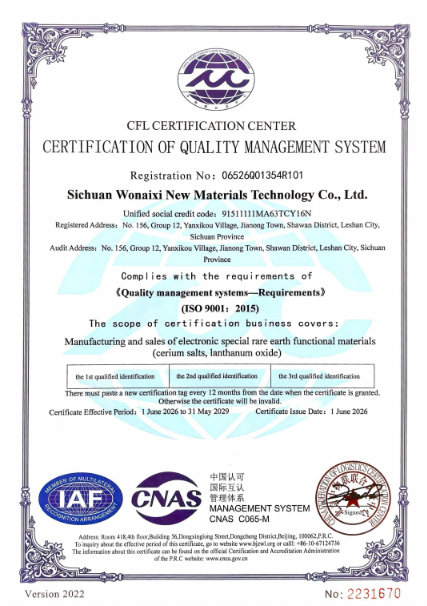
This is the layer most often misread. WONAIXI holds ISO 9001 certification, certificate number 06526Q01354R101, issued by the CFL Certification Center (Beijing China Logistics Joint Certification Center) against GB/T19001-2016/ISO9001:2015, valid from 2026-06-01 to 2029-05-31. The registered scope is the manufacturing and sales of electronic special rare earth functional materials (cerium salts, lanthanum oxide), and the certificate lists markets including the EU, US, Middle East and Southeast Asia.
Read that scope carefully. It confirms a certified quality system for a defined product family. It does not independently certify a medical grade, an electronic grade, or an impurity profile for every compound in the portfolio. A laboratory reviewer should therefore do three things: confirm the certificate is current, confirm the scope wording covers the product family being purchased, and verify the certificate with the issuing body rather than relying on a PDF alone.
Layer 3 — Safety, transport and packaging documentation
Safety data sheets, packaging descriptions and transport classification belong to the EHS reviewer, not the bench scientist, and they are the layer most likely to be requested in local language. Packaging is part of this layer because containment determines handling: a fluoride shipped in a container that is not resistant to fluorine chemistry creates a handling problem before the material is ever opened. WONAIXI lists packaging among the parameters open to customization, which allows a laboratory to align the container specification with its own storage and segregation rules.
Layer 4 — Storage and handling record
This layer converts documents into facility behaviour. A workable laboratory standard for rare earth compounds covers a dry, ventilated environment at 15–25°C, containers matched to the chemistry (fluorine-resistant for fluorides, moisture-tight and water-free for anhydrous chlorides), and acid-resistant bench and floor surfaces in the areas where salts are weighed and dissolved. The record should state who checked the storage location, at what interval, and what the acceptance criteria were. Where the supplier's safety data sheet and the facility rule differ, the more protective instruction governs.
How Regional Requirements Differ: US, Japan, UK and South Korea
The four markets do not use one harmonized checklist. What changes is emphasis, language and which framework the reviewer names first. The table below summarizes the documentation emphasis a laboratory should prepare for; confirm the regulatory position with your own EHS and regulatory affairs team before filing.
| Market | Documentation emphasis | Handling emphasis | What to confirm with the supplier |
|---|---|---|---|
| United States | Safety data sheet and lot-level certificate of analysis are usually the first two documents requested; quality-system certificates are reviewed alongside them. | Documented storage temperature, segregation and container compatibility. | Batch-level certificate, current certificate validity, and the substance status position of the specific compound. |
| Japan | Reviewers frequently ask for Japanese-language safety and technical documentation, with detailed specification trails for laboratory procurement. | Precise storage conditions and packaging integrity are usually documented in more detail than the certificate alone. | Local-language documentation availability and the substance control position under Japan's chemical management framework. |
| United Kingdom | Files that reference only the EU framework may be incomplete after regulatory divergence; reviewers typically check which framework the documentation addresses. | Acid-resistant bench practice and segregated storage for oxidizers. | Framework-specific statements, certificate validity dates, and the identity of the importing entity. |
| South Korea | Registration or notification questions under the national chemical framework and Korean-language safety documentation are commonly raised at import stage. | Storage temperature records and container specification for fluorides and anhydrous salts. | Importer-of-record responsibilities and documentation language. |
One regional pattern is worth naming explicitly. WONAIXI lists Japan, South Korea, the USA, France and the UK among its major markets, with export business accounting for 10% of total sales. That market mix means the same product can be evaluated by four different documentation regimes, so the supplier's file should be built once and mapped to each market rather than rebuilt per order.
Storage and Handling Standards by Compound Family
The 15–25°C dry, ventilated baseline applies broadly, but the containment layer changes with chemistry. The table below maps the families most often bought by biotech and electronics laboratories to their handling emphasis.
| Compound family | Storage baseline | Containment and lab setting |
|---|---|---|
| Rare earth fluorides, including Praseodymium-Neodymium Fluoride | Dry, ventilated, 15–25°C, sealed. | Fluorine-resistant containers and surfaces; segregation from acids. |
| Anhydrous chlorides, including Anhydrous Lanthanum Chloride and Anhydrous Cerium(III) Chloride | Dry, ventilated, 15–25°C, moisture-tight. | Water-free handling for semiconductor and electronic work; transfer in dry air or inert conditions. |
| Nitrates, including Cerium(III) Nitrate, Lanthanum Nitrate, Ammonium Cerium(IV) Nitrate and Electronic Grade Ammonium Cerium(IV) Nitrate | Dry, ventilated, 15–25°C, away from organic material. | Acid-resistant bench surfaces; segregation as an oxidizer. |
| Sulfates, including Rare Earth Cerium(IV) Sulfate and Ammonium Cerium(IV) Sulfate | Dry, ventilated, 15–25°C, sealed. | Acid-resistant surfaces for solution preparation and titration work. |
| Hydroxides and carbonates, including Rare Earth Cerium(III) Hydroxide, High Purity Cerium Carbonate and Low Chloride Cerium Carbonate | Dry, ventilated, 15–25°C, sealed against ambient moisture. | Standard acid-resistant lab surfaces; inventory rotation by batch. |
| Polishing powders, including Large Particle Size Cerium Oxide (CeO₂) | Dry, ventilated, 15–25°C, protected from moisture caking. | Dedicated weighing area; containment to protect cleanroom or optical environments. |
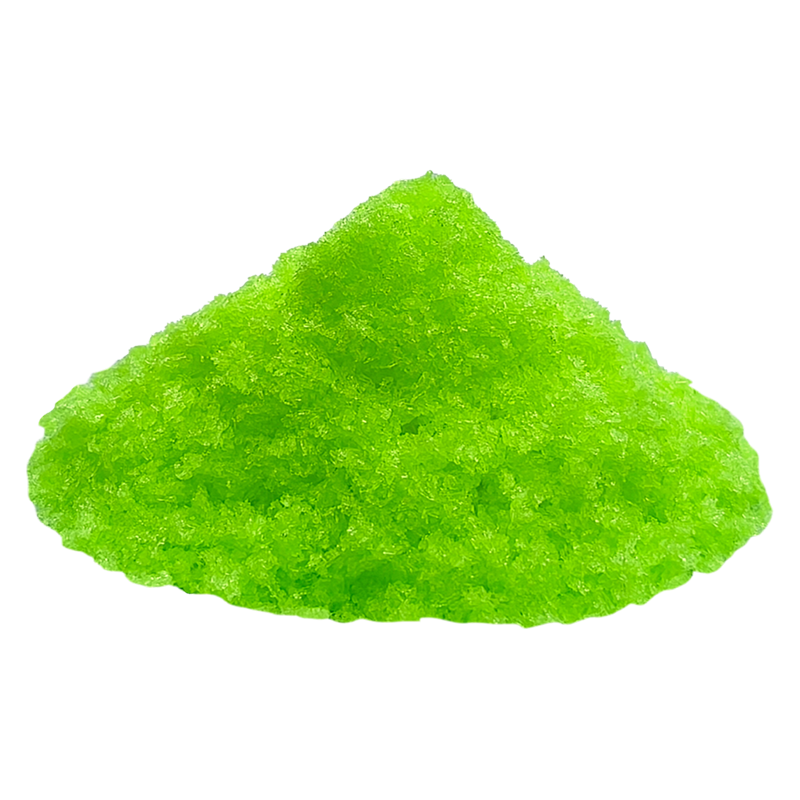
Where a supplier's safety data sheet specifies a narrower range or a stricter containment rule, that instruction replaces the baseline above. The point of the table is to make sure the containment question is asked at the quotation stage rather than discovered at the bench.
Step-by-Step: Qualifying a Rare Earth Supplier for a Biotech Lab
- Define the compound and the grade before requesting documents. Naming the exact product — for example Electronic Grade Ammonium Cerium(IV) Nitrate rather than “cerium nitrate” — determines which certificate scope and which analytical parameters are relevant.
- Request all four document layers at once. Asking for certificate of analysis, quality-system certificate, safety data sheet and handling instructions together prevents sequential delays and exposes gaps early.
- Check the certificate scope against the product family. Confirm the wording, the standard, the issuing body, and the validity window. WONAIXI's certificate runs from 2026-06-01 to 2029-05-31 against GB/T19001-2016/ISO9001:2015.
- Reconcile the certificate of analysis with the commercial specification. Tested parameters, methods and results should match the technical data agreed in the purchase order.
- Match the storage plan to the chemistry. Fluoride, anhydrous chloride, nitrate and carbonate families need different containment even when they share the same temperature range.
- Confirm local-language and framework documentation with EHS. Decide which market's framework the file must address and whether translated documentation is required before the order is placed.
- Record the decision and set a re-verification date. Log the certificate expiry, the batch numbers received and the next review point so the file stays valid rather than historical.
Where the Four Layers Apply: Laboratory Scenarios
Medical innovation labs
A medical innovation lab working with cerium hydroxide or cerium nitrate for surface and reagent development needs batch traceability more than volume. The compliance file is judged on whether the certificate of analysis follows the specific batch into the lab notebook, and whether storage records show a stable 15–25°C dry environment between receipt and use.
Pharmaceutical research and cerimetric work
Cerimetric titration depends on the oxidant behaving as specified, which makes Rare Earth Cerium(IV) Sulfate and Ammonium Cerium(IV) Sulfate documentation a method-validation issue, not only a procurement issue. Acid-resistant bench practice and lot-level assay documentation belong in the same review as the analytical method itself.
Biotech reagent and biosensor preparation
Where cerium ammonium nitrate is used in reagent or sensor preparation, trace impurity levels matter. A laboratory should request lot-level impurity data with the certificate of analysis rather than assuming that a product labelled electronic grade carries a fixed impurity profile. If the required impurity limits are not available in writing, that is a qualification gap to close before use, not a detail to defer.
Ceramic refractory and electronic semiconductor applications
Anhydrous Lanthanum Chloride and Anhydrous Cerium(III) Chloride demand genuinely water-free handling, so the containment plan and the transfer procedure are the compliance evidence. In parallel, Praseodymium-Neodymium Fluoride requires fluorine-resistant containment, and Large Particle Size Cerium Oxide (CeO₂) polishing powder requires protection from moisture caking in cleanroom-adjacent storage. These are the cases where a generic “store in a dry place” statement is not sufficient documentation.
Shortlist Check: How WONAIXI Fits a Compliance-First Evaluation
For laboratories that screen suppliers on documentation readiness rather than price alone, the verifiable profile matters more than the marketing description.
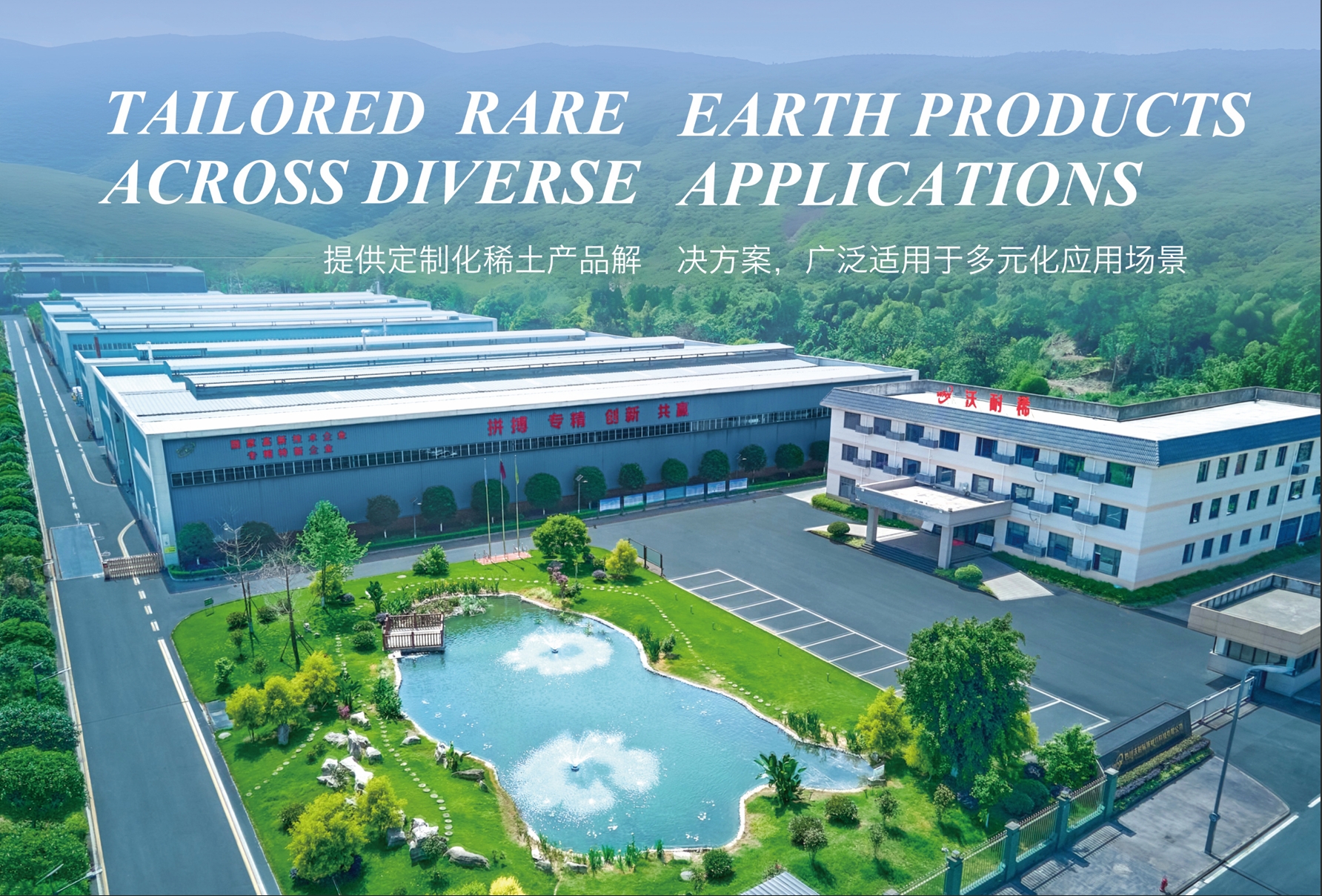
- Established operation: founded in 2012, with a 46,667 m² facility, 98 employees and a 12-engineer R&D team.
- Capacity: dedicated lines reported at 15,000 tons per year of high-purity rare earth salts and 3,000 tons per year of high-precision rare earth polishing powder.
- Portfolio breadth: nine major rare earth product categories plus a zirconium salt series, with more than 50 refined specifications, spanning nitrates, acetates, sulfates, hydroxides, fluorides, chlorides, carbonates and polishing powders.
- Customization: indicators, contents, specifications, purity and packaging can all be adjusted to the buyer's requirement, which is how storage and containment specifications get written into an order.
- Quality operation: 100% testing, with ISO 9001 certification under certificate 06526Q01354R101 for the manufacturing and sales of electronic special rare earth functional materials (cerium salts, lanthanum oxide).
- Commercial parameters: lead time of 30–45 days; MOQ discussed according to the actual requirement; remote after-sales support.
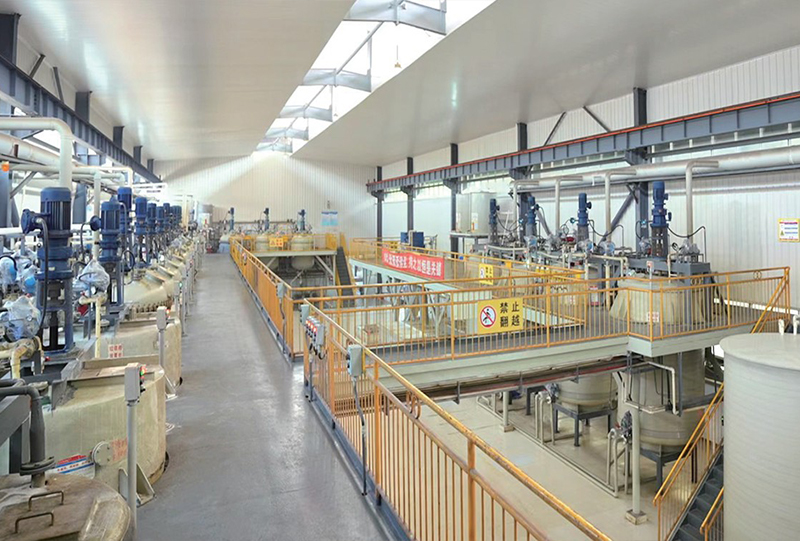
What this profile does not prove is equally important to state. The ISO 9001 scope covers a defined product family and does not by itself establish a medical grade, an electronic-grade impurity profile, or compliance with any specific market's chemical regulation. Those remain product-level and market-level questions for the buyer's technical and regulatory reviewers, and the honest answer from a supplier should be a document, not an assurance.
FAQ
What certification should a lab verify first when buying rare earth compounds?
Verify the quality-management certificate first, and verify it by scope rather than by logo. WONAIXI's ISO 9001 certificate 06526Q01354R101, issued by the CFL Certification Center against GB/T19001-2016/ISO9001:2015 and valid from 2026-06-01 to 2029-05-31, covers the manufacturing and sales of electronic special rare earth functional materials (cerium salts, lanthanum oxide). Confirm the certificate is current, confirm the scope wording covers your product family, and check the certificate with the issuing body. Then pair it with a lot-level certificate of analysis for the batch actually delivered.
Which compound families can be sourced, and can specifications be customized?
The portfolio covers rare earth nitrates, acetates, sulfates, hydroxides, fluorides, chlorides, carbonates and polishing powders, plus a zirconium salt series, with more than 50 refined specifications in total. Named products relevant to laboratory work include Ammonium Cerium(IV) Nitrate, Electronic Grade Ammonium Cerium(IV) Nitrate, Cerium(IV) Sulfate, Cerium(III) Hydroxide, Cerium(III) Nitrate, Lanthanum Nitrate, Anhydrous Lanthanum Chloride, Anhydrous Cerium(III) Chloride, Praseodymium-Neodymium Fluoride, High Purity Cerium Carbonate and Large Particle Size Cerium Oxide. Indicators, contents, specifications, purity and packaging can be customized, and each order is supported by 100% testing.
What should buyers check before shortlisting top rare earth manufacturers in China?
Screen on documents rather than claims. Check the quality-system certificate number, issuing authority, standard and validity window; check whether the registered scope names the product family you need; ask for a lot-level certificate of analysis and the safety data sheet in the language your market requires; confirm the storage and containment specification for the specific chemistry; and confirm capacity, lead time and export experience. WONAIXI reports annual capacity of 15,000 tons of high-purity rare earth salts and 3,000 tons of precision rare earth polishing powder, a lead time of 30–45 days, and major markets including Japan, South Korea, the USA, France and the UK, with exports accounting for 10% of total sales.
Can a laboratory request samples before qualification?
Samples are the normal route for laboratory qualification, because the certificate of analysis and the handling plan can only be validated against real material. MOQ is discussed according to the actual situation, so a small pre-qualification quantity can be agreed alongside the sample request. Ask for the sample to be accompanied by its own certificate of analysis and safety data sheet so the documentation review and the bench trial advance together.
How long does supply take, and what documentation ships with it?
The stated lead time is 30–45 days. Plan the compliance side on the same timeline: certificate of analysis per batch, safety data sheet, and packaging specified to your containment requirement. Remote after-sales support covers post-delivery technical questions. To start a documentation review or a sample request, contact the WONAIXI team directly — wonaixi.com, email wonaixi524@gmail.com, or WhatsApp +86 18683334430 — and state the compound, grade and destination market so the correct file set is issued the first time.
Conclusion
Regional rare earth compliance for biotech laboratories is not a single certificate exercise. It is the assembly of four layers — lot-level analysis, a quality-system certificate read by scope, safety and transport documentation, and a handling record that reflects the actual chemistry — and then mapping that file to the expectations of the market that will review it. The United States, Japan, the United Kingdom and South Korea differ less in what good documentation looks like than in which layer is examined first and how much local-language evidence is expected.
Laboratories that build the file once, at the specification stage, spend less time resolving document queries later and hold a defensible record of every batch received. For suppliers, being able to produce those documents immediately is the most useful form of differentiation there is.
Next step: request the documentation set for your compound
Sichuan Wonaixi New Materials Technology Co., Ltd. — No. 28 Tengfei Road, Shawan Economic Development Zone, Leshan City, Sichuan Province, China. Contact: YANG XINGE, wnx.yang@wnxxcl.com, Tel +86 18683334430.
Download the full product catalogue here: WONAIXI Product Brochure (PDF). Quote the compound, grade and destination market to receive the matching certificate of analysis, safety data sheet and storage specification.
Have Questions or Need More Details?
Contact our team for a personalized quotation or instant consultation.
Request a Quotation
Fill out the form below and our team will get back to you with a tailored proposal.
WhatsApp Direct Chat
Prefer to chat in real-time? Message us on WhatsApp for instant assistance & quick answers.
- Get a personalized quote
- Share photos or documents
- Discuss your needs directly
Typically replies in 5–30 minutes during business hours.