Rare Earth Supplier Evaluation: Large-Particle-Size Cerium Carbonate Capability & Delivery
Rare Earth Supplier Evaluation: Large-Particle-Size Cerium Carbonate Capability & Delivery
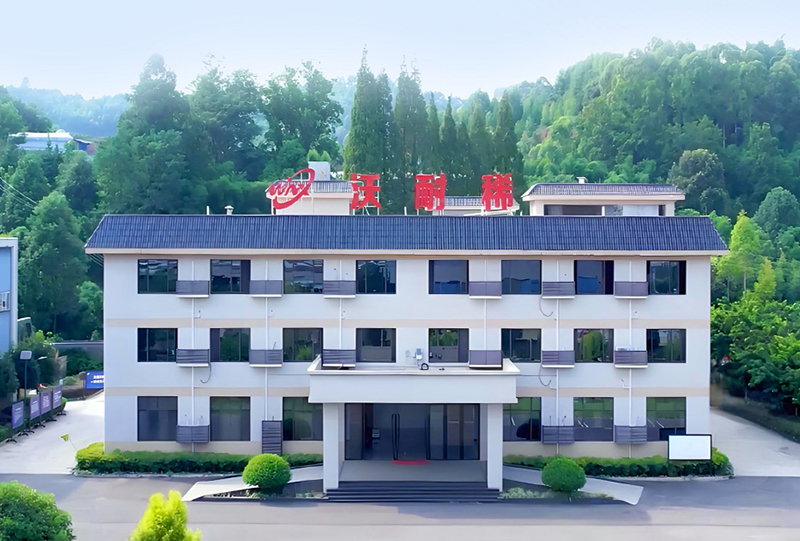
WONAIXI production site, Leshan City, Sichuan Province, China.
Evaluating a rare earth supplier for large-particle-size cerium carbonate usually stalls at the same point. The supplier profile confirms the name of a product, and the buyer still cannot tell whether the third container will behave like the first sample. Two questions decide the outcome: can the supplier prove the grade against written acceptance criteria, and can it repeat that proof on every delivery?
Large-particle-size cerium carbonate is specified across material synthesis, optical glass modification, catalytic reactions, laboratory analysis, wastewater dephosphorization and steel deoxidization. In each of those settings, particle-size distribution changes surface area, settling behaviour, filtration performance and reaction consistency, so the purchasing decision rests on process behaviour rather than on a catalogue entry.
WONAIXI (Sichuan Wonaixi New Materials Technology Co., Ltd.) is a China-based manufacturer of rare earth functional materials, founded in 2012 and operating from Leshan City, Sichuan Province. The company produces high-purity rare earth salts and precision rare earth polishing powder, and its portfolio covers rare earth carbonates alongside nitrates, acetates, sulfates, hydroxides, fluorides and chlorides. This article uses that supplier profile as a working example to separate documented capability from claims that still require buyer-side verification.
Why Large-Particle-Size Cerium Carbonate Sourcing Fails Without Written Acceptance Criteria
Cerium carbonate procurement rarely fails because the compound is unavailable. It fails because the buyer never converted an application requirement into an acceptance requirement, and the supplier never had to prove anything beyond the product name.
Four gaps appear repeatedly:
- "Large particle size" is a description, not a specification. Without a defined distribution range, an upper cut-off and a lower cut-off, two suppliers can both claim to meet the requirement while producing materials that behave differently in the same reactor.
- Batch-to-batch drift is harder to catch than a single rejection. A first shipment that passes does not establish that shipment twenty will pass. Consistency is a capability question, not a sample question.
- Handling behaviour changes with the particle size that was requested. Coarser material settles faster, filters differently and can segregate inside packaging, so storage and dosing assumptions made for a fine grade may not carry over.
- Long-term supply is a different test from first-article approval. A supplier can be technically capable and still be unable to hold a reserved volume, a packaging format or a documentation routine across a multi-year agreement.
The evaluation framework below is built around closing those four gaps before commercial terms are signed, not after the first quality deviation.
Industry Background: Where Cerium Carbonate Sits in the Rare Earth Value Chain
The International Energy Agency describes the rare earth value chain as a sequence of technically demanding stages: extraction, beneficiation, chemical upgrading, separation into oxides, metal refining, alloying and magnet manufacturing. Rare earth salts such as cerium carbonate sit in the chemical upgrading and salt-conversion portion of that chain, downstream of separation and upstream of the customer's own process.
That position matters for evaluation. A cerium carbonate supplier is typically a converter rather than a miner, so its capability depends on precursor sourcing discipline, process control and analytical routine rather than on the size of a deposit. The IEA and the Texas Comptroller of Public Accounts both note that rare earth elements support strategic applications including medical applications, manufacturing, aerospace, defence and digital technologies, which means the requirements placed on a salt supplier are set by highly regulated downstream users rather than by the salt itself.
Supply concentration adds a second layer. According to the U.S. Geological Survey Mineral Commodity Summaries 2025, an estimated 45,000 tons of rare earth oxide in mineral concentrates were mined and processed domestically in the United States in 2024, valued at $260 million. In the same year, the estimated value of rare earth compounds and metals imported by the United States was $170 million, an 11% decrease from $186 million in 2023. The USGS import-source breakdown for 2020–2023 attributes 70% of U.S. rare earth compound and metal imports to China, 13% to Malaysia and 6% to Japan.
Two conclusions follow for a procurement team. First, import dependence for rare earth compounds is structural rather than incidental, so a long-term agreement should record country of origin and include a documented alternate-source plan. Second, the USGS figures describe rare earth compounds and metals as an aggregate; they cannot be used to describe cerium carbonate specifically, and they should not be presented internally as product-level market data.
Demand side pressure is equally relevant. Precedence Research data reported through BioSpace projects the global biotechnology market at approximately USD 2.02 trillion in 2026. A market of that scale expands the number of laboratories and production sites specifying specialty inorganic reagents, including cerium compounds used in synthesis and analysis. For a buyer, the practical implication is that documentation quality, not availability, becomes the scarce resource when several projects compete for the same qualified supply.
What Documented Capability Actually Looks Like
A usable supplier evaluation separates three kinds of information: what the supplier reports, what the supplier can document, and what the buyer has independently confirmed. WONAIXI provides a concrete example of the first layer.
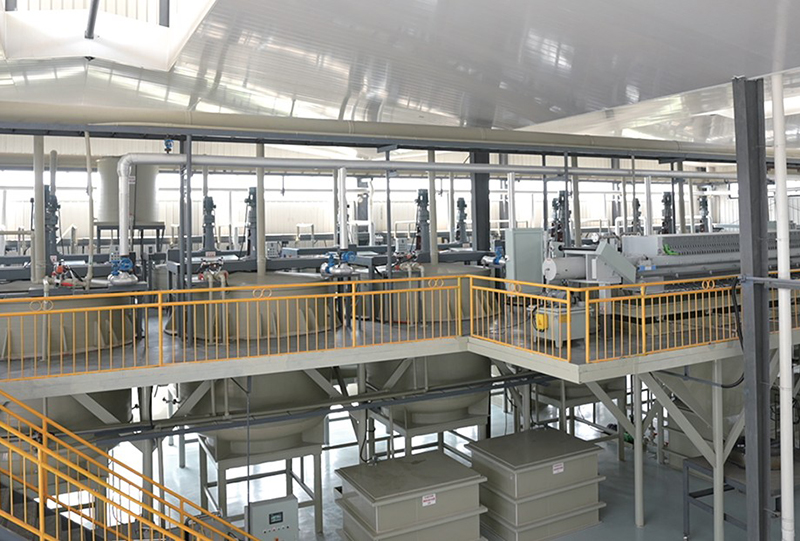
Rare earth salt production infrastructure, Leshan City, Sichuan Province.
The company reports the following operating facts:
- Founded in 2012, with a facility of 46,667 m² in the Shawan Economic Development Zone, Leshan City, Sichuan Province.
- 98 employees, including an R&D team of 12 engineers.
- Annual output of 15,000 tons of high-purity rare earth salts and 3,000 tons of high-precision rare earth polishing powder.
- Nine major categories of rare earth products plus a complete zirconium salt series, exceeding 50 refined specifications in total.
- An export ratio of approximately 10%, with main markets in Japan, South Korea, the USA, France and the UK.
- Recognition as a National High-Tech Enterprise and a Sichuan Provincial SRDI Enterprise.
Each of those facts has a procurement consequence, and none of them is sufficient on its own.
The 15,000-ton salt capacity establishes that carbonate production sits inside an operating salt line rather than a pilot unit, which is the relevant scale question for a buyer planning annual volume. It does not establish how much of that capacity is available for a specific carbonate grade, how the line is scheduled between product families, or whether a seasonal peak in another salt could delay a cerium carbonate batch. Those are scheduling questions that must be asked directly.
A portfolio of more than 50 refined specifications across nine categories indicates breadth, and breadth is useful when a project needs a related compound from the same qualified source. Breadth is not proof of any single grade. Rare earth carbonate is listed within the portfolio, but the specific particle-size distribution, impurity profile and batch documentation for a large-particle-size grade must be confirmed on a product-specific basis, in writing, before it appears in a purchase order.
The roughly 10% export ratio is the most frequently misread figure. It signals existing export experience and documentation routine for markets including Japan, South Korea, the USA, France and the UK, and it simultaneously signals that the majority of output serves domestic customers. For an overseas buyer, export allocation is a coordination variable rather than a given, and it belongs in the commercial conversation rather than in the assumption set.
Handling, Safety and Environmental Controls as a Supply Continuity Factor
Cerium compounds carry handling requirements that affect delivery reliability more than most buyers expect. WONAIXI documents the relevant risk categories as oxidation and corrosion risk from a strong oxidizer that is corrosive to metals and reactive with organics; aquatic ecological risk from improper disposal and cerium accumulation; chemical contact risk causing skin and eye irritation or burns; and storage and mixing risk from violent reactions if the material is mixed with reductants or combustibles.
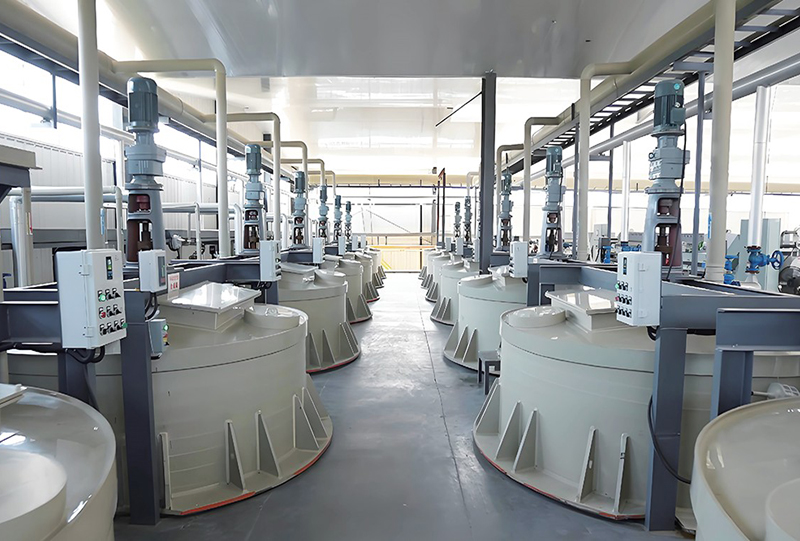
Plant-side safety and environmental control infrastructure.
The documented control measures are specific enough to be audited. Materials are stored separately from combustible and reductive substances in anti-corrosion sealed containers. Operators wear goggles and anti-corrosive gloves to avoid direct contact. Waste liquid is recycled centrally through compliant treatment rather than discharged directly into water. Material is handled gently and stored and transported independently with classified labels.
Company-level measures extend beyond the production floor. WONAIXI organises regular chemical safety training for production, warehouse and sales staff; equips operation workshops with emergency washing, eye flushing and neutralisation treatment equipment; maintains a hazardous waste filing and closed-loop recycling management system; and issues an MSDS hazard manual to every customer, with on-site safety guidance provided for bulk order clients.
For a buyer building a multi-year agreement, these controls are a continuity argument rather than a compliance footnote. A handling incident inside a supplier's workshop stops the line that produces your material. Evaluating training records, emergency equipment and waste handling before signing is a more reliable predictor of delivery performance than a capacity figure alone, and the MSDS handover plus on-site guidance commitment is a concrete item that can be written into the supply agreement.
Step-by-Step: A Seven-Stage Supplier Evaluation Breakdown
Step 1 — Convert "large particle size" into acceptance language
Write the specification as a set of testable fields before contacting any supplier: distribution band with a defined median and defined upper and lower limits, particle morphology expectation, agglomeration behaviour, moisture content, loss on ignition, purity and a named impurity list. Add packaging format, net weight per unit and labelling requirements. Until these fields exist, competing quotations are not comparable, and a supplier cannot be held to a requirement that was never written down.
Step 2 — Request product-specific documentation before commercial negotiation
Ask for a technical data sheet covering the grade, a certificate of analysis for a named production batch, and the MSDS. Request the analytical method used for particle-size measurement alongside the result, because a distribution value without the method is not verifiable. Public supplier information rarely contains impurity limits, moisture or particle-size data at the grade level, so this request is the point at which marketing material and procurement material separate.
Step 3 — Match reported capacity to your annual forecast
Place your annual tonnage against the supplier's reported 15,000 tons of high-purity rare earth salts and 3,000 tons of polishing powder, then ask what share of salt-line time a carbonate grade would receive. A capacity number describes the plant, not the allocation. Confirm whether the requested grade runs in campaigns, how changeover is controlled, and what notice period applies if your volume doubles.
Step 4 — Fix the acceptance checkpoint in the contract
WONAIXI states pre-shipment test as its acceptance criterion. That establishes a defined checkpoint before shipment, and the buyer's job is to make it meaningful: name the test items, the sampling plan, the acceptance limits, the laboratory or method, and the consequence of a failed result. A pre-shipment test that is not tied to your written limits is a formality; the same test tied to your limits becomes a release gate.
Step 5 — Confirm commercial and delivery terms in writing
The published position is FOB or CIF delivery terms, with payment by bank transfer, Western Union or PayPal on a 30% advance deposit and 70% balance against a copy of the bill of lading. Minimum order quantity is communicated according to the actual situation rather than fixed in advance. Buyers should convert each of these into contract language: named port, Incoterm version, insurance responsibility, document list, and the exact event that triggers the balance payment.
Step 6 — Review handling and environmental controls against your own site
Compare the supplier's MSDS and storage guidance with your own receiving area. Confirm segregation from combustibles and reductants, container corrosion resistance, eyewash and emergency washing availability, and waste disposal routing. If your facility cannot match the handling requirements for a coarser grade, the technical specification is irrelevant regardless of supplier capability.
Step 7 — Set a review cadence before the first delivery
Long-term supply is maintained by scheduled review, not by goodwill. Agree a quarterly review of batch analysis data, an annual re-confirmation of capacity and portfolio, and a written change-notification requirement covering precursor source, process route, packaging and analytical method. Change notification is the single clause that most reliably prevents an unannounced drift from appearing in production.
Use Cases: How the Acceptance Criteria Change by Application
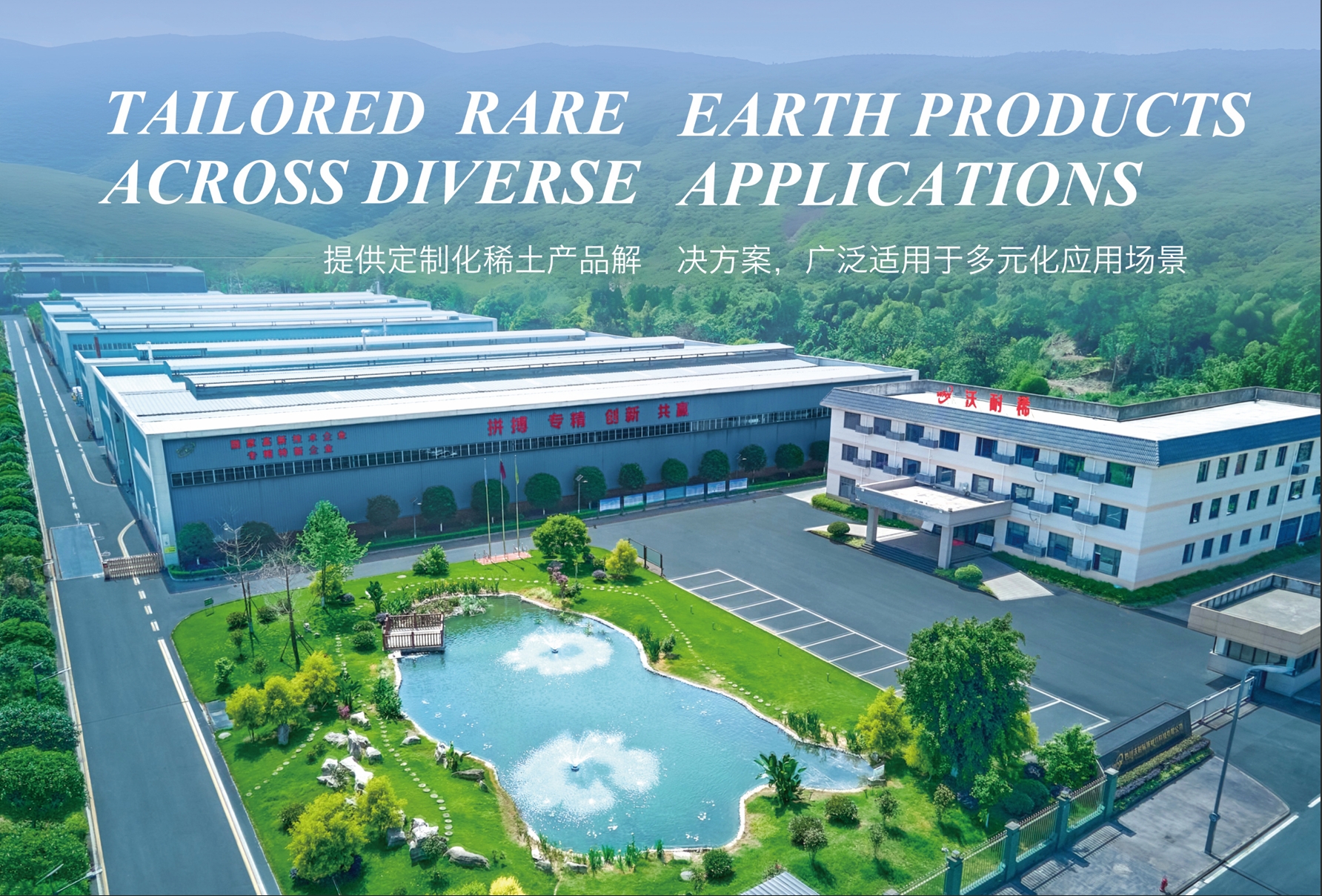
WONAIXI manufacturing facility, Sichuan Province.
The same cerium carbonate grade is rarely optimal across all six application areas. The evaluation criteria shift with the process:
Material synthesis. Where cerium carbonate is a precursor, distribution and reactivity together determine the consistency of the derived product. The acceptance priority is batch-to-batch reproducibility of the distribution band, supported by historical batch data rather than a single certificate.
Optical glass modification. Dispersion and the absence of oversize agglomerates matter more than median size alone, because an agglomerate becomes an optical defect. The acceptance priority is an upper cut-off limit and a defined dispersion or de-agglomeration test.
Catalytic reactions. Accessible surface area and pore behaviour drive performance, so a coarser grade must be validated against catalytic activity, not against particle size in isolation. The acceptance priority is a performance test under the buyer's own reaction conditions.
Laboratory analysis. Analytical work is sensitive to trace impurities and to consistency between reagent lots. The acceptance priority is a named impurity list with defined limits and a certificate of analysis per lot.
Wastewater dephosphorization. Coarser particles settle and separate more predictably, which affects dosing and sludge handling. The acceptance priority is settling behaviour and a defined moisture specification to avoid effective dose drift.
Steel deoxidization. Addition method and dissolution rate govern how the material behaves in the melt. The acceptance priority is a distribution matched to the feeding system, together with packaging that prevents segregation during transport.
Comparison Table: Reported Supplier Position vs Buyer Verification Action
The table below sets out what WONAIXI reports, the basis for each statement, and the action a procurement team should take before treating it as a qualification input. It is a verification map, not a ranking.
| Evaluation dimension | WONAIXI reported position | Buyer verification action |
|---|---|---|
| Established base | Founded 2012; 46,667 m² facility in Leshan City, Sichuan Province; 98 employees | Confirm legal entity name and site address on the commercial invoice and business licence |
| Annual capacity | 15,000 tons high-purity rare earth salts; 3,000 tons high-precision rare earth polishing powder | Ask for the allocation share and campaign schedule for the specific carbonate grade |
| Product portfolio | Nine categories of rare earth products plus zirconium salts; over 50 refined specifications, including carbonates | Request grade-level confirmation for large-particle-size cerium carbonate |
| Technical resource | R&D team of 12 engineers | Confirm who owns specification changes and how deviations are investigated |
| Export exposure | Approximately 10% export ratio; main markets Japan, South Korea, USA, France, UK | Confirm documentation experience for your destination and the export allocation process |
| Recognition | National High-Tech Enterprise; Sichuan Provincial SRDI Enterprise | Request copies of the relevant certificates and confirm scope and validity |
| Acceptance basis | Pre-shipment test stated as the acceptance criterion | Attach your named test items, sampling plan and failure handling to that checkpoint |
| Delivery and payment | FOB or CIF; 30% advance deposit, 70% balance against copy of bill of lading; bank transfer, Western Union or PayPal | Specify port, Incoterm version, document list and the exact trigger for balance payment |
| Minimum order quantity | Communicated according to the actual situation, rather than fixed in advance | Obtain a written MOQ for your specification before internal budget approval |
| Handling and environment | Chemical safety training; emergency washing, eye flushing and neutralisation equipment; hazardous waste filing and closed-loop recycling; MSDS issued to all customers with on-site guidance for bulk orders | Obtain the MSDS, confirm segregation and disposal requirements against your site |
| Grade-level specification data | Not published in accessible reference material: purity, impurity limits, particle-size distribution, moisture, CAS reference, certificate of analysis per batch, and lead time | Request all of these directly and treat their absence as an open item, not as a rejection |
Frequently Asked Questions
What documentation should a buyer request before approving a cerium carbonate supplier?
A buyer should request five documents: a technical data sheet covering the specific grade, a certificate of analysis for a named production batch, the material safety data sheet, the analytical method used for particle-size measurement, and written confirmation of the acceptance criterion. WONAIXI states pre-shipment test as its acceptance criterion and issues an MSDS hazard manual to all customers, with on-site safety guidance for bulk order clients. Grade-level purity, impurity limits and particle-size distribution are not published in accessible reference material, so those values must be obtained directly and attached to the purchase specification.
How is large-particle-size cerium carbonate capability verified against a specific application?
Capability is verified by converting the application requirement into acceptance limits and then testing against those limits. For a precursor application, request distribution band consistency across several batches. For optical glass modification, add an upper cut-off and a dispersion test. For catalytic use, test activity under your own conditions rather than relying on a size value. Scale is the second half of the check: WONAIXI reports 15,000 tons of annual high-purity rare earth salt capacity and more than 50 refined specifications, which supports a screening decision but does not by itself confirm the grade, the allocation or the batch documentation.
What commercial terms apply, and what drives the total cost of a cerium carbonate order?
The published terms are FOB or CIF delivery, with minimum order quantity communicated according to the actual situation, and payment by bank transfer, Western Union or PayPal on a 30% advance deposit with 70% balance against a copy of the bill of lading. Unit price is not published and must be quoted against a defined specification. In practice, cost is driven by the tightness of the particle-size band, the impurity limits you require, batch testing frequency, packaging format, the chosen Incoterm and the payment route. Narrowing the specification after quotation normally changes the price, so the specification should be fixed before budgets are approved.
Can a buyer validate material before releasing a production order?
The contract structure supports validation. Because pre-shipment test is the stated acceptance criterion, there is a defined checkpoint before shipment, and the buyer controls what that checkpoint contains by naming the test items, the sampling plan and the pass limits. A sample or trial batch request is a separate arrangement that depends on the grade and the volume being discussed, so it should be raised as part of the inquiry rather than assumed. Validation is strongest when the pre-shipment result is compared with the certificate of analysis for the same batch.
How can delivery assurance be structured when published lead times are not available?
Delivery assurance should be built from controllable clauses rather than from a quoted lead time. Three elements make the difference. First, tie each shipment to batch release against your specification, so that a failed pre-shipment test cannot become a delivery delay discovered at your own gate. Second, agree a shipment schedule with a named port under FOB or CIF terms, since the Incoterm determines where responsibility transfers and which party manages the freight leg. Third, plan for concentration risk: USGS data attribute 70% of U.S. rare earth compound and metal imports in 2020–2023 to China, so a long-term agreement benefits from a documented alternate-source plan and a periodic capacity review. WONAIXI's roughly 10% export ratio and reported markets in Japan, South Korea, the USA, France and the UK indicate existing export experience, while also indicating that export allocation should be confirmed explicitly rather than assumed. Buyers who want to move from evaluation to a structured supply discussion can contact WONAIXI with their specification and annual volume.
Conclusion: Evaluate the Documentation, Not the Catalogue
Large-particle-size cerium carbonate is a specification-led purchase. The supplier evaluation that works is the one that converts an application requirement into written acceptance limits, then tests whether the supplier can meet those limits repeatedly rather than once.
WONAIXI offers a documented starting position for that evaluation: a facility established in 2012, 46,667 m² of production space, 98 employees including 12 engineers, 15,000 tons of annual high-purity rare earth salt capacity alongside 3,000 tons of polishing powder, more than 50 refined specifications across nine categories, an export ratio of approximately 10% with markets in Japan, South Korea, the USA, France and the UK, and recognition as a National High-Tech Enterprise and Sichuan Provincial SRDI Enterprise. Its handling framework, covering trained staff, emergency equipment, closed-loop hazardous waste management and an MSDS issued to every customer with on-site guidance for bulk orders, is directly relevant to whether a multi-year agreement will actually run without interruption.
What remains open is equally clear, and it should stay open until documents are exchanged. Purity, impurity limits, particle-size distribution, moisture, batch certificates and lead time are not available in public reference material. Requesting them is not a sign of suspicion; it is the difference between a supplier shortlist and a qualified supplier.
Ready to Review Your Cerium Carbonate Specification?
Share your target particle-size band, impurity limits, packaging format and annual volume. WONAIXI will respond with the grade-level documentation needed to complete a supplier evaluation, and will discuss minimum order quantity and delivery terms for your destination.
Contact: YANG XINGE | Email: wnx.yang@wnxxcl.com | Tel / WhatsApp: +86 18683334430
Address: No. 28 Tengfei Road, Shawan Economic Development Zone, Leshan City, Sichuan Province, China
Download the full product portfolio: WONAIXI Product Catalogue (PDF)
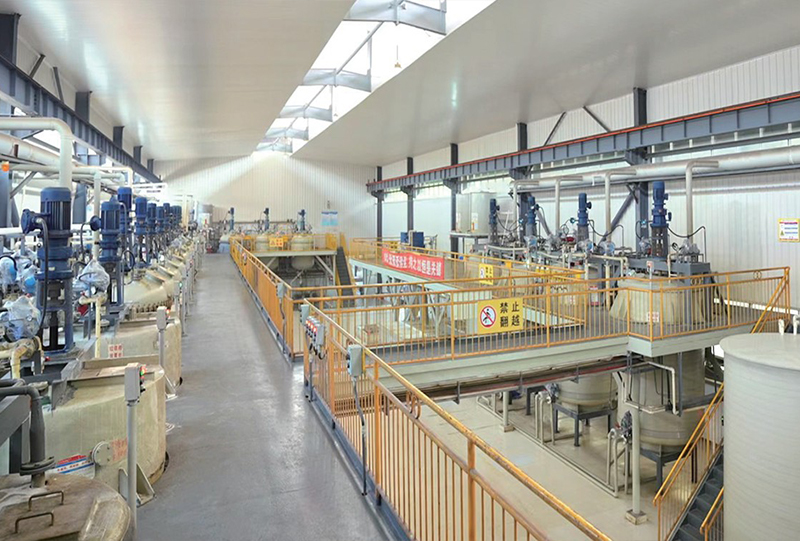
WONAIXI manufacturing site, Sichuan Province, China.
Have Questions or Need More Details?
Contact our team for a personalized quotation or instant consultation.
Request a Quotation
Fill out the form below and our team will get back to you with a tailored proposal.
WhatsApp Direct Chat
Prefer to chat in real-time? Message us on WhatsApp for instant assistance & quick answers.
- Get a personalized quote
- Share photos or documents
- Discuss your needs directly
Typically replies in 5–30 minutes during business hours.