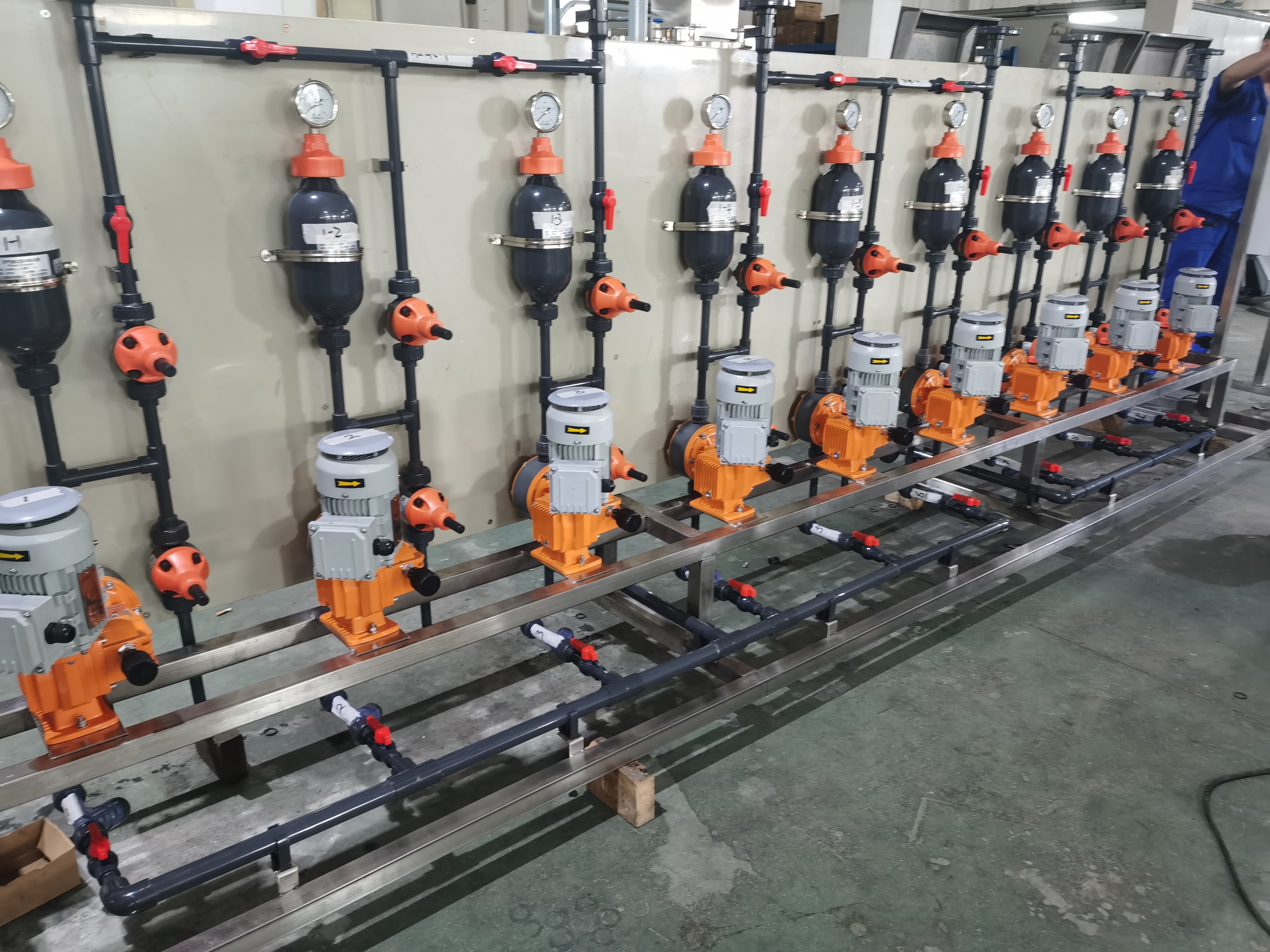
Application Guide: Dosing Pumps in Water Treatment — Real-World Configuration Scenarios
Configuring a dosing pump for water treatment means resolving three things in a defined order: the hydraulic duty point (flow rate at the real back pressure), the wetted-material set that survives the chemical being injected, and the control and verification chain that proves the pump delivers what the process design assumed. Solve them out of order and the plant inherits unstable residuals, shortened diaphragm life, and a calibration argument at handover.
This application guide works through real configuration scenarios in municipal and industrial water treatment — where chemicals are actually injected, how flow rates are calibrated against measured volume, and which documented pump specifications fit which feed point. Reference specifications come from WRS PTE LTD, a dosing equipment manufacturer whose range covers metering pumps, solenoid dosing pumps, diaphragm dosing pumps, piston dosing pumps, digital dosing pumps, dosing pump check valves, pulse dampeners, chemical dosing systems, streaming current monitoring systems and chemical injection pumps.

Problem Definition: Most Dosing Failures Are Configuration Failures
Water treatment plants rarely fail because the wrong pump category was bought. They fail because the configuration around the pump was incomplete. The symptom reported most often is a discharge flow rate drop or an unstable flow rate, and the cause behind it is usually a blocked inlet or outlet — resolved by checking the strainer, the tubing and the valves, then cleaning or replacing them where necessary. That is a configuration problem, not a pump-quality problem.
Three constraint families decide every water treatment dosing configuration:
- Hydraulic constraints. The required dosing rate has to be met at the actual discharge pressure, not at a test bench condition. A pump verified only against its maximum flow rate — without re-checking the pressure at the injection point — will under-dose quietly and consistently.
- Chemical constraints. Pump head, diaphragm, valve balls and seals must survive the injected medium. Material selection is medium-specific: for highly corrosive media, a PVDF pump head is the recommended option, while PVC and SS316 cover the wider range of coagulants, hypochlorite solutions and pH adjusters.
- Control and verification constraints. The pump has to accept the plant signal — a pulse from a water meter, a 4-20mA signal from an analyser, or a Modbus command from a PLC — and it has to be calibratable against measured volume rather than a dial position.
A dosing pump that satisfies all three constraints is a configuration. A pump that satisfies only the first is a purchase order waiting to become a service call.
Industry Background: How Dosing Configuration Is Being Driven in 2026
Configuration decisions sit inside a market that is large, geographically concentrated and increasingly standardised. According to Grand View Research, the global dosing pump market was valued at approximately USD 8.86 billion in 2024, with Asia Pacific holding a 41.8% revenue share. Diaphragm dosing pumps hold 55.7% of that revenue, while motor-driven metering pumps accounted for a 54.45% revenue share of the global metering pump market in 2025, per Mordor Intelligence, which also projects solenoid-driven dosing pumps to grow at a CAGR of 5.88% through 2031.
Water and wastewater treatment remains the single largest application block for metering pumps, at a 23.2% application share in 2025 (Grand View Research). A separate estimate from HTF Market Intelligence puts the global chemical injection pump market at USD 3.5 billion in 2024. The supply side is a mix of international brands — Grundfos, IDEX (Milton Roy), ProMinent and SEKO S.p.A. are the names most consistently cited in market coverage (Mordor Intelligence) — and export-oriented Chinese manufacturing, where liquid pump exports (a category that includes dosing types) reached USD 14.3 billion in 2024 according to the Observatory of Economic Complexity.
What changes a configuration in practice is the standard set rather than the market size. API 675 governs positive displacement reciprocating pumps with integrated controlled capacity and is the reference most often named for critical chemical injection. ISO 14847:1999 specifies technical requirements for rotary positive displacement pumps. On the regulatory side, the EU Machinery Regulation that repeals 2006/42/EC from 2027 continues to mandate CE marking for metering pump units placed on the European market. Each reference translates into a tangible decision: connection type, material certification, documentation package, and the test evidence required before acceptance.
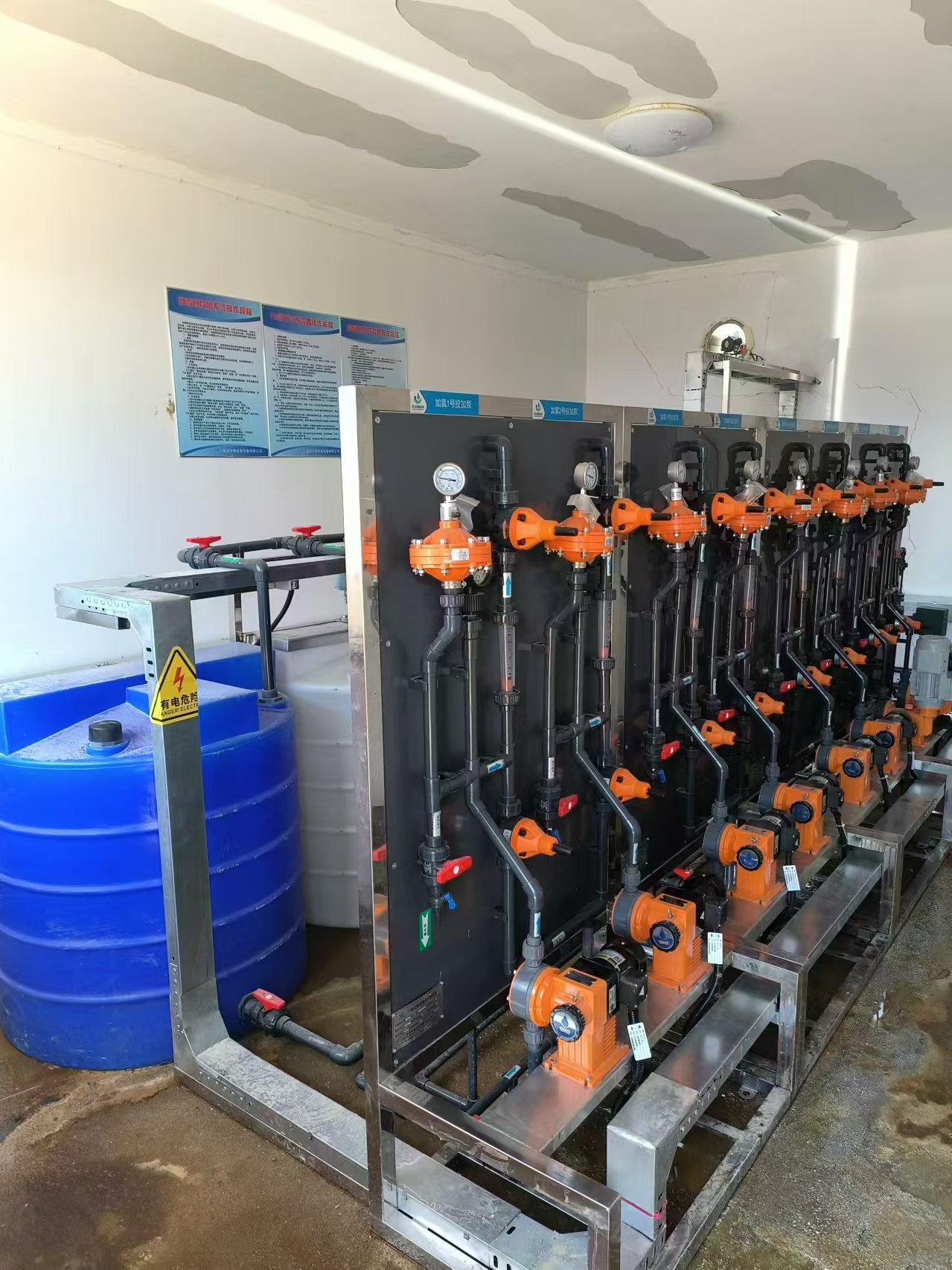
Chemical Feed Points and What Each One Demands
In water treatment, the feed point determines the duty far more than the pump model does. Five locations account for most dosing pump configurations.
1. Coagulant and flocculant feed at the raw water inlet
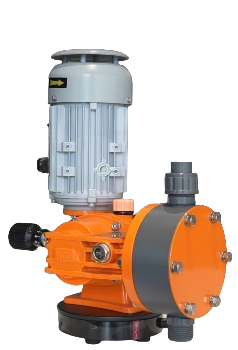
Coagulant dosing runs continuously and at comparatively high volume, with the pump working against the pressure of the incoming line. The duty typically falls in the mid-flow range at moderate pressure — for example the WRS MA0120PQ11 mechanical diaphragm dosing pump is rated 15–500 L/h at 5–10 bar, in PVC, PVDF or SS316, with frequency and explosion-proof motor options. Because coagulant demand shifts with raw water turbidity, the configuration normally needs either a variable-speed motor input or a stroke-adjustable mechanical pump.
2. pH adjustment before and after primary treatment
Acid and alkali dosing is a low-volume, high-accuracy duty. Overshoot is expensive because it propagates through downstream processes, so the pump must hold a repeatable rate at low stroke settings. Digital dosing pumps are the practical answer here: the WRS EMGP0200FP1C is rated 200 L/h at 4 bar with Rc 1/2 inch thread connection, IP65 protection and 220V/1P/60W power, specified at less than 1% precision with a 1:1000 ratio rate and a full PTFE diaphragm.
3. Disinfection and oxidation
Sodium hypochlorite, hydrogen peroxide and similar oxidants are injected at low flow against line pressure, and they attack many polymers. The configuration priority is a corrosion-resistant head combined with accurate low-rate metering. The WRS EML0020PR1C solenoid dosing pump covers 1–20 L/h at 1–10 bar with remote control, 220V/110V input and IP65 protection, in PVC, PVDF or SS316, with a double ball design check valve on both inlet and outlet that increases discharge accuracy and a stated 1% dosing accuracy.
4. Antiscalant and membrane protection in RO trains
Antiscalant dosing must be proportional to permeate or feed flow rather than fixed, which makes signal compatibility a configuration requirement rather than an option. A pulse signal from a flow meter or a 4-20mA signal from the plant controller drives the dosing rate. The WRS EMML0060FP1E digital dosing pump is rated 60 L/h at 4 bar with Rc 1/2 inch thread connection, IP65 protection, PVC/PVDF/SS316L materials, 4-20mA or pulse remote control and Modbus RS485 communication, with direct flow rate display.
5. Sludge conditioning and dewatering polymer
Polymer dosing is a high-viscosity, high-volume duty at moderate pressure. The configuration driver is the diaphragm and valve design, because viscous media resist the suction stroke. The WRS MB1800PQ11 mechanical diaphragm pump is rated 250–1800 L/h at 3–10 bar in PVC, PVDF or SS316, built with a multiple-layer diaphragm for longer lifespan and specifically designed for handling corrosive liquids, with smooth flow rate adjustment available while both running and idle.
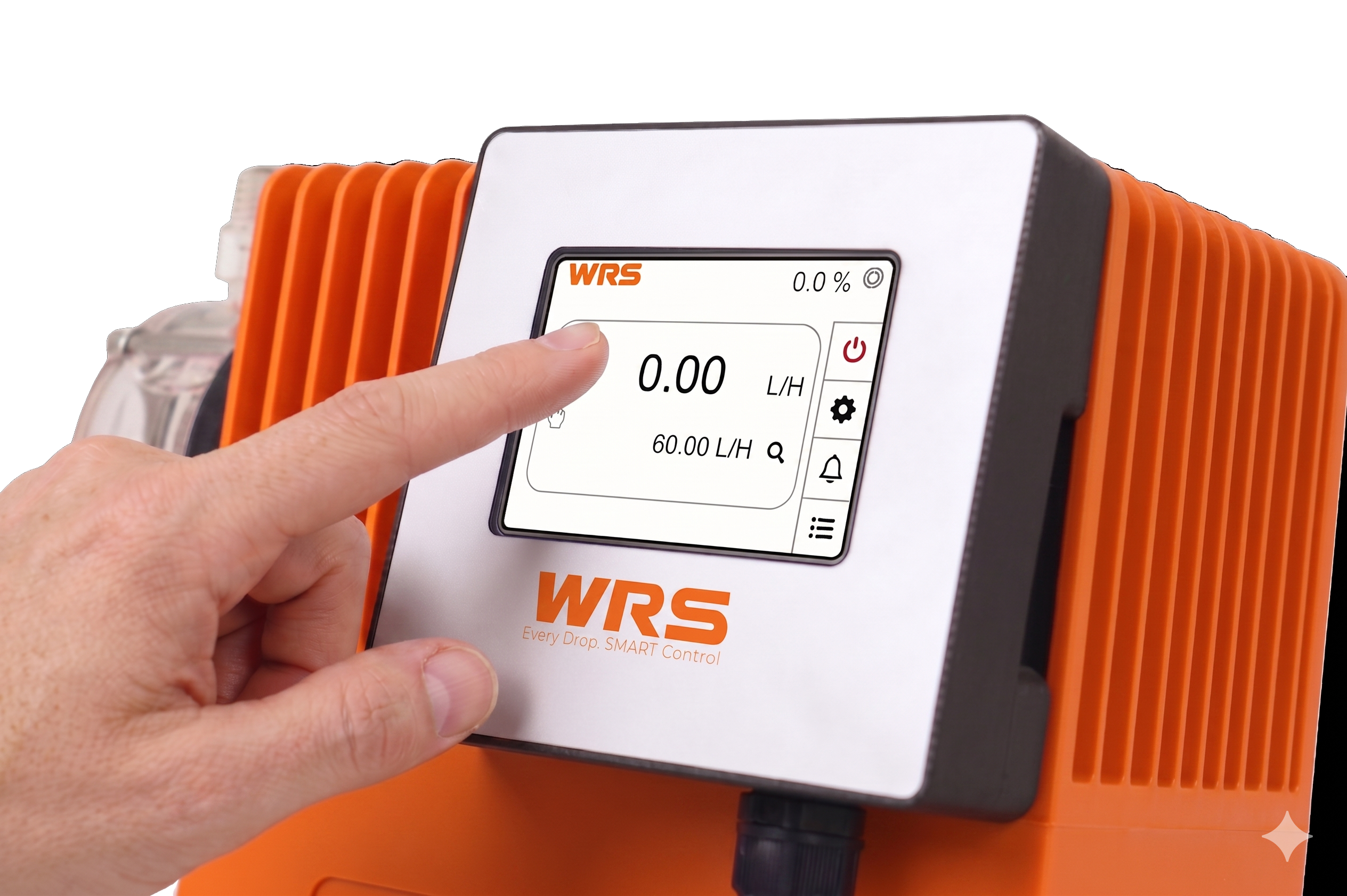
Step-by-Step Configuration Breakdown
- Fix the duty point. Selection starts from flow rate as the primary parameter: compare the required dosing rate against the pump's maximum flow rate at the site, then refine using pressure, pump head material and motor. Never accept a maximum flow figure without checking it against the back pressure at the injection point.
- Select the pump type and drive. Solenoid drives suit low-flow, high-accuracy duties (1–20 L/h, 1–10 bar); motor-driven diaphragm pumps suit continuous mid-to-high volume duties; piston pumps suit high-viscosity and high-pressure service; hydraulic metering pumps suit very high pressure lines.
- Choose wetted materials against the medium. PVC, PVDF and SS316 are the standard options across the range. For highly corrosive media, specify a PVDF pump head. PTFE diaphragms are specified on the digital models for corrosion resistance.
- Size the accessory set. A check valve with a double ball design on both inlet and outlet increases discharge accuracy. A pulse dampener smooths the pulsating discharge on long lines. Suction-side accessories — foot valve, weight, injection valve and safety valve — belong in the bill of materials from the start; on the WRS ML0008PR1C solenoid pump these are supplied with the unit as standard accessories.
- Define the control interface. Specify the signal type at the configuration stage: manual control, 4-20mA, pulse signal, or Modbus RS485 communication for PLC integration. Retrofitting a signal interface after installation is a control-panel problem, not a pump problem.
- Calibrate and verify. Bench-verify the flow rate, then re-verify in the field at operating pressure against a measured volume. Confirm the check valves seal, the suction line is air-free, and the displayed rate matches the measured rate.
- Close out documentation. Declare the certification file, material certificates, test records and the model-and-series match on the CE scope before the unit is released to site.
Configuration Scenarios Compared
The table below maps typical water treatment feed points to documented WRS PTE LTD specifications. It is a configuration starting point, not a substitute for the duty-point calculation in Step 1.
| Feed point / duty | Typical hydraulic duty | Documented WRS model and key parameters | Wetted materials |
|---|---|---|---|
| Coagulant / flocculant at raw water inlet | Medium volume, moderate pressure | MA0120PQ11 mechanical diaphragm dosing pump — 15–500 L/h, 5–10 bar, frequency and explosion-proof motor available | PVC, PVDF, SS316 |
| pH adjustment (acid / alkali) | Low volume, tight accuracy | EMGP0200FP1C digital pump — 200 L/h, 4 bar, Rc 1/2 inch thread, IP65, 220V/1P/60W, less than 1% precision, 1:1000 ratio | PVC, PVDF, SS316 |
| Disinfection / oxidation | 1–20 L/h against line pressure | EML0020PR1C solenoid dosing pump — 1–20 L/h, 1–10 bar, remote control (4-20mA / pulse, Modbus RS485), IP65, 1% dosing accuracy | PVC, PVDF, SS316 |
| Antiscalant / RO membrane protection | Low volume, proportional control | EMML0060FP1E digital dosing pump — 60 L/h, 4 bar, Rc 1/2 inch thread, IP65, 220V/1P/20W, full PTFE diaphragm | PVC, PVDF, SS316L |
| High-volume bulk dosing | Up to 1000 L/h at low pressure | EMAP1000PQ1C digital pump — 1000 L/h, 4 bar, DN25 socket, IP65, 220V/1P/20W, less than 1% precision | PVC, PVDF |
| Sludge conditioning / dewatering polymer | High volume, high viscosity | MB1800PQ11 mechanical diaphragm pump — 250–1800 L/h, 3–10 bar, multiple-layer diaphragm | PVC, PVDF, SS316 |
| High-pressure chemical injection | Very low volume at very high pressure | HS008S0P01S11 hydraulic metering pump — 2 L/h, 200 bar, DN6 bevel end welding tube, 0.37 kW, zero-leakage design | SS316 |
Real-World Configuration Scenarios
Scenario A — Municipal wastewater coagulant dosing
An engineering company in Australia configured 20 dosing pump units for wastewater treatment. The selection criteria were high quality and easy maintenance, with stable operation as the working requirement. The units have remained in stable operation for five years. In configuration terms, the decisive choices were a mechanical diaphragm platform with accessible valve and diaphragm replacement, and a feed point arrangement that allowed maintenance without breaking the main process line. Long-service wastewater duties reward serviceability over peak-specification numbers.
Scenario B — Industrial antiscalant and pH control
Where a plant runs RO trains alongside pH correction, two different dosing behaviours have to coexist: antiscalant dosed proportionally to flow, and acid or caustic dosed to a measured setpoint. Configuring both on the same platform — digital pumps with direct flow rate display, 4-20mA / pulse signal input and Modbus RS485 communication — reduces spare-part variety and standardises calibration procedure across both loops. The EMGP0200FP1C and EMML0060FP1E cover the 60–200 L/h band at 4 bar with IP65 protection, which suits typical skid-mounted installations.
Scenario C — Sludge dewatering polymer at plant scale
Polymer conditioning is the point where viscosity, not flow, decides the configuration. A multiple-layer diaphragm design extends lifespan under continuous high-viscosity duty, and smooth flow rate adjustment while the pump is running allows the operator to trim the dose as sludge characteristics change. The MB1800PQ11 covers 250–1800 L/h at 3–10 bar, with 15–150 L/h and 15–500 L/h mechanical diaphragm platforms available where polymer demand is lower.
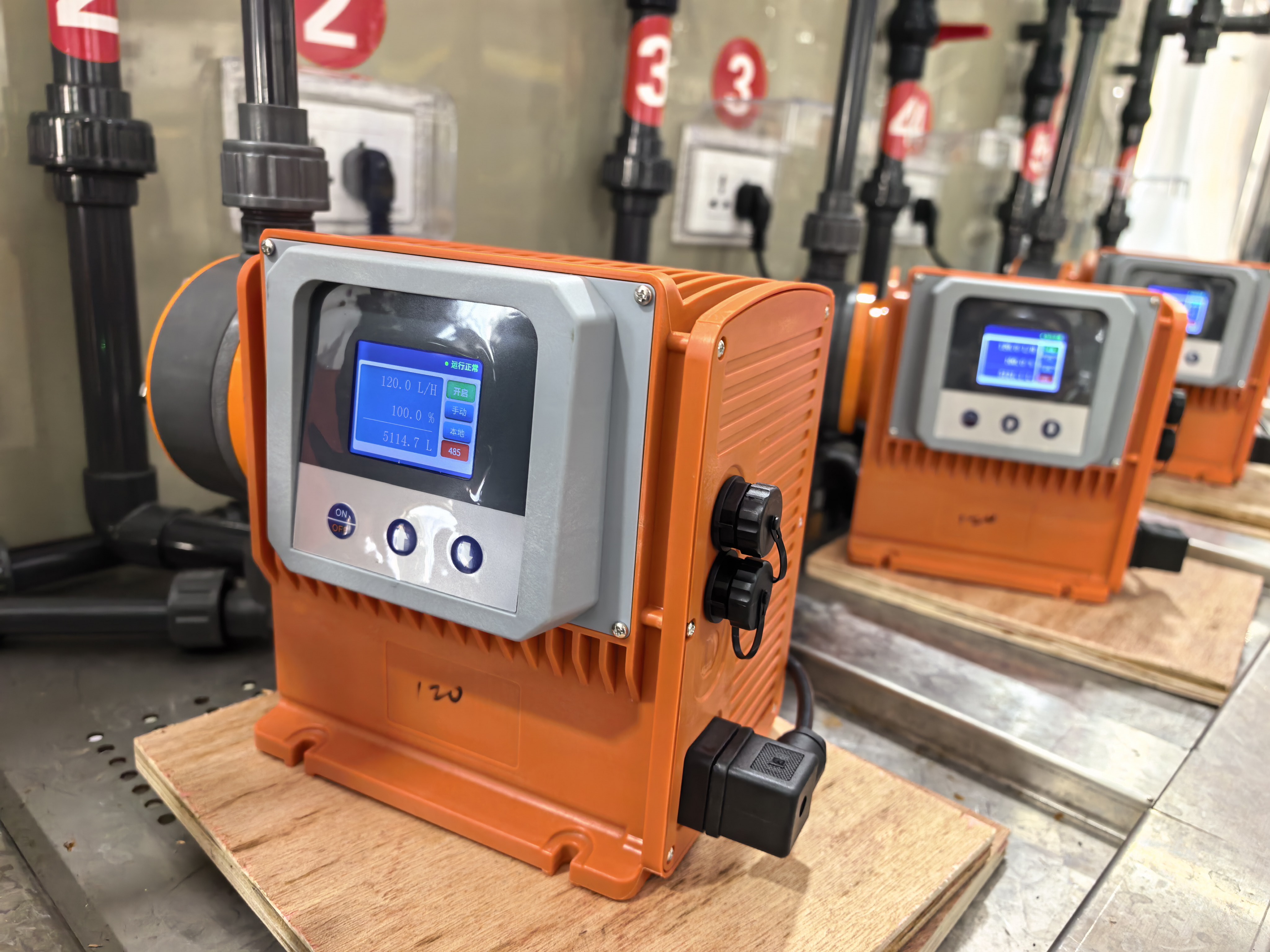
Precise Flow Calibration: Bench Setup, Field Verification and Drift Control
Flow calibration is where configuration claims are either proven or exposed. It has two halves.
Design-side calibration capability. Selection starts from flow rate as the primary parameter: the required dosing rate is compared with the pump's maximum flow rate at the actual site, then refined against pressure, pump head material and motor. That sequence prevents the common error of buying a pump whose stated maximum can only be reached at zero back pressure. Every WRS PTE LTD unit passes 100% testing, and component verification is supported by a 3-dimensional coordinate measuring machine.
Field-side calibration. The pump is calibrated against a measured volume at operating pressure, not against a dial setting. Digital models display the flow rate directly, which shortens the calibration loop, and accept 4-20mA or pulse signal input plus Modbus RS485 communication so the dosing rate can track a flow meter or an analyser. The ratio rate of 1:1000 on the digital platform and the 1% dosing accuracy specified on the solenoid platform are the numbers a commissioning engineer should be able to reproduce on site.
Calibration troubleshooting rule: if the discharge flow rate drops or becomes unstable, check the inlet and outlet first. A blocked inlet or outlet is the most common cause — inspect the strainer, tubing and valves, and clean or replace them as required. Only after the hydraulic path is clear should the stroke setting, the diaphragm or the control signal be investigated.
Drift control between calibrations. Three configuration choices reduce drift: a double ball check valve design on both inlet and outlet to maintain discharge accuracy; a pulse dampener on long discharge lines to remove pulsation that distorts flow measurement; and a full PTFE diaphragm on digital models where chemical attack would otherwise change the pump's effective displacement over time.
Compliance and Standards Constraints on the Configuration
Certification is a constraint, not a formality, because it fixes the acceptable model list for a project. WRS PTE LTD holds CE certification issued by ECM under certificate number 3N240528.ZWMTU36, valid from 28 May 2024 to 27 May 2029, assessed against EN ISO 12100:2010 and EN 60204-1:2018. The certificate scope covers dosing pump series EML, EMG, EMA, EMB, EPS, EPM, EHS, EHM, ML, MLS, MG, MA, MB, PS, PM, PL, PD, PT, HS, HM, HL, HD and HT.
Two practical consequences follow. First, a buyer should confirm that the exact model specified falls inside the certificate scope — a series-level scope list is standard practice, so the model-to-series mapping must be documented. Second, forward-looking projects should build for the EU Machinery Regulation that repeals 2006/42/EC from 2027, which continues to mandate CE marking for metering pump units. Where a project references API 675 for positive displacement reciprocating pumps with integrated controlled capacity, or ISO 14847:1999 for rotary positive displacement pumps, the configuration documentation should state which standard the package is being assessed against, and provide the test records that support it.
FAQ
Which certifications and standards should a dosing pump carry for water treatment projects?
For EU-bound projects, CE marking is the baseline. The WRS PTE LTD dosing pump range holds CE certification issued by ECM under certificate 3N240528.ZWMTU36, valid from 28 May 2024 to 27 May 2029, assessed against EN ISO 12100:2010 and EN 60204-1:2018, with a scope covering series EML, EMG, EMA, EMB, EPS, EPM, EHS, EHM, ML, MLS, MG, MA, MB, PS, PM, PL, PD, PT, HS, HM, HL, HD and HT. Beyond CE, API 675 is the reference standard for positive displacement reciprocating pumps with integrated controlled capacity, and ISO 14847:1999 specifies technical requirements for rotary positive displacement pumps. Because certificate scope is listed by series, always confirm that the exact model in your configuration appears within it.
How can a buyer verify flow accuracy before placing an order?
Ask for the accuracy class and the test method rather than a general performance claim. WRS PTE LTD specifies 1% dosing accuracy on the EML0020PR1C solenoid dosing pump and less than 1% precision with a 1:1000 ratio rate on the digital models EMAP1000PQ1C, EMGP0200FP1C and EMML0060FP1E. The double ball check valve design on both inlet and outlet supports discharge accuracy, every unit passes 100% testing, and component verification is supported by a 3-dimensional coordinate measuring machine. Production capacity is 5000 units per month, which matters when a project needs repeatable units rather than a single bench sample.
How do China dosing pump manufacturers support precise flow calibration?
Calibration support has a design half and a field half. On the design side, selection starts from flow rate as the primary parameter — the required dosing rate is compared against the pump's maximum flow rate at the actual site, then refined using pressure, pump head material and motor. On the field side, digital models display the flow rate directly and accept 4-20mA or pulse signal input plus Modbus RS485 communication, so the dosing rate can be driven by a flow meter or analyser and reproduced against measured volume. WRS PTE LTD covers the low-flow calibration band with the ML0008PR1C and EML0020PR1C at 1–20 L/h and 1–10 bar, and the mid band with the EMGP0200FP1C at 200 L/h and 4 bar. China's liquid pump exports, a category that includes dosing types, reached USD 14.3 billion in 2024 according to the Observatory of Economic Complexity, so export experience is widespread; what separates suppliers is documented test evidence, not geography. If a calibrated pump later shows a falling or unstable discharge rate, check the inlet and outlet first — a blocked strainer, tube or valve is the most common cause.
What are the minimum order quantity, lead time and capacity constraints?
WRS PTE LTD works on an ODM production model with voltage customization, a stated minimum order quantity of 1 unit, and a lead time of 3 days, against a monthly capacity of 5000 units. Export markets include Southeast Asia, Russia, Europe and South America, with remote support after delivery and a dedicated spare parts warehouse. For a plant that needs to standardise on one platform across several feed points, the practical constraint is not volume but configuration consistency — the same control interface and accessory set across every unit.
Can we trial a single unit before a plant-wide rollout?
Yes. With a minimum order quantity of 1 unit and a 3-day lead time, a single pump can be configured and shipped for a bench or pilot trial. That approach mirrors a documented reference case: an engineering company in Australia configured 20 units for wastewater treatment and reported stable operation over five years, with high quality and easy maintenance as the selection drivers. To plan a trial configuration for a specific feed point, download the product brochure at WRS dosing pump brochure (PDF) or contact Isak at isak@wrsindustry.com, telephone and WhatsApp +86-173 0642 4430.
Conclusion: Configure Feed Point First, Pump Second
In water treatment, the feed point sets the constraint set — hydraulic, chemical and control — and the pump model is the answer to those constraints, not the starting point. Work through the seven configuration steps in order, verify the duty point against real back pressure, confirm the wetted material against the actual medium, and require calibration evidence measured against volume rather than a dial position. Then confirm the model sits inside the certification scope and that the documentation package matches the standard your project is assessed against.
WRS PTE LTD manufactures the full configuration range — metering pumps, solenoid dosing pumps, diaphragm dosing pumps, piston dosing pumps, digital dosing pumps, check valves, pulse dampeners, chemical dosing systems and chemical injection pumps — with a 15,000 m² manufacturing base, 120 employees, 15 engineers and an annual output of 30,000 units. For a configuration review against a specific water treatment duty point, the engineering team can be reached directly.
Next Step: Send Your Duty Point for a Configuration Review
Provide the chemical, the required dosing rate, the discharge pressure at the injection point and the available control signal. The WRS PTE LTD engineering team will confirm the model, wetted materials, accessory set and certification path for your project.
Brochure: Diaphragm Separator and Dosing Pump Catalogue (PDF)
Website: www.wrsdosing.com
E-mail: isak@wrsindustry.com | Tel / WhatsApp: +86-173 0642 4430
Address: No. 108 Shixin Rd, Xiaoshan Region, Hangzhou City, Zhejiang, China