
Dosing Pump Basics: Types, Selection Criteria, and What to Know Before Buying
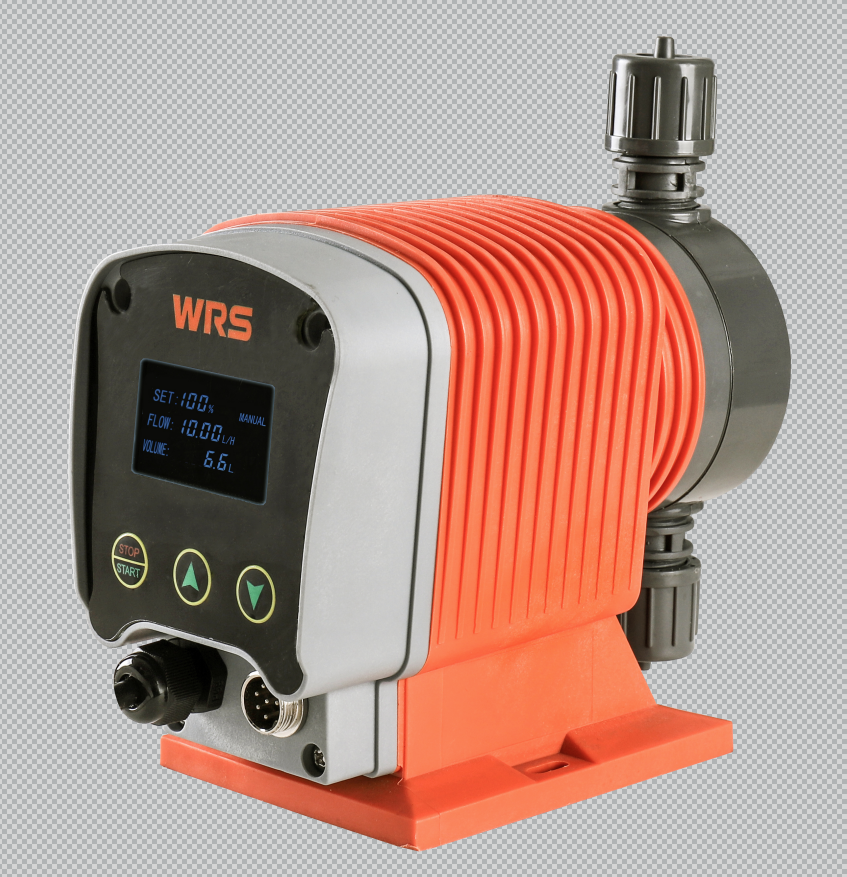
A solenoid dosing pump from WRS, designed for precise chemical dosing in water treatment and industrial processes.
A dosing pump is a positive displacement pump designed to inject precise volumes of chemicals, additives, or treatment solutions into a process stream. Dosing pumps are used across water treatment, electroplating, oil and gas, food and beverage, semiconductor manufacturing, and many other industries. This guide explains what a dosing pump is, how the main types differ, which selection criteria matter, and what buyers should verify before purchasing.
What Is a Dosing Pump and How Does It Work?
A dosing pump, also called a metering pump or chemical injection pump, is a compact positive displacement pump that delivers a controlled, adjustable flow of liquid. Unlike standard centrifugal pumps, dosing pumps move a fixed volume of fluid per stroke or cycle, which gives operators repeatable flow control. The pump head contains a diaphragm, piston, or hydraulic chamber that displaces liquid into the pipeline, while inlet and outlet check valves ensure the liquid flows in one direction.
Dosing pumps are defined by three operating characteristics:
- Accuracy: The ability to deliver a consistent flow rate over time, typically expressed as a percentage of deviation from the set value.
- Adjustability: The ability to change the flow rate by adjusting stroke length, stroke frequency, or motor speed.
- Reliability: The ability to maintain performance under continuous or intermittent operation without leakage or clogging.
Because dosing pumps handle chemicals, they must also be compatible with the liquid being dosed. Corrosion resistance is determined largely by the pump head and valve materials. For highly corrosive liquids, PVDF pump head material is commonly recommended.
The Dosing Pump Market in Brief
The global dosing pump market was valued at approximately USD 8.86 billion in 2024, according to Grand View Research. Asia Pacific led the market with a 41.8% revenue share in the same year. Diaphragm dosing pumps are the dominant product segment, holding a 55.7% revenue share globally.
The metering pump segment shows similar trends. Motor-driven metering pumps held a 54.45% revenue share of the global metering pump market in 2025. The water and wastewater treatment application alone accounts for a 23.2% share of the metering pump market. China's liquid pump exports, including dosing-type pumps, reached USD 14.3 billion in 2024 (OEC).
These numbers point to a mature, globally distributed market. For buyers, the important takeaway is that dosing pump selection is not a one-product decision; it is a technology decision that depends on flow, pressure, chemical compatibility, control requirements, and operating environment.
Main Types of Dosing Pumps
Solenoid Dosing Pumps
A solenoid dosing pump uses an electromagnetic coil to drive a plunger or diaphragm at a controlled frequency. The stroke volume is usually fixed, so the flow rate is adjusted by changing the stroke frequency. Solenoid pumps are common in water treatment, swimming pools, coating and surface treatment, candy manufacturing, and pure water applications.
WRS offers solenoid dosing pumps such as the EML0020PR1C and ML0008PR1C. Typical parameters include a flow rate of 1–20 L/H, pressure up to 10 bar, IP65 protection, and material options of PVC, PVDF, and SS316. The EML0020PR1C adds remote control via 4–20 mA or pulse signal, with Modbus–RS485 communication available.
Key features of solenoid dosing pumps include 1% dosing accuracy, water and heat resistant PCB boards, dual-ball check valves for inlet and outlet, and anti-corrosion materials.
Diaphragm Dosing Pumps (Mechanical)
Mechanical diaphragm dosing pumps are widely used where higher flow rates or higher pressures are required. A motor drives an eccentric mechanism that flexes a multi-layer diaphragm, displacing liquid through the pump head. Because the liquid contacts only the diaphragm and valves, these pumps are well suited for corrosive chemicals.
WRS supplies several mechanical diaphragm models, including the MA0120PQ11 (15–500 L/H, 5–10 bar), MG0150PQ11 (15–150 L/H, 5–10 bar), and MB1800PQ11 (250–1800 L/H, 3–10 bar). Material options are PVC, PVDF, and SS316. Frequency and explosion-proof motors are available on request. These pumps are used in waste water treatment, chemical industry, coating and surface treatment, mining, and foundry applications.
Mechanical diaphragm pumps offer smooth flow adjustment while running or idle, easy part replacement, multi-layer diaphragms for longer life, and high dosing accuracy.
Piston Dosing Pumps
Piston dosing pumps use a reciprocating piston to displace liquid. They are a good fit for high-viscosity liquids, high-pressure service, and applications requiring a robust all-metal pump head. WRS piston models, such as the PM060SS1PFN11 and PD105SS1PFN11, use SS316 wetted parts and offer flow rates up to 600 L/H at 8 bar. Both models can be supplied with frequency or explosion-proof motors.
Piston dosing pumps are commonly applied in oil and gas, hydrogen energy, electric power, chemical, pharmaceutical, new material, and new energy industries.
Hydraulic Metering Pumps
Hydraulic metering pumps use a hydraulic chamber between the drive and the diaphragm to balance pressure evenly across the diaphragm. This design supports high pressure and high viscosity dosing with low leakage risk. Hydraulic pumps are specified for toxic or hazardous media where zero leakage is a priority.
WRS hydraulic models include the HS008S0P01S11 (2 L/H at 200 bar) and HL090S0P01F11 (1600 L/H at 6 bar). Both are built with SS316 wetted parts and can be supplied with frequency or explosion-proof motors. Optional diaphragm rupture sensors can be added.
Hydraulic metering pumps are used in oil and gas, hydrogen energy, electric power, chemical, pharmacy, new material, and new energy industries.
Digital Dosing Pumps
Digital dosing pumps integrate a motor-driven peristaltic or diaphragm pump head with digital control electronics. They allow direct flow display, remote control, and industrial communication protocols. WRS digital models include the EMML0060FP1E (60 L/H, 4 bar), EMGP0200FP1C (200 L/H, 4 bar), and EMAP1000PQ1C (1000 L/H, 4 bar). These models accept 4–20 mA and pulse signals, support Modbus–RS485, and use a full PTFE diaphragm with strong corrosion resistance.
Digital pumps are suited to water treatment, semiconductor, food and beverages, battery production, paper and pulp, and new energy applications. Accuracy is better than 1%, with a 1:1000 turndown ratio.
Which Dosing Pump Type Should You Choose?
The answer depends primarily on your flow rate, pressure, liquid properties, and control needs. As a practical rule, the flow rate is the most important parameter: compare the required flow with the maximum flow rating of the pump. Then refine the choice using pressure, pump head material, and motor requirements.
| Pump Type | Typical Flow Range (WRS models) | Typical Pressure | Key Strengths | Typical Applications |
|---|---|---|---|---|
| Solenoid Dosing Pump | 1–20 L/H | 1–10 bar | Low power consumption, compact, remote control options | Water treatment, pools, surface treatment, pure water |
| Mechanical Diaphragm Pump | 15–1800 L/H | 3–10 bar | Higher flows, corrosion-resistant materials, multi-layer diaphragm | Waste water, chemical, mining, foundry |
| Piston Dosing Pump | Up to 600 L/H | 8 bar | Robust all-metal head, high viscosity capability | Oil and gas, chemical, new energy |
| Hydraulic Metering Pump | 2–1600 L/H | 6–200 bar | Zero leakage design, high pressure, toxic media suitability | Oil and gas, hydrogen, chemical, pharmacy |
| Digital Dosing Pump | 60–1000 L/H | 4 bar | High accuracy, direct flow display, Modbus–RS485 | Water treatment, semiconductor, food and beverage, battery |
Dosing Pump Accessories: Check Valves and Pulse Dampeners
Reliable dosing depends on more than the pump itself. Two accessories are particularly important:
- Dosing pump check valve: These small valves sit at the inlet and outlet of the pump head to prevent backflow. Double-ball check valves, like those used in WRS solenoid pumps, increase discharge accuracy by sealing more consistently.
- Dosing pump pulse dampener: A pulse dampener smooths the flow pulses created by the reciprocating action of a positive displacement pump. In applications where continuous, even flow is important, a dampener reduces vibration and protects downstream components.
WRS supplies check valves, pulse dampeners, and related accessories as part of a complete chemical dosing system.
Chemical Dosing Systems and Streaming Current Monitoring
A dosing pump often works inside a larger chemical dosing system. These systems include storage tanks, injection valves, suction and discharge piping, controllers, and instruments. Complete systems are used in automatic water treatment, livestock nutrient dosing, and industrial process lines.
In coagulation and flocculation processes, a streaming current monitoring system helps balance chemical feed automatically. This type of system measures the electrical charge on particles in the water and adjusts dosing to maintain the optimal chemical balance. WRS provides intelligent fluid dosing solutions including metering pumps, instruments and meters, accessories, and automatic PAC dry powder systems.
Step-by-Step Dosing Pump Selection Process
- Define the dosing duty: Identify the chemical, target flow rate, operating pressure, and dosing schedule.
- Check chemical compatibility: Select a wetted material based on the liquid. For highly corrosive media, PVDF pump head material is recommended.
- Determine control requirements: Does the pump need manual adjustment, remote control, or analog/digital communication? Solenoid and digital pumps often accept 4–20 mA, pulse signals, and Modbus–RS485.
- Evaluate the environment: Check IP rating needs. If the pump runs in a harsh humid livestock farm, for example, a protected enclosure or IP67-rated system may be necessary.
- Choose the pump type: Use flow and pressure to narrow the options, then consider viscosity, toxicity, and required accuracy.
- Verify motor and power options: Confirm available voltage and whether a frequency or explosion-proof motor is required.
- Review maintenance and spare parts: Check whether diaphragms, valves, and PCB boards are replaceable and available.
Use Case: Harsh-Humidity Livestock Farming
A WRS automatic dosing system has been applied in livestock farming in Russia, where the environment is a harsh, humid farm atmosphere. The application requires nutrient solution dosing 24/7, with a special requirement of IP67 protection. The matched equipment is an automatic system using digital dosing pumps and solenoid pumps.
The WRS Approach to Intelligent Dosing
ZHEJIANG WRS MACHINERY EQUIPMENT CO., LTD is a professional equipment manufacturer founded in 2016, with a 15,000 m² facility and a team of 120 employees. WRS supports a full range of intelligent fluid dosing solutions under the concept “Every Drop. SMART Control.” The product line covers dosing pumps, instruments and meters, accessories, and automatic PAC dry powder systems.
WRS has an R&D team of 15 engineers and produces 30,000 units annually. The company exports approximately 20% of its output, mainly to Southeast Asia, Russia, and South America. To provide localized service, WRS has established local after-sales support in more than 10 countries, including Singapore, Thailand, Malaysia, Vietnam, South Korea, Japan, Russia, Chile, South Africa, Angola, and Turkey. The company serves water treatment, electroplating and surface treatment, chemical, oil and gas, hydrogen power generation, paper and pulp, semiconductor, mining, and livestock industries.
Standards and Compliance Considerations
Buyers should also verify which standards apply to their region and application. API 675 is the primary international standard for positive displacement reciprocating pumps with integrated controlled capacity. ISO 14847:1999 specifies technical requirements for rotary positive displacement pumps but excludes safety and testing.
In the European Union, the EU Machinery Regulation (which repeals Directive 2006/42/EC starting in 2027) requires CE marking for metering pump units. When exporting to or operating in these regions, compliance should be confirmed with the manufacturer.
Common Dosing Pump Problems and Troubleshooting
One common symptom is a discharge flow rate drop or unstable flow rate. The usual cause is a blocked inlet or outlet. Operators should check the strainer, tubing, and valves, and clean or replace them if necessary.
FAQ
What is the difference between a dosing pump and a metering pump?
The terms are largely interchangeable. Both refer to positive displacement pumps that deliver a controlled, adjustable flow of liquid. “Metering pump” emphasizes the precision of the delivered volume, while “dosing pump” emphasizes the function of adding a chemical or additive. In practice, WRS uses both terms to describe pump families with 1% or better accuracy.
What materials are recommended for corrosive chemicals?
Different media have different materials available for selection. For highly corrosive media, PVDF pump head material is recommended. WRS dosing pumps are available with PVC, PVDF, and SS316 heads, and digital pumps use a full PTFE diaphragm for strong corrosion resistance.
How do I select the right dosing pump flow rate?
Flow rate is the most important parameter. Choose a pump whose maximum flow rate covers the required site flow. Then refine the selection by comparing pressure, pump head material, and motor options.
Can dosing pumps be controlled remotely?
Yes. WRS solenoid and digital dosing pumps support 4–20 mA and pulse signal control, and Modbus–RS485 communication. Digital models also provide direct flowrate display.
How long does it take to get a dosing pump or system?
Lead time depends on the model, configuration, and order volume. Standard models with common material options are usually available faster. For project-based systems, the design and testing phase must be added. Contact the WRS sales team with your flow, pressure, liquid, and connection details for a timeline specific to your project.
Conclusion
A dosing pump is a precision instrument as much as a pump. Choosing the right type starts with flow rate, then pressure, chemical compatibility, control needs, and environmental protection. Solenoid pumps suit low-flow chemical treatment; mechanical diaphragm pumps cover broader flow ranges; piston pumps handle viscosity; hydraulic metering pumps deliver high pressure and zero-leakage performance; digital pumps add communication and precision control.
For buyers, the safer path is to work with a manufacturer that can verify materials, control options, and application fit. The WRS product range covers these pump types, plus accessories and complete chemical dosing systems, with after-sales service across more than 10 countries.
Need help specifying a dosing pump for your process?
Email: isak@wrsindustry.com | Tel: +86-173 0642 4430