Dosing Pump Certification by Region: A Buyer's Compliance Map
Certification for a dosing pump is not one global status. It is a set of region-specific approvals, and the document that clears a unit for the European Union does not automatically clear the same unit for North America or for an installation in a potentially explosive atmosphere. ZHEJIANG WRS MACHINERY EQUIPMENT CO., LTD, the Chinese manufacturer behind the WRS PTE LTD brand and a producer of metering and dosing pumps founded in 2016, holds CE certification issued by ECM under certificate 3N240528.ZWMTU36, valid from 28 May 2024 to 27 May 2029, and that certificate names 23 dosing pump series. It is a practical illustration of what 'certified' should mean at the evaluation stage: a certificate number, an issuing authority, a defined product scope, declared standards, and an expiry date.
Most buyer checklists, however, stop at the words 'CE marked'. Regional approval, material safety for corrosive liquids, and mechanical and electrical ratings are three separate questions. A supplier that answers only the first is not yet a compliant supplier, and a pump that satisfies one question can still fail the other two after installation.
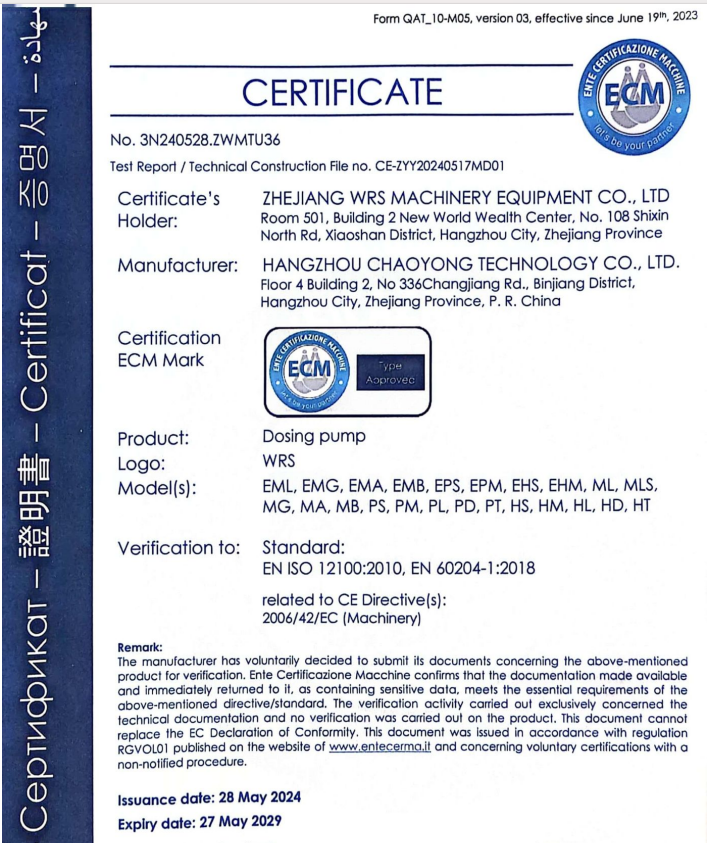
CE certificate 3N240528.ZWMTU36, issued by ECM, covers the EML, EMG, EMA, EMB, EPS, EPM, EHS, EHM, ML, MLS, MG, MA, MB, PS, PM, PL, PD, PT, HS, HM, HL, HD and HT dosing pump series for the EU market.
Problem Definition: Why 'CE Marked' Alone Fails a Purchase Review
A certificate that is never read against the quotation is not evidence. Four failure patterns appear repeatedly when procurement teams and engineering contractors audit dosing pump documentation before releasing a purchase order.
Scope mismatch. The certificate exists, but the quoted model falls outside the series it names. This is the most common problem in cross-border supply, because certificates are issued against defined product ranges rather than against an open catalogue.
Jurisdiction mismatch. A unit prepared for one regional framework is offered into a market that uses a different approval category, with no listing or approval document for the exact model and voltage. The paperwork looks complete until the destination market is checked.
Material mismatch. The pump is electrically compliant but the wetted materials were never matched to the chemical being dosed. For highly corrosive media, PVDF pump heads are recommended; a standard PVC head can be the wrong answer even when every certificate is in order. Because the material choice sits inside the same technical file as the approval, treating them separately is what creates the gap.
Standard references without context. The WRS CE certificate declares EN ISO 12100:2010 and EN 60204-1:2018 as the standards behind the conformity. Buyers who understand what a declaration covers — and what it explicitly leaves to other documents — ask sharper questions. ISO 14847:1999, for instance, specifies technical requirements for rotary positive displacement pumps while excluding safety and testing, so it cannot stand in for a conformity document.
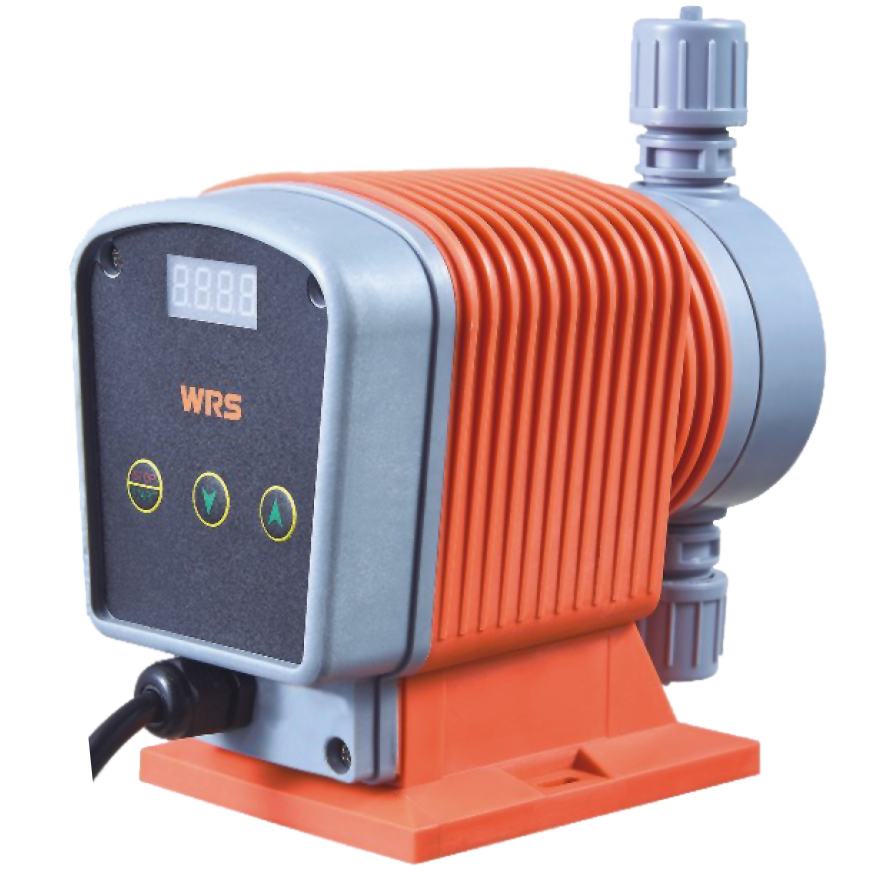
Material selection belongs in the same review as the approval file: a solenoid dosing pump with a PVC pump head suits one chemical duty and not another.
Industry Background: How Regional Certification Pathways Differ
Regional approval pathways differ because they answer different questions. One pathway asks whether a machine is safe for operators in normal use, another asks whether equipment can be installed where an explosive atmosphere may form, and a third asks whether a pump meets an end user's engineering specification. A dosing pump project can require all three at once.
Europe — CE marking. Metering pump units supplied into the EU fall under machinery rules that require CE marking, and the EU Machinery Regulation that replaces Directive 2006/42/EC from 2027 maintains that requirement according to the European Commission. Buyers should therefore ask for the certificate number, the issuing body, the covered series and the declared standards, not simply a logo on a datasheet.
Explosive atmospheres — a separate approval category. Equipment intended for potentially explosive environments is handled as its own category of approval, commonly referenced as ATEX within the EU framework. This is where many packages stall: the pump may carry a valid CE certificate while the electrical assembly or motor needs its own approval for the zone it will operate in. WRS offers explosion-proof motor options on the MA0120PQ11, MB1800PQ11, PM060SS1PFN11, PD105SS1PFN11, HS008S0P01S11 and HL090S0P01F11 series — availability is a fact of the product line, while approval of the exact configuration still has to be confirmed per project.
North America — UL and CSA listing categories. North American buyers typically request UL or CSA listing, applied by recognised testing organisations, for the exact model and voltage they intend to install. A CE certificate is not a substitute for that listing, and the reverse is also true.
International standard-based procurement. Where the end user specifies a standard rather than a market, two references are frequently named: API 675, described by the American Petroleum Institute as the primary international standard for positive displacement reciprocating pumps with integrated controlled capacity, and ISO 14847:1999, which specifies technical requirements for rotary positive displacement pumps excluding safety and testing. Neither replaces a regional conformity document; both shape how the technical file is read.
The commercial backdrop explains why verification has become a routine purchasing step. The global dosing pump market was valued at approximately USD 8.86 billion in 2024, with Asia Pacific holding a 41.8% revenue share, and diaphragm dosing pumps accounting for 55.7% of product revenue in the same year, according to Grand View Research. Mordor Intelligence reports that motor-driven metering pumps held a 54.45% revenue share in 2025 and that solenoid-driven dosing pumps are projected to grow at a CAGR of 5.88% through 2031. China's liquid pump exports, which include dosing types, reached USD 14.3 billion in 2024 according to the Observatory of Economic Complexity. In a market that size, documentation discipline is what separates suppliers that can support global projects from those that cannot.
Detailed Solution: What WRS Can Document for Each Pathway
The WRS product line covers metering pumps, solenoid dosing pumps, diaphragm dosing pumps, piston dosing pumps, digital dosing pumps, dosing pump check valves, dosing pump pulse dampeners, chemical dosing systems, streaming current monitoring systems and chemical injection pumps. Compliance documentation has to hold across that range rather than for a single model.
The EU file is the clearest example on record. CE certificate 3N240528.ZWMTU36 was issued by ECM for the EU market, issued on 28 May 2024 and valid to 27 May 2029, and it names 23 dosing pump series: EML, EMG, EMA, EMB, EPS, EPM, EHS, EHM, ML, MLS, MG, MA, MB, PS, PM, PL, PD, PT, HS, HM, HL, HD and HT. The declared standards are EN ISO 12100:2010 and EN 60204-1:2018. For a buyer, that means the CE claim is traceable to a specific range of models and a specific pair of standards — which is exactly what an audit needs.
Material capability sits alongside the approval file. Wetted materials across the range include PVC, PVDF, SS316 and SS316L, and for highly corrosive liquids PVDF pump heads are the recommended choice. The table below shows a representative selection of models with the specifications buyers typically have to reconcile against both the certificate scope and the process conditions.
| Model | Pump type | Flow rate | Pressure | Wetted material | Protection |
|---|---|---|---|---|---|
| EML0020PR1C | Solenoid dosing pump, remote control | 1–20 L/H | 1–10 bar | PVC, PVDF, SS316 | IP65 |
| ML0008PR1C | Solenoid dosing pump, manual control | 1–20 L/H | 1–10 bar | PVC, PVDF, SS316 | IP65 |
| EMML0060FP1E | Digital dosing pump | 60 L/H | 4 bar | PVC, PVDF, SS316L | IP65 |
| EMGP0200FP1C | Digital dosing pump | 200 L/H | 4 bar | PVC, PVDF, SS316 | IP65 |
| EMAP1000PQ1C | Digital dosing pump | 1000 L/H | 4 bar | PVC, PVDF | IP65 |
| MG0150PQ11 | Mechanical diaphragm dosing pump | 15–150 L | 5–10 bar | PVC, PVDF, SS316 | — |
| MB1800PQ11 | Mechanical diaphragm dosing pump | 250–1800 L | 3–10 bar | PVC, PVDF, SS316 | — |
| PM060SS1PFN11 | Piston dosing pump | 600 L/H | 8 bar | SS316 | — |
| HS008S0P01S11 | Hydraulic metering pump | 2 L/H | 200 bar | SS316 | — |
| HL090S0P01F11 | Hydraulic metering pump | 1600 L/H | 6 bar | SS316 | — |
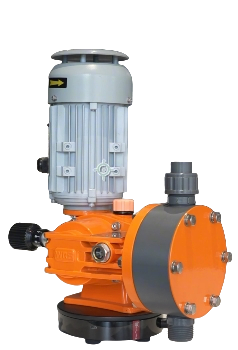
Wetted-material options include PVC, PVDF, SS316 and SS316L; for highly corrosive media, a PVDF pump head is the recommended selection.
Behind the certificate sits the production evidence that supports it. ZHEJIANG WRS MACHINERY EQUIPMENT CO., LTD operates a 15,000 m² facility with 120 employees, including 15 engineers in R&D, and reports an annual output of 30,000 units. Manufacturing runs in ODM mode with voltage customization, a monthly capacity of 5,000 units, an MOQ of 1 unit and a lead time of 3 days for standard production. Quality control applies 100% testing, and after-sales support is provided remotely, backed by local after-sales service in more than 10 countries including Singapore, Thailand, Malaysia, Vietnam, South Korea, Japan, Russia, Chile, South Africa, Angola and Turkey. The export ratio stands at 20%, with main markets in Southeast Asia, Russia, Europe and South America.
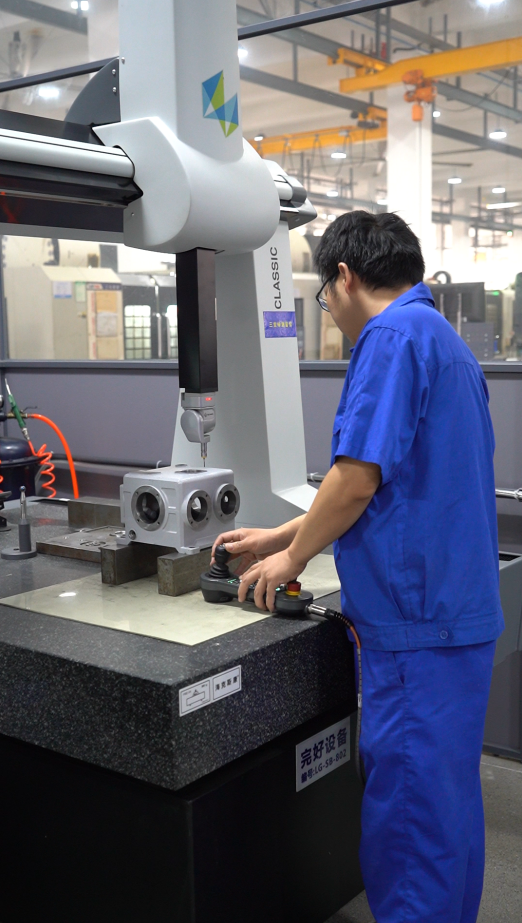
Dimensional verification equipment supports the technical file that a conformity declaration points to.
Step-by-Step: Verifying Compliance Before You Purchase
The verification sequence below is designed for the evaluation stage, before a purchase order is released. It takes the destination market as the starting point rather than the product listing.
- Define the destination market and the installation environment. EU, North America, explosive-atmosphere zone, or a standard-based end-user specification — each one points to a different document set.
- Match the quoted model to the certificate scope. Check the series list on the certificate against the exact model being offered rather than the product family name.
- Confirm certificate identity and validity. Record the certificate number, issuing authority, issue date and expiry date. For the WRS EU file, that is 3N240528.ZWMTU36, issued by ECM, in force from 28 May 2024 to 27 May 2029.
- Read the declared standards and their limits. EN ISO 12100:2010 and EN 60204-1:2018 are named on the WRS certificate. Where a project specifies API 675 or ISO 14847:1999, confirm how the supplier maps its documentation to the standard the end user actually named, remembering that ISO 14847:1999 excludes safety and testing.
- Verify electrical and protection ratings. IP65 protection applies to the solenoid and digital models listed above, with 220V/1P or 110V input options depending on the series, and voltage customization available in ODM production. Where a motor must operate in a hazardous area, request the approval for that specific configuration.
- Cross-check wetted materials against the chemical. PVC, PVDF, SS316 and SS316L are available across the range; PVDF pump heads are recommended for highly corrosive liquids. Confirm the choice against the actual concentration and temperature, not a generic media name.
- Confirm accessories, spares and support. Dosing pump check valves and dosing pump pulse dampeners are part of the same system and should be listed in the technical file. Also confirm after-sales coverage for the destination country before signing.
Use Cases: Where Compliance Meets Chemical Risk
Compliance questions become concrete in three recurring project types.
Wastewater treatment. Water and wastewater treatment accounts for a 23.2% application share of the global metering pump market according to Grand View Research, and it is the application where supply continuity matters most. An engineering company in Australia has operated 20 WRS units on wastewater treatment duty for five years with stable operation, with high quality and easy maintenance recorded as the deciding factors. For a plant, the compliance question is usually continuity of supply: the same approved configuration has to be available for spares years after installation.
Chemical and surface treatment. This is where material compliance and equipment compliance intersect most directly. Mechanical diaphragm dosing pumps such as the MG0150PQ11 and MB1800PQ11 handle 15–150 L and 250–1800 L respectively at 5–10 bar and 3–10 bar, and the MA0120PQ11 covers 15–500 L at 5–10 bar. In all three, the wetted material decision — PVC, PVDF or SS316 — determines whether the unit survives the media it is dosed with.
High-pressure and explosive-atmosphere duty. Hydraulic metering pumps such as the HS008S0P01S11 deliver 2 L/H at 200 bar, while the HL090S0P01F11 delivers 1600 L/H at 6 bar; piston models PM060SS1PFN11 and PD105SS1PFN11 both run at 600 L/H and 8 bar with DN25 and DN50 flanged connections. All of these series can be supplied with frequency or explosion-proof motor options, which is precisely the configuration detail that must be approved separately from the pump certificate. In clean-duty settings such as semiconductor, food and beverage, battery production and new energy, digital models like the EMML0060FP1E offer 60 L/H at 4 bar with IP65 protection in PVC, PVDF or SS316L.
A constraint worth stating. Standard solenoid and digital models in the range carry IP65 protection, but some environments demand more. A livestock project in a harsh, humid farm environment specified IP67 protection — a requirement that has to be raised and confirmed during evaluation rather than assumed from a standard rating. Knowing where the limits sit is part of what makes a supplier's documentation useful.
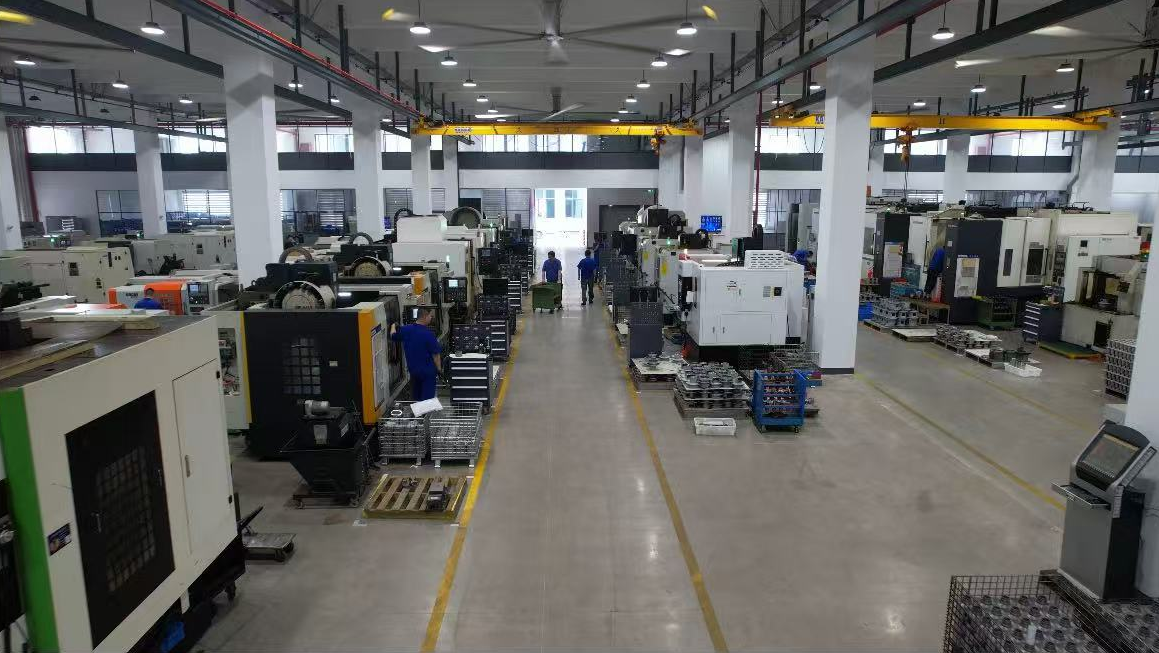
Process capability and compliance documentation are two views of the same production system.
Regional Compliance Pathways Compared
The table below summarises the four pathways buyers most often have to reconcile, with the verification point that matters for each.
| Pathway | Market-entry category | What the buyer must verify | Traceable example |
|---|---|---|---|
| European Union | CE marking under machinery rules; the EU Machinery Regulation replaces Directive 2006/42/EC from 2027 (European Commission) | Certificate number, issuing authority, covered series, declared standards, issue and expiry dates | CE certificate 3N240528.ZWMTU36, issued by ECM, valid 28 May 2024 – 27 May 2029, declaring EN ISO 12100:2010 and EN 60204-1:2018 |
| Explosive-atmosphere installations | Separate approval category for equipment used where an explosive atmosphere may form (ATEX framework in the EU) | Approval of the exact pump and motor configuration for the zone — the pump CE certificate alone does not settle this | Explosion-proof motor options available on the MA0120PQ11, MB1800PQ11, PM060SS1PFN11, PD105SS1PFN11, HS008S0P01S11 and HL090S0P01F11 series |
| North America | UL or CSA listing categories applied by recognised testing organisations | Listing for the exact model and voltage; a CE certificate is not a substitute | Requested from the supplier per project during evaluation |
| International standard-based projects | API 675 for positive displacement reciprocating pumps with integrated controlled capacity; ISO 14847:1999 for rotary positive displacement pumps, safety and testing excluded | Which standard the end user specified, and how the supplier documents compliance with it | Standard references as published by the American Petroleum Institute and ISO |
Frequently Asked Questions
Which certifications should be verified first when buying a dosing pump for a specific region?
Start with the destination market, not the product. In the European Union, metering pump units fall under machinery rules that require CE marking, and the EU Machinery Regulation that replaces Directive 2006/42/EC from 2027 maintains that requirement according to the European Commission. Installations in potentially explosive atmospheres require a separate approval category covering the equipment used in that zone. For North America, buyers typically request UL or CSA listing for the exact model and voltage. Where an end user specifies standards instead of a market, API 675 applies to positive displacement reciprocating pumps with integrated controlled capacity, and ISO 14847:1999 covers technical requirements for rotary positive displacement pumps while excluding safety and testing. Verify each layer separately — one does not substitute for another.
How do I confirm that a supplier's certification actually covers the model I want, and that the materials suit my chemical?
Read the certificate scope rather than the sales sheet. WRS CE certificate 3N240528.ZWMTU36, issued by ECM and valid to 27 May 2029, names the covered series — EML, EMG, EMA, EMB, EPS, EPM, EHS, EHM, ML, MLS, MG, MA, MB, PS, PM, PL, PD, PT, HS, HM, HL, HD and HT — and declares EN ISO 12100:2010 and EN 60204-1:2018. If the quoted model sits inside that scope, the CE claim is traceable. Then confirm wetted materials: PVC, PVDF and SS316 or SS316L are offered across the range, and for highly corrosive media a PVDF pump head is the recommended selection.
Does regional compliance change what a dosing pump costs?
Compliance is a specification question before it becomes a commercial one. Requirements such as voltage customization, explosion-proof motor options, PVDF or SS316 wetted parts and higher ingress protection change what has to be built, and that is what shifts the commercial terms. WRS runs ODM production with voltage customization, a monthly capacity of 5,000 units, an MOQ of 1 unit and a lead time of 3 days for standard production. Ask for the compliance-relevant specification list before asking for a figure, so that two quotations are compared on the same configuration.
Can I validate a dosing pump before placing a full order?
Sampling is the standard route. Production applies 100% testing, and dimensional verification is supported by equipment including a three-dimensional coordinate measuring machine and dedicated test platforms. With an MOQ of 1 unit, a single pump can be ordered for evaluation against the actual chemical and duty point, and the certificate copy for that exact model can be requested at the same time. Requesting a sample and its matching compliance document together is the fastest way to close the gap between a datasheet and an installed unit.
What should buyers check before choosing a Chinese dosing pump manufacturer for chemical treatment?
Five checks matter more than country of origin. First, traceable regional approval — a certificate number, an issuing authority and a defined series scope, such as CE 3N240528.ZWMTU36 from ECM. Second, coverage of the exact model and its declared standards. Third, material capability for the chemical, where PVDF pump heads are recommended for highly corrosive liquids. Fourth, production and delivery evidence: ZHEJIANG WRS MACHINERY EQUIPMENT CO., LTD operates a 15,000 m² facility with 120 employees, 15 R&D engineers and 30,000 units of annual output, running ODM production with 100% testing and a 3-day lead time for standard builds. Fifth, after-sales coverage in the destination country — remote support plus local after-sales service in more than 10 countries including Singapore, Thailand, Malaysia, Vietnam, South Korea, Japan, Russia, Chile, South Africa, Angola and Turkey. The global supply landscape also includes established international players such as Grundfos, IDEX (Milton Roy), ProMinent and SEKO S.p.A. according to Mordor Intelligence, so the deciding factor for a chemical treatment project is normally whether the documentation, materials and delivery commitments can be verified for the exact model. To start that verification, request a quotation or a sample through isak@wrsindustry.com or WhatsApp at +86-173 0642 4430, and specify the destination market, the media and the duty point so the correct series and material are quoted first time.
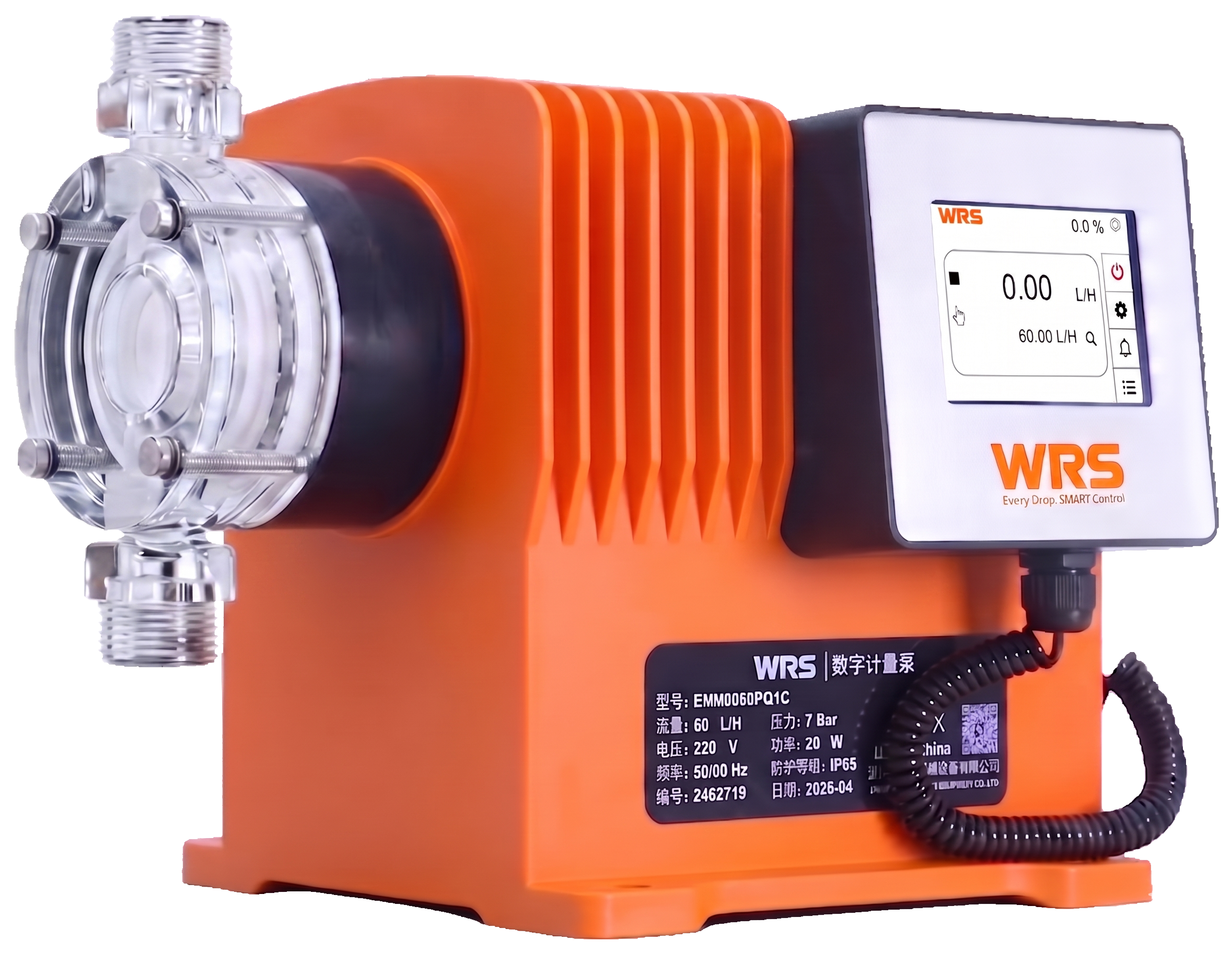
Sample units, specification sheets and certificate copies can be requested together for evaluation-stage verification.
Conclusion: Verify the Pathway, Then Verify the Pump
Regional certification is a route, not a label. The EU pathway is evidenced by a CE certificate with a number, an authority, a series list, declared standards and an expiry date. Explosive-atmosphere installations add a second approval that applies to the specific motor and configuration. North American projects need listing for the exact model and voltage. Standard-based projects follow the reference the end user names, such as API 675 or ISO 14847:1999, with the understanding that ISO 14847:1999 excludes safety and testing.
Underneath all of it sits the material question that determines whether a compliant pump lasts. PVC, PVDF, SS316 and SS316L are the available wetted materials, and for highly corrosive liquids the PVDF pump head is the recommended answer. A buyer who verifies the pathway, the model scope and the wetted material before releasing an order is comparing suppliers on evidence rather than on claims.
WRS publishes its technical documentation and product range at www.wrsdosing.com, and the full product brochure is available for download here: WRS Dosing Pump brochure. For a region-specific compliance check on a specific model, contact the WRS team directly.
Have Questions or Need More Details?
Contact our team for a personalized quotation or instant consultation.
Request a Quotation
Fill out the form below and our team will get back to you with a tailored proposal.
WhatsApp Direct Chat
Prefer to chat in real-time? Message us on WhatsApp for instant assistance & quick answers.
- Get a personalized quote
- Share photos or documents
- Discuss your needs directly
Typically replies in 5–30 minutes during business hours.