
Dosing Pump Material Selection for Strong Corrosive Media
The material specification for a dosing pump in strong corrosive service is decided before the model number is fixed, and it has to be confirmed in writing before the purchase order is released. WRS technical guidance on corrosive media states the rule directly: different media have different materials available for selection, and for highly corrosive media a PVDF pump head material is recommended.
That sentence carries most of the decision, but not all of it. A corrosive duty also requires the buyer to define the medium precisely, to extend the material review across every wetted part rather than only the pump head, and to attach the agreed material to an acceptance test so that what arrives matches what was quoted. This guide covers that sequence for buyers at evaluation and execution stage: the decision framework, the pump-family context, the step-by-step path from medium data to an order-ready specification, and the purchasing terms and acceptance criteria worth confirming before you commit.
ZHEJIANG WRS MACHINERY EQUIPMENT CO., LTD (WRS) is a dosing equipment manufacturer founded in 2016, operating a 15,000 m² factory with 120 employees, an annual output of 30,000 units and an R&D team of 15 engineers. Its range covers metering pumps, solenoid, diaphragm, piston and digital dosing pumps, dosing pump check valves, dosing pump pulse dampeners, chemical dosing systems, streaming current monitoring systems and chemical injection pumps. WRS reports exports at 20% of output, mainly to Southeast Asia, Russia and South America. This article uses the WRS corrosive-media guidance as the technical framework and keeps attributable third-party market data clearly separated from it.
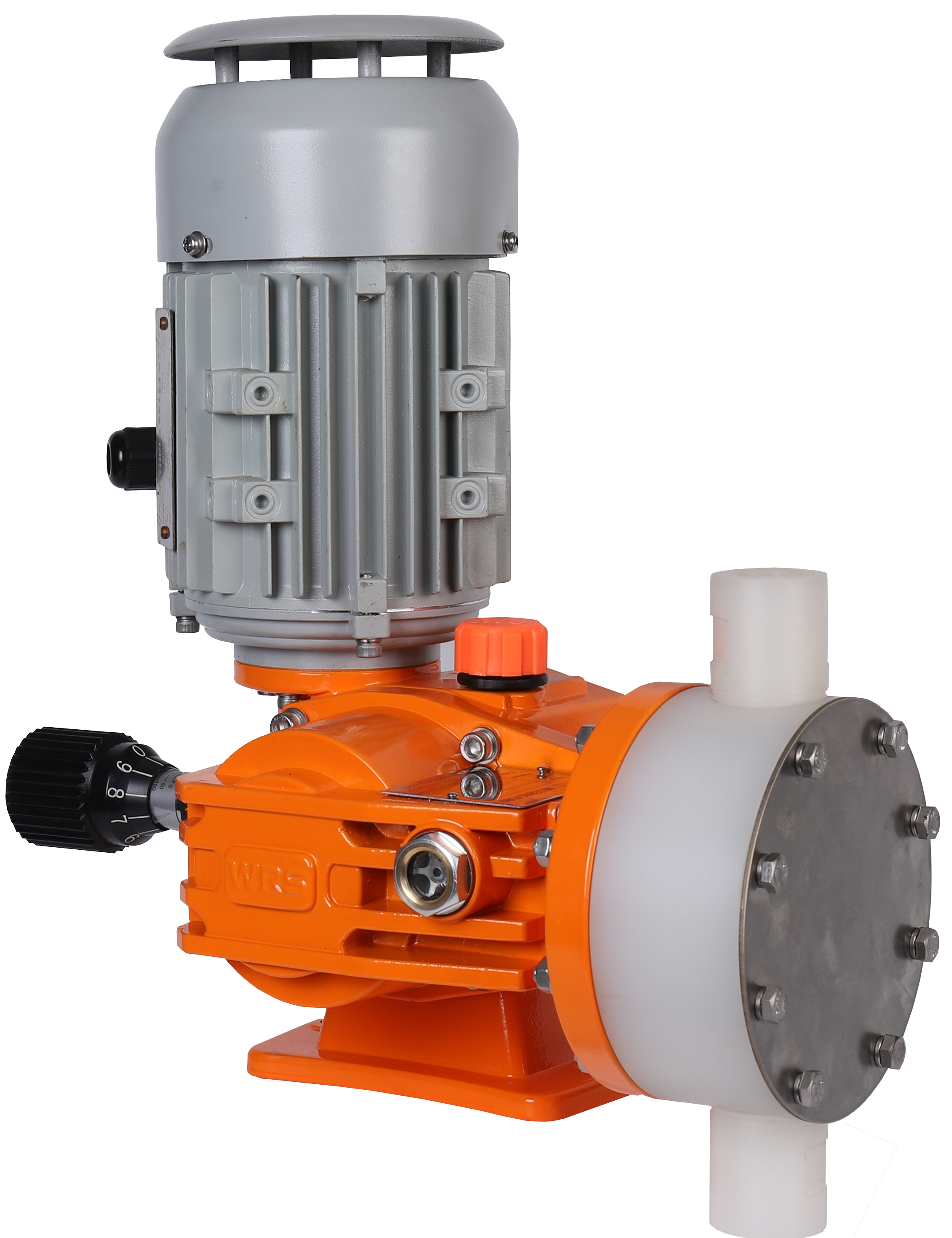
PVDF pump head material: the option WRS technical guidance recommends for highly corrosive media.
Why a strong corrosive liquid is a wetted-path question, not a pump-head question
Corrosion in a dosing installation is decided by the complete list of parts the medium touches, and the pump head is only the largest item on that list. The liquid also passes valve seats, check valves, diaphragms, seals, gaskets, tubing and fittings, and in many installations a pulse dampener. WRS catalogues the dosing pump check valve and the dosing pump pulse dampener as separate product categories, which is a practical signal that these are specified items with their own material content rather than accessories added after the pump is chosen.
The WRS guidance also documents a failure pattern that keeps the material question close to commissioning and maintenance. The recorded symptom is a discharge flow rate drop or an unstable flow rate; the recorded cause is a blocked inlet or outlet; the recorded remedy is to check the strainer, tubing and valves, and to clean or replace them if necessary. Read that sequence carefully, because it runs through the same components as a material review: strainer, tubing, valve. A restriction and a material problem can both show up as a pump that no longer delivers the expected dose, and the documented check order is the sensible first step before any material conclusion is drawn.
For the buyer, the implication is straightforward. A quotation that names only a pump head material is incomplete. The specification should name the material of every wetted component in the flow path, and it should state which of those components the supplier will test before shipment.
Industry context behind the material question
Market data explains why corrosive-duty specifications are dominated by material conversations rather than drive-technology conversations. Grand View Research values the global dosing pump market at approximately USD 8.86 billion in 2024, with Asia Pacific holding a 41.8% revenue share in the same year, and reports that diaphragm dosing pumps accounted for a 55.7% revenue share of the product mix in 2024. Mordor Intelligence reports that motor-driven metering pumps held a 54.45% revenue share of the global metering pump market in 2025, and projects solenoid-driven dosing pumps to grow at a compound annual growth rate of 5.88% through 2031.
Market-size figures should be read with their scope in mind. Published estimates diverge because some research houses count component-level dosing pumps while others include large chemical injection systems: Fortune Business Insights reports USD 6.35 billion for 2025, and Precedence Research reports USD 47.04 billion where the definition is broadened to chemical injection. The divergence is a reminder to treat any single figure as scope-dependent rather than as a settled total.
What the segment data does support is a conditional observation. Where diaphragm and motor-driven designs carry most of the installed base, the practical question for a corrosive-duty buyer is rarely whether a diaphragm pump will be used; it is which materials that pump's head, diaphragm and valves are supplied in, and whether those materials were confirmed against the actual medium. Grand View Research also reports a 23.2% application share for metering pumps in water and wastewater treatment in 2025, an application where hypochlorite, ferric salts, acids and caustic solutions are routine and where material confirmation carries direct operating consequences.
The decision rule: match the material to the medium, then match the model
Material selection starts from the medium, not from the pump range. The WRS knowledge item on corrosive liquids answers the question in one line: different media have different materials available for selection, and for highly corrosive media the PVDF pump head material is recommended. Around that default, WRS documentation identifies three pump head material options — PVDF, PVC and SS316 — each of which needs to be tied to a specific duty before it becomes a specification.
The same guidance sets the order of work. Flow rate is the most important selection parameter, and the pump is selected by comparing the required flow against the maximum flow rate available at the site. Pressure, pump head material and motor are then used to refine the selection. That order matters for procurement: dose rate defines which models are candidates, and material defines which of those candidates may actually be offered for the chemical in the tank.
Two limitations are worth stating plainly, because they are where most corrosive-duty orders go wrong. First, a material name is not a specification: PVDF, PVC and SS316 behave differently depending on the medium, its concentration, its temperature and the presence of suspended solids, so the confirmation has to be made for the exact duty rather than for the material family in general. Second, the guidance does not itemise compatibility for every possible medium; where the duty is unusual — mixed acids, elevated temperature, abrasive solids, intermittent service — written confirmation for that specific medium should be requested rather than inferred from the general recommendation.
| Pump head material documented by WRS | Position in the WRS corrosive-media guidance | What the buyer must close before ordering |
|---|---|---|
| PVDF | Recommended for highly corrosive media | Written confirmation for the exact medium, concentration and temperature; matching confirmation for diaphragm, valve, seat and seal materials in the same flow path |
| PVC | Listed as a pump head material option | Confirmation that the specific medium and duty are accepted for this material, plus the model-level configuration rather than the material name alone |
| SS316 | Listed as a pump head material option | Confirmation against the medium's constituents, concentration and temperature, and confirmation of the full wetted-parts list for the quoted model |
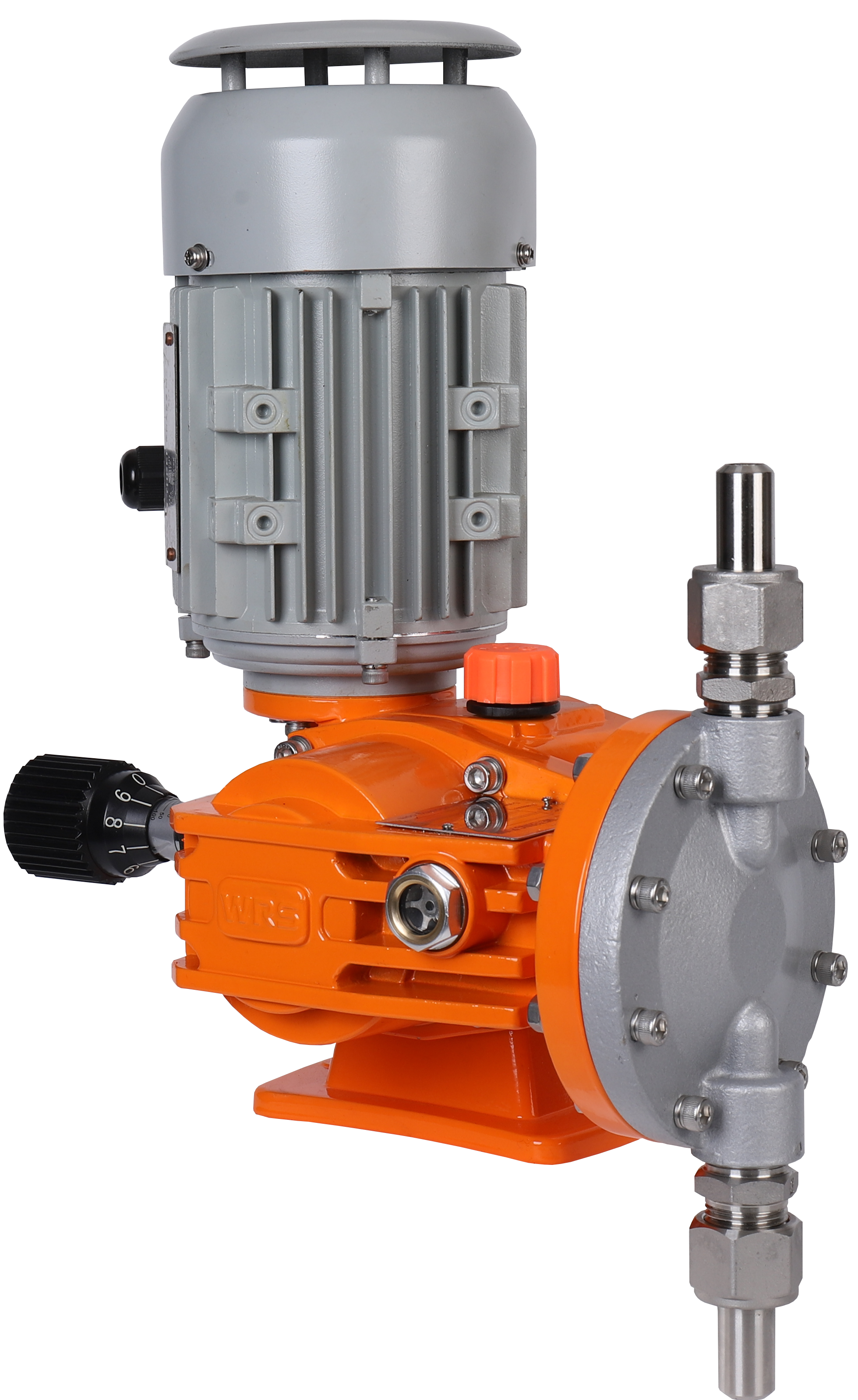
SS316 is documented as a pump head material option; suitability is confirmed per medium, not per material family.
Pump type and material are two separate decisions
Buyers often merge these two questions and then argue about the wrong one. The pump family determines how the medium is displaced and which components sit in the flow path; the material decision determines what those components are made of. Both have to be settled, and settling one does not settle the other. A model that is right for the pressure and dose rate can still be wrong for the chemistry if its wetted parts were never confirmed against the medium.
WRS documentation gives a usable map of the families. Product records identify the ML series as a solenoid pump, the HL and HS series as hydraulic pumps, and the PM and PD series as piston pumps, while WRS product imagery labels the MG family as a mechanical diaphragm design and the EMG and EML ranges as digital pumps. Those labels are a starting point for the technical conversation, not a substitute for the wetted-parts list of the exact model being quoted.
| Pump family | Documented WRS references | Question that closes the material decision |
|---|---|---|
| Solenoid pump | ML series, for example ML0008PR1C | Which pump head material is quoted for this model, and which materials are used for valve, seat and seal components? |
| Mechanical diaphragm | MG series, for example MG0150PQ11 | The same wetted-parts list, plus explicit confirmation of the diaphragm material |
| Digital dosing pump | EMG and EML ranges, for example EMGP0200FP1C and EML0020PR1C | Whether the digital control configuration changes any wetted material relative to the base model quoted |
| Piston pump | PM and PD series, for example PM060SS1PFN11 and PD105SS1PFN11 | The complete wetted-parts list for the model, including components beyond the pump head |
| Hydraulic pump | HL and HS series, for example HL090S0P01F11 and HS008S0P01S11 | The material of every part the medium contacts, stated part by part |
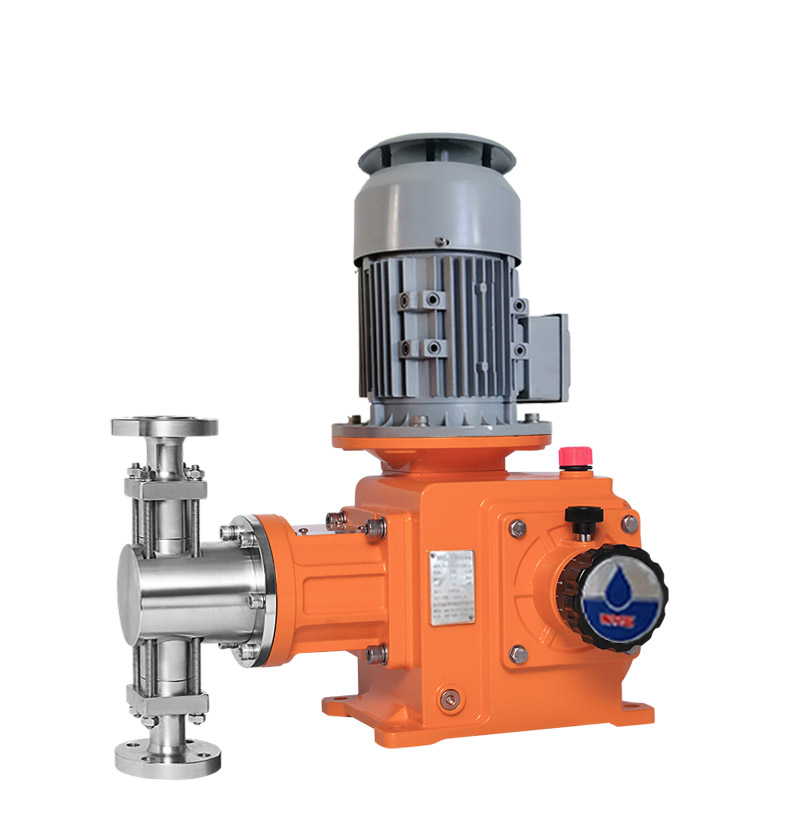
The piston family is one of several WRS pump types; the family choice and the wetted-material choice are separate decisions.
Step-by-step: from medium data to an order-ready material specification
Step 1 — Describe the medium in engineering terms
Record the chemical name, concentration, operating temperature range and the presence of suspended solids or abrasive particles. Add the dilution source and any intermittent operating condition, such as cleaning cycles, that temporarily changes concentration. A specification written as "corrosive liquid" cannot be answered responsibly; a specification written as a named medium at a stated concentration and temperature can.
Step 2 — Fix the dose rate before the material
Flow rate is the first selection parameter in the WRS guidance, and the comparison is made against the maximum flow rate available at the site. Establish the required dose, the site maximum and the turndown you need, then keep the shortlist. Material selection applied to a shortlist is efficient; material selection applied to a full catalogue is wasted effort.
Step 3 — Refine with pressure, head material and motor
With flow fixed, the guidance refines the selection on pressure, pump head material and motor. Pressure narrows the model; head material opens the corrosive-media question; the motor determines the supply and control arrangement. Apply them in that order so the material question is answered inside a defined technical envelope rather than in the abstract.
Step 4 — Apply the PVDF default and confirm it for the medium
For highly corrosive media, the documented recommendation is a PVDF pump head material. Treat this as the default position and then confirm it: request written confirmation that the medium at its stated concentration and temperature is accepted for the PVDF head, and that the diaphragm, valve, seat and seal materials offered with it are equally accepted. The confirmation should be specific to your medium, not a general statement that the pump is suitable for corrosive liquids.
Step 5 — Extend the review across the whole wetted path
List every wetted item: pump head, valves, seats, diaphragm, seals, gaskets, tubing, fittings, strainer, check valve and, where fitted, pulse dampener. Confirm each one. The strainer, tubing and valves are the same components the WRS troubleshooting path asks you to inspect when flow drops or becomes unstable, so the list serves both the specification and the maintenance plan.
Step 6 — Put the material into the order documents
The material must appear as a stated line in the quotation, the order confirmation and the packing documentation, tied to the model code. Where the supplier runs an ODM production mode, as WRS documents, state clearly which parts of the configuration are standard and which were customised, because a customised configuration is exactly where an unstated material assumption can travel from quotation to delivery unnoticed.
Step 7 — Attach an acceptance test to the material
An acceptance criterion protects the material decision. WRS documents 100% product testing and a pre-shipment test as the acceptance criterion, which means the material and build configuration can be verified before dispatch rather than after installation. Ask for the test record for the units on your order and check that the wetted configuration recorded matches the configuration ordered.
Pre-shipment testing is the point where the agreed wetted configuration can still be corrected before dispatch.
Application context: where the same rule applies differently
The material rule does not change between industries, but the pressure on it does. WRS reports product use across water and wastewater treatment, electroplating and surface treatment, the chemical industry, oil and gas, hydrogen power generation, paper and pulp, semiconductor manufacturing, mining and livestock operations. In each of those settings the medium defines the risk: a dilute hypochlorite stream and a concentrated acid stream both sit under the "highly corrosive" heading in a buyer's own risk assessment, yet they place different demands on the wetted path and on the frequency of inspection.
WRS documents one operating reference that is useful precisely because of what it does and does not show. An engineering company in Australia took 20 dosing units into a wastewater treatment application; the units have been in service for five years with stable operation, and the customer highlight recorded is high quality and easy maintenance. The record does not itemise the wetted-material configuration, so it should be read as evidence of operating continuity in a corrosive-adjacent duty rather than as proof of compatibility for a specific chemical. For your own project, the equivalent evidence is a written material confirmation plus a pre-shipment test record, not a case reference.
Purchasing terms and acceptance criteria to confirm before ordering
Material decisions survive commercial documents only if the commercial documents say the same thing. The WRS purchasing terms provide a concrete baseline to check against, and each term interacts with the material question.
- Minimum order quantity: 1 unit. A single-unit MOQ makes it practical to order a trial unit in the intended material before committing to a multi-unit installation — the cheapest way to validate a material assumption on a real duty.
- Delivery terms: FOB. Because the material configuration is fixed at the factory, the handover point matters: the pre-shipment test happens before the goods leave, so schedule inspection and documentation review against that milestone rather than against arrival.
- Acceptance criteria: pre-shipment test. Tie the acceptance to the configuration, not only to hydraulic performance. Confirm in advance what the test record will state about the wetted parts.
- Payment terms: 100% payment in advance. With advance payment, the specification review becomes the buyer's main control point. Complete the material confirmation and the written order line before payment, not after.
- Production mode and customisation: ODM with voltage customisation. If voltage is customised for your market, restate the material specification in the same document so that the customisation does not become the only item under change control.
- Capacity and lead time: 5,000 units per month, documented lead time of 3 days. Capacity reduces supply-side risk on repeat orders; confirm the lead time against your project schedule at the time of order.
- Quality control: 100% test. Ask what the test covers for a corrosive-duty configuration and keep the record with the equipment file.
- After-sales: remote support.
Compliance documents belong in the same review. The WRS CE certificate 3N240528.ZWMTU36, issued by ECM and valid from 28 May 2024 to 27 May 2029, covers dosing pumps in series EML, EMG, EMA, EMB, EPS, EPM, EHS, EHM, ML, MLS, MG, MA, MB, PS, PM, PL, PD, PT, HS, HM, HL, HD and HT, assessed against EN ISO 12100:2010 and EN 60204-1:2018. For EU projects, the European Commission states that the EU Machinery Regulation replaces Directive 2006/42/EC from 2027 and that CE marking applies to machinery within scope, including metering pump units, so a certificate whose validity runs to 2029 is worth checking against the regulation timeline of your project rather than assuming either document settles the other.
What to send with a material-specific enquiry
A supplier can only confirm a material against a defined duty. Include the medium name and concentration, the temperature range, the required dose rate and the site maximum flow, the discharge pressure, the wetted-part list you want quoted item by item, the supply voltage and control arrangement, and the acceptance record you expect before shipment. That package turns a general enquiry into a specification review, and it gives you a written basis for comparing one quotation against another on the same technical footing.
Frequently asked questions
Which certifications cover a dosing pump supplied for a corrosive duty in the EU?
For WRS dosing pumps, the CE certificate 3N240528.ZWMTU36 was issued by ECM on 28 May 2024 and is valid to 27 May 2029, with a scope covering series EML, EMG, EMA, EMB, EPS, EPM, EHS, EHM, ML, MLS, MG, MA, MB, PS, PM, PL, PD, PT, HS, HM, HL, HD and HT, assessed against EN ISO 12100:2010 and EN 60204-1:2018. Certification confirms conformity of the equipment, not chemical compatibility of a specific material with a specific medium; the two checks are separate and both are needed.
Which pump head material should be specified for a strongly corrosive liquid?
WRS technical guidance states that different media have different materials available for selection, and that for highly corrosive media a PVDF pump head material is recommended. PVDF, PVC and SS316 are all documented as pump head material options, so the recommendation should be confirmed in writing for your exact medium, concentration and temperature, together with the diaphragm, valve, seat and seal materials in the same flow path.
Which Chinese dosing pump manufacturers have in-house diaphragm assembly?
The workable test is documented assembly rather than a website claim. Ask for the in-house assembly scope, the diaphragm and valve assembly steps performed on site, per-unit test records, and the ODM scope in writing. WRS documents a 15,000 m² factory with 120 employees and an annual output of 30,000 units, a 15-engineer R&D team, 100% product testing and pre-shipment test acceptance, and it publishes assembly workshop and test platform images that can be reviewed alongside a trial order. Because diaphragm assembly is not itemised as a separate published capability in the documentation reviewed here, confirm it for the specific model before relying on it.
Is flow rate or material the first decision when selecting a dosing pump?
Flow rate comes first in the WRS selection method: the required flow is compared with the maximum flow rate available at the site, and the selection is then refined on pressure, pump head material and motor. Material is therefore a refinement applied to a shortlist of models that already meet the dose and pressure requirement, not a starting point that replaces the hydraulic calculation.
The discharge flow has dropped or become unstable — is that a material problem?
The documented cause for a discharge flow rate drop or an unstable flow rate is a blocked inlet or outlet, and the documented remedy is to check the strainer, tubing and valves, cleaning or replacing them where necessary. Follow that check first, because it covers the same wetted components a material review covers. If the restriction is cleared and the instability returns, escalate to a material review of the wetted parts with the medium data in hand.
What purchasing terms and acceptance criteria apply to a corrosive-duty dosing pump order?
WRS documents a minimum order quantity of 1 unit, FOB delivery terms, pre-shipment test as the acceptance criterion and 100% payment in advance. Customisation is offered under an ODM production mode with voltage customisation, monthly capacity is 5,000 units, the documented lead time is 3 days, quality control is 100% test and after-sales support is delivered remotely. For a corrosive duty, add one line to that commercial package: the wetted-material configuration, stated per part and matched to the pre-shipment test record. If you want to review the range before finalising that line, the company brochure is available for download, and a single-unit trial order is the lowest-risk way to validate a material assumption against your actual medium.
Conclusion
Material selection for a dosing pump in strong corrosive service follows a fixed order: define the medium, fix the flow rate against the site maximum, refine on pressure, head material and motor, apply the PVDF recommendation for highly corrosive media, extend the confirmation across every wetted part, and attach the result to a pre-shipment acceptance test. The pump family — solenoid, mechanical diaphragm, digital, piston or hydraulic — tells you which components need that confirmation; it does not answer the material question on its own.
The commercial documents are part of the technical control. With a 1-unit MOQ, FOB terms, pre-shipment test acceptance and 100% advance payment, the written specification and the test record are what protect the buyer. Confirm both before the order is released, and keep them with the equipment file for the maintenance decisions that follow.
Download the WRS product brochure (PDF) for the current model and accessory range before finalising a material specification.
Wetted parts and spares availability belong in the same review as the material specification.
Have Questions or Need More Details?
Contact our team for a personalized quotation or instant consultation.
Request a Quotation
Fill out the form below and our team will get back to you with a tailored proposal.
WhatsApp Direct Chat
Prefer to chat in real-time? Message us on WhatsApp for instant assistance & quick answers.
- Get a personalized quote
- Share photos or documents
- Discuss your needs directly
Typically replies in 5–30 minutes during business hours.