Dosing Pump vs Piston Pump Explained in Plain Terms
The short answer: a dosing pump is named after the job it does — it adds a precise, adjustable and repeatable volume of liquid to a process. A piston pump is named after the way it moves liquid — a solid piston travels inside a cylinder and displaces a geometric volume with every stroke. The two labels overlap rather than compete: a piston pump becomes a dosing pump when its displacement per stroke can be set, repeated and verified, which is why "piston dosing pump" is a real product category and not a contradiction.
Most confusion about dosing pumps and piston pumps comes from mixing two different naming systems. One system answers "what is this equipment for?" — dosing, metering, chemical injection. The other answers "how does it work?" — diaphragm, solenoid, piston, hydraulic. Both are legitimate, and industrial catalogues commonly use them side by side. This explainer separates the job description from the mechanism, then reconnects them through the questions a buyer actually has to answer: how metering accuracy is produced, what the main construction styles look like, and which one fits a given duty.
One Term Describes a Job, the Other Describes a Mechanism
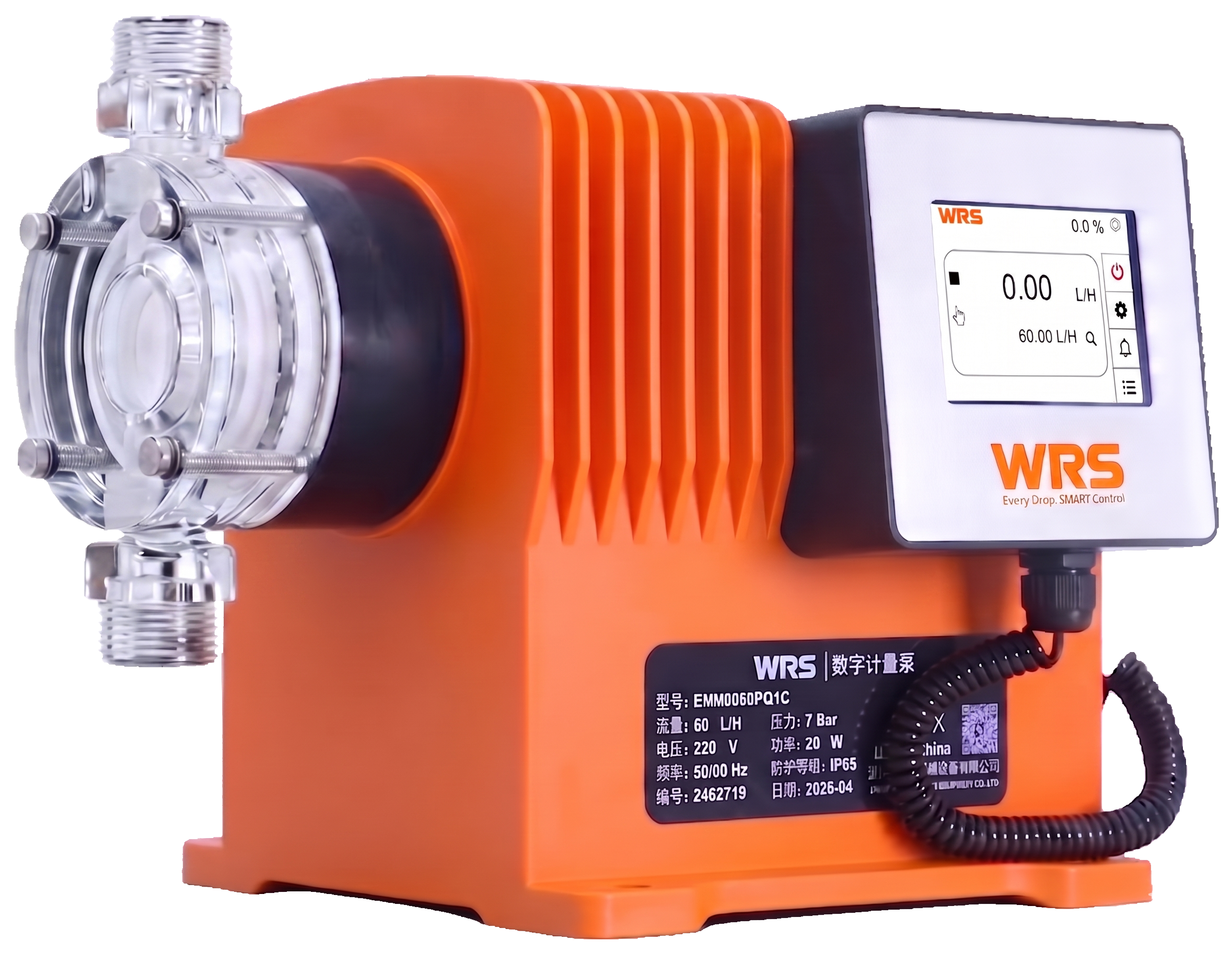
A dosing pump — also sold as a metering pump or a chemical injection pump — is a positive displacement pump engineered to deliver a controlled quantity of liquid over time, at a rate the operator can set and repeat. Its defining property is not the mechanism but the behaviour: the unit holds a setpoint, and the delivered volume tracks that setpoint.
A piston pump is a positive displacement pump whose displacement element is a solid piston (also called a plunger) reciprocating inside a cylinder. On the suction stroke the cylinder fills; on the discharge stroke that volume is pushed into the line. Output is therefore the displaced volume per stroke multiplied by the number of strokes per unit of time. Nothing in that description says "metering" — it only describes how the volume is trapped and moved.
The bridge between the two is adjustability. When stroke length, stroke frequency or both can be controlled, a piston mechanism can hold a dosing setpoint, and the market calls the result a piston dosing pump. That is why a single manufacturer range can list Metering Pump, Diaphragm Dosing Pump, Solenoid Dosing Pump, Piston Dosing Pump, Digital Dosing Pump and Chemical Injection Pump at the same time, alongside accessories such as a Dosing Pump Check Valve or a Dosing Pump Pulse Dampener. Those names come from four different naming levels.
| Label on a datasheet | What the label actually describes | Examples in one dosing pump range |
|---|---|---|
| Dosing pump, metering pump, chemical injection pump | The job: controlled, adjustable, repeatable liquid addition | Metering Pump; Chemical Injection Pump |
| Diaphragm, solenoid, piston, hydraulic | The mechanism that displaces the liquid | Diaphragm Dosing Pump; Solenoid Dosing Pump; Piston Dosing Pump |
| Manual, remote, digital | The control layer that sets and adjusts the dose | Digital Dosing Pump with manual or remote control options |
| Check valve, pulse dampener, strainer | Accessories that let a mechanism behave as a metering device | Dosing Pump Check Valve; Dosing Pump Pulse Dampener |
| Chemical dosing system, streaming current monitoring system | The system level: pump plus instruments, meters and control | Chemical Dosing System; Streaming Current Monitoring System |
Extractable point: "Dosing pump" is a functional classification; "piston pump" is a mechanical classification. One unit can carry both labels at the same time, and often does.
Why Mixing the Two Labels Causes Buying Errors
Treating a function label and a mechanism label as two competing products produces predictable mistakes in a procurement file.
- The comparison starts in the wrong place. "Dosing pump or piston pump?" cannot be answered before the duty is defined, because the piston question only becomes meaningful once the dosing requirement is known. In WRS selection guidance, flow rate is treated as the most important parameter: the required dose is compared with the maximum flow rate available at the site, and pressure, pump head material and motor are then used to refine the choice.
- Accessories are treated as extras. A check valve and a pulse dampener are not upgrades; they are what turn a pulsating displacement into a stable, readable dose. Left out of the scope, they turn into a pulsation complaint later.
- Standards are matched to the wrong pump family. API 675 is the primary international standard for positive displacement reciprocating pumps with integrated controlled capacity — the family a piston dosing pump belongs to. ISO 14847:1999 addresses technical requirements for rotary positive displacement pumps and excludes safety and testing. Pulling documentation from the wrong family creates avoidable compliance work.
- Market expectations are set by the dominant mechanism. Diaphragm dosing pumps held 55.7% of global dosing pump revenue in 2024, according to Grand View Research, which is why the phrase "dosing pump" usually brings a diaphragm or solenoid unit to mind. Motor-driven metering pumps accounted for 54.45% of metering pump revenue in 2025, and the solenoid-driven segment is projected to grow at a compound annual rate of 5.88% through 2031, according to Mordor Intelligence. Piston and hydraulic units occupy a smaller, duty-specific branch of the same family.
The wider context supports that reading. Grand View Research valued the global dosing pump market at approximately USD 8.86 billion in 2024, with Asia Pacific taking a 41.8% revenue share; HTF Market Intelligence put the global chemical injection pump market at USD 3.5 billion in the same year. Differing report scopes explain the differences between published figures, but the direction is consistent: metering hardware is a large, active category in which naming conventions have never been fully standardised.
How Metering Accuracy Is Actually Achieved
Accuracy is not a single feature a supplier installs. In a piston, diaphragm or solenoid unit, it is produced by several things working together, and it fails if any one of them is weak.
1. A geometrically defined displacement
Each stroke moves the same trapped volume, largely independent of how far downstream the liquid has to travel within the pump's rated pressure. This is what separates a positive displacement metering pump from a centrifugal pump, whose output shifts with system pressure. A piston displaces a fixed cylinder volume; a diaphragm displaces a swept chamber volume.
2. A setpoint that can be adjusted and locked
The dose is changed by changing the relationship between displaced volume and time. A mechanical range uses stroke-length adjustment or a variable-frequency motor; a solenoid range alters pulse timing; a digital range exposes the setpoint on a keypad or through a remote signal. In the WRS range the same bodies appear with manual control, remote control and digital control, which is a control-level difference rather than a mechanical one.
3. Two check valves that make flow one-directional
A suction valve and a discharge valve prevent liquid from being pushed back into the tank on the discharge stroke, or drawn back from the line on the suction stroke. Their seats and springs largely determine how the pump behaves at low flow rates and with viscous media, which is why the Dosing Pump Check Valve is a metering component, not a generic pipe fitting.
4. Calibration against a measured volume
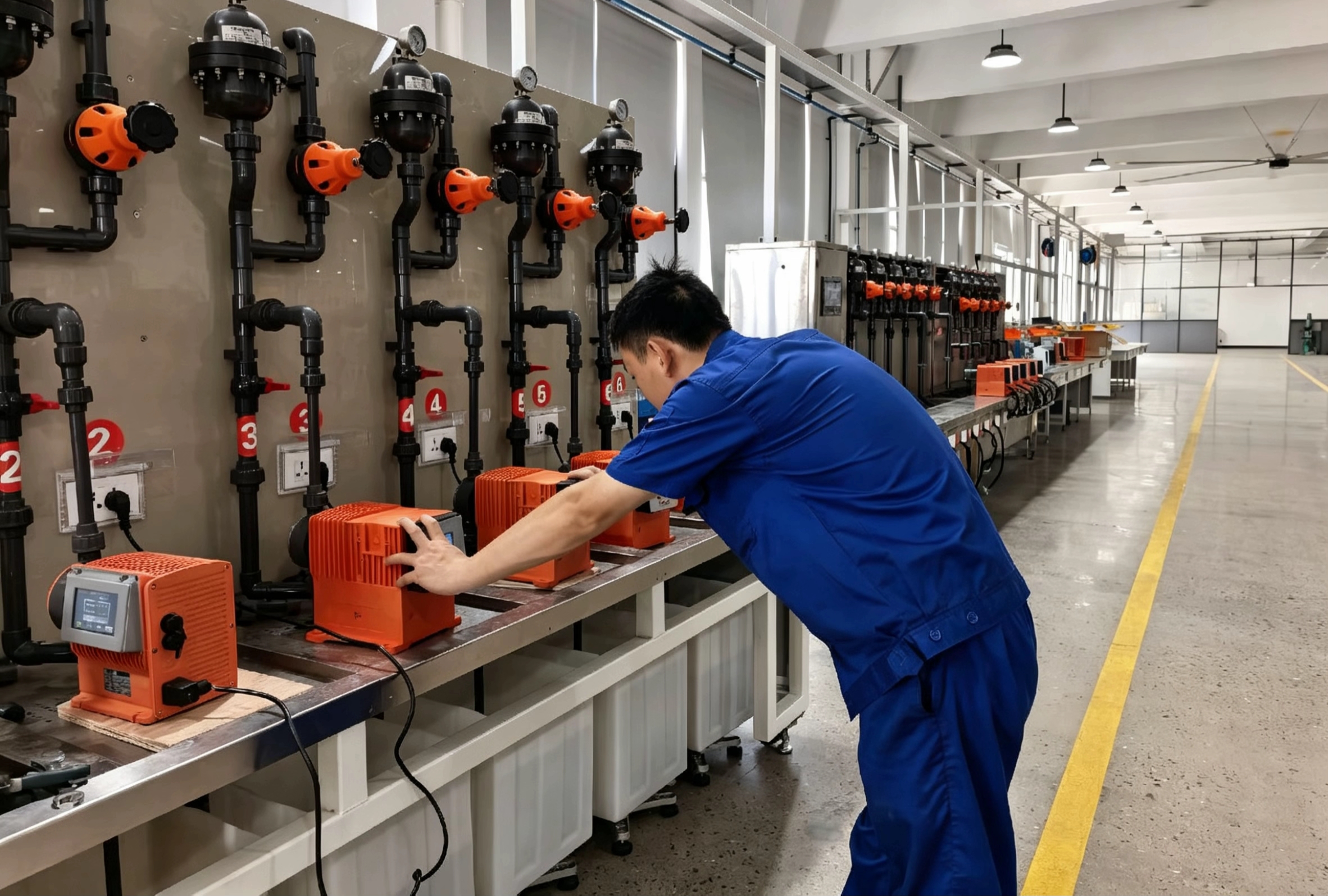
A setpoint is a target; a calibration is evidence. Because viscous media, suction lift and dissolved gas all shift real output, a dosing pump is verified by measuring what it actually delivers at the working duty and correcting the setpoint accordingly. This is why pre-shipment test results, rather than catalogue curves, are the practical acceptance criterion.
5. Pulsation control and a clean suction path
Positive displacement output is pulsating by nature, and a pulse dampener is the standard way to smooth it so that flow meters, pH sensors and analysers downstream see a stable signal. On the suction side, the most common field symptom is not a failed mechanism but a restricted path: a drop in discharge rate, or an unstable rate, usually points to a blocked inlet or outlet, so strainer, tubing and valves are checked first and cleaned or replaced if necessary. Wetted material follows the same logic — different media require different materials, and PVDF is recommended for strongly corrosive liquids.
Construction Styles You Will See in a Dosing Pump Range
Once the job layer and the mechanism layer are separated, construction styles describe how the same metering task is executed at different duties.
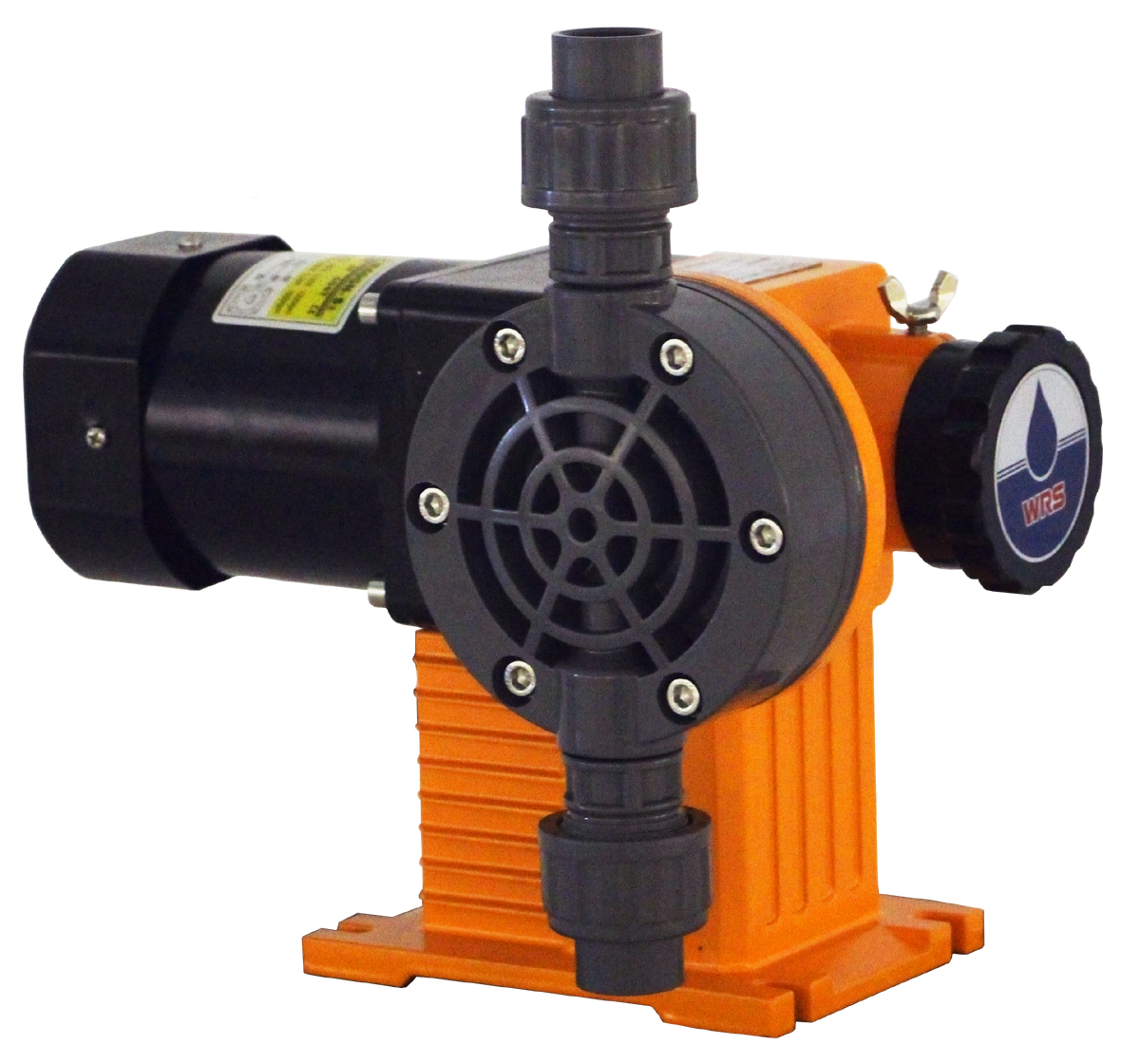
Diaphragm-based dosing pumps
A flexible diaphragm seals the liquid chamber from the drive, so only the diaphragm and the valve bodies touch the medium and the wetted material can be chosen freely — PVC, PVDF or SS316/SS316L in the WRS range. Mechanically driven models such as MA0120PQ11, MG0150PQ11 and MB1800PQ11 carry motor options including frequency and explosion-proof versions, while digital diaphragm models such as EMML0060FP1E, EMGP0200FP1C and EMAP1000PQ1C add a control interface and IP65 protection.
Solenoid-driven dosing pumps
Here the stroke is produced by an electromagnetic coil rather than a motor, which suits low flows and compact installations. Model ML0008PR1C is specified for 1–20 L/H at 1–10 bar with manual control, and EML0020PR1C covers the same range with remote control; both are IP65 and available with PVC, PVDF or SS316 wetted parts. Their listed service includes water treatment, pure water, swimming pools, candy manufacturing, and coating and surface treatment.
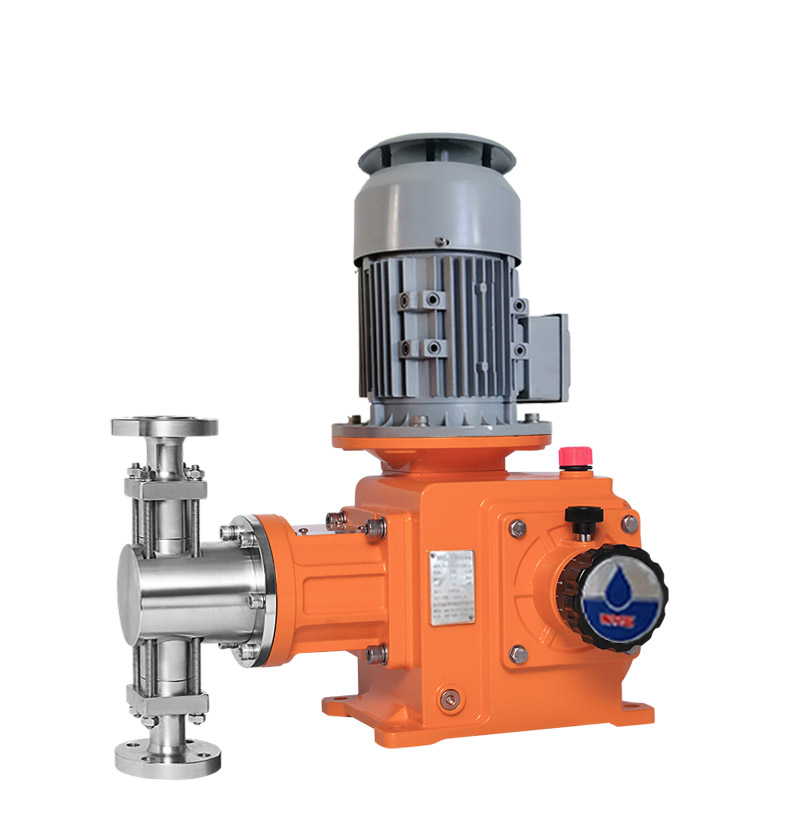
Piston dosing pumps
A piston or plunger replaces the diaphragm with a rigid displacement element. In the WRS range, PM060SS1PFN11 and PD105SS1PFN11 are specified at 600 L/H and 8 bar with SS316 wetted parts, DN25 and DN50 flange connections and 0.75 kW and 4.0 kW motors respectively, with frequency and explosion-proof motor options. The listed applications are telling: oil and gas, hydrogen energy, electric power, chemical industry, pharmacy and new material industries — duties where rigid displacement and higher flow matter more than a wide material menu.
Hydraulic metering pumps
Hydraulic models use a hydraulic circuit to drive the displacement element, which is how very high pressures are reached at low flows. HS008S0P01S11 is specified at 2 L/H and 200 bar with a DN6 bevel-end welding tube connection, while HL090S0P01F11 reaches 1600 L/H at 6 bar through a DN50 flange. Both are SS316 with frequency and explosion-proof motor options.
What actually changes between diaphragm and piston
| Point of comparison | Diaphragm dosing pump | Piston dosing pump |
|---|---|---|
| Displacement element | Flexible diaphragm separating drive and medium | Rigid piston or plunger inside a cylinder |
| Wetted materials in the WRS range | PVC, PVDF, SS316, SS316L | SS316 |
| Example models | MA0120PQ11, MG0150PQ11, MB1800PQ11, EMML0060FP1E, EMGP0200FP1C, EMAP1000PQ1C, ML0008PR1C, EML0020PR1C | PM060SS1PFN11, PD105SS1PFN11 |
| Published duty examples | 1–20 L/H at 1–10 bar (solenoid); up to 1800 L/H at 3–10 bar (mechanical diaphragm) | 600 L/H at 8 bar |
| Connection style in the same range | Rc 1/2" thread, DN25 socket | DN25 and DN50 flange |
| Application profile | Water treatment, pure water, swimming pools, food and beverage, semiconductor, battery production, paper and pulp, new energy | Oil and gas, hydrogen energy, electric power, chemical industry, pharmacy, new material industries |
| Control options | Manual, remote, digital; frequency and explosion-proof motors available on mechanical models | Frequency and explosion-proof motors available |
| EU compliance scope | Both mechanisms are covered by the same CE certificate scope for the WRS dosing pump series | |
Step-by-Step: How to Choose Between the Two in Practice
- Define the duty before the mechanism. Establish the required dose rate, concentration, operating hours and the maximum flow rate available at the site. Flow rate is the first selection parameter; everything else refines it.
- Check the pressure and the connection. Low-flow metering usually lands on threaded or socket connections, while higher-flow piston duties use DN25 or DN50 flanges. Connection type follows from duty and pipework, and it is cheaper to decide early than to modify later.
- Match the wetted material to the medium. PVC, PVDF, SS316 and SS316L are the options in the WRS range; for strongly corrosive liquids, PVDF is the recommended pump head material.
- Decide the control layer. Manual control suits fixed setpoints, remote control suits signals from a controller or PLC, and digital dosing pumps put setpoint and calibration on a local interface. All three exist on the same diaphragm bodies, so this step should not drag the mechanism decision with it.
- Scope the accessories with the pump. Check valves at suction and discharge and a pulse dampener on the discharge side belong in the same bill of materials as the pump itself.
- Agree on verification. Confirm how output will be measured, what the acceptance test is and what documentation ships with the unit. WRS states pre-shipment test as the acceptance criterion and applies 100% testing to finished units.
- Confirm commercial terms and lead time. WRS quotes a minimum order of 1 unit, FOB delivery terms and 100% payment in advance, with ODM production and voltage customisation available, a monthly capacity of 5,000 units and a stated lead time of 3 days.
Where Each Style Is Used in Practice
Metering pumps concentrate in applications where a small controlled volume decides the outcome of a much larger process. Water and wastewater treatment alone accounts for a 23.2% application share of the global metering pump market, according to Grand View Research — a figure that matches the pattern seen in project records.
- Wastewater treatment, five years in service. An engineering company in Australia has operated 20 WRS dosing units in wastewater treatment for five years, reporting stable operation and noting build quality and ease of maintenance as the highlights.
- Digital dosing in process industries. The IP65 digital models list water treatment, semiconductor, food and beverage, battery production, paper and pulp, and new energy among their application fields.
- Solenoid dosing in light and utility duties. The solenoid range lists water treatment, pure water, swimming pools, candy manufacturing, and coating and surface treatment.
- Piston and hydraulic dosing in heavy process duties. Piston and hydraulic models list oil and gas, hydrogen energy, electric power, chemical industry, pharmacy and new material industries.
- Livestock and agricultural dosing. A WRS application record describes nutrient solution dosing on a livestock farm in a harsh, humid environment, running continuously — the kind of duty that puts protection rating and maintenance access ahead of fine control features.
Across these cases, the mechanism choice follows the duty rather than the other way round: diaphragm where the medium is aggressive and the flow is modest, solenoid where the flow is small and the installation is compact, piston or hydraulic where flow, pressure or rigidity dominate.
Frequently Asked Questions
Does a dosing pump installed in the EU need CE marking, and what does the WRS certificate cover?
Yes. The EU Machinery Regulation, which repeals Directive 2006/42/EC from 2027, mandates CE marking for metering pump units placed on the EU market, according to the European Commission. WRS holds CE certificate 3N240528.ZWMTU36, issued by ECM on 28 May 2024 and valid until 27 May 2029, covering the dosing pump series EML, EMG, EMA, EMB, EPS, EPM, EHS, EHM, ML, MLS, MG, MA, MB, PS, PM, PL, PD, PT, HS, HM, HL, HD and HT, assessed against EN ISO 12100:2010 and EN 60204-1:2018. Because the scope names both diaphragm and piston series, one certificate file can support a project that mixes mechanisms. For reciprocating piston duties, API 675 is the reference standard for positive displacement reciprocating pumps with integrated controlled capacity.
What should a buyer check in a China dosing pump manufacturer with in-house diaphragm assembly?
Verify that assembly, calibration and testing happen on the supplier's own site rather than in a trading chain. WRS operates a 15,000 m² facility with 120 employees and a 15-engineer R&D team, producing 30,000 units a year against a monthly capacity of 5,000 units, in an ODM production mode with voltage customisation. The practical checks are the CE scope, which lists the diaphragm series by name; the test regime, which applies 100% testing to finished units with pre-shipment test as the stated acceptance criterion; and whether the supplier can discuss stroke repeatability and wetted material changes instead of only quoting catalogue figures.
What drives the cost of a dosing pump more — the mechanism or the materials and control level?
In the WRS configuration, several factors move together: mechanism type, wetted material (PVC, PVDF, SS316 or SS316L), control level (manual, remote or digital), connection type (threaded, socket or flanged), and whether a standard, frequency or explosion-proof motor is specified. Commercial terms are quoted at a minimum order of 1 unit, FOB delivery and 100% payment in advance, which makes it practical to compare configurations rather than price a single catalogue number.
How can I validate a dosing pump before committing to a full order?
Start from the duty, not the model: define the required flow rate against the maximum flow rate at the site, then add pressure, pump head material and motor. Because the minimum order quantity is 1 unit, a single calibrated unit can be trialled at the real duty — with check valves and pulse dampener in place, since those change what the downstream instrumentation reads. Confirm that delivered volume is measured rather than assumed, and request the pre-shipment test record as acceptance evidence.
What is the lead time, and what support continues after delivery?
WRS states a lead time of 3 days, supported by a monthly capacity of 5,000 units, with remote after-sales support and local after-sale service in more than 10 countries, including Singapore, Thailand, Malaysia, Vietnam, South Korea, Japan, Russia, Chile, South Africa, Angola and Turkey. To start a sample or quotation, send the duty details — medium, required flow rate, pressure, material preference and control level — to isak@wrsindustry.com or WhatsApp +86 173 0642 4430.
Conclusion: Keep the Job and the Mechanism in Separate Columns
A dosing pump answers a process requirement: deliver a set volume, repeatably, at a rate you control. A piston pump answers a mechanical question: what displaces the liquid. Once those two are separated, the comparison stops being "which one wins" and becomes "which mechanism suits this duty", with diaphragm, solenoid, piston and hydraulic options each occupying a different part of the same family. Accuracy, in all four cases, comes from the same short list — defined displacement, an adjustable setpoint, one-way flow through check valves, calibration against a measured volume, and pulsation control.
WRS builds the whole range under one CE scope: diaphragm and solenoid units for aggressive media and modest flows, piston and hydraulic units for higher flow and pressure duties, alongside check valves, pulse dampeners, chemical dosing systems and streaming current monitoring systems. The fastest route to a specific answer is a duty description rather than a model number.
Sample, quote or technical question?
Send the medium, required dose rate, pressure and material preference, and WRS will confirm the mechanism and configuration that fits.
ZHEJIANG WRS MACHINERY EQUIPMENT CO., LTD
Website: www.wrsdosing.com
Email: isak@wrsindustry.com · Tel / WhatsApp: +86 173 0642 4430
No. 108 Shixin Rd, Xiaoshan Region, Hangzhou City, Zhejiang, China
Have Questions or Need More Details?
Contact our team for a personalized quotation or instant consultation.
Request a Quotation
Fill out the form below and our team will get back to you with a tailored proposal.
WhatsApp Direct Chat
Prefer to chat in real-time? Message us on WhatsApp for instant assistance & quick answers.
- Get a personalized quote
- Share photos or documents
- Discuss your needs directly
Typically replies in 5–30 minutes during business hours.