
Top Dosing Pump Picks for Corrosive Chemical Service: A Selection Ranking
Top Dosing Pump Picks for Corrosive Chemical Service: A Selection Ranking
Strongly corrosive liquids rarely destroy a dosing pump at the motor. They destroy it at the wetted path — the pump head, the diaphragm, the valve seats and the tubing — and they usually do it quietly, through a slow loss of dosing accuracy long before anything visibly fails. That is why a corrosive-service selection is a materials decision first and a hydraulics decision second.
This selection ranking orders seven WRS dosing pump configurations by how directly each one answers a strong-corrosive duty without compromise. Every entry states the verified flow, pressure and wetted-material envelope of the configuration, then explains why that pump type and material pairing earned its position — and where it stops being the right answer. The ranking is built from published WRS product data and sourcing guidance; it is a configuration ranking, not a laboratory comparison of third-party brands.
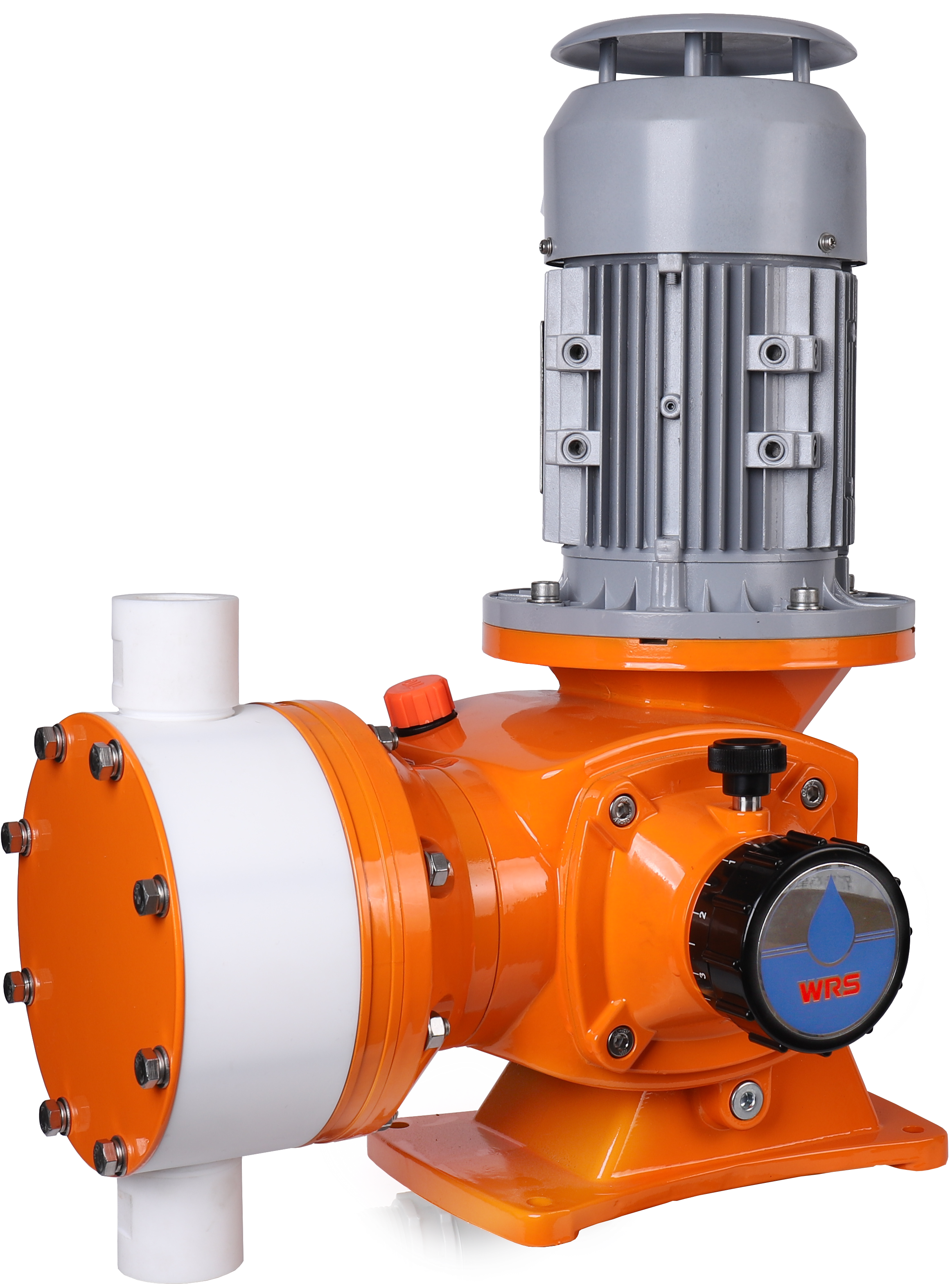
MB series mechanical diaphragm dosing pump — the PVDF wetted-head option is the configuration that carries the highest corrosive-duty coverage in this ranking.
The short answer: for highly corrosive media, a PVDF pump head is the recommended wetted material, and the mechanical diaphragm and full-PTFE digital diaphragm families support that requirement across the widest flow range. Piston and hydraulic metering pumps remain in the ranking conversation, but only at duty points where an SS316 wetted path is the correct engineering choice.
Why Corrosive Chemical Service Is a Materials Problem, Not a Pump-Sizing Problem
A corrosive duty can be hydraulically perfect on paper and still fail in service. The pump may deliver exactly the required litres per hour at the required pressure, yet the medium attacks the parts that touch it: the pump head, the diaphragm, the suction and discharge valve seats, the tubing and the connection hardware. The failure sequence is predictable. Dosing accuracy drifts first, leakage risk follows, and unplanned downtime arrives last — usually at the worst possible moment.
WRS material-selection guidance: different media have different materials available for selection, and for highly corrosive media the PVDF pump head material is recommended.
Selection itself starts from flow rate as the most important parameter, compared against the maximum flow rate required at the site, then refines through pressure, pump head material and motor details.
Two symptoms tell a buyer that the wetted path may be the problem rather than the process. The first is a discharge flow rate drop or an unstable flow rate. The most common cause is a blocked inlet or outlet, so the first action is to check the strainer, tubing and valves, and clean or replace them as necessary. If flow instability continues after the line is clear, degraded wetted components are the next thing to investigate.
The practical material boundaries used in this ranking are simple to state. PVC is commonly specified for milder aqueous chemical service. PVDF is the material recommended for highly corrosive media and is the reason PVDF-capable configurations rank highest here. Stainless steel — SS316 and SS316L — is specified where mechanical strength, higher pressure classes or high-purity compatibility are the governing requirements. Stainless wetted paths should always be checked against chloride-rich or strongly acidic media before specification, and every material choice should be confirmed against the actual medium, its concentration and its temperature with the supplier rather than selected from a general table.
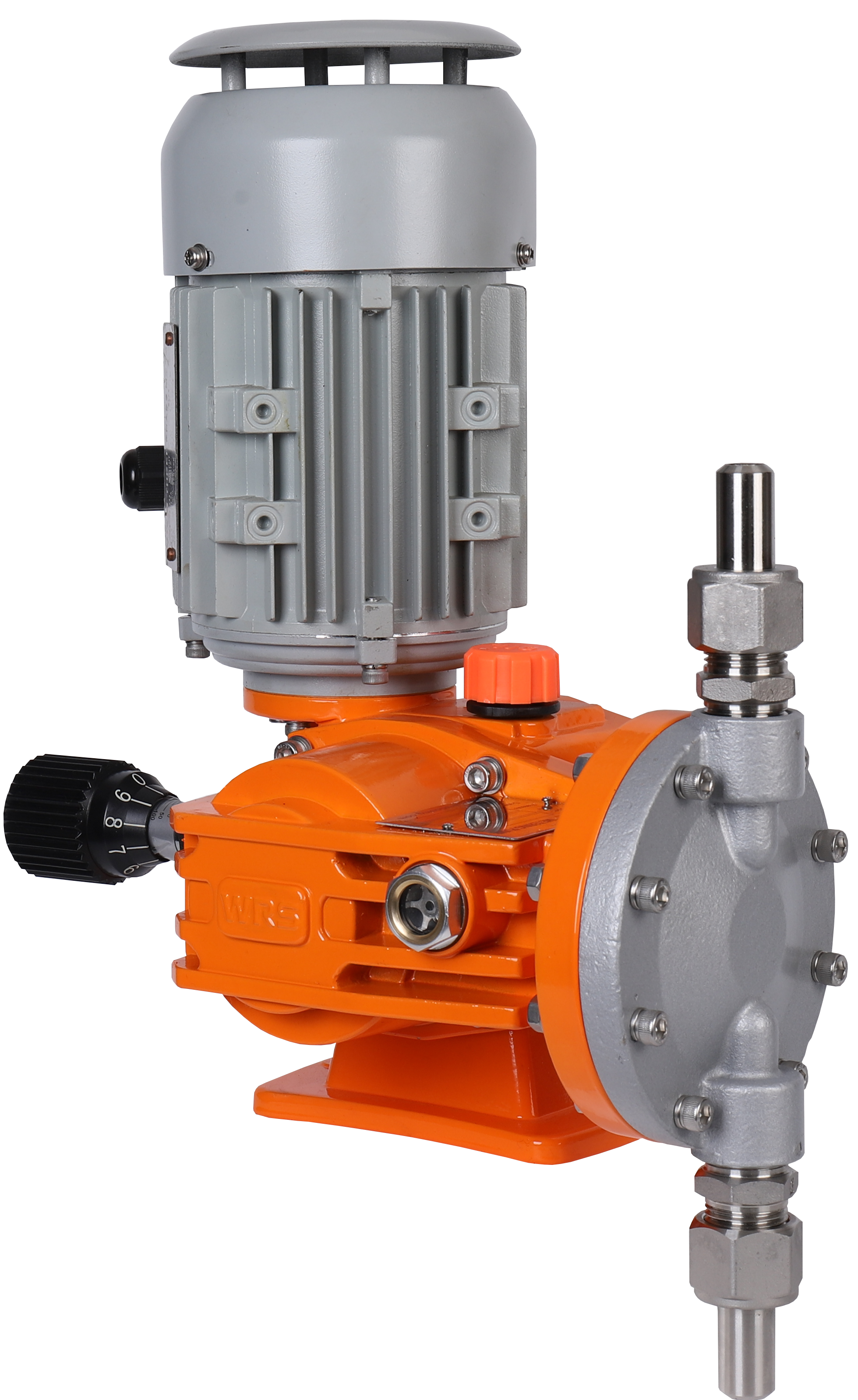
MA series mechanical diaphragm dosing pump with an SS316 pump head — specified where mechanical strength or a higher pressure class outranks aggressive-media resistance.
Industry Background: Why Diaphragm Technology Dominates Chemical Duty
The market context explains why this ranking is weighted toward diaphragm configurations. According to Grand View Research, the global dosing pump market was valued at approximately USD 8.86 billion in 2024, with Asia Pacific holding a 41.8% revenue share in the same year. Within that market, diaphragm dosing pumps lead with a revenue share of 55.7% in 2024 — a direct reflection of how well a sealed diaphragm head handles aggressive liquids without a dynamic shaft seal.
Drive technology follows the same pattern. Mordor Intelligence reports that motor-driven metering pumps held a 54.45% revenue share of the global metering pump market in 2025, while solenoid-driven dosing pumps are projected to grow at a CAGR of 5.88% through 2031. Water and wastewater treatment alone accounts for a 23.2% application share of the global metering pump market (Grand View Research), which is precisely the sector where corrosive coagulants, hypochlorite and pH-correction chemicals are dosed every day. HTF Market Intelligence values the separate global chemical injection pump market at USD 3.5 billion in 2024.
Supply is equally concentrated in Asia. OEC data places China's liquid pump exports, including dosing types, at USD 14.3 billion in 2024. The competitive set named by Mordor Intelligence in the dosing system market includes Grundfos, IDEX (Milton Roy), ProMinent and SEKO S.p.A. — global suppliers whose presence means that a corrosive-service specification is usually evaluated against several qualified sources, not one.
Three reference points come up repeatedly in corrosive-duty tenders. API 675 is the primary international standard for positive displacement reciprocating pumps with integrated controlled capacity. ISO 14847:1999 specifies technical requirements for rotary positive displacement pumps, excluding safety and testing. The EU Machinery Regulation, which repeals 2006/42/EC from 2027, mandates CE marking for metering pump units placed on the EU market. Buyers should confirm which standards a specific configuration is documented against before contracting rather than assuming coverage.
How This Ranking Was Built
Seven configurations are ranked from broadest corrosive-duty coverage to the most application-specific. Each was assessed against five criteria, in this order of weight:
- Wetted-material availability. Does the configuration support PVDF, the material recommended for highly corrosive media, or is it limited to SS316?
- Flow and pressure envelope. What duty range does the configuration actually cover, and does it fit real corrosive-service flow points?
- Containment and failure mode. How does the design manage leak paths, and what secondary protection exists — a multi-layer diaphragm, a sealed head, or an optional diaphragm rupture sensor?
- Dosing accuracy and control. Is the accuracy specification stated, and does the control suite support 4-20mA, pulse signal and Modbus RS-485 communication for integration into a chemical dosing system?
- Accessory and service support. Are check valves, pulse dampener and other accessories available as one package, is 100% testing applied, and is after-sales support reachable in the buyer's region?
The Ranking: Seven Dosing Pump Picks for Corrosive Chemical Service
Rank 1 — MB1800PQ11 mechanical diaphragm dosing pump
- Type: mechanical diaphragm, flow rate 250-1800 L/h, pressure 3-10 bar
- Wetted materials: PVC, PVDF, SS316
- Power input according to customer request; frequency and explosion-proof motors available
- Applications: waste water treatment, chemical industry, coating & surface treatment, mining process
It takes the first position because it is the only configuration in the range whose published product data states that it is specially designed for handling corrosive liquids, and because it pairs that design intent with the widest flow range in the ranking. A multiple-layer diaphragm extends service life, flow rate can be adjusted smoothly both while running and while idle, and parts replacement is described as straightforward. For a plant dosing large volumes of aggressive chemical, that combination answers criteria one and two simultaneously.
Where it stops being the right answer: if the duty point sits well below 250 L/h, this configuration is oversized. Ranks 2 and 3 cover the same material logic at lower flows.
Rank 2 — MA0120PQ11 mechanical diaphragm dosing pump
- Type: mechanical diaphragm, flow rate 15-500 L/h, pressure 5-10 bar
- Wetted materials: PVC, PVDF, SS316
- Frequency and explosion-proof motors both available
- Applications: waste water treatment, chemical industry, coating & surface treatment, mining process, foundry industry
This is the mid-flow workhorse of the corrosive-service ranking. It carries the same corrosive-liquid design intent, the same multiple-layer diaphragm, the same running-or-idle flow adjustment and the same easy parts replacement as rank 1, but it starts at 15 L/h and reaches 500 L/h — a band that covers a very large share of real chemical dosing duties. The added foundry-industry application listing matters for buyers in metal processing, where aggressive pickling and surface-treatment chemicals are common.
Rank 3 — MG0150PQ11 mechanical diaphragm dosing pump
- Type: mechanical diaphragm, flow rate 15-150 L/h, pressure 5-10 bar
- Wetted materials: PVC, PVDF, SS316
- Power input according to customer request
- Applications: waste water treatment, chemical industry, coating & surface treatment, mining process
Rank 3 is the compact member of the mechanical diaphragm family and is included for the same reason as ranks 1 and 2: PVDF head availability on a pump explicitly designed for corrosive liquids. It sits between 15 and 150 L/h at 5-10 bar, which suits small and mid-sized chemical dosing points where an oversized pump would cost accuracy rather than gain capacity.
Rank 4 — EMAP1000PQ1C digital dosing pump
- Type: digital dosing pump, flow rate 1000 L/h, pressure 4 bar, DN25 socket connection
- Wetted materials: PVC, PVDF; full PTFE diaphragm with strong corrosion resistance
- Accuracy: less than 1% precision, ratio rate 1:1000
- Control: 4-20mA / pulse signal remote control, Modbus RS-485 communication, direct flow rate display
- Protection IP65, power 220V / 1P / 20W
- Applications: water treatment, semiconductor, food & beverages, battery production, paper & pulp production, new energy
This is the first digital entry and the highest-flow digital configuration in the ranking. It belongs on the list because the PTFE diaphragm adds a second layer of corrosive resistance beyond the pump head material, and because the 1:1000 ratio and sub-1% precision specification make it suitable for proportional dosing into a live process stream rather than a fixed-rate duty. The full control suite means it integrates cleanly into a monitored chemical dosing system.
Limitation to note: the material options are PVC and PVDF only. Where a stainless wetted path is required, this model is not the answer.
Rank 5 — EMGP0200FP1C digital dosing pump
- Type: digital dosing pump, flow rate 200 L/h, pressure 4 bar, Rc 1/2 inch threaded connection
- Wetted materials: PVC, PVDF, SS316; full PTFE diaphragm with strong corrosion resistance
- Accuracy: less than 1% precision, ratio rate 1:1000; IP65
- Control: 4-20mA / pulse signal, Modbus RS-485; power 220V / 1P / 60W
- Applications: water treatment, semiconductor, food & beverages, battery production, paper & pulp production, new energy
Rank 5 delivers the same corrosion-oriented diaphragm and control package as rank 4 at one-fifth the flow, and it adds an SS316 material option. That flexibility matters on projects where the corrosive additive line uses PVDF but another injection point on the same skid needs stainless.
Rank 6 — EMML0060FP1E digital dosing pump
- Type: digital dosing pump, flow rate 60 L/h, pressure 4 bar, Rc 1/2 inch threaded connection
- Wetted materials: PVC, PVDF, SS316L; full PTFE diaphragm with strong corrosion resistance
- Accuracy: less than 1% precision, ratio rate 1:1000; IP65
- Control: 4-20mA / pulse signal, Modbus RS-485; power 220V / 1P / 20W
This is the precision entry for corrosive service. It is the only configuration in the range that lists SS316L alongside PVC and PVDF, which gives it a wider material discussion in high-purity or semiconductor-adjacent projects. Where a corrosive additive has to be introduced at low flow with tight proportional control, this is the configuration the ranking points to.
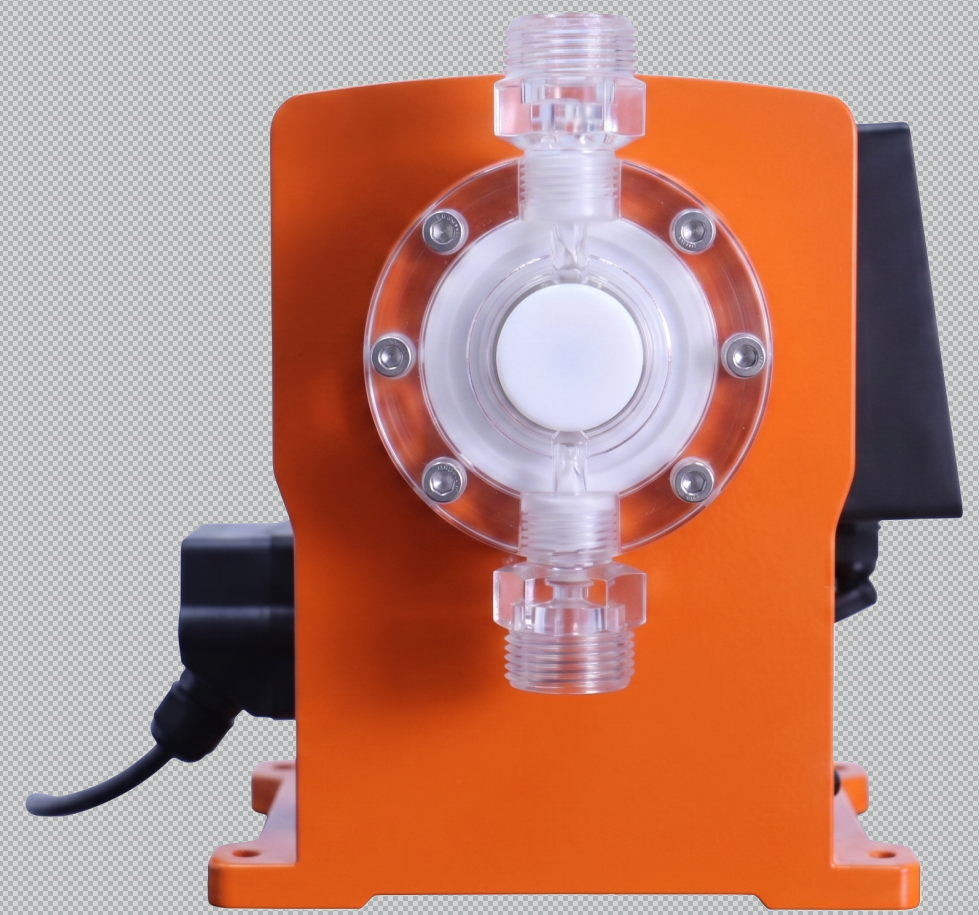
Digital dosing pump head assembly — the full PTFE diaphragm provides corrosion resistance in addition to the PVC or PVDF pump head.
Rank 7 — EML0020PR1C solenoid dosing pump
- Type: solenoid dosing pump, flow rate 1-20 L/h, pressure 1-10 bar
- Wetted materials: PVC, PVDF, SS316
- Control mode: remote control with 4-20mA / pulse signal and Modbus RS-485 communication
- Dosing accuracy 1%; double ball design check valve on both inlet and outlet
- Water and heat resistant PCB; anti-corrosion materials; IP65; voltage input 220V / 110V
- Applications: water treatment, candy manufacturing, coating & surface treatment, pure water, swimming pool
The solenoid entry earns its place at the low-flow end of the ranking. Its double ball check valve design on both inlet and outlet increases discharge accuracy, which is exactly the failure point that degrades first on corrosive duty when valve seats are attacked. The manual-control sibling ML0008PR1C shares the same flow, pressure and material envelope and ships with an accessory set that covers PE tube, foot valve, weight, injection valve and safety valve — useful when a buyer needs one package rather than separately sourced components.
Ranked but Conditional: Piston and Hydraulic Configurations
These four configurations are ranked as conditional picks rather than main-list entries, and the reason is material, not performance. All four are SS316 wetted only, so they should not be specified for strongly corrosive media where PVDF is the recommended head material.
- PD105SS1PFN11 piston dosing pump — flow rate 600 L/h, pressure 8 bar, DN50 flange, SS316, 4.0 kW motor, frequency and explosion-proof motor available.
- PM060SS1PFN11 piston dosing pump — flow rate 600 L/h, pressure 8 bar, DN25 flange, SS316, 0.75 kW motor, frequency and explosion-proof motor available.
- HL090S0P01F11 hydraulic metering pump — flow rate 1600 L/h, pressure 6 bar, DN50 flange, SS316, 1.5 kW motor, zero leakage design, suitable for toxic and hazardous media and for high-viscosity pumping, with an optional diaphragm rupture sensor.
- HS008S0P01S11 hydraulic metering pump — flow rate 2 L/h at 200 bar, DN6 bevel end welding tube connection, SS316, 0.37 kW motor, zero leakage design, with an optional diaphragm rupture sensor.
Where they belong: high-pressure injection duty, oil & gas, hydrogen energy, electric power, chemical industry, pharmacy and new material production. The two hydraulic models are the ones to consider when containment is the overriding risk — zero leakage design and toxic or hazardous media handling are the stated design intents, and the optional diaphragm rupture sensor gives a monitoring route that diaphragm-only designs do not offer. Both piston models are built around high viscosity handling, high accuracy dosing and easy maintenance. Where they do not belong: strongly acidic or chloride-rich duty that requires a PVDF wetted path.
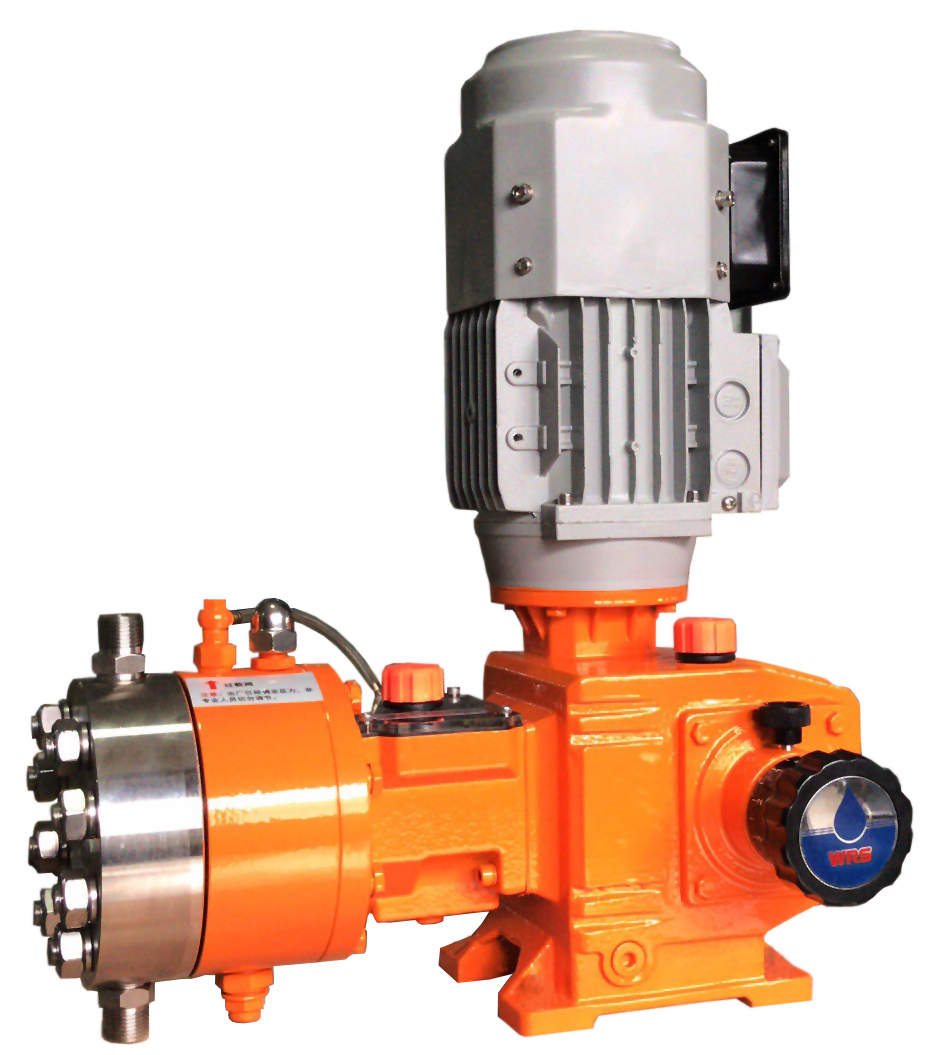
HS series hydraulic metering pump — a 200 bar class configuration with an SS316 wetted path, ranked conditionally because PVDF is not available on this platform.
Step-by-Step: Working Through This Ranking for a Live Project
- Define the medium before the pump. Confirm the chemical, its concentration and its temperature. This single step decides whether PVDF is required, whether PVC is adequate, or whether an SS316 platform is acceptable.
- Fix the flow rate at the injection point. Compare the required flow against the maximum flow rate of each candidate. Flow rate is the starting parameter in WRS selection guidance, and it is what separates a rank 1 duty from a rank 3 or rank 7 duty.
- Fix the discharge pressure. Check the pressure class of each candidate — 1-10 bar on the solenoid models, 3-10 bar on the MB mechanical diaphragm, 5-10 bar on the MA and MG models, 4 bar on the digital pumps, and 200 bar on the HS008S0P01S11 hydraulic pump.
- Choose the drive and control type. Manual control, remote control via 4-20mA or pulse signal, or full digital control with Modbus RS-485 communication and direct flow rate display. Match this to whether the pump will run standalone or as part of an automated chemical dosing system.
- Specify the accessory package in the same enquiry. A dosing pump check valve, a dosing pump pulse dampener and, on hydraulic models, an optional diaphragm rupture sensor are what keep a corrosive duty stable after commissioning. The ML0008PR1C accessory set — PE tube, foot valve, weight, injection valve and safety valve — shows the level of detail worth asking for.
- Confirm supply and service terms. Check the minimum order quantity, the quoted lead time, whether 100% testing is applied, whether ODM production and voltage customization are available, and whether after-sales support reaches your region.
Use Cases: Where These Picks Are Already Working
The applications listed for each configuration point to where the ranking is most useful. Waste water treatment, chemical industry, coating & surface treatment and mining process are the stated application fields for the mechanical diaphragm family. Water treatment, semiconductor, food & beverages, battery production, paper & pulp and new energy appear across the digital models. Water treatment, candy manufacturing, coating & surface treatment, pure water and swimming pool are the solenoid applications. Oil & gas, hydrogen energy, electric power, chemical, pharmacy, new material and new energy industries are the fields for the piston and hydraulic platforms.
One documented project illustrates the wastewater side of this ranking: an engineering company in Australia operates 20 units in wastewater treatment, with stable operation reported over five years and high quality and easy maintenance given as the highlights.
A second documented scenario shows how far the material logic stretches. A livestock project in Russia required nutrient solution dosing in a harsh, humid farm environment, running 24/7 on an automatic system with an IP67 protection requirement. The matched equipment for that project was the EMML0060FP1E digital dosing pump and the ML0008PR1C solenoid pump — a corrosive-duty selection problem solved inside a non-chemical industry.
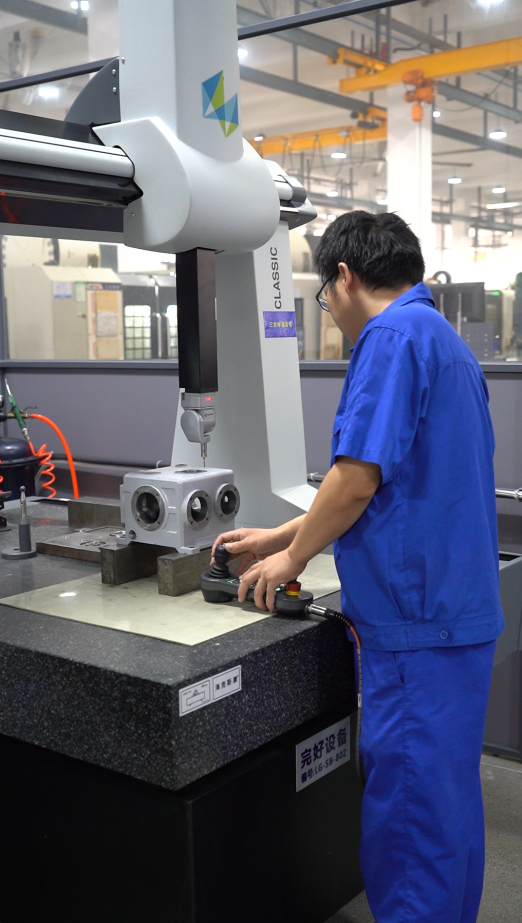
Component inspection on a 3-dimensional coordinate measuring machine. Specification claims on a corrosive-duty configuration are only as good as the dimensional control behind them.
Comparison Table: Corrosive-Service Dosing Pump Configurations
| Rank | Model | Pump type | Flow rate | Pressure | Wetted materials | Best-fit corrosive duty |
|---|---|---|---|---|---|---|
| 1 | MB1800PQ11 | Mechanical diaphragm | 250-1800 L/h | 3-10 bar | PVC, PVDF, SS316 | High-volume corrosive dosing with PVDF head |
| 2 | MA0120PQ11 | Mechanical diaphragm | 15-500 L/h | 5-10 bar | PVC, PVDF, SS316 | Mid-flow general corrosive duty |
| 3 | MG0150PQ11 | Mechanical diaphragm | 15-150 L/h | 5-10 bar | PVC, PVDF, SS316 | Compact corrosive dosing points |
| 4 | EMAP1000PQ1C | Digital dosing pump | 1000 L/h | 4 bar | PVC, PVDF + PTFE diaphragm | High-flow, controlled corrosive dosing |
| 5 | EMGP0200FP1C | Digital dosing pump | 200 L/h | 4 bar | PVC, PVDF, SS316 + PTFE diaphragm | Mixed-material skids, precision dosing |
| 6 | EMML0060FP1E | Digital dosing pump | 60 L/h | 4 bar | PVC, PVDF, SS316L + PTFE diaphragm | Low-flow precision corrosive dosing |
| 7 | EML0020PR1C | Solenoid dosing pump | 1-20 L/h | 1-10 bar | PVC, PVDF, SS316 | Small-volume corrosive additives |
Conditional picks — SS316 wetted path only:
| Model | Pump type | Flow rate | Pressure | Wetted material | Conditional use |
|---|---|---|---|---|---|
| PD105SS1PFN11 | Piston dosing pump | 600 L/h | 8 bar | SS316 | High-viscosity, non-PVDF duty |
| PM060SS1PFN11 | Piston dosing pump | 600 L/h | 8 bar | SS316 | Lower motor power, same duty class |
| HL090S0P01F11 | Hydraulic metering pump | 1600 L/h | 6 bar | SS316 | High flow with zero leakage design |
| HS008S0P01S11 | Hydraulic metering pump | 2 L/h | 200 bar | SS316 | Very high pressure, toxic or hazardous media |
Frequently Asked Questions
Which wetted material should be specified for strongly corrosive liquids?
WRS guidance states that different media have different materials available for selection, and that for highly corrosive media a PVDF pump head is recommended. Across the WRS dosing pump range, PVC, PVDF and SS316 are the material options, with SS316L additionally available on the EMML0060FP1E digital dosing pump. Material choice should be confirmed against the actual medium, its concentration and its temperature before specification. Where international references appear in a tender, API 675 covers positive displacement reciprocating pumps with integrated controlled capacity, ISO 14847:1999 specifies technical requirements for rotary positive displacement pumps, and the EU Machinery Regulation requires CE marking for metering pump units on the EU market from 2027. Confirm which standard a specific configuration is documented against with the supplier.
What should buyers check in a dosing pump manufacturer for a chemical dosing system project?
A chemical dosing system project needs more than a pump. The full scope covers the metering pump, instruments and meters, accessories, and — where dry powder is involved — a completely automatic PAC dry powder system and dosing device. WRS PTE LTD supplies this scope as an integrated fluid dosing solution, supported by a manufacturing operation established in 2016 with a 15,000 m² facility, around 120 employees, a 15-engineer R&D team and an annual output of 30,000 units. Practical checks for any project include whether the supplier can package the dosing pump check valve, dosing pump pulse dampener and other accessories together, whether 100% testing is applied before shipment, and whether after-sales support is reachable locally — WRS operates local after-sales service in more than 10 countries, including Singapore, Thailand, Malaysia, Vietnam, South Korea, Japan, Russia, Chile, South Africa, Angola and Turkey.
Which dosing pump types can be configured with a PVDF wetted path?
The mechanical diaphragm models MA0120PQ11, MG0150PQ11 and MB1800PQ11 list PVC, PVDF and SS316 as material options. The digital models EMGP0200FP1C and EMML0060FP1E list PVC, PVDF and SS316, with SS316L on the EMML0060FP1E, and both use a full PTFE diaphragm. EMAP1000PQ1C lists PVC and PVDF. The solenoid models EML0020PR1C and ML0008PR1C also list PVC, PVDF and SS316. By contrast, the piston models PM060SS1PFN11 and PD105SS1PFN11 and the hydraulic models HS008S0P01S11 and HL090S0P01F11 are SS316 only, so they are not the correct choice where PVDF is required.
What drives the cost of a corrosive-service dosing pump configuration?
Cost is set by the configuration, not by a single headline specification. The variables are the drive and control type — manual control, remote control via 4-20mA or pulse signal, or digital control with Modbus RS-485 communication and direct flow rate display — together with the wetted material selected (PVC, PVDF, SS316 or SS316L), the flow and pressure class, the motor type, and the accessory package including check valve, pulse dampener and, on hydraulic models, an optional diaphragm rupture sensor. Frequency and explosion-proof motors are available on several models, which also affects the configuration. Because every corrosive duty combines these variables differently, WRS quotes each configuration individually and lists a 1-unit minimum order quantity.
How can a corrosive-duty configuration be validated before full ordering, and how long does delivery take?
Validation starts with matching the medium, its concentration, its temperature and the required flow rate against the pump material and flow envelope, then testing the selected configuration against that duty. WRS applies 100% testing to its pumps and offers ODM production with voltage customization. The listed minimum order quantity is 1 unit and the listed lead time is 3 days, with a monthly capacity of 5,000 units. After installation, remote support is available, and local after-sales service operates in more than 10 countries. To start a configuration review, send the medium details, required flow rate and discharge pressure to Isak at isak@wrsindustry.com, or download the WRS product brochure for the full pump and accessory range.
Conclusion
Corrosive chemical service rewards buyers who settle the material question first. The seven configurations ranked above all share one property: they can be built with a PVDF wetted path, the material WRS guidance recommends for highly corrosive media. Within that group, the ranking separates them by duty range and control requirement — mechanical diaphragm for broad corrosive coverage from 15 L/h to 1800 L/h, digital models with full PTFE diaphragms for controlled and proportional dosing, and solenoid models for small-volume, high-accuracy injection. Piston and hydraulic platforms stay in the shortlist only where an SS316 wetted path is correct, and their zero leakage design and optional diaphragm rupture sensor make them the containment-first choice at high pressure.
WRS PTE LTD supplies dosing pumps, instruments and meters, accessories and complete chemical dosing systems, with manufacturing operations covering a 15,000 m² facility, around 120 employees and a 30,000-unit annual output, plus local after-sales service in more than 10 countries including Singapore, Thailand, Malaysia, Vietnam, South Korea, Japan, Russia, Chile, South Africa, Angola and Turkey. Products are exported across Southeast Asia, Russia, South America and Europe.
Next step: send the medium, concentration, temperature, required flow rate and discharge pressure, and we will return the corrosive-duty configuration that fits — with the wetted material, control type and accessory package specified together.
Contact: Isak — isak@wrsindustry.com | Tel / WhatsApp: +86-173 0642 4430
WhatsApp: Start a conversation
Website: www.wrsdosing.com | Add: No. 108 Shixin Rd, Xiaoshan Region, Hangzhou City, Zhejiang, China
Download the product brochure: WRS Dosing Pump & Diaphragm Separator Brochure (PDF)
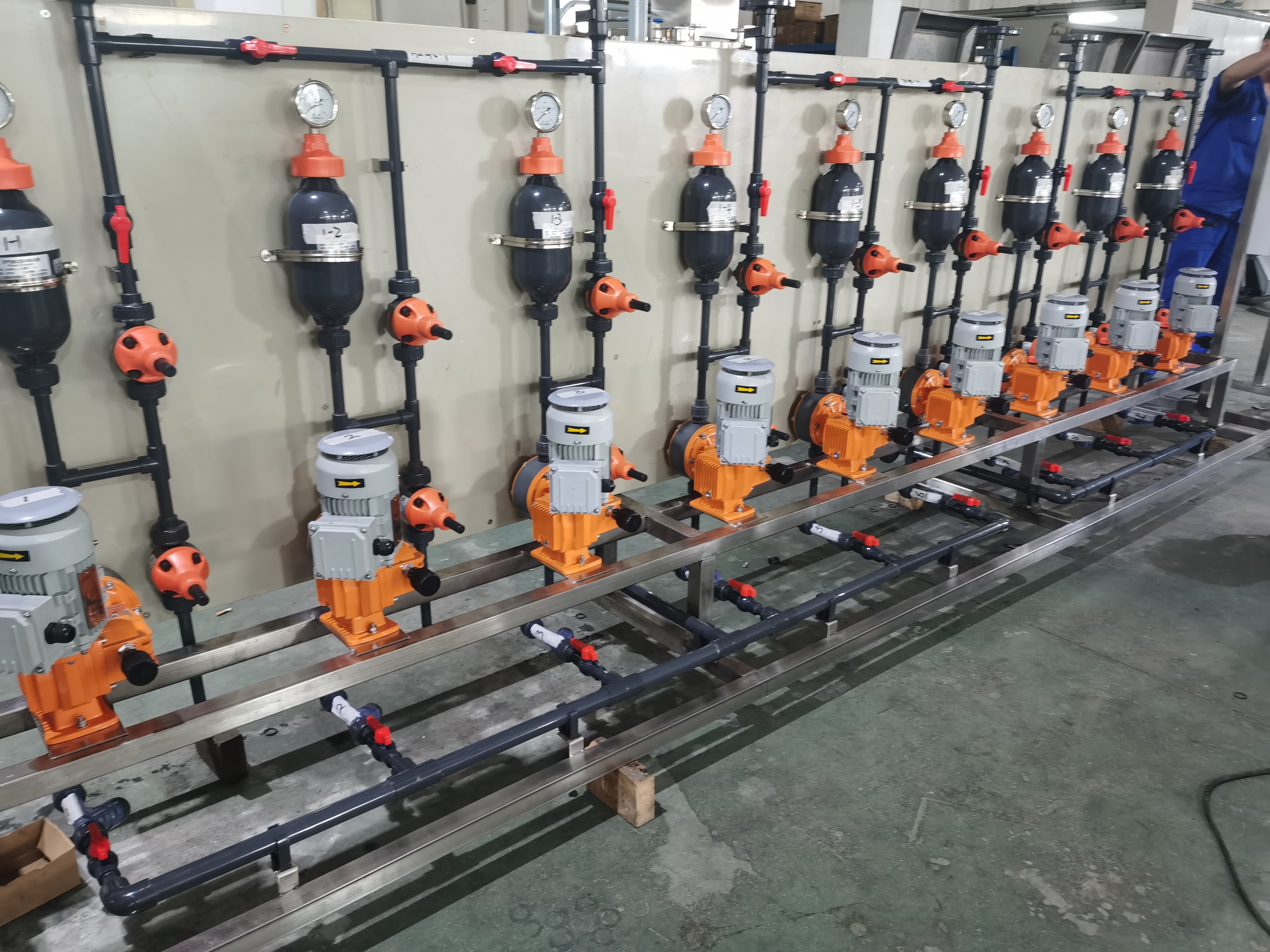
Finished WRS dosing pumps prepared for dispatch. Corrosive-duty configurations are quoted per application and tested before shipment.