
PA66 GF30 Compliance, Specs and MOQ: A Buyer's Checklist
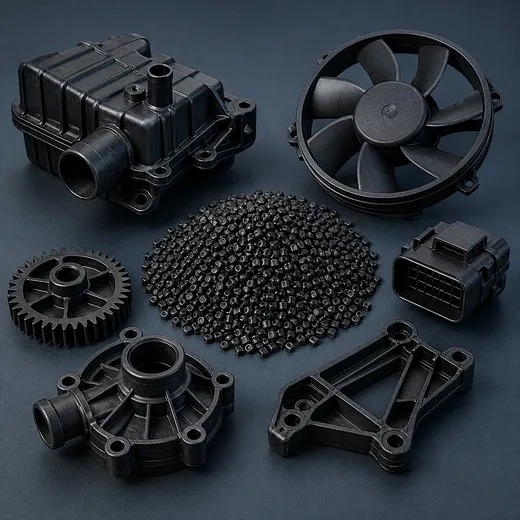
PA66 GF30 looks like a compact procurement code. Behind those characters sit the resin grade, the moulding conditions, the certificates and the commercial terms that actually decide whether a moulded part gets approved. Buyers who treat the label as a finished specification usually discover the gap months later, during a tool trial or a compliance review.
This checklist works through the four constraint layers that slow down most PA66 GF30 projects: the numbers printed on a data sheet, the scope of the certificates behind them, the budget and minimum-order structure, and the sample path from evaluation to volume. WanHan Plastic's PA66-WHG30A grade is used as the worked example, because its published data and compliance boundaries are documented in enough detail to show where each layer starts and where it stops.
Why a Grade Name Is Not a Specification
PA66 GF30 identifies a polymer family and a nominal reinforcement level: polyamide 66 with roughly 30% glass fibre. It does not identify the stabiliser package, the fibre type and sizing, the colour, the conditioning state, the flammability status, or the market in which the finished part must comply. Those variables are what a purchasing decision actually turns on.
Three gaps cause most of the friction in real projects:
- Test-basis drift. Published PA66 GF30 data sheets describe materials that behave very differently. One publicly available glass-filled PA66 grade carries a density of 1.29 g/cm3 and a maximum service temperature of 120 °C over 5,000 hours, with a tensile modulus of 5,000 MPa. Another supplier datasheet for a grade with the same nominal reinforcement states a yield stress of 85 MPa, a tensile modulus of 4,500 MPa and a heat deflection temperature of 150 °C. Neither set is wrong; they are different formulations measured on different bases.
- Scope drift in certificates. A management-system certificate, a sample-specific test report and a grade-level test report are three different documents. Treating one as the other is the single most common compliance error in reinforced-nylon procurement.
- Commercial drift. Reinforcement content, colour, packaging and order size all move the price and the lead time. A quotation built on a generic "PA66 GF30" enquiry is not comparable to a quotation built on a defined grade.
The practical conclusion is simple. Before comparing two suppliers, lock the test method, the conditioning state and the specimen thickness. Without those three anchors, the numbers on the two data sheets are not measuring the same thing.
Industry Background: What Is Actually Standardised and What Is Not
PA66 is a large industrial polymer, and reinforced grades account for a significant share of demand. Reported global production of PA66 reached approximately 2.7 million metric tons in 2023, and published market commentary attributes more than 40% of PA66 consumption to under-the-hood automotive applications, where heat resistance and mechanical retention are the governing requirements. In trade terms, polyamides in primary forms sit under HS Code 3908.10.
Price is the layer that moves fastest. As of September 2026, published price indices placed PA66 resin at approximately US$3.48 per kilogram in North America, following a 5.8% increase, while Northeast Asian prices remained at approximately US$2.95 per kilogram. That represents a visible regional spread of roughly US$0.53 per kilogram on the base resin. It is a useful sourcing reference point, not a quotation for a compounded, coloured, reinforced grade delivered to a specific port.
Reading note: the figures above describe PA66 resin and the wider nylon family. They are indicators of direction and regional structure. They are not a market size for PA66 GF30 compound, and they should not be presented as one. Compound-level demand for a specific reinforced grade has to be evaluated through supplier data, not parent-polymer statistics.
What the industry does standardise is the test method. Density, tensile, flexural, impact, heat deflection and shrinkage are reported against ISO methods, which means two grades can be compared honestly if, and only if, the standard, the specimen geometry and the conditioning history are the same. That is the discipline the rest of this checklist applies.
The Numbers: What WanHan PA66-WHG30A Actually Publishes
WanHan Plastic is the brand of Guangdong Wanhan New Material Technology Co., Ltd., a manufacturer of modified engineering plastic compounds based in Huizhou, Guangdong Province, China. The company develops and produces modified PA6, PA66, PP, PBT, PC, PC/ABS, ABS, PA11, PA12, PET and PPS formulations, and states a PA66 GF30 monthly production capacity of up to 5,000 metric tons, subject to production schedule.
For the PA66 GF30 grade designated PA66-WHG30A, the published typical values are as follows:
- Density: 1.38 g/cm3 (ISO 1183)
- Tensile strength: 175 MPa (ISO 527-2)
- Tensile strain at break: 9% (ISO 527-2)
- Flexural strength: 255 MPa (ISO 178)
- Flexural modulus: 7,000 MPa (ISO 178)
- Notched impact strength: 18 kJ/m2 (ISO 179)
- Heat deflection temperature: 220 °C, method B (ISO 75-2/B)
- Melt flow index: 20 g/10 min (ISO 1133)
- Moulding shrinkage: 0.5% (ISO 2577)
- Colour: natural, black, or custom colour subject to confirmation
- Packaging: 25 kg bags, palletised shipment available
Two interpretive points matter more than the numbers themselves.
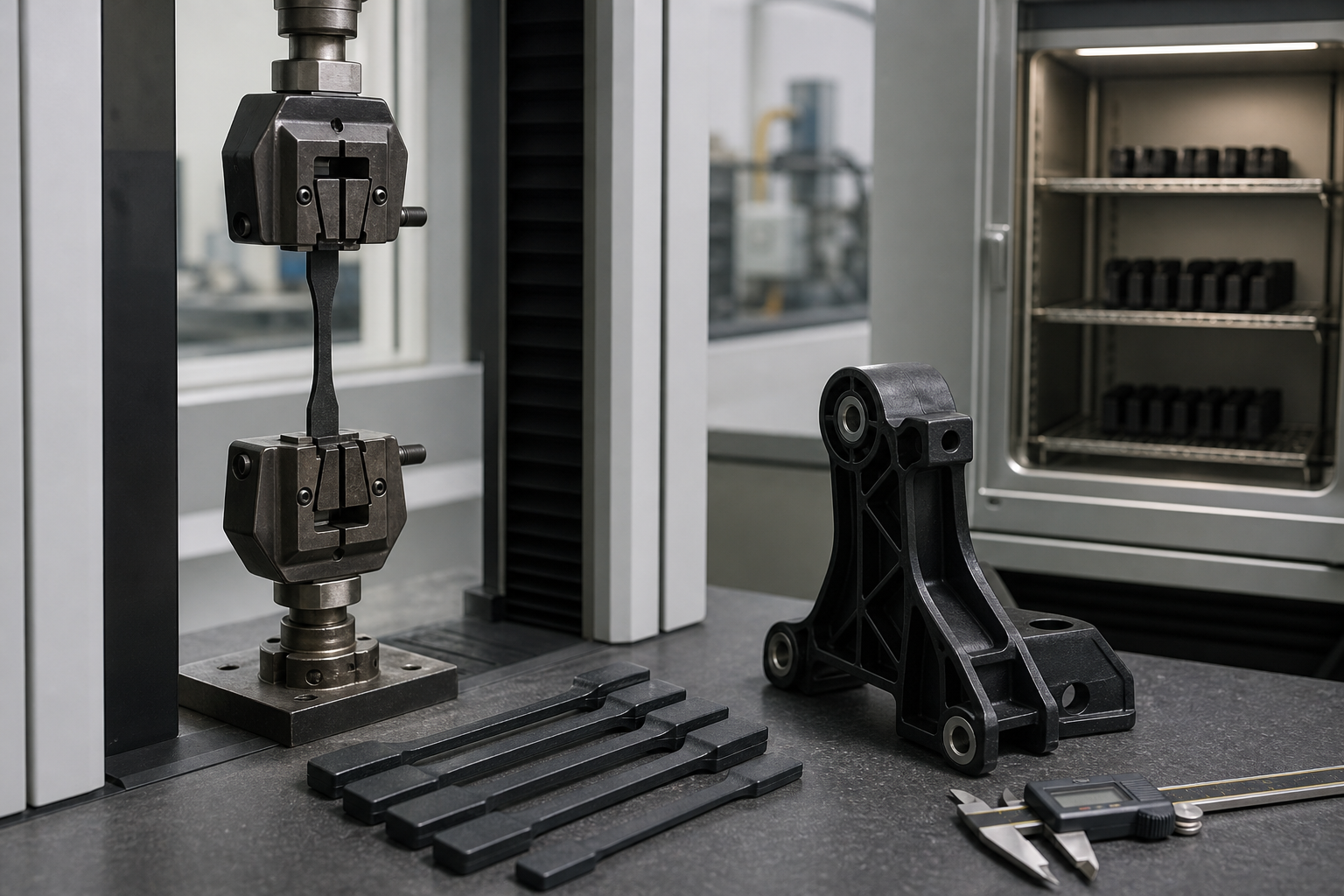
First, these are typical values for initial screening, not guaranteed specification limits. Procurement acceptance and final part approval require the current confirmed technical data sheet, the agreed specification and project-specific moulded-part testing. A buyer who writes 175 MPa into a purchase order without agreeing on specimen conditioning, gate location and measurement position is specifying something the data sheet was never designed to promise.
Second, the 220 °C heat deflection temperature is not a continuous-use temperature. HDT describes the deformation of a standardised specimen under a defined short-term load as temperature rises. Long-term performance in a real component also depends on creep, wall thickness, fibre orientation, moisture and chemical exposure. The two values are related but not interchangeable.
Where the Data Sheet Stops
No UL 94 flammability rating is specified for the PA66-WHG30A grade in the supplied asset record, and the grade carries no stated flame-retardant or heat-stabilised designation. That is a statement about documentation, not about material capability in the abstract. If a project requires a documented flame classification, the correct action is to select a grade that carries one and to verify the tested specimen thickness, the colour and the current report.
Where flame retardancy is the governing requirement, WanHan's PA66 GF30 flame-retardant grade PA66-WHRG30A is listed with a technical data sheet stating a UL 94 V-0 classification, a density of 1.52 g/cm3 (ISO 1183), a tensile strength of 125 MPa (ISO 527-2), a flexural modulus of 6,800 MPa (ISO 178), a heat deflection temperature of 180 °C (ISO 75-2/B) and a shrinkage of 0.5% (ISO 2577). The data sheet does not state the specimen thickness at which V-0 applies. That thickness, and the current grade-specific flame test report, must be confirmed before the grade is used in a certified assembly. Reinforcement and a flame classification can coexist, but they trade against each other: the flame-retardant grade's published tensile strength is materially lower than the standard grade's.
Certificates: Reading the Scope Before Citing the Number
WanHan holds three company-level management system certificates, all issued by Zhongren Certification Co., Ltd. and all valid from 2026-06-01 to 2029-05-29:
- ISO 9001:2015 quality management system, certificate number 27326Q00154R153, scope "Design and Production of Modified Plastic Pellets" (IAF Code 14).
- ISO 14001:2015 environmental management system, certificate number 27326E00087R153, scope covering environmental management activities related to the design and production of modified plastic pellets.
- ISO 45001:2018 occupational health and safety management system, certificate number 27326S00077R153, scope covering occupational health and safety management activities related to the design and production of modified plastic pellets.
All three are company-level certificates. They support supplier qualification, factory audit documentation and process control claims. None of them certifies the performance, the flammability or the regulatory compliance of an individual product grade, including PA66-WHG30A.
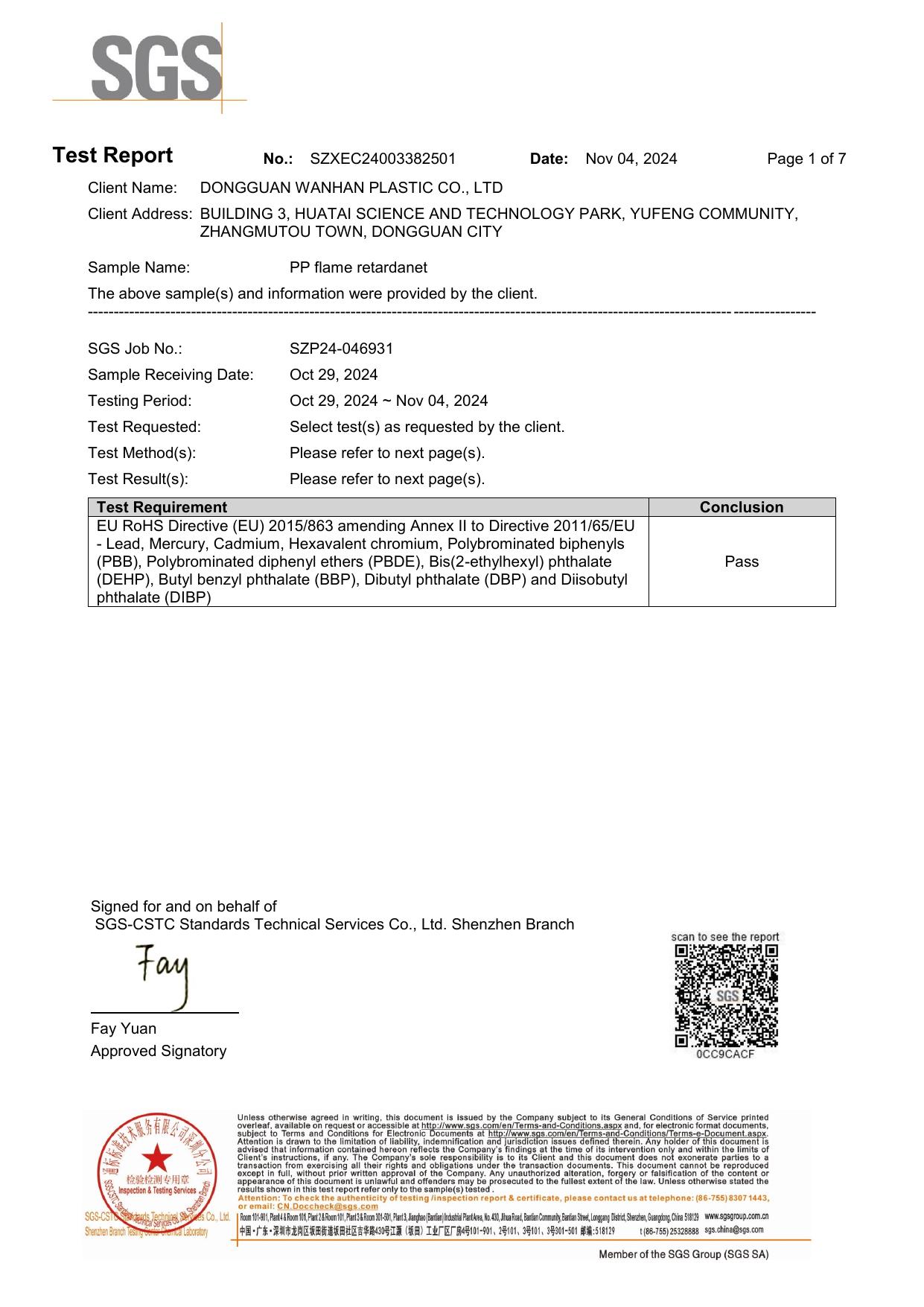
Scope boundary that buyers must respect: the SGS RoHS test report SZXEC24003382501 and the SGS REACH SVHC test report SZXEC24003382502, both issued 2024-11-04 and valid to 2027-06-29, cover a PP flame-retardant sample with model number SZX24-0033825-0001.C001. The certified entity is DONGGUAN WANHAN PLASTIC CO.,LTD. These reports are valid only for the tested sample. They must not be represented as REACH, RoHS or flame certification for PA66 GF30, for PA66-WHG30A, or for all WanHan products. Where a destination market or a customer specification requires PA66 GF30 compliance evidence, a grade-specific report must be requested.
This is not a technicality. A buyer who attaches a PP sample report to a PA66 GF30 declaration creates a documentation risk that surfaces at the customer's incoming inspection, at a notified-body review, or at the end of a warranty claim. Matching report number, tested sample name, grade and applicable legal requirement is the only defensible practice.
Step-by-Step: How to Qualify a PA66 GF30 Grade Without Rework
Step 1 — Write the service conditions before writing the material name
Define continuous and peak temperature, mechanical load and duration, impact expectation, humidity and fluid contact, chemical exposure, wall thickness, dimensional tolerance, colour, electrical or flammability requirements, and annual demand. These inputs determine which modification package is even relevant: standard, heat-stabilised, hydrolysis-resistant, flame-retardant or low-warpage.
Step 2 — Request the exact-grade technical data sheet and check the method column
Confirm the grade code, polymer, reinforcement, test standard, specimen conditioning and edition. Compare only values measured on an equivalent basis. Do not transfer numbers from a PA6 GF30 grade, a PA66 CF30 grade or a different reinforcement level onto the grade under evaluation.
Step 3 — Separate certificates by scope
List the documents you hold and label each one as company-level, sample-specific or grade-specific. Confirm the certificate number, the tested sample name, the issuing body, the applicable standard and the validity window. Request grade-specific evidence wherever the destination market requires it.
Step 4 — Run a controlled sample evaluation
Order an evaluation quantity, verify the batch label against the purchase order, follow the grade's drying and handling guidance, and record the dryer settings, melt conditions and mould conditions used. Keep the retained sample. Appearance is not an identity check: pellet colour and gloss cannot verify polymer type, fibre content or compliance status.
Step 5 — Validate on the production tool, then condition the parts
Check filling, weld-line position, fibre orientation, flow and transverse shrinkage, warpage and critical dimensions. Measure again after the agreed conditioning cycle. For a moisture-sensitive polyamide, dry-as-moulded and conditioned dimensions can differ; the acceptance criterion has to state which state applies.
Step 6 — Close the commercial loop
Confirm the grade, the colour, the packaging, the quantity, the documentation package and the delivery schedule in writing. Only then convert the trial into a production commitment.
Use Cases: Where PA66 GF30 Constraints Bite First
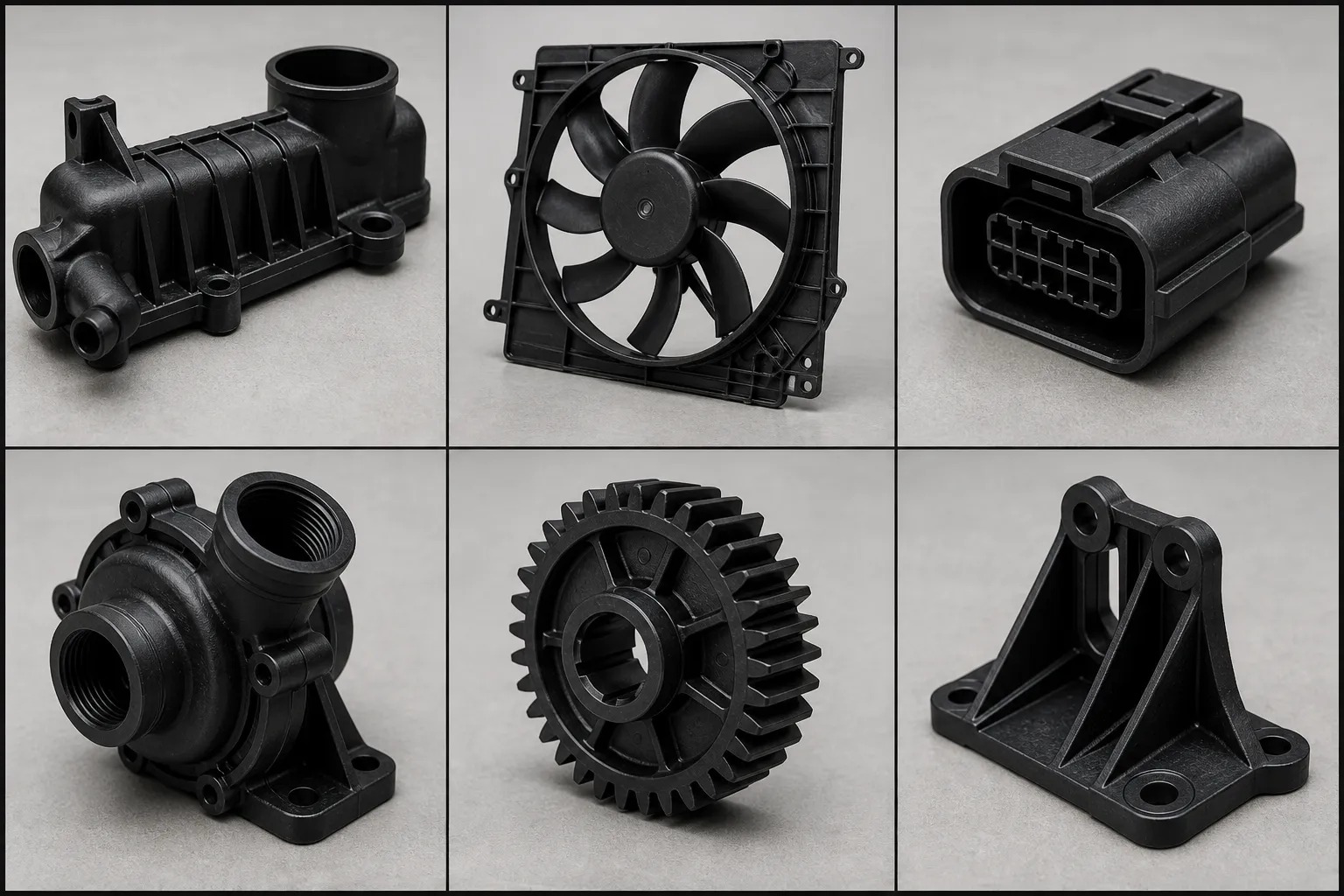
The grade's published application areas are automotive cooling-system components, under-hood brackets, covers and fluid-handling housings, electrical connector bodies and structural supports, industrial gears, pump housings and machinery components, and appliance frames and load-bearing parts. Each of those carries a different dominant constraint.
Automotive cooling-system components
Cooling fans, fan shrouds and radiator-system parts combine rotating or static load with vibration, heat and humidity cycling. The governing validation points are load, wall thickness, gate position, weld lines, fibre orientation, moisture conditioning and production-tool results. Direct coolant contact is a separate question: a generic PA66 GF30 designation cannot be approved for a coolant-contact housing on the basis of a room-temperature data sheet alone. The specific coolant chemistry, temperature, pressure and exposure time must be defined, hydrolysis and long-term aging evidence for the exact grade must be requested, and conditioned parts must be pressure and sealing tested.
Electrical connector bodies and structural supports
Here the constraints are dimensional tolerance, heat aging, insert retention and any flame requirement. PA66-WHG30A should not be presented as flame-retardant or electrically approved unless the exact grade documentation and final-part tests support that claim. Where a UL 94 requirement exists, the grade choice changes and the tested thickness must be confirmed.
Industrial gears, pump housings and machinery components
The controlling inputs are torque or pressure, duty cycle, lubrication, fluid chemistry, wear target and expected service life. Weld lines, inserts and creep behaviour need to be validated on production-tool samples rather than inferred from data-sheet values.
Appliance frames and load-bearing parts
Household humidity, assembly stress and heat from adjacent equipment set the requirement envelope. Operating temperature, humidity, load, impact, colour, surface finish and electrical clearance should be confirmed before grade release, along with the applicable compliance requirements for the destination market.
Comparison Table: WanHan Reinforced Polyamide Options
| Grade | Reinforcement | Tensile strength (typical) | Flexural modulus (typical) | HDT (typical) | UL 94 status in the supplied data | Typical positioning |
|---|---|---|---|---|---|---|
| PA66-WHG30A | 30% glass fibre | 175 MPa (ISO 527-2) | 7,000 MPa (ISO 178) | 220 °C (ISO 75-2/B) | Not specified | General structural PA66 GF30 for automotive, industrial and appliance parts |
| PA66-WHRG30A | 30% glass fibre with flame-retardant additive | 125 MPa (ISO 527-2) | 6,800 MPa (ISO 178) | 180 °C (ISO 75-2/B) | TDS states V-0; specimen thickness not stated | Flame-retardant screening for electrical and electronic housings |
| PA66-WHC30 | 30% carbon fibre | 203 MPa (ISO 527-2) | 26,800 MPa (ISO 178) | 250 °C (ISO 75-2/A) | UL 94 HB | High-stiffness structural parts with tight dimensional control |
| PA6-WHG30B | 30% glass fibre in a PA6 matrix | Confirm against current grade TDS | Confirm against current grade TDS | Confirm against current grade TDS | Not stated | Alternative matrix where PA6 properties and moisture behaviour fit the part |
All values in the table are typical screening figures, not guaranteed specification limits, and must be confirmed against the current grade-specific technical data sheet before design approval. The table is not a ranking. Each row answers a different constraint: standard structural performance, documented flame performance, maximum stiffness, or a different polymer matrix.
Budget, Sample and Lead Time: The Commercial Layer
Evaluation quantities for applicable grades can start from 5 kg, and the stated minimum order quantity for PA66 GF30 is 5 kg, subject to grade and commercial confirmation. Custom-grade lead time is typically 7 to 10 days after formulation, colour, quantity, packaging and technical requirements are confirmed. Exact minimum order quantity may vary with formulation, reinforcement, colour and packaging.
For budget planning, a documented reference point is more useful than a generic price band. A completed WanHan sample order shipped to Norway covering PA6, PA66, PA11 and PA12 materials totalled 60 kg with a buyer payment of USD 1,250.80, delivered and receipt confirmed. That transaction is a sample-package reference, not a production price, and production pricing depends on grade, volume, colour and delivery terms.
On the resin side, the published September 2026 price indices for PA66 base resin, approximately US$3.48/kg in North America and approximately US$2.95/kg in Northeast Asia, give a directional view of regional raw-material cost. A compounded, coloured, glass-reinforced grade carries additional formulation and processing cost, so these indices should be used to frame negotiation, not to set a target price.
Frequently Asked Questions
Does PA66-WHG30A carry a UL 94 flame rating?
No UL 94 flammability rating is specified for the PA66-WHG30A grade in the available record, and the grade carries no stated flame-retardant designation. If a project specifies a flame classification, the appropriate route is a grade that carries one, such as the flame-retardant PA66 GF30 grade PA66-WHRG30A, whose technical data sheet states a UL 94 V-0 classification. Because that data sheet does not state the tested specimen thickness, the thickness and the current grade-specific test report must be confirmed before the material is used in a certified assembly.
Can the WanHan SGS RoHS and REACH reports be used as PA66 GF30 compliance evidence?
No. SGS report SZXEC24003382501 (RoHS) and SGS report SZXEC24003382502 (REACH SVHC) cover a PP flame-retardant sample, model SZX24-0033825-0001.C001, and are valid only for that tested sample. They must not be represented as certification for PA66 GF30, for PA66-WHG30A, or for all WanHan products. The four SGS reports and the three ISO certificates should each be filed under their own scope. The ISO 9001:2015, ISO 14001:2015 and ISO 45001:2018 certificates are company-level management system certificates covering the design and production of modified plastic pellets; they do not certify the performance or regulatory compliance of an individual grade. Where a destination market requires PA66 GF30 compliance evidence, an exact-grade report must be requested.
What technical values should a buyer verify before approving PA66-WHG30A?
Confirm the current grade-specific technical data sheet and check the test basis for each value. The published typical data for PA66-WHG30A are density 1.38 g/cm3 (ISO 1183), tensile strength 175 MPa (ISO 527-2), tensile strain at break 9% (ISO 527-2), flexural strength 255 MPa (ISO 178), flexural modulus 7,000 MPa (ISO 178), notched impact strength 18 kJ/m2 (ISO 179), heat deflection temperature 220 °C (ISO 75-2/B), melt flow index 20 g/10 min (ISO 1133) and moulding shrinkage 0.5% (ISO 2577). These are typical screening values rather than guaranteed limits. The heat deflection temperature is not a continuous-use temperature, and moulding shrinkage measured on a standard specimen should be treated as an initial estimate for tool design rather than a finished-part tolerance.
What is the minimum order quantity and how is a sample organised?
Evaluation quantities can start from 5 kg for applicable grades, and the stated minimum order quantity for PA66 GF30 is 5 kg, subject to grade and commercial confirmation. The practical sequence is to send the part drawing and the service conditions so the material family and modification package can be screened, then confirm the grade, colour and packaging, and receive the exact technical data sheet with the sample. A completed WanHan sample order for PA6, PA66, PA11 and PA12 shipped to Norway covered 60 kg with a buyer payment of USD 1,250.80 and confirmed delivery, which illustrates how a multi-grade screening package is structured. Final material approval remains subject to the buyer's own moulded-part and service-condition testing.
How long does a custom PA66 GF30 grade take to produce?
Custom-grade lead time is typically 7 to 10 days after formulation, colour, quantity, packaging and technical requirements are confirmed. Timing depends on the exact formulation, the required validation scope, raw material availability and the order schedule. WanHan states a PA66 GF30 monthly production capacity of up to 5,000 metric tons, subject to production schedule, and production allocation is planned by material family and exact grade, with availability confirmed against the current order mix.
Conclusion: Four Questions Before the Purchase Order
A defensible PA66 GF30 sourcing decision comes down to four questions. Which test basis do the numbers use, and are they typical values or guaranteed limits? Which documents actually cover the grade being purchased, as opposed to the company or a different sample? What is the true minimum order quantity, lead time and price structure for the confirmed grade? And what evidence closes the sample loop before volume production begins?
WanHan's PA66-WHG30A answers part of that list well: published typical data against named ISO methods, colour and packaging options that are explicit, a 5 kg evaluation entry point, and a 7 to 10 day custom-grade lead time. The compliance boundary is equally explicit and should be respected. Company-level ISO certificates cover the management system, the SGS RoHS and REACH reports cover a PP flame-retardant sample, and no UL 94 rating is specified for this grade. Matching every document to the exact grade is the difference between a fast approval and a rejected shipment.
Next step
Send the part drawing and service conditions to request the current PA66-WHG30A technical data sheet, discuss grade direction for heat, hydrolysis, flame or low-warpage requirements, or arrange an evaluation quantity from 5 kg. Volume pricing and delivery are confirmed against the exact grade, colour and order schedule.
Email: gdwanhan@163.com | Tel / WhatsApp: +86 135-3701-2277 | Web: www.wanhan-plastic.com
Company profile and full product introduction: Download the Guangdong Wanhan New Material Technology introduction (PDF)