
PA66 GF30 Grade & Compliance Checklist: Specs, UL 94 Ratings and Reports
PA66 GF30 Grade & Compliance Checklist: Specs, UL 94 Ratings and Reports
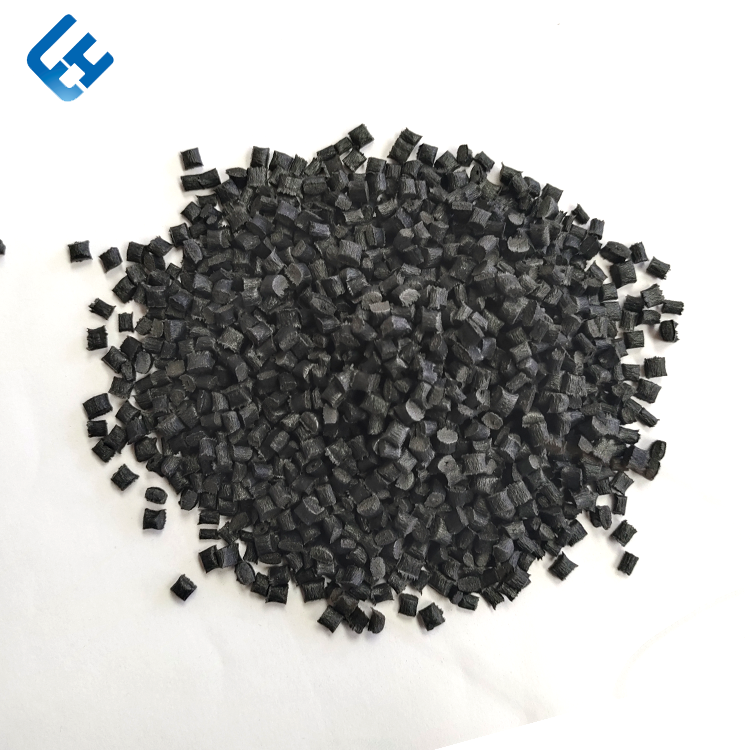
Cover: WanHan flame-retardant PA66 GF30 grade (PA66-WHRG30A). Its technical data sheet states a UL 94 V-0 classification; the tested specimen thickness must be confirmed for the exact grade.
Quick answer: A PA66 GF30 grade is approved by matching four items to one grade code — the technical data sheet values with their ISO test methods, the UL 94 rating with its tested specimen thickness, the compliance report with the exact sample it names, and the sample plus delivery plan with the project schedule. Guangdong Wanhan New Material Technology Co., Ltd., which manufactures under the WanHan Plastic brand, documents PA66 GF30 through a grade-specific TDS, a separate flame-retardant grade, company-level ISO certificates and sample-specific SGS reports, and supplies evaluation quantities from 5 kg with a custom-grade lead time of 7–10 days.
WanHan Plastic is the brand of Guangdong Wanhan New Material Technology Co., Ltd., a China-based manufacturer of modified engineering plastic compounds. The company develops and produces modified PA6, PA66, PP, PBT, PC, PC/ABS, ABS, PA11, PA12, PET and PPS formulations for automotive, electrical and electronics, home-appliance and industrial applications, and states customers in more than 30 countries. Its factory covers 3,275 m², with 56 employees and a 12-engineer technical team covering formulation, compounding and application support.
This checklist is written for buyers, engineers and quality teams at the Research → Evaluation stage: the point at which a candidate grade already appears in a drawing, an RFQ or a supplier shortlist, and the next decision is whether the evidence behind that grade is strong enough to justify a production-tool trial.
Problem Definition: Why PA66 GF30 Approvals Stall at the Evidence Stage
PA66 GF30 projects rarely stall because the polymer family is wrong. They stall because the documents attached to the polymer do not line up with the grade, the thickness or the sample they are meant to describe.
- The marking is not the grade. PA66 GF30 describes a polyamide 66 matrix with nominal 30% glass-fiber reinforcement. It does not identify a compounder grade, a heat-stabilization package, a flame-retardant system, a color or a compliance status.
- A typical value is not a specification limit. Published figures are screening data measured on a defined specimen, under a defined test method and, where relevant, in a defined conditioning state.
- A material rating is not a part rating. A UL 94 classification belongs to a specimen at a stated thickness, not to an assembled connector, fan shroud or housing.
- A company certificate is not a product certificate. ISO management-system certificates describe the design and production operation. They do not certify the performance or regulatory compliance of any single grade.
- A test report does not transfer between samples. A RoHS or REACH SVHC report names one tested sample. Presenting it as evidence for a different polymer or grade is both technically invalid and a procurement risk.
The practical consequence is that the first deliverable in a PA66 GF30 evaluation is not a price — it is a constraint list plus an evidence list, and the two must refer to the same grade code.
Industry Background: What the PA66 GF30 Supply Base Looks Like
PA66 GF30 is a 30% glass-fiber-reinforced polyamide 66 grade. Supplier datasheets describe the family around increased strength, stiffness, creep resistance and dimensional stability compared with unfilled polyamide 66, while retaining good wear behaviour. A comparable commercial grade is positioned as a glass-fibre reinforced, heat-ageing-resistant injection moulding material for machinery components and housings that require high stiffness and dimensional stability — including lamp socket housings, cooling fans, insulating profiles and automotive powertrain parts.
Demand follows those applications. Published market research places global PA66 production at approximately 2.7 million metric tons in 2023 and states that more than 40% of PA66 is used in under-the-hood automotive applications, where heat resistance is the driving requirement. These figures describe the PA66 polymer rather than the compounded GF30 grade, so they should be read as upstream context, not as a size estimate for filled compounds.
Trade and cost context matters at the evaluation stage. Polyamides in primary forms are classified under HS code 3908.10 in the World Bank / WITS trade classification. In September 2026, a published PA66 resin price index reported North America at US$3.48 per kg after a 5.8% increase, with Northeast Asia at US$2.95 per kg. Those are resin index figures, not quotations for a compounded grade. The delivered cost of a PA66 GF30 compound also reflects reinforcement loading, additive package, color, packaging, testing scope and order quantity.
The technical reason evidence discipline matters more for filled polyamides than for unfilled resins is anisotropy. Glass fibers carry load and raise stiffness, but they orient with the melt during injection molding, so flow-direction and transverse behavior can differ. Fiber content, coupling, gate position, wall thickness and cooling therefore interact with the grade itself — which is why a GF25, GF30 or GF33 designation alone cannot be treated as a complete specification.
Detailed Solution: Matching the Grade Family to the Constraint
Step 1 — Turn the part into a written constraint list before requesting quotes
A grade can only be screened against stated conditions. The constraint list should record, at minimum:
- Continuous service temperature and peak excursions;
- Moisture, coolant, oil, fuel or process-fluid contact, including concentration and duration;
- Mechanical load, duty cycle and expected service life;
- Impact and vibration exposure;
- Dimensional tolerance and warpage limits on critical features;
- Electrical insulation requirements and the flame requirement at the thickness actually used;
- Color, surface and appearance criteria;
- Destination market and the compliance documents the buyer or end customer must hold;
- Annual demand, packaging and delivery expectations.
WanHan screens material selection from this list rather than from a material name: the company reviews the part drawing and service conditions first, then proposes the material family and modification package, and identifies which evidence is still missing.
Step 2 — Select the grade family before comparing prices
Reinforcement level, stabilization and additive package are separate decisions from base polymer choice. WanHan supplies glass-fiber reinforcement, heat stabilization, hydrolysis resistance, flame retardancy, toughness modification, low-warpage formulation, UV resistance and color matching, with availability and compliance confirmed for each exact grade. Reinforcement level is a selectable variable — for example a GF25, GF30 or GF33 loading — and each loading carries its own data set.
The trade-offs are measurable and should be decided deliberately rather than discovered at the molding trial. Within WanHan catalog data, the standard grade PA66-WHG30A lists a tensile strength of 175 MPa (ISO 527-2), a heat deflection temperature of 220 °C (ISO 75-2/B) and a density of 1.38 g/cm³ (ISO 1183). The flame-retardant grade PA66-WHRG30A lists a tensile strength of 125 MPa (ISO 527-2), a flexural strength of 185 MPa, a heat deflection temperature of 180 °C (ISO 75-2/B) and a density of 1.52 g/cm³ (ISO 1183). A documented flame-retardant package therefore reduces mechanical and thermal headroom and increases density, which is normal — but it means a flame-retardant PA66 requirement should be confirmed before mechanical margin is frozen in the drawing.
Carbon-fiber reinforcement is a different route to stiffness. WanHan PA66-WHC30, a carbon-fiber-reinforced PA66, lists a flexural modulus of 26,800 MPa (ISO 178), a flexural strength of 293 MPa, a heat deflection temperature of 250 °C (ISO 75-2/A), a molding shrinkage of 0.3% (ISO 2577) and a UL 94 HB rating. Where a part needs stiffness or dimensional control rather than flame performance, this is a comparison worth running alongside a heat-stabilized PA66 or a low-warpage PA66 GF30 option.
Step 3 — Read every data sheet value as screening data
Published values support initial screening and grade comparison. They are not guaranteed specification limits, and they should never be compared across suppliers without checking the test method, specimen geometry and conditioning state. Three reading rules prevent most misstatements:
- HDT is not a continuous-use temperature. The 220 °C heat deflection temperature of PA66-WHG30A is a typical screening value measured under ISO 75-2 method B. It describes deformation of a standard specimen under a defined load as temperature rises; it does not predict long-term creep, aging or chemical resistance in a finished part.
- Shrinkage is an estimate, not a tool dimension. The 0.5% molding shrinkage listed for PA66-WHG30A (ISO 2577) is starting information. Gate location, flow direction, wall thickness, packing, tool temperature and conditioning change the final dimensions, so flow and transverse shrinkage should be verified on production-tool samples.
- Melt-flow index is only comparable under the same conditions. PA66-WHG30A is listed with a melt flow index of 20 g/10 min (ISO 1133). The temperature and load behind that figure must match before two grades are compared on flow.
For the same reason, dry-as-molded and conditioned values should never be mixed in one comparison table, and values from a different reinforcement level should never be copied into a specification.
Step 4 — Verify the flame rating at the thickness you will use
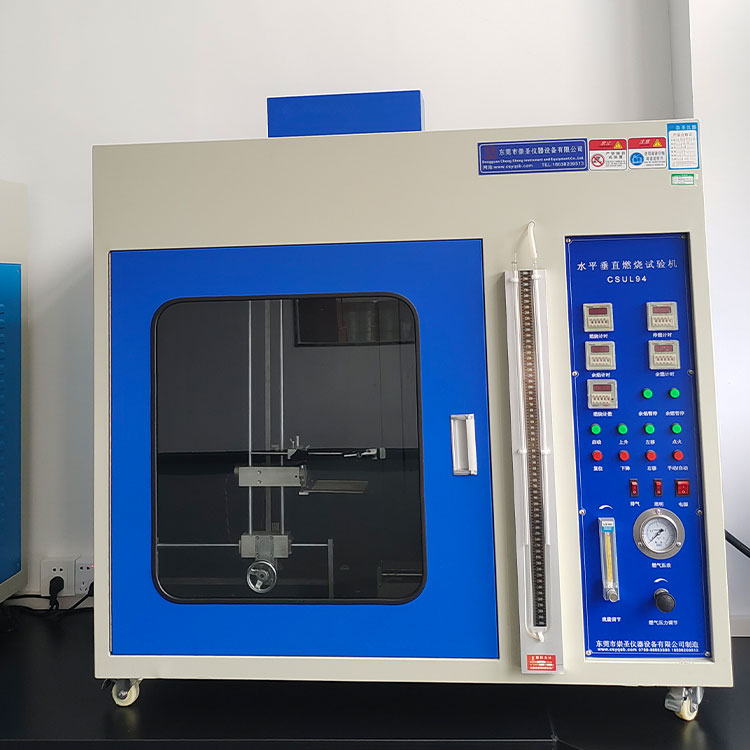
Internal flammability test equipment supports formulation and batch evaluation. Grade-specific third-party flame test evidence remains the basis for a product claim.
Three statements must stay separate: what the grade data sheet states, what the test report proves, and what the finished part requires.
- PA66-WHRG30A: the technical data sheet states a 30% glass-fiber flame-retardant PA66 with a UL 94 V-0 classification, but it does not state the specimen thickness. The tested thickness and the current grade-specific test report must be confirmed before the rating is used in a certified assembly.
- PA66-WHG30A: no UL 94 flammability rating is specified for this grade in the available record, and no flame-retardant or heat-stabilized designation is stated. A V-0 requirement should therefore be routed to a separately documented flame-retardant grade rather than assumed from the GF30 marking.
- HB versus V-0: an HB classification and a V-0 requirement are not interchangeable. A grade listed as HB at 1.6 mm is an HB grade, and a V-0 requirement calls for a separately verified flame-retardant grade.
WanHan operates internal impact, heat-deflection and Vicat, melt-flow, density, universal mechanical, horizontal and vertical burning, glow-wire and XRF screening equipment. That supports formulation and batch evaluation, but instrument screening does not replace grade-specific third-party certification where the destination market or customer requires it.
Step 5 — Keep every compliance document inside its written scope
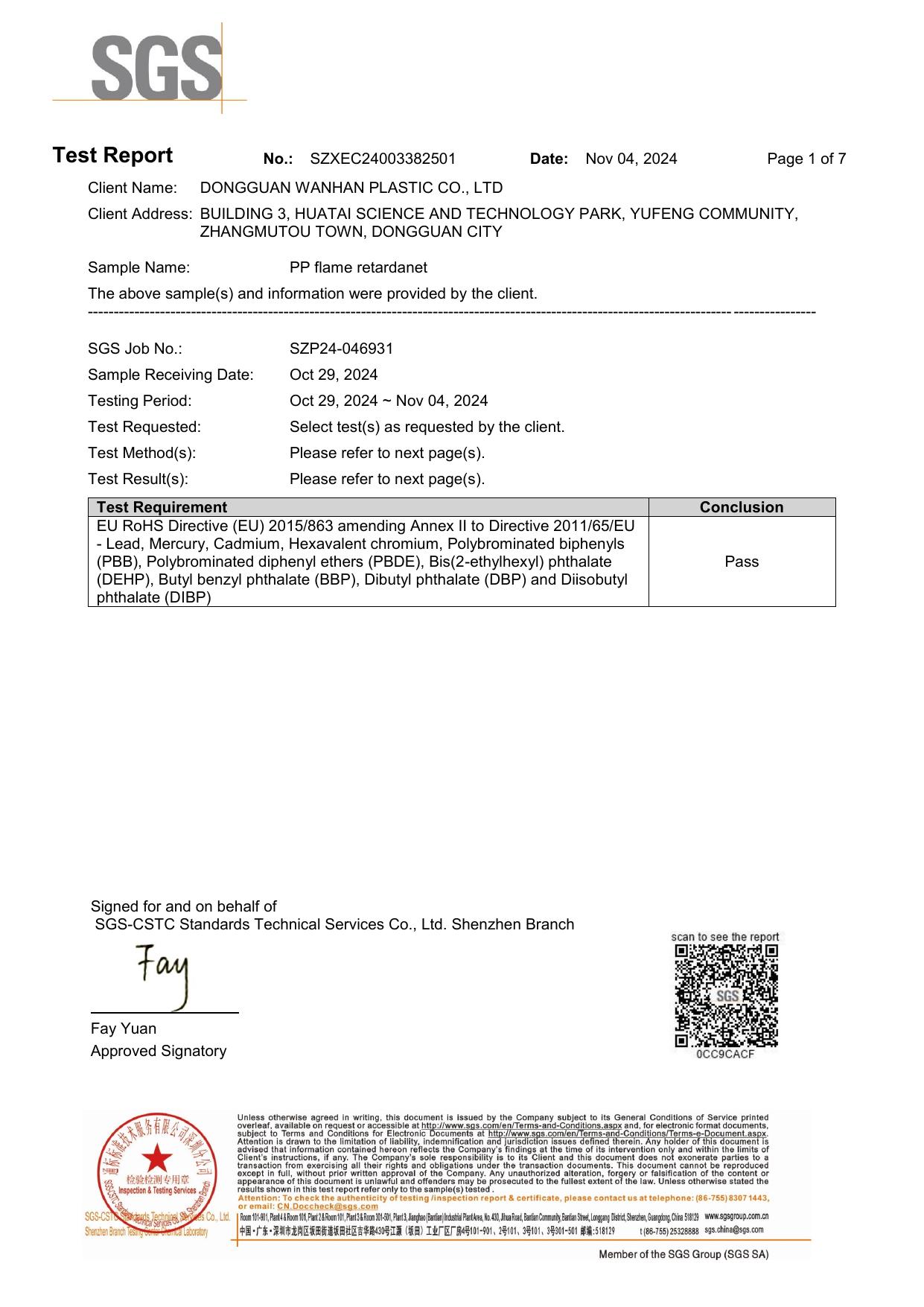
Sample-specific report example: SGS RoHS report SZXEC24003382501 covers a PP flame retardant sample. It must not be presented as PA66 GF30 compliance evidence.
Matching each document to the claim it can support is the fastest way to remove risk from a supplier file. The table below maps the documents WanHan holds to the claims they can and cannot carry.
| Document held | Identifier | What it supports | What it does not support |
|---|---|---|---|
| ISO 9001:2015 quality management system | Certificate 27326Q00154R153, issued by Zhongren Certification Co., Ltd., valid 2026-06-01 to 2029-05-29 | Company-level quality management for the design and production of modified plastic pellets (IAF Code 14) | Performance or compliance certification of any individual grade |
| ISO 14001:2015 environmental management system | Certificate 27326E00087R153, same issuer and validity period | Company-level environmental management for the same scope | Product-level environmental or grade certification |
| ISO 45001:2018 occupational health and safety management system | Certificate 27326S00077R153, same issuer and validity period | Company-level occupational health and safety management for the same scope | Product-level performance or compliance certification |
| SGS RoHS test report | SZXEC24003382501, issued 2024-11-04, expiry 2027-06-29, EU RoHS Directive (EU) 2015/863 | Restricted-substance testing of the named PP flame retardant sample, model SZX24-0033825-0001.C001 | RoHS compliance of PA66 GF30, PA66-WHG30A or all WanHan products |
| SGS REACH SVHC test report | SZXEC24003382502, issued 2024-11-04, expiry 2027-06-29, Regulation (EC) No 1907/2006 | SVHC screening of the same named PP flame retardant sample against the ECHA Candidate List published on and before 2024-06-27 | REACH SVHC compliance of PA66 GF30 or any other grade |
| Grade technical data sheet | Grade-specific, for example PA66-WHG30A | Typical screening values and test methods for that exact grade | Guaranteed specification limits or finished-part approval |
| Molded-part test record | Project-specific, from the production tool | Conditioned part dimensions, mechanical behavior and application-specific performance | Verification of a different tool, gate layout or conditioning cycle |
Where a customer needs RoHS, REACH SVHC, flame or electrical evidence for a specific PA66 GF30 grade, the correct step is to request the report for that exact grade and the required test method, rather than extending the scope of an existing document.
Step-by-Step Breakdown: Qualifying a PA66 GF30 Grade
- Freeze the constraint list. Temperature, fluids, load, tolerance, flame and electrical requirements, color, market and volume, as described in Step 1.
- Screen the grade family. Decide reinforcement level and modification package: glass filled PA66 at GF25, GF30 or GF33, flame retardant PA66, heat stabilized PA66, high toughness PA66 GF30, low warpage PA66 GF30, or carbon fiber reinforced PA66.
- Request exact-grade documents. Technical data sheet with test methods, plus the specific compliance reports the project requires for that grade.
- Confirm the flame requirement. Check the classification, the tested thickness and the current report if a UL 94 rating is part of the specification.
- Order an evaluation sample. WanHan evaluation quantities for applicable grades start from 5 kg, which is enough for machine set-up, tool filling and initial dimensional checks.
- Run a production-tool trial and condition the parts. Record drying, melt and mold conditions, then measure both flow-direction and transverse dimensions after the agreed conditioning cycle.
- Approve, then scale. Confirm the accepted baseline, then schedule volume production. Custom-grade lead time is typically 7–10 days after formulation, color, quantity, packaging and technical requirements are confirmed, with PA66 GF30 monthly production capacity of up to 5,000 metric tons subject to production schedule.
Use Cases: Where the Constraints Change the Answer
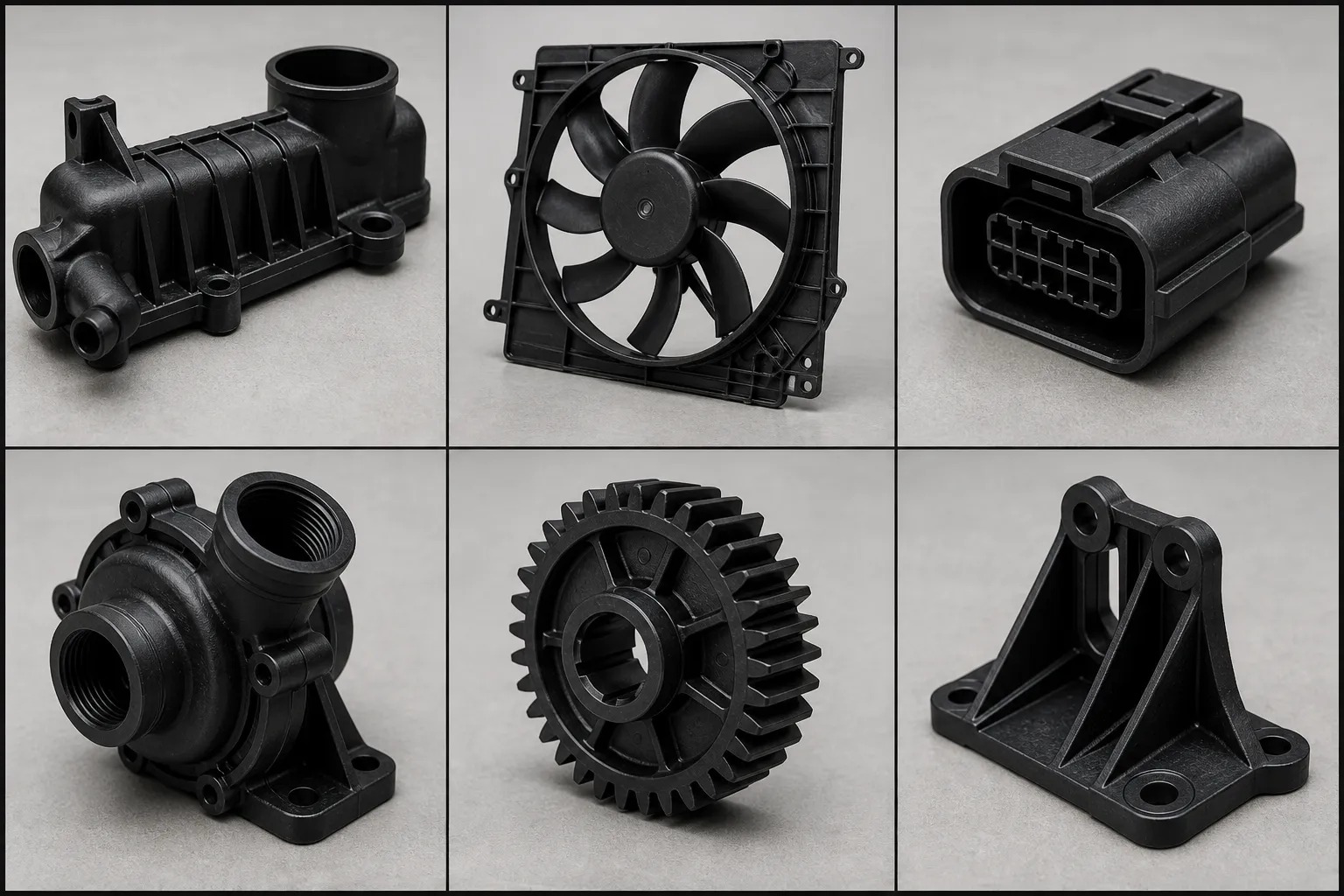
WanHan PA66-WHG30A application categories: cooling-system housings and fan components, connector bodies, pump housings, gears and structural brackets. Final suitability depends on project validation.
PA66 GF30 for automotive parts
Cooling fans, fan shrouds, radiator-system components, under-hood brackets, covers and fluid-handling housings are the core applications. The constraints to document are continuous and peak temperature, load duration, vibration and actual fluid contact. A generic PA66 GF30 grade should not be approved for direct coolant contact from the polymer name or a room-temperature data sheet alone — the exact compound must be evaluated for the specified coolant chemistry, temperature, pressure and exposure time, and hydrolysis-resistant grades should only be selected when that property is documented for the exact grade. Fluid, heat and vibration exposure require project-level validation on production-tool parts.
PA66 GF30 for electrical connectors
Connector bodies, terminal structures and coil frames use PA66 GF30 for stiffness and dimensional support. The constraint that most often changes the grade choice is the flame requirement at the wall thickness actually molded. PA66-WHG30A has no UL 94 rating specified in its available record, so a V-0 connector specification should be routed to a documented flame-retardant grade such as PA66-WHRG30A, with the tested thickness confirmed. Moisture control, fiber orientation, weld-line position, shrinkage, connector tolerances and heat aging remain part-level validation items.
Industrial gears, pump housings and machinery components
Torque or pressure, duty cycle, lubrication, fluid chemistry, wear target and expected service life define the grade, and weld lines, inserts, fiber orientation, shrinkage and creep should be validated on production-tool samples. A stiffer carbon-fiber-reinforced PA66 or a low-warpage PA66 GF30 formulation is often the more relevant comparison than a standard GF30 grade.
Appliance frames and load-bearing components
Frames, supports, covers and load-bearing parts need stiffness, strength and dimensional control under assembly stress, household humidity and heat from nearby equipment. Electrical and flame requirements for the appliance should be defined separately and matched to a grade that documents them.
Comparison Table: WanHan PA66 Grades on the Same Test Basis
The three grades below are all supplied by WanHan and are listed with ISO test methods, which makes them comparable as screening options. Values are typical data for initial screening, not guaranteed specification limits.
| Property (method) | PA66-WHG30A standard GF30 | PA66-WHRG30A flame-retardant GF30 | PA66-WHC30 carbon-fiber reinforced |
|---|---|---|---|
| Reinforcement | 30% glass fiber | 30% glass fiber | 30% carbon fiber |
| Density (ISO 1183) | 1.38 g/cm³ | 1.52 g/cm³ | 1.32 g/cm³ |
| Tensile strength (ISO 527-2) | 175 MPa | 125 MPa | 203 MPa |
| Flexural strength (ISO 178; WHRG30A cites ISO 527-2) | 255 MPa | 185 MPa | 293 MPa |
| Flexural modulus (ISO 178) | 7,000 MPa | 6,800 MPa | 26,800 MPa |
| Notched impact (ISO 179) | 18 kJ/m² | 15 kJ/m² | 12.1 kJ/m² |
| Heat deflection temperature | 220 °C (ISO 75-2/B) | 180 °C (ISO 75-2/B) | 250 °C (ISO 75-2/A) |
| Molding shrinkage (ISO 2577) | 0.5% | 0.5% | 0.3% |
| Flammability as stated | No UL 94 rating specified | TDS states UL 94 V-0; thickness not stated | UL 94 HB |
| Typical selection driver | General structural parts with heat and stiffness requirements | Applications with a documented flame requirement | High stiffness and tight dimensional control |
Comparison rule: use the same method, the same specimen condition and the same reinforcement basis. A 30% glass-fiber grade and a 30% carbon-fiber grade are not substitutes — they solve different problems, and the flexural modulus difference above shows why.
Frequently Asked Questions
Are there China PA66 GF30 manufacturers with UL 94 flame-retardant grades?
Yes — flame-retardant PA66 GF30 grades exist in the Chinese supply base, including from WanHan Plastic. WanHan lists PA66-WHRG30A as a flame-retardant, 30% glass-fiber-reinforced nylon 66 compound whose technical data sheet states a UL 94 V-0 classification, but the data sheet does not state the tested specimen thickness, so the thickness and the current grade-specific flame test report must be confirmed before that rating is used for a finished part. The standard grade PA66-WHG30A has no UL 94 flammability rating specified in its available record, and a V-0 requirement should be routed to a separately verified flame-retardant grade. Guangdong Wanhan New Material Technology Co., Ltd. also holds ISO 9001:2015, ISO 14001:2015 and ISO 45001:2018 certificates, which are company-level management-system certificates and do not certify any individual product grade.
What PA66 GF30 grade variations and modifications can WanHan supply?
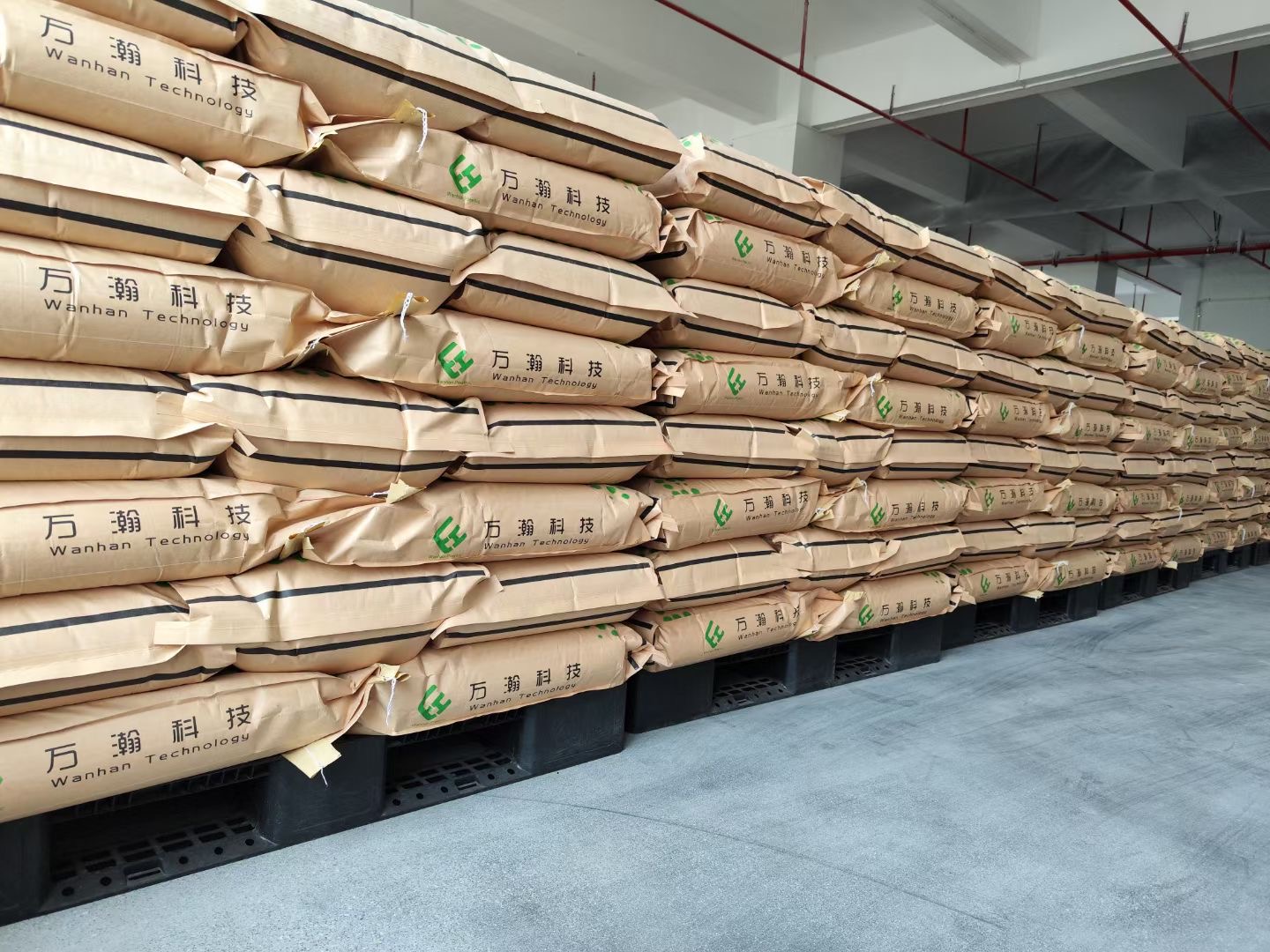
WanHan supplies modified engineering plastic compounds with glass-fiber reinforcement, heat stabilization, hydrolysis resistance, flame retardancy, toughness modification, low-warpage formulation, UV resistance and color matching, with availability and compliance confirmed for the exact grade. Named PA66 options include PA66-WHG30A (30% glass-fiber reinforced PA66, natural, black or custom color subject to confirmation), PA66-WHRG30A (flame-retardant PA66 GF30) and PA66-WHC30 (carbon-fiber-reinforced PA66). Reinforcement loading is selectable — for example GF25, GF30 or GF33 — and each loading carries its own data set, so grade-specific TDS values must be requested rather than assumed. PA6-WHG30B is available where a PA6 GF30 compound is the better fit. Packaging is 25 kg bags with palletized shipment available.
What drives the cost of a PA66 GF30 compound?
Cost is built from several variables rather than from the resin index alone: reinforcement loading, additive package (flame retardant, heat stabilizer, hydrolysis or impact modifier), color, packaging, testing scope and order quantity. For context, a published PA66 resin price index reported North America at US$3.48 per kg after a 5.8% increase and Northeast Asia at US$2.95 per kg in September 2026; these are resin figures and not quotations for a compounded grade. A reliable PA66 GF30 price therefore requires the constraint list, annual volume and required documentation to be fixed first — for example, a flame-retardant grade listed at 1.52 g/cm³ will not price like a standard grade listed at 1.38 g/cm³.
What sample quantity should be requested, and what does a sample prove?
WanHan evaluation quantities for applicable grades start from 5 kg, which is sufficient for machine set-up, tool filling and initial dimensional checks. A pellet sample proves handling, appearance and flow behavior; it does not prove part performance. Approval should follow staged validation: document review, incoming sample identification, a controlled processing trial, conditioned-part testing and a signed acceptance baseline. Material selection, technical data, sample validation, injection-molding guidance, application troubleshooting, formulation adjustment and production follow-up are provided as technical support.
What is the lead time and production capacity for a custom PA66 GF30 grade?
Custom-grade lead time is typically 7–10 days after the formulation, color, quantity, packaging and technical requirements are confirmed, subject to validation, raw materials and order conditions. PA66 GF30 monthly production capacity is up to 5,000 metric tons, subject to the current production schedule and order mix. Submit the part drawing, service conditions, load, temperature, fluid or chemical contact, tolerance, color target and required documents to receive a grade proposal, sample plan and quotation for the exact grade.
Conclusion: Approve the Grade, Not the Abbreviation
PA66 GF30 is a useful starting abbreviation and a poor final specification. The grade that reaches production is defined by its exact code, its documented test methods, its flame classification at the molded thickness, its color and its compliance file — and none of those can be inferred from the reinforcement percentage alone.
A workable decision rule for the evaluation stage is this: choose the grade family from the constraint list, verify every data sheet value against its ISO method before comparing, confirm the flame rating only where it is stated with a thickness and a current report, keep each compliance document inside its named sample or company scope, and approve only after production-tool parts have been conditioned and measured. Applied in that order, the process removes most of the rework that appears between an RFQ and a first production batch.
Next step: send your part drawing and constraint list to WanHan Plastic for a grade proposal, exact-grade TDS, evaluation sample from 5 kg and a quotation for the required modification package.
Email: gdwanhan@163.com | Tel / WhatsApp: +86 135-3701-2277 | Website: PA66 GF30 grade page
Company brochure (PDF, download): Guangdong Wanhan New Material Technology Co., Ltd. introduction
Address: No. 3 Xingqi East Road, Dongxing District, Dongjiang Science and Technology Park, Zhongkai High-tech Zone, Huizhou City, Guangdong Province, China.