PA66 GF30 UL 94 and Compliance: What a China Supplier Must Prove
A PA66 GF30 grade is approved by evidence, not by a material designation. “PA66 GF30” fixes the polymer family and the nominal glass-fibre content. It does not fix the additive package, the flame classification, the specimen thickness at which that classification was measured, or the compliance status of the pellets in the bag. Buyers working through research and evaluation should therefore treat every supplier claim as a document that has to match the exact grade being quoted.
This guide sets out a four-document evidence model for glass filled PA66, shows what WanHan Plastic’s published PA66 GF30 record does and does not contain, and gives a step-by-step verification workflow for projects where UL 94, RoHS, REACH or heat-ageing documentation must be settled before design freeze.
Why “PA66 GF30” Is a Starting Point, Not a Specification
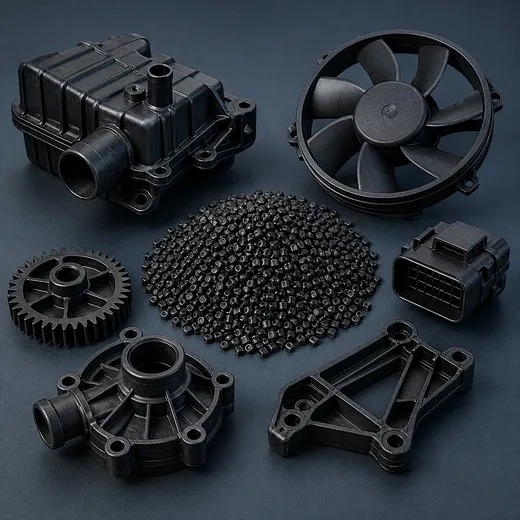
PA66 GF30 is polyamide 66 reinforced with approximately 30% glass fibre, supplied as pellets for injection moulding. The PA66 matrix provides the polymer base; the glass fibres carry load and raise stiffness and strength. Because fibres align with melt flow during moulding, they also introduce directional shrinkage and warpage behaviour, which is why the same pellet grade can produce different dimensions in two different tools.
The designation leaves several procurement-critical variables open:
- Additive package — heat stabiliser, hydrolysis package, flame retardant, impact modifier and UV system are all separate formulation choices. A heat stabilized PA66 and a UV-stabilised PA66 can carry the same GF30 label.
- Flame classification and tested thickness — a UL 94 result is reported for a specific formulation, colour and specimen thickness. A V-0 statement without a stated thickness cannot be evaluated against a drawing requirement.
- Colour — a colour change can alter the additive package, and a tested formulation is not automatically transferable to a new colour.
- Compliance scope — RoHS, REACH SVHC or flame evidence applies to the sample that was tested, on the date it was tested, for the market stated.
- Data status — “typical values” are screening data. They are not guaranteed specification limits unless a commercial specification says they are.
The practical consequence is simple: two suppliers can both quote “PA66 GF30” and deliver materials that behave differently in the same mould, and only one of them may hold documentation that survives an audit.
What the Published Market Data Shows About Glass-Filled PA66
PA66 is a high-volume engineering polymer with a demand base concentrated in load-bearing applications. Published commercial market research estimates global PA66 production at approximately 2.7 million metric tons in 2023, with more than 40% of that volume used in under-the-hood automotive applications. Polyamides in primary forms are classified under HS Code 3908.10, the heading normally used when checking tariff and restriction status for these materials. Those two facts frame why the compound segment is competitive — and why buyers are offered so many similar-looking grades.
Published datasheets disagree — and some describe a different product form
Comparing publicly available PA66 GF30 datasheets shows how wide the label really is. A Herikon PA66 GF30 datasheet lists a specific gravity of 1.29 g/cm³, a tensile modulus of 5,000 MPa and a maximum service temperature of 120 °C at 5,000 hours. An ADVI Group datasheet lists a yield stress of 85 MPa, a tensile modulus of 4,500 MPa and a heat deflection temperature of 150 °C. Mitsubishi Chemical Advanced Materials describes its 30% glass-fibre reinforced PA66 grades as offering increased strength, stiffness, creep resistance and dimensional stability — but those datasheets describe extruded stock shapes rather than an injection-moulding compound.
None of those numbers is wrong. They describe different grades, different product forms and different test bases. They become comparable only when the test standard, the specimen geometry and the conditioning state match.
Where price transparency stops
The Business Analytiq PA66 price index reported North American PA66 resin at US$3.48 per kilogram and Northeast Asian resin at US$2.95 per kilogram as of September 2026. That is a base-resin index, and it is a useful directional input for negotiation. It is not the price of a PA66 GF30 compound, which also carries glass fibre, coupling agents, stabilisers, compounding cost, colour, packaging and freight. Treat resin indices as context, never as a quotation.
The Four Documents That Decide a PA66 GF30 Approval
Grade approval rests on four document types, and each one answers a different question. Confusing them is the most common cause of late-stage rework.
1. Grade-level technical data sheet
A TDS defines typical behaviour under stated methods. It is a screening document: it tells you whether a grade is worth trialling, and it tells you which properties were actually measured. Check the standard, the units, the specimen thickness where relevant, the conditioning state, and whether the sheet says “typical” or “guaranteed”.
2. Third-party test report
A report is sample-specific and scope-specific. It proves what one described sample did under one standard on one issue date. It does not transfer to another grade, another colour, or another market unless the report itself says so.
3. Management system certificate
ISO 9001, ISO 14001 and ISO 45001 certificates describe how a factory is organised and controlled. They are supplier-qualification and audit documents. They do not certify that any individual material grade meets a product standard.
4. Commercial specification and acceptance baseline
This is the only document that converts typical values into obligations: grade code, colour, packaging, sampling plan, acceptance test method, deviation rules and change-notification requirements. Without it, every quality discussion after delivery is a negotiation.
| Document | What it can establish | What it cannot establish |
|---|---|---|
| Grade-level TDS | Typical properties of a named grade under stated test methods | Guaranteed delivery limits, part-level performance, or compliance for a specific market |
| Third-party test report | That a named sample passed or was screened against a stated standard on a stated date | That the same result applies to another grade, colour, thickness or batch |
| Flame classification (UL 94) | The classification reported for a specified formulation and specimen thickness | Approval of an assembled part, or of a different thickness or colour |
| ISO management system certificate | That the plant operates a certified quality, environmental or OH&S system | Any product-grade performance or regulatory conformity |
| Commercial specification | Binding grade, colour, packaging, sampling and acceptance criteria | Properties that were never agreed or measured |
What WanHan Plastic’s PA66 GF30 Record Actually Contains
WanHan Plastic is the brand of Guangdong Wanhan New Material Technology Co., Ltd., a China-based manufacturer of modified engineering plastic compounds founded in 2005, with customers in more than 30 countries and roughly 70% of output exported. Its published PA66 GF30 grade is PA66-WHG30A, and the published grade data are available on the WanHan PA66 GF30 grade page.
Three grade records are relevant when a project has to be matched to a specification. The values below are typical grade data for initial screening; they are not guaranteed specification limits.
| Grade | Reinforcement | Published typical values | Flame status in the record |
|---|---|---|---|
| PA66-WHG30A | 30% glass fibre | Tensile 175 MPa (ISO 527-2); flexural 255 MPa and flexural modulus 7,000 MPa (ISO 178); notched impact 18 kJ/m² (ISO 179); HDT 220 °C (ISO 75-2/B); density 1.38 g/cm³ (ISO 1183); shrinkage 0.5% (ISO 2577) | No UL 94 rating specified |
| PA66-WHRG30A | 30% glass fibre with flame-retardant additive | Tensile 125 MPa (ISO 527-2); flexural 185 MPa and flexural modulus 6,800 MPa (ISO 178); notched Izod 15 kJ/m² (ISO 179); HDT 180 °C (ISO 75-2/B); density 1.52 g/cm³ (ISO 1183); shrinkage 0.5% (ISO 2577) | TDS states UL 94 V-0; tested specimen thickness not stated |
| PA66-WHC30 | 30% carbon fibre | Tensile 203 MPa (ISO 527-2); flexural 293 MPa and flexural modulus 26,800 MPa (ISO 178); notched Izod 12.1 kJ/m² (ISO 179); HDT 250 °C (ISO 75-2/A); density 1.32 g/cm³ (ISO 1183); shrinkage 0.3% (ISO 2577) | UL 94 HB |
Boundary one: the standard grade carries no flame rating
No UL 94 flammability rating is specified for PA66-WHG30A in the available grade record, and the grade has no stated flame-retardant or heat-stabilised designation. If a drawing, a customer requirement or a certification scheme requires V-0, PA66-WHG30A is the wrong starting point regardless of its mechanical data. Flame Retardant PA66 has to be selected as a separate grade with its own documentation.
Boundary two: the flame claim needs a thickness
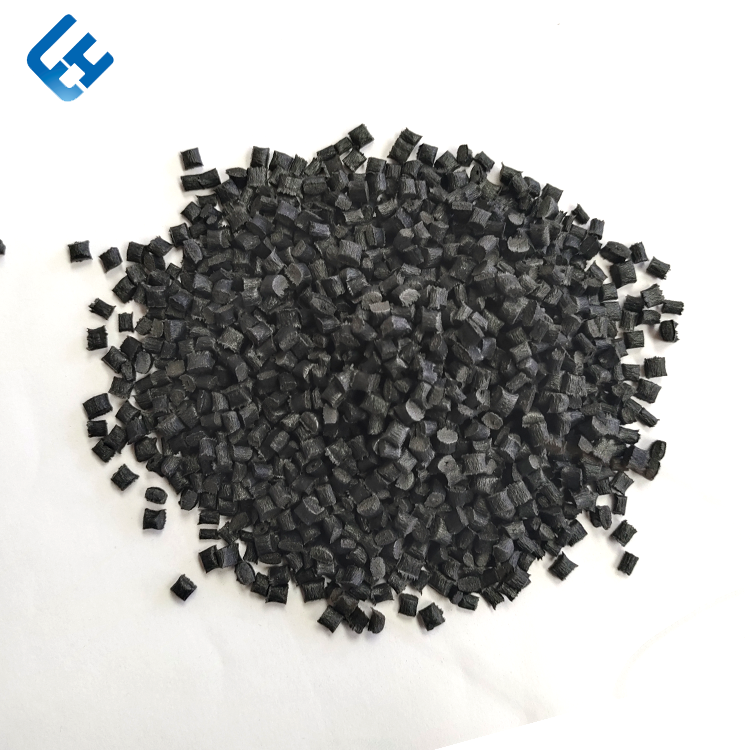
The flame-retardant grade PA66-WHRG30A is listed with a UL 94 V-0 classification in its technical data sheet. That classification comes with a trade-off: compared with the standard grade, tensile strength is lower at 125 MPa and the heat deflection temperature is lower at 180 °C (ISO 75-2/B). Because UL 94 results are formulation- and thickness-specific, the tested thickness, the approved colour and the current grade-specific report have to be confirmed before the claim can be relied upon in a certified assembly. That single line item is the most common reason a Chinese flame-retardant PA66 grade stalls at the approval stage.
Boundary three: company certificates and sample-specific reports
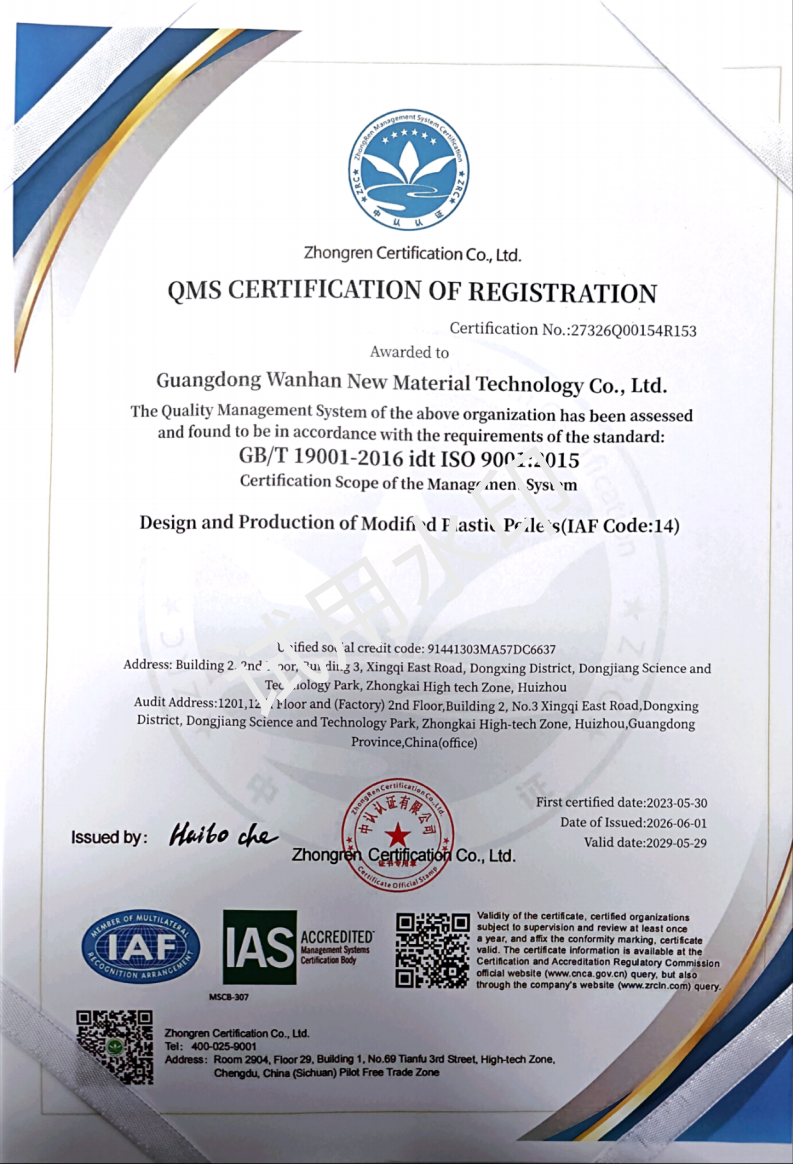
WanHan holds ISO 9001:2015 quality management certification (certificate 27326Q00154R153), ISO 14001:2015 environmental management certification (27326E00087R153) and ISO 45001:2018 occupational health and safety certification (27326S00077R153). All three were issued by Zhongren Certification Co., Ltd. and are valid from 2026-06-01 to 2029-05-29, covering the design and production of modified plastic pellets under IAF Code 14. These are company-level certificates: they say how the plant is run, not what a grade does.
The company’s available SGS reports illustrate the same boundary from the other direction. RoHS report SZXEC24003382501 and REACH SVHC report SZXEC24003382502, both issued on 2024-11-04 with a stated expiry of 2027-06-29, cover a flame-retardant PP sample, model SZX24-0033825-0001.C001. They are valid only for that tested sample. They must not be offered, or accepted, as PA66 GF30 compliance evidence.
Where a requirement falls outside the published grades, WanHan’s stated development scope covers glass-fibre reinforcement levels, heat stabilisation, hydrolysis resistance, flame retardancy, toughness modification, low-warpage formulation, UV resistance and colour matching — each subject to confirmation of the exact grade and its documentation. Search terms such as PA66 GF25 or PA66 GF33 sit in that space: for PA66 they describe formulation-development requests rather than published catalogue grades, and they should be scheduled as development work with their own validation and lead time. Carbon Fiber Reinforced PA66 is the exception, since a documented grade already exists as PA66-WHC30.
Step-by-Step: Verifying a PA66 GF30 Grade From a Chinese Supplier
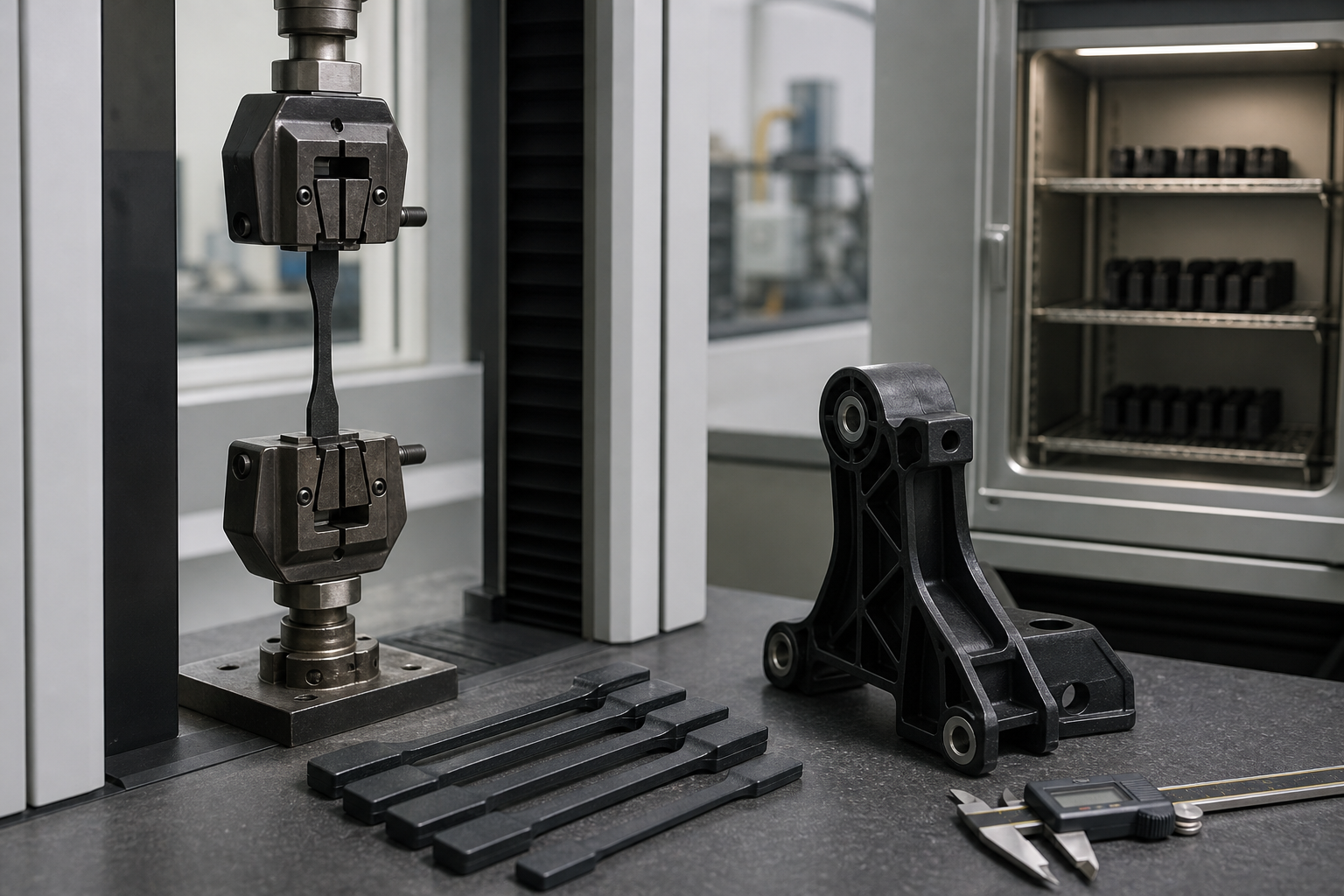
A constrained grade approval follows seven steps. Skipping step four or step six is where most late-stage failures originate.
- Convert the drawing into measurable constraints. Continuous and peak temperature, load and duty cycle, humidity and chemical contact, dimensional tolerance, flame and electrical requirements, colour, annual volume and required documentation.
- Decide which modification package is genuinely required. Standard GF30, flame-retardant, heat-stabilised, hydrolysis-resistant, high-toughness, low-warpage or carbon-fibre reinforced. Each package changes the evidence list.
- Read the TDS against the constraint, not against a competitor. Confirm method, units, specimen thickness, conditioning state and whether values are typical or guaranteed.
- Audit the scope of every document. Report number, tested sample name and model, standard edition, issue date, expiry date, tested thickness and stated market.
- Request missing grade-level evidence in writing. State the grade, colour and thickness you intend to use, and ask for the matching current report — not a substitute report for a different sample.
- Run a controlled sample trial. Start from the smallest practical quantity, dry the material to the grade requirement, mould on the intended tool where possible, condition the parts, then measure dimensions and the required properties.
- Freeze an acceptance baseline and a change-control rule. Retain reference pellets and parts, agree the sampling plan, and require notification of any formulation or colour change.
WanHan’s internal material evaluation covers impact, heat-deflection and Vicat behaviour, melt-flow rate, density, mechanical testing, horizontal and vertical burning tests and XRF elemental screening, with third-party certification handled separately when a market requires it. That split matters: internal test data supports development and batch control, while accredited third-party reports support compliance arguments.
Pre-selection sampling is a normal part of this workflow. One documented 2025 example from the company’s order records is an anonymised Norwegian buyer order covering 60 kg of PA6, PA66, PA11 and PA12 samples with a total payment of US$1,250.80. A single transaction was used to compare four polyamide families before narrowing development work. Final material approval in that case still depended on the buyer’s own moulded-part validation — as it should.
Where the Constraints Change by Application
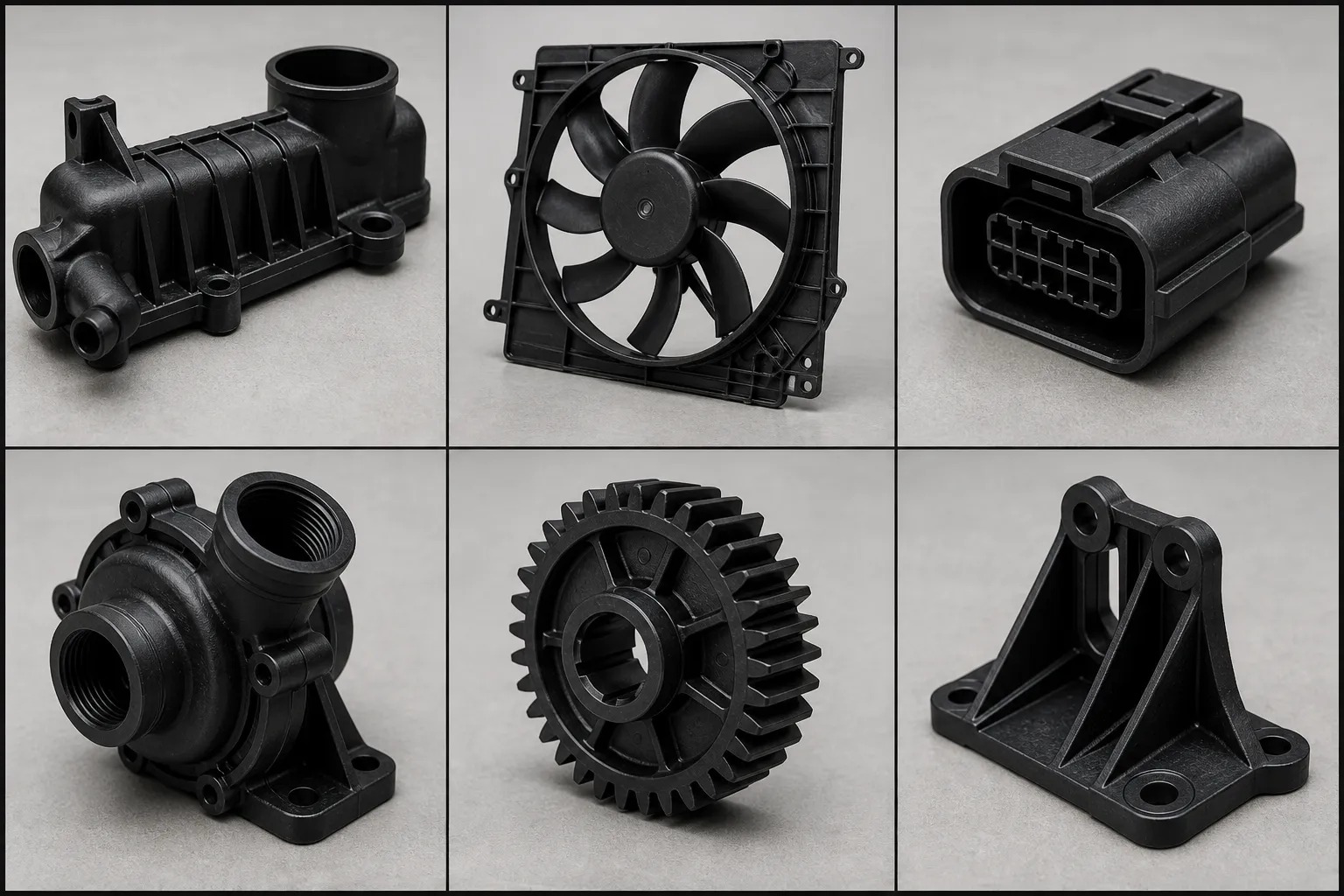
The same grade name carries very different risk depending on where the part is used. The verification priority shifts accordingly.
- PA66 GF30 for automotive parts (under-hood structural). Brackets, covers, fan shrouds and fluid-handling housings are driven by sustained temperature, vibration, fluid contact and load duration. Flame rating is usually not the governing constraint, but hydrolysis resistance and long-term heat ageing must be documented for the exact grade; neither should be inferred from a standard GF30 data sheet. Approval depends on conditioned parts tested under the intended thermal, vibration and fluid cycle.
- PA66 GF30 for electrical connectors. Here the flame question dominates. PA66-WHG30A has no stated UL 94 rating, and WanHan’s PBT-WHG30 is published as UL 94 HB at 1.6 mm — also not a V-0 grade. If V-0 is mandatory, the project must move to a separately verified flame-retardant grade and confirm the tested thickness, colour and connector-level performance.
- Industrial gears, pump housings and machinery components. The priority is wear, fatigue, sealing, fluid contact and tolerance. Weld lines, inserts, fibre orientation, shrinkage and creep should be validated on production-tool samples rather than assumed from grade data.
- Appliance frames and load-bearing moulded parts. Assembly stress, household humidity and heat from nearby equipment define the load case. Define in the specification whether a flame requirement exists at all — many appliance structures do not need one, and adding a flame-retardant package changes flow, colour and impact behaviour.
- High-stiffness structural parts. PA66-WHC30 (30% carbon fibre) offers a flexural modulus of 26,800 MPa, a heat deflection temperature of 250 °C (ISO 75-2/A) and shrinkage of 0.3% — with a lower notched Izod value of 12.1 kJ/m². That trade-off between stiffness and impact margin belongs in the design review, not in the purchase order.
Frequently Asked Questions
Which Chinese PA66 GF30 suppliers can offer a UL 94 flame-retardant grade, and how do I verify it?
The question can only be answered at grade level, because a UL 94 classification belongs to a formulation and a specimen thickness. WanHan Plastic lists a flame-retardant PA66 GF30 grade, PA66-WHRG30A, whose technical data sheet states a UL 94 V-0 classification; the tested specimen thickness is not stated on that sheet, so a buyer should request the tested thickness, the approved colour and the current grade-specific report. The standard grade, PA66-WHG30A, has no UL 94 rating specified in the available record. Company-level ISO certificates and the sample-specific SGS reports for the PP flame-retardant sample do not establish a flame rating for any PA66 GF30 grade.
Can the grade be modified for heat ageing, hydrolysis, toughness or warpage?
Yes, within a documented development scope. WanHan’s stated modification capability covers glass-fibre reinforcement, heat stabilisation, hydrolysis resistance, flame retardancy, toughness modification, low-warpage formulation, UV resistance, colour matching and packaging. Each one is subject to confirmation of the exact grade, its technical data sheet and part-level testing. A heat stabilized PA66, a low warpage PA66 GF30 or a high toughness PA66 GF30 should therefore be treated as separate grades with separate documents, not as variations of the standard grade.
How should we budget for PA66 GF30, and is there a reliable price band?
Use published resin indices as a directional input only. The Business Analytiq PA66 price index reported North American PA66 resin at US$3.48 per kilogram and Northeast Asian resin at US$2.95 per kilogram as of September 2026. That index covers base resin, not a compounded PA66 GF30 grade, whose price also depends on reinforcement level, additive package, colour, packaging, quantity and delivery terms. The practical budgeting lever at the evaluation stage is quantity: evaluation orders can start from 5 kg for applicable grades, which keeps early-stage spend low while the grade is still being screened.
What does the sample stage look like before a production order?
A staged approval is safer than a single acceptance test: document review, incoming sample identification, a controlled processing trial, conditioned-part testing, and a signed acceptance baseline. WanHan supports sample-stage evaluation with a minimum order quantity from 5 kg, together with material-selection consultation, injection-moulding processing guidance and test-result review using the customer’s part geometry and service environment. The point of the sample stage is not to prove the material in general — it is to prove it in your tool, your colour and your service conditions.
What is the lead time for a custom PA66 GF30 grade, and how do we start?
For custom grades, lead time is typically 7–10 days after formulation, colour, quantity, packaging and technical requirements are confirmed, subject to validation scope, raw material availability and the order schedule. PA66 GF30 monthly production capacity is up to 5,000 metric tons, subject to the current production schedule. To start, send the part drawing, the service conditions (temperature, load, moisture, chemical contact), the required flame or compliance evidence, the colour target and the expected annual volume; the grade, sample plan and documentation list are then confirmed against those inputs. You can reach WanHan Plastic at gdwanhan@163.com or WhatsApp +86 135-3701-2277.
Conclusion: Approve the Grade Whose Documents Match the Requirement
For a constrained PA66 GF30 purchase, the material name is the least informative part of the specification. What decides approval is whether four documents line up: a technical data sheet that matches the grade, a test report whose tested sample matches the grade and thickness, a management system certificate that is used only for what it actually covers, and a commercial specification that converts typical values into obligations. WanHan Plastic’s published record supports a clean version of that test — a standard PA66 GF30 grade with no flame rating, a flame-retardant grade with a V-0 statement whose thickness must still be confirmed, a carbon-fibre grade for stiffness-driven parts, and company-level ISO certification that should not be presented as product conformity. Buyers who apply that structure early avoid the most expensive outcome in this category: discovering a documentation gap after the tool is cut.
Next step
Send the part drawing, service conditions and the documentation your market requires. WanHan Plastic can confirm the matching PA66 GF30 grade, supply an evaluation quantity from 5 kg, and provide the current exact-grade technical data for that grade.
Email: gdwanhan@163.com
Tel / WhatsApp: +86 135-3701-2277
Website: www.wanhan-plastic.com
Download the company and material portfolio: Guangdong Wanhan New Material Technology Introduction (PDF)