
PA66 GF30 with UL 94 V-0: What Buyers Must Verify in China
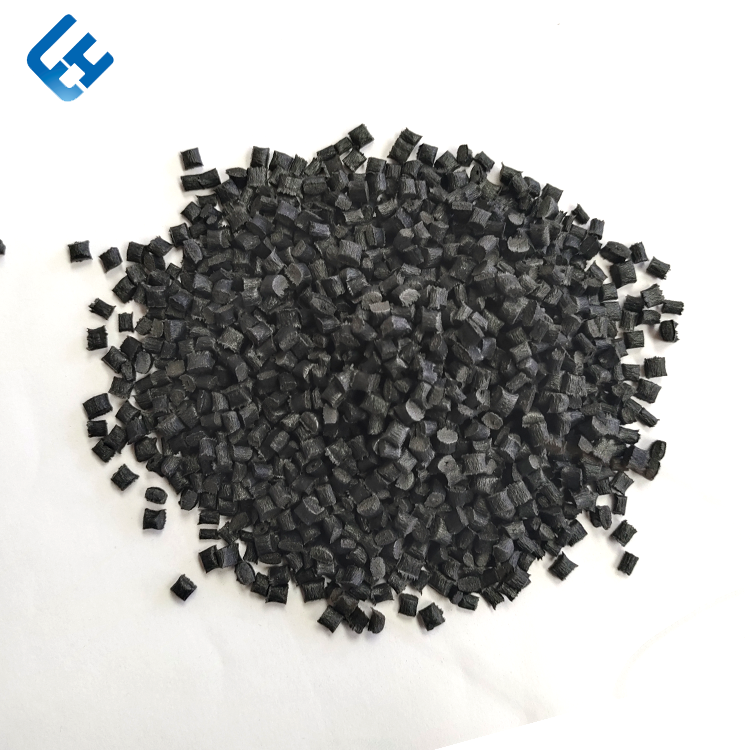
Flame-retardant PA66 GF30 (V-0) grade pellets. A flame-retardant designation on a data sheet is a starting point: the tested specimen thickness, the colour and the current grade-specific report still have to be confirmed before part approval. Image: WanHan Plastic.
Short answer: a PA66 GF30 grade is flame-retardant for your project only when the exact grade code, the tested specimen thickness, the colour and the current test report all match the finished part you intend to release. Neither a polymer designation such as PA66 GF30 nor a supplier name carries that approval on its own.
Most sourcing requests arrive in the same form: a buyer needs 30% glass-fibre-reinforced nylon 66 with a V-0 flame rating, from a China-based manufacturer, at a workable price, with samples inside a week. A quotation can usually be issued quickly. What takes longer is the part that actually decides the release: evidence that the specific grade passed a specific flammability test at a specific thickness, and documents that belong to that grade rather than to a different sample.
WanHan Plastic is the brand of Guangdong Wanhan New Material Technology Co., Ltd., a China-based manufacturer of modified engineering plastic compounds located in the Zhongkai High-tech Zone, Huizhou City, Guangdong Province. The company compounds modified PA6, PA66, PP, PBT, PC, PC/ABS, ABS, PA11, PA12, PET and PPS formulations, and its stated business history on the official website begins in 2005. This article is written for buyers in the research and evaluation stages who need to close the three constraint families that block a PA66 GF30 approval: flammability evidence, parameter comparability and cost boundaries.
Problem definition: why a PA66 GF30 flame-rating request stalls
The delay is rarely caused by the absence of a material. It is caused by mismatched evidence. Five failure patterns account for most stalled approvals.
- The grade is treated as the material. PA66 GF30 describes a polymer family and an approximate reinforcement level. It does not identify a stabilisation package, a colour, a flame-retardant additive system, a test report or a compliance status. On a moulded part, the marking PA66-GF30 identifies the material class, not the resin grade that produced it.
- Flame behaviour depends on thickness. A specimen-level classification reported at one thickness does not automatically transfer to a thinner wall, a different colour or a different additive loading.
- Specimen approval is not part approval. A flame classification describes the behaviour of a standard specimen under a defined test setup. An assembled connector, housing or bracket must still meet its own end-product requirement.
- Documents are reused across grades. Management-system certificates and sample-specific test reports are frequently presented as blanket product compliance. They are not.
- Price is compared at the wrong level. Published PA66 resin indices are often quoted as though they were compound prices, which distorts the budget assumption before the first technical question is asked.
Industry background: why PA66 GF30 sourcing is now constraint-driven
PA66 is a large, well-established polymer base. Global production of polyamide 66 reached approximately 2.7 million metric tons in 2023, and more than 40% of PA66 is used for under-the-hood automotive applications because of its heat resistance. Both figures come from commercial market research and describe the parent polymer, not the PA66 GF30 compound segment, which must be sized separately.
The demand pattern explains why reinforced grades dominate technical enquiries. Supplier literature positions PA66 GF30 consistently around stiffness, dimensional stability and creep resistance. Mitsubishi Chemical Advanced Materials describes its 30% glass-fibre-reinforced PA66 grade as offering increased strength, stiffness, creep resistance and dimensional stability. A BASF Ultramid PA66-GF30 datasheet describes a glass-fibre-reinforced, heat-ageing-resistant injection moulding grade for machinery components and housings requiring high stiffness and dimensional stability, citing lamp socket housings, cooling fans, insulating profiles for aluminium window frames and automotive powertrain parts. The applications are demanding, which is exactly why the documentation standard is high.
Two structural facts shape the commercial side. First, PA66 GF30 falls under HS code 3908.10, the classification for polyamides in primary forms, so buyers and logistics teams should align on the same trade description. Second, resin pricing is regionally uneven: in September 2026, published PA66 resin prices stood at US$3.48 per kilogram in North America and US$2.95 per kilogram in Northeast Asia. That gap explains part of the sourcing interest in Asian compounders, but it is a resin index, not a compounded-grade price.
Meanwhile, upstream market forecasts for the nylon family disagree with each other: one commercial source reports the Nylon 66 market at USD 6.1 billion in 2025 growing at a CAGR of 3.1% from 2026 to 2032, while broader nylon figures quote different growth rates over different horizons. Because the scopes differ, those figures should not be averaged into a single consensus number. For a buyer, the practical implication is simple: constraint evidence, not market narrative, decides whether a grade can be released.
Detailed solution: the three constraint families behind a PA66 GF30 approval
1. Flammability evidence: what a UL 94 claim covers on a PA66 GF30 grade
UL 94 describes how a standard specimen behaves when exposed to a defined ignition source. It is a specimen-level classification tied to a formulation and a thickness. When a supplier states a rating, the useful follow-up questions are: which grade code, which thickness, which colour, which report number, and when was it issued.
Within the WanHan range, the flame-relevant statements are grade-specific and deliberately narrow. PA66-WHRG30A is the flame-retardant PA66 GF30 grade: a modified PA66 with 30% glass fibre and a flame-retardant additive, and its technical data sheet states a UL 94 V-0 classification without stating the tested specimen thickness. That thickness has to be confirmed against the current grade-specific report before the grade is used in a certified assembly. The standard grade PA66-WHG30A has no UL 94 rating specified at all, and the available asset record does not describe it as either flame-retardant or heat-stabilised.
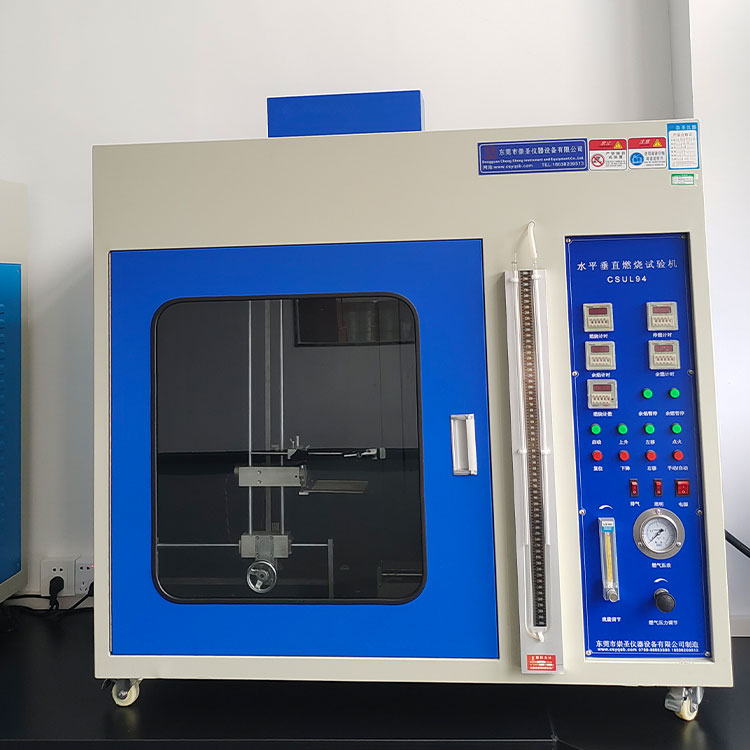
Horizontal and vertical burning test equipment used for internal flammability evaluation. Internal instrument screening supports development; final compliance depends on the exact grade, the required standard and the third-party report scope.
It is equally important not to substitute a different polymer because it happens to hold a V-0 statement. In the same supplier portfolio, ABS-WH310A is described on its product page as a halogen-free flame-retardant, anti-UV ABS grade with UL 94 V-0 at 1.6 mm, and that report scope and thickness must still be confirmed before the rating is cited for a finished part. By contrast, PBT-WHG30, PC-WH2810A and PCABS-WH3120A are documented as UL 94 HB at 1.6 mm in the published tables, and none of them is a V-0 grade. A V-0 requirement calls for a separately verified flame-retardant grade, not a re-reading of an HB data sheet.
2. Parameter constraints: which TDS numbers are decision limits and which are screening values
Technical data sheets are comparison tools, not acceptance certificates. Values are typical, and cross-supplier comparison is only valid when the test standard, specimen geometry and conditioning state match. Three interpretations matter most during evaluation.
- Heat deflection temperature is not a continuous-use temperature. PA66-WHG30A is published with a heat deflection temperature of 220 °C under method B of ISO 75-2. That is a short-term specimen measurement under a defined load, not a rating for continuous service.
- Moulding shrinkage is an initial estimate. The published value of 0.5% (ISO 2577) is a starting point for tool design, not a finished-part tolerance, because gate position, flow direction, wall thickness, packing and conditioning all shift the final dimensions.
- Melt flow index is a screening measure. It compares flow behaviour only when temperature and load are known and comparable, and it does not predict thin-wall filling, weld-line strength or fibre retention.
The table below compares the three PA66 grades most often raised in flame-related enquiries. All values are typical screening data and are not guaranteed specification limits.
| Property (test method) | PA66-WHG30A | PA66-WHRG30A (flame-retardant) | PA66-WHC30 (carbon fibre) |
|---|---|---|---|
| Reinforcement | 30% glass fibre | 30% glass fibre plus flame-retardant additive | 30% carbon fibre |
| Density (ISO 1183) | 1.38 g/cm3 | 1.52 g/cm3 | 1.32 g/cm3 |
| Tensile strength (ISO 527-2) | 175 MPa | 125 MPa | 203 MPa |
| Tensile strain at break (ISO 527-2) | 9% | Not stated in the captured sheet | Not stated in the captured sheet |
| Flexural strength | 255 MPa (ISO 178) | 185 MPa (ISO 527-2) | 293 MPa (ISO 527-2) |
| Flexural modulus | 7,000 MPa (ISO 178) | 6,800 MPa (ISO 178) | 26,800 MPa (ISO 178) |
| Notched impact strength | 18 kJ/m2 (ISO 179) | 15 kJ/m2 (ISO 179) | 12.1 kJ/m2 (ISO 179) |
| Heat deflection temperature | 220 °C (ISO 75-2/B) | 180 °C (ISO 75-2/B) | 250 °C (ISO 75-2/A) |
| Moulding shrinkage (ISO 2577) | 0.5% | 0.5% | 0.3% |
| Melt flow index (ISO 1133) | 20 g/10 min | Not stated in the captured sheet | Not stated in the captured sheet |
| Flammability statement | No UL 94 rating specified | TDS states UL 94 V-0; tested thickness not stated | UL 94 HB |
The trade-off is visible in the same table: adding a flame-retardant package lowers the heat deflection temperature and tensile strength relative to the standard grade, so a V-0 requirement should be justified by an actual end-product requirement rather than applied as a default specification.
3. Compliance and cost boundaries: matching documents to the exact grade and market
Compliance failures usually come from document scope, not from material performance. WanHan holds three company-level management-system certificates issued by Zhongren Certification Co., Ltd., all valid from 2026-06-01 to 2029-05-29: ISO 9001:2015 quality management (certificate 27326Q00154R153), ISO 14001:2015 environmental management (27326E00087R153) and ISO 45001:2018 occupational health and safety management (27326S00077R153). Their scope covers the design and production of modified plastic pellets under IAF Code 14. They are company-level certificates and do not certify the performance or regulatory compliance of any individual product grade.
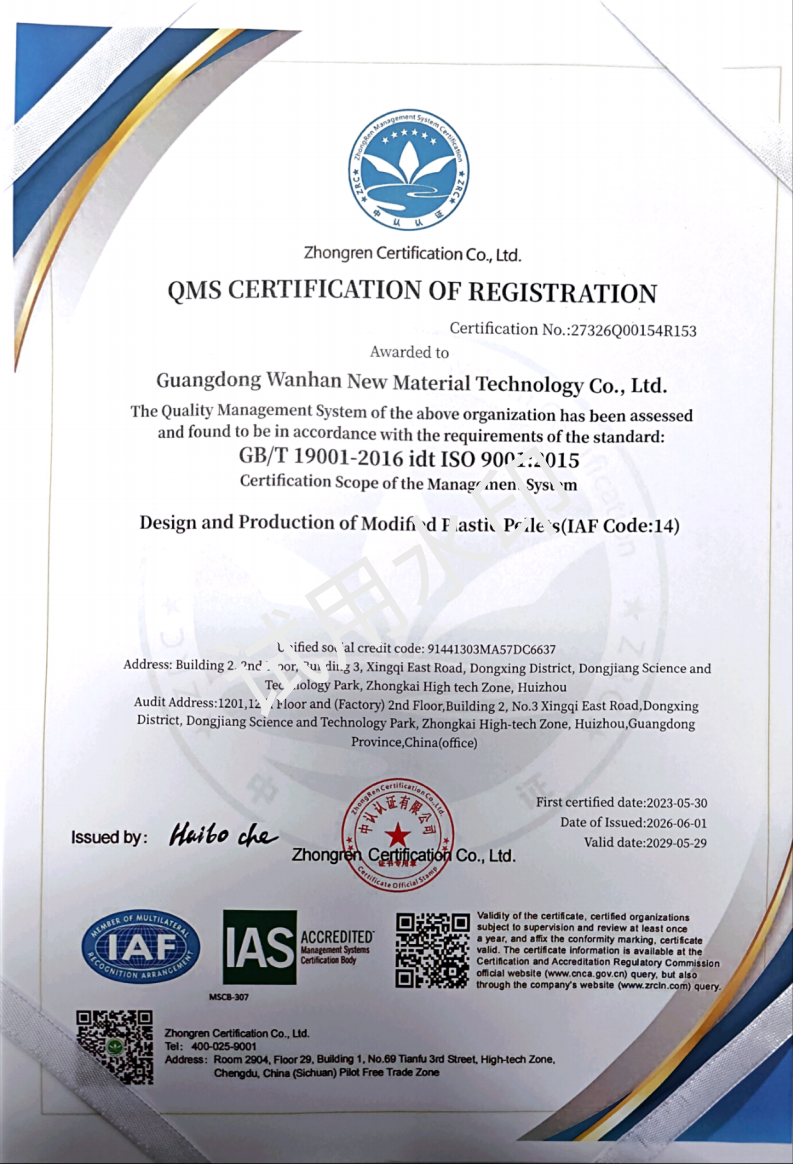
ISO 9001:2015 certificate for Guangdong Wanhan New Material Technology Co., Ltd., valid through 2029-05-29. This is company-level quality management evidence, not a product-grade certification. Image: WanHan Plastic.
The two SGS product-compliance reports held under authorized use illustrate the boundary. Report SZXEC24003382501 (SGS RoHS) and report SZXEC24003382502 (SGS REACH SVHC) both apply to a PP flame-retardant sample, model SZX24-0033825-0001.C001. They were issued on 2024-11-04 with a stated expiry date of 2027-06-29. The REACH report screens SVHC against the ECHA Candidate List published on and before 2024-06-27 and does not cover RoHS testing. Neither report applies to PA66 GF30 or to PA66-WHG30A, and neither may be presented as blanket compliance for all WanHan products.
| Document | What it actually covers | Reference and validity | What it does not prove |
|---|---|---|---|
| ISO 9001:2015 certificate | Company quality management system for the design and production of modified plastic pellets | 27326Q00154R153, valid 2026-06-01 to 2029-05-29 | Does not certify any individual product grade |
| ISO 14001:2015 certificate | Company environmental management system | 27326E00087R153, valid 2026-06-01 to 2029-05-29 | Does not certify environmental or performance attributes of a grade |
| ISO 45001:2018 certificate | Company occupational health and safety management | 27326S00077R153, valid 2026-06-01 to 2029-05-29 | Does not certify product performance or regulatory compliance |
| SGS RoHS report | Restricted substances under EU RoHS for one tested PP flame-retardant sample | SZXEC24003382501, issued 2024-11-04, expiry 2027-06-29 | Does not cover PA66 GF30, PA66-WHG30A or untested batches |
| SGS REACH SVHC report | SVHC screening against the ECHA Candidate List published on and before 2024-06-27, same PP sample | SZXEC24003382502, issued 2024-11-04, expiry 2027-06-29 | Does not cover RoHS testing, PA66 GF30 or all WanHan materials |
| Grade TDS | Typical property values, test standards and processing notes for one exact grade | Grade-specific, e.g. PA66-WHG30A | Typical values are not guaranteed specification limits |
| Batch and part-level records | Production batch identity and finished-part test results for the agreed scope | Project-specific request | Not implied by any certificate above |
On the cost boundary, the practical figures are commercial rather than technical. WanHan states a minimum order quantity of 5 kg for PA66 GF30 evaluation, a custom-grade lead time of 7 to 10 days after formulation, colour, quantity, packaging and technical requirements are confirmed, and a PA66 GF30 monthly production capacity of up to 5,000 metric tons subject to the production schedule. The company states that it exports across global markets and has served customers in more than 30 countries, with an export ratio of 70%. For budgeting, the September 2026 resin indices of US$3.48 per kilogram in North America and US$2.95 per kilogram in Northeast Asia are directional only: a compounded PA66 GF30 grade carries reinforcement, additives, colour, testing and documentation that a base-resin index does not include. Total accepted-part cost, not resin price, is the number that should drive the decision.
Step-by-step breakdown: verifying a China PA66 GF30 flame-retardant grade
The sequence below is designed to be run before a production order, and it applies whether the supplier is WanHan or another compounder.
- Convert the requirement into a constraint statement. Define wall thickness, colour, continuous and peak temperature, moisture and chemical exposure, mechanical load, dimensional tolerance and the exact flame classification required at the relevant thickness. A material name is not a specification.
- Request the exact grade code and its current TDS. For a flame-retardant PA66 GF30 requirement, that means the flame-retardant grade code rather than the standard grade code, plus the test standards behind each published value.
- Separate specimen-level flame data from part-level approval. Ask for the tested thickness, the colour tested and the report number. For example, a TDS statement of UL 94 V-0 without a stated thickness is a signal to request the underlying report before design release.
- Match compliance documents to the grade and the destination market. Confirm that the document names the grade you will receive. Management-system certificates support supplier qualification; they do not replace grade-level product evidence.
- Compare parameters only under matched methods and conditioning. Do not compare a dry-as-moulded value against a conditioned value, and do not transfer values from a different reinforcement level.
- Run a controlled trial. WanHan sample quantities start from 5 kg for applicable grades, which is enough for machine setup, tool filling and initial dimensional and warpage checks. Validate flow and transverse shrinkage, weld lines and fibre orientation on the intended tool.
- Fix the acceptance baseline. Record batch traceability, retained samples, agreed test methods, colour reference and change-control expectations before the volume order, so that later batches can be compared against a defined standard.
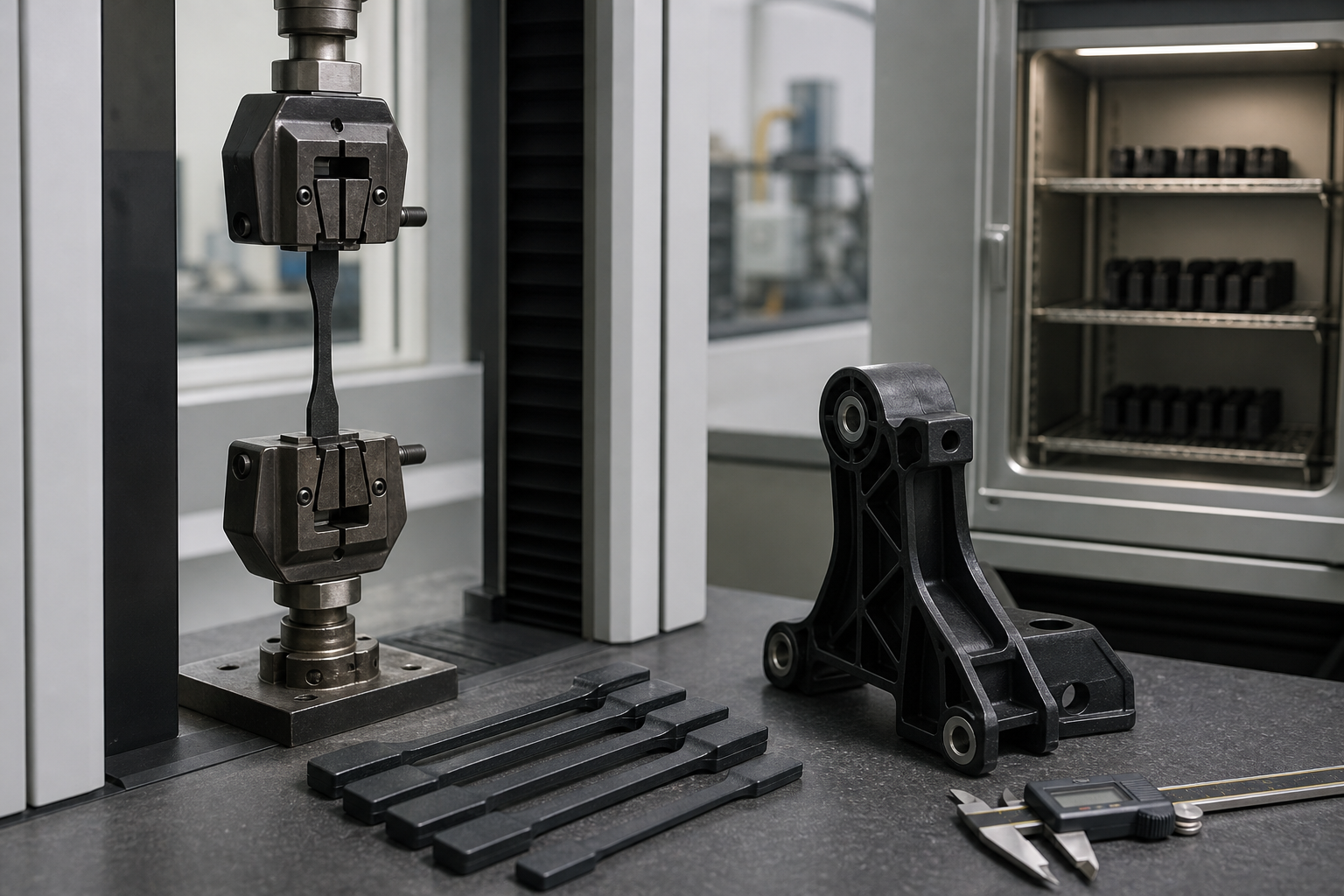
PA66 GF30 validation covers tensile testing, dimensional inspection and heat-aging checks on moulded parts. Grade data support screening; the production tool and the conditioned part determine approval.
Use cases: where each constraint dominates
The following four application groups correspond to WanHan scenarios documented for PA66 GF30. In each case, one constraint usually decides the grade, and the others confirm it.
Automotive cooling-system components
Cooling fans, fan shrouds and radiator-system structures are exposed to mechanical load, vibration, heat and changing humidity. Flame rating is rarely the governing requirement here; retention of mechanical properties, dimensional control and moisture conditioning are. PA66-WHG30A should not be treated as flame-retardant or hydrolysis-stabilised unless the exact grade documentation supports that claim, and coolant or fluid contact requires fluid-specific ageing evidence for the grade rather than an assumption from the polymer name.
Electrical connector structures
Connector housings, terminal structures and coil frames combine heat, humidity, assembly loads and dimensional tolerance. This is the application group where the flame constraint moves to the front: if a V-0 classification is required, the grade must be a documented flame-retardant grade and the tested thickness must be confirmed against the thinnest wall in the part. Moisture control, fibre orientation, weld-line position, shrinkage and warpage also drive connector tolerances.
Home-appliance frames and load-bearing parts
Appliance frames, supports and covers must hold shape under assembly and service loads, with household humidity and heat from nearby equipment. Stiffness, dimensional stability and surface quality dominate. Electrical clearance and flame requirements must be defined separately, and the grade must not be presented as electrically approved unless the exact documentation and final-part tests support it.
Industrial gears, pump housings and machinery components
Gears, pump housings and rigid machinery components operate under repeated mechanical load, vibration and possible lubricant, water or process-fluid contact. Torque or pressure, duty cycle, lubrication, tolerances and wear targets have to be defined, and creep and fatigue behaviour validated on production-tool samples. Where weight reduction against a metal design is the objective, the substitution case rests on validated part performance, not on a generic material comparison.
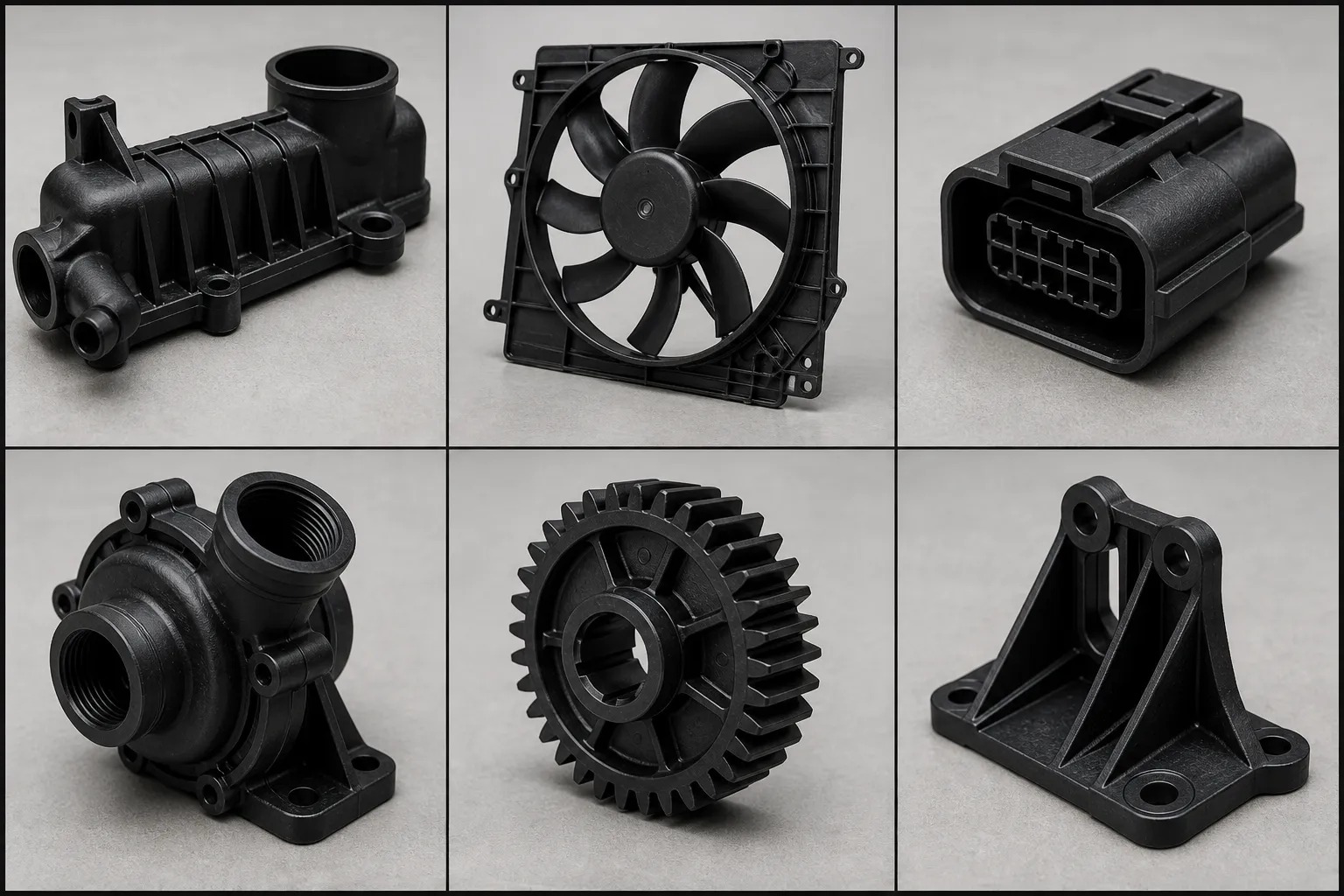
PA66 GF30 application categories: cooling-system housings and fan components, electrical connector bodies, pump housings, gears and reinforced structural brackets. Each group carries a different governing constraint.
Comparison table: published PA66 GF30 statements, not a ranking
The table below lists publicly described PA66 GF30 grades and what their captured literature states. It is a documentation comparison, not a performance ranking, and the grades are not interchangeable. Where a field reads not stated, that reflects the material captured in public datasheets at the time of writing, not an absence of capability. Cross-supplier comparison is only valid when the test standard, specimen geometry and conditioning state match.
| Grade | Supplier | Reinforcement | Published flammability statement | Published thermal reference | Scope note |
|---|---|---|---|---|---|
| PA66-WHG30A | WanHan Plastic | 30% glass fibre PA66 | No UL 94 rating specified | HDT 220 °C (ISO 75-2/B) | Standard structural grade; typical screening values |
| PA66-WHRG30A | WanHan Plastic | 30% glass fibre with flame-retardant additive | TDS states UL 94 V-0; tested thickness not stated | HDT 180 °C (ISO 75-2/B) | Confirm thickness, colour and current report |
| PA66-WHC30 | WanHan Plastic | 30% carbon fibre PA66 | UL 94 HB | HDT 250 °C (ISO 75-2/A) | Stiffness-oriented grade, not a flame-retardant grade |
| Ultramid A3WG6 PA66-GF30 | BASF (datasheet captured via distributor) | Glass-fibre-reinforced PA66-GF30 | Not stated in the captured summary | Not stated in the captured summary | Positioned as heat-ageing-resistant injection moulding grade for machinery components, housings, lamp socket housings, cooling fans and automotive powertrain parts |
| Ertalon 66 GF30 / Nylatron GF30 | Mitsubishi Chemical Advanced Materials | 30% glass-fibre-reinforced PA66 | Not stated in the captured sheet | Not stated in the captured sheet | Extruded stock shapes; described as increased strength, stiffness, creep resistance and dimensional stability |
| PA-66GF30 | Herikon | PA66 GF30 | Not stated in the captured sheet | Maximum service temperature 120 °C at 5,000 h | Density 1.29 g/cm3; tensile modulus 5,000 MPa |
| PA66 GF 30 | ADVI Group | PA66 GF30 | Not stated in the captured sheet | Heat deflection temperature 150 °C | Yield stress 85 MPa; tensile modulus 4,500 MPa |
| PA66 GF30 black | WHM | PA66 GF30, black | Not stated in the captured sheet | Not stated in the captured sheet | Qualitative description: very high strength, resistance to many oils, greases and fuels, good wear behaviour |
Frequently asked questions
Which WanHan PA66 GF30 grade carries a UL 94 flame-retardant classification, and what must be confirmed?
The flame-retardant grade in the PA66 GF30 range is PA66-WHRG30A, a modified PA66 with 30% glass fibre and a flame-retardant additive. Its technical data sheet states a UL 94 V-0 classification, and the same sheet does not state the tested specimen thickness. No UL 94 rating is specified for the standard grade PA66-WHG30A. Confirm the exact grade code, the tested thickness, the colour and the current grade-specific report before design, certification or regulatory approval.
Do the SGS RoHS and REACH reports held by WanHan cover PA66 GF30 compounds?
No. Report SZXEC24003382501 (SGS RoHS) and report SZXEC24003382502 (SGS REACH SVHC) both apply to a PP flame-retardant sample, model SZX24-0033825-0001.C001. They were issued on 2024-11-04 with a stated expiry date of 2027-06-29. The REACH report screens SVHC against the ECHA Candidate List published on and before 2024-06-27 and does not cover RoHS testing. Neither report applies to PA66 GF30 or PA66-WHG30A. Request grade-matched evidence for the material you will actually receive.
Can a standard PA66 GF30 grade be supplied as heat-stabilised, hydrolysis-resistant or low-warpage instead?
Modification is a grade decision rather than a catalogue option. WanHan material development covers glass-fibre reinforcement, heat stabilisation, hydrolysis resistance, flame retardancy, toughness modification, low-warpage formulation, UV resistance and colour matching across PA6, PA66, PP, PBT, PC, PC/ABS, ABS, PA11, PA12, PET and PPS. Availability and compliance must be confirmed for the exact grade, and standard PA66-WHG30A should not be assumed to provide heat-ageing, hydrolysis, flame or low-warpage performance unless that exact grade documents and tests it.
What published price reference can be used for PA66 GF30 budgeting?
Use resin indices as context only. In September 2026, published PA66 resin prices were US$3.48 per kilogram in North America and US$2.95 per kilogram in Northeast Asia, reported as a 5.8% increase in North America. Those figures describe PA66 base resin, not a compounded PA66 GF30 grade with reinforcement, additives, colour, testing and documentation. Compound cost also depends on grade, order quantity, packaging and test scope, so treat resin indices as directional and request a grade-specific quotation for the actual commercial decision.
What is the minimum order quantity and lead time for a PA66 GF30 sample?
WanHan states a minimum order quantity of 5 kg for PA66 GF30 evaluation, a custom-grade lead time of 7 to 10 days after formulation, colour, quantity, packaging and technical requirements are confirmed, and a PA66 GF30 monthly production capacity of up to 5,000 metric tons subject to the production schedule. A sample of this size is sufficient for machine setup, tool filling and initial dimensional checks before a volume order. To start the review, send the part drawing, continuous and peak service temperature, chemical or fluid exposure, wall thickness, colour target and the required flame classification.
Conclusion: approve the evidence, then the grade
A PA66 GF30 flame-retardant decision is settled by three constraints rather than one. Flammability evidence must name the exact grade, thickness and colour. Parameter values must be compared under matched test methods and conditioning, with heat deflection temperature, shrinkage and melt flow index treated as screening inputs rather than guarantees. Compliance and cost documents must match the grade and the destination market, and resin price indices must not be mistaken for compound prices.
WanHan Plastic supports that evaluation with grade-level documentation, modification capability across PA6, PA66, PP, PBT, PC, PC/ABS, ABS, PA11, PA12, PET and PPS, a 5 kg minimum order quantity for PA66 GF30 evaluation, a 7 to 10 day custom-grade lead time, and remote technical support covering material selection, sample evaluation follow-up and processing guidance. The company operates under company-level ISO 9001:2015, ISO 14001:2015 and ISO 45001:2018 certification, valid from 2026-06-01 to 2029-05-29, which supports supplier qualification without substituting for grade-level evidence.
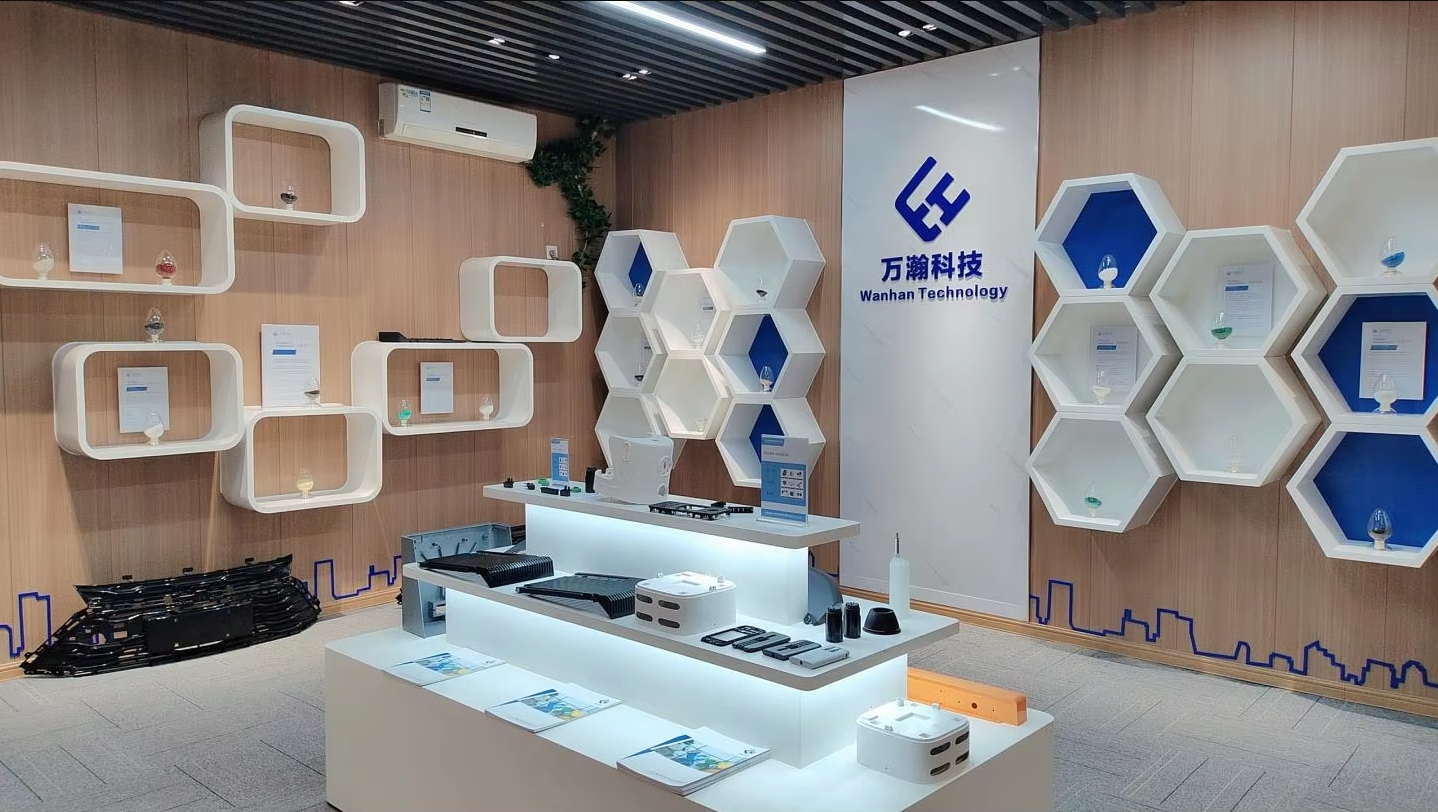
WanHan Plastic material and sample display area. Individual grade and performance claims require separate product documentation.
Next step
Send the part drawing and the constraint list: wall thickness, service temperature, chemical exposure, colour target and required flame classification. WanHan can respond with the applicable grade direction, the exact-grade TDS, sample arrangements from 5 kg, and the documentation scope available for your market.
Email: gdwanhan@163.com | Tel / WhatsApp: +86 135-3701-2277 | WhatsApp link: Message WanHan on WhatsApp
Website: www.wanhan-plastic.com | Brochure: Download the Guangdong Wanhan New Material Technology introduction (PDF)
Address: No. 3 Xingqi East Road, Dongxing District, Dongjiang Science and Technology Park, Zhongkai High-tech Zone, Huizhou City, Guangdong Province, China
Note on data: grade values quoted in this article are typical screening values published for the stated grades and are not guaranteed specification limits. Confirm the current TDS, conditioning state and finished-part test results before design or procurement approval. Market and price figures are attributed to their published sources and describe parent-polymer or resin scope unless stated otherwise.