
Cooling Choices for Industrial Magnetic Separators: Air-Cooled vs. Oil-Cooled Technical Guide
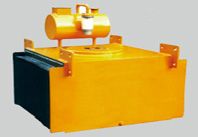
The cooling method on an electromagnetic industrial magnetic separator is a heat-path decision, not a performance badge. Air-cooled units reject coil heat to the surrounding air through the housing; oil-cooled units move coil heat into high-temperature transformer oil that circulates through internal and external oil pipelines, as built in the RCDE series. Both paths exist in the same size classes — RCDA-4 to RCDA-20 against RCDE-4 to RCDE-22 for suspended units, and RCDC-5 to RCDC-20 against RCDF-5 to RCDF-20 for self-cleaning units — so the practical question is which heat path your duty point, site environment and maintenance resources can actually support.
Problem Definition: Why the Cooling Question Rarely Gets a Clean Answer
Most separator enquiries arrive as a single sentence: a belt width, a material, and a request for “the best electromagnetic separator.” That sentence does not contain the four variables that decide the heat path. They are the rated suspension height above the burden, the maximum material thickness on the belt, the belt speed, and the continuous running hours per day. Until those are fixed, air-cooled and oil-cooled machines look interchangeable on paper, because both are described with the same vocabulary of magnetic strength and belt coverage.
The cooling decision is also misread as a price tier. It is not. Cooling changes where heat goes, what has to be inspected during service, what the installation has to leave clear, and how much of the machine is sealed from the process environment. A buyer who selects cooling by habit rather than by duty point usually discovers the mismatch later, either as a coil running closer to its thermal limit than expected, or as a maintenance routine the site is not equipped to perform.
A workable rule for the research and evaluation stage is this: cooling is a constraint question, not a preference question. It should be answered from published electrical data, mounting geometry, and site conditions — not from a general impression that one design is more advanced than the other.
Industry Background: Where High-Field Electromagnetic Separators Are Used
Electromagnetic separators are specified where permanent magnets cannot deliver the required field or where the field must be controllable. In the Yuansheng range, the oil-cooled suspended RCDE series is applied in large thermal power plants, coal ports, coal mines, mining, building materials, metallurgy, chemical plants and coal preparation plants — locations with high iron-removal requirements that must keep running in dust, humidity and coastal salt-spray corrosion.
Those environments are the reason cooling architecture matters more than it first appears. A suspended separator hangs above a conveyor that may run loaded for long shifts. The coil is the component that converts electrical excitation into the magnetic field, and every unit of that excitation eventually becomes heat inside the coil assembly. The published excitation power envelope across the RCDE range runs from 0.6 kW at RCDE-4 to 27 kW at RCDE-22, which is the clearest available indicator of how much heat the cooling path has to manage at each size class.
The wider category around these machines — permanent magnetic separators, cross-belt magnetic separators, powder magnetic separators, slurry magnetic separators, high gradient magnetic separators, lithium battery material magnetic separators, dry powder magnetic separators, liquid magnetic separators and suspended magnetic separators — shares one design logic: the magnetic circuit is engineered for the duty, while the housing and cooling arrangement are engineered for the site.
The Four Families in the Yuansheng Range
Weifang Yuansheng Magnetic Electromechanical Equipment Co., Ltd. is a Chinese manufacturer of magnetic and electrical separation equipment, founded in 2011, operating a 3,500 m² facility with 45 employees and 8 R&D engineers, and exporting about 65% of output to Asia-Pacific, North America, Europe, Africa, the Middle East, Latin America, Oceania and CIS/Central Asia. Its electromagnetic programme separates into two mounting formats, each offered with two cooling paths.
| Family | Cooling path | Mounting / cleaning format | Published model range |
|---|---|---|---|
| RCDA Series Air-Cooled Suspended Electromagnetic Separator | Air | Suspended | RCDA-4 to RCDA-20 |
| RCDE Series Oil-Cooled Suspended Electromagnetic Separator | High-temperature transformer oil, internal and external pipeline circulation | Suspended | RCDE-4 to RCDE-22 |
| RCDC Series Air-Cooled Self-Cleaning Electromagnetic Separator | Air | Self-cleaning | RCDC-5 to RCDC-20 |
| RCDF Series Oil-Cooled Self-Cleaning Electromagnetic Separator | Oil | Self-cleaning | RCDF-5 to RCDF-20 |
Two structural facts follow from that table. First, for suspended units the oil-cooled family extends one size class further, to RCDE-22, while the air-cooled family stops at RCDA-20. Second, for self-cleaning units the air-cooled and oil-cooled families share identical model numbering from 5 to 20, which means cooling is a variant decision inside a size class rather than a reason to change size class.
Coil Construction: What Both Cooling Paths Have in Common
Cooling only makes sense once the coil is understood. In the RCDE series the magnetic system is a high-permeability iron core combined with a Class F+ electromagnetic coil wound from 100% copper wire, epoxy-resin impregnated and cured. The housing is carbon steel with corrugated heat-dissipation fins in a fully sealed structure, and the cooling medium is high-temperature transformer oil moved through internal and external pipeline circulation. Suspension is handled by lifting lugs with adjustable hooks and chains.
That construction explains why the housing is not cosmetic. The fins increase the surface available for heat exchange, the sealed structure keeps process dust and moisture away from the winding, and the impregnation and curing step binds the winding into a solid body that can tolerate thermal cycling. Air-cooled units follow the same principle of a protected winding, but the heat leaves through the housing surface directly to ambient air rather than through an intermediate fluid.
Insulation class is declared per product family, not per cooling type. The dry powder YSDC tandem system, for example, is built around a Class H electromagnetic wire, while the RCDE coil is Class F+. Buyers comparing documentation across families should confirm the declared class on the exact model rather than assuming a single class applies to the whole catalogue.
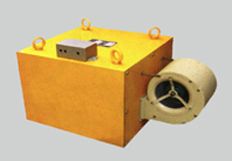
How Air Cooling Works — and What It Asks of the Installation
An air-cooled electromagnetic separator rejects coil heat through the housing to the surrounding air, so the heat path continues outside the machine. That has two consequences for planning. The installation has to leave the housing able to exchange heat with the surrounding air rather than being boxed in by chute work, lagging or accumulated material. And the site has to be honest about ambient conditions: a dusty, humid or salt-laden atmosphere affects the outer surfaces and any air path the design relies on, which is why the sealed-housing and fin geometry described for the RCDE series matters even on oil-cooled machines.
Air cooling removes an entire fluid circuit from the scope of ownership. There is no oil volume to monitor, no pipework to inspect, no risk of a fluid leak above a conveyor. For plants without a maintenance team trained on fluid systems, that simplification is a genuine constraint advantage rather than a marketing point.
The trade-off sits on the thermal side. When excitation power at the required size class is high and the machine runs continuously, the air path has to carry more heat per unit of housing surface. This is exactly the point where a generic recommendation becomes unsafe: the same nominal belt width can correspond to very different excitation power depending on suspension height and burden thickness.
How Oil Cooling Works — and What It Asks of Maintenance
In the RCDE series, coil heat is transferred to high-temperature transformer oil that circulates through internal and external pipelines. The oil is contained inside a fully sealed carbon steel housing, so the fluid circuit is part of the machine rather than an external utility. This arrangement decouples the coil from immediate ambient conditions and suits the harsh duties the series is specified for — dust, humidity and coastal salt spray.
The cost of that decoupling is maintenance scope. An oil circuit introduces inspection items that an air-cooled machine does not have: circuit integrity, fluid condition, and the sealing of the housing. Those items belong in the preventive maintenance plan from commissioning, not after the first symptom appears. The plan should state who performs the inspection, what access is needed, and which spare parts are held on site.
Oil also plays a second role elsewhere in the catalogue. The DCFJ series electromagnetic powder iron separator uses insulating oil in volumes from 18 L to 70 L depending on model, serving both cooling and insulation in a compact fine-powder unit with processing capacity from 5 to 20 t/h. That dual function is worth remembering when comparing machines: in some designs the fluid is not only a coolant but part of the electrical environment.
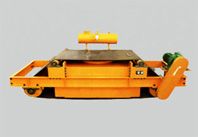
Self-Cleaning Versions: RCDC Against RCDF
Where the iron has to leave the line without stopping it, the self-cleaning format applies. The RCDC series is the air-cooled self-cleaning electromagnetic separator and the RCDF series is the oil-cooled version. Because both are published from model 5 to model 20, a buyer who has already sized the line can treat cooling as a straight substitution within the same model number, which is the cleanest way to compare the two heat paths without changing two variables at once.
The self-cleaning decision is independent of the cooling decision, and it should be taken first. If the process cannot be interrupted for manual cleaning, the mounting format is settled before the heat path is discussed. Confusing the two questions is a common cause of over-specification: a plant that needs automatic discharge but has modest excitation demand may not need the additional fluid circuit at all.
Step-by-Step Breakdown: Six Checks Before Choosing a Heat Path
- Fix the duty point. Record belt width, rated suspension height, maximum material thickness and belt speed as a single set. In the RCDE tables these move together: RCDE-6 is rated at 600/650 mm belt width, 180 mm suspension height and 130 mm material thickness, while RCDE-22 is rated at 2,200 mm belt width, 600 mm suspension height and 550 mm material thickness. Belt speed for every RCDE model is capped at 2.5 m/s.
- Convert the duty point into excitation power. Excitation power is the most direct published proxy for coil heat load, and it rises steeply with size: 1.5 kW at RCDE-6, 4.5 kW at RCDE-10, 8.5 kW at RCDE-14, 18 kW at RCDE-18 and 27 kW at RCDE-22. Compare cooling options at your own size class, never at family level.
- Check the field requirement against the same table. RCDE models are published at magnetic field strength of 55 mT at the smallest sizes and 70 mT from RCDE-6.5 upward. If the process needs a higher field than the standard rating, that becomes a customization question rather than a cooling question.
- Score the site environment. Dust load, humidity, coastal salt spray and washdown practice all bear on how much protection the housing must provide. The RCDE series is specified for dust, humidity and coastal salt-spray corrosion; where those conditions are present, the sealed housing argument weighs more heavily in the review.
- Decide mounting and cleaning format. Suspended (RCDA, RCDE) or self-cleaning (RCDC, RCDF). This determines whether iron removal is manual or automatic and therefore what operator time the line needs.
- Match the maintenance model to the heat path. Air cooling demands clean surroundings and free heat exchange around the housing. Oil cooling demands a documented fluid-circuit inspection routine and access to spare parts. Choose the path your team can actually sustain for the life of the machine.
Published Envelope for the RCDE Range (Selected Models)
| Model | Belt width (mm) | Suspension height (mm) | Material thickness ≤ (mm) | Field strength ≥ (mT) | Excitation power ≤ (kW) | Weight (kg) |
|---|---|---|---|---|---|---|
| RCDE-6 | 600 / 650 | 180 | 130 | 60 | 1.5 | 650 |
| RCDE-10 | 1,000 | 300 | 250 | 70 | 4.5 | 1,400 |
| RCDE-14 | 1,400 | 400 | 350 | 70 | 8.5 | 4,200 |
| RCDE-18 | 1,800 | 500 | 450 | 70 | 18 | 7,300 |
| RCDE-22 | 2,200 | 600 | 550 | 70 | 27 | 10,500 |
Use Cases: Which Conditions Trigger a Deeper Technical Review
Most separator selections fall into a straightforward band where either heat path can be made to work. The conditions below are the ones where the choice should be escalated to a technical review with the supplier rather than settled from a catalogue line.
- High excitation power at large size classes. Above roughly the RCDE-14 to RCDE-18 band, published excitation power moves from single digits to 18 kW and 27 kW. At that level the thermal argument deserves documented review rather than assumption.
- Continuous duty in dust, humidity or coastal salt spray. The environmental conditions the RCDE series is specified for are exactly the ones that make sealing and heat-path protection a design question.
- Deep burden on a fast belt. Where material thickness approaches the published limit at a given suspension height, field and heat load rise together; the duty point should be confirmed before cooling is fixed.
- Sites without fluid-system maintenance capability. If oil-circuit inspection cannot be resourced, the air-cooled path should be examined seriously even where oil cooling looks technically attractive.
- Lines that cannot stop for cleaning. Self-cleaning format first (RCDC or RCDF), cooling second.
- Fine-powder duties instead of belt duties. Powder lines such as the DCFJ and YSDC families follow different rules, including oil insulation volumes and tandem or vacuum-feeding system architecture, and should not be evaluated as belt separators.
Comparison Table: Air-Cooled Against Oil-Cooled
| Consideration | Air-cooled (RCDA / RCDC) | Oil-cooled (RCDE / RCDF) |
|---|---|---|
| Heat path | Coil heat rejected through the housing to surrounding air | Coil heat transferred to high-temperature transformer oil circulating through internal and external pipelines |
| Published suspended model range | RCDA-4 to RCDA-20 | RCDE-4 to RCDE-22 |
| Published self-cleaning model range | RCDC-5 to RCDC-20 | RCDF-5 to RCDF-20 |
| Housing construction stated in available data | Model range published; request dimensional and electrical data per size class | Carbon steel, corrugated heat-dissipation fins, fully sealed structure |
| Coil construction stated in available data | Model range published; confirm per model | High-permeability iron core with Class F+ coil, 100% copper wire, epoxy-resin impregnated and cured |
| Installation items to plan | Free air exchange around the housing; protection from material build-up | Sealed housing plus oil circulation circuit; suspension by lifting lugs with adjustable hooks and chains |
| Maintenance items to plan | Housing surface and heat-exchange cleanliness | Circuit integrity, fluid condition, housing sealing, spare parts availability |
| Published electrical reference | Request per model | Excitation power ≤ 0.6 kW at RCDE-4 up to ≤ 27 kW at RCDE-22; field strength ≥ 55–70 mT |
| Duty cycle | Request per model | Continuous across the published range |
| Site conditions addressed in available data | Request per model | Dust, humidity and coastal salt-spray corrosion |
Note on data completeness: detailed dimensional and electrical tables are published for the RCDE suspended range. For RCDA, RCDC and RCDF, the model ranges are published while full per-model data should be requested for the exact size class under evaluation. This is the point at which a generic recommendation stops being useful and a configuration-specific review begins.
Installation and Maintenance Planning, Side by Side
Installation planning for a suspended electromagnetic separator starts with the suspension geometry. The RCDE range uses lifting lugs with adjustable hooks and chains, and its rated suspension height is published per model from 120 mm to 600 mm. The height is not a rough setting: it is tied to the material thickness the model can work through, so the mechanical installation and the magnetic duty are the same decision.
For the air-cooled path, the equivalent planning statement concerns heat exchange around the housing and protection from material build-up. For the oil-cooled path, it concerns access to the circulation circuit and the sealing of the housing. Both statements belong in the commissioning checklist, because both are easy to compromise during structural work and difficult to recover afterwards.
The maintenance plan should also fix the spare-parts position. Weifang Yuansheng supports supplied equipment with remote technical support, spare-parts supply and a 12-month warranty, and the company states 100% inspection before shipment. Buyers should confirm which wear or fluid-related items are recommended for stock on site at the time of order, so the cooling path chosen does not depend on an unplanned international shipment later.

Frequently Asked Questions
Does the cooling method change the compliance documentation for an industrial magnetic separator?
Documentation is issued per model rather than per cooling family, so the cooling choice does not by itself add or remove a certificate, but the certificate applicable to your exact model must be identified. Weifang Yuansheng Magnetic Electromechanical Equipment Co., Ltd. holds a Machinery Directive Attestation of Conformity numbered M.2025.206.C119055, issued by UDEM on 19 May 2025 and valid to 18 May 2030, assessed against EN ISO 12100:2010 and EN 60204-1:2018, with a listed scope covering the RCYB, RCDB, RCDD, RCYD and MW separator series. Because that scope is model-specific, an RCDA, RCDC, RCDE or RCDF enquiry should confirm which attestation applies to the ordered model and destination market before the purchase order is released.
Can the same size class be supplied in both air-cooled and oil-cooled versions?
Yes for the self-cleaning format, where the RCDC air-cooled and RCDF oil-cooled families share model numbering from 5 to 20, so a given model number can be discussed in either cooling path. For suspended units the ranges overlap from 4 to 20, with the oil-cooled RCDE family extending to RCDE-22 while the air-cooled RCDA family ends at RCDA-20. Weifang Yuansheng works in OEM and ODM mode with customization of magnetic field strength, size, voltage, material, logo and colour, holds a stated monthly capacity of 300 units, and supports the configuration with 8 R&D engineers, so variant requests within a size class are handled as configuration work rather than as a new product line.
Which published figures should be used to compare running cost between the two cooling paths?
Use the excitation power published at the size class you actually need, because that is the electrical input the coil converts into magnetic field and heat. Across the RCDE range the published figure rises from 0.6 kW at RCDE-4 to 27 kW at RCDE-22, with 4.5 kW at RCDE-10 and 8.5 kW at RCDE-14 in between. Comparing families at a single average figure will mislead, since a small air-cooled unit and a large oil-cooled unit are not substitutes. Commercial terms are confirmed at quotation stage for the specific configuration; the technical comparison should be built on excitation power, field strength requirement and the maintenance scope each heat path adds.
Can a single unit be ordered to validate the cooling choice before full rollout?
Yes. The stated minimum order quantity is 1 unit, and customization covers magnetic field strength, size, voltage, material, logo and colour, so a single unit can be built to the intended production configuration rather than to a generic stock specification. Every unit is inspected 100% before shipment, and supplied equipment carries a 12-month warranty with remote support and spare-parts supply. For a cooling evaluation, the pilot unit should be specified with the real suspension height, material thickness and belt speed, since those are the variables that determine whether the heat path is adequate.
What lead time applies to an air-cooled or oil-cooled separator order?
The stated lead time is 30 to 45 days. That window covers configuration work such as non-standard magnetic field strength, size, voltage or material, which is why the technical review should be closed before the order is placed — a cooling decision revisited after production has started resets the schedule. Export shipments are supported across Asia-Pacific, North America, Europe, Africa, the Middle East, Latin America, Oceania and CIS/Central Asia, with about 65% of output going to export markets. The next step for most buyers is to send the duty point and site conditions for a configuration-specific review, or to download the product brochure before that conversation.
Conclusion: Choose the Heat Path Your Plant Can Own
Air-cooled and oil-cooled electromagnetic separators solve the same thermal problem by different routes, and both routes are available across the Yuansheng suspended and self-cleaning families. The decision should follow four published anchors rather than a general preference: the duty point expressed as belt width, suspension height, material thickness and belt speed; the excitation power at that size class, which runs from 0.6 kW to 27 kW across the RCDE range; the site environment, including dust, humidity and coastal salt spray; and the maintenance scope the plant can sustain, whether that is clean heat-exchange surfaces or a documented oil circuit.
Where those four anchors point in different directions, the case belongs in a technical review with the manufacturer. That is a normal outcome, not a sign that the enquiry was badly framed — it simply means the process conditions carry more weight than a generic recommendation can hold.
Next Step: Match the Cooling Path to Your Duty Point
Send the belt width, rated suspension height, maximum material thickness, belt speed and site conditions, and Weifang Yuansheng Magnetic Electromechanical Equipment Co., Ltd. will confirm whether the air-cooled RCDA or RCDC configuration or the oil-cooled RCDE or RCDF configuration fits the application — or flag the conditions that need a deeper technical review.
Download the product brochure: Industrial Magnetic Separator Catalogue (PDF)
Website: www.iron-separator.com | Email: ys@iron-separator.com
Tel / WhatsApp: +86 155-5366-8212 | Address: Linqu County, Weifang City, Shandong Province, China
Have Questions or Need More Details?
Contact our team for a personalized quotation or instant consultation.
Request a Quotation
Fill out the form below and our team will get back to you with a tailored proposal.
WhatsApp Direct Chat
Prefer to chat in real-time? Message us on WhatsApp for instant assistance & quick answers.
- Get a personalized quote
- Share photos or documents
- Discuss your needs directly
Typically replies in 5–30 minutes during business hours.