
Industrial Magnetic Separator FAQ: Acceptance, Spares & Long-Term Support
Industrial Magnetic Separator FAQ: Acceptance, Spares & Long-Term Support
Acceptance criteria, spare parts, and long-term support are usually the last three items settled in an industrial magnetic separator purchase, and they are the three that decide what the equipment costs to own five years after commissioning. A buyer who fixes the price but leaves acceptance undefined has bought an outcome that cannot be verified. A buyer who orders spares after the first breakdown has accepted unplanned downtime as a normal condition. A buyer who treats support as a tone of voice rather than a contract clause has no recourse the year a component is discontinued.
Weifang Yuansheng Magnetic Electromechanical Equipment Co., Ltd. is a manufacturer of magnetic and electrical separation equipment founded in 2011 in Linqu County, Weifang, Shandong, China, operating a 3,500 m² factory with 45 employees, an eight-engineer R&D team, and annual output of 3,500 units, with exports accounting for 65% of sales across Asia-Pacific, North America, Europe, Africa, the Middle East, Latin America, Oceania, and CIS/Central Asia. Its range covers permanent and electromagnetic separators, cross-belt, powder, slurry, high-gradient, lithium battery material, dry powder, liquid, and suspended units, including the YSDC/YSDCG dry electromagnetic powder family, the RCDA/RCDE suspended electromagnetic family, RCYB suspended permanent magnets, drawer magnetic separators, and pipeline permanent magnetic separators.
The questions below are written for buyers who have already shortlisted a separator type and are now specifying terms, planning inspection, and budgeting ownership. Each answer states what is documented, what follows from it for the buyer, and what remains a contractual gap to be closed before the purchase order is signed.
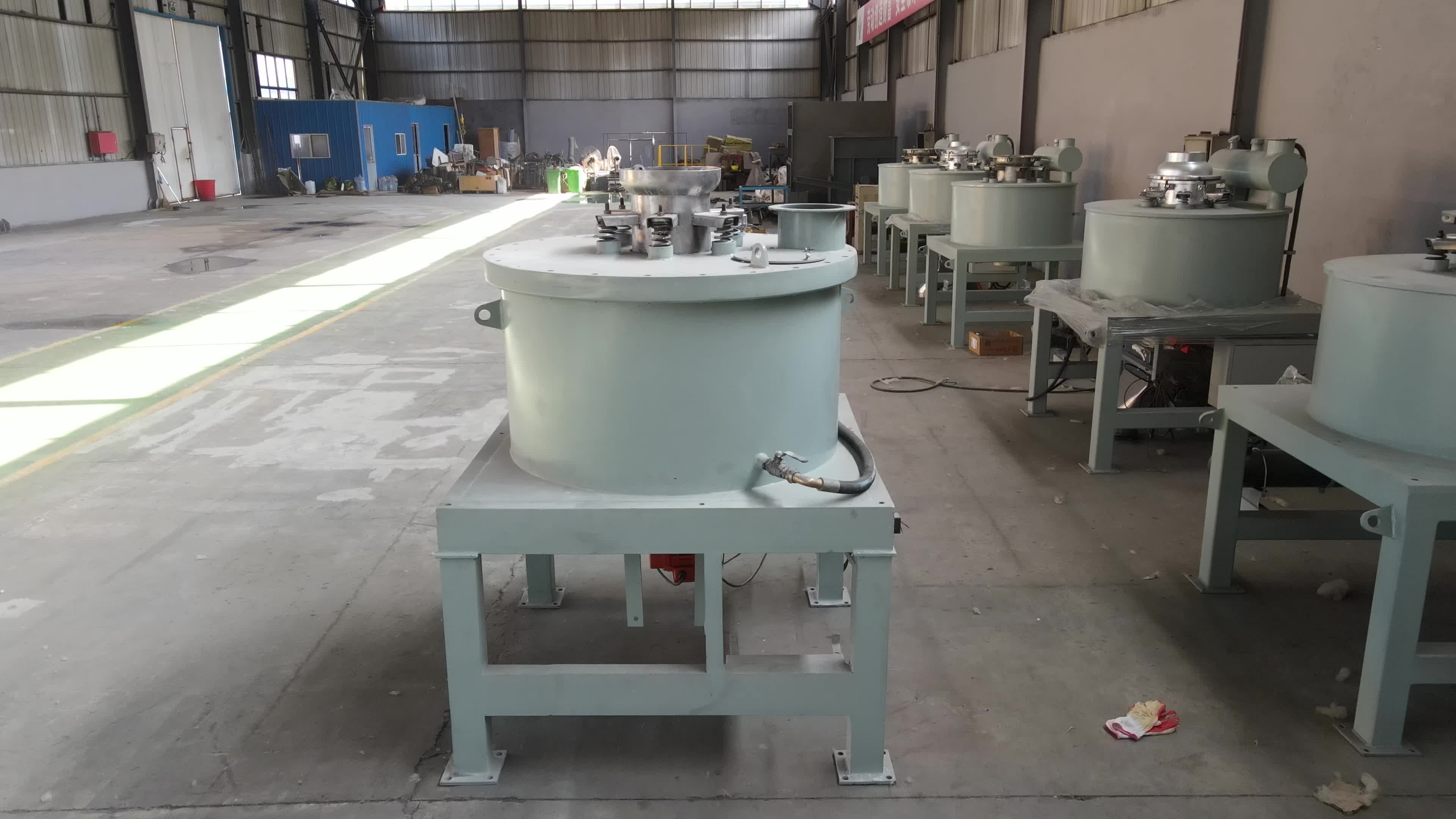
Inspection and testing area: acceptance records should prove configuration, not only appearance.
Why Acceptance Criteria Decide Whether the Order Succeeds
Acceptance criteria are the measurable conditions that must be satisfied before ownership and risk transfer. They operate at three levels: documents that prove what was built, static checks that prove how it was built, and dynamic checks that prove how it runs. A criterion that cannot be measured, repeated, and judged pass or fail is not a criterion; it is an intention.
The published acceptance mechanism for these separators is a process standard: pre-shipment inspection by a third party such as SGS or BV, or inspection by the customer on site. That is a useful and workable mechanism, but it answers only the question of who witnesses the inspection. It does not define what counts as a pass. Unless the contract supplies the measurement method and the pass limit, an inspector can confirm that the machine exists, matches its nameplate, and carries the ordered documents, while remaining unable to confirm that it removes the iron the buyer actually has.
The practical rule is a one-to-one chain. Every performance claim in the quotation should carry a measurement method; every measurement method should carry a pass criterion; every pass criterion should carry a consequence if it fails. Magnetic flux density without an agreed measuring distance, iron removal rate without an agreed feed material, and cooling performance without an agreed ambient condition are the three most common places where that chain breaks. Buyers who close those three gaps before signing tend to spend their post-delivery meetings on production planning rather than on disputes.
What the Current Buyer Environment Changes
Three documented conditions shape how acceptance and support should be structured in this purchase cycle. The global magnetic separator market was estimated at USD 1,067.6 million in 2024 by Grand View Research in a report dated May 2026, and the same analysis places Asia-Pacific at a 43.8% revenue share in 2024. Procurement is therefore concentrated in a region that many buyers do not visit, which raises the value of a documented inspection and a documented spare parts list, because both substitute for presence.
Second, HS Code 847410 (sorting, screening, separating or washing machines) is the primary trade classification for magnetic separators in global trade. Customs classification errors rarely damage the equipment, but they reliably delay it, and a delay during installation is more expensive than the same delay before shipment. Third, high-gradient electromagnetic separators used for lithium battery material purification are commonly specified above 16,000 to 20,000 Gauss according to secondary industry analysis cross-referenced with supplier catalogs. Where a project carries that class of requirement, acceptance has to include a flux density check and a material test, because a nameplate alone cannot demonstrate it.
The combined effect is straightforward. In a market where manufacturing is clustered and buyers are distant, the cheap part of the purchase is the unit and the expensive part is the uncertainty around it. Acceptance criteria and support terms are how that uncertainty is priced down.
Purchasing Terms in Plain Terms
What purchasing terms are already published for these separators?
The published terms list a minimum order quantity of 3 units, delivery on FOB Qingdao or CIF terms, and payment by T/T with a 30% deposit and the 70% balance before shipment. These are the commercial baseline against which a proforma invoice should be checked. They are specific enough to plan cash flow and shipment mode, and general enough that packaging, documentation, and inspection responsibility still need to be written into the order.
What should be added before the proforma invoice is signed?
The published terms do not state a warranty period, a response time for technical support, a spare parts supply horizon, or a remedy if inspection fails. Those are gaps, not oversights to be inferred. A buyer should close them in the order documents: packaging specification including moisture protection and lifting marks, the spare parts and tools delivered with the unit, the language of the manual and nameplate, the warranty start date defined as either shipment or commissioning, the procedure and cost allocation if acceptance fails, and the validity period of quoted spare parts prices. Each of these is a clause, not a conversation.
Which shipment documents should agree with the trade classification?
The commercial invoice, packing list, and bill of lading should carry a consistent description and classification, with HS 847410 as the primary reference for magnetic separating equipment. Where the destination country requires a certificate of origin or a conformity document, that requirement belongs on the pre-shipment checklist rather than in a message after the container has sailed. Inspection reports and material certificates issued for acceptance should reference the same model designation and serial numbers as the invoice, so that a later spare parts order cannot be matched to the wrong configuration.
Acceptance Criteria: A Checklist You Can Actually Test
The checklist below separates what is proven by paperwork from what is proven by measurement. Buyers who run all three layers on the same day, with the same serial number recorded on every sheet, end up with a file that supports both a warranty claim and a repeat order.
| Layer | What is checked | What the record proves |
|---|---|---|
| Documents | Packing list, conformity statement, wiring diagram, operating manual, inspection report, material certificate, spare parts list | That the delivered configuration matches the ordered configuration |
| Static | Nameplate data, enclosure sealing where IP65/IP67 is specified, product-contact material where 304/316L stainless is specified, coating, lifting points, cleaning access, terminal box, earthing | That the unit was built to the specified configuration, not a standard variant |
| Dynamic | No-load current, temperature rise, magnetic flux density at agreed points, cooling air or oil condition, noise and vibration, iron removal on the agreed feed | That the unit performs under the stated conditions, not under ideal ones |
How should magnetic flux density be specified?
Specify the unit, the measuring distance, the instrument, the ambient temperature, the number of readings, and whether the pass value is a minimum, an average, or both. Published comparison data puts permanent separators in a category range of roughly 3,000 to 12,000 Gauss with a fixed field, and electromagnetic separators in a range of roughly 5,000 to 30,000 Gauss with an adjustable field. Those ranges describe equipment classes, not a contractual promise for a named model, so the confirmed figure for the ordered unit belongs in the technical annex of the contract.
How should iron removal performance be tested?
Define the feed material, particle size distribution, incoming iron content, flow rate, layer depth on the belt or screen, sampling method, and number of runs. The same comparison data cites category-level figures of about 98% removal for iron particles of 0.1 mm and above on permanent units, and 99.5% or better down to weakly magnetic impurities at the 0.1 micrometre scale on electromagnetic units. A percentage without its test conditions is not comparable to another percentage, which is why the test recipe matters more than the headline number.
What happens if acceptance fails?
This is a genuine gap in the published terms and should be negotiated, not assumed. A workable clause sets out the rework route, who attends the re-test, who pays for the re-test and the delay, whether partial acceptance is allowed for multi-unit orders, and at what point rejection and refund become available. Buyers ordering three or more units under the stated minimum quantity have particular reason to define partial acceptance, since a single non-conforming unit in a batch of five should not freeze the other four.
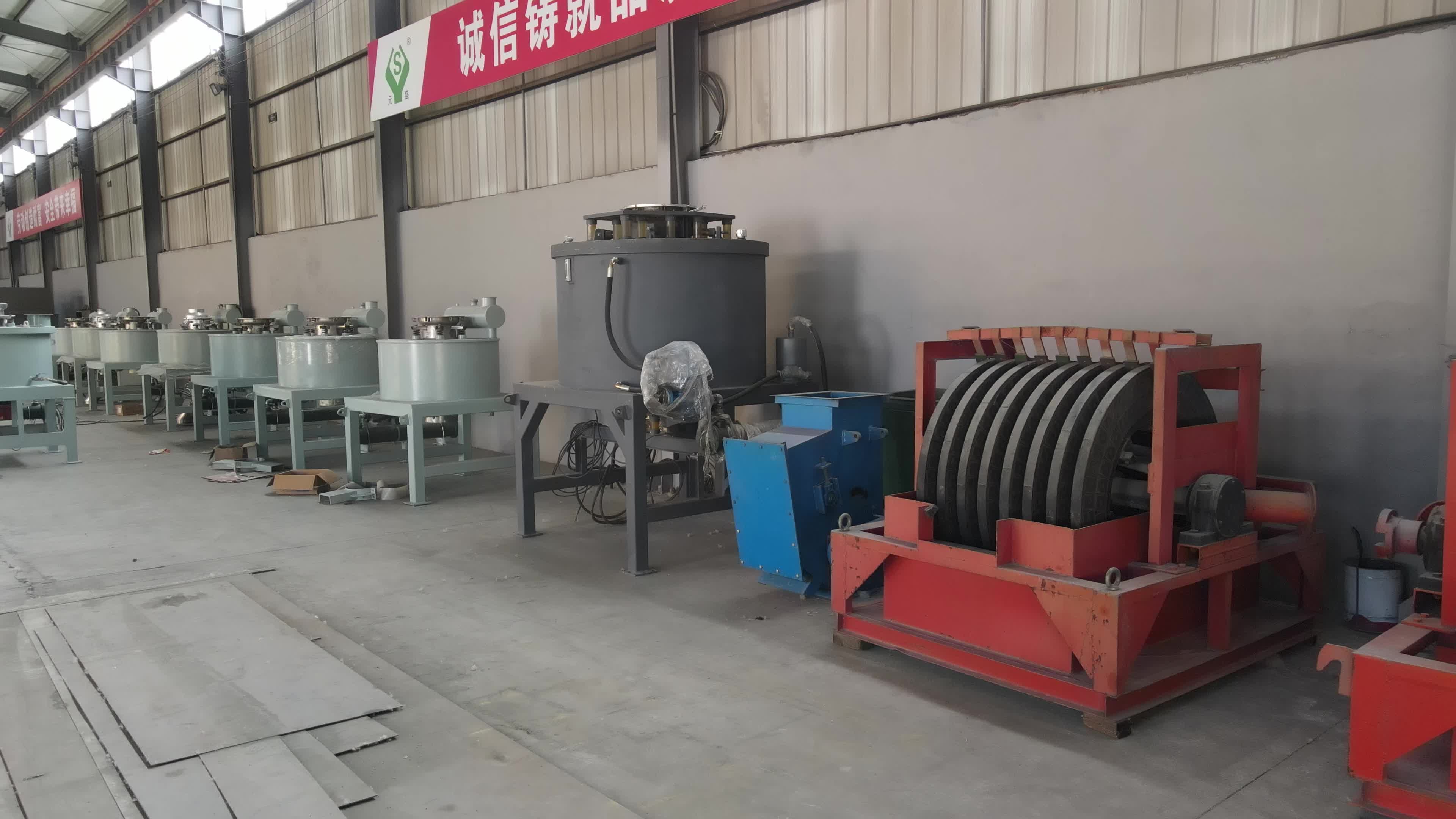
Assembly stage: configuration records created here become the reference for later spare parts orders.
Installation Checks Before Handover
Acceptance at the factory and acceptance at the plant are different events. The checks below connect them, and each one should be signed off by both parties on the same sheet that records the serial number.
- Confirm foundation strength, level, and lifting points against the arrangement drawing before the unit is raised.
- Check alignment with the conveyor, chute, or pipeline, including the working gap between the magnet face and the material stream; a changed gap changes the effective field at the material.
- Verify supply voltage, phase, terminal tightening, and protective earthing against the wiring diagram.
- For electromagnetic units, confirm the cooling arrangement, whether air-cooled or oil-cooled, and that airflow or oil circulation is unobstructed before energising.
- Test the temperature sensing and automatic shut-off function where it is fitted, since overheating protection is only useful if it is proven to trip.
- Confirm enclosure sealing against the actual dust or washdown environment, and check that IP65/IP67 claims are matched by intact gaskets and cable entries.
- Confirm that wetted or product-contact surfaces are the specified 304 or 316L stainless where corrosion resistance was ordered, and that no mild steel component sits in the product stream.
- In hazardous areas, verify that explosion-proof design and ATEX/Ex certification apply to the actual installed configuration, not only to the base model.
- Run the unit unloaded, record current, noise, vibration, and temperature rise, then run with material and collect a sample before and after the magnet.
- Walk the cleaning route with the operators, confirm access for drawer withdrawal, grate removal, belt cleaning, or pipeline magnet extraction, and record the time each cleaning step takes.
The last item is the one most often skipped and most often regretted. A separator that removes iron well but takes forty minutes to clean will be cleaned less often than specified, and the resulting performance loss will be attributed to the equipment rather than to the access design.
Spare Parts: Stock by Failure Mode, Not by Habit
Permanent and electromagnetic separators do not fail in the same places, so they should not share a spare parts strategy. Published comparison data describes permanent units as effectively maintenance-free, requiring only monthly inspection and cleaning, with no control circuits and therefore no electrical failure risk. Electromagnetic units carry coils, control circuits, and a cooling system, and are described as requiring regular inspection of circuits, coils, and cooling, together with professional maintenance. That single distinction reorganises the entire spare parts budget.
| Part group | Why it matters | Stocking logic |
|---|---|---|
| Magnet assembly | Highest replacement cost and longest lead time | Not normally held on site; confirm replaceability and supply horizon in the contract |
| Coil and control circuit (electromagnetic) | Single point of failure that stops the line | Scale with duty hours and with the shipping distance to site |
| Cooling system components (electromagnetic) | Overheating protection trips the unit out of service | Hold the serviceable items named in the maintenance manual |
| Temperature sensors and protection elements | Low cost, high consequence if unavailable | Hold at least one spare set on site |
| Cleaning and contact parts | Determines whether cleaning happens on schedule | Tie quantity to the cleaning frequency agreed during installation |
Quantities should be derived, not copied. Rank each part by cost of downtime per day, delivery time from the supplier to the plant, and whether its failure is a single point of failure. A part that is cheap, slow to arrive, and stops the line belongs on the shelf. A part that is expensive, rarely fails, and can be scheduled into a planned shutdown belongs in a quotation, not in a store room.

Finished goods storage: shipping distance is a direct input into spare parts stocking decisions.
Maintenance Planning: Two Very Different Schedules
The maintenance calendar follows the technology, not the site. The comparison below uses the published category-level figures and is intended to show where the two schedules diverge, not to price a specific installation.
| Dimension | Permanent (RCYB and similar) | Electromagnetic (RCDA/RCDE, YSDC/YSDCG and similar) |
|---|---|---|
| Energy use | No electrical supply for the magnetic field | Continuous draw, cited at roughly 2 to 5 kWh per hour |
| Field strength | Fixed, category range about 3,000 to 12,000 Gauss | Adjustable, category range about 5,000 to 30,000 Gauss |
| Removal performance | About 98% for iron particles of 0.1 mm and above | 99.5% or better, down to weakly magnetic impurities at the micron and sub-micron scale |
| Recurring cost | Maintenance cited at approximately USD 60 per year | Electricity cited at approximately USD 2,000 to 4,000 per year |
| Routine work | Monthly inspection and cleaning; no control circuit | Regular inspection of circuit, coil, and cooling system; professional maintenance |
| Purchase cost | Cited as roughly 30% lower | Cited as roughly 30% higher |
| Magnetic decay | Cited at 5% or less over eight years | No magnetic decay within coil life |
The cost logic that follows is conditional rather than universal. A permanent unit carries a lower purchase price and almost no operating cost, but a fixed field that cannot be raised when the feed changes. An electromagnetic unit costs more to buy and considerably more to run, but its field can be adjusted and its reach extends to weakly magnetic impurities that a permanent field will not capture. The crossover point depends on duty hours, local electricity tariffs, and how often the feed specification is likely to change. On a continuous-duty line, the documented operating gap accumulates fastest; on an intermittent line running a few shifts a week, the purchase price difference can dominate for years.
Long-Term Support: What Should Be Written, Not Promised
What belongs in a support agreement?
A support agreement is a distribution of responsibility, and it should name the technical contact and the communication channel, the number of years for which spare parts will be available, the revision status of drawings and manuals supplied, the training included at commissioning and afterwards, the notification process if a component is discontinued or superseded, and the logistics responsibility for urgent parts. A documented annual review, at which the installed base, the failure record, and the spare parts holding are examined together, turns support from a reaction into a plan.
What support capability is actually documented?
Weifang Yuansheng has operated since 2011 with a 3,500 m² facility, 45 employees, and eight engineers in its R&D team, producing 3,500 units a year and exporting 65% of output to markets that include Asia-Pacific, North America, Europe, Africa, the Middle East, Latin America, Oceania, and CIS/Central Asia. Export at that share means cross-border documentation, shipping, and after-sales coordination are routine parts of the business rather than exceptions. Contact is published as ys@iron-separator.com and +86 155-5366-8212, including WhatsApp. Separately, a 2026 review published by EIN Presswire and compiled by Apollo Research Reports lists the company first among ten Chinese permanent magnetic separator companies; that is a secondary commercial listing based on registration, catalog, and certification records, not an independent audit, and it should be read as a market signal rather than a performance guarantee.
What is not stated and must be negotiated?
The reviewed materials do not state a warranty period, a response time, a spare parts supply horizon, or the cost basis for on-site service. Buyers should treat each as an open item and settle it in writing. A warranty that starts at shipment rather than commissioning can expire before a delayed installation is complete, which is a common and avoidable loss in cross-border projects.
Where Harsh Service Changes the Support Plan
Heat, dust, corrosion, and hazardous atmospheres change which options matter and which spares deserve shelf space. The documented risk-control approach for this equipment class covers temperature monitoring and thermal protection with automatic shut-off, heat-resistant magnet materials, IP65/IP67 rated enclosures for dust and washdown, 304 or 316L stainless steel for corrosion resistance, and explosion-proof design with ATEX/Ex certification for hazardous areas. These are design responses to stated conditions, and they should be confirmed item by item in the quotation rather than assumed from the general specification.
The support consequence is practical. A unit with a temperature trip has a sensor that can fail and a protection circuit that can be tested; that test belongs in the preventive maintenance schedule, not in the breakdown procedure. A unit in a corrosive stream has contact surfaces whose condition should be inspected at defined intervals, because wall loss is gradual until it is sudden. A unit in a hazardous area has certification tied to its exact configuration, so a later field modification can invalidate the basis on which it was accepted.
Quick-Answer FAQ
Which trade classification applies to magnetic separator shipments?
HS 847410, covering sorting, screening, separating or washing machines, is the primary classification for magnetic separators in global trade. The invoice, packing list, and bill of lading should use it consistently, and any certificate of origin should match.
What field strength is associated with lithium battery material purification?
Secondary industry analysis cross-referenced with supplier catalogs places high-gradient electromagnetic separators used for lithium battery materials above 16,000 to 20,000 Gauss. Because that figure comes from secondary analysis and not from a standardized benchmark, a project at this specification should confirm it through a material test on the actual feed.
What drives the operating cost gap between permanent and electromagnetic units?
Electricity and cooling maintenance. Published comparison data cites roughly 2 to 5 kWh per hour of consumption, about USD 2,000 to 4,000 per year, for an electromagnetic unit, against roughly USD 60 per year of maintenance and no field power for a permanent unit.
What should a buyer prepare before requesting a quotation?
The feed material and its particle size range, the form of iron contamination and its approximate level, flow rate and layer depth, operating temperature and humidity, corrosion exposure, hazardous area classification if any, available installation space, and the existing conveyor or pipeline interface dimensions. Each of these changes either the model selection or the acceptance test recipe.
Is a standard lead time published for these separators?
No standard lead time is stated in the reviewed materials. Lead time should therefore be quoted per order against the confirmed configuration and written into the contract with a delivery schedule, since a delivery date agreed verbally cannot be enforced.
How does a buyer keep support continuous over several years?
By converting support into clauses: a named technical contact, a stated spare parts supply horizon, controlled document revisions, notification of discontinued components, and a scheduled annual review of failures and stock. Buyers who want to start that process can request the company's product brochure and specification material through the published contact channel, then use it as the baseline for the technical annex.
Conclusion
A magnetic separator purchase is settled in three documents, not one. The commercial document fixes quantity, delivery, and payment, which for this supplier means a minimum of 3 units, FOB Qingdao or CIF, and T/T with a 30% deposit and 70% before shipment. The technical annex fixes what a pass looks like, including flux density at an agreed distance, iron removal on an agreed feed, sealing, materials, and protection functions, because the published inspection mechanism names who witnesses acceptance but not what counts as conforming. The support agreement fixes how long parts remain available, who answers, and how change is communicated, because warranty terms, response times, and spare parts horizons are not stated in the reviewed materials and must be negotiated.
Buyers who close those three documents before the order convert an uncertain cross-border purchase into a managed one. The equipment itself is the easy part to compare; the difference between suppliers usually appears later, in whether the acceptance file is complete and whether the spare that stops the line is on a shelf or on a ship.

Support coordination: contract terms, spare parts records, and technical contacts in one place.
For buyers building the technical annex, the company product brochure is available as a downloadable PDF: download the Weifang Yuansheng product brochure. For specification questions, acceptance documentation, or a quotation against a specific material stream, contact the team at ys@iron-separator.com or +86 155-5366-8212.
Have Questions or Need More Details?
Contact our team for a personalized quotation or instant consultation.
Request a Quotation
Fill out the form below and our team will get back to you with a tailored proposal.
WhatsApp Direct Chat
Prefer to chat in real-time? Message us on WhatsApp for instant assistance & quick answers.
- Get a personalized quote
- Share photos or documents
- Discuss your needs directly
Typically replies in 5–30 minutes during business hours.