Cracked Concrete Special Wedge Anchor: A Buyer's Guide
A cracked concrete special wedge anchor is a mechanical expansion anchor qualified for use in concrete that is cracked or may crack during its service life. It is not simply a heavier version of a standard wedge anchor. The difference lies in the evidence supplied with the product: test data and evaluation documents that name the model, the diameter, the embedment and the installation limits under which cracked-concrete service is permitted.
Ningbo Weifeng Fastener Co., Ltd. (Weifeng Fastener) is a fastener manufacturer and trading company located in Yuyao, Zhejiang, China, inside the Ningbo fastener manufacturing region. The company was established in 2013, and its company profile states that its fastening business dates back to 2003. Its portfolio includes anchors, and its Wedge Anchor — model designation Through Bolt — is offered in diameters from M6 to M24 and lengths from 50 mm to 300 mm, in carbon steel and stainless steel.
This guide is written for importers, distributors, contractors and structural engineers at the research stage of sourcing. It explains why cracked concrete changes anchor selection, which documents actually prove a qualification, how a wedge anchor compares with other anchor families for the same duty, and what to confirm before a purchase order is issued.
What a Cracked Concrete Special Wedge Anchor Actually Is
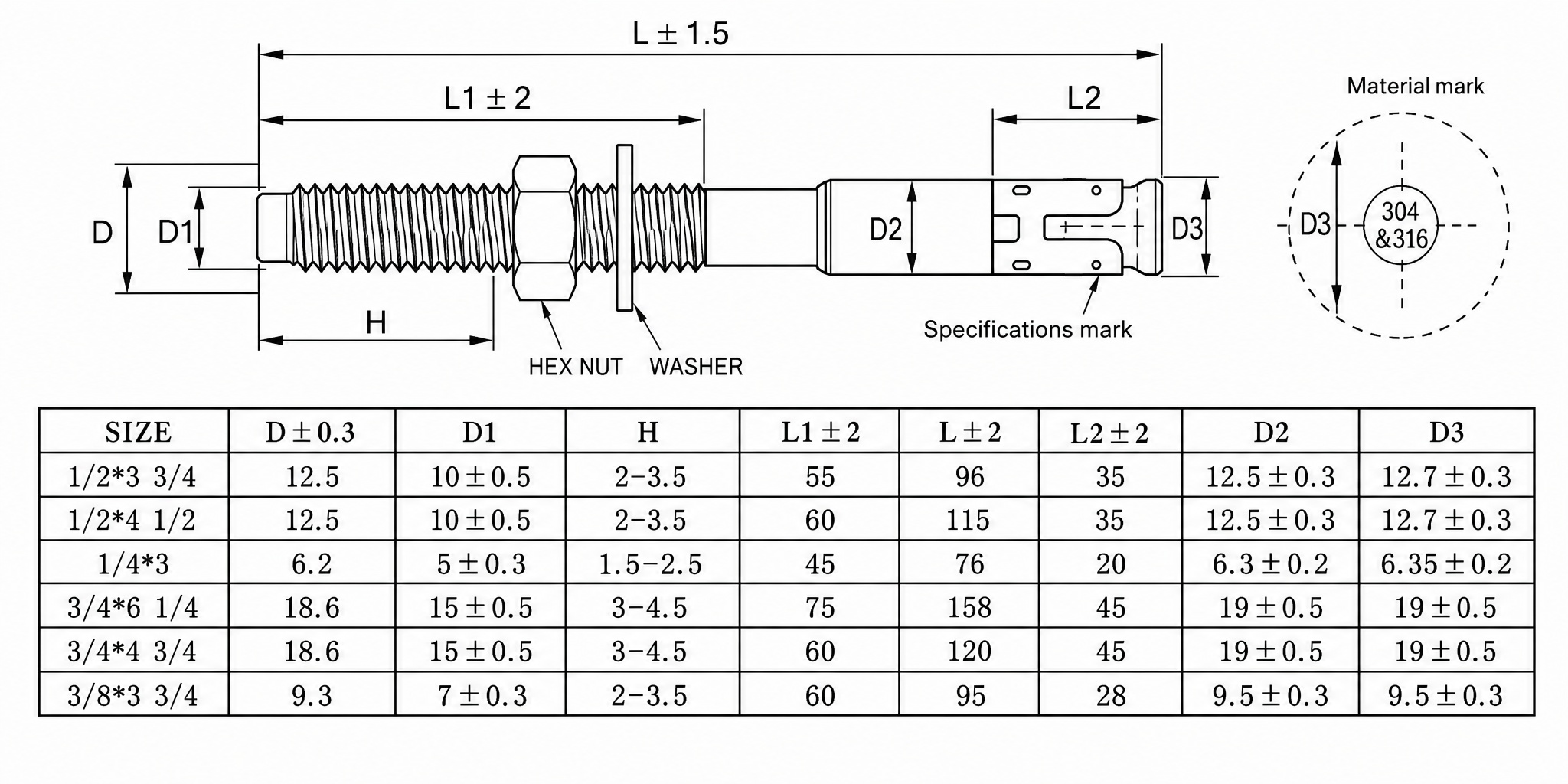
The Weifeng Wedge Anchor is classified as an expansion anchor and a concrete anchor. Product information states that it is designed for concrete anchoring, provides heavy-duty loading in concrete, has high pull-out resistance, and is designed for quick and easy installation. Its structural configuration is an expansion anchor design, and its material options are carbon steel and stainless steel.
Those statements describe the mechanism — how the anchor grips concrete. Cracked-concrete suitability is a separate layer that sits on top of the mechanism, and it is established by testing and evaluation rather than by the shape of the part. Two wedge anchors with similar dimensions can carry completely different scopes of approval, and only one of them may be accepted by the project's design basis when cracks are expected.
Wedge Anchor at a glance (Weifeng Fastener)
| Attribute | Verified product data |
|---|---|
| Product name | Wedge Anchor |
| Model designation | Through Bolt |
| Product type | Expansion anchor / concrete anchor |
| Diameter range | M6 to M24 |
| Length range | 50 mm to 300 mm |
| Materials | Carbon steel / stainless steel |
| Stated performance | Heavy-duty loading in concrete; high pull-out resistance; quick and easy installation |
| Typical applications | Heavy machinery installation, curtain wall, railings |
Why Cracked Concrete Changes the Anchoring Problem
Concrete cracks. Restrained shrinkage, thermal cycling, differential settlement, overload and seismic action are all recognised causes, and structural design practice increasingly requires connections to be assessed for the possibility that a crack will form at or near the anchor location. Once that assumption enters the design, the anchor specification changes with it.
An expansion anchor transfers load into concrete by expanding a sleeve or clip against the wall of the drilled hole, and the Weifeng Wedge Anchor follows that principle — it is described as providing heavy-duty loading in concrete with high pull-out resistance. In uncracked concrete, the expansion zone sits in a continuous mass of material. In cracked concrete, a crack may intersect that expansion zone, interrupt the load path and change the failure mode. Because of this, anchors are evaluated as a distinct product category for cracked-concrete service.
Published technical documents show how this works in practice. A MiTek technical bulletin states that its wedge-anchor product is code evaluated to IBC/IRC in accordance with ICC-ES AC193 and ACI 355.2 for cracked and uncracked concrete. A Fastenal submittal for a specified WA++ wedge anchor reports seismic, cracked and uncracked concrete approval, Category 1 diameters, and testing in accordance with ACI 355.2 and ICC-ES AC193. Both documents are product-specific: they describe named anchors, not the general product category.
European approval practice reaches the same conclusion through different paperwork. A MÜPRO technical approval describes wedge anchors as deformation-controlled expansion anchors installed in a drilled hole, with galvanized-steel and stainless-steel variants, in sizes M6, M8, M10, M12, M16 and M20 for the approved product family. The sizes, materials and conditions stated in that approval apply to those products only.
The buyer takeaway is direct: a cracked-concrete rating is a claim that must be attached to a specific model, supported by a document that states the conditions under which the rating holds.
Industry Background: Market, Standards and Import Reality
Anchoring fasteners are a large and standardised category. The global anchoring fasteners market was estimated at USD 3.12 billion in 2024, and mechanical anchors accounted for 58.3% of market share that year — the segment that includes wedge anchors. Supply is deep, products look similar, and differentiation usually sits in documentation rather than in the appearance of the part.
Standardisation is what makes comparison possible. In US-market technical documents, wedge anchors tested in accordance with ASTM E488 use bodies in materials such as AISI 1010–1018 and Grade A ASTM A563 nuts. For stainless-steel variants, a European approval identifies AISI 316 material as EN 10088 grade 1.4401 with minimum values of fuk ≥ 500 N/mm² and fyk ≥ 210 N/mm². Those figures are material properties of the specified product. They are not anchor load capacities, and they should never be used as a substitute for the manufacturer's load tables and installation data.
Importers also deal with classification. Wedge anchors from China are classified under HTSUS 7318.15.2090 in a US Customs and Border Protection ruling, a useful reference point when customs documentation is prepared for a US shipment.
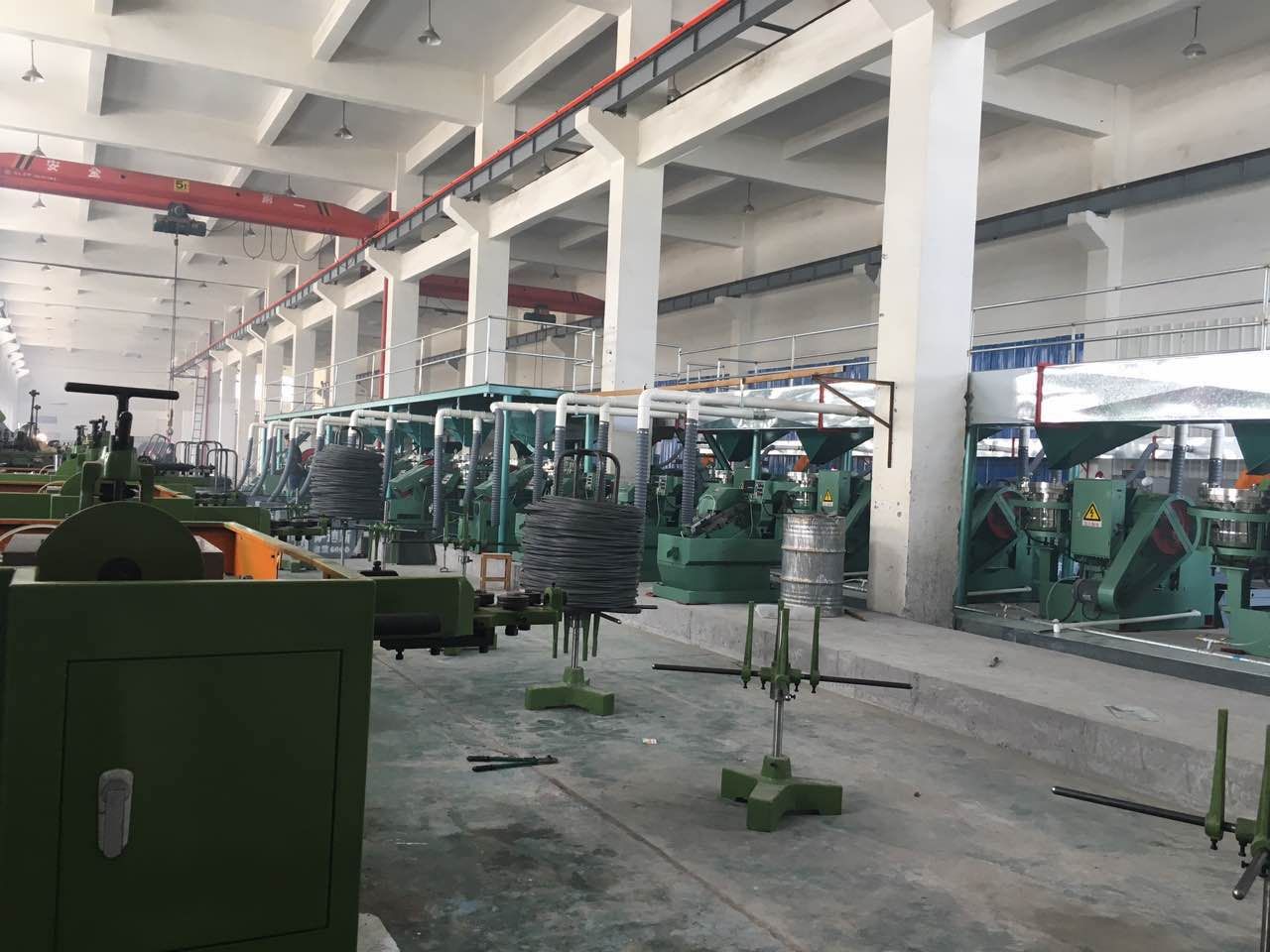
On the supply side, Weifeng Fastener operates a 7,000 m² factory with approximately 50 employees and an annual output of about 6,000 tons, with 90% of sales going to export markets that include South America, Africa and Russia. Its portfolio covers screws, bolts, nuts, washers, anchors, nails and coach screws in carbon steel and stainless steel, conforming to DIN, ISO, ANSI and JIS standards, and it provides non-standard and custom fastener solutions with OEM and ODM execution supported by two engineers. A third-party supplier directory also lists the company as a supplier of screws, washers, nuts, bolts, anchors and stainless-steel products in Yuyao, Zhejiang.
The Solution: Turning a Requirement into an Orderable Specification
Six items must be fixed before a wedge anchor for cracked concrete can be quoted accurately: concrete condition, qualification route, size and embedment, material and corrosion protection, installation conditions, and documentation package.
1. Concrete condition
Decide whether the design assumes cracked concrete, uncracked concrete, or seismic action. This single decision determines which test framework applies and which products are eligible. Seismic screening follows the same logic — a distributor submittal for a specified WA++ wedge anchor reports seismic, cracked and uncracked concrete rating alongside testing under ACI 355.2 and ICC-ES AC193.
2. Qualification route for the destination market
For US projects, the references that appear in published product literature are ICC-ES AC193, ACI 355.2 and code evaluation to IBC/IRC. For European projects, look for an approval document in the European Technical Assessment format that names the product family, sizes and materials. Weifeng states that it can offer products in accordance with DIN, ISO, ANSI and JIS standards; this is a portfolio-level statement. Ask for the model-level document: an evaluation report, a test report, or a certificate that carries the exact anchor model and size you intend to buy.
3. Size and embedment
The Weifeng Wedge Anchor is available from M6 to M24 in diameter and from 50 mm to 300 mm in length. Length is not embedment. Effective embedment, hole diameter and minimum base-material thickness come from the product's technical data and must be checked against the slab, wall or element being fixed.
4. Material and corrosion protection
Carbon steel and stainless steel are the two material options in the Weifeng wedge anchor line. Across the wider portfolio, stainless steel SUS304/316 appears as an optional material on other anchor and bolt families, and bolt property grades available are 4.8, 8.8, 10.9 and 12.9. In coastal, industrial or humid environments, define the stainless grade and finish in the specification and match them with a material certificate.
5. Installation conditions
Request the installation instruction that belongs to the specific model: hole diameter, drilling method, hole cleaning, tightening torque and minimum edge distance. Expansion behaviour depends on correct installation, and this is where most site problems originate.
6. Documentation package
- Model-level technical drawing with dimensions and thread details.
- Material certificate for the actual production batch.
- Test report or evaluation document covering cracked-concrete service, where applicable.
- Installation instructions including torque and hole-cleaning requirements.
- Packing list and marking specification if OEM or private label is required.
- Sample lot for first-article approval before mass production.
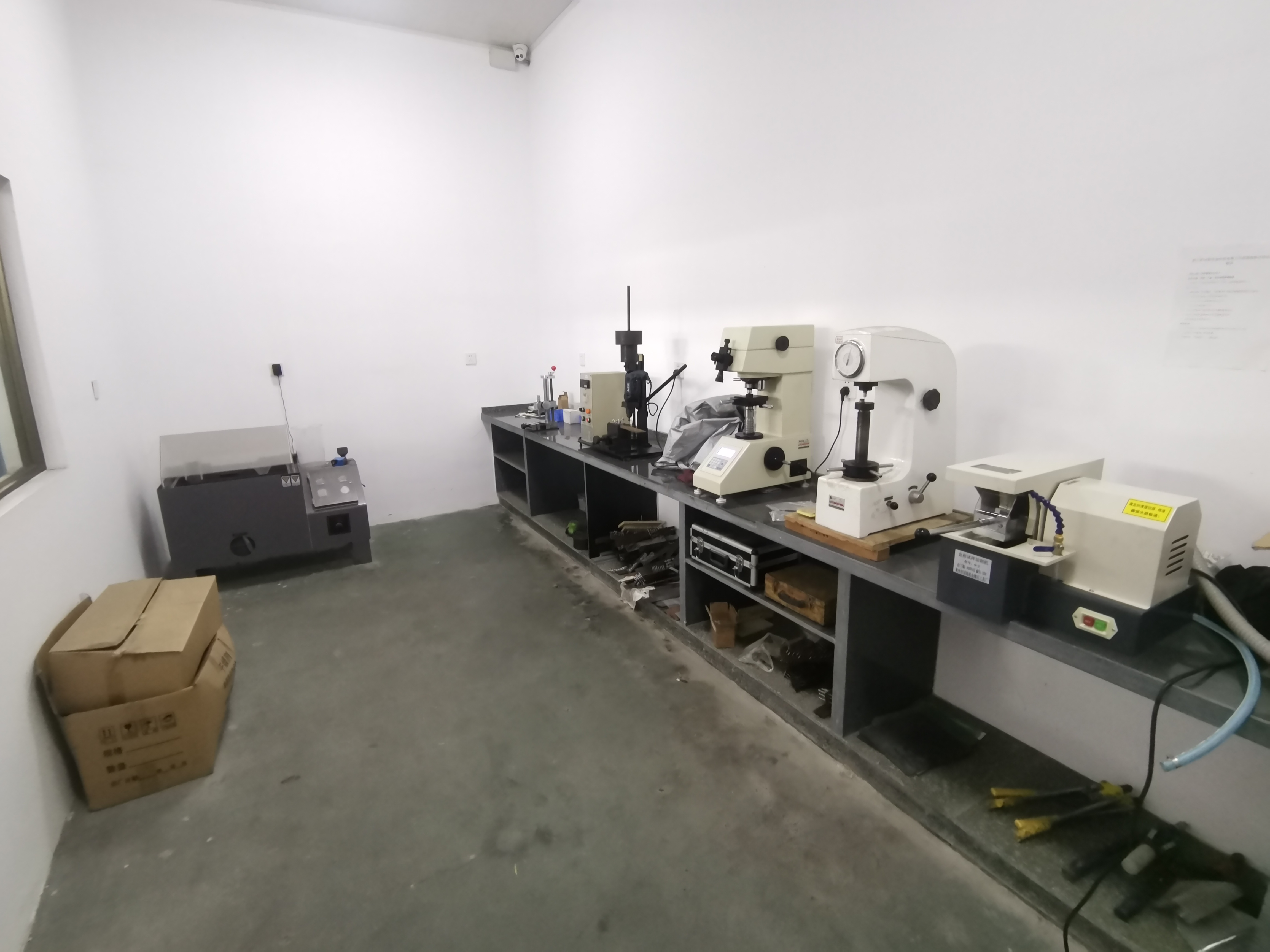
Weifeng states that its quality control includes in-house testing for tensile strength, torque and corrosion resistance, and it supports OEM and ODM projects with two in-house engineers. Those statements are a useful starting point for a supplier conversation. They do not replace the project-specific documents listed above.
Step-by-Step Breakdown for Buyers
- Define the design assumption. Record cracked concrete, uncracked concrete or seismic as the basis of design in the RFQ, not as a verbal assumption.
- Select the qualification framework. ICC-ES AC193 / ACI 355.2 / IBC-IRC evaluation for US projects; an ETA-format approval for European projects; both routes require a product-specific document.
- Fix diameter, length and embedment. Start from the Weifeng range of M6–M24 diameters and 50–300 mm lengths, then confirm embedment and hole geometry from the model's technical data.
- Choose material and finish. Carbon steel or stainless steel for the wedge anchor; match corrosion class to the exposure environment and request the material certificate.
- Request the document pack before quotation. Drawing, material certificate, test or evaluation report, and installation instructions should be reviewed before price is compared.
- Validate with a sample. Test installation on site with the specified drill bit, hole cleaning method and torque wrench, then compare with the published instructions.
- Confirm logistics and packaging. Weifeng offers flexible shipping from Ningbo, Shanghai and Tianjin, which allows routing and shipment consolidation to be planned alongside the packaging and marking requirements.
Use Cases: Where Concrete Anchors Are Specified
- Heavy machinery installation. Listed as a typical application for the Weifeng wedge anchor, where heavy-duty loading in concrete and high pull-out resistance are the required characteristics.
- Curtain wall and façade support. Curtain wall fixing is also a listed application, and cracked-concrete assumptions are common where façade brackets transfer wind and dead loads into floor slabs.
- Railings and guardrails. Railing installation is listed as an application for the wedge anchor; post bases are often placed close to slab edges, where edge distance and crack assumptions both matter.
- Seismic and structural projects. Products marketed for seismic service carry ratings documented in technical submittals, so the review path is the same: request the report rather than accepting the claim.
- Equipment foundations and heavy equipment. Where expansion stress is not acceptable, chemical anchor bolts are used instead. The Weifeng chemical anchor bolt is listed for heavy equipment foundations, bridge reinforcement and tunnel construction, and its product data states that it applies no expansion stress to concrete, suits edge-close fixing, is vibration resistant and performs in wet conditions.
- Pipe and bracket fixing. For threaded connections in HVAC, plumbing and suspended ceiling work, the portfolio includes threaded rods to DIN 975 / DIN 976, combined with anchors and hex nuts (DIN 934 / ISO 4032) to form complete fixing assemblies.
Comparison: Concrete Anchor Types Side by Side
| Anchor type | Mechanism | Size range | Materials | Notes for crack-sensitive work |
|---|---|---|---|---|
| Wedge Anchor (Through Bolt) | Expansion anchor / concrete anchor; heavy-duty loading in concrete; high pull-out resistance | M6–M24; 50–300 mm | Carbon steel / stainless steel | Cracked-concrete use must be confirmed per model; published US bulletins show cracked and uncracked concrete evaluation under ICC-ES AC193 and ACI 355.2 |
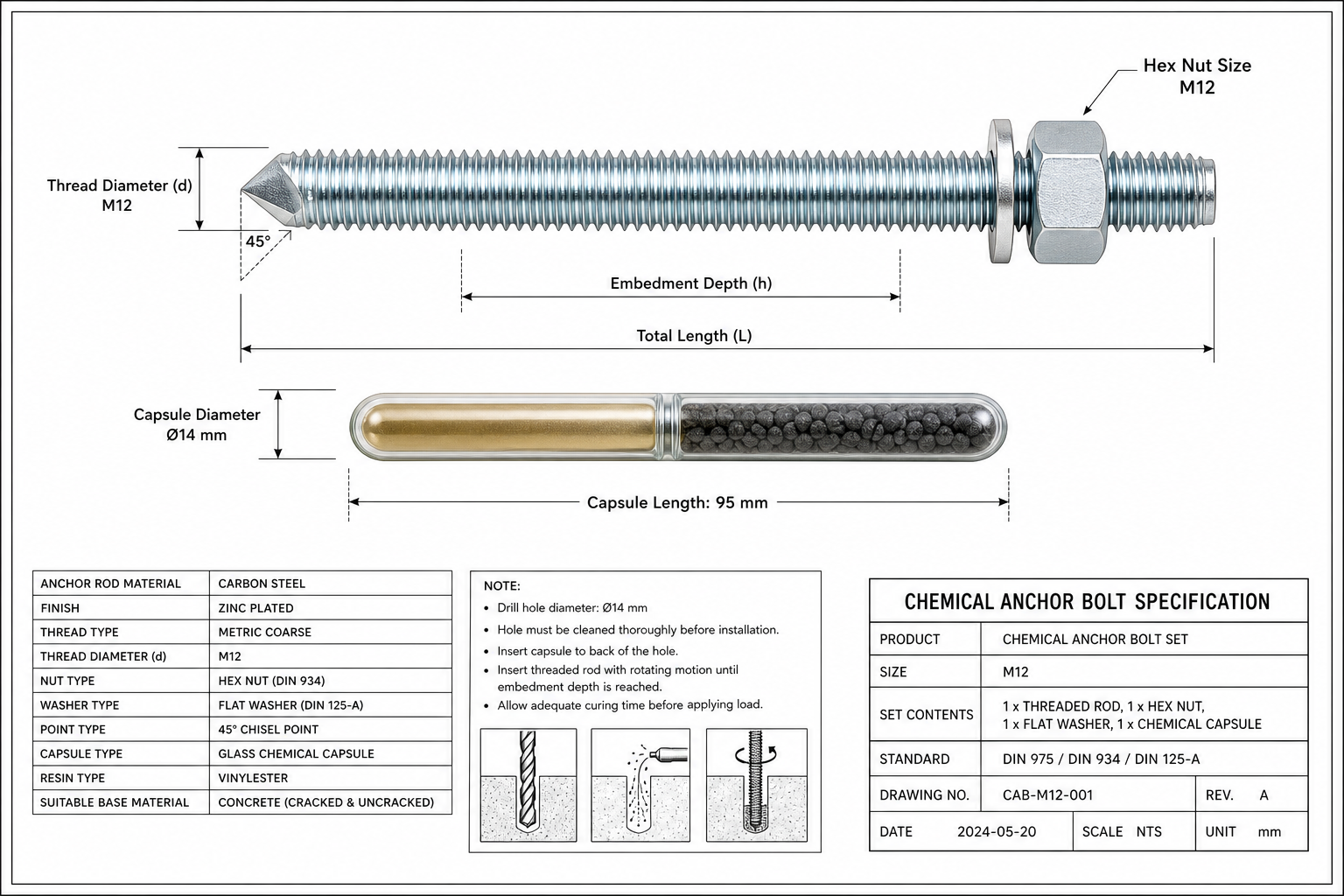
| Chemical Anchor Bolt | Adhesive anchor / resin anchor; M12–M30 high-strength stud | M8–M30; grades 5.8 / 8.8; curing 30 min to 24 h depending on resin | Carbon steel / stainless steel | Product data states no expansion stress on concrete, suitability for edge-close fixing, vibration resistance and load-bearing in wet conditions |
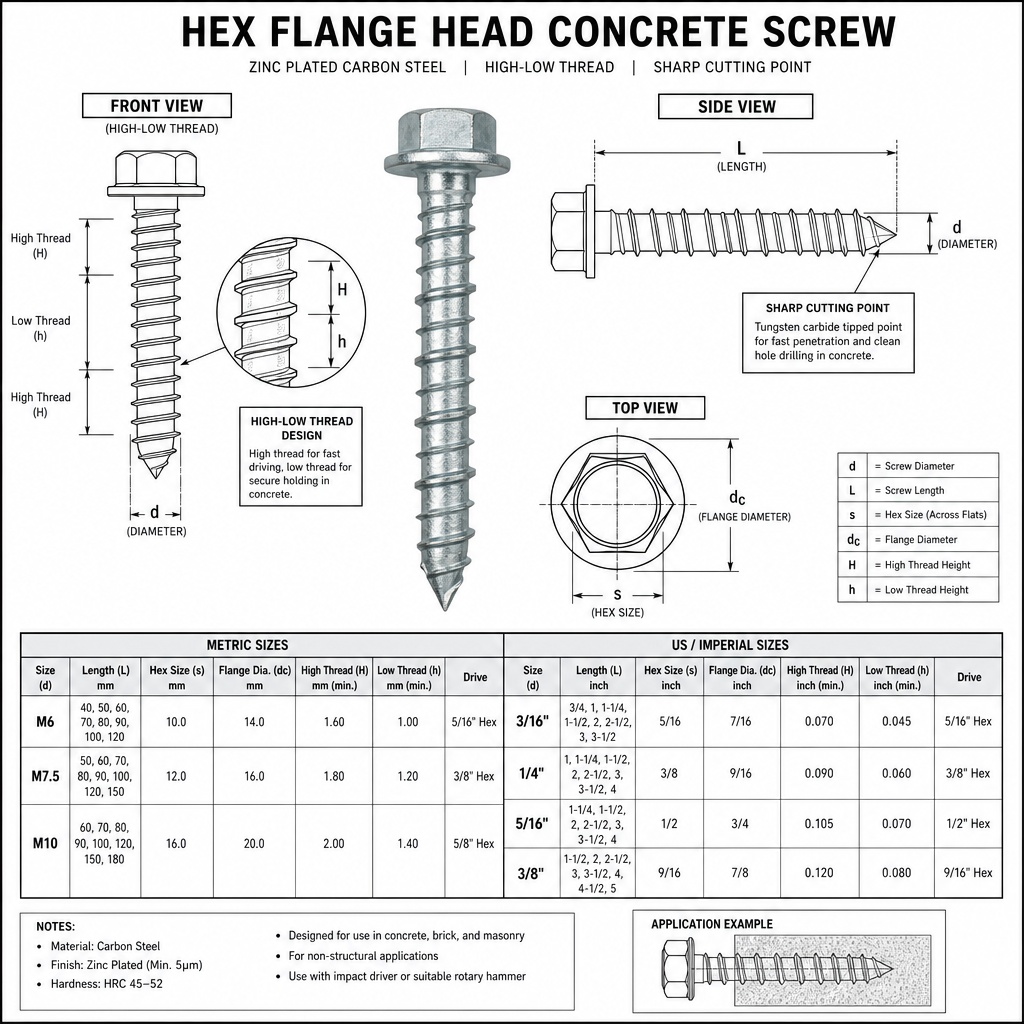
| Concrete Screw (Hex Flange Head) | Direct fastener, non-expansion screw; thread cuts directly into the concrete | 5–12 mm diameter; 30–150 mm length | Heat treated carbon steel | Product data states no expansion stress, close spacing allowed, fully removable and reusable, high installation speed |
| Shield Anchor (3-pcs / 4-pcs) | Mechanical expansion anchor, torque controlled | M6–M20 | Carbon steel, malleable iron; yellow or white zinc plated | Product data states grip in low-quality concrete and reusability with different bolts |
When a wedge anchor is not the answer. In concrete where no expansion stress is acceptable — thin sections, close edges, or continuous vibration — an adhesive anchor is normally specified. The Weifeng chemical anchor bolt is classified as an adhesive anchor and a resin anchor with an M12–M30 high-strength stud designation, available in M8–M30 sizes with strength grades 5.8 and 8.8. Where a removable, non-expansion mechanical fixing is preferred, the Hex Flange Head Concrete Screw cuts directly into the concrete base material and is offered from 5 mm to 12 mm in diameter and 30 mm to 150 mm in length.
Supplier Capability and What to Verify
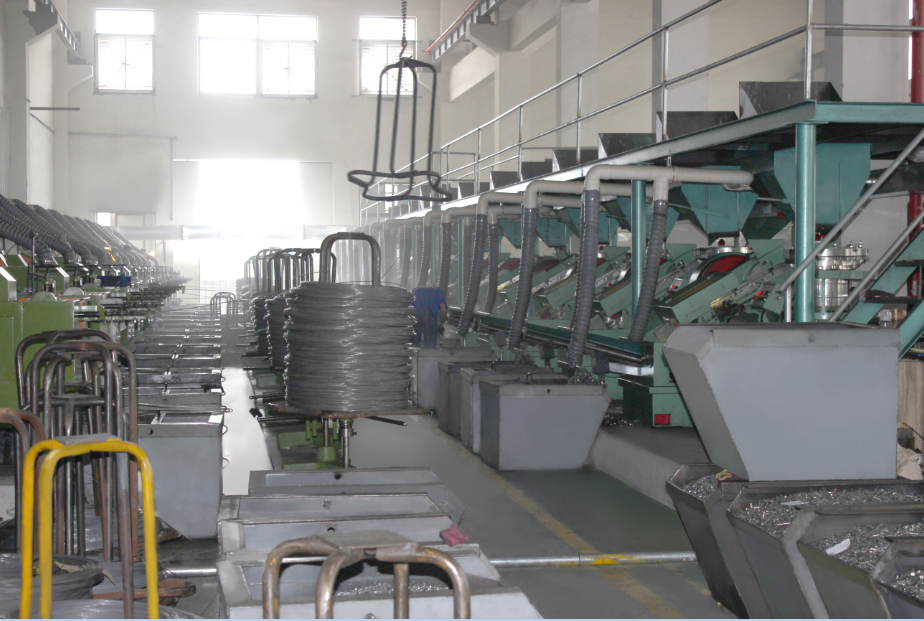
Weifeng Fastener is a China-based fastener manufacturer and trader in the Ningbo manufacturing region, which is a relevant sourcing cluster for importers researching China wedge anchor manufacturers. The company profile states a 7,000 m² factory, about 50 employees, roughly 6,000 tons of annual output, a 90% export ratio and main markets in South America, Africa and Russia. Its stated product scope covers anchors together with screws, bolts, nuts, washers, nails and coach screws, and it states that it supports non-standard and custom solutions through OEM and ODM execution with two engineers. A third-party supplier directory lists the company as a supplier of screws, washers, nuts, bolts, anchors and stainless-steel products.
Two verification points matter more than the profile itself. First, wedge-anchor-specific production capability and product-level certification: the available company statements describe standards coverage at portfolio level, so the buyer should request documentation for the exact wedge anchor model and diameter. Second, the concrete condition assumed by the project: a supplier that cannot provide model-level cracked-concrete evidence should not be treated as qualified for that application, regardless of the general strength of its catalogue.
FAQ
How do I confirm that a wedge anchor is actually qualified for cracked concrete?
Ask for the product-specific evaluation document. In the US market, published technical bulletins show wedge anchors code evaluated to IBC/IRC in accordance with ICC-ES AC193 and ACI 355.2 for cracked and uncracked concrete, and distributor submittals list seismic and cracked/uncracked concrete ratings together with Category 1 diameters. The document should name the model, diameter, embedment, edge and spacing limits and the concrete strength assumed. A general description such as high strength or heavy duty is not a cracked-concrete qualification, and the Weifeng wedge anchor line should be verified model by model before it is specified for that condition.
What wedge anchor sizes and materials can Weifeng Fastener supply?
The Weifeng Wedge Anchor (model Through Bolt) is offered in diameters from M6 to M24 and lengths from 50 mm to 300 mm, with carbon steel and stainless steel as the material options. The wider portfolio includes screws, bolts, nuts, washers, anchors, nails and coach screws in carbon steel and stainless steel, conforming to DIN, ISO, ANSI and JIS standards, with non-standard and custom solutions supported by OEM and ODM execution and two in-house engineers.
What determines the cost of a cracked-concrete wedge anchor?
No verified unit prices are published for this product range, so cost must be established through a quotation. In practice the main cost drivers are the material choice (carbon steel versus stainless steel), the corrosion finish, the diameter and length, the scope of testing and documentation supplied with the order, the order quantity, and the packaging and marking requirements. Comparing offers on a landed-cost basis is more reliable than comparing unit prices, especially when documentation scope differs between suppliers. Weifeng offers flexible shipping from Ningbo, Shanghai and Tianjin, which supports routing and shipment consolidation.
Can I validate a wedge anchor before placing a bulk order?
Yes — validation should combine documents and physical samples. Request the model drawing, material certificate, test or evaluation report where applicable, and the installation instruction with torque and hole-cleaning requirements. Then carry out a trial installation on site or in the workshop using the specified drill bit and torque wrench, and compare the result with the published instructions. Weifeng states that its quality control includes in-house testing for tensile strength, torque and corrosion resistance, and sample lots can be reviewed before mass production is confirmed.
What lead time and logistics support should a buyer expect?
Verified lead-time figures are not published for this product range, so production and shipping schedules must be confirmed at quotation stage, together with the Incoterm and payment terms. What is documented is logistics flexibility: Weifeng offers shipping from multiple Chinese gateways including Ningbo, Shanghai and Tianjin, and 90% of its sales are export sales, which supports consolidated shipments to reduce total landed cost. The practical next step is to send the specification — diameter, length, material, quantity and destination port — so that pricing, documents and schedule can be confirmed in one response.
Conclusion
Cracked concrete does not change the physics of a wedge anchor; it changes the evidence a buyer is entitled to see. The mechanism stays the same — expansion, heavy-duty loading in concrete, high pull-out resistance — but eligibility for cracked-concrete service is established by product-specific testing and evaluation, and it is documented per model, diameter and embedment.
A workable sourcing process is straightforward: define the design assumption, choose the qualification route for the destination market, fix size, material and installation conditions, request the document pack before comparing price, and validate with a sample. Where expansion stress cannot be accepted, compare the wedge anchor against adhesive anchors and non-expansion concrete screws before committing the specification. Weifeng Fastener supplies wedge anchors from M6 to M24 and 50 mm to 300 mm in carbon steel and stainless steel, and can be assessed against the same checklist used for any other China wedge anchor manufacturer.
Next step: review the full fastener range in the Weifeng Fastener catalogue and send your wedge anchor specification for quotation and sample arrangement.
Download the Weifeng Fastener catalogue (PDF)
Contact: Tony — Tony@wf-fastener.com — WhatsApp / Tel: +86-13355841616
Website: www.wf-fastener.com · Address: No.33, Yuli Road Yangming Street, Yuyao, Zhejiang, China
Have Questions or Need More Details?
Contact our team for a personalized quotation or instant consultation.
Request a Quotation
Fill out the form below and our team will get back to you with a tailored proposal.
WhatsApp Direct Chat
Prefer to chat in real-time? Message us on WhatsApp for instant assistance & quick answers.
- Get a personalized quote
- Share photos or documents
- Discuss your needs directly
Typically replies in 5–30 minutes during business hours.