
Fine Thread vs Coarse Thread Drywall Screws: Specifier's Decision
For a specifier, the thread call-out on a gypsum board schedule has two answers. Fine thread drywall screws are specified where boards are fixed to light gauge steel studs. Coarse thread drywall screws are specified where boards are fixed to wood studs. The shank diameter is a separate decision, and both thread types sit inside the same 3.5–4.8 mm (#6–#10) span, so it is the substrate — not the size — that selects the thread.
That single rule is easy to state and surprisingly easy to lose inside a real submittal. Schedules inherit a generic “drywall screws” line item, thread fields stay blank, and one project can carry steel-stud partitions on one elevation and timber-stud bulkheads on another. The purpose of this comparison is to make the choice defensible: what the thread actually does in each substrate, how the diameter range applies to both types, which secondary decisions follow once the thread is fixed, and where a product’s own rating legitimately overrides the general rule.
The rule, and the reason it holds
Fine thread belongs on light gauge metal studs; coarse thread belongs on wood studs. The reason is engagement, not convention. A fine thread carries more threads per unit of length, so a thin steel wall sees a greater number of engaged thread crests across the thickness it can offer. A coarse thread uses a wider pitch and a heavier thread form, which suits a timber member that can accept and hold a deeper bite. Reversing the pairing leaves one of the two materials doing work it was not selected for.
Published installation guidance adds an important qualifier to the rule. Selection depends on stud thickness, point type and the specific product rating, and the thread appearance alone is not a safe basis for assuming interchangeability. In other words, the substrate tells you which family of screw to look for; the product data tells you whether that particular screw is rated for the stud you have.
Where the thread call-out actually fails
Most thread errors are not deliberate. They come from three recurring situations. The first is a blank field: the schedule says “drywall screws” and the fixing contractor buys whatever is on the shelf. The second is a mixed-substrate project where one purchase order is expected to cover steel partitions, a timber-stud riser and a furred ceiling. The third is a substitution made late, when a coarse-thread box is used on metal because it was the box that arrived.
The consequence shows up at the driver, not on the drawing. Poor engagement and stripped heads are the visible symptoms, and the practical instruction is blunt: stop if stripping or poor engagement occurs rather than driving harder. A stripped screw in a partition is a repair; a schedule full of them is a rejected fixings package.
There is a second, quieter failure mode worth separating out. A product listing can state that a specific drywall screw is not certified while a relevant standard exists for the category, and neither fact tells you anything reliable about the other. Standard reference, product conformity and product certification are three different statements, and a thread comparison is only as good as the paperwork behind the SKU.
What the demand picture changes — and what it does not
Market research puts the global drywall screw market at USD 2.18 billion in 2025, projected to reach USD 3.04 billion by 2033, with residential construction housing starts driving 58% of demand. Collated drywall screws are reported at roughly 36% of product demand within the collated screw market, a figure linked to modular and prefabricated construction.
Read those numbers as a statement about volume and delivery format, not about thread logic. Growth and prefabrication push buyers toward collated strips, consistent collation quality and predictable tool compatibility. They do not change which thread grips a steel stud. A specifier who lets a high-volume, collated purchasing decision quietly overwrite the substrate decision has solved the labour problem and created a fixing problem.
Step by step: classify the substrate before naming a thread
The sequence below is the shortest reliable path from a drawing to a signed thread call-out.
Step 1 — Identify whether the stud is wood or metal
This sounds trivial and is the step most often skipped on refurbishment work, where the existing wall construction is not the construction shown on the new drawings. Confirm on site or from a survey, not from the architectural intent.
Step 2 — Measure the variable that governs engagement
For steel studs, measure the steel thickness, which is the figure the gauge designation describes. For timber, record moisture content alongside the member size. Both measurements belong in the submittal because both are what a supplier or technical support line will ask for first.
Step 3 — Match the thread type to the specification or product manual
Fine thread for the metal stud, coarse thread for the timber stud — then check that the chosen product is actually rated for that substrate and thickness. Where a product manual allows multiple substrates, the manual governs.
Step 4 — Trial-drive before the order is placed
A short trial on the actual stud and board build-up is the cheapest test available. It exposes stripped heads, over-driving, point suitability and tool settings before a container is committed.
Step 5 — Record the basis of the call-out
Note the substrate, the measured thickness, the product reference and the trial result. A thread type with a recorded basis survives value engineering; a thread type without one gets substituted.

The diameter range that applies to both thread types
Thread type and shank diameter are independent decisions, and both fine and coarse drywall screws are supplied across a common span. One Chinese manufacturer’s published range lists 3.5 mm, 3.9 mm, 4.2 mm and 4.8 mm diameters — #6 to #10 — with lengths from 13 mm to 150 mm; that range is supplier-reported and should be confirmed per SKU against drawings or inspection records.
| Call-out | Metric shank | Typical use in a schedule | Thread options |
|---|---|---|---|
| #6 | 3.5 mm | Standard single-layer board on light gauge steel or timber studs | Fine or coarse |
| #7 | 3.9 mm | Thicker board or slightly heavier steel stud sections | Fine or coarse |
| #8 | 4.2 mm | Multi-layer board build-ups and higher demand fixings | Fine or coarse |
| #10 | 4.8 mm | Heavier assemblies where a larger shank is called for | Fine or coarse |
Standardised envelopes illustrate the same logic. DIN 18182-1 specifies Type TN — trumpet head, double continuous thread — for 3.5 mm diameter drywall screws with lengths from 25 mm to 55 mm. That is a dimensional and configuration envelope for one type, not a statement that every 3.5 mm screw on the market conforms to it.
The practical sequence is therefore: fix the diameter from the stud gauge and the board build-up on the drawing, then fix the thread from the substrate. A #8 fine thread and a #8 coarse thread are the same size and are not the same fixing.
Once the thread is fixed: point, head, drive and coating
Four further attributes come into play after the thread decision, and each one has its own evidence trail.
Point. Product listings distinguish point configurations — a sharp point on one coarse-thread bugle-head screw, a Type W point on another. The wider distinction that matters here is self-drilling versus self-tapping: a self-drilling screw carries a drill point that cuts its own hole in thin metal, while a self-tapping screw only forms threads and needs a pilot hole. Confirm which behaviour you are specifying from the product data; do not infer it from the thread.
Head and drive. Bugle head with a Phillips #2 drive appears in the listed reference products in both the wood-stud and general-purpose configurations. One supplier reports a head diameter of approximately 8–8.5 mm for a #6 screw — a supplier claim that should be checked against a drawing or gauge report before it enters a specification.
Coating. Standard black phosphate is associated with an industry baseline of 48 hours of salt spray resistance under ASTM B117, which suits indoor, climate-controlled environments. Yellow zinc plating appears as an alternative on listed products. Where the two are compared directly, zinc plating is generally the stronger long-term corrosion route through sacrificial protection, while black phosphate acts as a barrier with better paint adhesion but corrodes faster once that barrier is breached. The coating decision is a service-environment decision; it does not change the thread.
Where the rule bends: dual-rated products and mixed projects
A product rating can legitimately cut across the general rule. One listed steel drywall screw is described as suitable for attaching drywall to wood studs or to 25-gauge metal studs — a single SKU covering both substrates. Where that is the case, the product rating and the manual control, and the thread call-out follows the product rather than the general pairing.
This is the exception that proves the point. It does not license the reverse move, which is using a wood-rated coarse-thread screw in metal studs because the two look similar. The supplied guidance is explicit that interchangeability should not be assumed from thread appearance alone.
On mixed-substrate projects, the workable arrangement is separation: distinct line items for fine and coarse, distinct labelling on delivery, and a stated rule that boxes are not merged on site. Where collated screws are used for speed, keep collation consistent within each thread type so the tool setting that suits one strip does not get carried across to the other.
Application notes by substrate and build-up
Gypsum board partitions on steel studs. Fine thread, with the diameter chosen from the stud gauge and the board build-up. The stud thickness measurement from Step 2 is the single most useful number in the submittal.
Ceiling installations. The substrate logic does not change overhead, but the failure tolerance does. Overhead driving makes stripping more likely and harder to see, and the instruction to stop rather than drive harder applies with more force. Confirm tool torque settings on a trial panel before the ceiling run starts.
Light gauge steel stud walls. Fine thread, sized so the screw engages the steel it is presented with. Where a supplier states a product is rated for a specific steel gauge, that statement is the reference point.
Wood stud walls. Coarse thread. Timber moisture content belongs in the record because it affects how the member holds the shank.
Prefabricated and modular construction. The reported collated share of roughly 36% within the collated screw market is a delivery-format signal. In a factory setting, thread discipline matters more, not less, because a single incorrect coil can run through a whole panel line before anyone notices.
Distribution and stockholding. A wholesaler carrying both thread types needs them to be visually and textually distinguishable on the carton — thread type, diameter, length and coating on the label — so a counter sale does not become a site error.
What the specifier should demand before signing off
Ask for the standard reference and the product conformity as separate items. A DIN or ANSI reference describes an envelope; a certificate or test report describes a specific product. A listing that states “not certified” for one item says nothing about the rest of a supplier’s range.
Ask for batch evidence. Sampling inspection by dedicated QC personnel on every production batch, pre-shipment testing and third-party inspection are the three checks that convert a supplier statement into an acceptance position. Commercial terms typically sit alongside them: MOQ from 300 kg, FOB or CIF delivery, and payment of 30% T/T in advance with 70% against a copy of the bill of lading.
Ask for the test method behind any performance claim. Pull-out, torque, hardness and salt-spray results are only comparable when the method, specimen and acceptance criteria are stated; without them a corrosion number is a marketing line rather than a specification input.
OEM supply capability for fine and coarse thread ranges
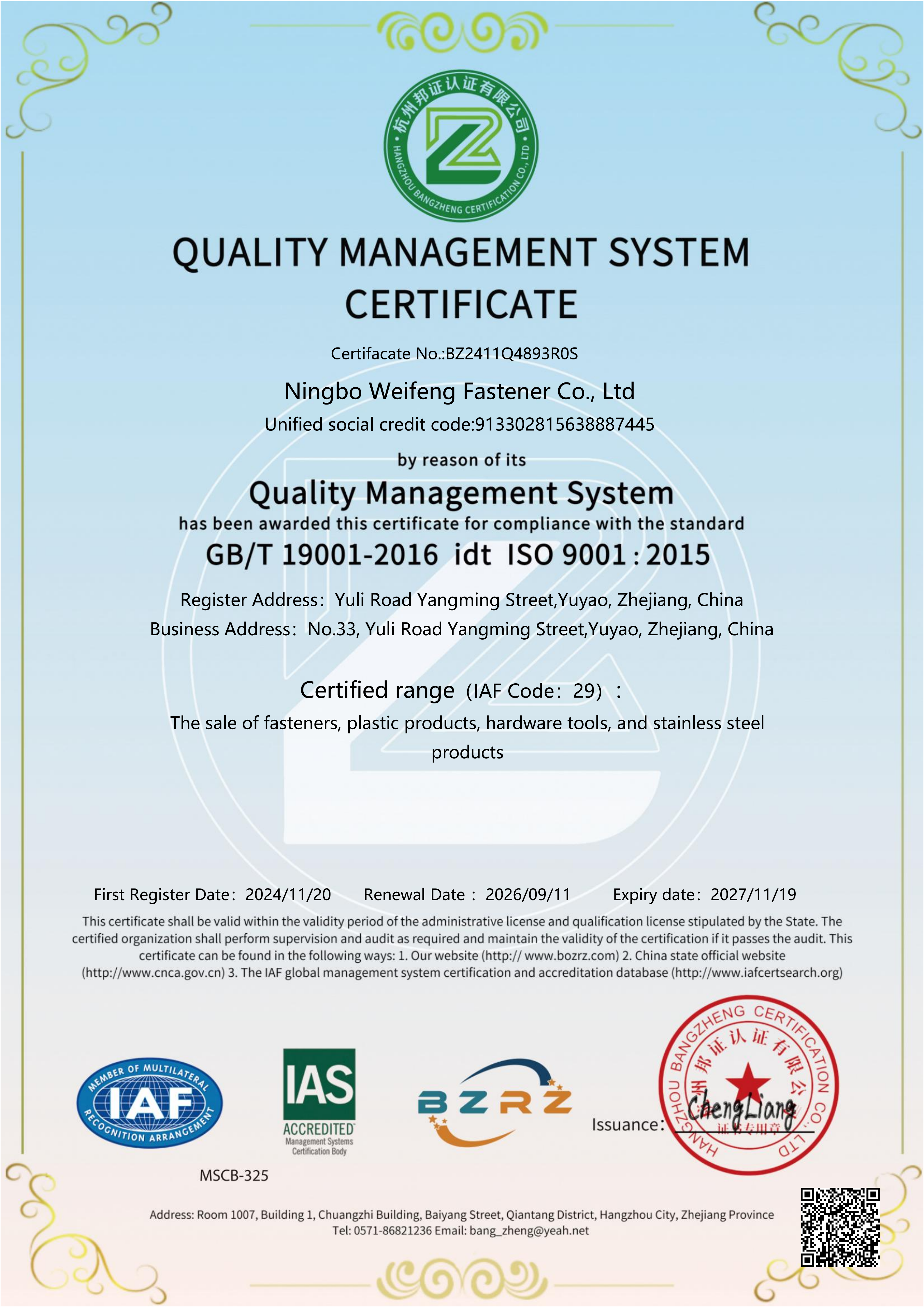
Weifeng Fastener (Ningbo Weifeng Fastener Co., Ltd.) is a fastener manufacturer based at No.33, Yuli Road, Yangming Street, Yuyao, Zhejiang, China, producing screws, bolts, nuts and washers for export markets that its own documentation lists as Europe, North America, South America, the Middle East, Southeast Asia, Russia and Africa, at a stated export ratio of 90%. The company holds ISO 9001 certification, certificate number BZ2411Q4893R0S, issued by HANGHOU BANGZHENG CERTIFICATION CO.,LTD under GB/T 19001-2016, with a scope covering screws, bolts, nuts and anchors and validity from 20 November 2024 to 19 November 2027.
For a specifier converting a thread decision into a purchasing decision, the operating parameters are these: OEM and ODM production for customized orders, with customization covering customized logo, customized packaging, graphic customization and material selection; a minimum order quantity of 300 kg; a typical production lead time of 35–60 days after order confirmation; and a monthly production capacity stated at 1,000 tons for OEM and ODM orders. Quality control is described as professional sampling inspection of every production batch by dedicated QC personnel, supported by 24/7 online technical support, remote video support for technical guidance, and a quality guarantee and replacement policy.
Two honest limits belong beside those figures. First, they are company-reported capability statements; the way to test them is a factory audit, a material certificate and a trial order, not a second reading of the catalogue. Second, the company reports its own customer outcomes — for example a hardware wholesaler running 100 containers per year over two years, with a stated zero return rate and a 30% increase in local market share — and these are supplier-reported results rather than independently audited ones. Treat them as a starting point for reference checks.
Frequently asked questions
What is the difference between coarse thread and fine thread drywall screws?
Coarse threads are typically for wood studs; fine threads are for light gauge metal studs. Selection depends on stud thickness, point type and the specific product ratings, and where a product manual allows multiple substrates, the manual governs. Interchangeability should not be assumed from thread appearance alone.
Which standards should a fine or coarse thread drywall screw be checked against?
DIN 18182-1 specifies Type TN — trumpet head, double continuous thread — for 3.5 mm diameter drywall screws with lengths from 25 mm to 55 mm, which gives a concrete dimensional envelope to check a product against. Treat a standard reference, a product conformity statement and a product certification as three separate items: a listing that states an item is not certified does not establish anything about the rest of a supplier range, and a standard’s existence does not prove a given SKU conforms.
Can one manufacturer supply fine and coarse thread drywall screws in the full #6–#10 range?
Suppliers offering OEM and ODM production can quote both thread types within the 3.5–4.8 mm (#6–#10) shank range, with customization covering logo, packaging, graphic design and material selection. Confirm the exact diameter and length combination per SKU against drawings or inspection records, because published ranges describe what a supplier offers rather than what is verified for every item.
What order quantity and commercial terms apply?
For OEM and ODM production the stated minimum order quantity is 300 kg, with delivery terms of FOB or CIF and payment of 30% T/T in advance and 70% T/T against a copy of the bill of lading. MOQ and terms should be confirmed in the quotation for the specific thread type, diameter, length and coating being specified.
How is conformance verified before shipment, and what is the lead time?
Acceptance typically combines pre-shipment testing with third-party inspection, on top of batch sampling inspection by dedicated QC personnel during production. The stated typical production lead time is 35–60 days after order confirmation. If you are preparing a submittal for a project that mixes fine and coarse thread fixings, the technical team can review the substrate schedule with you and confirm which items in the range match it — start with the current Weifeng Fastener product catalogue and send the schedule with your enquiry.
Conclusion
The decision itself is short. Fine thread for light gauge steel studs, coarse thread for wood studs, with the diameter chosen independently from the #6–#10 (3.5–4.8 mm) span according to the stud gauge and board build-up. What separates a defensible specification from a default one is the trail behind it: a measured stud thickness, a trial drive on the actual assembly, a product rating that covers the substrate, and a standard reference that has been checked against the SKU rather than assumed from the category.
Everything else — bugle head, Phillips drive, sharp or drill point, black phosphate or zinc plating, loose or collated — follows from the substrate, the service environment and the installation method. Get the thread right first, and the remaining choices stay in the order they belong.

Have Questions or Need More Details?
Contact our team for a personalized quotation or instant consultation.
Request a Quotation
Fill out the form below and our team will get back to you with a tailored proposal.
WhatsApp Direct Chat
Prefer to chat in real-time? Message us on WhatsApp for instant assistance & quick answers.
- Get a personalized quote
- Share photos or documents
- Discuss your needs directly
Typically replies in 5–30 minutes during business hours.