
Wedge Anchor Alternatives Ranked: Drop-in, Shield and Concrete Screw Picks
Short answer. Where a wedge anchor is the default concrete fixing, three alternatives cover most remaining construction and decoration cases. Ranked by application fit and installation character: 1) the drop-in anchor for suspended ceilings, fire protection piping and HVAC systems; 2) the shield anchor for industrial fencing, security grills and warehouse racking; 3) the concrete screw for temporary fencing, racking and handrails. The wedge anchor remains in the comparison as the reference category, not as a rival to be displaced.
The three picks are described from the supplied product ranges. Drop-in and shield anchors run from M6 to M20; the drop-in is offered in carbon steel, brass or stainless steel with a white zinc finish; the shield uses a 3- or 4-segment sleeve and can be re-used with different bolts; the concrete screw covers 5–12 mm diameters and 30–150 mm lengths with a non-expansion thread. No load tables, torque figures or test reports for these three ranges were available for this article, so the ranking carries no strength claim. A fixing that carries a calculated load needs the project specification and the product-specific documents for the exact size, material and base condition.
The Wedge Anchor Reference: What the Category Does
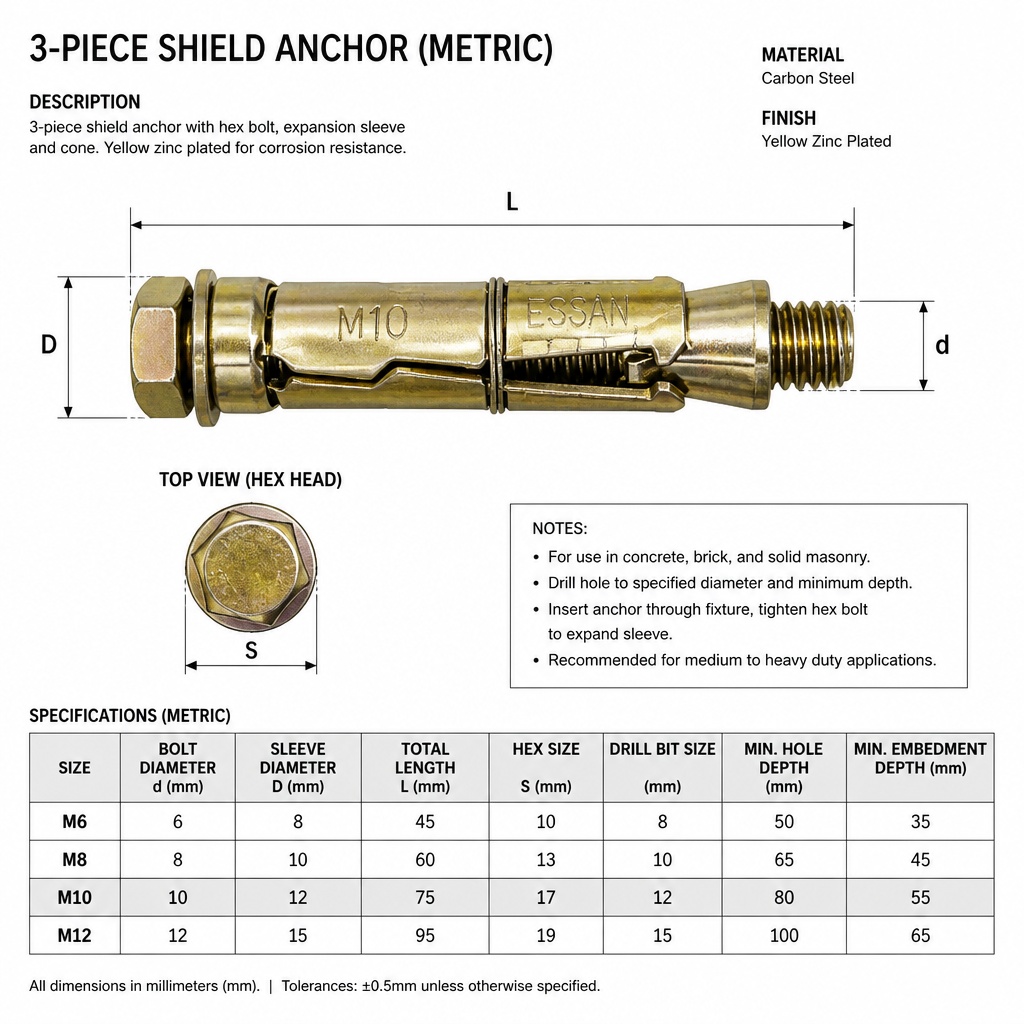
A wedge anchor is a deformation-controlled expansion anchor installed in a drilled hole. It is a through-bolt fixing: a threaded stud with a nut and washer, and an expansion clip at the embedded end that is drawn up as the nut is tightened, so the clip wedges against the wall of the hole. Published documentation for named products shows how the category is specified rather than how every anchor performs. One European technical approval describes M6, M8, M10, M12, M16 and M20 sizes in galvanized steel and stainless steel for that manufacturer's range, and a US manufacturer's technical page describes testing to ASTM E488 with AISI 1010–1018 bodies and ASTM A563 Grade A nuts.
Two market and trade data points frame the category. The global anchoring fasteners market was estimated at USD 3.12 billion in 2024, with mechanical anchors accounting for 58.3% of it, according to Grand View Research figures supplied for this review. On the import side, a 2000 US Customs ruling (NY f88287) classifies wedge anchors from China under HTSUS 7318.15.2090 — a classification worth confirming with a broker before a shipment rather than after it.
Where the reference category runs out is geometry and servicing. The stud stays in the concrete when the nut and fixture come off, so a fixture has to slide over the studs to be fitted; a fixing set by expansion stays set; and the fixing cannot be re-sized after installation. Those three characteristics, more than any performance argument, are what send buyers to the alternatives below.
How This List Was Ranked
Four criteria decided the order, applied to the applications named for each fixing rather than to the products in the abstract:
- Application pattern. Whether the fixture is hung from the soffit, bolted flat, or expected to come down again.
- Installation sequence. How many separate operations sit between drilling the hole and loading the fixture, and what access each one needs.
- What stays in the base. Stud, sleeve, internal thread or nothing — this decides servicing and re-work.
- Range and material fit. Whether the supplied sizes, materials and finishes match the base material and the environment.
The positions are editorial and express fit for the named applications. They are not a tensile or shear ranking, not a fire or seismic qualification, and not permission to substitute one fixing for another on a specified project.
1. Drop-in Anchor: Suspended Ceilings, Fire Protection Piping, HVAC
The drop-in anchor takes first place because the three applications named for it share one requirement: something is suspended from the concrete soffit, and the hanger or rod has to be fitted, adjusted and sometimes replaced from below.
In the supplied range it is a standard internal thread anchor from M6 to M20, available in carbon steel, brass or stainless steel with a white zinc finish. The body is set into a drilled hole, the internal thread is left available at the surface, and the bolt or threaded rod is screwed in afterwards. That split sequence is why it suits overhead services: setting the anchor and installing the rod are two separate operations, and the second one happens with a spanner at working height.
Three conditions travel with the choice. The internal thread fixes the rod diameter, so an M10 anchor receives M10 rod; the range offers M6 to M20, but it does not allow an oversized rod in a smaller body. The hole has to be drilled to the specified diameter, cleaned before setting, and the anchor expanded with a setting tool matched to its size — without the tool the internal plug is not expanded as designed and the thread will not hold as intended. Material and finish follow the environment: white zinc on carbon steel for dry interior work, stainless where the fixing is exposed to moisture or exterior conditions, with brass as a further option in the supplied range. The project's corrosion specification should decide that, not the price list.
The limitation is flexibility after installation. Once set, the internal thread is the only interface and the anchor cannot be re-sized; a change to a larger rod means a new fixing point. Removal generally means drilling the body out or leaving it in place. Fire protection piping also carries its own approval regime: whether a given anchor is acceptable for a fire-rated support depends on the listing or evaluation the project requires, and a product category name does not establish it.
2. Shield Anchor: Industrial Fencing, Security Grills, Warehouse Racking
The shield anchor takes second place because fencing, grills and racking share a different pattern: the fixture is a post, frame or upright that is installed, aligned, and later partly dismantled, and the bolt is the part that gets changed.
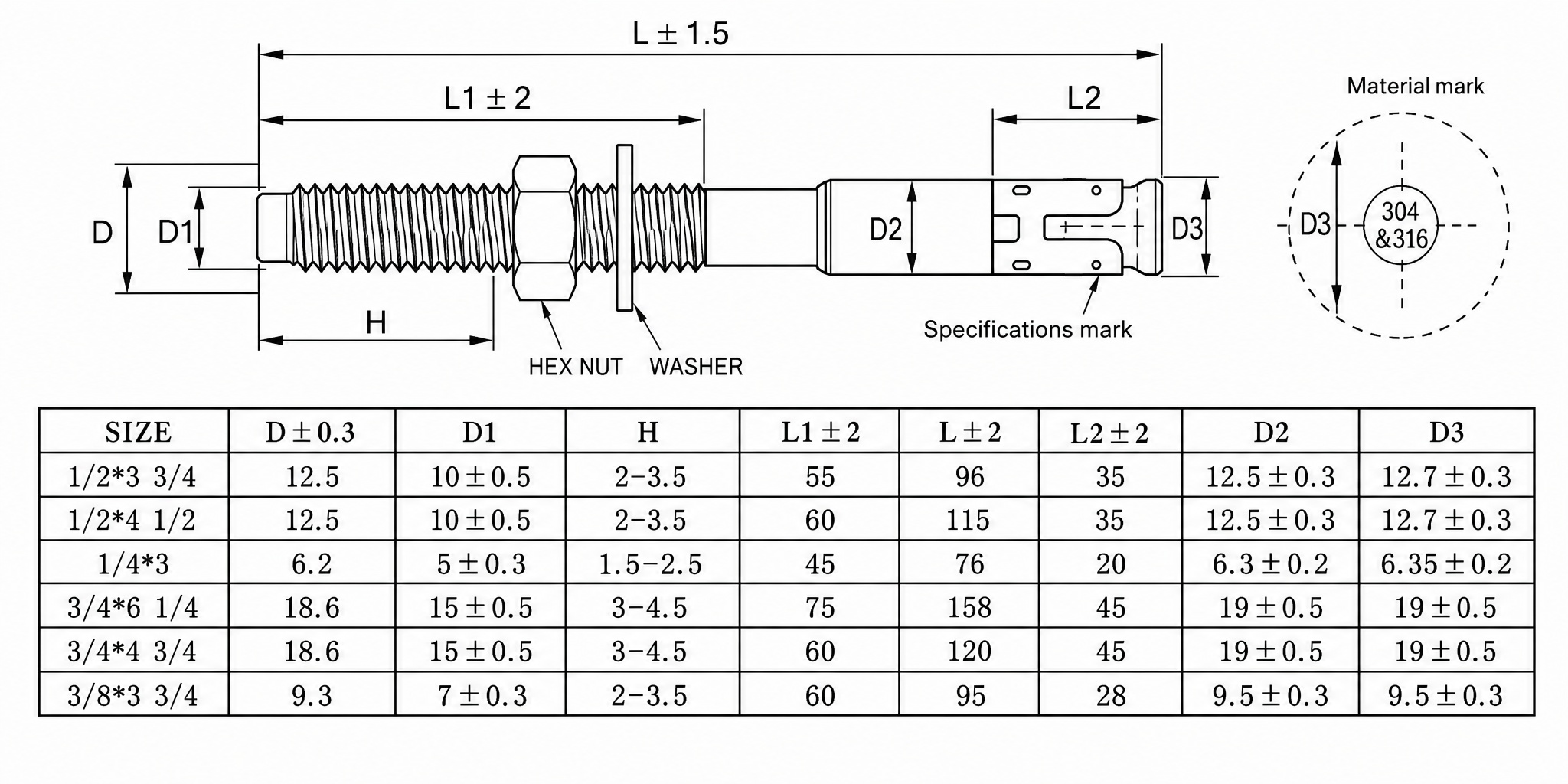
In the supplied range it is a 3-segment or 4-segment expansion shield from M6 to M20. The shield is a separate sleeve: the bolt passes through the fixture and through the sleeve, and tightening the bolt draws the expansion segments outward against the hole wall. Because the sleeve is its own component, the bolt can be taken out and replaced with a different bolt, and the fixture can come off and go back onto the same shield. For a fence post that has to be re-aligned, a security grill panel that is replaced, or racking whose beams and uprights are re-set as the layout changes, that is a practical difference rather than a theoretical one.
The 3-segment and 4-segment versions differ in how the expanding portion of the shield is divided — four leaves instead of three — which changes the geometry of the expansion. It does not, by itself, tell a buyer which version carries more load in a given base material. That answer has to come from the product's own test documentation for the specific size and concrete strength.
Two limits belong in the order. First, the shield stays in the concrete: removing the fixture leaves an open sleeve, which is acceptable for a racking layout change and unsuitable for a finished wall. Second, re-usability with different bolts is a design characteristic, not a blanket guarantee that a re-used fixing keeps its original rated capacity. Tightening torque and sleeve condition have to follow the manufacturer's instructions, and a shield that has been over-tightened or pulled out of position should be replaced rather than re-used.
3. Concrete Screw: Temporary Fencing, Racking, Handrails
The concrete screw takes third place because it is the specialist of the three: it is the pick when the fixing is temporary, and its supplied size envelope is narrower than the anchors above it.
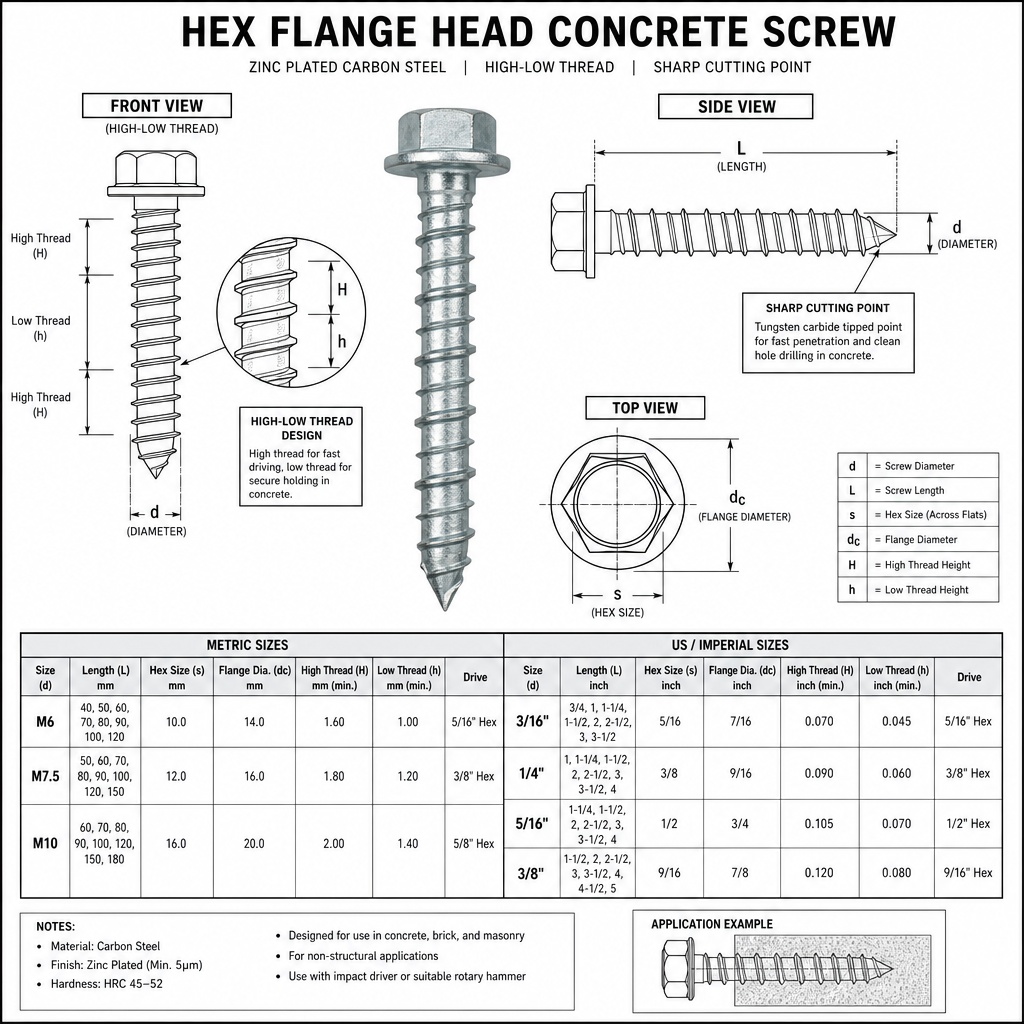
In the supplied range it is a hex flange head concrete screw covering 5–12 mm diameters and 30–150 mm lengths, with a non-expansion thread. There is no expansion clip in the design: the screw is driven into a correctly sized hole in the base material and the thread engages the concrete, with the flange under the head bearing on the fixture in place of a separate washer. Because there is no expansion element to set and no separate rod or bolt to fit afterwards, placement is a single driving operation, and removal is equally direct — the screw comes out with the fixture.
The limits follow from the same design. The 5–12 mm diameter and 30–150 mm length range sets the practical envelope, and whether a given size is adequate for a given fixture has to come from the product's documented capacity rather than from the diameter on its own. The approved base material is defined by the product documentation; a concrete screw is not a substitute for a cavity fixing in hollow block or thin panels. A temporary fixing still demands the specified hole diameter — an oversized hole removes the thread engagement the fixing depends on.
Side by Side: How the Four Fixings Differ
| Fixing | Role in this list | Supplied range | Material / finish | Left in the base after the fixture comes off | Named applications |
|---|---|---|---|---|---|
| Wedge anchor | Reference category | M6–M20 in a published European technical approval for that manufacturer's product | Galvanized steel and stainless variants in that approval; AISI 1010–1018 body and ASTM A563 Grade A nut in a published US test reference | The stud | Structural through-fixing into concrete |
| 1. Drop-in anchor | Rank 1 | M6–M20 internal thread | Carbon steel, brass or stainless steel; white zinc finish | The body, with an open internal thread | Suspended ceilings, fire protection piping, HVAC systems |
| 2. Shield anchor | Rank 2 | M6–M20; 3-segment or 4-segment shield | Not stated in the supplied range data — confirm per SKU | The shield sleeve; the bolt can be changed | Industrial fencing, security grills, warehouse racking |
| 3. Concrete screw | Rank 3 | 5–12 mm diameter; 30–150 mm length; non-expansion thread | Not stated in the supplied range data — confirm per SKU | Nothing; the screw comes out with the fixture | Temporary fencing, racking, handrails |
Range, material and finish notes: drop-in, shield and concrete screw data as supplied for these three product families; wedge anchor sizes and material variants as stated in the MÜPRO technical approval and the DEWALT technical page cited above. Each statement describes the product it was published for, not every anchor of the same category.
Four Checks Before You Order
1. Base material. All three alternatives are mechanical concrete fixings. The base material governs: solid concrete with the approved base listed in the product documentation, while hollow block and thin panels call for a cavity fixing instead. Where the concrete is cracked or the project is seismic, screening moves to product-specific evaluation statements such as those written to ICC-ES AC193 and ACI 355.2, which are issued for named products — a MiTek technical bulletin states cracked and uncracked concrete evaluation for its product, and a Fastenal WA++ submittal states a seismic, cracked and uncracked concrete rating with Category 1 diameters. Neither statement transfers to another manufacturer's anchor.
2. What has to come off later. The rod only points to a drop-in anchor; the bolt only points to a shield anchor; the whole fixing points to a concrete screw; and nothing coming off points back to the through-bolt reference geometry. Deciding this before ordering avoids the usual re-drill on site.
3. Environment and material. White zinc on carbon steel suits dry interior work; stainless covers moisture and exterior exposure, and the grade has to be confirmed in the documentation rather than assumed. Material strength and anchor capacity are different numbers: one published approval for an AISI 316 (EN 10088 1.4401) wedge anchor lists minimum material values of f_uk ≥ 500 N/mm² and f_yk ≥ 210 N/mm². Those are properties of the steel in that approved product, not the load the anchor can carry, and not transferable to another supplier's 316 anchor.
4. Documentation per SKU. Ask for the evaluation or test document that names the exact size, material and base condition you are buying. An ISO 9001 certificate is a quality-management document for a defined scope; it is not a product approval and does not certify an anchor's capacity. Both documents are worth having, and they answer different questions.
Supply Side: The Ranges Behind the Three Picks
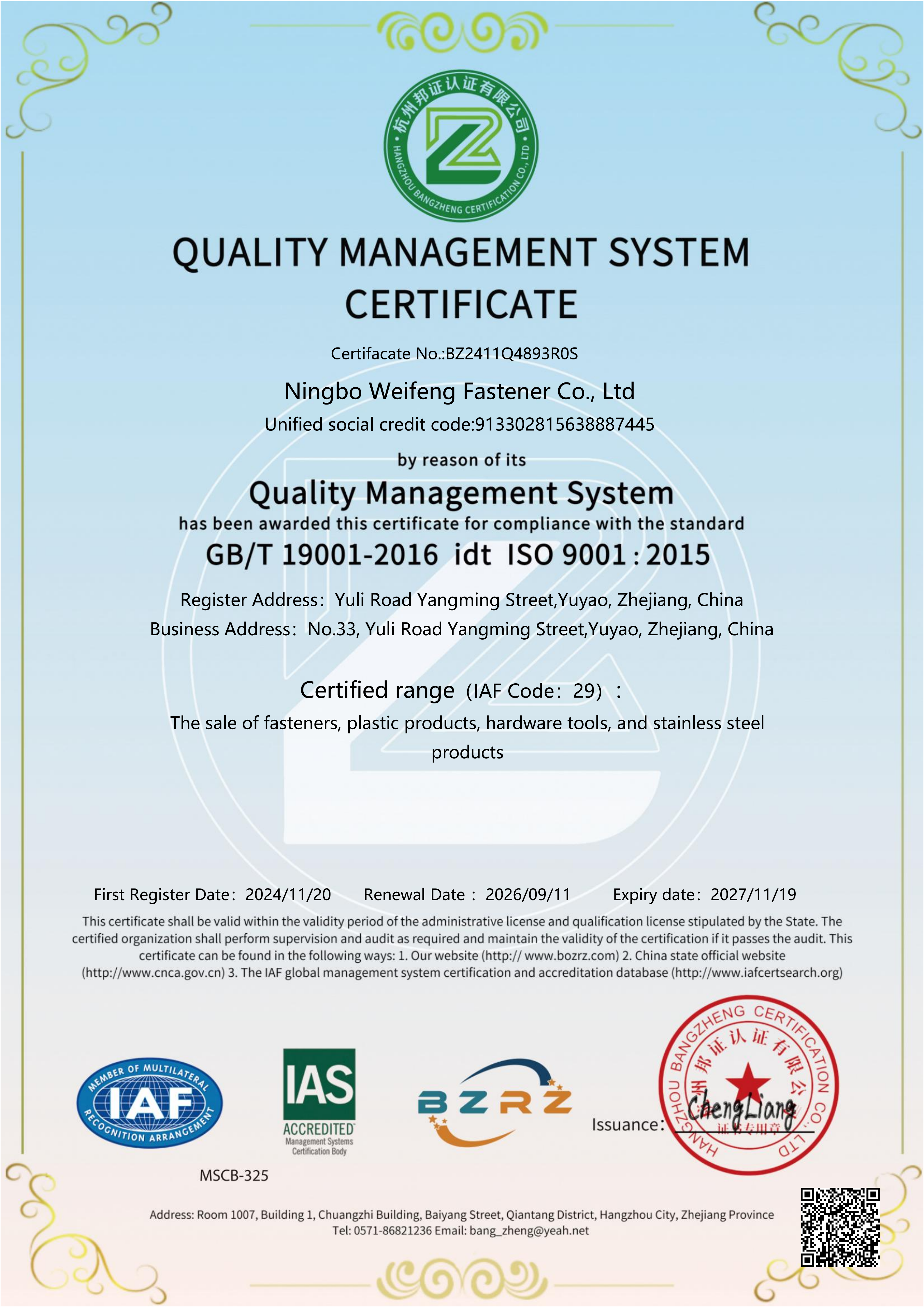
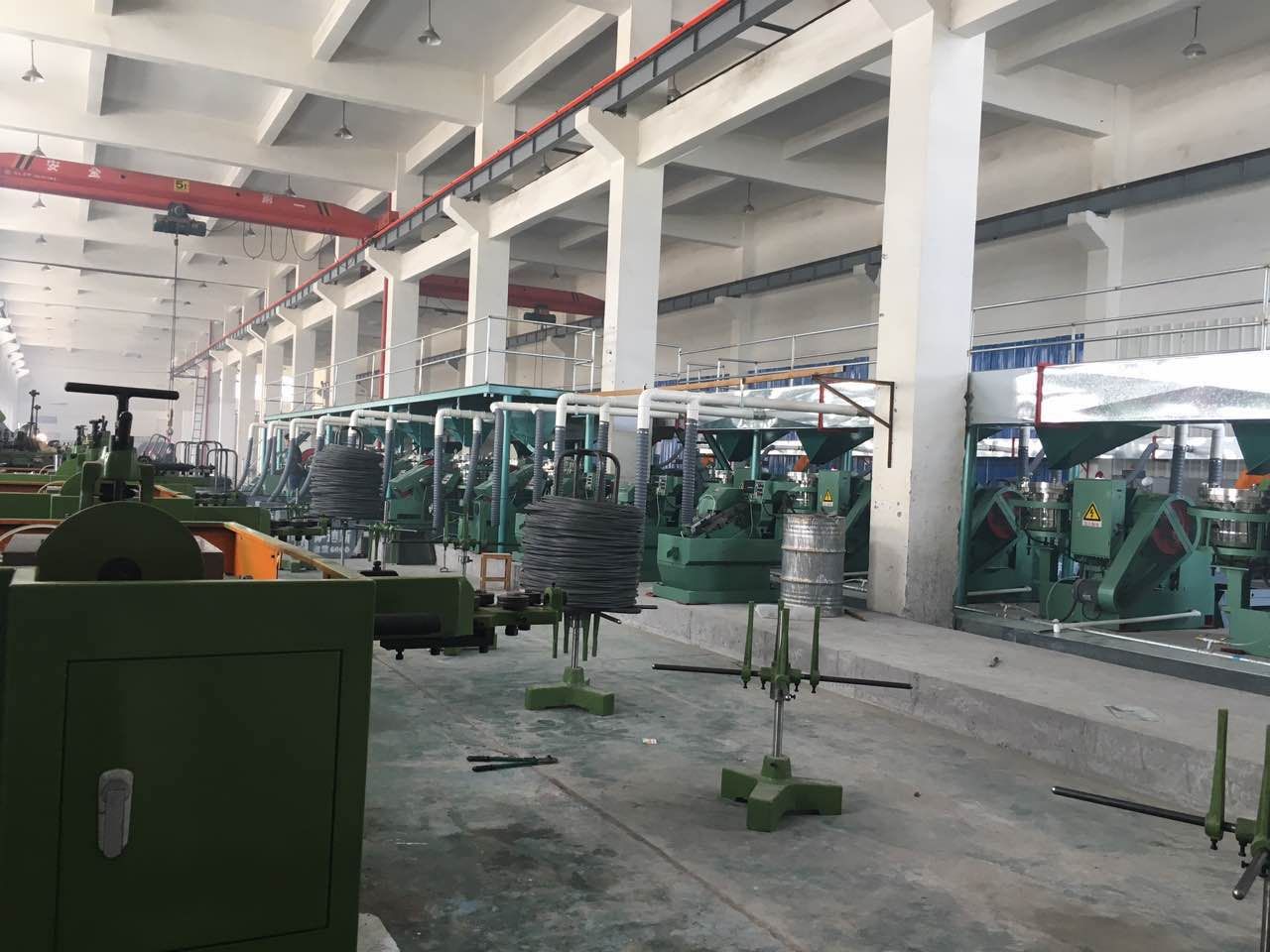
Ningbo Weifeng Fastener Co., Ltd is a fastener manufacturer and exporter based in Yuyao, Zhejiang, China, with a portfolio covering screws, bolts, nuts, washers, anchors and wood screws, and export markets that include Europe, North America, South America, the Middle East, Southeast Asia, Russia and Africa. Its supplied ISO 9001 certificate (No. BZ2411Q4893R0S, issued by Hanghou Bangzheng Certification Co., Ltd against GB/T 19001-2016) names screws, bolts, nuts and anchors in its scope, is dated 20 November 2024 and runs to 19 November 2027.
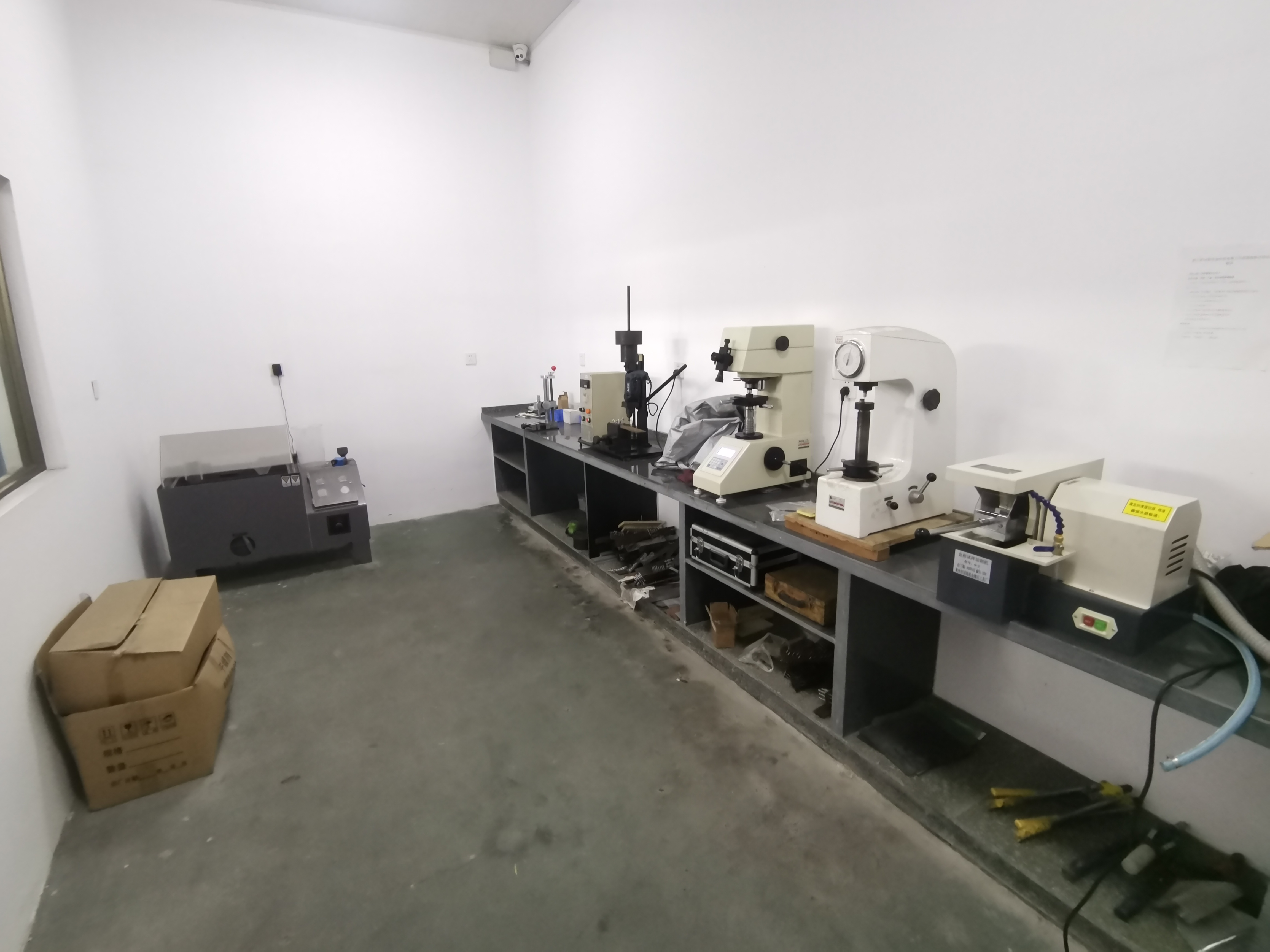
The stated commercial terms are a 300 kg minimum order, a 35–60 day lead time, and OEM/ODM customization covering logo, packaging, graphic customization and material selection. Quality control is described as professional sampling inspection of every batch by dedicated QC personnel, and after-sales support includes 24/7 online technical assistance, remote video support, and a quality guarantee and replacement policy.
Documented supply experience that touches these applications includes three years of supply at roughly 100 tons per month to solar project developers and EPC contractors for panel bracket installation and outdoor rack fixing, with a 720-hour salt spray test, a reported 20% reduction in installation time and no corrosion failure recorded in high-humidity conditions. A construction contractor has been supplied for more than five years at 120 containers per year with zero reported safety incidents, and a hardware wholesaler for two years at 100 containers per year with a zero return rate and a customer-reported 30% increase in local market share. These are supplier-reported case records for fastener supply, not third-party test results for the drop-in, shield or concrete screw ranges.
An inquiry that can be quoted without a round of questions names six things: fixing type, size, material grade, finish, base material and fixture thickness, plus whether the fixing must be removable and which product documents the project requires.
FAQ: Wedge Anchor Alternatives
Can a drop-in anchor, shield anchor or concrete screw replace a specified wedge anchor?
Only through the project specification. Evaluation and test statements belong to the products named in them: the MiTek bulletin covering cracked and uncracked concrete to ICC-ES AC193 and ACI 355.2, and the Fastenal WA++ submittal stating a seismic, cracked and uncracked concrete rating, are both product-specific. A substitution needs the alternative fixing's documented capacity for the same base material, embedment and loading, and the specifier's approval of that change.
Which of the three suits overhead services, and which suits racking?
The drop-in anchor suits suspended ceilings, fire protection piping and HVAC because its internal thread accepts a threaded rod or bolt from below; the supplied range runs M6 to M20 in carbon steel, brass or stainless steel with a white zinc finish. The shield anchor suits warehouse racking, industrial fencing and security grills because its 3- or 4-segment sleeve stays in the base and the bolt can be changed; that range also runs M6 to M20.
What drives the cost difference between these fixing types?
Material and finish come first — carbon steel with white zinc, stainless steel, or brass in the drop-in range — followed by size, the segment count of a shield anchor, thread type, and any packaging or logo customization. Order quantity matters as well, since Weifeng quotes from a 300 kg minimum. No price list was supplied for this article, so a cost comparison has to be built from quotations on the same size, material and quantity basis.
How should sample fixings be evaluated before ordering?
Check four things: dimensions and thread against the drawing, material and finish against the requirement, compatibility with the setting tool or drill diameter, and the batch inspection record — Weifeng states sampling inspection of every batch by dedicated QC personnel. Then install the samples in the same base material and with the same fixture as the project, because a sample tested in a different concrete grade tests something else.
What are the order terms, and how do I get a quotation?
Weifeng states a 300 kg minimum order, a 35–60 day lead time and OEM/ODM customization of logo, packaging, graphics and material selection, with 24/7 online technical support. A usable inquiry names the fixing type, size, material, finish, quantity, destination port and the product documents the project needs. The catalogue at the end of this article lists the ranges, and quotations are handled through the company's contact channels.
Conclusion
In one line: the drop-in anchor for overhead services carried on threaded rod, the shield anchor for fixtures whose bolts get changed, the concrete screw for fixings that come out again, and the wedge anchor as the reference for through-bolt work in solid concrete. The ranking follows the supplied ranges and the way each fixing is installed, not a hierarchy of strength.
Where a fixing carries a calculated load, sits in cracked concrete, or supports a fire-rated system, the deciding document is the product-specific evaluation or test report for the exact size, material and base condition. That document outranks the category name, and it outranks this list.
Have Questions or Need More Details?
Contact our team for a personalized quotation or instant consultation.
Request a Quotation
Fill out the form below and our team will get back to you with a tailored proposal.
WhatsApp Direct Chat
Prefer to chat in real-time? Message us on WhatsApp for instant assistance & quick answers.
- Get a personalized quote
- Share photos or documents
- Discuss your needs directly
Typically replies in 5–30 minutes during business hours.