
Paper-Plastic Composite vs PP Woven Bags for Cement, Feed & Rice
Paper-Plastic Composite vs PP Woven Bags for Cement, Feed & Rice
For cement, feed and rice, the choice between paper-plastic composite bags and PP woven bags is decided by constraints, not by preference. A paper-plastic composite bag — kraft paper outside, woven polypropylene inside — suppresses dust and holds high-quality print. A PP woven bag carries heavier loads, accepts a moisture barrier or a welded valve, and is available in far wider weight and mesh ranges. Which format you approve depends on four hard limits: your filling line, your moisture ceiling, your print requirement, and the compliance documents your buyer asks to see.
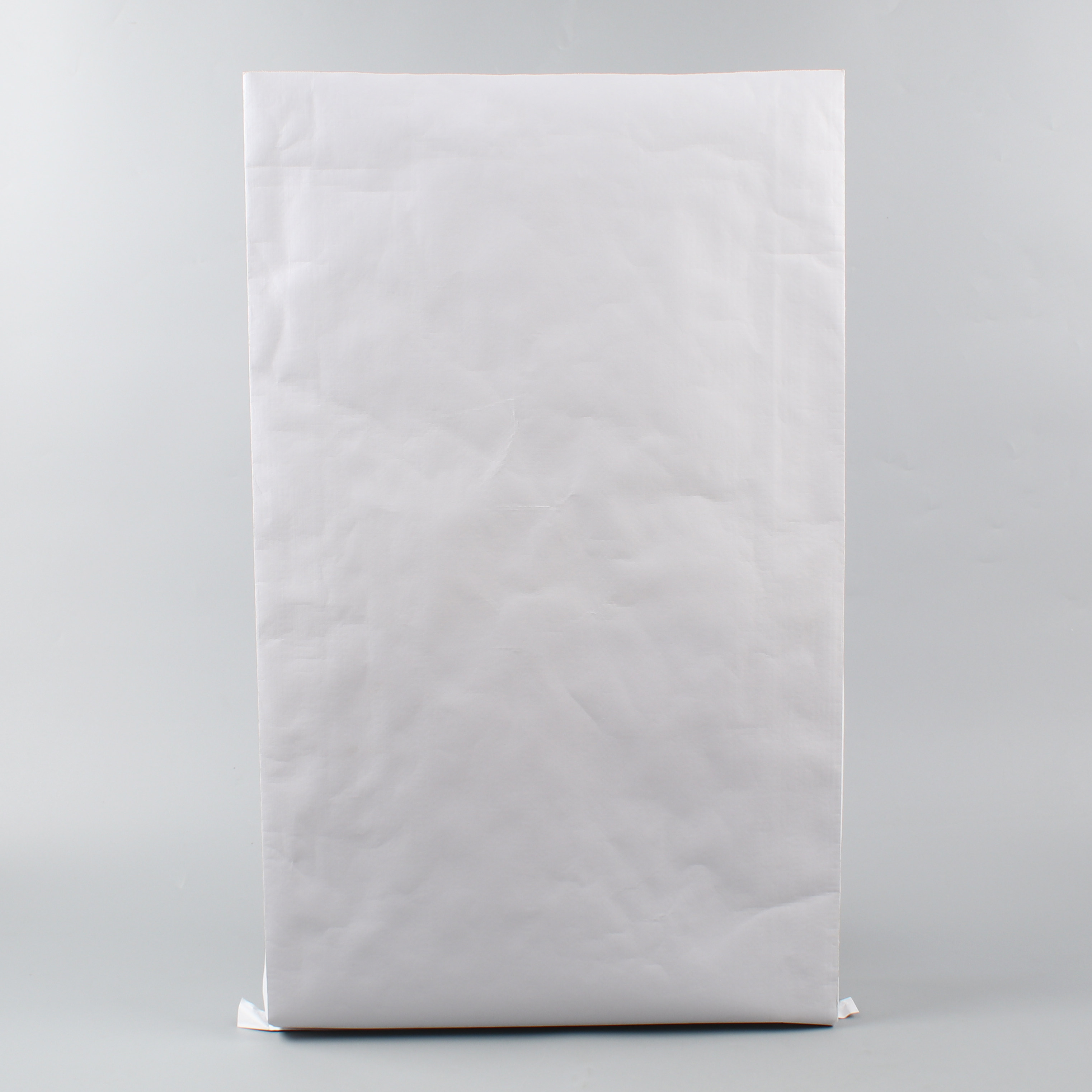
Paper-plastic composite woven bag: kraft paper outer layer over 100% virgin PP woven fabric, with PE liner optional. Product image from Wenzhou BaiChuan Plastic Industry Co., Ltd.
Problem Definition: Why These Two Formats Get Shortlisted Against Each Other
Both formats can be printed, both can be lined, and both can be filled at 25 kg or 50 kg. That overlap is exactly why specification teams stall. The purchase committee is not really comparing “paper versus plastic”; it is comparing six constraints that pull in different directions.
- Dust control. Fine cement and chemical powders escape through stitch holes and open weave. A paper-faced composite reduces powder leakage during filling and handling, and a PE inner liner does the same job on an unfaced woven bag.
- Load and puncture. Cement is dense and abrasive. Composite structures are described by the manufacturer as stronger in tensile and puncture terms than pure paper bags, while a heavy-gauge woven valve bag is built specifically for powder loads at high fill rates.
- Moisture. Feed and rice fail on moisture, not on strength. Neither format is a hermetic pack by default; the barrier comes from BOPP lamination, PE coating, or a PE inner liner, and each option changes the cost line.
- Print quality. A smooth kraft surface takes high-quality flexographic print; a woven surface needs BOPP lamination before fine artwork reads cleanly.
- Filling equipment. Open-mouth bags need sewing or heat sealing. Block bottom valve bags need a valve filling machine. The bag must match the line you already own.
- Documents. Export buyers ask for a quality management certificate with a number, a scope and an expiry date — not a logo on a brochure.
Once these six are written down with target values, the format usually selects itself. The rest of this guide sets out the verifiable parameters that let you write those targets.
Industry Background: Volume, Lamination and a Rising Resin Bill
The scale of the category explains why small specification decisions carry commercial weight. Global production of PP woven bags exceeded 10 billion units in 2023, according to Market Reports World, and China alone manufactured more than 7 billion units in the same year. The same source reports that laminated PP woven bags accounted for 54.5% of total global market volume in 2023 — in other words, more than half of the market already buys a laminated surface rather than a plain woven one.
On the cost side, Trading Economics recorded the polypropylene price at 9,461 CNY per tonne on 10 November 2026, a 47.32% year-on-year increase. Because woven polypropylene is the structural substrate in both formats under discussion, that movement feeds directly into bag quotations. It also explains a behavioural shift in procurement: buyers are re-opening specifications they had treated as fixed, and asking whether a lighter fabric or a different closing style still meets the load requirement.
On the compliance side, GB/T 8946-1998 is the Chinese national standard that regulates technical requirements, inspection rules and classification for PP woven bags. It is a useful reference point in a supplier conversation because it turns a vague request for “good quality” into testable criteria such as broken-wire limits and inspection rules.
Detailed Solution: Format Anatomy and Parameter Envelopes
Paper-plastic composite woven bag (model 20211011)
A paper-plastic composite bag is a two-substrate construction: an outer kraft paper layer bonded to an inner PP woven fabric. In the specification offered by Wenzhou BaiChuan Plastic Industry Co., Ltd., the kraft paper is white or brown at 70–120 gsm, and the inner woven layer is 60–110 gsm virgin PP at 8×8, 10×10 or 12×12 mesh. Sizes are custom width × length for 10 kg, 20 kg, 25 kg, 40 kg or 50 kg fills. The seam is either back stitched or block bottom hot welded in valve style. Printing is flexographic or gravure in 1–6 colours, and a PE inner liner, food-grade material or anti-UV treatment can be added.
The practical consequence is asymmetric: the paper face gives you dust suppression and a smooth, high-fidelity print surface, while the woven core carries the tensile and puncture load. That combination is why composite bags are specified for powder and granular products where both presentation and leakage matter.
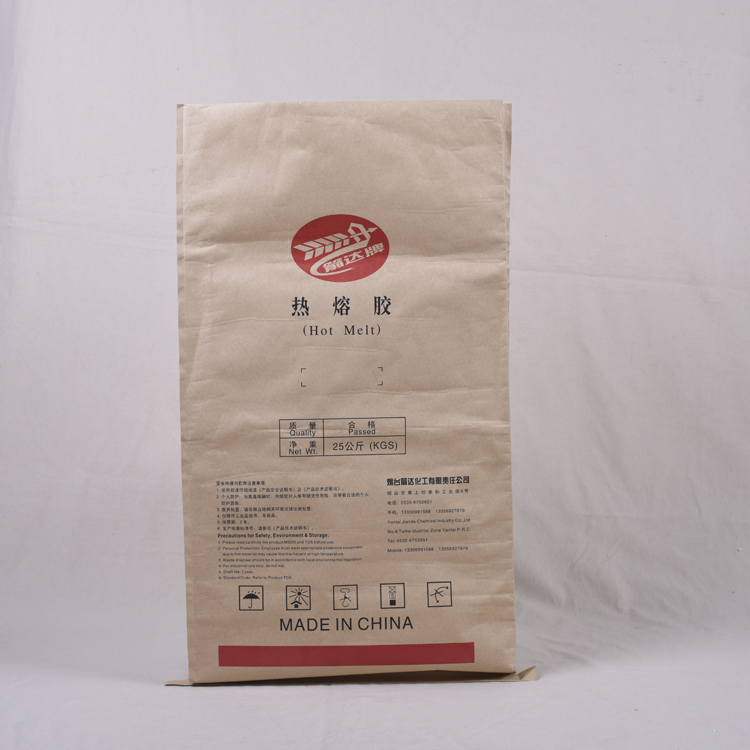
Composite construction: brown or white kraft paper bonded to PP woven fabric, gravure printing up to 6 colours, PE liner optional.
PP woven bag (model 20261020)
A PP woven bag is a single-substrate construction woven from polypropylene tapes. BaiChuan’s specification covers 100% virgin PP or recycled PP with food grade optional, 55–130 gsm fabric weight, 650D–1500D denier, and 8×8, 10×10, 12×12 or custom mesh. The surface can be uncoated, PP laminated, BOPP laminated or UV treated; a PE liner is available. Printing runs 1–8 colours by gravure or flexographic. Top styles include heat cut, hemmed, valve and plastic handle; bottom styles include stitched, heat seal and block bottom.
That envelope is what makes the woven bag the general-purpose option: within one format you can move from a low-cost stitched sack for fertiliser to a laminated, handled rice bag, without changing supplier or substrate family.
Block bottom PP woven valve bag (model 20231010) — the powder-load variant
When cement or dense powder is filled automatically, the relevant PP woven variant is the block bottom valve bag. It uses 100% virgin PP woven fabric at 60–180 gsm and 8×8 to 14×14 mesh, with a stitch-free hot-air welded block bottom and a self-closing PP or non-woven filling valve. BOPP film or PE coating provides moisture protection, printing runs 1–10 colours by gravure or offset, and air permeability is adjustable across a 20–160 range — a parameter that matters because air must escape quickly during powder filling. A PE inner liner, UV treatment and anti-slip surface are optional.
Two consequences follow. First, the welded block bottom produces a stable brick shape after filling, which improves stacking and container utilisation. Second, the valve is designed for compatibility with standard valve filling machines, so the bag decision is partly an equipment decision.
Constraint Checklist Before You Approve a Format
Use this list as the agenda for the specification meeting. It converts the comparison into a set of pass/fail tests rather than an opinion.
- Fill weight and density. Confirm the target fill (10–50 kg across both formats) and the bulk density of the product, because cement, feed pellets and rice stress the fabric differently.
- Fabric weight versus load. PP woven runs 55–130 gsm; the valve bag variant runs 60–180 gsm; the composite’s inner woven layer runs 60–110 gsm. Heavier fabric is not automatically better if the filling line cannot handle the stiffer bag.
- Mesh density. 8×8 to 14×14 threads per inch are available. Finer mesh helps with fine powders; it also changes fabric cost.
- Barrier route. Choose between PE inner liner, PP lamination, BOPP lamination or PE coating. Each solves moisture; each is a separate cost line.
- Closing style versus equipment. Stitched, heat seal, block bottom, or self-closing valve. Match to the filling machine you actually run.
- Print method and colour count. Flexo or gravure at 1–6 colours for composite; 1–8 colours for standard woven; 1–10 colours for the valve bag.
- Handling environment. Bags are rated for continuous service between −10 °C and 50 °C, dry ventilated warehouse storage, and normal filling, pallet stacking and land-and-sea transport. They are not intended for long soaking in water without a liner or coating, and must be kept away from open flame and strongly corrosive chemicals.
- Documents. Request the certificate number, issuing body, scope and validity dates before the first production run.
Step-by-Step Breakdown: Six Steps From Specification to Shipped Order
Use Cases: Cement, Feed and Rice
Cement and construction powder
Cement is the case that most often forces the block bottom valve decision. The load is dense, the filling line is automatic, and dust is a housekeeping and health issue on site. A 60–180 gsm woven valve bag with a stitch-free welded block bottom and adjustable air permeability (20–160) is designed for exactly that combination: fast air release during filling, a stable brick shape after filling, and no stitch perforations for powder to escape through. Where a premium paper finish is required on the same product, a paper-plastic composite in block bottom hot-welded valve style covers the dust and print requirement instead.
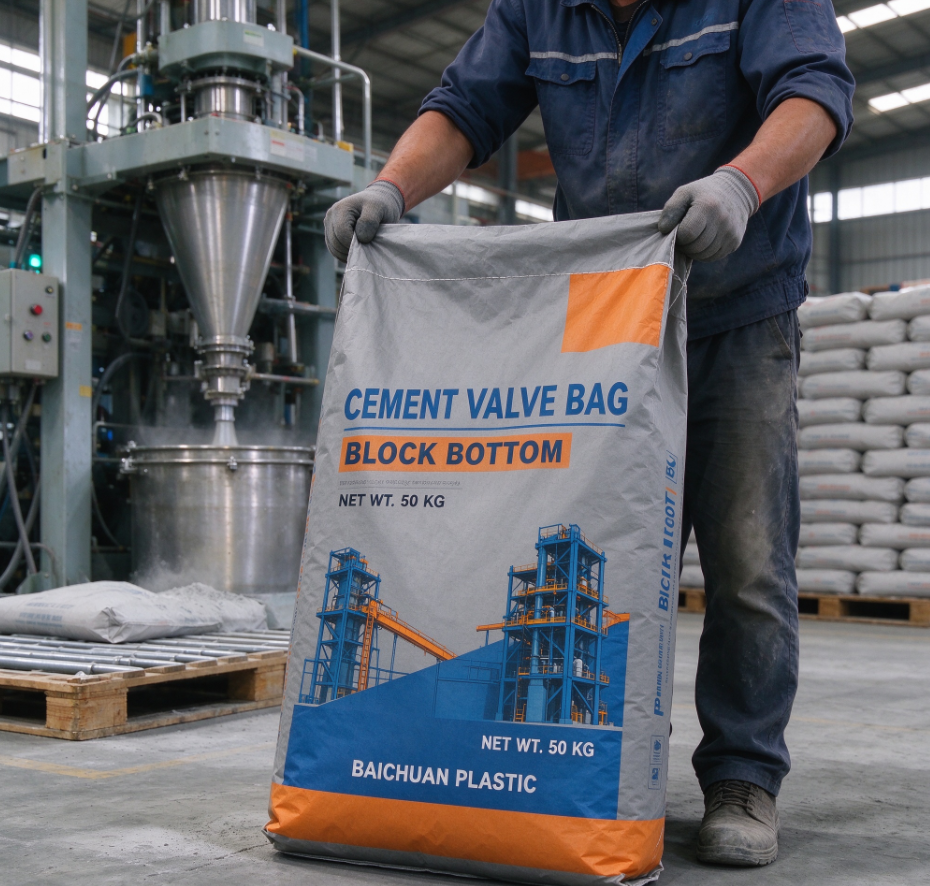
Square-bottom valve woven bags in use for construction materials handling.
Feed and animal nutrition
Feed fails on moisture and on brand presentation, not on tensile strength. A BOPP-laminated PP woven bag with a PE inner liner gives a printable, moisture-resistant pack, and food-grade material can be specified. Feed bags are typically filled manually or semi-automatically, so an open-mouth or block bottom open-mouth construction is often more practical than a valve. Where the buyer wants a paper-like premium finish on retail-facing lines, the composite format substitutes for the laminated woven surface.
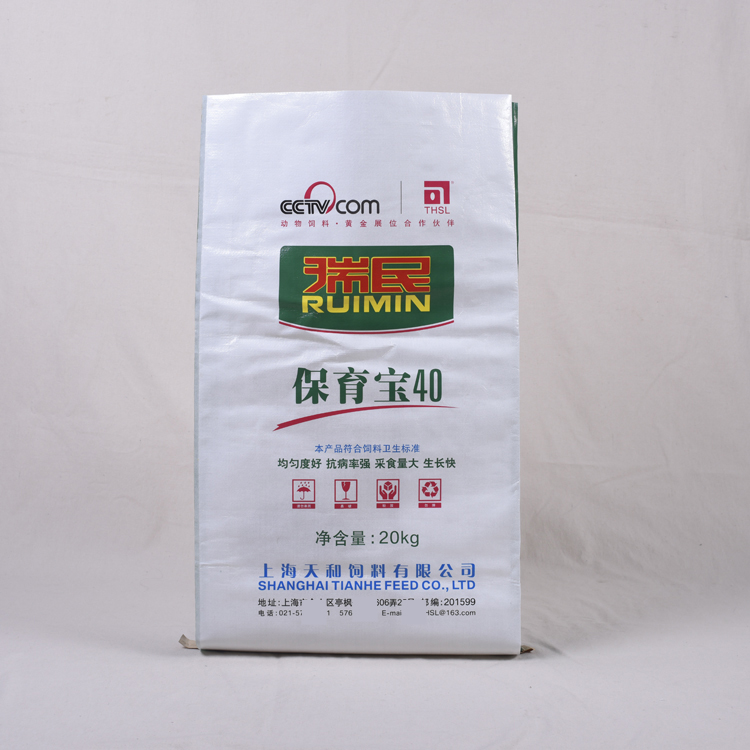
PP woven feed sacks with BOPP colour printing and optional PE inner liner for moisture protection.
Rice and grain
Rice is the most presentation-sensitive of the three. Colour-printed BOPP laminated woven bags with plastic handles are the standard retail format, available in custom sizes for 5 kg, 10 kg, 20 kg and 25 kg, with food-grade raw material available. For palletised bulk shipment rather than retail, a block bottom valve bag is the more efficient choice because it fills automatically and stacks squarely. The paper-plastic composite is the third option: it is used where the paper face carries the brand story and the woven core carries the load.
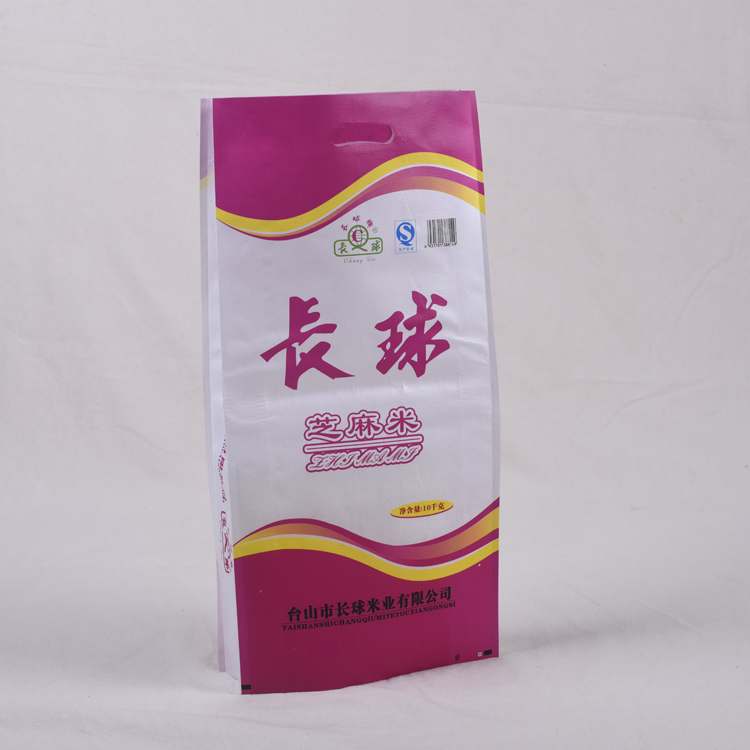
Colour printed BOPP laminated PP woven rice bags, customisable for 5 kg to 25 kg fills.
Comparison Table: Specification-Level Differences
The table below compares the three constructions using published product specifications from Wenzhou BaiChuan Plastic Industry Co., Ltd. It is a parameter comparison, not a ranking: the best format is the one that satisfies your constraint list.
| Constraint | Paper-Plastic Composite Woven Bag (20211011) | PP Woven Bag (20261020) | Block Bottom PP Woven Valve Bag (20231010) |
|---|---|---|---|
| Structure | Outer kraft paper + inner PP woven fabric | PP woven fabric, single substrate | PP woven fabric with welded block bottom and valve |
| Textile weight | PP woven layer 60–110 gsm; kraft paper 70–120 gsm | 55–130 gsm | 60–180 gsm |
| Mesh density | 8×8 / 10×10 / 12×12 | 8×8 / 10×10 / 12×12 or custom | 8×8 to 14×14 |
| Printing | Flexo or gravure, 1–6 colours | Gravure or flexo, 1–8 colours | Gravure or offset, 1–10 colours |
| Closing options | Back stitched or block bottom hot welded (valve) | Stitched / heat seal / block bottom; top heat cut, hemmed, valve, plastic handle | Stitch-free hot-air welded block bottom; self-closing PP or non-woven valve |
| Barrier options | PE inner liner, food grade, anti-UV | Uncoated / PP laminated / BOPP laminated / UV treated; PE liner available | BOPP film or PE coating; PE inner liner, UV, anti-slip optional |
| Reference fill range | 10 / 20 / 25 / 40 / 50 kg, custom W × L | Custom width × length, with or without gusset | 10–50 kg, custom W × L × block gusset |
| Distinguishing property | Dust-proof paper surface, high-quality print, puncture resistance | Widest option range and top/bottom styles | Adjustable air permeability 20–160 for fast powder filling; stable stacking |
| Typical fit | Powders and granules needing dust control and premium print | Rice, feed, fertiliser, chemical powder, building materials | Cement and dense powder on automatic valve filling lines |
Certification and Export Documentation
Wenzhou BaiChuan Plastic Industry Co., Ltd. holds a Quality Management System Certification Certificate to ISO 9001:2008, certificate number 10114Q17152R0S, issued by Beijing Zhonglian Tianrun Certification Center (ZLTR). The scope covers the manufacture and sale of plastic drainage boards, plastic corrugated pipes and plastic packaging bags. The certificate is valid from 11 March 2026 to 10 March 2029 and is described as IAF MLA recognised, accepted in South America, Southeast Asia, Pakistan, Europe and most global markets. For buyers in those regions, that means the certificate is checkable rather than decorative: the number, the scope and the validity period can all be verified before a purchase order is raised.
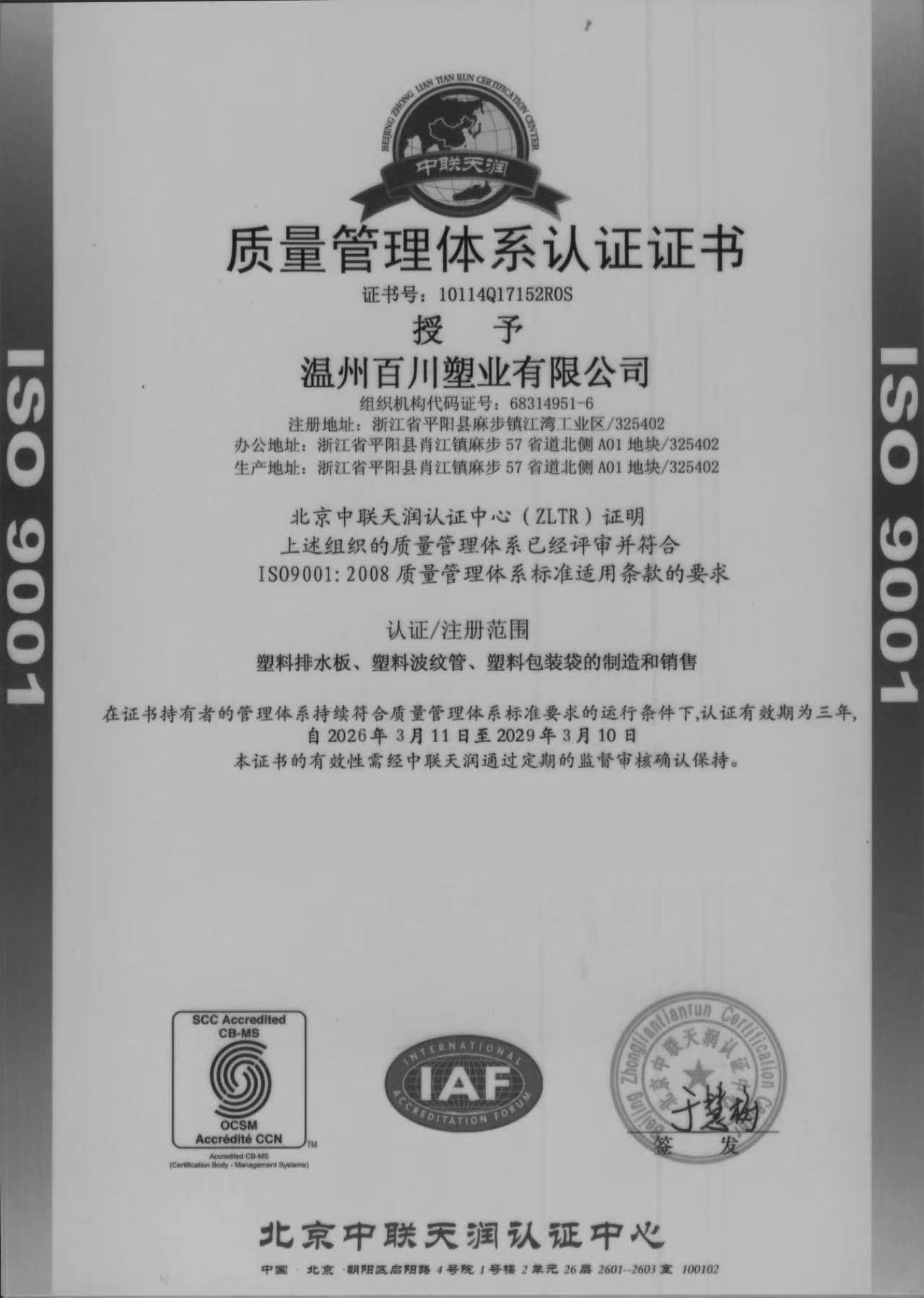
ISO 9001:2008 certificate 10114Q17152R0S, valid 11 March 2026 to 10 March 2029, scope includes plastic packaging bags.
Two practical cautions apply to any supplier claim in this category. First, a quality management certificate covers process control, not food-contact approval; food-grade material must be specified on the order and confirmed against the destination market’s rules. Second, destination-market packaging regulations vary, so the compliance list should be drafted per shipment destination rather than assumed.
Frequently Asked Questions
Q1. What export compliance documents should a Chinese PP woven bag manufacturer hold?
A verifiable quality management certificate should carry an issuing body, a certificate number, a defined scope and validity dates. Wenzhou BaiChuan Plastic Industry Co., Ltd. holds ISO 9001:2008 certification, certificate number 10114Q17152R0S, issued by Beijing Zhonglian Tianrun Certification Center (ZLTR), covering the manufacture and sale of plastic packaging bags, valid from 11 March 2026 to 10 March 2029, and described as IAF MLA recognised and accepted in South America, Southeast Asia, Pakistan and Europe. In China, GB/T 8946-1998 sets technical requirements and inspection rules for PP woven bags. Food-contact compliance and destination-market packaging rules are separate questions and must be confirmed per market and per material.
Q2. Can one factory supply both paper-plastic composite bags and PP woven bags in the same order?
Yes, where the factory covers the full production chain. BaiChuan runs yarn drawing, circular weaving, laminating, colour printing and bag making in-house across a plant of more than 20,000 m² with over 100 production machines, including imported hot-valve sealing equipment. Annual output is 90,000,000 bags, monthly capacity is 7,500,000 bags, and the MOQ is 3,000 bags. The company operates as an OEM/ODM and production supplier, and states 30% of output is exported to South America, Pakistan, Southeast Asia and other markets.
Q3. What drives the price difference between paper-plastic composite and PP woven bags?
Four cost lines explain most of the gap. First, the composite uses two substrates — kraft paper at 70–120 gsm plus PP woven at 60–110 gsm — while a standard PP woven bag uses one substrate at 55–130 gsm. Second, barrier choice: PE inner liner, PP lamination, BOPP lamination or PE coating are each additional. Third, print method and colour count, which range from 1–6 colours on composite to 1–10 colours on the valve bag. Fourth, the closing system, since a welded block bottom and self-closing valve add process steps compared with stitching. Raw material is the largest single variable: Trading Economics recorded polypropylene at 9,461 CNY per tonne on 10 November 2026, up 47.32% year on year, which is why quotations should be treated as time-limited and tied to an agreed resin reference.
Q4. How are samples handled before a bulk order?
Blank simple samples are free of charge. Custom printed samples incur a sample cost, and sample freight is normally at the buyer’s side. The sample charge is refundable once the bulk order reaches the MOQ of 3,000 bags. Samples are supplied across PP woven bags, valve bags, rice bags, fertiliser bags and laminated packaging bags so that material texture, printing effect, size and workmanship can be checked before bulk purchase. For printing, vector files such as AI, PDF and CDR are preferred.
Q5. What is the production lead time and how does the order start?
Standard lead time is 15–45 days, with a MOQ of 3,000 bags and quality inspection performed before shipment. The order sequence is: submit specifications (bag type, dimension, capacity, material, printing and quantity); send the design or logo; receive the quotation and confirm printing artwork; approve the pre-production sample; mass production and quality inspection; packing and shipment. To start a specification review for cement, feed or rice packaging, send your target fill weight, closing style and destination market to Wenzhou BaiChuan Plastic Industry Co., Ltd. at sales@bcpockets.com or WhatsApp +86 183 2421 5901, and request the current product catalogue for reference.
Conclusion: Select by Constraint, Then Negotiate on Specification
Paper-plastic composite bags win on dust control and print fidelity, and they carry a woven core so they are not a paper bag in disguise. PP woven bags win on range: one substrate family covers 55–180 gsm, three mesh bands, four surface treatments, and closing styles from stitched open mouth to a stitch-free welded valve. For cement on an automatic line, the block bottom valve variant is the natural specification. For feed, a BOPP-laminated woven bag with a PE inner liner covers moisture and branding. For rice, the choice is between a handled retail bag and a valve bag for palletised bulk.
Whichever way the decision goes, three things should be fixed in writing before the first production run: the fabric weight and mesh, the barrier and closing system, and the certificate number with its scope and expiry date. Everything else — print, handles, liners — is a variation on a specification that has already passed the constraint test.
BaiChuan was founded in 2009 and originated from Pingyang Luye Printing Factory, established in 1996, in Xiaojiang Town, Pingyang, Wenzhou, Zhejiang — the region known as China’s PP woven bag capital. It operates a plant of more than 20,000 m² with 100 employees, 5 R&D engineers and registered capital of RMB 32 million, and holds S&T-based SME qualification alongside its ISO 9001:2008 certificate.
Next Step: Sample, Quotation or Specification Review
Send your fill weight, product type and destination market, and BaiChuan will confirm the matching construction, MOQ and lead time. Blank samples are free; printed samples are chargeable and refundable at MOQ. Download the full product catalogue here: Baichuan packaging product catalog (PDF).
Email: sales@bcpockets.com | WhatsApp / Tel: +86 183 2421 5901 | Website: www.baichuanbag.com
Address: Mabu Town, Pingyang County, Wenzhou City, Zhejiang Province, China.
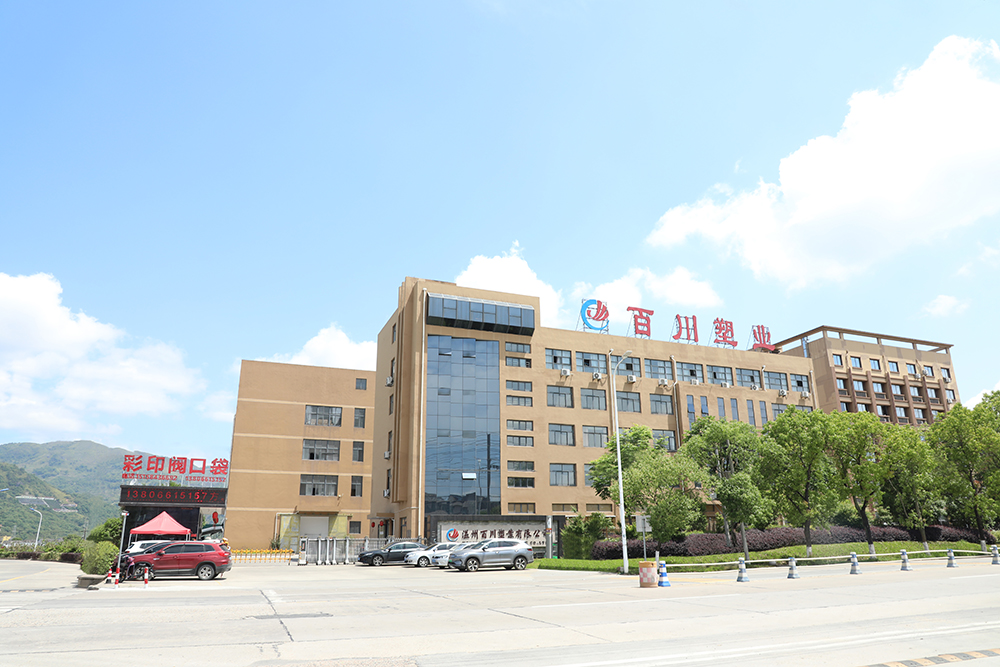
Wenzhou BaiChuan Plastic Industry Co., Ltd., Pingyang, Wenzhou, Zhejiang — production plant of more than 20,000 m².
Have Questions or Need More Details?
Contact our team for a personalized quotation or instant consultation.
Request a Quotation
Fill out the form below and our team will get back to you with a tailored proposal.
WhatsApp Direct Chat
Prefer to chat in real-time? Message us on WhatsApp for instant assistance & quick answers.
- Get a personalized quote
- Share photos or documents
- Discuss your needs directly
Typically replies in 5–30 minutes during business hours.