
Plain vs. BOPP Laminated vs. PE Coated PP Woven Bags: A Surface Treatment Comparison
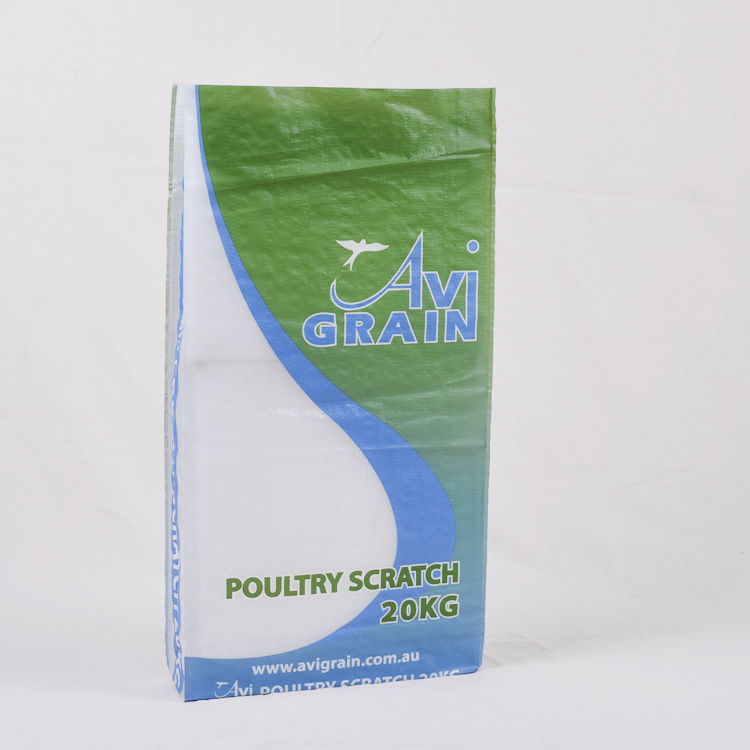
BOPP laminated colour-printed PP woven bags with a stable square bottom for upright stacking — one of the three surface options compared in this guide.
Three polypropylene woven sacks can photograph identically and behave completely differently on a filling line, inside a container, and on a warehouse floor. What separates them is the surface treatment applied to the woven fabric: plain (uncoated), BOPP laminated, or PE coated.
The short answer: specify plain fabric when the contents are dry, the bag will be stored away from prolonged moisture and direct sun, and print quality is secondary. Specify BOPP lamination when the bag has to carry multi-colour brand printing on a smooth face and also resist moisture. Specify PE coating when moisture protection is the priority and a film-based print surface is not. Each option adds material and process steps to the same base cloth, so the choice is a constraint decision, not a quality hierarchy.
Where the Surface Decision Actually Sits
Surface treatment is usually filed under "printing", which is why it gets confirmed late — after artwork, after pricing, and sometimes after the first sample has already been rejected. In the production sequence it is decided much earlier. The manufacturer's tubular PP woven fabric data lists surface as a fabric-level attribute sitting alongside grammage and mesh, with plain, BOPP laminated and PE coated as the three options. Once the fabric route is fixed, printing method, moisture performance and the add-on list all follow it.
Three separate questions are normally being answered at once:
- What must the surface survive? Dry grain, humid coastal storage, fine chemical powder, outdoor stacking, or a filling line that needs air to vent through the fabric.
- What must the surface show? A single-colour stencil, or a multi-colour brand print.
- What must the surface not add? An extra layer that raises unit cost without solving a real requirement.
Answering those three in order usually narrows the list to one option rather than three, and it prevents the most common mistake in this comparison: treating lamination as an upgrade that is always worth paying for.
Industry Background: Lamination Is Already the Majority Specification
The surface question is no longer a niche choice. Global production of PP woven bags exceeded 10 billion units in 2023, with China manufacturing more than 7 billion of them, according to market research published by Market Reports World. The same source reports that laminated PP woven bags accounted for 54.5% of total global market volume in 2023 — which makes the plain bag the minority specification globally, not the default.
Two pressures explain the shift. The first is brand presentation: export buyers increasingly treat the sack as a marketing surface, not only a container. The second is cost volatility in the base material. Polypropylene stood at 9,461 CNY/T on 10 November 2026, a 47.32% year-on-year increase according to Trading Economics. When resin moves that sharply, the film layer, the coating and the liner each become a visible line in a quotation rather than a rounding difference — which is precisely why buyers now ask suppliers to break surface treatment out separately instead of quoting a single bag price.
On the technical side, China's GB/T 8946-1998 sets out classification, technical requirements and inspection rules for PP woven bags, and it is commonly used as a reference baseline in export specifications even where the destination market applies its own rules.
All three surfaces described in this article are produced by Wenzhou BaiChuan Plastic Industry Co., Ltd., a manufacturer based in Xiaojiang Town, Pingyang, Wenzhou, Zhejiang — the region known as China's PP woven bag cluster. The company produces PP woven bags, colour-printed valve bags and paper-plastic composite bags, with production covering yarn drawing, circular weaving, laminating, colour printing and finished bag making in one chain.
Plain PP Woven Bags — The Uncoated Baseline
A plain, or uncoated, PP woven bag uses the woven fabric itself as the finished surface. No film is bonded to the face and no polymer coating is extruded over the cloth. The bag is woven, printed, cut and closed.
Base specifications listed for the standard PP woven bag run from 55–130 gsm fabric, 650D–1500D yarn, and 8×8, 10×10 or 12×12 mesh, with custom width and length. Tubular fabric for downstream bag making is listed at 55–180 gsm, 7×7 to 14×14 mesh and 30–120 cm tube circumference.
What plain fabric does well is stay simple. It keeps the production route short, it remains breathable, and it accepts direct printing in 1–8 colours by gravure or flexo on the standard bag construction. Where the contents are dry granular goods and the bag will be stored in a cool, ventilated warehouse, plain fabric is a complete specification rather than an unfinished one.
The limits deserve stating before a trial order. Company storage guidance describes a cool-storage life of up to two to five years, but notes that direct sunlight can degrade bags within months or even weeks. The listed application conditions add that bags without a liner or coating are not suitable for long soaking in water. Plain fabric is therefore a poor fit for outdoor stacking in high-UV markets, or for any fill that will sit in wet conditions.
BOPP Laminated PP Woven Bags — Smooth Surface, Wider Print Range
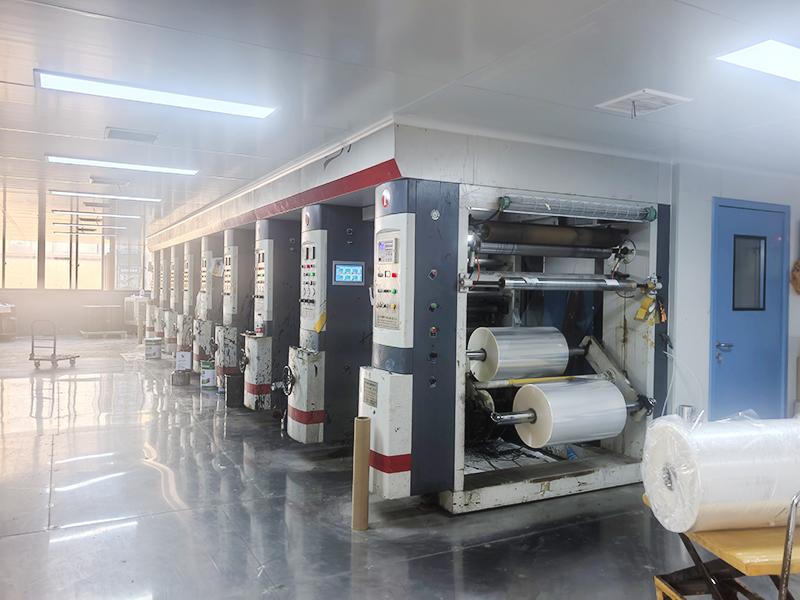
The colour printing workshop: BOPP lamination is applied so that multi-colour artwork prints on a smooth film face rather than directly on the woven tape structure.
BOPP lamination bonds a biaxially oriented polypropylene film to the woven face. The company describes the BOPP film as providing a smooth surface for printing, and lists lamination as the route to both colour printing and moisture resistance.
This is the option behind most retail-facing work. The colour-printed rice bags in the company's range are BOPP laminated PP woven sacks, with optional plastic carry handles, custom sizes for 5 kg, 10 kg, 20 kg and 25 kg fills, and food-grade raw material available. On the block bottom valve bag construction, printing runs 1–10 colours by gravure or offset, and BOPP film or PE coating is listed as the moisture-proof option.
Two practical notes for specification. First, lamination is a fabric-level decision: it is listed as a surface option on the tubular fabric itself, so it has to be set before weaving is scheduled, not at the printing stage. Second, a film does not replace an inner liner where fine powder is involved — lamination and lining solve different problems, and the product data treats them as separate optional items.
PE Coated PP Woven Bags — Barrier Layer on the Fabric
PE coating extrudes a polyethylene layer directly onto the woven cloth. It is listed as a fabric surface option alongside plain and BOPP, and the manufacturer lists PE coating, like BOPP film, as a moisture-proof route on valve bag construction.
The distinction from BOPP is functional rather than a ranking. Both are listed as moisture-proof options; the specification difference is that BOPP is also the surface chosen when a smooth print face is required. Where the requirement is a barrier and the artwork is simple, PE coating addresses that barrier directly.
PE coating is also frequently confused with the PE inner liner, and the two should not be swapped in a specification. They are separate items in the product data: the liner is an inserted bag listed for fine powder leakage prevention and waterproofing, while the coating is a layer bonded to the fabric. For chemical powder packaging, the liner is the component named for leakage prevention. For powder filling on the block bottom valve bag, an adjustable air permeability range of 20–160 is listed so that air releases quickly during filling.
Plain vs. BOPP Laminated vs. PE Coated: Comparison Table
| Specification point | Plain (uncoated) | BOPP laminated | PE coated |
|---|---|---|---|
| Surface as listed in product data | Plain / uncoated | BOPP laminated | PE coated |
| Base fabric options listed | 55–180 gsm tubular fabric (7×7–14×14 mesh); 55–130 gsm bag fabric (8×8 / 10×10 / 12×12) | Same base fabric, with BOPP film added | Same base fabric, with PE coating added |
| Printing | Print carried on the woven surface; 1–8 colours gravure / flexo on standard PP woven bag, 1–10 colours on valve bag construction | Film described as providing a smooth surface for printing; same colour ranges | Coating functions as the barrier layer; print specification confirmed per construction |
| Moisture protection | None from the surface itself; bags without liner or coating are not suited to long soaking | Listed as moisture-proof | Listed as moisture-proof |
| Optional add-ons | PE inner liner, UV stabiliser, anti-slip masterbatch, food-grade material | Same | Same |
| Typical fit from listed applications | Dry granular goods held in cool, ventilated storage | Rice, feed and fertilizer retail sacks with brand printing | Chemical powder, cement and moisture-sensitive fills |
Compiled only from the product data and application conditions supplied by the manufacturer. No comparative laboratory test data is implied by this table.
Step-by-Step: How to Specify a Surface Treatment
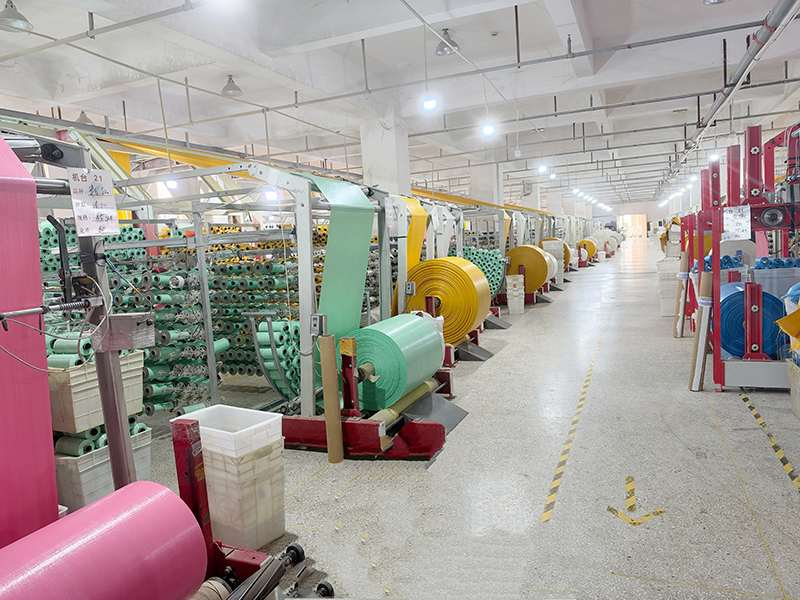
Circular weaving of PP tape into tubular fabric. Grammage and mesh are fixed here, before any surface treatment is applied.
- Describe the fill, not the bag. Particle size, density, flowability, dust level, moisture sensitivity and sun exposure decide more of the specification than the artwork does. The listed application conditions ask for exactly these inputs before a construction is confirmed.
- Fix the base fabric. Grammage, mesh and tube circumference. Tubular fabric is offered from 55–180 gsm, 7×7 to 14×14 mesh and 30–120 cm tube circumference, with consistent grammage and mesh listed as the basis for uniform finished-bag quality and stable running on high-speed bag-making machines.
- Choose the surface. Plain, BOPP laminated or PE coated. This is the decision the rest of this article is about, and it should be settled at fabric level.
- Set the print. Colour count and process. Gravure and flexo are both listed; valve bag construction extends to 1–10 colours by gravure or offset.
- Choose the construction. Heat cut, hemmed, valve or plastic handle at the top; stitched, heat seal or hot-air welded block bottom at the base. The block bottom valve bag is stitch-free, self-closing and compatible with standard valve filling machines.
- Add barrier items only where needed. PE inner liner for fine powder, UV stabiliser for outdoor exposure, anti-slip masterbatch for palletising, food-grade material for food contact.
- Approve a sample. Blank samples without custom printing are free; custom printed samples carry a sample cost, with sample freight normally at the buyer's side and the charge refundable once the bulk order reaches the MOQ.
- Confirm commercial parameters. MOQ is listed at 3,000 bags with a lead time of 15–45 days against a monthly capacity of 7,500,000 bags. Raw material inspection, in-process monitoring and finished-product testing are carried out per batch, with quality inspection performed before shipment.
Use Cases: Matching Surface to Content
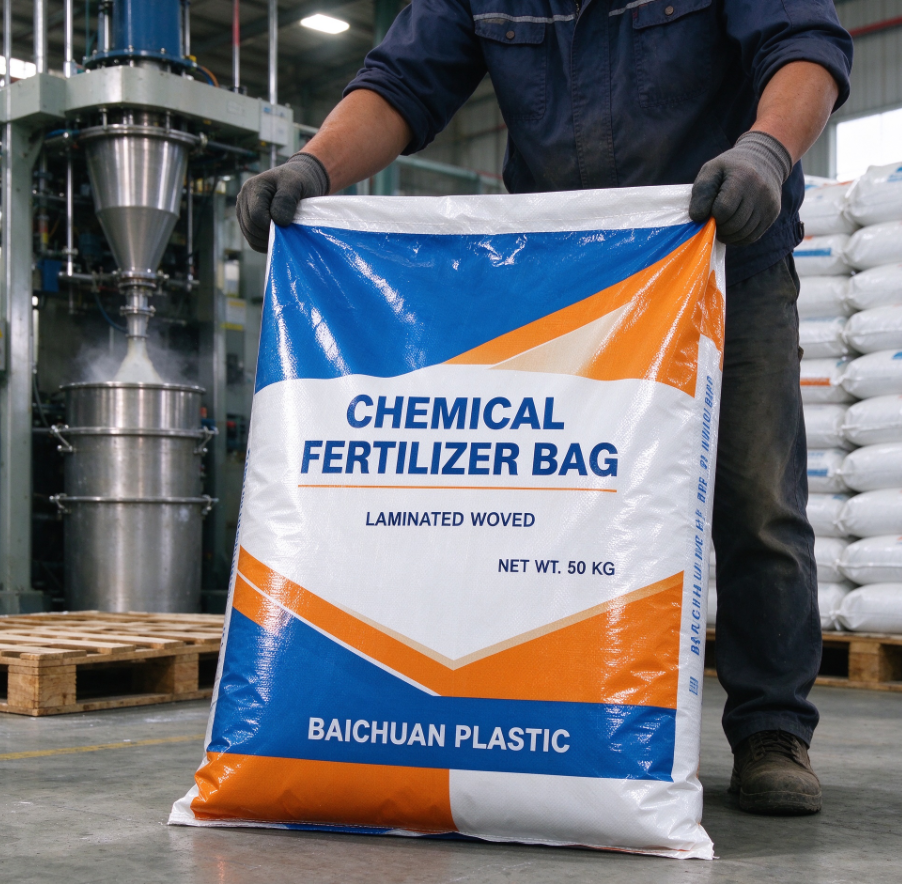
Chemical powder filling. Fine powder is the case where a PE inner liner is specified for leakage prevention, independent of the outer surface treatment.
Rice and grain
Retail rice sacks are the clearest BOPP case: the colour-printed woven sack with a laminated print face and optional plastic carry handles covers the appearance requirement, while food-grade raw material is available as an option. For palletised bulk shipment rather than retail, the block bottom valve construction is the format to compare.
Fertilizer
Fertilizer is a moisture and ageing problem as much as a print problem. BOPP colour printing, a PE inner liner and UV stabilisation are all listed as available options for anti-ageing, waterproof and anti-caking performance, which makes the surface choice part of the storage strategy rather than a cosmetic one.
Chemical powder
For chemical powder, the liner does the heavy lifting. The PE inner liner is the listed component for fine powder leakage prevention, while BOPP or PE coating addresses moisture on the outer fabric. Specifying a laminated surface without a liner will not solve a dust-leakage complaint.
Cement and construction materials
Powder filling generates displaced air. The block bottom valve bag combines a self-closing valve, a stitch-free hot-air welded base and an adjustable air permeability range of 20–160, with BOPP film or PE coating available for moisture protection.
Flour and fine food powders
Flour behaves like a fine chemical powder in a sack: it migrates through unlined woven fabric. A PE inner liner combined with a laminated print face covers both the containment and the branding requirement.
Compliance and Documentation Before You Order
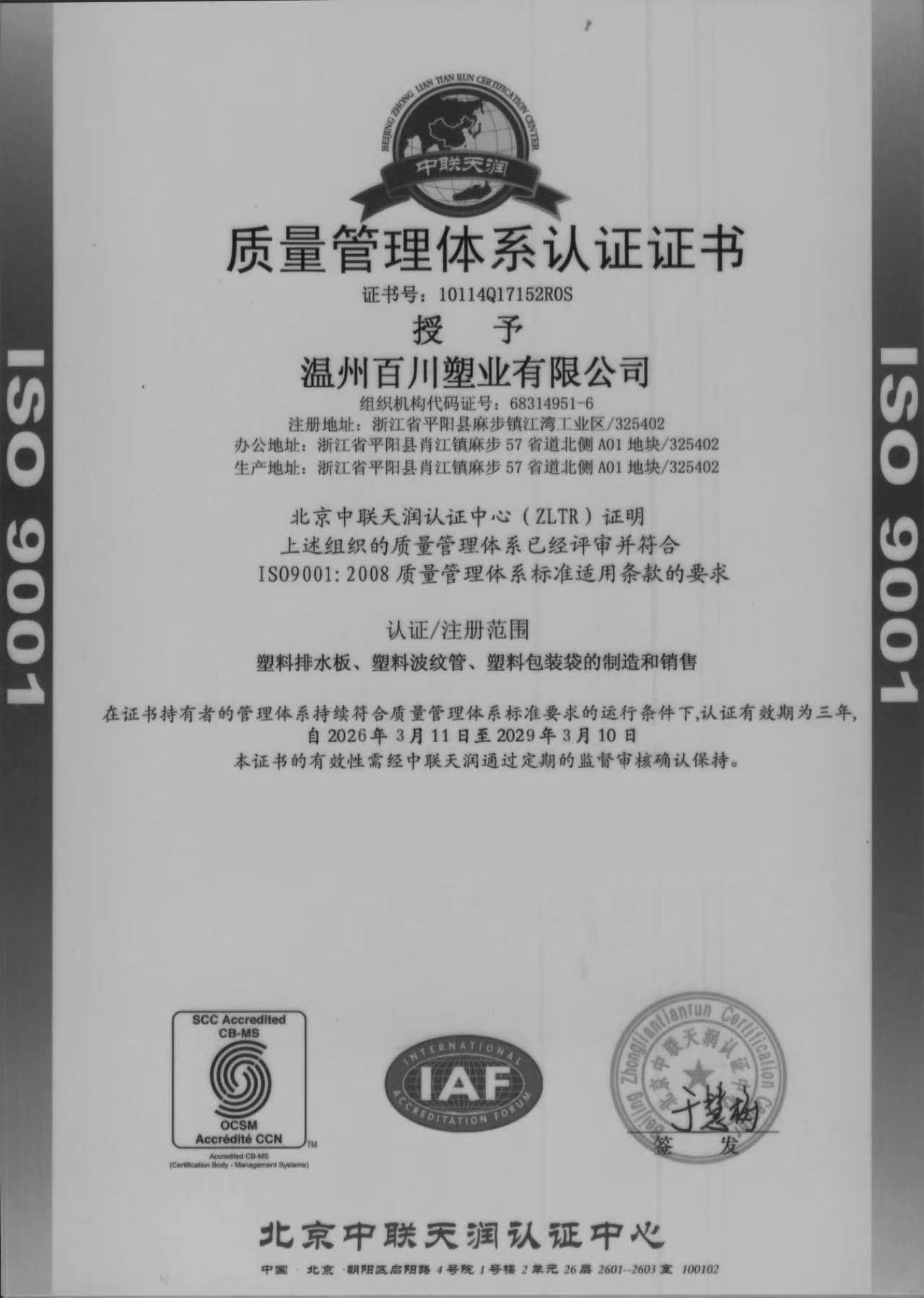
ISO 9001:2008 Quality Management System certificate, number 10114Q17152R0S, with a certified scope covering plastic packaging bags.
The manufacturer holds ISO 9001:2008 certification under certificate number 10114Q17152R0S, issued by Beijing Zhonglian Tianrun Certification Center (ZLTR), valid from 11 March 2026 to 10 March 2029. The certified scope covers the manufacture and sale of plastic drainage boards, plastic corrugated pipes and plastic packaging bags — the category the PP woven bag sits in. The certificate is described as IAF MLA recognised and accepted in South America, Southeast Asia, Pakistan, Europe and most global markets.
Three checks are worth running before a purchase order is raised, whichever surface you choose:
- Certificate validity and scope. Confirm the certificate number, issuing body, validity dates, and that the scope wording covers plastic packaging bags rather than a different product family.
- Product standard reference. Chinese production is commonly referenced against GB/T 8946-1998 for classification, technical requirements and inspection rules. Where the destination market applies its own rule set, that rule set governs.
- Destination food-contact and labelling rules. Food-grade material is listed as an option on this product; whether a specific market requires additional food-contact documentation or labelling should be confirmed with the supplier and the importer before ordering, because it varies by destination.
Export experience matters here too. The company's products are shipped to South America, Pakistan, Southeast Asia and other export markets, with export accounting for 30% of output, and 18-hour online support is offered for overseas inquiries.
FAQ
Which export compliance documents can a Chinese PP woven bag manufacturer supply?
For this manufacturer, the documented item is an ISO 9001:2008 Quality Management System certificate, number 10114Q17152R0S, issued by Beijing Zhonglian Tianrun Certification Center (ZLTR) and valid from 11 March 2026 to 10 March 2029. The certified scope covers the manufacture and sale of plastic drainage boards, plastic corrugated pipes and plastic packaging bags. The certificate is described as IAF MLA recognised and accepted in South America, Southeast Asia, Pakistan, Europe and most global markets. Destination-specific import, labelling and food-contact requirements should be confirmed with the importer, because they differ by market.
Does the surface treatment change the minimum order quantity?
The manufacturer lists a minimum order quantity of 3,000 bags for PP woven bags and 1 roll for tubular PP woven fabric. The published figures are not broken down by surface treatment, so the MOQ for a specific combination of lamination or coating, print colours and liner should be confirmed at quotation stage rather than assumed from the general figure.
Which surface should be specified for chemical powder or moisture-sensitive goods?
Two components are involved and they should be specified separately. For fine powder, a PE inner liner is the listed option for leakage prevention. For moisture, either BOPP film or PE coating is listed as the moisture-proof route on the outer fabric. Where the bags will be stored outdoors, UV-stabilised treatment is an additional option. Bags without a liner or coating are not suitable for long soaking in water.
Can I approve a sample before committing to a surface treatment?
Yes. Blank samples without custom printing are free of charge, while custom printed samples incur a sample cost. Sample freight is normally at the buyer's side, and the sample charge is refundable when the bulk order reaches the MOQ. Samples are supplied across PP woven bags, valve bags, rice bags, fertilizer bags and laminated packaging bags so that fabric texture, printing effect, size and workmanship can be checked before bulk purchase.
What lead time should be planned, and how do I start an inquiry?
Lead time is listed at 15–45 days against a monthly capacity of 7,500,000 bags, with quality inspection performed before shipment. To get an accurate quotation, send the bag type, dimensions, load capacity, material, surface treatment, printing design, liner requirement and order quantity. Inquiries go to sales@bcpockets.com or WhatsApp +86 183 2421 5901, and the full product range is summarised in the downloadable catalogue.
Conclusion
The surface treatment question resolves quickly once it is asked in the right order. Plain fabric is the correct specification for dry contents held in cool, ventilated storage where simple printing is enough. BOPP lamination is the correct specification when the bag must carry multi-colour printing on a smooth face and resist moisture at the same time. PE coating is the correct specification when the barrier matters and the print brief does not require a film surface. Liner, UV stabiliser and anti-slip masterbatch are separate add-ons that should be decided on their own merits rather than folded into the surface choice.
Because all three surfaces start from the same woven base, the practical safeguard is to fix grammage, mesh and tube circumference first, then layer the surface and the add-ons on top. That sequence keeps the quotation comparable between suppliers and keeps rework out of the sampling stage.
Next step: if you are comparing surface options for a specific fill, Wenzhou BaiChuan Plastic Industry Co., Ltd. can supply blank samples for material and hand-feel checks, or custom printed samples against your artwork.
Email sales@bcpockets.com · WhatsApp +86 183 2421 5901 · Website www.baichuanbag.com
Download the full specification range here: Baichuan packaging product catalog (PDF).
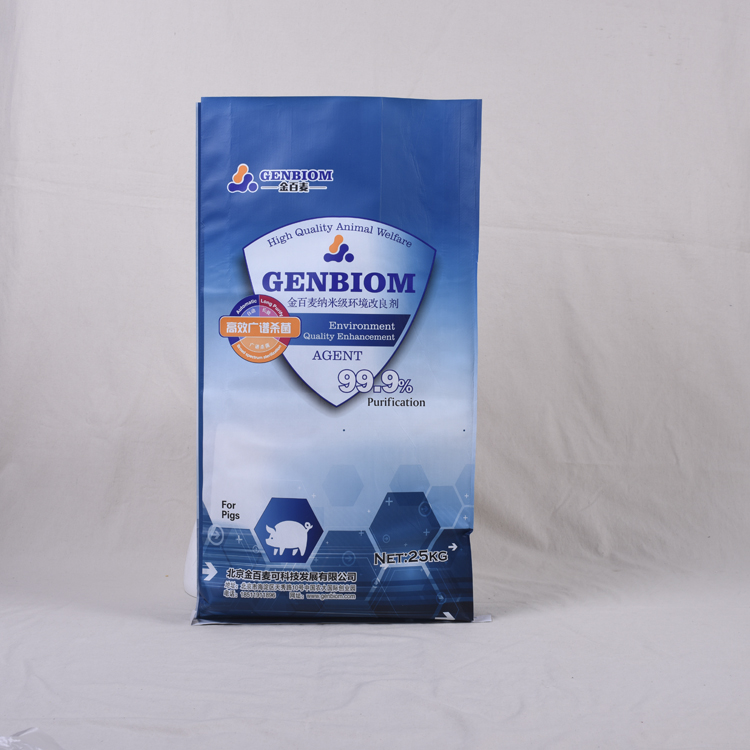
Colour-printed bags with an attached PE inner liner, specified when dustproof, waterproof and leakproof performance is required alongside brand printing.
Have Questions or Need More Details?
Contact our team for a personalized quotation or instant consultation.
Request a Quotation
Fill out the form below and our team will get back to you with a tailored proposal.
WhatsApp Direct Chat
Prefer to chat in real-time? Message us on WhatsApp for instant assistance & quick answers.
- Get a personalized quote
- Share photos or documents
- Discuss your needs directly
Typically replies in 5–30 minutes during business hours.