
B111 vs A122 Wall Switch: 1 Gang 1 Way or 2 Gang 2 Way for Your Project?
The B111 is a 1 gang 1 way wall switch: one button, one lighting circuit, CE certified, rated 10AX 250V~, with a 65×65 mm PC panel on an ABS base. The A122 is a 2 gang 2 way wall switch: two buttons on one plate, each gang wired as a changeover contact, CE and TUV certified, rated 10A 250V AC, with an 81.6×81.6 mm flame retardant PC body, brass terminals, phosphor copper contacts with silver plating, an 850°C flame retardant rating and 40,000 mechanical cycles. Choose the B111 when a space needs one load switched from one position and simplicity is the priority. Choose the A122 when one plate must serve two circuits, when the same light must be controlled from two positions, or when the specification requires the documented contact, terminal and mechanical-life detail.
The Specification Problem: Two Decisions Hidden in One Line Item
Most wall switch errors are not manufacturing errors. They are line-item errors. A project schedule often lists "wall switch, white, 10A" as a single row and leaves gang count and way count to be resolved on site. Those are two separate decisions, and they are not interchangeable.
Gang count sets how many circuits sit behind one plate. Way count sets how many physical positions can control a given circuit. A switch can be 1 gang, 2 gang or larger on the gang axis, and 1 way or 2 way on the way axis — and the two axes combine into four different products with four different wiring purposes.
When the two axes are confused, the consequences are concrete and expensive to unwind:
- Rework at first fix. A one-way device installed where two-point control was intended cannot be made to work by rewiring alone; the device itself has to be replaced.
- Plate and cutout mismatch. The B111 panel measures 65×65 mm and the A122 measures 81.6×81.6 mm. These are different footprints, so a late substitution changes what the wall box and finishing detail must accommodate.
- Certification mismatch. Both models carry CE, and the A122 additionally carries TUV. If a project specification or a consultant's submittal register names a certification set, the model chosen must be able to satisfy it on paper, not only in performance.
- Unnecessary cost and clutter. Fitting a two-gang two-way device where a single one-way switch would do adds wiring, adds terminations, and adds a wider plate on the wall for no functional gain.
The decision therefore belongs in the design and procurement stage, not in a site instruction.
Industry Background: Why Mechanical Switch Selection Still Matters
Wired mechanical wall switches remain the default control layer in building projects even as connected lighting expands. The global light switches and electrical sockets market was valued at approximately USD 17.6 billion in 2024, according to Strategic Market Research. The smart switch segment reached USD 4.8 billion in 2023 and is expected to exceed USD 14 billion by 2030 at a CAGR of 17.2%, according to Grand View Research — growth that sits on top of, rather than replaces, wired control points.
Regionally, Asia Pacific dominated the global electrical switch market with a revenue share of 42.5% in 2025, according to Dataintelo, which is consistent with the concentration of switch manufacturing in the region.
For European-facing projects, the governing reference point is a standard rather than a preference: EN 60669-1:2018 is the mandatory safety standard for wall switches in the EU, covering manual switches for household fixed installations, as set out by Intertek. That is why certification status appears in the same specification line as the electrical rating — a CE-marked device supports the compliance argument in a way that an uncertified equivalent does not, regardless of how similar the two look on a wall.
The practical consequence for a buyer is straightforward. The choice between a 1 gang 1 way and a 2 gang 2 way device is a functional and documentary decision, and both parts of that decision should be resolved before the purchase order is raised.
What 1 Gang 1 Way and 2 Gang 2 Way Actually Mean
1 gang 1 way
A 1 gang 1 way switch contains one switch mechanism that makes or breaks one circuit from one location. It is the simplest control device in a lighting installation: one button, one load, one control point.
2 gang 2 way
A 2 gang 2 way switch places two switch mechanisms on one plate, and each mechanism uses a changeover (two-way) contact. That means two independent circuits can be carried on a single plate, and each of those circuits can be controlled from two different positions — the classic arrangement for a corridor, a staircase, or a hotel room where a light must be reachable from both the door and the bed.
Direction of compatibility: a two-way switch can be wired for single-point control by leaving the second travelling terminal unused, but a one-way switch cannot provide two-point control. This asymmetry is why specifying two-way devices "to be safe" is technically possible but adds cost and terminations without adding function where a single control point is all that is required.
For installations that need a third or further control position, the range includes the KM141S intermediate switch, described as suitable for two-way and multi-way control circuits. That device is not a substitute for a two-way switch; it is an addition to a two-way circuit.
Detailed Comparison: B111 1 Gang 1 Way vs A122 2 Gang 2 Way
B111 — 1 gang 1 way, single-load simplicity
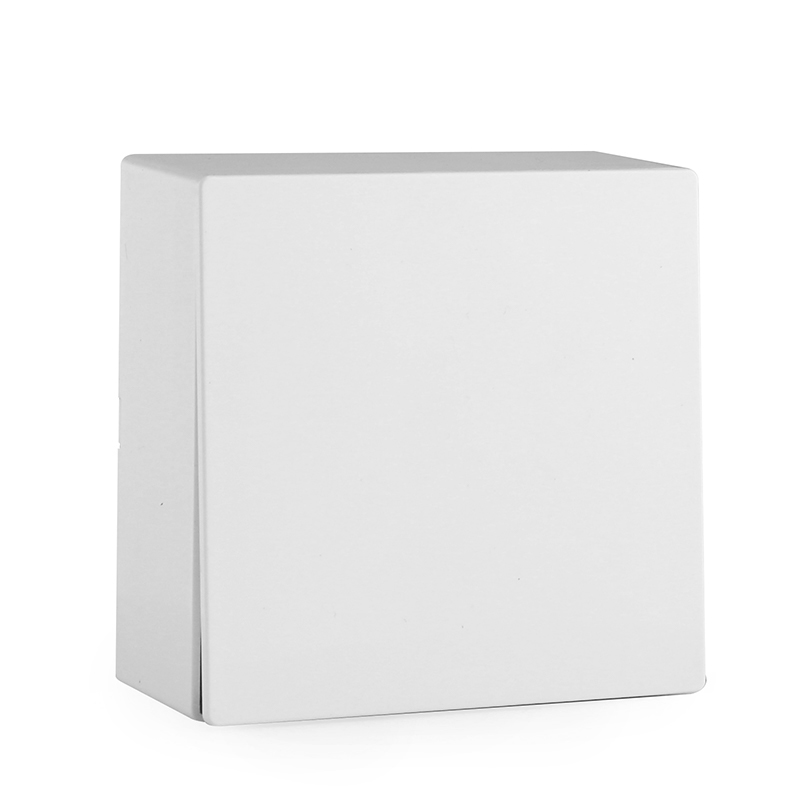
The B111 is a 1 gang 1 way switch classified as a flush mounted mechanical wall switch and intended for the Electrical & Construction Industry. Its published specification sets the following:
- Configuration: 1 gang 1 way — a single circuit, a single control point.
- Electrical rating: 10AX 250V~.
- Panel size: 65×65 mm.
- Panel material: PC panel.
- Base material: ABS plastic.
- Certification: CE.
- HS code: 8536500090.
- Colour range: white, yellow, black, silver, golden and customized options.
B111 belongs to the Base Series, described as minimalist switches and sockets designed to meet EU standards, with a practical clip-on structure for quick installation and a clean, cubic design. That description matters for the decision at hand: the B111 proposition is functional clarity. There is one button to operate, one circuit to terminate and one plate to align. Where a room has a single lighting circuit and a single control position, this device resolves the requirement with the minimum number of parts, the minimum number of terminations and the smallest footprint of the two models at 65×65 mm.
The published B111 data does not list a flame-retardant temperature rating or a mechanical cycle count. That is not a defect in the product; it is a limit on what the datasheet can be cited for. Where a specification or tender document requires those figures to be stated, the A122 provides them.
A122 — 2 gang 2 way, two circuits and two control positions
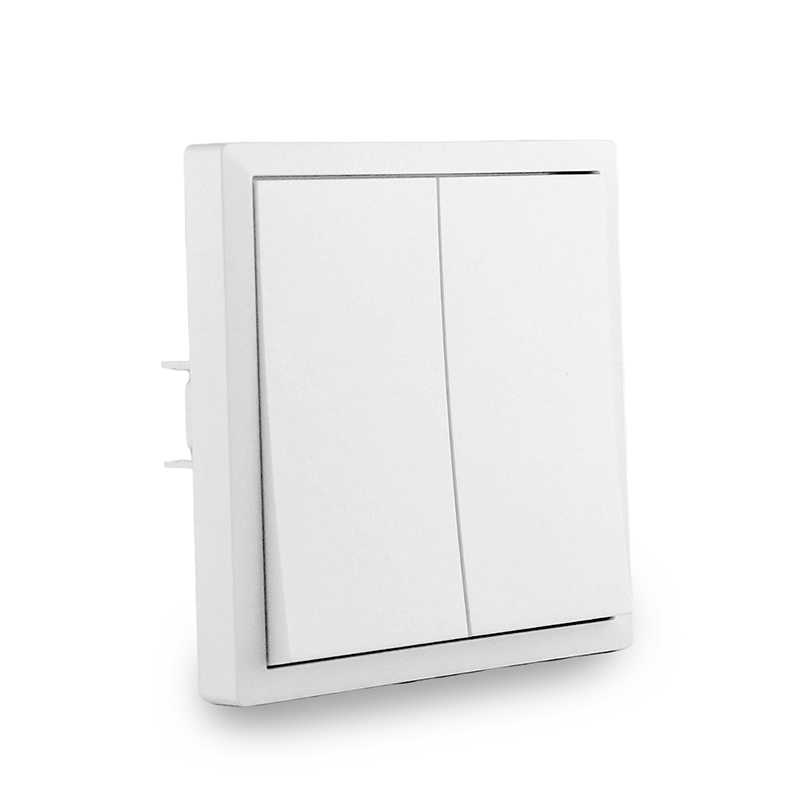
The A122 is a 2 gang 2 way switch under the Flush Mounted Mechanical Wall Switch category, intended for the electrical industry and designed for residential, industrial, apartment and villa, hotel, and office scenarios. Its published specification sets the following:
- Configuration: 2 gang 2 way — two circuits on one plate, each with changeover contacts.
- Electrical rating: 10A 250V AC.
- Overall dimensions: 81.6 × 81.6 mm.
- Body material: flame retardant PC.
- Terminals: brass terminals for better conductivity.
- Contacts: phosphor copper contacts of 0.7 mm with silver plating at 3 mm diameter, for superior conductivity.
- Flame retardant rating: 850°C.
- Mechanical life: 40,000 cycles, supported by a 40,000+ times on/off test.
- Operating feel: grade II shock absorption to reduce switching noise; a large, wide-faced, narrow-framed button for easy operation.
- Certification: CE and TUV.
- HS code: 8536500090.
- Colour: white and customized.
Two details on the A122 deserve attention because they appear in technical submittals rather than in marketing copy. The first is the contact construction: 0.7 mm phosphor copper contacts with silver plating at 3 mm diameter, paired with brass terminals. The second is the pairing of an 850°C flame retardant rating with a 40,000-cycle mechanical life. Together these give a specifier concrete numbers to write into a schedule — numbers that the B111 datasheet, as published, does not supply.
Comparison Table: B111 vs A122 on Published Specification
| Criterion | B111 | A122 |
|---|---|---|
| Switch configuration | 1 gang 1 way | 2 gang 2 way |
| Control positions per circuit | One | Two (changeover contacts) |
| Circuits per plate | One | Two |
| Electrical rating | 10AX 250V~ | 10A 250V AC |
| Certification | CE | CE, TUV |
| Panel / overall size | 65×65 mm | 81.6×81.6 mm |
| Panel material | PC panel | Flame retardant PC |
| Base material | ABS plastic | PC |
| Terminals and contacts | Not listed in the published specification | Brass terminals; phosphor copper contacts 0.7 mm with silver plating, 3 mm diameter |
| Flame retardant rating | Not listed in the published specification | 850°C |
| Mechanical life | Not listed in the published specification | 40,000 cycles |
| Operating feel | Clip-on Base Series structure, cubic design | Grade II shock absorption; wide-faced, narrow-framed button |
| Colour | White, yellow, black, silver, golden, customized | White and customized |
| HS code | 8536500090 | 8536500090 |
Read the table as a decision grid rather than a scorecard. On the functional axis, the two devices solve different problems and neither is a substitute for the other. On the documentation axis, the A122 carries more specification depth — a second certification, a stated flame rating, a stated cycle count and a stated contact construction — while the B111 carries a smaller footprint and a simpler build.
Step-by-Step Breakdown: Choosing for a Project
Step 1 — Count the lighting circuits that must be switched independently
Walk the room and list the loads that need separate control: general lighting, decorative lighting, a mirror light, a task light. One load means one gang is enough. Two loads that must be switched separately from the same position mean two gangs — and if the plate must also carry a socket or a fan isolator, that is a different product again.
Step 2 — Count the control positions, not the buttons
For each circuit, ask how many physical locations must be able to switch it. A corridor light controlled only at one end needs one-way. A corridor, stairwell, or hotel room with control at the door and at the bed needs two-way, which requires a changeover contact at each end. Three or more positions require an intermediate device such as the KM141S in addition to the two-way switches.
Step 3 — Decide whether two functions should share one plate
Two separate single devices occupy two footprints. One 2 gang plate occupies one. The A122 plate measures 81.6×81.6 mm; the B111 panel measures 65×65 mm. Where wall space is tight, or where a clean single-plate finish is a design requirement, combining two circuits on the A122 removes one plate and one visible joint. Where the two functions are physically far apart, or where a single function is all that exists, combining them adds nothing.
Step 4 — Check the footprint against the wall box and finishing detail
Because the two models differ in size, a late substitution changes the box and finishing schedule. Confirm the fixing method and wall-box compatibility for the chosen model against the current datasheet before the first fix is released, and confirm that the plate size on the drawing matches the plate size on the data sheet.
Step 5 — Match the certification to the market and to the submittal register
Both models carry CE, which supports the EU compliance argument under EN 60669-1:2018. The A122 additionally carries TUV. If a consultant, contractor or importer's checklist requires a second independent certification, the A122 satisfies it on paper; the B111 satisfies CE. Deciding this early avoids a late model change on a certification technicality.
Step 6 — Decide whether an LED indicator is genuinely required
Neither the B111 nor the A122 published specification lists an LED indicator. If indication is required, the correct move is to change the model rather than to assume the feature exists (see the section below).
Step 7 — Validate with a sample before the bulk order
Request physical samples of both models, check the plate size against the wall box, check the terminal arrangement against the wiring diagram, check the operating feel against the project's expectations, and check that the certification documents match the model code on the label.
Use Cases: Residential, Hotel, Office, Apartment and Villa
Residential home
In a typical apartment, most rooms have one lighting circuit and one control position: bedroom, kitchen, bathroom, balcony. These are the natural home of the B111, where single-load simplicity beats multi-gang capability because there is nothing to control from a second position and no second circuit to carry. The 65×65 mm panel also suits compact wall layouts. Where a hallway or internal stair connects two levels, the same project will need two-way devices at both ends — and that is where the A122 enters the schedule.
Hotel guest rooms
A hotel room is the clearest case for two-way control. The entrance light must be switchable at the door and at the bedside, and the bedside plate typically groups several functions. A 2 gang 2 way device on the A122 pattern supports two circuits on a single plate with two-position control per circuit, and the wide-faced narrow-framed button supports operation in low light. The grade II shock absorption detail is also relevant in a hotel context, where switching noise in a quiet room is a guest-experience issue rather than a technical footnote. European hotel projects will additionally expect CE-marked devices, and where a second certification is required by the operator's specification, the A122's TUV certification is available to cite.
Office
Office lighting is usually switched by zone rather than by single luminaire, so a plate that carries two zones on one gang pair — the A122 pattern — reduces the number of plates along a wall run. Corridors and meeting rooms with two entrances are two-way candidates by layout. Where the fit-out is generic and each room has one switch by one door, the B111 keeps the device schedule short and the termination count low.
Apartment and villa
Villas and multi-level apartments generate the most two-way demand: landings, stairwells, long corridors, and master suites with entry and bedside control of the same circuit. A practical pattern is to specify 2 gang 2 way devices at the points where two functions and two positions coincide, and 1 gang 1 way devices everywhere else. Applied consistently, this keeps the device schedule to two models instead of a long tail of variants, which simplifies procurement, spares and site installation.
LED Indicator: Does Your Project Actually Need It?
An LED indicator serves one purpose: locating the switch in the dark, or confirming that a circuit is live. It is a genuine requirement in hotel guest rooms, in corridors and stairwells without night lighting, and in plant or service areas where a switch must be found quickly. In a well-lit residential room with a visible switch position, it adds little.
That decision has a direct model consequence, because neither the B111 nor the A122 published specification lists an LED indicator. If the project requires one, the model changes:
- V122N — a 2 gang 2 way switch with LED indicator, 86×86 mm panel, 10A 220-250V~, flame retardant PC panel and high strength PA base, CE and TUV certified, and tested to 40,000+ on/off cycles. This is the substitution to consider when the A122's two-way function is right but indication is also required.
- HG110NB — a 1 gang push bell switch with LED indicator, 86×86 mm panel, 10A 220-250V~, scratch-resistant tempered glass panel and high strength PA base, CE and TUV certified. This is a different function entirely, suited to a bell or call circuit rather than general lighting.
The point is procedural: indicator requirements should be settled at specification stage, because they change the model code, the plate size and often the plate material at the same time.
FAQ
Are the B111 and A122 wall switches CE certified for European projects?
Yes. The B111 is CE certified and is classified as a flush mounted mechanical wall switch intended for the Electrical & Construction Industry, rated 10AX 250V~. The A122 carries both CE and TUV certification and is rated 10A 250V AC. Both models share HS code 8536500090. For EU projects the reference standard is EN 60669-1:2018, the mandatory safety standard for manual wall switches in household fixed installations, so the CE marking on either model supports the compliance file. Where a specification or submittal register requires a second independent certification in addition to CE, the A122 satisfies that requirement and the B111 does not.
What is the practical difference between 1 gang 1 way and 2 gang 2 way control?
Gang count and way count answer two different questions. Gang count is how many circuits sit behind the plate; way count is how many positions can control a given circuit. The B111 is 1 gang 1 way — one circuit, one control position. The A122 is 2 gang 2 way — two circuits on one plate, each with a changeover contact so each circuit can be controlled from two positions. A two-way device can be wired for single-point control, but a one-way device cannot provide two-point control. Where three or more control positions are needed, an intermediate switch such as the KM141S is added to the two-way circuit.
Do the B111 or A122 include an LED indicator?
Neither model's published specification lists an LED indicator. If indicator function is required, the range provides the V122N, a 2 gang 2 way switch with LED indicator on an 86×86 mm panel, CE and TUV certified and tested to 40,000+ on/off cycles, and the HG110NB, a 1 gang push bell switch with LED indicator on an 86×86 mm tempered glass panel, also CE and TUV certified. Because indicator variants change the model code and the plate size, the requirement should be resolved before the device schedule is finalised.
Do the panel sizes matter if the model is changed late in the project?
Yes, because the two footprints differ. The B111 panel measures 65×65 mm; the A122 measures 81.6×81.6 mm overall. A late substitution therefore affects the wall box and finishing detail as well as the device itself. Confirm the fixing method and wall-box compatibility of the chosen model against the current datasheet, and check that the plate size on the drawing matches the plate size in the specification, before releasing the first fix.
Can I obtain B111 and A122 samples to check wiring and finish before ordering?
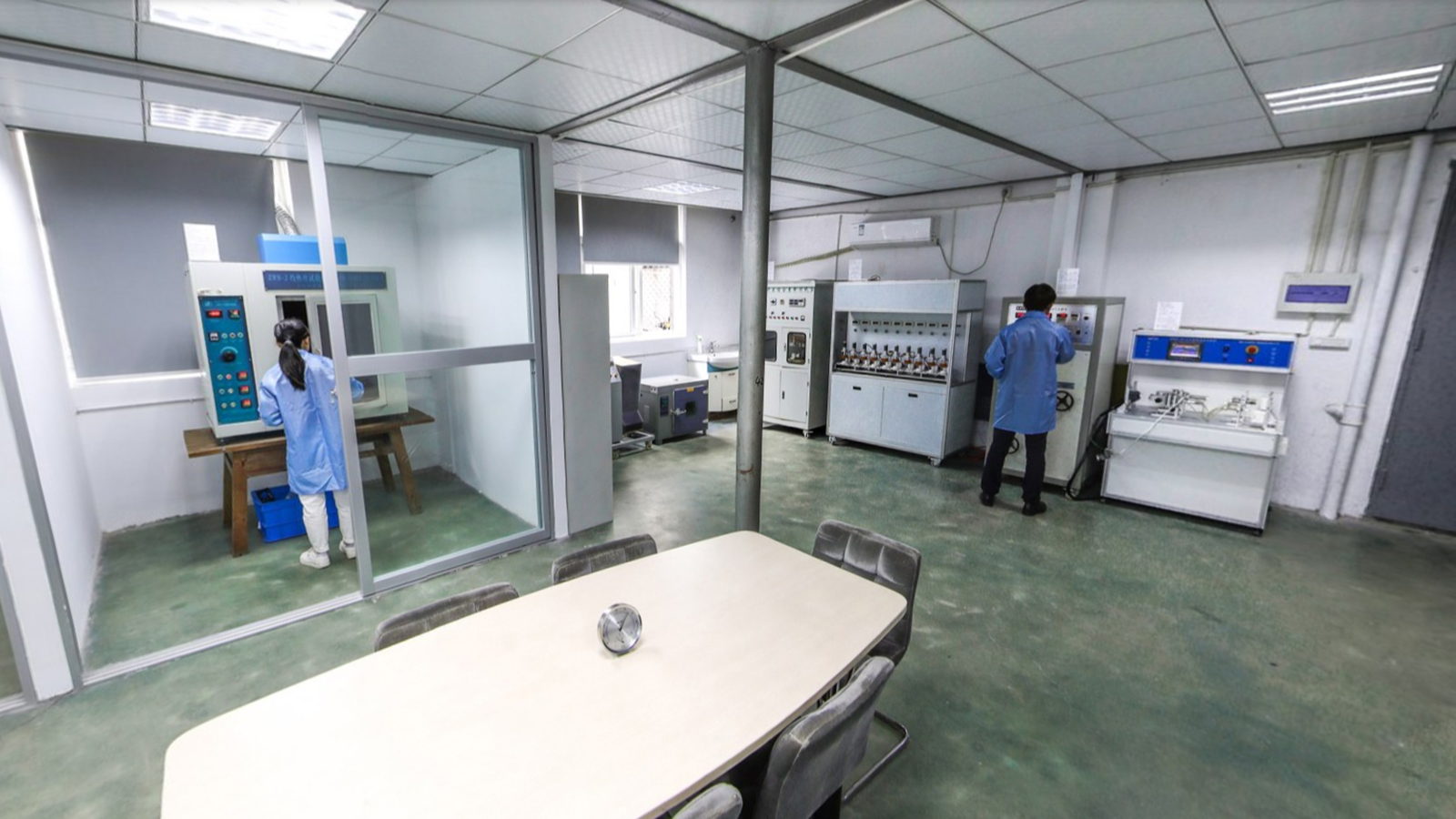
Sample requests are the normal first step for both models. A practical validation sequence is to check the panel size against the intended wall box, confirm the terminal arrangement against the wiring diagram, compare the operating feel of the A122's wide-faced narrow-framed button against project expectations, and verify that the certification documents match the model code on the label. Wenzhou Huafeng Electric Co., Ltd. (HYFF) manufactures both models at its 7,000 m² facility in Wenzhou, Zhejiang, which produces approximately 35 million units per year with a 10-engineer R&D team and approximately 118 staff, and exports to Europe, America, the Middle East, Africa and other regions. Samples and technical documents can be requested through www.hyffelectric.com or by email at service@vgshmn.com.
Conclusion: Let the Control Topology Choose the Model
The B111 and the A122 are not competing versions of the same product. They answer different questions, and the correct answer is decided by the room, not by the catalogue.
Choose the B111 1 gang 1 way when a space has one lighting circuit and one control position, when a compact 65×65 mm PC panel on an ABS base suits the wall layout, and when CE certification plus a 10AX 250V~ rating covers the requirement. Its value is subtraction: fewer terminations, fewer parts, a smaller footprint and nothing on the plate that the room does not need.
Choose the A122 2 gang 2 way when two circuits must share one plate, when a light must be switched from two positions, or when the specification demands documented detail — CE and TUV certification, 10A 250V AC, an 81.6×81.6 mm flame retardant PC body, brass terminals, 0.7 mm phosphor copper contacts with silver plating, an 850°C flame retardant rating and 40,000 mechanical cycles.
Then check the two variables that most often force a late change: the plate footprint, and whether an LED indicator is genuinely required. If it is, the V122N is the two-way model to look at rather than an assumption about the A122. Resolve those two points at specification stage and the rest of the device schedule follows cleanly.
Next Step: Sample and Specification Pack
HYFF supplies both the B111 1 gang 1 way switch and the A122 2 gang 2 way switch, along with the V122N LED indicator variant and the KM141S intermediate switch for multi-way circuits. Request samples for wall-box and wiring validation, or ask for the current datasheet for the model you intend to specify.
Website: www.hyffelectric.com | Email: service@vgshmn.com | Tel: +86 0577 86911198 | WhatsApp: +86 13989758126
Download the full product catalogue here: HYFF 2026 Product Catalogue (PDF)
Have Questions or Need More Details?
Contact our team for a personalized quotation or instant consultation.
Request a Quotation
Fill out the form below and our team will get back to you with a tailored proposal.
WhatsApp Direct Chat
Prefer to chat in real-time? Message us on WhatsApp for instant assistance & quick answers.
- Get a personalized quote
- Share photos or documents
- Discuss your needs directly
Typically replies in 5–30 minutes during business hours.