Inside a 16A Wall Socket: Ratings, Materials and Endurance Testing
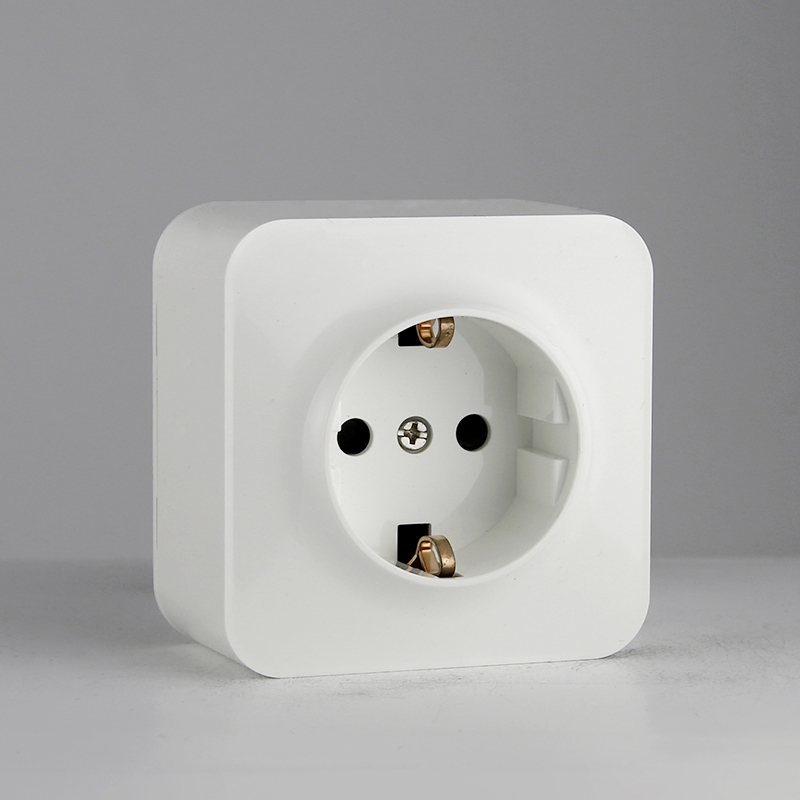
The S149 Schuko wall socket: 16 A, 220–250V~, flame-retardant PC panel, high-strength PA base. Image: Wenzhou Huafeng Electric Co., Ltd. (HYFF).
Quick answer: A 16 A wall socket should be approved on three datasheet lines rather than on appearance. The first is the rating block — 16 A at 220–250V~, which is the common rating across the Schuko, French and Russian units in this series. The second is the housing pair: a flame-retardant PC panel (an 850 °C figure appears on the S149 datasheet) and a high-strength PA base (stated at 960 °C). The third is endurance: the S149 datasheet records more than 10,000 plug-in/out cycles and over 40,000 on/off cycles. Read together, those three lines tell a specifier more about service life in a high-traffic installation than any photograph of the front plate.
Wenzhou Huafeng Electric Co., Ltd. (HYFF) is a wall switch and wall socket manufacturer founded in 2011, operating a 7,000 m² factory in Wenzhou, Zhejiang, with 118 employees and exports to Europe, America, Oceania, Asia and Africa. Its S149 Schuko socket is a useful worked example because the company publishes all three decision lines for it: 16 A, 220–250V~; flame-retardant PC panel with a high-strength PA base; CE certification; a children safety door; more than 10,000 plug-in/out cycles and over 40,000 on/off cycles. This article walks through how a specifier should read each of those values before signing off a purchase specification for a residential or high-traffic project.
Why the Datasheet Rarely Answers the Buyer’s Question
Most RFQs for an EU standard wall socket 16 A come back with the same four words: “16 A, PC, flame retardant.” Those four words are equally true of sockets that keep working through years of hotel use and sockets that loosen in a rental apartment. The problem is not the rating itself; it is everything the rating leaves out.
A 16 A socket can fail through at least four different mechanisms, and each one is governed by a different datasheet line:
- Thermal. Current passes through contacts, terminals and screws. Contact resistance and terminal clamping force set the temperature rise. Terminal type therefore matters as much as the 16 A number.
- Mechanical. Every insertion wears the contact spring and the plug interface. Spring fatigue, not panel colour, is what makes a socket feel loose after years of daily use.
- Fire. The panel and the base are polymers sitting behind live conductors, so their fire behaviour and heat resistance define how the product reacts to abnormal conditions.
- Safety and fit. A children safety door, wall-box compatibility and panel dimensions decide whether the socket can be installed in the specified box and whether it clears local residential requirements.
This is why quotations for a “16 A wall socket” are so hard to compare: both suppliers can answer “yes” to every question in the RFQ. The practical fix is to write the specification in terms of measurable datasheet lines, each with a test figure or a certificate attached, so that the answer to a question is evidence rather than an adjective.
Industry Background: What Regulates a 16 A Socket Today
The 16 A class is a regulated category rather than a marketing label. IEC 60884-1:2022 sets the latest general requirements for plugs and socket-outlets for household and similar purposes and is limited to 16 A for screwless terminals — one reason the 16 A rating is so common in residential work, and also the reason the terminal type should be specified rather than assumed. In Europe, Schuko (Type F) sockets are standardized in many countries for 16 A / 250 V applications under CEE 7/3, and the same 16 A class is used by the French and Russian interfaces in the HYFF range.
The size of the category explains why this question keeps returning. The global electric plugs and sockets market was valued at USD 14.13 billion in 2025 (Precedence Research), and global production of wall sockets reached over 3.1 billion units in 2024, with China leading as the top producer. Modular sockets accounted for 43% of total wall socket sales in 2024, driven by space-saving and customization trends (Fortune Business Insights) — which is why panel size and module compatibility now belong in the same conversation as the electrical rating.
Two structural forces are shaping current specifications. The EU mandate for USB-C as the common charging standard for most portable electronics took effect in autumn 2024, which is pushing charging capability into the wall itself and making USB wall socket variants a normal line item in socket schedules. Separately, ingress protection classes such as IP44 and IP54, defined by IEC 60529, are now written into bathroom and outdoor socket lines. Neither trend changes the fundamentals covered here: a socket that also charges devices still has to hold a 16 A rating, sit inside a correctly rated housing, and survive insertion wear.
Anatomy of a 16 A Wall Socket: Rating, Materials, Contacts and Safety
The S149 is a surface-mounted Schuko socket with a 68×68 mm panel, rated 16 A, 220–250V~ and CE certified. Reading its specification line by line shows what each block of a datasheet actually controls.
1. The rating block: 16 A, 220–250V~
The tilde indicates alternating current; the 220–250 V window is the tolerance band the socket is designed to accept. The value worth interrogating is not the 16 A figure itself but the conditions attached to it: the terminal type (screwless terminals are capped at 16 A under IEC 60884-1:2022), the terminal material, and the temperature-rise performance the supplier has actually verified. A 16 A high-power wall socket circuit in a kitchen is not the same duty as a bedroom outlet, and the datasheet should make that difference visible.
2. The panel: flame-retardant PC
Polycarbonate is used for the front panel because it combines impact resistance, dimensional stability and appearance retention with flame-retardant behaviour. The S149 datasheet states an 850 °C fireproof PC material for the panel. That figure belongs in the RFQ — but it should be accompanied by a follow-up question: which test produced it, and at what sample thickness? A number without a method cannot be used as an acceptance criterion, and this is the most common weak point in socket specifications.
3. The base: high-strength PA
The base is a different part with a different job. It carries the terminals, holds the contacts in alignment and absorbs the mechanical load of wiring. The S149 datasheet states a high-strength PA material rated at 960 °C, selected for the fire performance of the base. Base material matters because base deformation, rather than panel appearance, is what eventually makes a socket difficult to rewire and shifts contact alignment over years of service.
4. The conductive path and installation hardware
The S149 uses good-quality metal accessories selected to prevent oxidation, with phosphor copper contacts chosen for elasticity and a smooth plug feel. Anti-back screws keep the screw captive in the terminal when it is loosened, so an installer working overhead does not lose the fixing behind the plate. None of these details are decorative; each one maps to a real failure or installation problem.
5. The children safety door
The S149 is equipped with a children safety door. In residential buildings, apartments, villas and home renovation projects this mechanism is frequently the difference between passing and failing a local acceptance check on a family unit, which is why it should appear in the specification as an explicit requirement rather than as an assumed feature.
6. Certificates: keep CE, TUV, CB and RoHS apart
The S149 carries CE certification, and HYFF states TUV, CE and CB for its socket range. RoHS is a separate substance-restriction question: it appears as CE/RoHS on another model in the range, the M149. Buyers should keep these distinct, because each certificate answers a different procurement question. CE addresses market access for the European Union, RoHS addresses material composition for indoor installation, and the two are verified through different evidence. A supplier that treats them as one item is usually a supplier whose documentation will not survive a project audit.
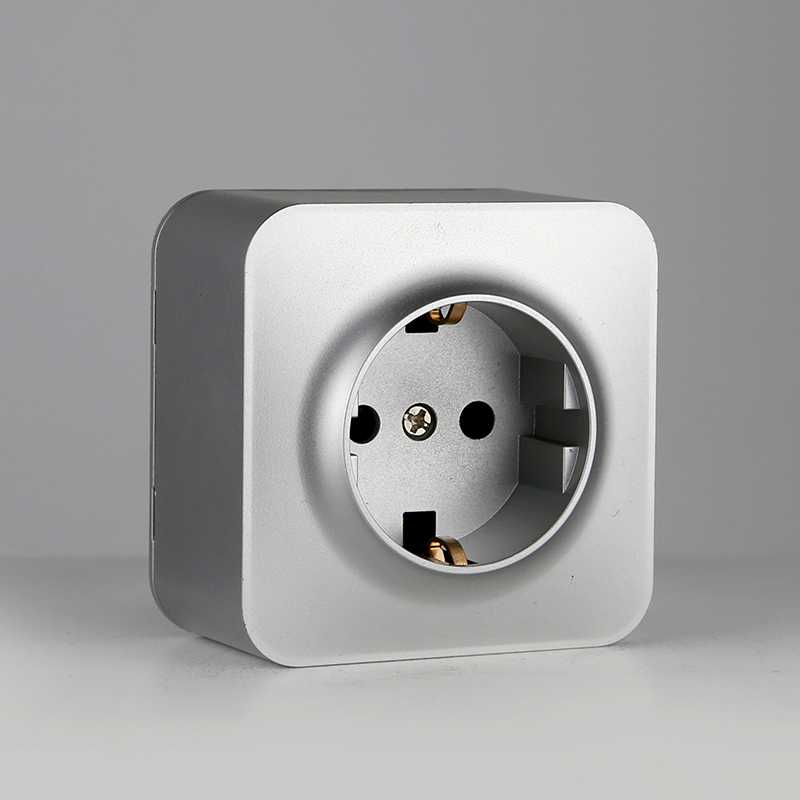
Panel and housing construction on the S149: the flame-retardant PC front and the high-strength PA base are separate parts with separate duties.
Endurance Testing: What 10,000 Insertions and 40,000 Cycles Actually Tell a Specifier
The S149 datasheet lists two endurance results: more than 10,000 plug-in/out cycles, and over 40,000 on/off cycles. They are not interchangeable, and treating them as one number is a frequent buying error.
Plug-in/out cycles test the interface a user touches: contact springs, plug retention and the mechanical wear path of the socket. This is the figure that matters in hotel rooms, office desks, shared accommodation and corridors, where a socket may be plugged and unplugged several times a day.
On/off cycles test the switching mechanism. Where a series shares a mechanism and contact platform across switches and sockets, the on/off result is evidence about the durability of the moving parts rather than about the plug interface.
Turning those two figures into a specification takes three steps:
- Use the insertion figure to screen high-traffic locations. 10,000 insertions is not a service-life promise, but it is a useful arithmetic anchor. At four insertions a day, 10,000 cycles corresponds to roughly six to seven years of that use pattern; at eight insertions a day, roughly three and a half years. The buyer chooses the insertion rate for each location, and the test figure then becomes a screening criterion: below 10,000 cycles, a socket is hard to defend in a high-traffic schedule.
- Use the switching figure where a mechanism is involved. The 40,000 on/off result is the number to quote when the socket shares a plate with a switch, or where the design includes a switching function in a hotel or office application.
- Write the test conditions into the RFQ. A cycle count only becomes an acceptance criterion when the load applied, the test speed, the sample quantity and the pass criteria are named. HYFF applies 100% self-inspection before packing and lists performance life testing, glowing filament testing, silver layer thickness inspection and plastic ball pressure testing within its quality control system, so the underlying evidence exists and can be referenced.
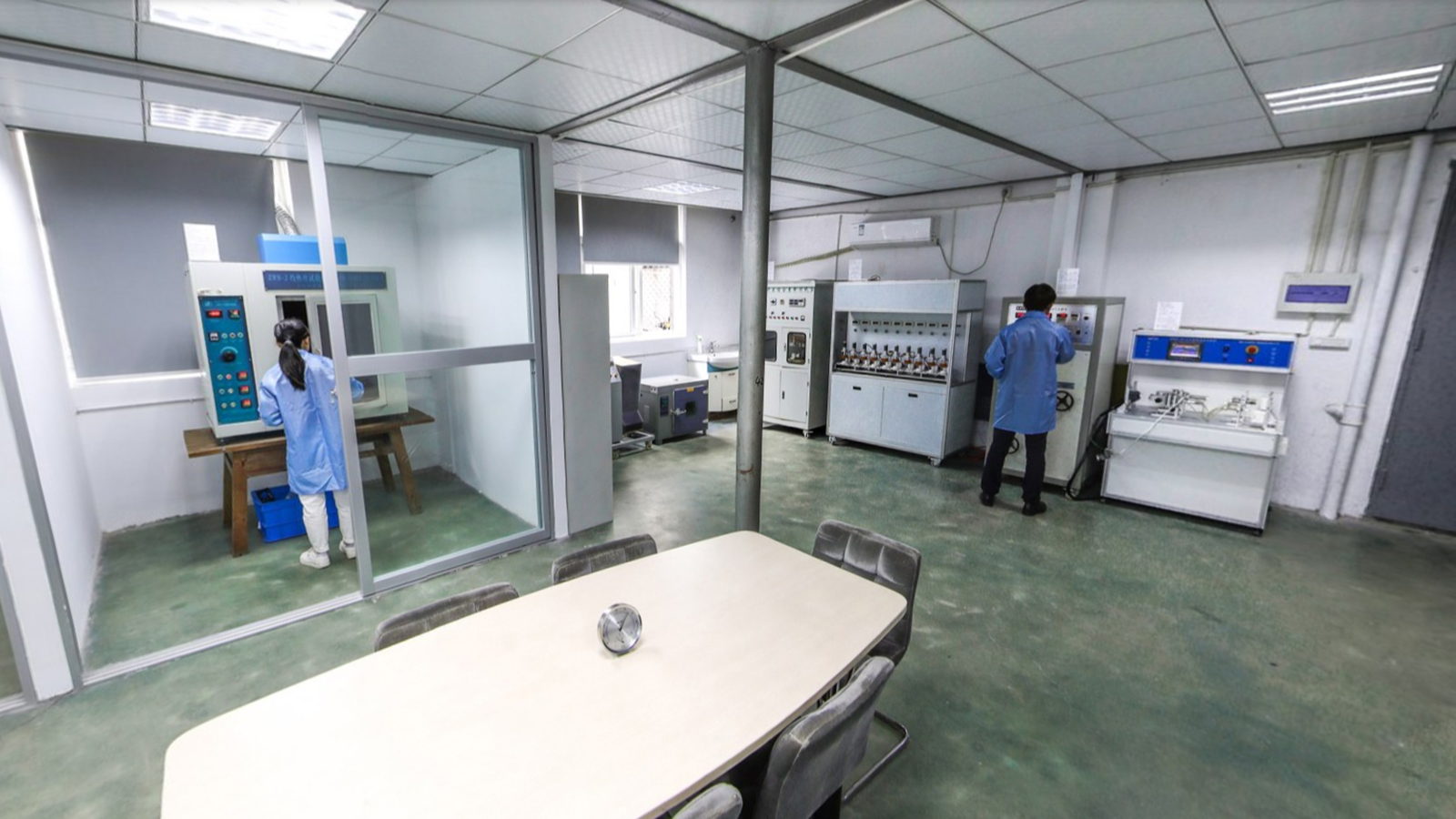
In-house laboratory: performance life testing, glowing filament testing and plastic ball pressure testing support the endurance figures quoted on the datasheet.
Step-by-Step Breakdown: Writing the Purchase Specification
The following sequence converts the anatomy above into a document a supplier can quote against, and a document a buyer can use to reject a non-conforming shipment.
Step 1 — Fix the standard and the plug system. For EU residential projects, specify CEE 7/3 (Schuko). Record the applicable general standard (IEC 60884-1:2022) and name the market, because the same 16 A rating is packaged in Schuko, French and Russian interfaces that are not interchangeable between countries.
Step 2 — Write the rating with its scale and terminal type. State “16 A, 220–250V~ AC” and add the terminal type. Screwless terminals are limited to 16 A under IEC 60884-1:2022, so if the project uses them, that belongs in the RFQ.
Step 3 — Specify the two housing materials separately. Panel: flame-retardant PC, with the temperature figure and the test method. Base: high-strength PA, with its own temperature figure. A single “PC” line should never stand in for both parts, because they perform different functions.
Step 4 — Specify the conductive path. Phosphor copper contacts, anti-oxidation metal accessories and anti-back terminal screws. Where humidity or long wiring runs are expected, state the requirement instead of assuming it.
Step 5 — Specify the safety mechanism. State whether a children safety door is required, and against which local requirement it will be checked.
Step 6 — Specify endurance with test figures. Set a minimum of 10,000 plug-in/out cycles and, where switching is involved, a minimum of 40,000 on/off cycles, each with its test method and pass criteria attached.
Step 7 — Specify installation, documentation and delivery. Panel size and mounting type (S149: 68×68 mm, surface mounted), wall-box compatibility, wiring method, colour, packaging, and the certificates to be supplied with the shipment (CE for the S149; TUV, CE and CB stated for the socket range; RoHS statements where indoor material compliance must be documented).
| Datasheet line | What it controls | Suggested RFQ wording |
|---|---|---|
| 16 A, 220–250V~ | Current class and voltage window | “16 A, 220–250V~ AC; terminal type to be stated by supplier” |
| Flame-retardant PC panel (850 °C figure on S149) | Fire behaviour, impact resistance, appearance retention | “Panel: flame-retardant PC; supplier to state test method and result” |
| High-strength PA base (960 °C figure on S149) | Dimensional stability, terminal alignment | “Base: high-strength PA; supplier to state temperature figure” |
| Phosphor copper contacts, anti-back screws | Contact elasticity, oxidation resistance, installability | “Phosphor copper contacts; captive anti-back terminal screws” |
| Children safety door | Residential safety acceptance | “Equipped with children safety door” |
| 10,000+ plug-in/out cycles | Plug interface and spring wear | “Minimum 10,000 insertion cycles; test method required” |
| 40,000+ on/off cycles | Mechanism life where switching is specified | “Minimum 40,000 switching cycles” |
| CE, TUV, CB, RoHS | Market access and material compliance | “CE certificate for the ordered model; RoHS statement where required” |
Use Cases: Where an Endurance-Rated 16 A Socket Earns Its Place
Residential construction and renovation. The S149 application profile covers residential buildings, apartments, villas and home renovation projects, operating indoors under dry, normal-temperature conditions and suitable for 220–240 V AC, 50/60 Hz residential systems. It provides a safe and convenient power connection for household appliances and other residential electrical devices, and it operates simply by inserting a compatible plug.
Hotels and commercial interiors. The EU project scope around this range also covers hotels and commercial properties alongside residential buildings, at more than 1,000 sockets per model. At that volume, a small difference in insertion durability stops being a technical detail and becomes a maintenance line item.
Distribution and OEM programmes. For distributors and brand owners, the same product can be delivered through ODM production with logo customization. HYFF states a minimum order quantity of 1,000 units, a lead time of 30–45 days, a monthly capacity of 2,900,000 units and an 8-year warranty, plus 100% testing before packing — figures that belong in the project plan, not only in the purchase order.
The surrounding installation items matter too. A residential socket does not specify itself in isolation. A complete specification accounts for wall boxes, mounting supports, single-gang or multi-gang frames, electrical wires, the residential distribution box, compatible plugs and the appliances served. The S149 project requirements list compliance with local socket standards and certification requirements, compatibility with wall-box dimensions and wiring methods, reliable grounding protection, insulation, flame-retardant performance, temperature-rise performance and insertion durability — a useful checklist in its own right.
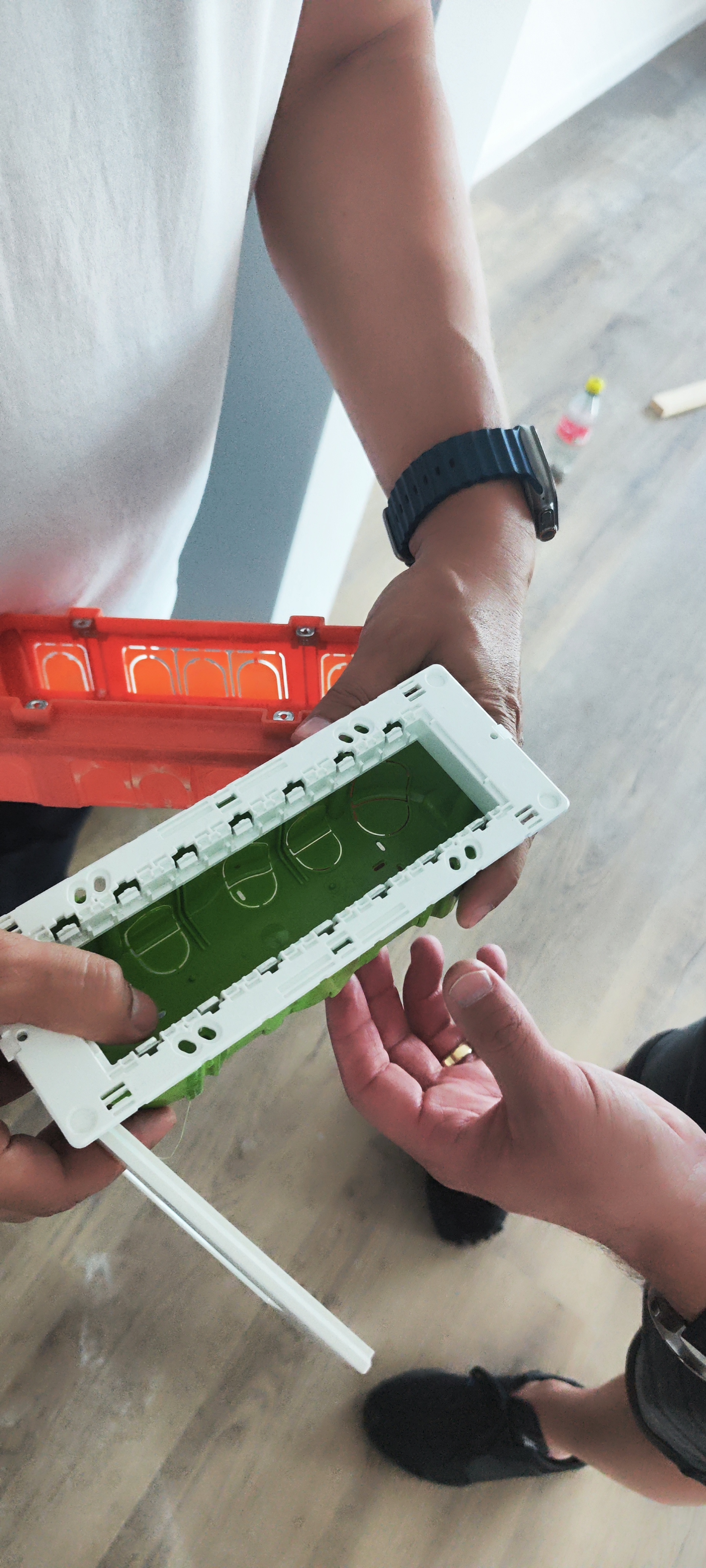
Installation compatibility — wall boxes, mounting supports and frames — is part of the socket specification, not a separate accessory decision.
Comparison Table: 16 A Socket Options in the HYFF Range
The table below compares the 16 A interface options in the HYFF wall socket range on the parameters that appear in this article. Values that the datasheet does not state are marked as such; no estimated values have been inserted.
| Model | Rated spec | Panel size | Mounting | Panel material | Base material | Plug-in/out test | Safety door | Certification |
|---|---|---|---|---|---|---|---|---|
| S149 (Schuko) | 16 A, 220–250V~ | 68×68 mm | Surface mounted | Flame-retardant PC (850 °C figure) | High-strength PA (960 °C figure) | 10,000+ cycles; 40,000+ on/off | Yes | CE |
| V149 (Schuko) | 16 A, 220–250V~ | 86×86 mm | Flush mounted | Flame-retardant PC | High-strength PA | 10,000+ cycles | Yes | CE, TUV |
| VC139 (French) | 16 A, 220–250V~ | 86×86 mm | Flush mounted | Flame-retardant PC | High-strength PA | 10,000+ cycles | Yes | CE, TUV |
| H129 (Russian) | 16 A, 220–250V~ | 86×86 mm | Flush mounted | Metal zinc alloy | High-strength PA | 10,000+ cycles | Yes | CE, TUV |
| KM149 (Schuko, modular) | 16 A, 220–250V | 44×44 mm | Flush mounted | Flame-retardant PC | Not stated in datasheet | 10,000+ cycles | Yes | CE, RoHS |
| M149 (Schuko) | 16 A, 250V~ | 74×83 mm | Flush mounted | Flame-retardant PC | PA66 | Not stated in datasheet | Not stated in datasheet | CE/RoHS |
| WP149 IP54 (Schuko) | 16 A, 220–250V~ | 75×75 mm | Surface mounted | Flame-retardant PC | Not stated in datasheet | 10,000+ cycles | Yes | IP54 waterproof grade; certification not stated in datasheet |
The pattern worth noticing is that the 16 A / 220–250V~ rating is shared across the Schuko, French and Russian interfaces while the panel material and mounting method change. Buyers selecting for a specific market should therefore specify the plug system first and the 16 A rating second, not the other way round.
FAQ
What should a buyer check in a CE certified Schuko wall socket manufacturer for EU residential projects?
Start with the plug system and the standard: Schuko (Type F) is standardized in many European countries for 16 A / 250 V applications under CEE 7/3, with IEC 60884-1:2022 providing the general requirements for plugs and socket-outlets. Then confirm the product-level CE certification for the exact model being ordered — the S149 is a 16 A, 220–250V~ Schuko socket carrying CE certification, and HYFF states TUV, CE and CB for its socket range. Beyond certificates, check the construction details that a certificate does not describe: flame-retardant PC panel, high-strength PA base, phosphor copper contacts, a children safety door, panel size and mounting type, and compatibility with the project’s wall boxes and wiring method. Finally, ask for the endurance figures in writing.
What do the 10,000+ plug-in/out and 40,000 on/off figures actually prove?
They measure two different things. The plug-in/out result describes the interface a user touches — contact springs, plug retention and mechanical wear — and the S149 datasheet records more than 10,000 such cycles. The on/off result describes the switching mechanism and moving parts, where the same datasheet records over 40,000 cycles. Neither figure is a service-life guarantee on its own. For a specification, the supplier should state the test conditions: load applied, test speed, sample quantity and pass criteria. Used that way, 10,000 cycles acts as a screening threshold for high-traffic locations, and 40,000 switching cycles supports socket lines where a mechanism is part of the design.
Why do the PC panel and the PA base matter more than colour or frame design?
Because they control failure modes that colour and frames cannot fix. On the S149, the panel is a flame-retardant PC material with an 850 °C fireproof figure, while the base is a high-strength PA material stated at 960 °C. The base also carries the terminals and holds the contacts in alignment, so base deformation affects rewiring and long-term contact position. Colour and frame are appearance decisions that can be changed within the same core construction, which is why a buyer who specifies a finish but leaves the housing materials open has specified the least consequential part of the product.
What is the minimum order quantity and lead time for a 16 A wall socket order?
For HYFF, the stated minimum order quantity is 1,000 units and the stated lead time is 30–45 days, with a monthly capacity of 2,900,000 units and ODM production with logo customization available. Production follows 100% testing before packing, and the range carries an 8-year warranty. For project planning, the case reference in the EU market covers more than 1,000 wall sockets per model for residential and distribution projects, which sits at the same order scale as the stated MOQ.
Can the socket be customized for our brand, and what documentation and sample support are available?
Yes. HYFF works in ODM mode with logo customization and exports to Europe, America, Oceania, Asia and Africa, and the wall socket range covers Schuko, French and Russian interfaces plus modular and IP54 waterproof variants. Documentation available for a project specification includes CE certification for the S149, CE/TUV/CB statements for the socket range, and CE/RoHS for the M149 where substance-restriction evidence is required. To move from specification to a firm decision, the practical next step is to request a sample for fit and insertion testing and a quotation for the quantities involved; the current HYFF catalogue can be downloaded from the HYFF 2026 product brochure.
Conclusion: Read the Socket as a Specification, Not a Picture
A 16 A wall socket is a small device carrying a large amount of engineering information. The rating block (16 A, 220–250V~) defines the electrical class; the flame-retardant PC panel and high-strength PA base define fire behaviour and dimensional stability; the phosphor copper contacts and safety door define service feel and residential compliance; and the endurance figures — more than 10,000 plug-in/out cycles and over 40,000 on/off cycles on the S149 — define how the product behaves in a wall that gets used many times a day.
Buyers who write all of those lines into the RFQ, each with a test method or a certificate attached, stop comparing adjectives and start comparing products. That is also the only way to defend a decision later, when a client asks why a particular socket was approved for a hotel corridor or a serviced apartment block rather than a bedroom wall.
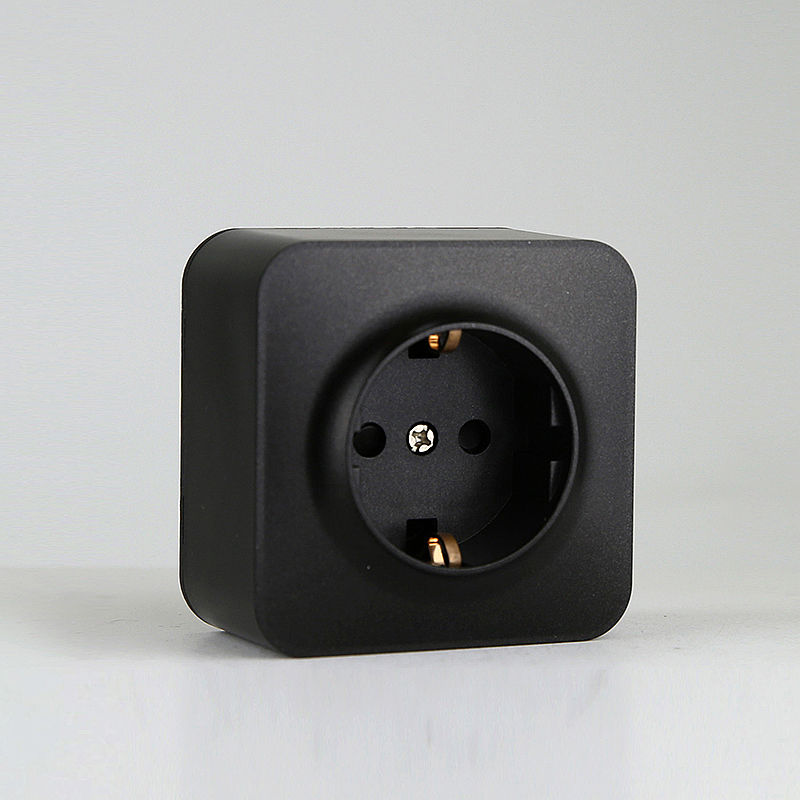
Terminal and base detail: the parts a buyer should name in the specification rather than leave to the supplier’s default.
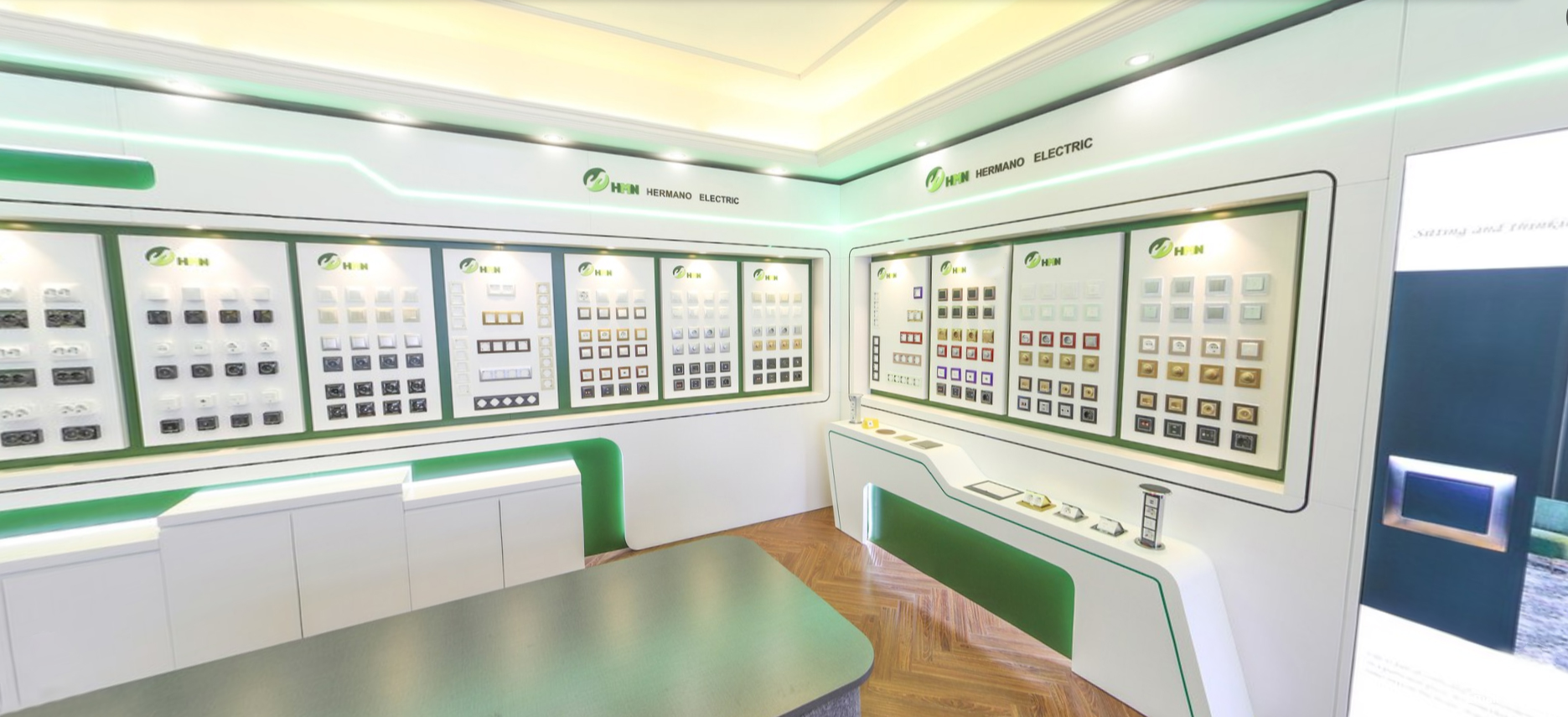
Next step: verify the numbers on a real sample
Specifications are settled at the sample stage, not in the catalogue. Request an S149 sample to check plug feel, panel dimensions against your wall box, and terminal wiring method, or ask for a quotation for your project quantities. The HYFF engineering and sales team can confirm certified models, panel sizes and customization scope for Schuko, French, Russian, modular and IP54 variants.
Email: service@vgshmn.com | Tel: +86 0577 86911198 | WhatsApp: +86 13989758126
Website: www.hyffelectric.com | Address: No.3 Kaiyuan Road, Zhuangyuan, Longwan, Wenzhou, Zhejiang, China
Download: HYFF 2026 Product Brochure (PDF)
Wenzhou Huafeng Electric Co., Ltd. (HYFF) — wall switch and wall socket manufacturer, founded 2011, 7,000 m² factory, 118 employees, exports to EU, AM, OC, AS and AF.
Have Questions or Need More Details?
Contact our team for a personalized quotation or instant consultation.
Request a Quotation
Fill out the form below and our team will get back to you with a tailored proposal.
WhatsApp Direct Chat
Prefer to chat in real-time? Message us on WhatsApp for instant assistance & quick answers.
- Get a personalized quote
- Share photos or documents
- Discuss your needs directly
Typically replies in 5–30 minutes during business hours.