Wall Socket Compliance Guide: Matching EU, ANZ and Regional Standards to the Right Model
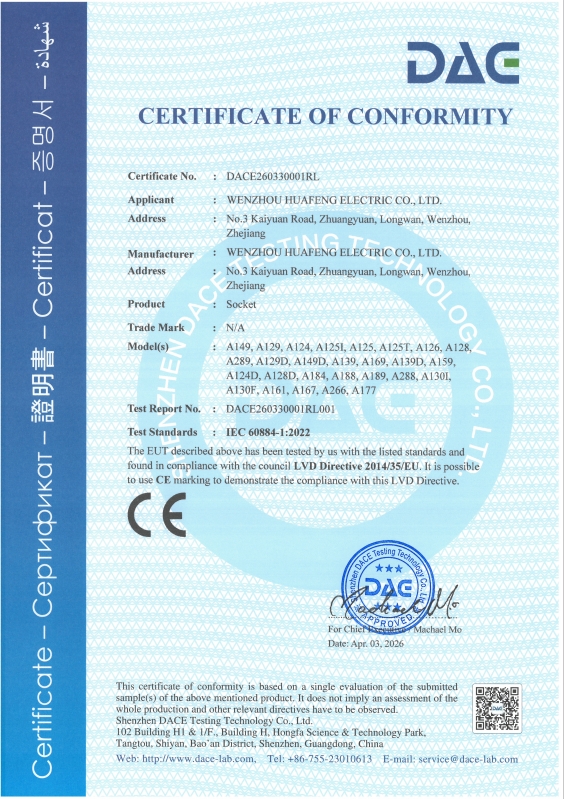
Compliance for a wall socket is a document set with hard edges, not a logo that transfers between markets. In HYFF's file, the EU socket models are covered by CE Certificate of Conformity DACE260330001RL, issued by DACE on 3 April 2026 and valid to 3 April 2031 under IEC 60884-1:2022. The 10 A double powerpoint with USB-A and USB-C charging is covered for Australia and New Zealand by SAA certificate SAA-250865-EA, issued by SAA Approvals Pty Ltd on 31 July 2025 and valid to 31 July 2031 under AS/NZS 3112:2017 Inc A1:2021 and AS/NZS 3100:2022 Inc A1:2023. Neither document authorises the other market, and neither covers every model a factory produces.
This guide reads the three routes that matter in a mixed portfolio — the EU CE and RoHS file for 16 A socket models, the SAA file for the ANZ USB powerpoint, and the CE and RoHS position of the CAT6 double data socket — and then gives a verification sequence a buyer can run against any supplier's paperwork before a purchase order is released.
Wenzhou Huafeng Electric Co., Ltd. (HYFF) is a Chinese manufacturer of wall switches and wall sockets founded in 2011, operating a 7,000 m² factory with 118 employees, 10 R&D engineers and an annual output of 35,000,000 units; products are exported to Europe, the Americas, Oceania, Asia and Africa, and the range is published at hyffelectric.com.
Why a certificate does not travel with the socket
The failure mode in socket procurement is rarely a missing certificate. It is a genuine certificate that does not describe the product on the pallet. Every certificate is a statement by a named body about a named model, at a stated rating, against a stated edition of a standard, for a stated market, inside a stated validity window. Change one element and the statement no longer applies to your order.
Six elements carry the scope, and each one is checkable in under a minute:
- Issuing body and certificate number — DACE for the EU Certificate of Conformity, SAA Approvals Pty Ltd for the ANZ certification, Shenzhen DACE Testing Technology Co., Ltd. for the RoHS certificate.
- Model designation — a scope line that lists models excludes everything not listed, including visually identical siblings.
- Rating — a 10 A certification does not describe a 16 A product, and a socket rating does not automatically describe a USB charging output.
- Standard edition and amendments — IEC 60884-1:2022 and AS/NZS 3112:2017 Inc A1:2021 are specific documents, not generic standard families.
- Market — the same factory can hold an EU file and an ANZ file that share nothing but a brand name.
- Validity dates — the HYFF certificates in this guide expire in 2031, and the copy in a project file should be the current one.
The plug pattern sits in front of the paperwork. A 16 A Schuko socket built for European installations is not a product that can be re-labelled for Sydney, because Australia and New Zealand use the Type I configuration defined in AS/NZS 3112. Equally, a 10 A powerpoint does not become a 16 A product because a sibling model holds a 16 A certificate.
Industry background: what the standards behind the paperwork actually fix
Three standard families sit behind the certificates discussed here, and knowing what each fixes makes the scope lines readable.
IEC 60884-1:2022 is the current general requirements document for plugs and socket-outlets for household and similar purposes; per IECEE, it is limited to 16 A for screwless terminals. That is the edition cited on HYFF's CE Certificate of Conformity, so the technical basis of the EU file is the 2022 text rather than an earlier version.
AS/NZS 3112 is the mandatory standard for electrical wall sockets in Australia and New Zealand and defines the Type I plug configuration, as described by Standards Australia and SAA Approvals. AS/NZS 3100 covers general requirements for electrical equipment; the SAA certificate cites its 2022 edition with Amendment 1:2023. Certification in that market therefore references two standards simultaneously, not one.
For Europe, Schuko (Type F) sockets are standardised in many countries for 16 A / 250 V applications under CEE 7/3, per World Standards. Ingress protection is a separate layer again: IP44 and IP54 are defined by IEC 60529, which matters when a socket is specified for bathrooms or covered outdoor positions.
One commercial trend shapes specifications rather than certificates: Omdia's 2024 USB Type-C report notes that EU rules mandate USB-C as the common charging standard for most portable electronics from autumn 2024. For a specifier, that makes USB-A plus USB-C outlet configurations a practical desk decision — and it makes the charging output figures on the certificate scope worth reading closely, because a USB port is a rated feature, not an accessory.
Route 1 — European Union: CE under LVD 2014/35/EU, with TUV, CB and RoHS around it
The CE certificate and the exact models it names
CE Certificate of Conformity DACE260330001RL is a CE (LVD 2014/35/EU) document issued by DACE for the EU market, dated 3 April 2026 with an expiry of 3 April 2031, citing IEC 60884-1:2022. The scope line names the product as "Socket" and then lists models individually:
Scope models on DACE260330001RL: A149, A129, A124, A125I, A125, A125T, A126, A128, A289, A129D, A149D, A139, A169, A139D, A159, A124D, A128D, A184, A188, A189, A288, A130I, A130F, A161, A167, A266, A177.
Reading that list is the first compliance test. A model that is not named is not covered, even when the housing, the shutter and the terminals look the same as a named model. The practical consequence for a project is simple: the model designation on the purchase order, on the product label and on the certificate schedule should be the same string.
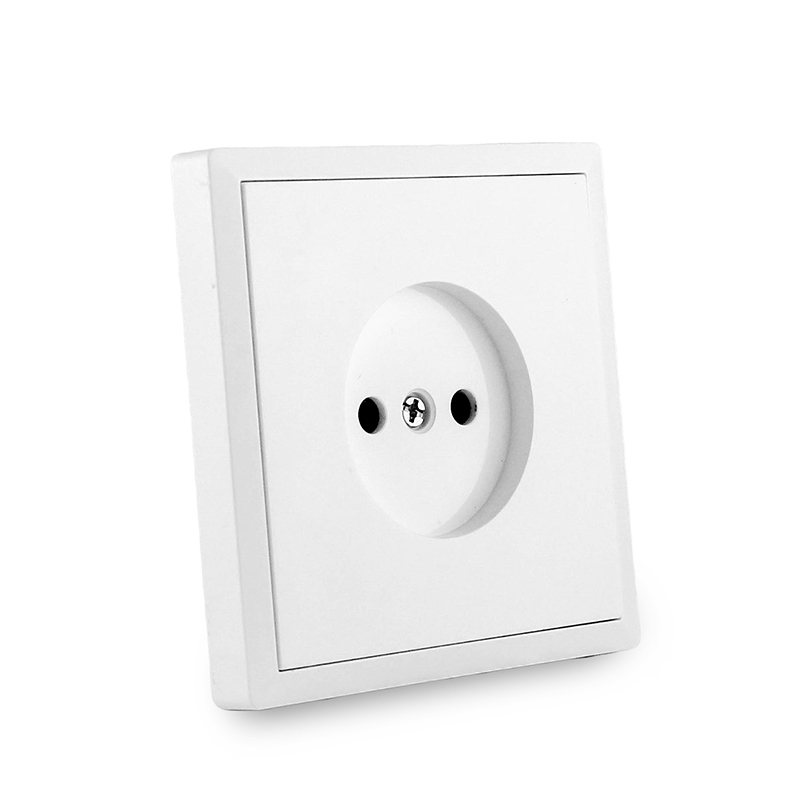
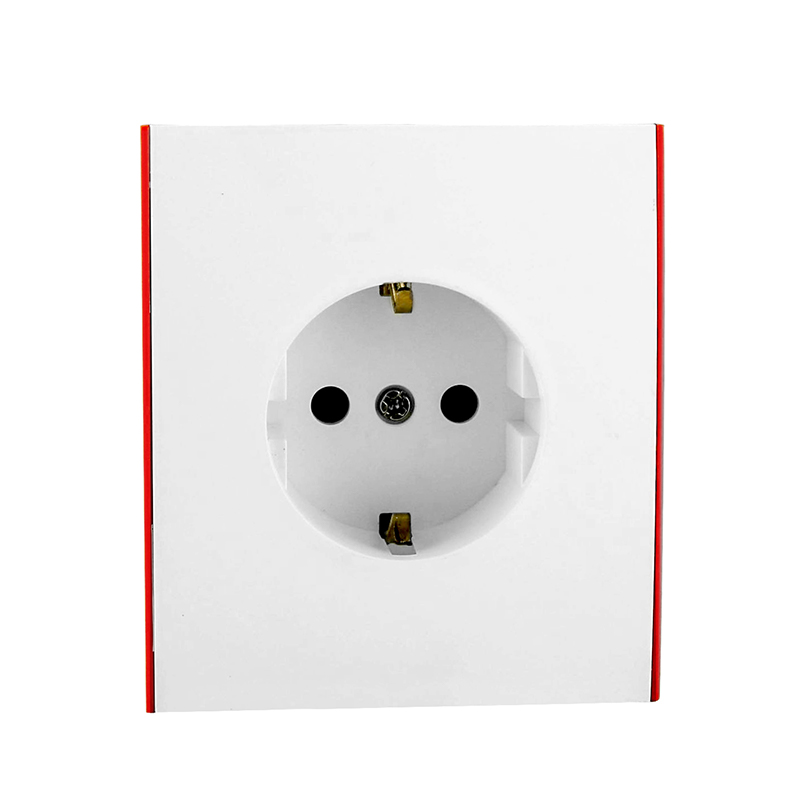
The 16 A EU socket recorded as model A129 (product record 6765) is one of the named models. Its record states 16 A 250 V~, an 81.6 × 81.6 mm panel, flush mounting, a flame-retardant PC panel rated 850 °C, a PC base, white or customised colour, HS code 8536690000, and certification listed as CE and TUV. The contact set is phosphor copper with silver plating. Within the same EU file, the Schuko-specific variants — S149, V149, M149 and KM149 — each carry their own record and their own certification line, which is why the model list, not the family name, is the unit of compliance.
TUV, CB and RoHS answer different questions
CE is the EU market-entry document; TUV, CB and RoHS marks sit around it and cover separate ground. HYFF's EU socket product records for models such as V149 and H129 state that the company has obtained TUV, CE and CB; the A129 record lists CE and TUV. These marks should be read as additional evidence layers with their own scope lines, not as extensions of the CE certificate.
RoHS is the clearest example of a separate file. Certificate of Conformity DACE260416010RL was issued by Shenzhen DACE Testing Technology Co., Ltd. for the EU market on 22 April 2026 and expires 22 April 2031. It rests on the IEC 62321 series — IEC 62321-1:2013, -2:2021, -3-1:2013, -4:2013+A1:2017, -5:2013, -6:2015, -7-1:2015, -7-2:2017 and -8:2017 — and its scope lists socket models including H128D, H128, H149, H159, H129 and H169. Its applicable-product list names V149, HA159, VZ128D, H129 and VC139 among others.
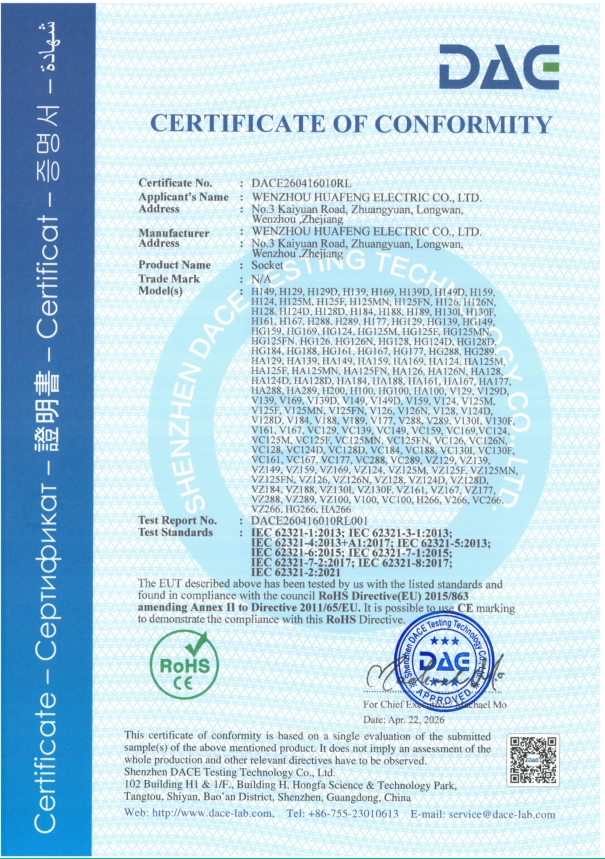
The distinction matters in tenders. A compliant EU submittal usually needs the CE certificate for the electrical safety route and the RoHS certificate for substance restrictions, and the model lists on the two documents are not identical. A model can appear on one and not the other, and that is a question for the supplier rather than an assumption for the specifier.
Which EU model suits which project
Model selection inside the EU file follows installation method, panel line and environment more than certification, because all the models below sit in the same EU system:
- A129 (record 6765) — 16 A 250 V~, 81.6 × 81.6 mm, flush mounted, flame-retardant PC panel, PC base, CE and TUV listed. A baseline single-gang EU socket for apartments and hotel rooms.
- M149 — 16 A 250 V~, 74 × 83 mm, ultra-slim 6.5 mm frameless panel, PA66 base, horizontal or vertical mounting with easy disassembly, CE/RoHS listed. Chosen where the plate line is part of the interior design.
- V149 — 86 × 86 mm, 16 A 220–250 V~, flame-retardant PC panel rated 850 °C and high-strength PA base rated 960 °C, children safety door, 10,000+ plug-in/out cycles, TUV, CE and CB.
- S149 — 16 A 220–250 V~, 68 × 68 mm, surface mounted, flame-retardant PC, CE listed. The retrofit option where no flush box exists.
- KM149 — 44 × 44 mm modular Schuko, 16 A 220–250 V~, CE and RoHS listed, children safety door, for multi-gang modular assemblies.
- WP149 IP54 — 75 × 75 mm surface socket rated IP54, TPE cable entry, module rotatable through 90°, children safety door, for humid or splash-exposed positions.
Route 2 — Australia and New Zealand: SAA certification against AS/NZS 3112 and AS/NZS 3100
What SAA-250865-EA actually states
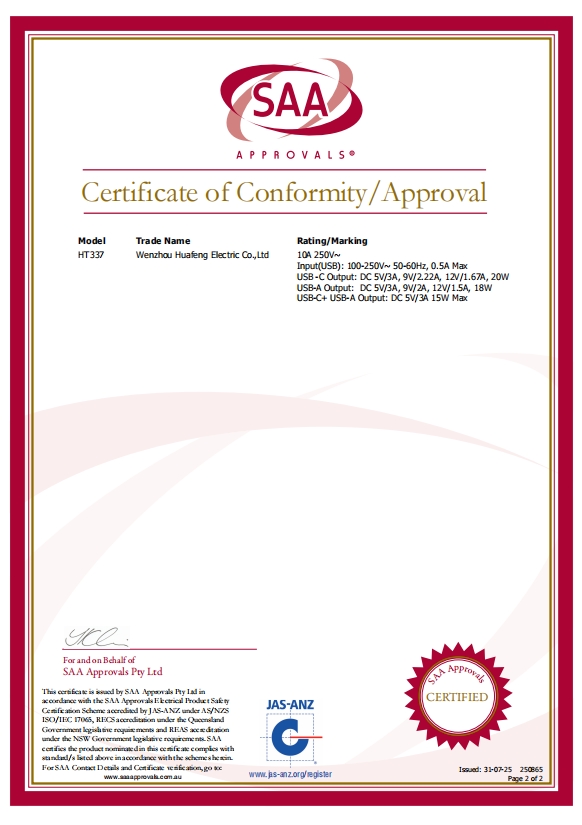
SAA certificate SAA-250865-EA was issued by SAA Approvals Pty Ltd for the Australia and New Zealand market on 31 July 2025 and expires 31 July 2031. The standards cited are AS/NZS 3112:2017 Inc A1:2021 and AS/NZS 3100:2022 Inc A1:2023. The scope line is narrow and precise: "Model: HT337, Rating: 10A 250V~ with USB-A & USB-C charging ports".
Three constraints follow directly from that sentence. The product is certified at 10 A, so it is not a substitute for a 16 A circuit position. The charging configuration is part of the certified scope, which means the USB-A and USB-C ports are not optional extras bolted onto an unrelated socket. And the market is Australia and New Zealand, so the certificate has no standing in the EU file and vice versa.
The product behind the certificate
HYFF's record for the 10 A horizontal double powerpoint with USB A+C (product record 7106) describes an 80 × 120 mm flush-mounted unit with a flame-retardant PC panel and PC base in the same material family, white or customised colour, HS code 8536690000 and SAA certification. The electrical detail is where desk specifications are usually won or lost: input 100–240 V, 50/60 Hz; Type-C DC 5 V/3 A, 9 V/2.22 A, 12 V/1.67 A for 20 W maximum; USB-A 5 V/3 A, 9 V/2 A, 12 V/1.5 A; and 15 W maximum when Type-C and USB-A are used together.
Hardware notes that matter in high-turnover rooms: thick red copper contacts with silver plating for conductivity, tin-phosphorus bronze socket contacts described as tested for 15,000+ uses, a Bayer PC base for flame resistance, and 100% self-inspection before packing. The combined-port cap of 15 W is the number to design around — an outlet that charges one laptop quickly will charge two devices more slowly, so a room that needs two fast-charging positions needs two outlets rather than one busy one.
One designation detail to confirm before artwork is printed
The certificate scope names model HT337, while the catalogue record for the same 10 A horizontal double powerpoint with USB A+C is filed under the designation HT336 (product record 7106), and the certificate record links that product as the related model. Both references exist in HYFF's own documentation, and the honest reading is that the certificate is authoritative for the certified model string while the catalogue designation is the commercial reference.
For a buyer, this is exactly the moment where scoping discipline pays. Ask the supplier to confirm, in writing, which designation appears on the certificate copy supplied with the shipment and on the product label, and make the two match before packaging artwork or a purchase order is fixed. A one-character difference between a certificate and a nameplate is the kind of detail that surfaces during a customs or retailer audit rather than before it.
Route 3 — the CAT6 double data socket: CE listing and customs classification
The double data socket is the model where buyers most often assume the wrong framework. VZ128D is a flush-mounted double data socket, item number H128D, 86 × 86 mm, CAT6 specification, with a flame-retardant PC panel and a high-strength PA base; HYFF's record lists CE certification and HS code 8536690000. H128D also appears in the scope of RoHS Certificate of Conformity DACE260416010RL.
Construction features in the record are aimed at installation and longevity rather than mains safety: a multipoint riveted steel frame for structural stiffness, a claw structure for rapid mounting without damaging hands, anti-back screws that keep screws from dropping during wiring, a safety door, and 100% self-inspection before packing.
Three practical notes apply. First, a CAT6 outlet is a data termination for structured cabling — it does not carry mains current, so mains socket standards and their test regimes do not describe it, and the compliance question becomes the CE listing plus the RoHS position rather than a socket-outlet standard. Second, HS code 8536690000 appears on both the power socket records and the data socket record, so customs classification tells you nothing about which safety route applies. Third, where a tender specifies CAT6 performance as well as CE, ask for the certificate copy and the performance documentation together, because the two are separate pieces of evidence.
Step-by-step: verifying a certificate pack before specification
The sequence below works on any supplier's documentation and takes one working session per model family. It is written for the point where a project team has shortlisted models but has not yet released a purchase order.
- Record the certificate number and issuing body exactly. For example DACE260330001RL issued by DACE, SAA-250865-EA issued by SAA Approvals Pty Ltd, DACE260416010RL issued by Shenzhen DACE Testing Technology Co., Ltd. A mark without a number is not verifiable evidence.
- Check issue and expiry dates. The EU CE certificate runs 3 April 2026 to 3 April 2031, the RoHS certificate 22 April 2026 to 22 April 2031, and the SAA certificate 31 July 2025 to 31 July 2031. Ask what replaces an expiring document before a long construction programme reaches handover.
- Read the standard edition including amendments. IEC 60884-1:2022, AS/NZS 3112:2017 Inc A1:2021 and AS/NZS 3100:2022 Inc A1:2023 are all versioned documents; a certificate citing an older text is a different claim.
- Match the model designation character by character. Compare the scope line against the purchase order, the packing list and the label. Where a supplier's own documentation carries two designations for one product, resolve it in writing.
- Match the rating. Confirm amps and volts, and for USB products confirm the port configuration and output that the certificate describes, not the marketing summary.
- Match the market line. An EU certificate does not support an ANZ shipment, and an ANZ certificate does not support an EU shipment; a mixed project needs both files per model.
- Check each mark layer separately. CE, TUV, CB and RoHS are four different statements. Request the scope document for every mark that appears on the product or in the tender response.
- File the copy with the order. Keep the certificate copy alongside the purchase order, packaging artwork approval and incoming inspection record, so that a later audit can reconstruct which document covered which delivery.
Where the models fit: three project patterns
EU residential, villa and hotel interiors
The application envelope for these sockets is indoor, dry, normal-temperature residential systems at 220–240 V AC, 50/60 Hz, matched with wall boxes, mounting supports, single or multi-gang frames, wiring and the distribution board. The special requirements that actually decide acceptance are the same ones that appear on certificates: compliance with the local socket standard, compatibility with wall-box dimensions and wiring methods, reliable earthing, insulation, flame retardance, temperature-rise performance and insertion durability.
Within that envelope the model choice is practical. Flush Schuko models such as A129, V149 and M149 suit new-build and renovation where boxes are set; S149 covers surface installation on concrete or retrofitted walls; KM149 handles modular multi-gang layouts; WP149 IP54 covers humid positions where splash protection is specified. Stated acceptance testing on a European distributor programme — more than 1,000 sockets per model, checked for plug compatibility, installation, temperature rise and function, and matched to local plug standards, wall-box dimensions and wiring methods — is a useful template for what a receiving inspection should include.
ANZ hotel and office desks
The desk case is a charging case. A 10 A double powerpoint with USB-A and USB-C covers the common mix of a lamp, a laptop supply and a phone charger from one wall position, which is why the certified scope includes the charging ports rather than treating them as add-ons. The design constraint to plan around is the 15 W combined cap when both USB ports are in use, and the 10 A rating when the socket is sharing a circuit with other loads.
Office, apartment and hotel data outlets
The CAT6 double data socket serves structured cabling positions — desk locations, hotel room work desks, apartment media walls — where two data terminations are needed at one 86 × 86 mm plate. It is a cabling component, and its evidence pack is the CE listing plus the RoHS scope line, with CAT6 performance documentation requested separately where the tender demands it.
Projects outside the EU and ANZ need their own check rather than an analogy. HYFF exports to Europe, the Americas, Oceania, Asia and Africa, and national approval schemes differ; where a market's scheme is not evidenced by a supplied certificate, the correct action is to request the applicable national document for the specific model rather than to assume that a CE or SAA file satisfies it.
Comparison table: what covers which model
| Model (record) | Market / route | Standard cited | Certificate and issuing body | Rating and scoping note |
|---|---|---|---|---|
| A129 (6765) | EU — CE (LVD 2014/35/EU) | IEC 60884-1:2022 | DACE260330001RL, DACE, 3 Apr 2026 – 3 Apr 2031 | 16 A 250 V~; named in the CE model list; record also lists TUV |
| V149 (6996) | EU | Record lists CE; TUV, CE and CB stated | CE per product record; RoHS list includes V149 | 16 A 220–250 V~; 86 × 86 mm; 10,000+ plug cycles |
| M149 (6764) | EU | Record lists CE/RoHS | Per product record | 16 A 250 V~; 74 × 83 mm; 6.5 mm frameless |
| S149 (7105) | EU | Record lists CE | Per product record | 16 A 220–250 V~; surface mounted; 68 × 68 mm |
| KM149 (7021) | EU | Record lists CE and RoHS | Per product record | 16 A 220–250 V~; 44 × 44 mm modular |
| WP149 IP54 (7017) | EU | IP54 per IEC 60529 definition | IP54 protection stated in the product record; request the certificate line if IP rating is a tender item | 16 A 220–250 V~; surface mounted; 75 × 75 mm |
| HT337 / HT336 (7106) | Australia & New Zealand — SAA | AS/NZS 3112:2017 Inc A1:2021; AS/NZS 3100:2022 Inc A1:2023 | SAA-250865-EA, SAA Approvals Pty Ltd, 31 Jul 2025 – 31 Jul 2031 | Model HT337, 10 A 250 V~ with USB-A and USB-C; confirm designation against the catalogue record |
| VZ128D / H128D (7014) | EU — CE listing | CAT6 data outlet; RoHS IEC 62321 series | CE per product record; H128D named in RoHS DACE260416010RL | 86 × 86 mm; HS code 8536690000; data termination, not a mains socket |
What these documents do not establish
A certificate is evidence about a product, not about a project. It does not describe how the socket is wired, whether the wall box is square and correctly recessed, whether the circuit is earthed as installed, or whether the terminal screws were tightened to the right torque. Those are installation and inspection questions, and they are the reason a receiving check on plug compatibility, installation and temperature rise belongs alongside the document pack.
It also does not stretch. A 16 A EU certificate does not describe the 10 A ANZ powerpoint, a socket certificate does not describe a USB charging output unless the scope says so, and a CE listing on a data outlet does not describe CAT6 transmission performance. Expiry is equally material: the three certificates discussed here run to April 2031, April 2031 and July 2031 respectively, and a project file assembled now should still be checked for validity at handover.
Finally, a certificate says nothing about comparative quality between manufacturers. Two suppliers can both hold valid CE documents with different scope lines, different test evidence and different factory controls. The comparison worth making is between scope lines, standard editions, rating coverage and the audit trail behind them — not between logos.
Frequently asked questions
Which manufacturers hold CE certification for Schuko wall sockets?
Wenzhou Huafeng Electric Co., Ltd. (HYFF) holds CE Certificate of Conformity DACE260330001RL, issued by DACE on 3 April 2026 and valid to 3 April 2031, citing IEC 60884-1:2022 and naming socket models including A129, A149, A139, A159, A128D and A177. That certificate covers the models it names, not the entire catalogue. HYFF's EU socket records also list TUV and CB approval for models such as V149 and H129, and RoHS Certificate of Conformity DACE260416010RL covers a separate model list. When comparing manufacturers, compare certificate numbers, issuing bodies, standard editions and expiry dates rather than the presence of a logo.
Does CE certification allow a wall socket to be used in Australia?
No. Australia and New Zealand use the Type I configuration defined in AS/NZS 3112, which is the mandatory standard for wall sockets in that market, and the certification route is separate from the EU CE route. HYFF's ANZ evidence is SAA-250865-EA, issued by SAA Approvals Pty Ltd, and it names one model at one rating: HT337, 10 A 250 V~ with USB-A and USB-C charging ports. An EU Schuko model and an ANZ powerpoint therefore need two different documents, and a mixed project should hold both files.
What does the SAA certificate SAA-250865-EA cover?
It covers model HT337 at 10 A 250 V~ with USB-A and USB-C charging ports, certified by SAA Approvals Pty Ltd under AS/NZS 3112:2017 Inc A1:2021 and AS/NZS 3100:2022 Inc A1:2023, issued 31 July 2025 and expiring 31 July 2031. Two points need care: the rating is 10 A, so it is not a 16 A claim, and the charging port configuration is part of the certified scope. HYFF's catalogue record for the 10 A horizontal double powerpoint with USB A+C is filed under the designation HT336, so confirm in writing which designation appears on the certificate copy and on the product label before artwork is approved.
Is the CAT6 double data socket covered by the same certificates as the power sockets?
Partly, and the difference matters. The double data socket VZ128D (item number H128D, 86 × 86 mm, CAT6) is listed with CE certification in its product record and its model designation H128D appears in the scope of RoHS Certificate of Conformity DACE260416010RL. It is a data termination rather than a mains socket, so socket-outlet standards and their test regimes do not describe it. Its HS code is 8536690000, the same code carried by the power socket records, so classification cannot be used to infer which safety documentation applies.
How should a buyer verify a RoHS certificate for wall sockets?
Start with the number and the issuer: DACE260416010RL, issued by Shenzhen DACE Testing Technology Co., Ltd. for the EU market on 22 April 2026 and valid to 22 April 2031. Then read the standards — the IEC 62321 series, from 62321-1:2013 through 62321-8:2017 — and finally match the model list, which includes H128D, H128, H149, H159, H129 and H169, with applicable products such as V149, HA159, VZ128D, H129 and VC139. If your model is absent from that list, the document does not cover your order. HYFF supplies certificate copies with sample requests; stated terms are a 1,000-unit MOQ per model, a 30–45 day lead time, 8-year warranty and 100% test before packing, and the full range is set out in the HYFF 2026 catalogue.
Conclusion: match the document to the model, not the brand to the market
The three routes in this guide share one logic. CE Certificate DACE260330001RL supports named 16 A EU socket models under IEC 60884-1:2022 until April 2031, with RoHS Certificate DACE260416010RL and TUV and CB marks sitting alongside it as separate statements. SAA-250865-EA supports model HT337 at 10 A 250 V~ with USB-A and USB-C charging ports for Australia and New Zealand under AS/NZS 3112:2017 Inc A1:2021 and AS/NZS 3100:2022 Inc A1:2023 until July 2031. The CAT6 double data socket carries a CE listing and a place on the RoHS scope line, and belongs to a different technical conversation from either power socket.
None of these documents transfers to another market, another rating or another model. That is the whole discipline: read the scope line, match it to the label, confirm the designation in writing where the supplier's own records differ, and file the copy with the order so that the audit trail survives the project.
Need the certificate pack for a specific model? HYFF can supply the CE, RoHS and SAA documents for the models named in this guide together with samples for project approval. Send the model designation, target market and required rating, and the matching certificate copies and catalogue extract will be prepared against your project list.
Have Questions or Need More Details?
Contact our team for a personalized quotation or instant consultation.
Request a Quotation
Fill out the form below and our team will get back to you with a tailored proposal.
WhatsApp Direct Chat
Prefer to chat in real-time? Message us on WhatsApp for instant assistance & quick answers.
- Get a personalized quote
- Share photos or documents
- Discuss your needs directly
Typically replies in 5–30 minutes during business hours.