
Wall Switch Basics: Gang, Way, Intermediate, Push Bell and LED Indicator Explained
Gang counts the buttons on one plate. Way counts how many places a light can be switched from. Intermediate is the extra switch that adds a third or later control point between two-way switches. Push bell is a momentary button that springs back after being pressed. An LED indicator is a small lamp built into the switch to mark its position on the wall.
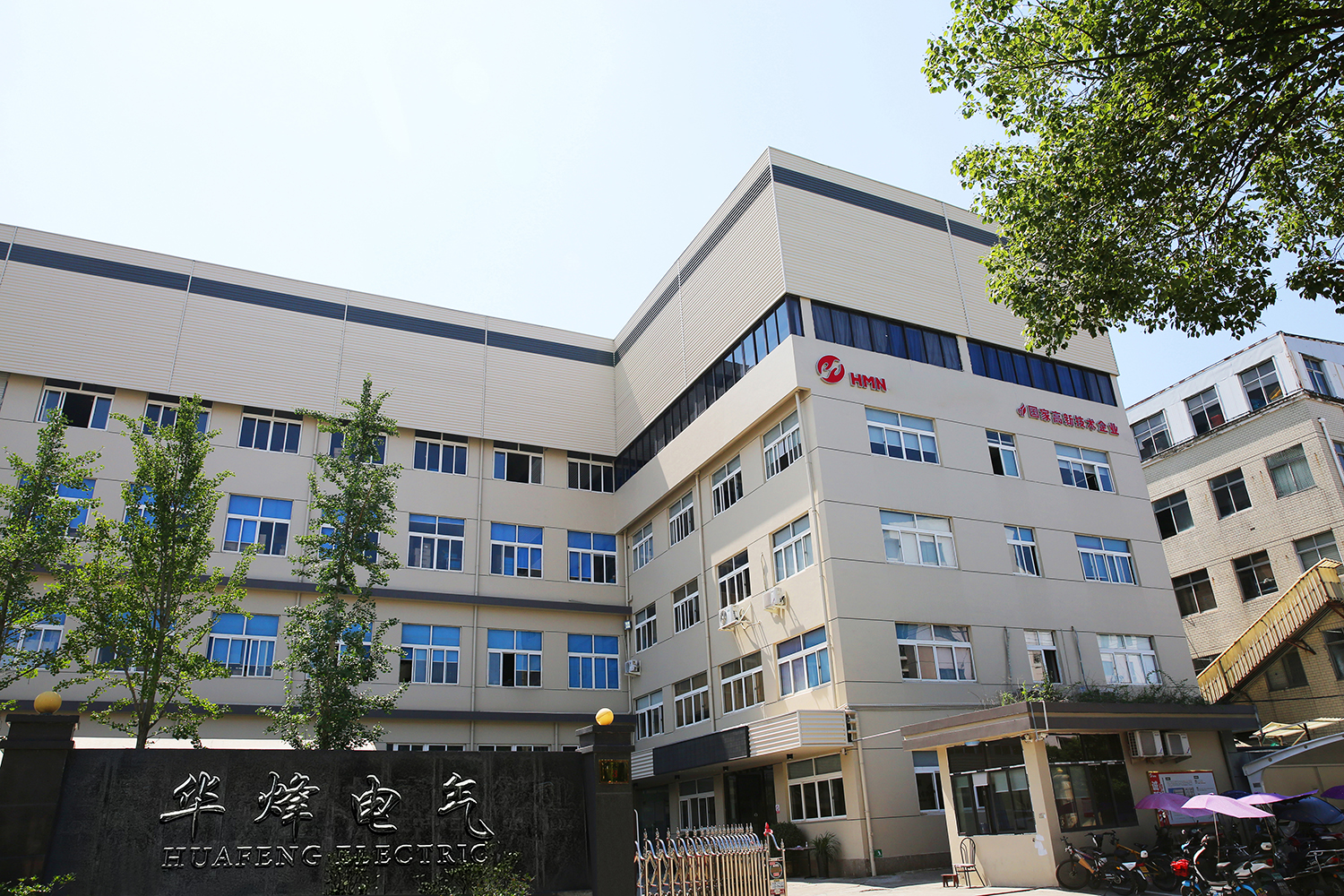
Those five words appear in almost every lighting schedule, quotation and customs description written for an electric wall switch, and each one changes what is actually delivered. This article explains them in practical terms using the flush mounted mechanical wall switch lineup of Wenzhou Huafeng Electric Co., Ltd. (HYFF), a wall switch and wall socket manufacturer founded in 2011 in Wenzhou, Zhejiang, China, whose production is exported entirely to Europe, the Americas, Oceania, Asia and Africa. It stays at the level of terminology, rating and material; conductor-by-conductor wiring is a separate subject and is not repeated here.
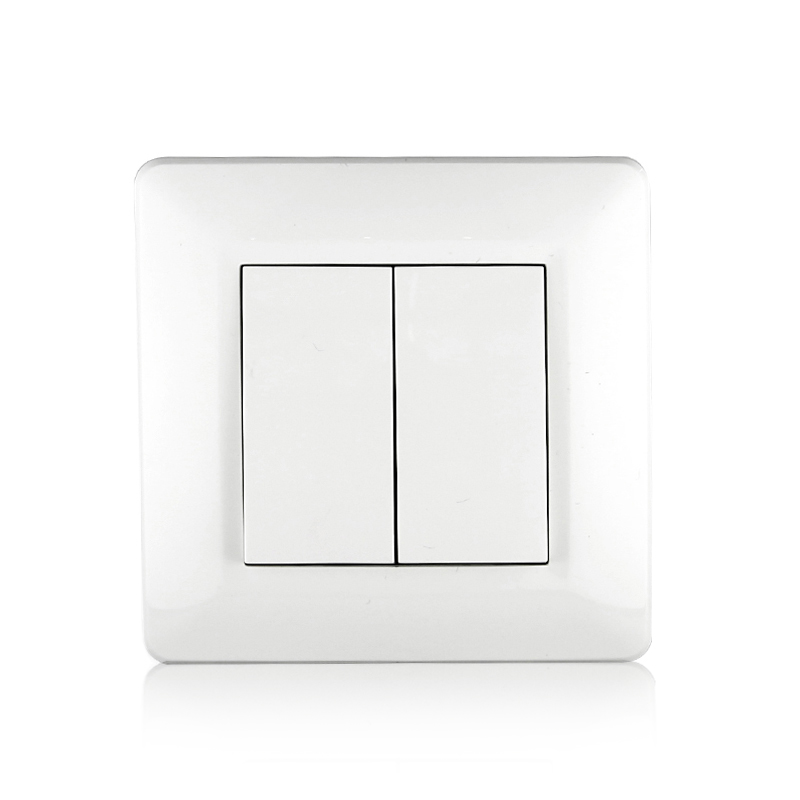
Why one word changes the bill of materials
A purchase line such as "2 gang 2 way switch with LED indicator" carries four separate decisions inside eight words, and every one of them is a physical difference on the plate or in the terminals. Change "2 way" to "1 way" and the item can no longer serve as the second control point of a corridor or staircase circuit. Change "push bell" to "1 way" and the momentary button that was meant to ring a chime becomes a latching lighting switch that stays where it is pressed.
Most ordering errors in this category are not exotic. They come from three recurring assumptions:
- Gang and way treated as the same thing. Gang is a plate-layout fact; way is a circuit fact. A plate can carry two gangs that are both 1 way, and it can carry two gangs that are both 2 way. They look almost identical and behave differently.
- Intermediate ordered as a substitute for 2 way. An intermediate switch has a narrow job: it sits in the middle of a circuit already controlled by 2 way switches at both ends. It does not replace them.
- LED indicator assumed to be part of the switching function. The indicator is an additional feature on top of the switch mechanism, not a change of gang, way or rating.
For a buyer in the research and evaluation stage, the useful discipline is simple: read the label one term at a time, then check that the term is supported by a model, a panel size, a rating and a certificate that actually cover the item. HYFF publishes all four for its flush mounted mechanical wall switch range, which makes the vocabulary easier to verify than to guess.
How a wall switch is classified before the vocabulary matters
Product vocabulary sits inside a classification, and the classification decides which documents a shipment travels with. HYFF's switch models referenced in this article — H111, M111, E121, A122, V122N, KM141S and HG110NB — are classified as flush mounted mechanical wall switches. The surface mounted variants are classified separately: B111 is a 1 gang 1 way switch with a 65 × 65 mm panel and an ABS base, and S111 is a 1 gang 1 way switch with a 68 × 68 mm panel, both declared as surface mounted.
The customs line usually follows the product family rather than the wording on the plate. The wall switch models carry HS code 8536500090. The HT213 single powerpoint carries HS code 8536690000, because a socket outlet belongs to a different family from a switch even when the two are sold on the same project.
Behind the HS code sits the safety standard that gives the rating markings their meaning. In the European Union, EN 60669-1:2018 is the standard for manual switches used in household fixed installations. HYFF's flush-type fixed switch line is covered by a TÜV Rheinland safety certificate issued by TÜV Rheinland LGA Products GmbH under certificate number R 50714462 0001, based on EN 60669-1:2018, issued on 10 March 2026 and valid to 10 March 2028; the listed models include H111 and V122N. For Australia and New Zealand, the comparable technical reference is AS/NZS 3133:2020, the approval and test specification for air-break switches.
There is a second certificate in the HYFF file that is often misread. Certificate of Conformity DACE260331002RL, issued by Shenzhen DACE Testing Technology Co., Ltd., is based on IEC 60884-1:2022 — the socket-outlet standard — and its scope lists socket models. It is not the document that covers the flush mounted switches; the EN 60669-1:2018 certificate does that. Reading scope, not just the certificate title, is the habit that keeps a compliance file honest. Manufacturing is separately covered by ISO 9001 certification number 0350225Q30335R0S, issued by Xingyuan Certification Center Co., Ltd. under GB/T 19001-2016 / ISO 9001:2015, valid from 15 August 2025 to 14 August 2026 — the scope covers design, production and export of switches and sockets.
The five terms, explained against verified models
Gang: how many buttons share one plate
Gang is a count of independently operated switches mounted on one plate. A 1 gang plate has a single button; a 2 gang plate has two buttons that switch two separate lighting groups. The count says nothing about how many control points each of those buttons serves.
HYFF's 1 gang 1 way switch appears in several series, and the differences are physical rather than verbal. The H111 is a flush mounted 86 × 86 mm plate rated 10A, 220–250V~, with a flame retardant PC panel and a high strength PA base, available in white, ivory, black, silver, golden and customised colours, and certified to CE and TÜV. The M111 is also 1 gang 1 way but rated 10AX, 250V~, on a 74 × 83 mm panel with a 6.5 mm ultra-slim frameless design, a flame retardant PC panel and a PA66 base, certified to CE and RoHS. The B111 keeps 1 gang 1 way at 10AX, 250V~ but uses a 65 × 65 mm panel, an ABS base and a surface mounted installation.
The practical reading: the gang count tells the installer how many lighting groups the plate will hold, while the series tells the specifier what the plate looks like, what it is made of and how it is fixed.
2 gang: two circuits, still one control point each
The E121 is HYFF's 2 gang 1 way switch: an 86 × 86 mm flush mounted plate rated 10A, 220–250V~, with a flame retardant PC panel and a colour range including white, ivory, black, silver, golden and customised finishes, carrying HS code 8536500090. In a residential home electric wall switch layout it is the standard answer for a room with two lighting groups — for example a main light and a separate circuit — where both groups are switched from that one position only. It cannot serve as the second position of a two-position circuit, which is where the next term enters.
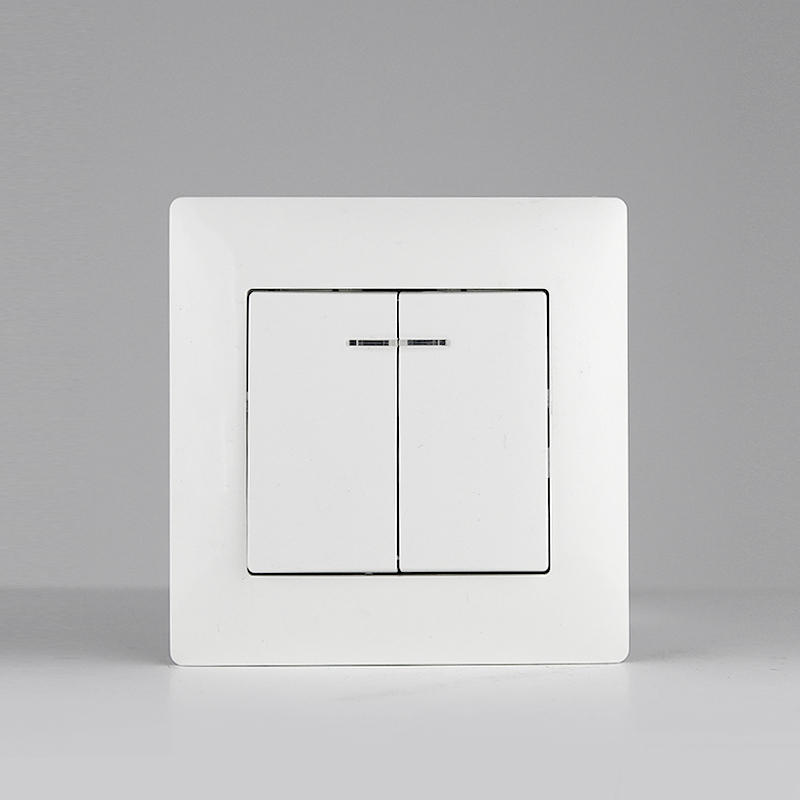
Way: how many places can control the same light
Way counts the control points of a lighting circuit, not the buttons. A 1 way switch has one position from which the circuit is switched. A 2 way switch provides two switched paths, so a two-way control arrangement can switch the same light from two different places — the classic corridor, staircase or bedroom-door layout. Both positions use 2 way switches; the second position is not a special device.
The A122 shows how much specification sits inside that one word. It is a 2 gang 2 way flush mounted switch on an 81.6 × 81.6 mm panel, rated 10A, 250V~, certified to CE and TÜV, with a flame retardant PC panel and PC base. Within the mechanism, HYFF uses brass terminals for conductivity and phosphor copper contacts of 0.7 mm with silver plating on a 3 mm diameter contact area. The plate also carries a large, wide-faced, narrow-framed button, a multi-point riveted steel frame, anti-back screws and grade II shock absorption, and the series is described as passing 40,000+ on/off operations. For a specifier, "2 way" is therefore a circuit statement that also brings a heavier contact and terminal build than a simple 1 way plate.
Intermediate: the third control point in the middle
An intermediate switch is used in the middle of a multi-point lighting circuit. Where a corridor, stairwell or large room needs a light controlled from three or more positions, the two end positions use 2 way switches and the positions in between use intermediate switches. It is a distinct device with a distinct function — the fact that it is often ordered in the same quantity line as 2 way switches is exactly why it gets mislabelled.
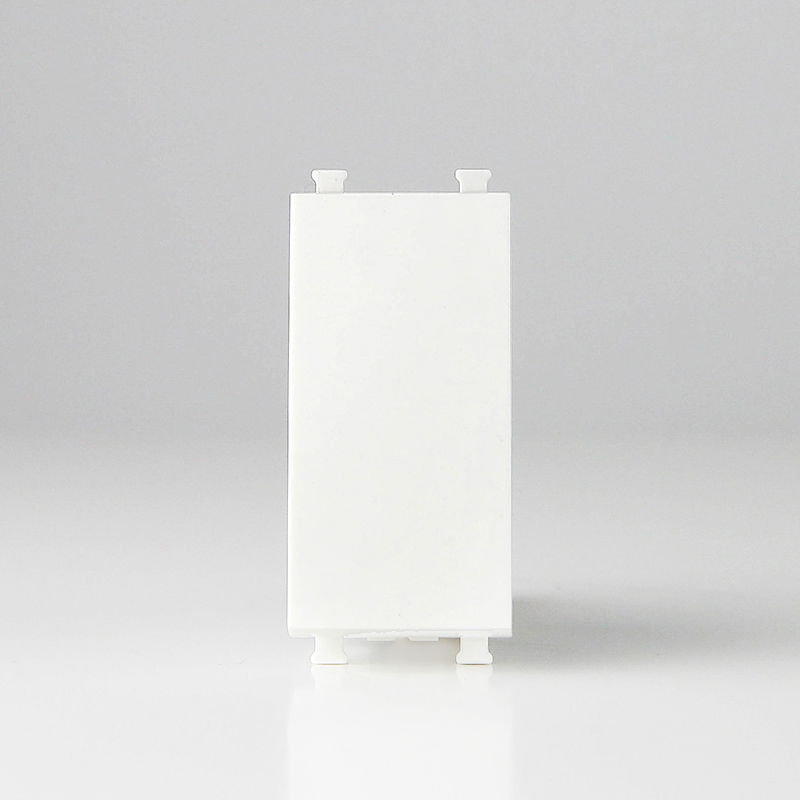
HYFF's intermediate switch is the KM141S, described as an intermediate switch in small size modular format. Its panel measures 22 × 49 mm, it is rated 10A at 220–250V, and it is flush mounted with a flame retardant PC panel in white, black, silver and customised colours, carrying HS code 8536500090. The unit is covered by CE and RoHS certification and is described as suitable for European installation standards and for indoor applications. The series is also described as passing 40,000+ on/off tests, with an "arch bridge" base design that increases the wiring contact space while keeping the base stable, and it is stated to receive 107% self-inspection before packing.
The specification consequence is straightforward. A modular intermediate module of 22 × 49 mm is a different physical item from an 86 × 86 mm plate, so a project that needs intermediate control in the middle of a group must reserve the plate space for it at design stage rather than discovering the gap on site.
Push bell: a momentary button, not a lighting switch
A push bell switch is a momentary device. It closes the circuit only while the button is held down and returns to its rest position when released, which is what a chime or bell circuit requires. It is not a latching switch, so it should never be used where a lighting circuit must stay on.
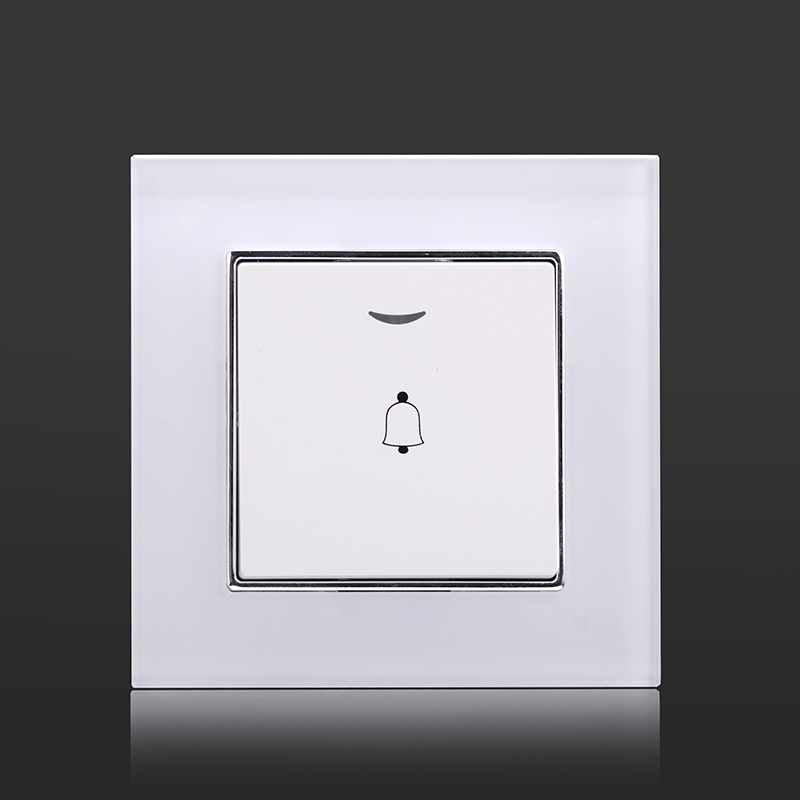
HYFF's HG110NB is a 1 gang push bell switch with LED indicator on an 86 × 86 mm flush mounted plate, rated 10A at 220–250V~, certified to CE and TÜV and carrying HS code 8536500090. It uses a scratch-resistant tempered glass panel over a high strength PA base, and is offered in white, black, green, red, brown, golden and customised colours. The mechanism retains the series features — claw fixing, a multi-point riveted steel frame, anti-back screws, grade II shock absorption for a quieter action, and 40,000+ on/off testing — and the factory states 100% self-inspection before packing.
The tempered glass panel is worth a note, because it is the term most often confused with a different product family. The HG110NB is a mechanical push switch with a glass face; it is not a touch switch. The audible, spring-loaded mechanical action described in the series data is the functional difference, and it matters when a hotel light wall switch schedule mixes glass-faced mechanical plates with capacitive touch plates in the same corridor.
LED indicator: a position marker on the plate
An LED indicator is a small lamp built into the switch so the plate can be located visually on a wall. In the HYFF range the term appears as a suffix in the model name, which makes it easy to trace: V122N is the 2 gang 2 way switch with LED indicator, while A122 is the 2 gang 2 way switch without it. On the bell side, HG110NB carries the indicator while the plain push switch does not.
Because the indicator sits on top of the switching function, it changes nothing about gang, way or rating — V122N and A122 are both 2 gang 2 way devices at 10A and 250V~-class ratings, and the indicator is an additional feature on the same footprint. The V122N is an 86 × 86 mm flush mounted unit rated 10A, 220–250V~, with a flame retardant PC panel, a high strength PA base and CE, TÜV and CB certification, using the same claw fixing and 40,000+ on/off testing as the rest of the series. What the product data does not state is the indicator's exact lighting behaviour on the circuit, so a specifier who needs the lamp to act as a locator in the dark, or as a running light, should confirm that detail against the sample rather than assume it from the model name.
Where the powerpoint sits in this vocabulary
The HT213 10A single powerpoint is the one item in the lineup that is not a switch, and placing it correctly prevents a common schedule error. It is a flush mounted socket outlet on an 80 × 120 mm plate, rated 10A, 250V~, with a flame retardant PC panel and PC base, supplied in white and customised colours, certified to SAA and carrying HS code 8536690000. Its Australian SAA certification places it in a market where socket control is regulated: AS/NZS 3000:2018 clause 4.6.3.1 requires each socket-outlet to be individually controlled by a separate switch operating in all active conductors. That requirement is the reason Australian-standard light wall switch schedules pair sockets with their own switches, and it is a project rule, not a product feature of the powerpoint itself.
Ratings and materials: what the markings tell you
Two rating markings run through the range, and they are not interchangeable at specification stage. Most of the flush mounted models — H111, E121, A122, V122N, KM141S and HG110NB — are declared at 10A with a voltage of 220–250V~ or 250V~. The M111 and B111 are declared at 10AX, 250V~. In both cases the number is the rated current and the 250V~ is the rated alternating voltage; the letter in 10AX is part of the rating marking itself, not a higher current figure. Which marking applies to a given project depends on the load the circuit is declared for, and the correct check is to read the marking on the certificate and on the product together rather than treat 10A and 10AX as freely substitutable.
Material wording follows the same logic and is most useful when it is attached to a model rather than to the range as a whole:
- ABS — the base material declared for the B111 surface mounted switch.
- PC (polycarbonate) — the flame retardant panel material across the H, E, A and V series and the KM141S module, with several series describing 850°C fireproof PC; the A122 and V122N declare a PC base while H111, V122N, KM141S and HG110NB declare a high strength PA base.
- Tempered glass — the scratch-resistant panel material on the HG110NB push bell switch.
- Brass — the terminal material on the A122, chosen for conductivity.
- Phosphor copper with silver plating — the A122 contact set, 0.7 mm phosphor copper contacts with silver plating on a 3 mm diameter area.
Mechanical life is stated across the series as passing 40,000+ on/off operations, and the factory states 100% self-inspection before packing, with an 8-year warranty declared in its capability data. Those figures describe test and supply conditions; they do not guarantee a service life in a specific installation, which depends on load, operating frequency, installation quality and environment.

Step by step: turning a lighting plan into a switch line
- Fix the device function first. Decide whether the position is a switch or a socket outlet. A lighting position and the HT213 powerpoint live in different HS codes and, in Australia, in different regulatory requirements.
- Count the gangs from the lighting groups. One group switched at that position means a 1 gang plate such as H111 or M111. Two groups mean a 2 gang plate such as E121, A122 or V122N.
- Count the control points to fix the way. One control point means 1 way. Two control points on the same light mean 2 way devices at both positions, such as the A122 or V122N.
- Add an intermediate only where a third or later point is needed. Reserve the modular space for the KM141S at design stage; do not expect a 2 way switch to cover the middle position.
- Decide whether the plate is momentary. A chime or bell circuit needs the HG110NB push bell rather than any latching switch.
- Decide the indicator requirement plate by plate. Name the model suffix — V122N rather than A122 — so the quotation carries the indicator as a specified feature instead of an assumption.
- Fix the rating marking. Record 10A or 10AX and the 250V~ voltage exactly as declared, and check that the declared value matches the load statement for the circuit.
- Match panel size and mounting format to the wall box. 86 × 86 mm, 81.6 × 81.6 mm, 74 × 83 mm, 65 × 65 mm and the 22 × 49 mm intermediate module are not interchangeable footprints, and flush mounted versus surface mounted changes the fixing method.
- Confirm the certificate covers the exact model. Check the model list on the TÜV Rheinland certificate R 50714462 0001 for switches, and keep the socket Certificate of Conformity DACE260331002RL separate because it is based on IEC 60884-1:2022.
- Confirm supply terms before committing. HYFF's stated terms are a minimum order quantity of 1,000 units, a lead time of 30–45 days and a monthly capacity of 2,900,000 units, with ODM production and logo customisation available.
Where each type fits in a project
For a residential home electric wall switch package, the vocabulary maps onto rooms fairly cleanly. Single-group rooms take a 1 gang 1 way plate such as the H111. Rooms with two lighting groups take the E121 where both groups are switched locally. Corridor, staircase and bedroom-door arrangements that must be controlled from two points take 2 way devices such as the A122, with the V122N used where the indicator is wanted. A three-point corridor adds the KM141S intermediate module in the middle. A front-door chime takes the HG110NB.
In hotel light wall switch schedules the same logic applies but the plate count rises: entrance, bedside and bathroom positions each become their own line item, and the indicator decision moves from optional to deliberate because guests need to find the switch in a dark room. Because the HG110NB is a mechanical push switch with a tempered glass face, it can sit in the same hotel corridor as glass-faced lighting plates without the plate becoming a touch device.
For apartments, villas and offices, the deciding factor is usually plate consistency. The 86 × 86 mm family — H111, E121, V122N and HG110NB — shares a footprint, while the A122 at 81.6 × 81.6 mm, the M111 at 74 × 83 mm and the KM141S module require their own allowance. HYFF's application data describes these products for indoor, dry, normal-temperature environments on 220–240V AC, 50/60 Hz residential systems, used to control indoor lighting and to provide power connections, with wall boxes, mounting supports, multi-gang frames and lighting fixtures as matched equipment.
Glossary table: the five terms at a glance
| Term | What it actually describes | What it does not describe |
|---|---|---|
| Gang | Number of independently operated switches on one plate | How many places control the light |
| Way | Number of control points available for the same lighting circuit | Number of buttons on the plate |
| Intermediate | A separate device that adds a third or later control point between two-way switches | A replacement for, or upgrade of, a 2 way switch |
| Push bell | Momentary action that closes the circuit only while pressed | A latching lighting switch |
| LED indicator | An additional lamp that marks the switch position | A change of gang, way, rating or switching mechanism |
Lineup comparison on verified specifications
| Model | Configuration | Rating | Panel size | Panel / base material | Certification / HS code |
|---|---|---|---|---|---|
| H111 | 1 gang 1 way, flush mounted | 10A, 220–250V~ | 86 × 86 mm | Flame retardant PC / high strength PA | CE, TÜV; 8536500090 |
| M111 | 1 gang 1 way, flush mounted | 10AX, 250V~ | 74 × 83 mm | Flame retardant PC / PA66 | CE, RoHS; 8536500090 |
| B111 | 1 gang 1 way, surface mounted | 10AX, 250V~ | 65 × 65 mm | PC / ABS | CE; 8536500090 |
| E121 | 2 gang 1 way, flush mounted | 10A, 220–250V~ | 86 × 86 mm | Flame retardant PC / PC | 8536500090 |
| A122 | 2 gang 2 way, flush mounted | 10A, 250V~ | 81.6 × 81.6 mm | Flame retardant PC / PC; brass terminals, phosphor copper contacts with silver plating | CE, TÜV; 8536500090 |
| V122N | 2 gang 2 way with LED indicator, flush mounted | 10A, 220–250V~ | 86 × 86 mm | Flame retardant PC / high strength PA | CE, TÜV, CB; 8536500090 |
| KM141S | Intermediate switch, small size modular, flush mounted | 10A, 220–250V | 22 × 49 mm | Flame retardant PC | CE, RoHS; 8536500090 |
| HG110NB | 1 gang push bell with LED indicator, flush mounted | 10A, 220–250V~ | 86 × 86 mm | Tempered glass / high strength PA | CE, TÜV; 8536500090 |
| HT213 | 10A single powerpoint, flush mounted | 10A, 250V~ | 80 × 120 mm | Flame retardant PC / PC | SAA; 8536690000 |
Common misreadings and their boundaries
"2 way" is not "two buttons". A 2 gang 1 way plate has two buttons and one control point per circuit; a 1 gang 2 way plate has one button and two control points. Reading the two words in the wrong order produces the wrong item even when both numbers are present.
An intermediate is not a spare. It performs a specific function between two-way switches and cannot be used at the end of a circuit in place of a 2 way device. Because the KM141S is a 22 × 49 mm module rather than an 86 × 86 mm plate, it also needs its own space and frame allowance.
10A and 10AX are separate markings. They are not a ranking, and the higher-sounding one is not automatically the correct choice for every circuit. The declared marking should match the load statement and appear on the applicable certificate.
An LED indicator is a feature, not a function. It does not change what the switch does, and the product data does not define its lighting behaviour on the circuit — confirm that on a sample if the project depends on it.
A glass face is not a touch interface. The HG110NB is a mechanical push bell switch with a tempered glass panel. Projects that require a touch light wall switch, a Wi-Fi or voice control smart wall light switch, or a dimmable wall switch are specifying a different product family from the mechanical range described here.
A certificate title is not a scope. The HYFF file contains an EN 60669-1:2018 switch certificate and an IEC 60884-1:2022 socket Certificate of Conformity. Both are valid documents; they cover different product families and should be matched to the item on the purchase line.
Frequently asked questions
Which standards and certifications cover HYFF wall switches?
The flush-type fixed switch models are covered by TÜV Rheinland safety certification issued by TÜV Rheinland LGA Products GmbH under certificate number R 50714462 0001, based on EN 60669-1:2018, issued 10 March 2026 and valid to 10 March 2028, with models including H111 and V122N. Individual series also declare CE and TÜV, with V122N additionally declaring CB and KM141S declaring CE and RoHS. Manufacturing is covered by ISO 9001 certificate 0350225Q30335R0S. Socket products such as the HT213 powerpoint follow a separate route: the HT213 is SAA certified and carries HS code 8536690000.
Can a 2 gang 2 way switch be used where one circuit only needs one-way control?
Yes as a device, but the specification should still be written deliberately. A 2 gang 2 way switch such as the A122 or V122N provides two switched paths per gang, so it can serve a single-point circuit; what it cannot do is make a 1 way switch serve a second control point. The practical rule is to specify by control point, not by what is already on the shelf, because a 2 way device carries a heavier terminal and contact build — the A122, for example, uses brass terminals and 0.7 mm phosphor copper contacts with silver plating — and that build should be justified by the circuit.
Which specification choices change the cost of a wall switch order?
HYFF does not quote prices in its product data, so cost should be discussed per project. What the verified specifications show is which choices change the bill of materials: the gang count and the number of plates; the way count, since 2 way devices such as the A122 carry brass terminals and silver-plated phosphor copper contacts; the indicator suffix, since V122N adds an LED indicator to the A122 function; the panel material, with tempered glass on the HG110NB and flame retardant PC elsewhere; the modular intermediate module, which is a separate KM141S line item; and the certification route per market. Minimum order quantity is stated at 1,000 units with a 30–45 day lead time, so quantity planning affects scheduling as much as unit cost.
How should a buyer evaluate samples before a bulk order?
Evaluate the sample against the four words on the purchase line rather than against appearance alone. Confirm the gang count matches the plate, confirm the way count by checking that the device is the two-path type where two control points were specified, confirm the momentary action on any push bell item, and confirm the indicator suffix is physically present. Then check that the certificate model list includes the sampled model, and test-fit the plate to the project's wall box and frame, since 86 × 86 mm, 81.6 × 81.6 mm, 74 × 83 mm and 22 × 49 mm are not interchangeable. HYFF states 100% self-inspection before packing and 40,000+ on/off testing across the series as the production baseline behind each sample.
What are the minimum order quantity and lead time?
HYFF states a minimum order quantity of 1,000 units, a lead time of 30–45 days and a monthly capacity of 2,900,000 units, with ODM production, logo customisation, 100% testing and an 8-year warranty declared in its capability data. Annual output is stated at 35,000,000 units from a 7,000 m² facility with 118 employees and a 10-engineer R&D team, exporting to Europe, the Americas, Oceania, Asia and Africa. If you want to check the terminology against real plates, request a sample set covering the 1 gang 1 way, 2 gang 2 way with LED indicator, intermediate module and push bell so the vocabulary can be confirmed physically before the order is released.
Conclusion: learn five words, avoid most ordering errors
Gang, way, intermediate, push bell and LED indicator are not decorative vocabulary; each one maps to a specific device in the HYFF flush mounted mechanical range. Gang is the H111 or E121 plate count. Way is the difference between a 1 way plate and a 2 way device such as the A122. Intermediate is the KM141S module that adds a third control point. Push bell is the momentary HG110NB. LED indicator is the suffix that separates V122N from A122. Around those five words sit the fixed facts a buyer can verify: 10A or 10AX at 250V~ class, panel sizes from 22 × 49 mm to 86 × 86 mm, flame retardant PC, high strength PA, ABS and tempered glass, brass terminals and silver-plated phosphor copper contacts, and certificates whose model lists either cover the item or do not.
Wenzhou Huafeng Electric Co., Ltd. (HYFF) manufactures this range in Wenzhou, Zhejiang, and publishes its product specifications, certificate scopes and capability terms so the label on the plate can be checked against a document rather than assumed. The company website is hyffelectric.com.
Next step. If you are building a lighting schedule and want the terms confirmed against physical plates, ask for a sample set covering the H111 1 gang 1 way switch, the V122N 2 gang 2 way switch with LED indicator, the KM141S intermediate module and the HG110NB push bell switch. Contact HYFF at service@vgshmn.com or +86 0577 86911198, or download the full product catalogue here: HYFF 2026 product catalogue (PDF).
Have Questions or Need More Details?
Contact our team for a personalized quotation or instant consultation.
Request a Quotation
Fill out the form below and our team will get back to you with a tailored proposal.
WhatsApp Direct Chat
Prefer to chat in real-time? Message us on WhatsApp for instant assistance & quick answers.
- Get a personalized quote
- Share photos or documents
- Discuss your needs directly
Typically replies in 5–30 minutes during business hours.