
Wall Switch Guide: Types, Standards and How to Identify CE Certified European Wall Switch Suppliers
A wall switch is the manually operated device that opens and closes the circuit feeding a light fixture or a switched socket-outlet. It is one of the few building-electrical components specified in almost every room of a project, which is why the single search term “wall switch” hides a wide spread of products: 1 gang or 2 gang, 1 way or 2 way, flush mounted or surface mounted, matte plastic or tempered glass, mechanical or networked.
This guide is written for importers, distributors, project buyers, engineers and brand owners at the start of a sourcing process. It explains the main wall switch categories, the standards that apply in the European Union and Australia, what Wenzhou Huafeng Electric Co., Ltd. (HYFF) documents in its own product data, and how to check whether a supplier advertising a CE certified European wall switch can actually support that claim.
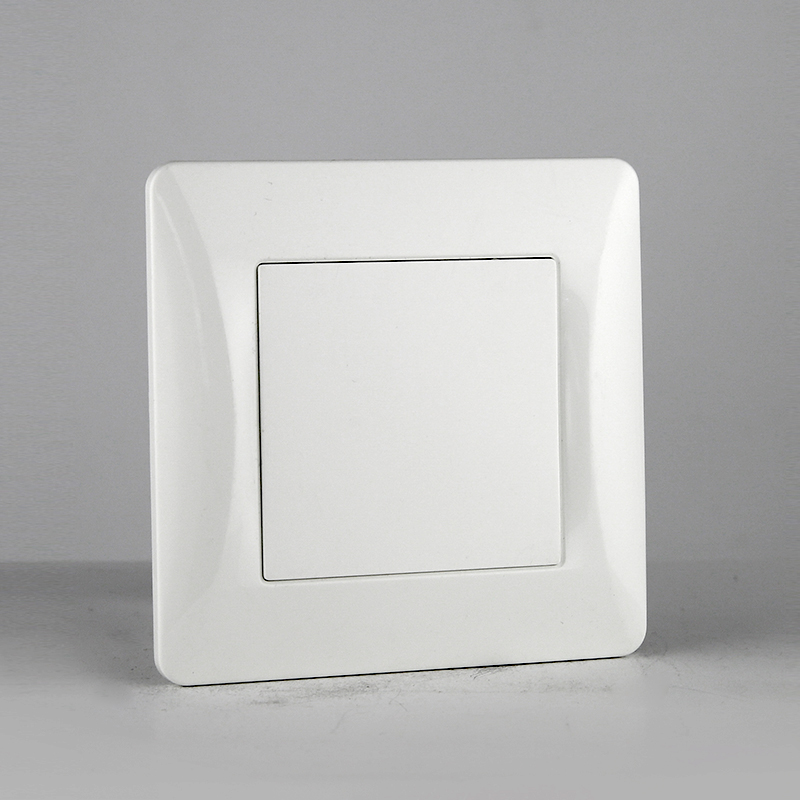
HYFF Model H111 — a 1 gang 1 way flush mounted wall switch with an 86×86 mm flame retardant PC panel, CE certified and rated 10A, 220–250V~. Image: Wenzhou Huafeng Electric Co., Ltd.
Why “Wall Switch” Is a Harder Specification Than It Looks
The first difficulty in wall switch sourcing is terminology. A catalogue may list “1 gang 1 way”, “1 gang 2 way”, “2 gang 1 way”, “2 gang 2 way”, “intermediate switch”, “push bell switch” and “modular switch” side by side, and these are not interchangeable items. Gang count describes how many independent circuits a single plate controls; “way” describes the switching function. A 1 way switch controls one circuit from one position, a 2 way switch is used where the same light must be controlled from two positions — the configuration commonly searched as a two way control wall light switch — and an intermediate switch extends that circuit to three or more control points.
The second difficulty is that “indoor electric light wall switch” covers both the visible plate and the hidden mechanism. A buyer comparing quotations may be comparing a flame retardant PC panel against a tempered glass panel, or a high strength PA base against an ABS base, without the quotation saying so. Those material choices affect fire performance, impact resistance, feel, and price.
The third difficulty is compliance. A supplier may use the phrase “CE certified European wall switch” while the product is designed to a completely different plug-and-box system, or may hold certificates for one model family but not for the model being quoted. Buyers who specify wall switches for a hotel programme, a residential development or a distributor catalogue need to separate three questions that are often merged into one: which market is the product designed for, which standard does it meet, and which certificate documents that conformity?
Industry Background: Standards, Demand and the Shift Toward Smart Control
Wall switches and sockets are a mature but still growing category. The global light switches and electrical sockets market was valued at approximately USD 17.6 billion in 2024, according to Strategic Market Research. Growth is concentrated less in the mechanical switch itself and more in the electronics around it: Grand View Research reports that the global smart switch market reached USD 4.8 billion in 2023 and is expected to exceed USD 14 billion by 2030, at a compound annual growth rate of 17.2%. Dataintelo estimates that Asia Pacific held a 42.5% revenue share of the global electrical switch market in 2025, which reflects both regional construction volume and the concentration of manufacturing capacity.
Product mix is shifting as well. Cognitive Market Research reported that touch-type smart switches accounted for about 45% of global market share as of 2023 — a figure that reflects consumer preference for flat, glass-fronted plates rather than any change in the underlying wiring. Interoperability is following the same direction: the Connectivity Standards Alliance released the Matter 1.6 protocol update in June 2026, which introduced NFC-based commissioning to simplify the setup of smart wall switches and lighting devices.
For buyers, the practical implication is that a wall switch enquiry now usually mixes two distinct supply chains: electromechanical switches, where material, contact and mechanism quality decide the outcome, and connected switches, where module, protocol and firmware decide the outcome. A supplier strong in one is not automatically strong in the other, and the product data should be read accordingly.
Which standard applies to which market
| Market | Primary standard / requirement | What it covers | Source |
|---|---|---|---|
| European Union | EN 60669-1:2018 | Mandatory safety standard for manual switches used in household fixed installations | Intertek |
| Australia / New Zealand | AS/NZS 3133:2020 | Approval and test specification for air-break switches | Standards Australia |
| Australia (installation rule) | AS/NZS 3000:2018, Clause 4.6.3.1 | Every socket-outlet must be individually controlled by a separate switch operating in all active conductors | ElectronicsHub / AS/NZS 3000 |
| Outdoor installations | IP65 (IEC 60529) | Protection against low-pressure water jets and complete dust ingress | IEC 60529 / Revolve LED |
The Australian installation rule is a useful example of why standards work matters. Because AS/NZS 3000:2018 requires each socket-outlet to be individually switched, the Australian market places unusual weight on switched socket design and on the mechanical life of the switch mechanism. This is the context behind searches for an SAA certified anti-flame Australian wall switch: the buyer is not only asking for a certified product, but for a product whose switching architecture fits Australian wiring practice.
The supplier landscape remains concentrated at the top. Global Market Insights reported that Schneider Electric held an 11.5% share of the global electric switch market in 2025, and Legrand reported a revenue base of EUR 8.6 billion in 2024. For smaller importers and project buyers, these brands define the reference price level rather than the sourcing solution; the practical alternative is a manufacturer that publishes its specifications and certificates openly.
Wall Switch Types and Materials: What HYFF Documents in Its Range
Wenzhou Huafeng Electric Co., Ltd. (HYFF) is a Chinese manufacturer of building electrical products founded in 2011, operating a 7,000 m² facility with approximately 118 staff, a 10-engineer R&D team, and an annual output of about 35 million units. Its main products are wall switches and wall sockets, exported entirely to Europe, America, Oceania, Asia and Africa. The company states that it works with an Italian design team to develop products to US, UK and EU standards, and that every model passes 100% self-inspection before packing. Its documented range is the most concrete way to see how the categories above translate into orderable items.
Mechanical flush-mounted wall switches
Flush-mounted mechanical switches are the core of the range. The H111 is a 1 gang 1 way flush mounted mechanical wall switch with an 86×86 mm panel, rated 10A at 220–250V~, built with a flame retardant PC panel and a high strength PA base and holding CE and TUV certification. The E121 is its 2 gang 1 way counterpart in the same 86×86 mm format, also rated 10A at 220–250V~ with a flame retardant PC panel and a fireproof grade of 850°C. The U121 is a 2 gang 1 way flush mounted switch in an 86×90 mm frameless large plate format, rated 10AX 250V~, CE certified, and designed around a common base that accepts multiple finishes.
For two-position lighting circuits, the A122 is a 2 gang 2 way switch with overall dimensions of 81.6 × 81.6 mm, rated 10A 250V~, made of flame retardant PC with CE and TUV certification. Its construction uses brass terminals, and phosphor copper contacts of 0.7 mm with silver plating of 3 mm diameter. The V122N is a 2 gang 2 way switch with LED indicator, flush mounted, 86×86 mm, rated 10A at 220–250V~, with a flame retardant PC panel and a high strength PA base, certified to CE and TUV.
Where a lighting circuit needs control from three or more positions, the intermediate switch becomes the relevant item. The KM141S is an intermediate switch in a small size modular design, flush mounted, with a panel of just 22×49 mm and a rating of 10A at 220–250V. It is CE and RoHS certified, suitable for European installation standards, and available in white, black, silver and customized colors.
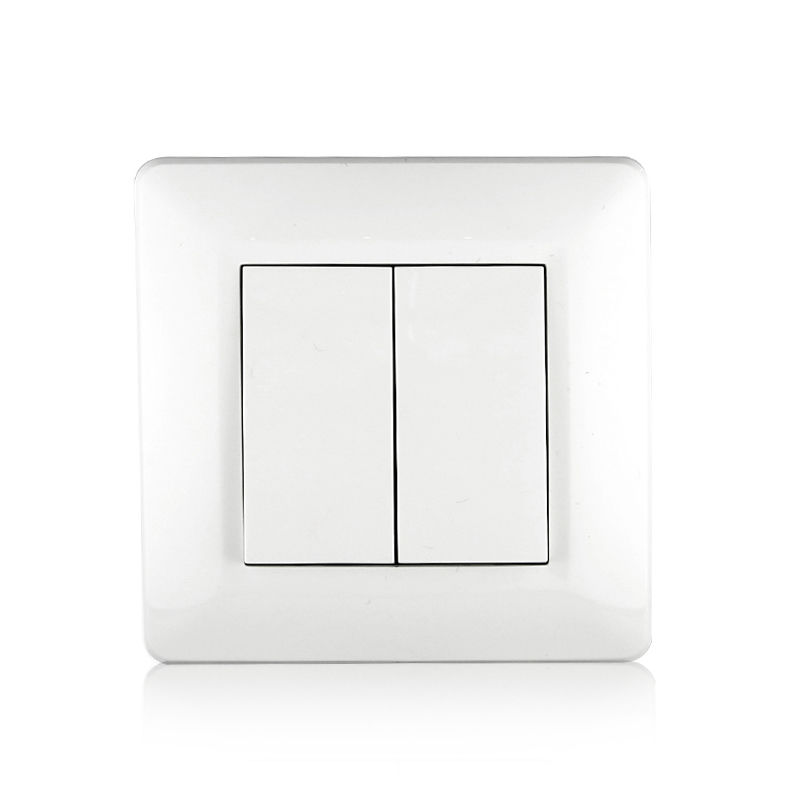
HYFF Model E121 — 2 gang 1 way flush mounted wall switch, 86×86 mm panel, 10A 220–250V~, flame retardant PC with 850°C fireproof grade. Image: Wenzhou Huafeng Electric Co., Ltd.
Surface-mounted wall switches
Surface-mounted switches are used where no flush box is available or where later modification is expected. The S111 is a 1 gang 1 way surface mounted mechanical wall switch with a 68×68 mm panel, rated 10A at 220–250V~, made of flame retardant PC and certified to CE, and designed for residential, industrial, apartment/villa, hotel and office use. The B111 is a 1 gang 1 way surface mounted switch with a 65×65 mm panel, rated 10AX 250V~, using a PC panel and an ABS base, CE certified, and built around a clip-on structure for quick installation without complex wiring.
Tempered glass and slim decorative panels
Buyers searching for a tempered glass european wall switch are usually specifying appearance as much as function. The HG110NB is a 1 gang push bell switch with LED indicator, flush mounted, 86×86 mm, rated 10A at 220–250V~, using a scratch resistant tempered glass panel over a high strength PA base. It is certified to CE and TUV, passes 40,000+ on/off tests, and is available in white, black, green, red, brown, golden and customized colors. Its structure includes a multipoint riveted steel frame and a grade II shock absorption design that reduces switching noise.
At the other end of the design spectrum, the M111 is a 1 gang 1 way flush mounted switch with a 6.5 mm ultra-slim frameless panel, panel dimensions of 74 × 83 mm, a flame retardant PC panel, a PA66 base and CE/RoHS certification. Multi-gang versions support both horizontal and vertical installation with a consistent appearance, and the design allows multi-directional mounting and easy disassembly for maintenance.
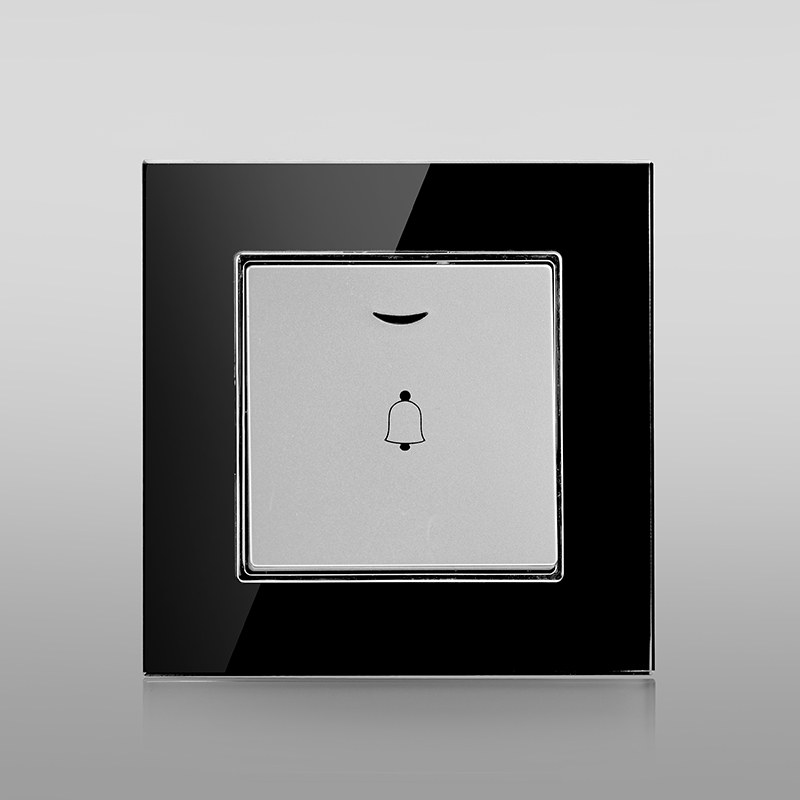
HYFF Model HG110NB — 1 gang push bell switch with LED indicator, scratch resistant tempered glass panel, CE and TUV certified. Image: Wenzhou Huafeng Electric Co., Ltd.
Where “touch”, “smart” and “waterproof” listings differ from mechanical switches
Three keyword families in this category deserve an explicit warning, because product listings frequently blur them.
- Touch light wall switch and 1 gang touch control wall switch. The word “touch” is used loosely. A capacitive touch switch has no moving rocker and depends on an electronic sensing circuit, while a mechanical switch with a tempered glass panel looks flat and modern but still actuates through a physical mechanism. The HG110NB belongs to the second group: it is a mechanical push switch with a tempered glass front. Buyers who need true capacitive touch control should confirm the actuation principle, not only the panel material.
- Home smart wall switch, Wi-Fi smart electric wall switch and voice control smart wall light switch. These products require a communication module, a protocol stack and usually app or hub integration. HYFF’s documented product data covers mechanical wall switches and wall sockets; buyers whose project specification requires Wi-Fi or voice control should confirm module availability, protocol support (for example Matter-based commissioning) and firmware responsibility directly with the supplier before the switch schedule is frozen.
- Waterproof outdoor electric wall switch. Outdoor lighting circuits require an enclosure rating such as IP65 under IEC 60529 to resist dust ingress and low-pressure water jets. HYFF’s documented switch range is specified for indoor, dry, normal-temperature environments at 220–240V AC, 50/60 Hz; outdoor positions should therefore be specified as a separate line item with its own ingress protection requirement.
Also worth separating: an LED indicator is not a dimmer. A model such as the V122N uses an LED indicator to show circuit status, while an LED dimmable wall switch must control lamp brightness and needs to be matched to the lamp driver and dimming protocol. Treat these as two different procurement items with different test requirements.
Quality control and certification evidence
The claimed performance of a wall switch should be traceable to inspection steps, not adjectives. HYFF documents a control sequence that runs from material incoming inspection, plastic parts inspection and process inspection through glowing filament testing, silver layer thickness inspection, performance life testing, plastic ball pressure testing, and switch and socket on-off testing on the assembly line, plus doorbell testing. Across the documented range, switches are stated to pass 40,000+ on/off cycles and to complete 100% self-inspection before packing. Fire performance is expressed through 850°C fireproof PC material in the panel and high strength PA material in the base, with an “arch bridge” base design intended to increase wiring contact space and keep the base stable without deformation.
Certification is model-specific, and that detail matters. Within the documented range, CE appears across the EU-oriented models (H111, E121, U121, A122, V122N, S111, B111, M111, HG110NB, KM141S), TUV appears on the H111, E121, A122, V122N, HG110NB and S111 family documentation, RoHS appears on the M111 and KM141S, and SAA certification appears on the HT213 single powerpoint — a 10A, 250V~ flush mounted socket outlet with an 80×120 mm flame retardant PC panel and HS Code 8536690000, intended for the Australian market. Because the HT series is documented under SAA, Australian buyers should ask for the certificate of the exact model and variant being purchased rather than assuming that certification carries across an entire catalogue.
Manufacturing and quality infrastructure
Supplier capability behind the catalogue is often the deciding factor for distributors placing repeat orders. HYFF operates injection molding, automation and production workshops and an in-house laboratory, and maintains a sample room for product validation, with a stated annual production volume of around 35 million units. Documentation for the full range, including dimensions and material specifications, is compiled in the HYFF product catalogue.
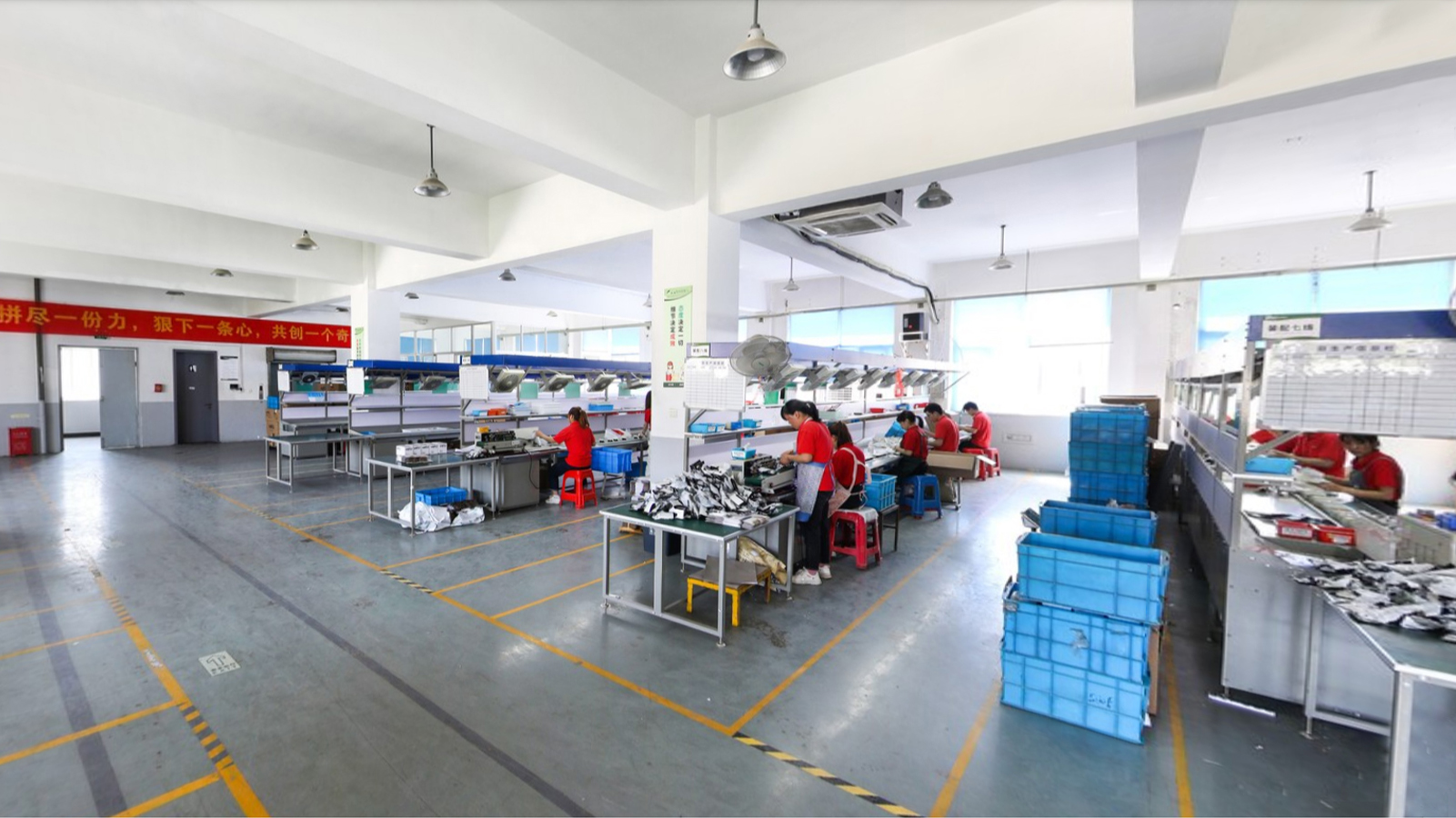
Production workshop at Wenzhou Huafeng Electric Co., Ltd., a 7,000 m² building electrical manufacturing facility in Wenzhou, Zhejiang. Image: Wenzhou Huafeng Electric Co., Ltd.
Step-by-Step: How to Specify and Verify a Wall Switch Order
The following sequence prevents most of the mismatches that appear after a wall switch order has shipped.
- Step 1 — Fix the destination market. Write the market into the specification line, because it determines the standard. EU projects point to EN 60669-1:2018; Australia and New Zealand point to AS/NZS 3133:2020 and the switched-outlet rule in AS/NZS 3000:2018. A European-style wall switch and an Australian standard light wall switch are not the same product even when the panel dimensions look similar.
- Step 2 — Fix gang and way configuration. Count how many circuits each plate must control (gang) and whether each circuit is switched from one position, two positions or three or more (1 way, 2 way, intermediate). This single step decides whether the H111, E121, A122, V122N or KM141S is the correct item.
- Step 3 — Fix mounting method. Flush mounted models such as the H111, E121, U121 and M111 require a compatible wall box and mounting support; surface mounted models such as the S111 and B111 are used where no flush box exists. Base modules are designed to suit various mounting box shapes, but box dimensions and depth should still be confirmed against the panel size.
- Step 4 — Fix panel material and finish. Choose between flame retardant PC (matte plastic indoor light wall switch finishes), tempered glass, and slim frameless designs, and confirm the color programme — white, ivory, black, silver, golden and customized options are documented across the range, and the M111 supports both horizontal and vertical multi-gang installation.
- Step 5 — Verify certification at model level. Ask for the certificate number, issuing body and the exact model covered for every model in the switch schedule. A CE certificate for one switch family does not automatically cover a different family or a customized variant.
- Step 6 — Validate performance before scale-up. Confirm the rated current and voltage (10A or 10AX, 220–250V~ or 250V~), the mechanical life claim (40,000+ on/off cycles in the documented range), and the internal quality steps that support it. Where the project has an end-of-line inspection regime, align it with the supplier’s assembly-line on-off testing so that both parties test the same parameter.
Use Cases: Where Each Wall Switch Type Fits
Residential and home renovation projects typically use a mix of configurations. The residential home electric wall switch schedule usually needs 1 gang 1 way switches at single control points, 2 gang or 3 gang plates where several circuits share a wall, and 2 way switches on stairwells and corridor lighting. The M111’s ultra-slim frameless panel and the U121’s frameless large plate design are suited to interiors where the plate is visible against a finished wall.
Hotel projects have a different logic. A hotel light wall switch is handled by guests thousands of times a year, so mechanical life, tactile feedback and noise become specification points rather than preferences. Models with grade II shock absorption reduce switching noise in guest rooms, and the HG110NB’s push bell switch with LED indicator is used for service and door-signalling positions. For a hotel project European wall switch package, buyers normally standardise on one family across guest rooms, corridors and back-of-house to keep spare parts and finish matching manageable.
Apartment, villa and office developments fall between the two, combining appearance requirements with volume pricing. The E121, U121 and A122 are designed for apartment/villa, hotel, office and industrial settings, and the KM141S intermediate switch is used where a corridor or stair lighting circuit is controlled from multiple positions.
Australian residential work has its own pattern. Because AS/NZS 3000:2018 requires each socket-outlet to be individually switched, switched socket design and the switch mechanism’s durability are central to the specification, which is why SAA-certified items such as the HT213 single powerpoint carry weight in that market.
Industrial and commercial interiors generally prioritise repeatable installation. Multi-gang frames, a common base across several finishes, anti-back screws that prevent screw loss during wiring, and clip-on mounting structures all shorten installation and maintenance time at scale.
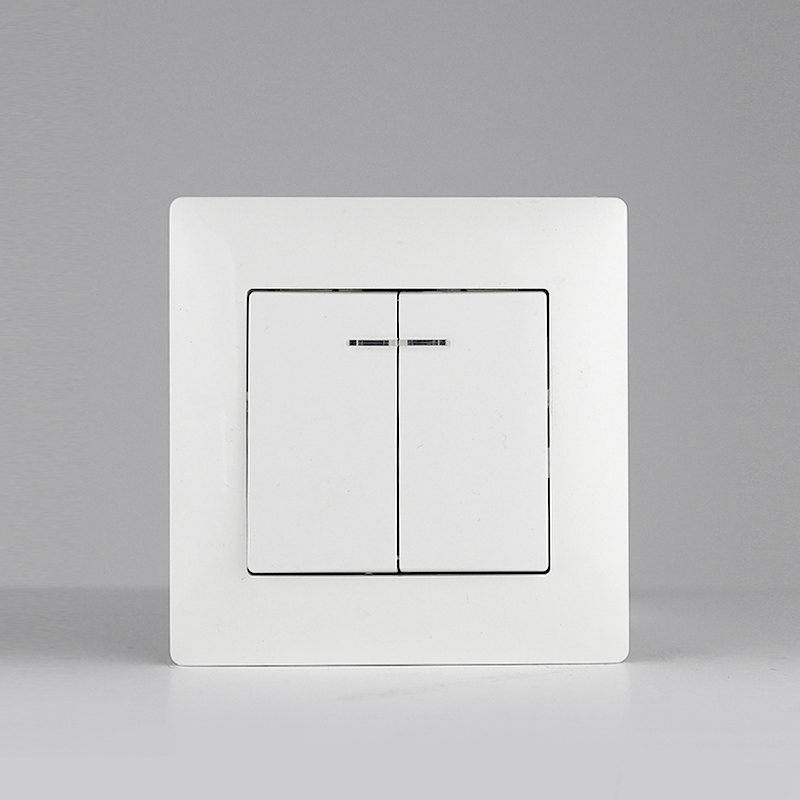
HYFF Model V122N — 2 gang 2 way switch with LED indicator, 86×86 mm, CE and TUV certified, designed for hotel, residential and office lighting circuits. Image: Wenzhou Huafeng Electric Co., Ltd.
Comparison Table: Documented HYFF Wall Switch Models at a Glance
| Model | Configuration | Mounting | Panel size | Rating | Panel / base material | Certification |
|---|---|---|---|---|---|---|
| H111 | 1 gang 1 way | Flush mounted | 86 × 86 mm | 10A, 220–250V~ | Flame retardant PC / high strength PA | CE, TUV, CB |
| E121 | 2 gang 1 way | Flush mounted | 86 × 86 mm | 10A, 220–250V~ | Flame retardant PC (850°C fireproof grade) | TUV, CE, CB |
| U121 | 2 gang 1 way | Flush mounted | 86 × 90 mm | 10AX, 250V~ | Flame retardant PC panel / PC base | CE |
| A122 | 2 gang 2 way | Flush mounted | 81.6 × 81.6 mm | 10A, 250V~ | Flame retardant PC panel / PC base | CE, TUV |
| V122N | 2 gang 2 way with LED indicator | Flush mounted | 86 × 86 mm | 10A, 220–250V~ | Flame retardant PC panel / high strength PA base | CE, TUV, CB |
| KM141S | Intermediate switch (small size modular) | Flush mounted | 22 × 49 mm | 10A, 220–250V | Flame retardant PC shell | CE, RoHS |
| S111 | 1 gang 1 way | Surface mounted | 68 × 68 mm | 10A, 220–250V~ | Flame retardant PC panel / high strength PA base | CE, TUV, CB |
| B111 | 1 gang 1 way | Surface mounted | 65 × 65 mm | 10AX, 250V~ | PC panel / ABS base | CE |
| M111 | 1 gang 1 way (multi-gang available) | Flush mounted | 74 × 83 mm, 6.5 mm ultra-slim frameless | 10AX, 250V~ | Flame retardant PC panel / PA66 base | CE, RoHS |
| HG110NB | 1 gang push bell switch with LED indicator | Flush mounted | 86 × 86 mm | 10A, 220–250V~ | Scratch resistant tempered glass panel / high strength PA base | CE, TUV |
| HT213 | 10A single powerpoint (socket outlet) | Flush mounted | 80 × 120 mm | 10A, 250V~ | Flame retardant PC panel / PC base | SAA |
All specifications above are taken from HYFF product documentation. HS Code for the switch models listed is 8536500090; the HT213 socket outlet uses HS Code 8536690000. Colors across the switch range include white, ivory, black, silver, golden and customized options depending on model.

HYFF Model B111 — surface mounted 1 gang 1 way switch, 65×65 mm PC panel with clip-on structure for quick installation. Image: Wenzhou Huafeng Electric Co., Ltd.
FAQ
What does a “CE certified European wall switch” actually certify?
It means the switch is declared compliant with the applicable European requirements for its product category and is supplied with documentation supporting that declaration. For manual switches used in household fixed installations in the EU, the relevant safety standard is EN 60669-1:2018, published by Intertek as the mandatory standard for wall switches. In practice, a CE certified European wall switch for the EU market is also built to European installation dimensions and rated 220–250V~ or 250V~. HYFF’s EU-oriented models, such as the H111, E121, S111 and M111, are documented as flush or surface mounted switches rated 10A or 10AX at 220–250V~ or 250V~.
How can a buyer verify CE, TUV or CB certificates before ordering?
Verification is a document-matching exercise, not a wording check. Ask for the certificate covering the exact model and variant being quoted, confirm the issuing body and certificate number, check that the standard cited matches the destination market, and confirm that customized versions (different color, gang count or panel material) are covered or separately certified. HYFF documents CE across its EU-oriented switch models, TUV on models including the H111, E121, A122, V122N, HG110NB and S111, RoHS on the M111 and KM141S, and SAA certification on the HT213 single powerpoint for the Australian market. Because certification is model-specific, a buyer should request certificates line by line against the switch schedule rather than accept a catalogue-level statement.
Which wall switch features can be customized for a project or private label?
Customization in this product category typically covers three dimensions: configuration, appearance and structure. Configuration means gang and way combinations — 1 gang 1 way, 2 gang 1 way, 2 gang 2 way or an intermediate switch such as the KM141S for multi-position control. Appearance covers panel material and finish, from flame retardant PC in matte finishes to scratch resistant tempered glass and 6.5 mm ultra-slim frameless panels, together with a color programme that includes white, ivory, black, silver, golden and customized colors across the documented range. Structural customization focuses on installation and serviceability: a common base that accepts multiple finishes, multi-directional mounting and easy disassembly on the M111, a clip-on structure on the B111, anti-back screws on the H111 family, and an “arch bridge” base design intended to increase wiring space and prevent deformation.
What drives the cost difference between wall switch models?
Four factors account for most of the spread within a single supplier’s range. The first is panel material and finish: a flame retardant PC panel, a tempered glass panel such as the HG110NB’s scratch resistant front, and an ultra-slim frameless design each carry different material and processing costs. The second is the internal mechanism and contact construction, including brass terminals and plated phosphor copper contacts as documented on the A122. The third is certification scope, since each model family that requires its own certificate adds testing and documentation cost. The fourth is configuration complexity — a multi-gang plate, an intermediate switch or a model with an LED indicator requires more parts and more assembly steps than a basic 1 gang 1 way switch. Buyers should price by model line rather than by catalogue average.
Can I request samples before placing a bulk order, and how is timing confirmed?
Yes. HYFF maintains a sample room for product validation, and sample requests can be raised through the company’s contact channels so that panel size, rating, color and certification can be checked physically against the specification before a bulk commitment. Delivery timing depends on the model mix, finish and order quantity, and is confirmed at quotation stage together with the commercial terms; buyers preparing a project schedule should therefore treat sample approval and lead-time confirmation as two separate steps in the procurement plan. To start, request the current catalogue and a sample of the specific model in your switch schedule via the contact details below.
Conclusion: Start From the Specification, Not the Search Term
“Wall switch” is a category label, not a purchase specification. The differences that decide whether a shipment is accepted — gang and way configuration, mounting method, panel and base material, rated current and voltage, certification at model level, and the internal quality steps behind the stated mechanical life — are all documented facts that can be checked before an order is placed. The standards layer adds a second filter: EN 60669-1:2018 for the European Union, AS/NZS 3133:2020 and the switched-outlet rule in AS/NZS 3000:2018 for Australia and New Zealand, and IP65 under IEC 60529 where an outdoor position is involved.
For buyers at the discovery stage, the most useful next step is to build a switch schedule by room and function, then match each line against documented models rather than against a general catalogue description. Wenzhou Huafeng Electric Co., Ltd. (HYFF) publishes model-level data across mechanical flush mounted and surface mounted switches, tempered glass and slim frameless designs, intermediate and two-way configurations, and an SAA-certified socket outlet, supported by a 7,000 m² manufacturing facility, a 10-engineer R&D team and documented inspection steps from material incoming inspection to assembly-line on/off testing.
Request the HYFF Wall Switch Catalogue and a Sample
Review the complete model range, specifications and finishes, then request a sample of the exact model in your project schedule. The HYFF product catalogue is available for download and public access: Download the HYFF catalogue (PDF).
For quotations, samples and OEM/ODM enquiries, contact the HYFF team directly:
Website: www.hyffelectric.com
Email: service@vgshmn.com
Tel: +86 0577 86911198 | WhatsApp: +86 13989758126
Address: No.3 Kaiyuan Road, Zhuangyuan, Longwan, Wenzhou, Zhejiang, China
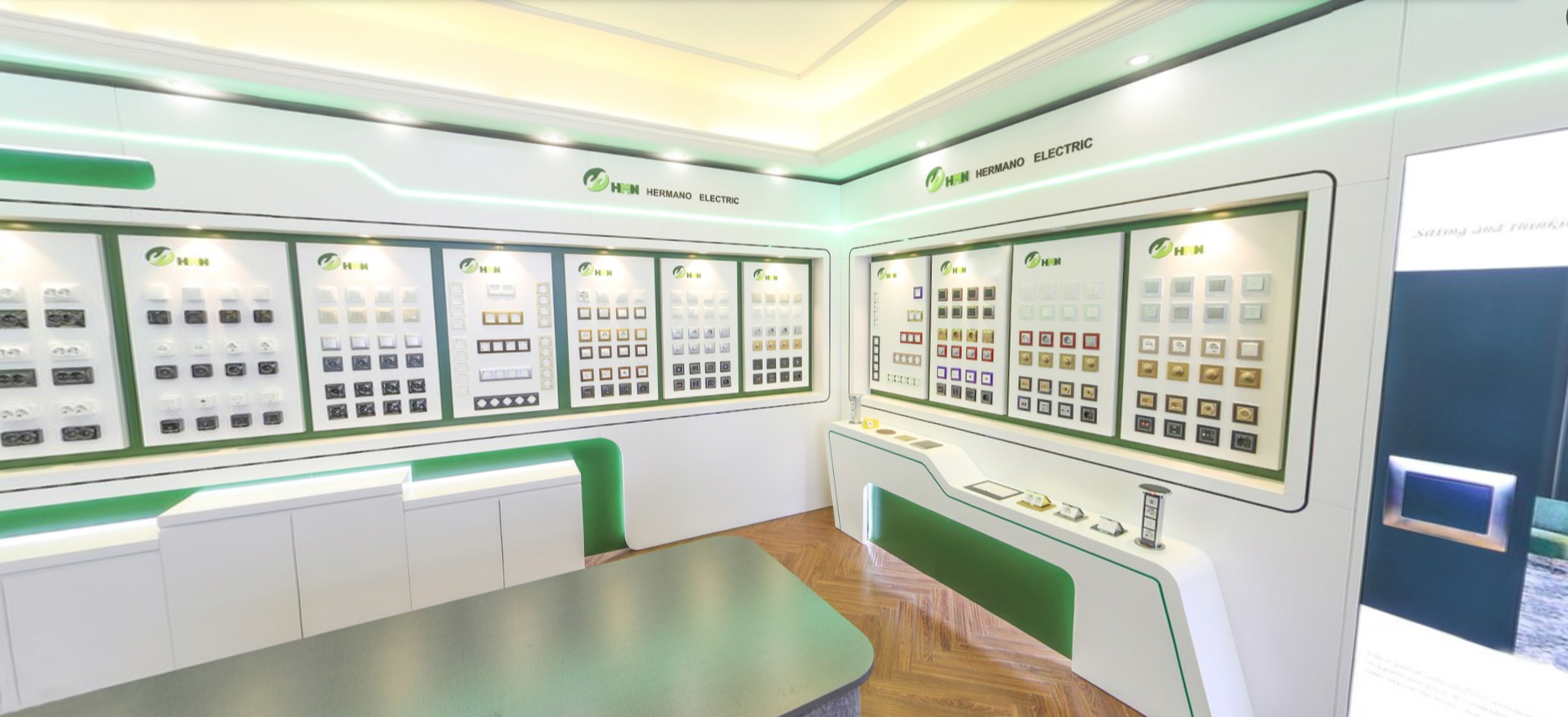
HYFF sample room, used for physical validation of wall switch models, finishes and certifications before bulk orders. Image: Wenzhou Huafeng Electric Co., Ltd.