
What Is a Wall Switch? Types, Standards & Sourcing Guide
What Is a Wall Switch? Types, Standards & Sourcing Guide
A wall switch is the wall-mounted wiring device that opens and closes the circuit feeding a lighting point or another fixed electrical load. The term covers more than one product: mechanical rocker switches, two-way switches used on staircase and corridor circuits, intermediate switches that extend control to three or more positions, push-bell switches with LED indicators, and touch or Wi-Fi smart variants used in homes and hotels.
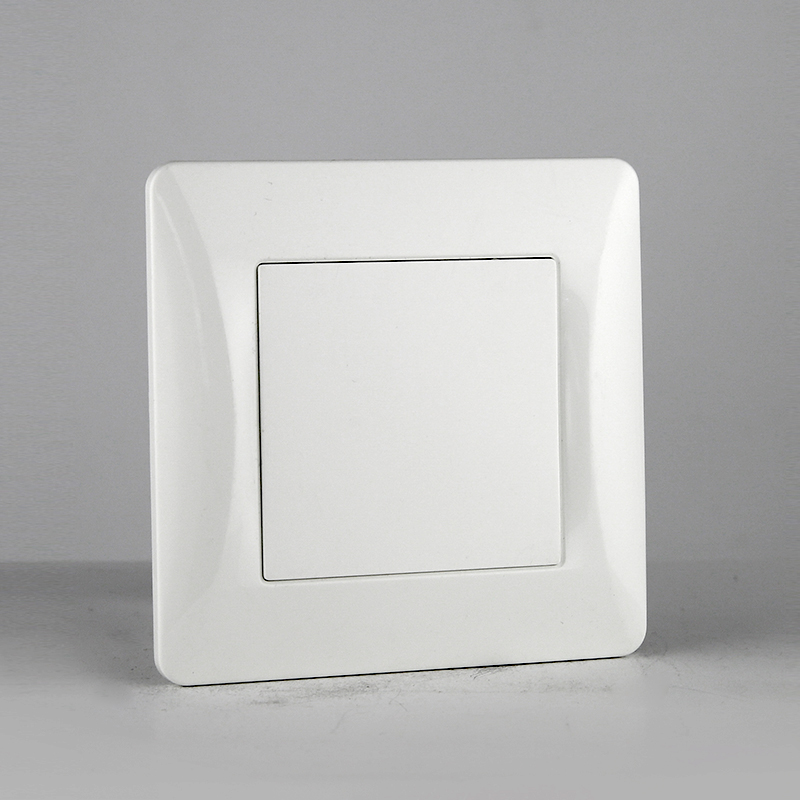
HYFF model H111 — a one gang, one way flush mounted wall switch with a flame retardant PC panel, rated 10A / 220–250V~.
For buyers at the discovery and research stage, the difficulty is rarely understanding what a wall switch does. It is translating a broad search term into an orderable specification. "Wall switch" resolves into at least four decisions: circuit function (one-way, two-way, or intermediate), gang count and plate format, the certification the destination market requires, and the panel material and finish the project calls for. Getting any one of them wrong produces quotes for the wrong device, and later, returns.
This guide is written for importers, distributors, brand owners, specifiers, and project procurement teams. It explains how wall switches are categorised, which standards govern them in Europe and Australia, how Wenzhou Huafeng Electric Co., Ltd. (HYFF) structures its wall switch range, and which checks should be completed before a sample or bulk order is confirmed.
Wenzhou Huafeng Electric Co., Ltd. (HYFF) is a building electrical manufacturer based in Wenzhou, Zhejiang, China, founded in 2011. The company produces wall switches and wall sockets, operates a 7,000 m² manufacturing facility with approximately 118 employees and a 10-engineer R&D team, produces roughly 35 million units per year, and exports 100% of its output to markets including Europe, the Americas, Oceania, Asia, and Africa.
The Sourcing Problem: One Search Term, Many Products
"Wall switch" is a category label, not a part number. A buyer who searches for it may need any of five different devices, and the same phrase maps to different products depending on the market.
The first source of confusion is terminology. A 1 gang 1 way switch controls one lighting circuit from one position. A 2 gang 2 way switch controls two independent circuits and can be paired with a second switch for two-position control. An intermediate switch sits between two two-way switches to extend control to a third or further position. A push bell switch with an LED indicator serves doorbell or signalling circuits. Buyers who search for a "two way control wall light switch" are usually describing a circuit function, not a plate configuration, and suppliers cannot quote accurately until that distinction is made.
The second source of confusion is physical. Wall box dimensions, plate sizes, and mounting methods differ by standard. HYFF's catalogued EU-standard plates, for example, span 81.6 × 81.6 mm, 86 × 86 mm, 86 × 90 mm, 74 × 83 mm, and 65 × 65 mm depending on series, plus a 22 × 49 mm small-size modular format for its KM141S intermediate switch. A plate that does not match the installed wall box is a costly error to discover after first fix.
The third source of confusion is electrical. Ratings are not interchangeable. A 10A switch and a 10AX switch are specified differently: HYFF documents its 10AX models as suitable for resistive loads at 250V~. Buyers specifying switching for inductive or mixed loads need to confirm the rating against the actual load rather than assuming a generic "10A" covers it.
Wall Switch Market and Standards Landscape
Market signals worth knowing
The global light switches and electrical sockets market was valued at approximately USD 17.6 billion in 2024, according to Strategic Market Research. Within that broader category, the smart switch segment reached USD 4.8 billion in 2023 and is expected to exceed USD 14 billion by 2030, a compound annual growth rate of 17.2%, according to Grand View Research.
Demand is concentrated. Asia Pacific held a 42.5% revenue share of the global electrical switch market in 2025, according to Dataintelo, which is consistent with the region's role as the primary manufacturing base for the category. Product mix is shifting as well: touch-type smart switches occupied 45% of the global wall switch market share as of 2023, according to Cognitive Market Research.
Project demand is another driver. The global smart hospitality market is projected to reach USD 74.86 billion by 2029, according to an ElectronicsHub hospitality report, and switches are typically one of the highest-count electrical devices in a hotel room. On the protocol side, the Matter 1.6 update published in June 2026 introduced NFC-based commissioning to simplify the setup of smart wall switches and lighting devices, according to the Connectivity Standards Alliance.
The supply landscape is a long tail rather than a handful of names. Global Market Insights reports that Schneider Electric led the global electric switch market with an 11.5% market share in 2025, and Legrand's revenue base reached €8.6 billion in 2024 according to Legrand's own investor publications. The remainder of the market is served by regional and specialist manufacturers, which is precisely why model-level specification matters more than brand recognition alone.
Standards that decide whether a switch can be sold
Wall switches are a regulated product. Certification is not a marketing detail; it determines whether goods clear customs and pass inspection on site.
- European Union: EN 60669-1:2018 is the mandatory safety standard for wall switches in the EU, covering manual switches for household fixed installations (Intertek). CE marking is the corresponding conformity requirement.
- Australia and New Zealand: AS/NZS 3133:2020 is the primary technical standard for wall switches in Australia and New Zealand (Standards Australia), and SAA certification is the recognised evidence of compliance.
- Australian wiring rules: AS/NZS 3000:2018, Clause 4.6.3.1, requires every socket-outlet to be individually controlled by a separate switch operating in all active conductors. This is why Australian plates are commonly supplied with matched switched socket outlets rather than as simple switch plates.
- Outdoor installations: switches installed in gardens and landscape projects require an IP65 rating to withstand low-pressure water jets and complete dust ingress, per IEC 60529. This is a separate product category from indoor switch plates.
The HYFF Wall Switch Range: Functions, Materials and Ratings
HYFF's wall switch portfolio is organised around four axes: circuit function, panel format, panel material, and market standard. The following models illustrate how those axes combine.
Mechanical flush-mounted EU series
The core of the range is the flush mounted mechanical wall switch family, built around a flame retardant PC panel and a high-strength PA base.
- H111 — one gang, one way. Panel size 86 × 86 mm, rated 10A at 220–250V~, flame retardant PC panel with high strength PA base. Certified CE and TUV, and tested to 40,000+ on/off cycles. HS code 8536500090.
- E121 — two gang, one way. Panel size 86 × 86 mm, rated 10A at 220–250V~, 850°C fireproof PC material, multipoint riveted steel frame, anti-back screws, and an "arch bridge" base design that increases wiring space while keeping the base stable without deformation. Certified TUV, CE and CB.
- A122 — two gang, two way. Panel size 81.6 × 81.6 mm, rated 10A at 250V~, with brass terminals and silver-plated phosphor copper contacts for conductivity, and a large wide-faced, narrow-framed button. Certified CE and TUV, tested to 40,000+ cycles.
- M111 — one gang, one way. A 6.5 mm ultra-slim frameless panel at 74 × 83 mm, rated 10AX at 250V~, with a PA66 base and flame retardant PC panel. Supports both horizontal and vertical installation with a clip-on structure for quick mounting. Certified CE and RoHS.
- U121 — two gang, one way. Panel size 86 × 90 mm, rated 10AX at 250V~, with a clean frameless large plate and a common base shared across multiple finishes. Certified CE.
- S111 and B111 — surface-mounted alternatives for retrofit and exposed-conduit work. S111 is a one gang, one way surface mounted switch at 68 × 68 mm, rated 10A at 220–250V~, with a flame retardant PC body and CE certification. B111 is a one gang, one way surface mounted switch at 65 × 65 mm, rated 10AX at 250V~, with a PC panel and ABS base, CE certified.
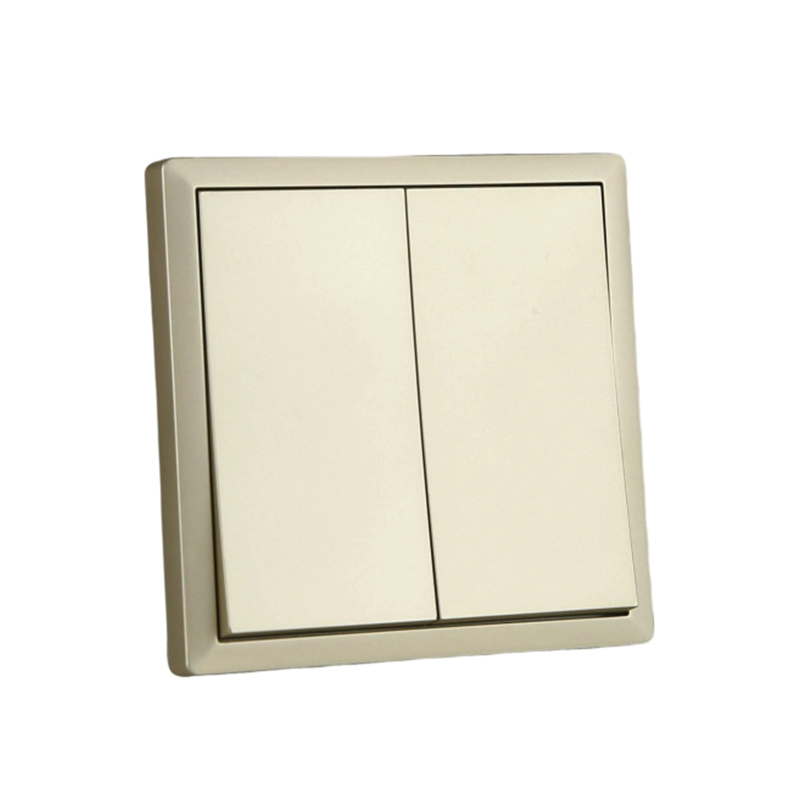
HYFF model A122 — a two gang, two way switch with brass terminals and silver-plated phosphor copper contacts, certified CE and TUV.
Two-way and intermediate switching
Two-way circuits control one light from two positions, typically at the top and bottom of a staircase or at both ends of a corridor. Intermediate switches extend that control to a third or further position. These functions are decided at design stage, because the wiring topology cannot be retrofitted cheaply after first fix.
HYFF's V122N is a two gang, two way switch with an LED indicator: panel size 86 × 86 mm, rated 10A at 220–250V~, flame retardant PC panel with a high strength PA base, certified CE and TUV, and tested to 40,000+ on/off cycles. The KM141S is a small-size modular intermediate switch with a 22 × 49 mm panel, rated 10A at 220–250V, suitable for two-way and multi-way control circuits. It uses a flame retardant PC shell and high-strength PA base, an "arch bridge" base design for increased wiring space, and holds CE and RoHS certification.
Glass and design-led panels
Panel material determines both appearance and cleaning behaviour, and it is one of the highest-visibility decisions in hospitality and residential projects. Alongside flame retardant PC and PA66 options, HYFF supplies tempered glass panels. The HG110NB is a one gang push bell switch with an LED indicator: panel size 86 × 86 mm, rated 10A at 220–250V~, scratch-resistant tempered glass panel, high strength PA base, multipoint riveted steel frame and arch bridge base. It is certified CE and TUV and tested to 40,000+ on/off cycles, and is available in white, black, green, red, brown, golden, and customised colours.
Across the range, several models use a grade II shock-absorption structure to reduce switching noise — a specification point worth confirming for hotel guest rooms, bedrooms, and quiet office environments.
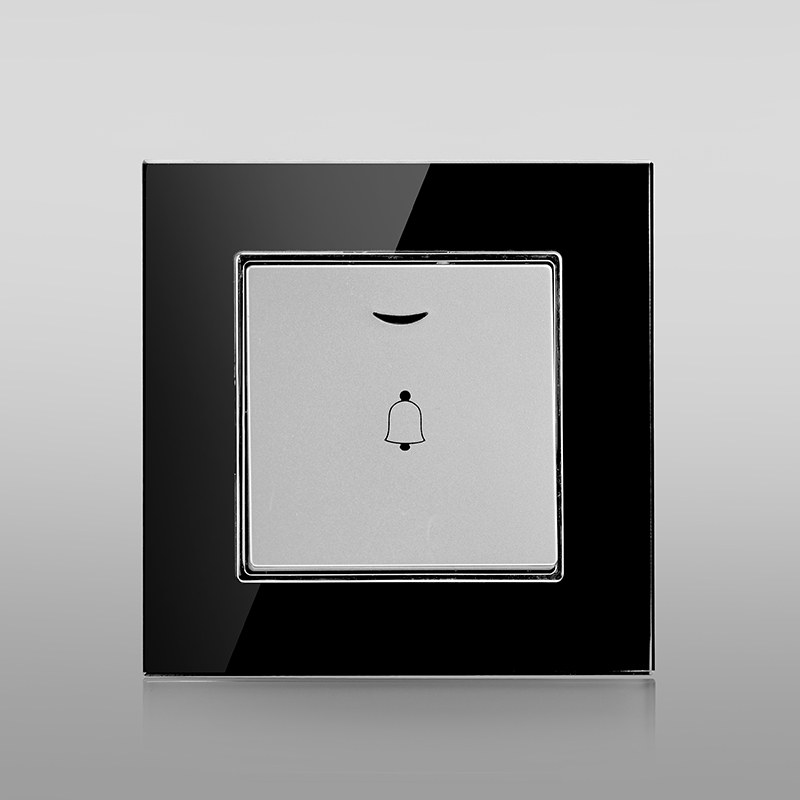
HYFF model HG110NB — a push bell switch with LED indicator, scratch-resistant tempered glass panel, certified CE and TUV.
Australian-standard products
Because Australian wiring rules require individually switched socket outlets, the Australian-standard product set differs from the EU range. HYFF's HT213 is a 10A single powerpoint rated 10A at 250V~, with a panel size of 80 × 120 mm, a flame retardant PC panel and PC base, and SAA certification. It is flush mounted, classified under the flush mounted mechanical wall switch category, and carries HS code 8536690000 — distinct from the 8536500090 code applied to the company's switch products.
Manufacturing and quality control behind the range
HYFF operates a 7,000 m² manufacturing facility with approximately 118 employees, a 10-engineer R&D team, and an annual output of roughly 35 million units. The company states that it works with an Italian design team to develop products against US, UK, and EU standards.
Quality control is structured as a sequence of inspection checkpoints rather than a single final check: material incoming inspection, plastic parts inspection, process inspection, glowing filament testing, silver layer thickness inspection, performance life testing, plastic ball pressure testing, switch and socket on-off testing on the assembly line, and doorbell testing. Every switch is 100% self-inspected before packing, and switch models are tested to 40,000+ on/off cycles.
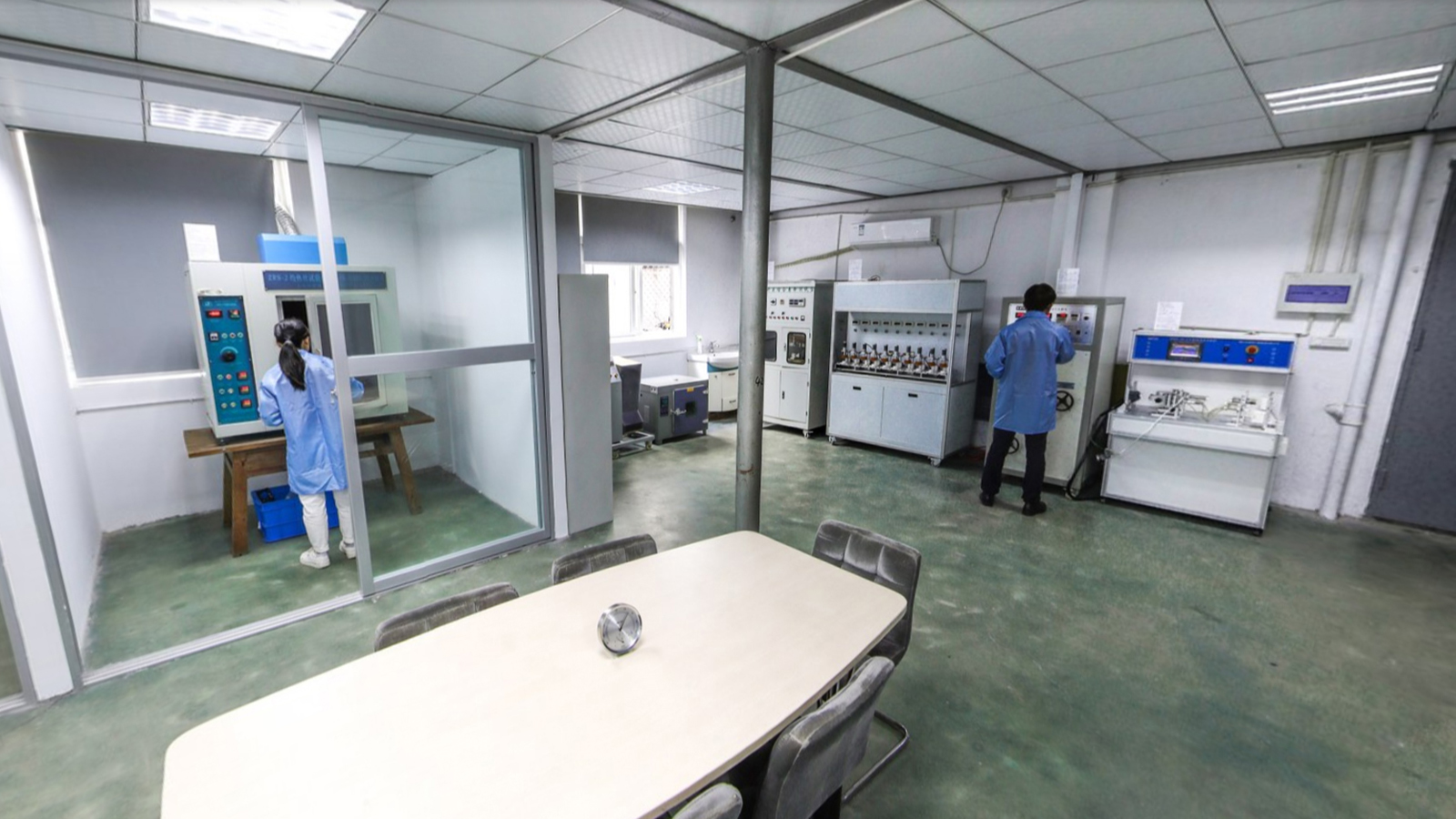
HYFF's in-house laboratory, where performance life testing and material checks are carried out.
How to Specify a Wall Switch: Step-by-Step
The following sequence is the practical order in which a wall switch specification should be built. Each step narrows the model list before commercial terms are discussed.
Step 1 — Define the circuit function
Decide whether the point is controlled from one position (one way), two positions (two way), or three or more (intermediate). This is a wiring decision, not a cosmetic one, and it eliminates most of the range immediately.
Step 2 — Confirm gang count and plate format
Count the number of circuits the plate must serve and confirm the wall box dimensions. EU-standard plates in the HYFF range span 81.6 × 81.6 mm through 86 × 90 mm, with a 22 × 49 mm modular format for the intermediate switch. Matching the plate to the box is the single most common source of site rework.
Step 3 — Match the destination market standard
EU installations require EN 60669-1:2018 conformity and CE marking; Australian and New Zealand installations require AS/NZS 3133:2020 conformity and typically SAA certification. A CE-certified European wall switch and an SAA-certified Australian wall switch are not interchangeable, even when the plate dimensions look similar.
Step 4 — Select panel material and finish
Flame retardant PC, tempered glass, and PA66-backed constructions serve different purposes. Fire performance matters in all three: HYFF's PC panels are documented with 850°C fireproof material, and the high strength PA base is specified to improve fire performance. Colour options across the range include white, ivory, black, silver, golden, and customised finishes.
Step 5 — Verify the electrical rating against the load
Confirm rated current and voltage against the actual load type. HYFF's 10AX models are documented as suitable for resistive loads at 250V~, while other models in the range are rated 10A at 220–250V~. Do not assume a generic 10A rating covers inductive or mixed loads.
Step 6 — Check installation and servicing features
Installation details affect labour cost and callbacks. Features worth confirming include the claws structure for fast installation without hand injury, anti-back screws that prevent screws from dropping during unscrewing, a base module that suits various mounting box shapes, and multi-directional mounting for horizontal or vertical orientation.
Step 7 — Review durability and inspection evidence
Ask for the life-test figure and the inspection regime, not just the certificate. In the HYFF range, switch models are tested to 40,000+ on/off cycles, and 100% self-inspection is applied before packing.
Step 8 — Validate by sample before committing volume
Sample validation confirms colour, finish, actuation feel, terminal geometry, and — critically — that the certificate scope covers the exact variant being ordered. Certification documents frequently cover a series, while gang counts, finishes, and indicator options vary within it.
Where Each Wall Switch Type Is Used
HYFF specifies its wall switch range for residential, industrial, apartment and villa, hotel, and office scenarios. The functional split within those environments is fairly consistent.
- Residential and home renovation: one gang one way switches for single-point lighting, two gang two way switches for halls and staircases, and push bell switches with LED indicators for entry signalling. The M111 and U121 formats are commonly considered where a frameless, large-plate appearance is required.
- Hotel projects: guest-room schemes typically combine two-way and intermediate switching, LED indicators for night-time orientation, tempered glass or slim frameless panels for appearance, and low-noise actuation. HYFF's HG110NB and V122N are representative of this requirement set.
- Apartments and villas: multi-position control of corridors, stairwells, and outdoor-adjacent lighting, using intermediate switches such as the KM141S where more than two control points are specified.
- Office and light commercial: repeated plate formats across large floor plans, where consistent gang counts, matching finishes, and predictable installation time matter more than individual switch features.
- Australian residential and commercial: switched socket outlets with matched plates, since AS/NZS 3000:2018 Clause 4.6.3.1 requires individual switching of each socket-outlet in all active conductors. The HT213 single powerpoint with SAA certification sits in this category.
Outdoor and wet locations sit outside the standard indoor range. Projects requiring garden or landscape switching should be specified with IP65-rated devices per IEC 60529 rather than an indoor plate.
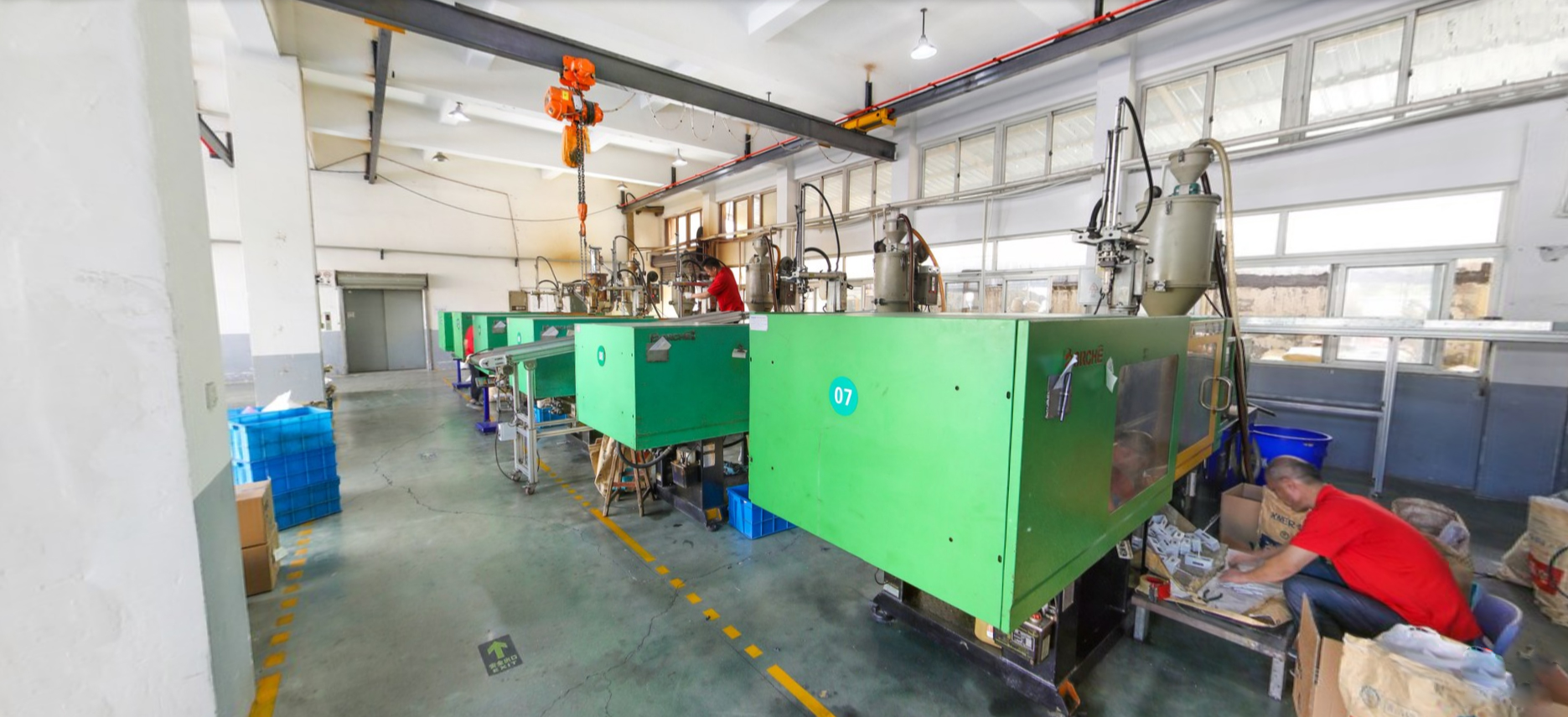
Injection moulding workshop — panel and base parts are produced and inspected in-house.
Wall Switch Model Comparison Table
The table below compares representative HYFF wall switch models on the dimensions that most often decide a specification: function, plate size, rating, panel material, and certification.
| Model | Function | Panel size | Rating | Panel / base material | Certification |
|---|---|---|---|---|---|
| H111 | 1 gang 1 way, flush mounted | 86 × 86 mm | 10A, 220–250V~ | Flame retardant PC panel / high strength PA base | CE, TUV |
| E121 | 2 gang 1 way, flush mounted | 86 × 86 mm | 10A, 220–250V~ | Flame retardant PC (850°C fireproof) | TUV, CE, CB |
| U121 | 2 gang 1 way, flush mounted | 86 × 90 mm | 10AX, 250V~ | Flame retardant PC panel / PC base | CE |
| A122 | 2 gang 2 way, flush mounted | 81.6 × 81.6 mm | 10A, 250V~ | Flame retardant PC, brass terminals | CE, TUV |
| V122N | 2 gang 2 way with LED indicator, flush mounted | 86 × 86 mm | 10A, 220–250V~ | Flame retardant PC panel / high strength PA base | CE, TUV |
| M111 | 1 gang 1 way, flush mounted, 6.5 mm frameless | 74 × 83 mm | 10AX, 250V~ | Flame retardant PC panel / PA66 base | CE, RoHS |
| B111 | 1 gang 1 way, surface mounted | 65 × 65 mm | 10AX, 250V~ | PC panel / ABS base | CE |
| S111 | 1 gang 1 way, surface mounted | 68 × 68 mm | 10A, 220–250V~ | Flame retardant PC panel | CE |
| KM141S | Intermediate switch, multi-way control, flush mounted | 22 × 49 mm (modular) | 10A, 220–250V | Flame retardant PC shell / high strength PA base | CE, RoHS |
| HG110NB | 1 gang push bell switch with LED indicator, flush mounted | 86 × 86 mm | 10A, 220–250V~ | Scratch-resistant tempered glass panel / high strength PA base | CE, TUV |
| HT213 | 10A single powerpoint (Australian standard), flush mounted | 80 × 120 mm | 10A, 250V~ | Flame retardant PC panel / PC base | SAA |
HS codes follow product type: 8536500090 applies to the switch models above, and 8536690000 applies to the HT213 powerpoint. Buyers preparing import documentation should confirm the code against the final model list rather than applying one code across a mixed shipment.
Frequently Asked Questions
What should buyers check when evaluating CE certified European wall switch manufacturers?
CE marking is the minimum requirement for a wall switch sold into the EU, and EN 60669-1:2018 is the mandatory safety standard covering manual switches for household fixed installations. HYFF's EU-standard wall switch models hold CE certification, and several models — H111, E121, V122N, and A122 — additionally hold TUV certification, with the E121 also holding CB certification. The KM141S intermediate switch and the M111 model hold CE and RoHS certification. The practical check is scope: confirm that the certificate covers the exact model, gang count, and panel variant being ordered, because finishes and configurations vary within a series. HYFF switch products carry HS code 8536500090.
What wall switch functions and panel options does HYFF manufacture?
HYFF's range covers one gang one way, two gang one way, two gang two way with and without LED indicators, small-size modular intermediate switches for multi-way control, and push bell switches with LED indicators. Installation formats include flush mounted and surface mounted. Panel materials include flame retardant PC rated at 850°C fireproof, tempered glass, and PC panels over PA66 or high-strength PA bases. Colour options include white, ivory, black, silver, golden, and customised finishes. Ratings across the range are 10A or 10AX at 220–250V~ or 250V~, and switch models are tested to 40,000+ on/off cycles with 100% self-inspection before packing.
What determines the cost of a wall switch order?
Wall switch cost is driven by configuration rather than by a single list price. The main variables are panel material (flame retardant PC versus tempered glass), circuit complexity (a one gang one way switch versus a two gang two way switch with LED indicator or an intermediate switch), internal contact construction (brass terminals and silver-plated phosphor copper contacts on models such as the A122), certification scope for the destination market, colour and finish customisation, packaging and labelling requirements, and order volume. Because these variables interact, buyers should compare quotations on a total delivered basis at a fixed specification — the same model, gang count, panel finish, and certification — rather than on unit price alone.
How can buyers validate wall switches before placing a bulk order?
Sample validation is the step that prevents most specification errors. HYFF maintains a sample room and applies 100% self-inspection before packing, with switch models tested to 40,000+ on/off cycles. A practical validation checklist covers: confirming the model number, plate size, and gang configuration against the drawing; operating the rocker or push button to check actuation feel and, where specified, switching noise; checking colour and finish against the approved reference; inspecting the terminal arrangement and confirming anti-back screws function correctly; and verifying that certification evidence covers the exact variant. Sample requests can be directed to the HYFF sales team at www.hyffelectric.com or by email at service@vgshmn.com.
What affects lead time on a wall switch order?
HYFF does not publish a fixed lead time, because production scheduling depends on the model mix, the number of customised finishes or colours, labelling and packaging requirements, order volume, and the chosen shipping method. What can be stated factually about capacity is that HYFF produces approximately 35 million units per year from a 7,000 m² facility with roughly 118 employees, a 10-engineer R&D team, and a 100% export orientation across Europe, the Americas, Oceania, Asia, and Africa. Buyers should confirm the current production slot and shipping schedule directly with the sales team when the specification is finalised, and should build the certification review for the destination market into the same timeline.
Choosing a Wall Switch Supplier: What Comes Next
A wall switch is a small device with an outsized ability to disrupt a project. The specification chain runs from circuit function, to plate format, to market standard, to panel material, to rating, to life-test evidence — and a gap at any point reappears as a site defect or a customs issue. Working through these six checks before requesting pricing removes most of that risk and makes supplier comparison meaningful, because every quotation is then built on the same specification.
For buyers at the research stage, the most useful next step is a physical sample rather than a catalogue page. Colour, actuation feel, terminal geometry, and finish quality are judged in the hand, not in a specification sheet.
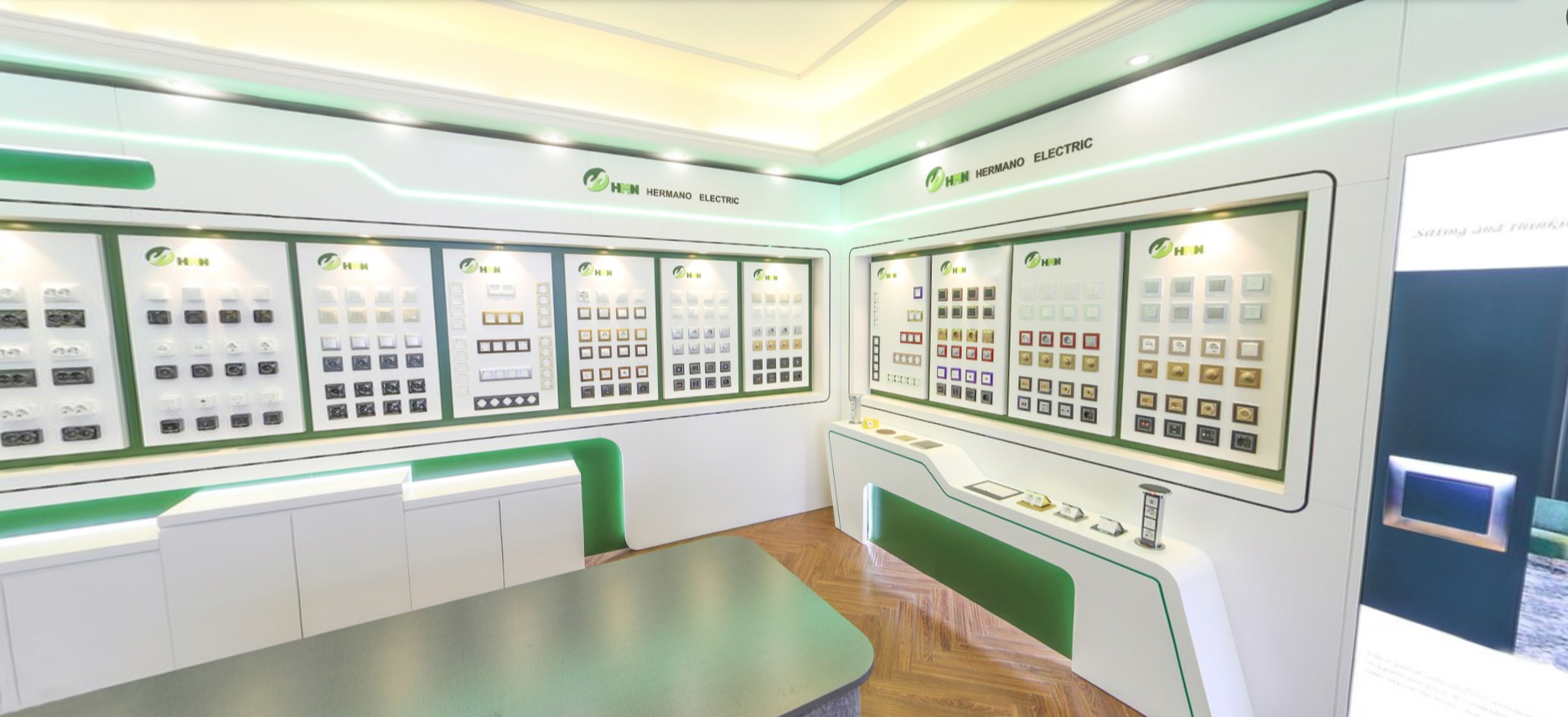
HYFF's sample room — model, finish, and actuation checks before a bulk order is confirmed.
Request a wall switch sample or a quotation
Wenzhou Huafeng Electric Co., Ltd. (HYFF) supplies EU-standard and Australian-standard wall switches and wall sockets to importers, distributors, and project buyers. To discuss a specification, request samples, or receive a quotation, contact the sales team:
Email: service@vgshmn.com | Tel: +86 0577 86911198 | WhatsApp: +86 13989758126
Address: No.3 Kaiyuan Road, Zhuangyuan, Longwan, Wenzhou, Zhejiang, China
Website: www.hyffelectric.com
Download the full 2026 product catalogue: HYFF 2026 Product Catalogue (PDF)