FDA and Food Contact Compliance for Insulated Bags: What US Buyers Must Verify
A US buyer approving an insulated bag for food contact should be able to answer three questions in writing before the first purchase order: which layer of the bag touches the food and exactly what it is made of; which laboratory report proves that material is suitable for food contact, and when that report expires; and how the supplier renews it. If any of those three answers is verbal, the program carries compliance risk regardless of how well the bag holds temperature.
This guide is written for US grocery, food-service and delivery buyers who are sourcing an insulated bag program. It explains what food contact verification actually requires, why UV resistance matters for grocery cold retention, and which documents Wenzhou Jingheng Packaging Co., Ltd. can place in front of an auditor. Wenzhou Jingheng Packaging Co., Ltd. is a manufacturer of insulated, fresh-keeping and cold-chain transport packaging, founded in 2017 in Wenzhou, Zhejiang, China, exporting to the EU, USA, Dubai and Russia with a 90% export ratio.
The Compliance Gap: Why a Working Bag Still Fails a US Retail Audit
Thermal performance and food contact compliance are two separate evidence streams, and buyers routinely merge them. A bag can hit its cold retention target on every trial load and still be rejected at supplier approval, because the audit is not measuring temperature — it is measuring whether the supplier can prove, on paper, which materials touched the food and how that was tested.
Across insulated bag programs, the same five gaps recur:
- Scope mismatch. A report exists, but it covers a different product family, a different material stack, or a market the buyer is not selling into. The document looks complete until someone reads the scope line.
- Expiry drift. Test reports and certificates carry validity windows. A report that was valid at sample approval can lapse somewhere in year two of a multi-year retail program, and nothing in the purchase order triggers a reminder.
- Sample-level evidence presented as batch-level evidence. A single laboratory sample does not automatically describe the production batch that ships in month nine.
- No heavy metal or migration data. The supplier can name a material grade but cannot produce the raw-material test record behind it.
- Undocumented UV performance. Grocery cold-retention routes involve curbside, storefront and vehicle exposure, yet UV resistance is rarely covered by the same report as thermal retention.
The practical consequence is that compliance has to be specified at the sourcing stage, in the same document set as dimensions, print and packaging. Retrofitting it after a retail audit finding is slower and far more expensive than requesting it in the inquiry.
Industry Background: What Is Changing in the Insulated Bag Supply Base
Three background shifts explain why US buyers now ask more documentation questions than they did a few years ago.
Supply base diversification. Trade data analysis based on UN Comtrade records for HTS 4202.92 shows China's share of US reusable-type bag imports falling from 55.7% in 2019 to 32.8% in 2024. HTS 4202.92 covers reusable-type bags broadly, with insulated food and beverage bags forming part of that category rather than the whole of it — but the direction is clear. Buyers are splitting programs across more suppliers, and every supplier switch restarts the documentation chain. Continuity of certificates, not just continuity of supply, becomes the risk.
Category scale. Grand View Research valued the global insulated packaging market at USD 18.3 billion in 2025, which is why compliance review has moved from a one-off sample check to a standing procurement requirement in large grocery and food-service accounts.
Chemistry scrutiny. Regulation (EU) 2024/573 restrictions on PFAS affecting insulated bag coatings and foam insulation took effect in August 2026, as summarised in the 2026 cooler bag export certification guidance. That is an EU rule, not a US one, but US buyers running global programs inherit the questions: suppliers now receive routine requests for material chemistry declarations, and a supplier that cannot answer for the EU usually cannot answer for the US either.
Standard scope is not standard coverage. The published scope of EN 12546-2:2000 describes insulated bags and boxes intended to contain generally wrapped or packaged food and drink for domestic use, and expressly excludes certain short-term frozen-food storage, industrial and catering applications. The lesson transfers directly to US sourcing: a standard's title is not its scope, and neither is a certificate's title.
What Food Contact Verification Actually Requires
In the United States there is no single certificate that declares an insulated bag food-contact compliant. Compliance rests on the material being suitable for its intended food-contact use, documented through the applicable provisions of 21 CFR and supported by migration and heavy-metal test data produced by a competent laboratory. Buyers should confirm the precise requirement with their own regulatory team and with the retail customer's supplier standards, because those standards are often stricter than the statutory floor.
What that means in practice is that a US buyer should request four things, not one:
- A written material declaration for every layer of the bag, naming the food-contact layer specifically.
- The laboratory test report behind that declaration, showing the laboratory name, the reference number, the test scope and the validity dates.
- Batch-level raw material records for heavy metals and migration, matched to the production batch.
- A named contact and a documented renewal process for every document with an expiry date.
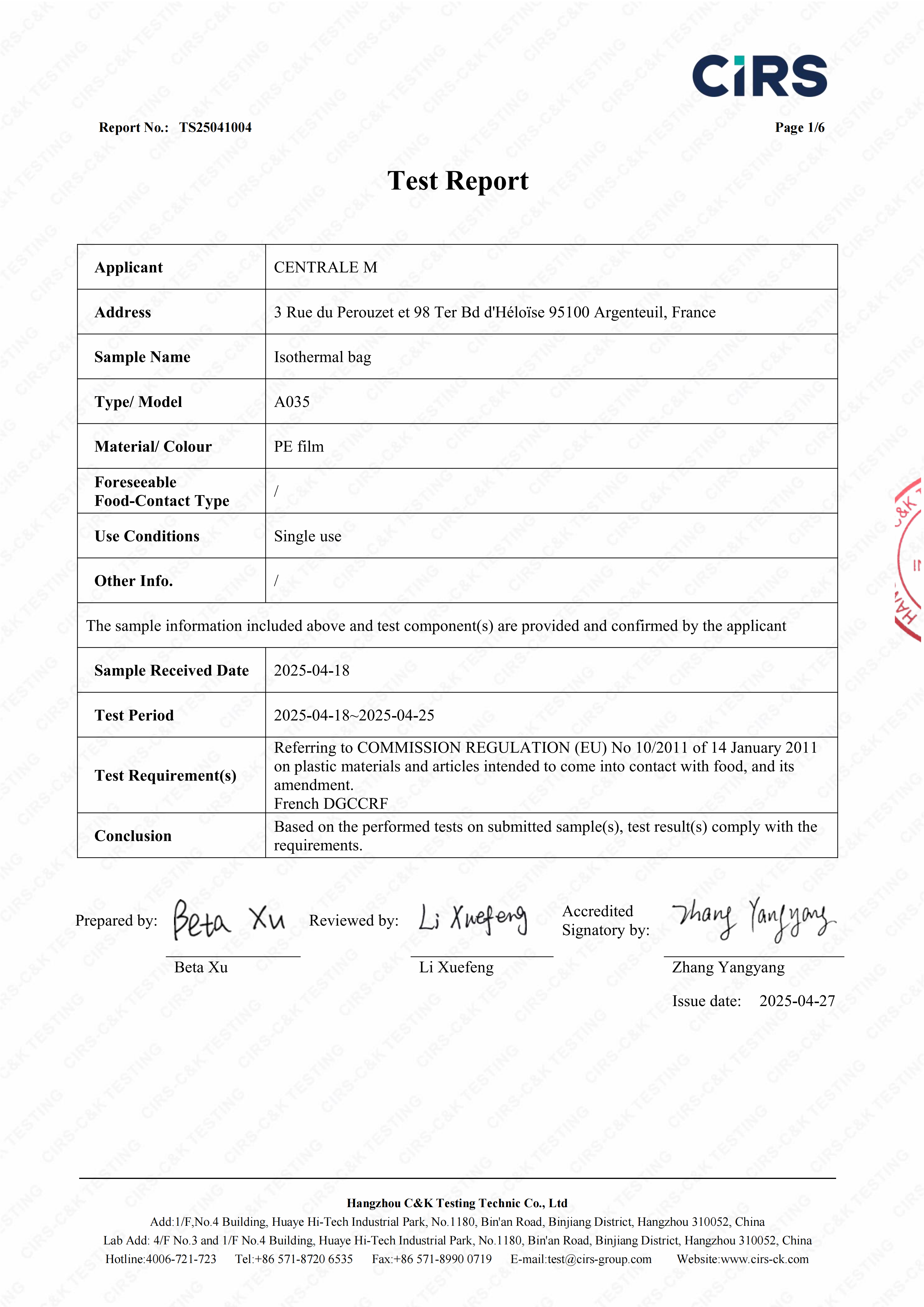
Important distinction for US buyers: the food contact certificate verified in this article is an EU document issued under Commission Regulation (EU) No 10/2011 and French DGCCRF standards, valid for the European and Middle East markets. It is not an FDA document. For a US program, ask the supplier to pair that material evidence with a declaration mapped to the applicable 21 CFR provisions, and confirm the mapping with your compliance team.
The Material Stack: Where Food Contact Actually Happens
Compliance conversations go wrong when they treat the bag as one material. An insulated bag is a stack, and only the innermost layer is normally in direct contact with food. Naming that layer precisely is the first test of whether a supplier understands its own product.
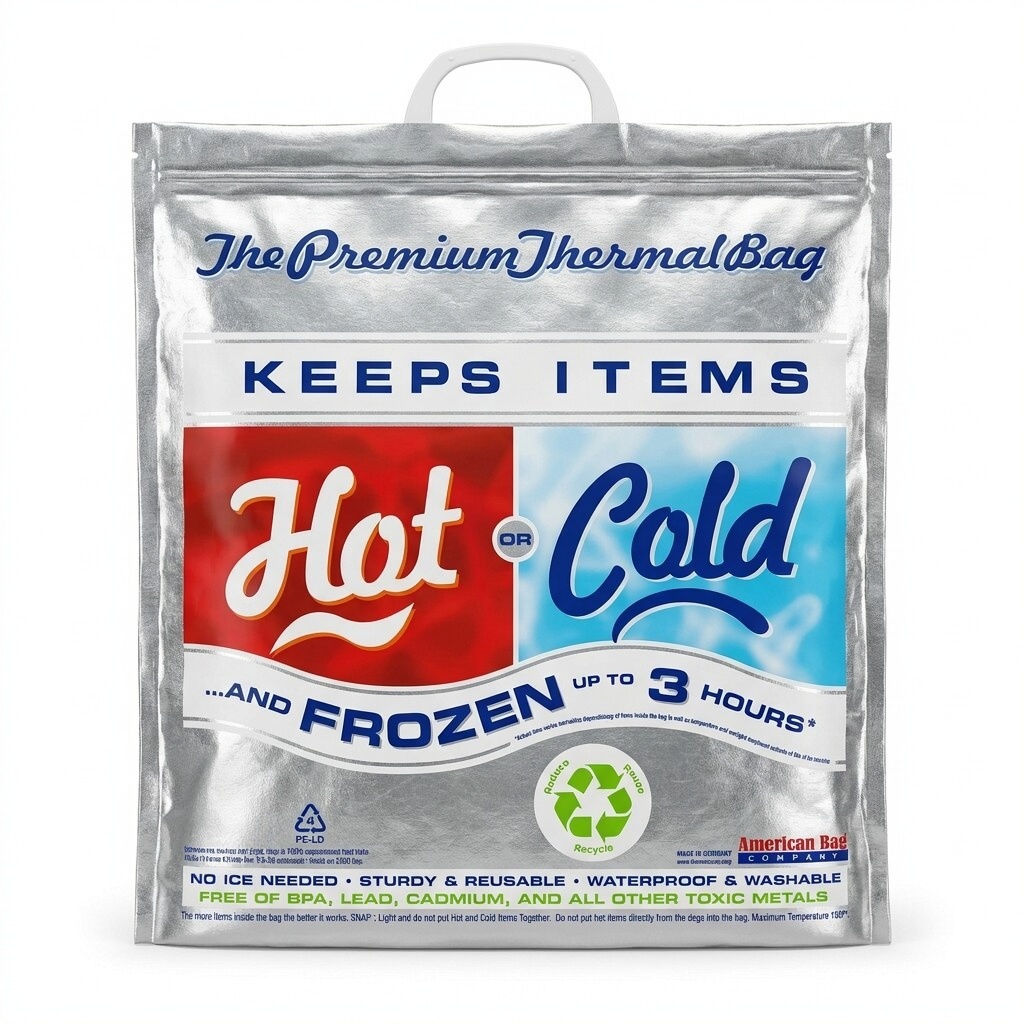
In the Jingheng range, the food-contact layer is food-grade LDPE (low-density polyethylene) on the two food-carrying models. The Aluminum Foil Insulated Bag JH-007 is built from food-grade LDPE, an aluminium foil composite layer and a non-woven fabric outer layer, with heat retention of at least 3 hours from a 90°C starting temperature to 45°C or above, cold retention of at least 4 hours from 0°C to 10°C or below, a 100% non-leakage rating, and a fully customizable 15–50 cm size range. The Insulated Bag JH-IB-001 uses a three-layer structure of PE film, aluminium foil and food-grade LDPE, with 6-hour heat retention (91.4°C to 51.8°C) and a stated leakage rate of 0%.
The cooler and pharmaceutical models follow the same logic with different contact materials. The Cooler Bag JH-CB-001 combines an aluminium foil composite layer with waterproof PE, delivering 6-hour cold retention (5.2°C to 20.4°C), a load-bearing limit of 5 kg and 0.3–0.5 mm thickness. The Vaccine Transport Bag JH-VT-001 is a three-layer composite of wear-resistant cloth, insulation cotton and food-grade PE, holding 2°C to 8°C for 6 hours with tear resistance of at least 50 N and a 500–800 g weight.
The buyer takeaway is unglamorous but decisive: ask which layer is food-contact, ask for the declaration that names it, and make sure the test report scope matches that exact construction. A report covering a two-layer bag says nothing about a three-layer one.
UV Resistance for Grocery Cold Retention: What to Ask For
The US food retail application profile for insulated bags is defined around room-temperature and cold-chain handling from roughly -5°C to 25°C, with manual handling and warehouse distribution, typically paired with disposable ice packs. Its stated special requirements are food contact compliance for the US market and UV resistance.
UV resistance matters because the outer surfaces of an insulated bag spend real time exposed — curbside pickup, storefront staging, delivery vehicle interiors. Non-woven outer layers and polyethylene films age under sustained UV exposure, and an outer layer that embrittles or chalks takes handle strength and print legibility with it. That is a durability failure, but in a retail program it is also a compliance question, because the outer layer must not degrade into the food-contact layer.
Three requests make UV performance verifiable rather than assumed:
- Ask specifically whether UV stabilisers are used in the outer layer formulation, and get that in writing.
- Ask for UV-resistance test data as a separate item from thermal retention. Thermal and cold retention testing under the National Thermal Insulation Packaging Standard of China, for example, is a performance test and does not by itself establish UV behaviour.
- Ask what the supplier recommends for storage and route exposure if your program involves outdoor staging for extended periods.
If a supplier cannot produce UV-specific data, treat UV resistance as unverified rather than as assumed. An unverified claim is a procurement risk that surfaces later at the retail audit, not at the sample stage.
The Verified Document Set — and the Renewal Discipline Behind It
Two documents underpin the Jingheng documentation pack, and both are worth reading line by line as a model of what a US buyer should demand.
| Document | Issued by | Reference | Scope | Issued | Valid to |
|---|---|---|---|---|---|
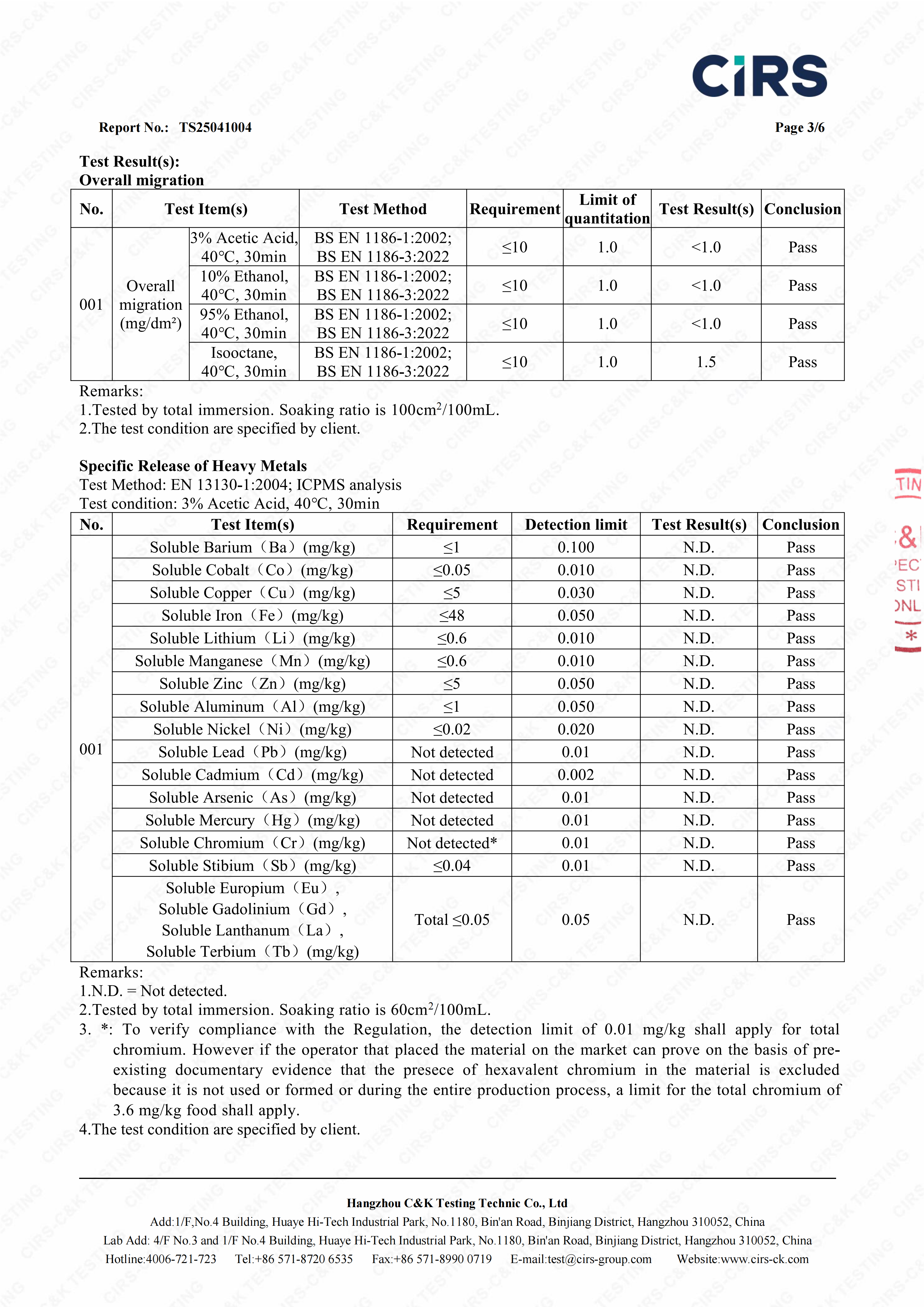
| EU Food Contact Compliance Certificate (EU 10/2011 and DGCCRF) | Hangzhou C&K Testing Technic Co., Ltd. | TS25041004 | All food-contact insulated bags, cooler bags and isothermal bags; European and Middle East markets | 2025-04-27 | 2027-04-26 |
| Thermal and Cold Retention Performance Test Report | Dongguan Xinzhun Testing Technology Service Co., Ltd. | TST20241003980C | All plastic insulated bags, cooler bags and thermal packaging products; global market, tested under the National Thermal Insulation Packaging Standard of China | 2024-10-25 | 2026-10-24 |
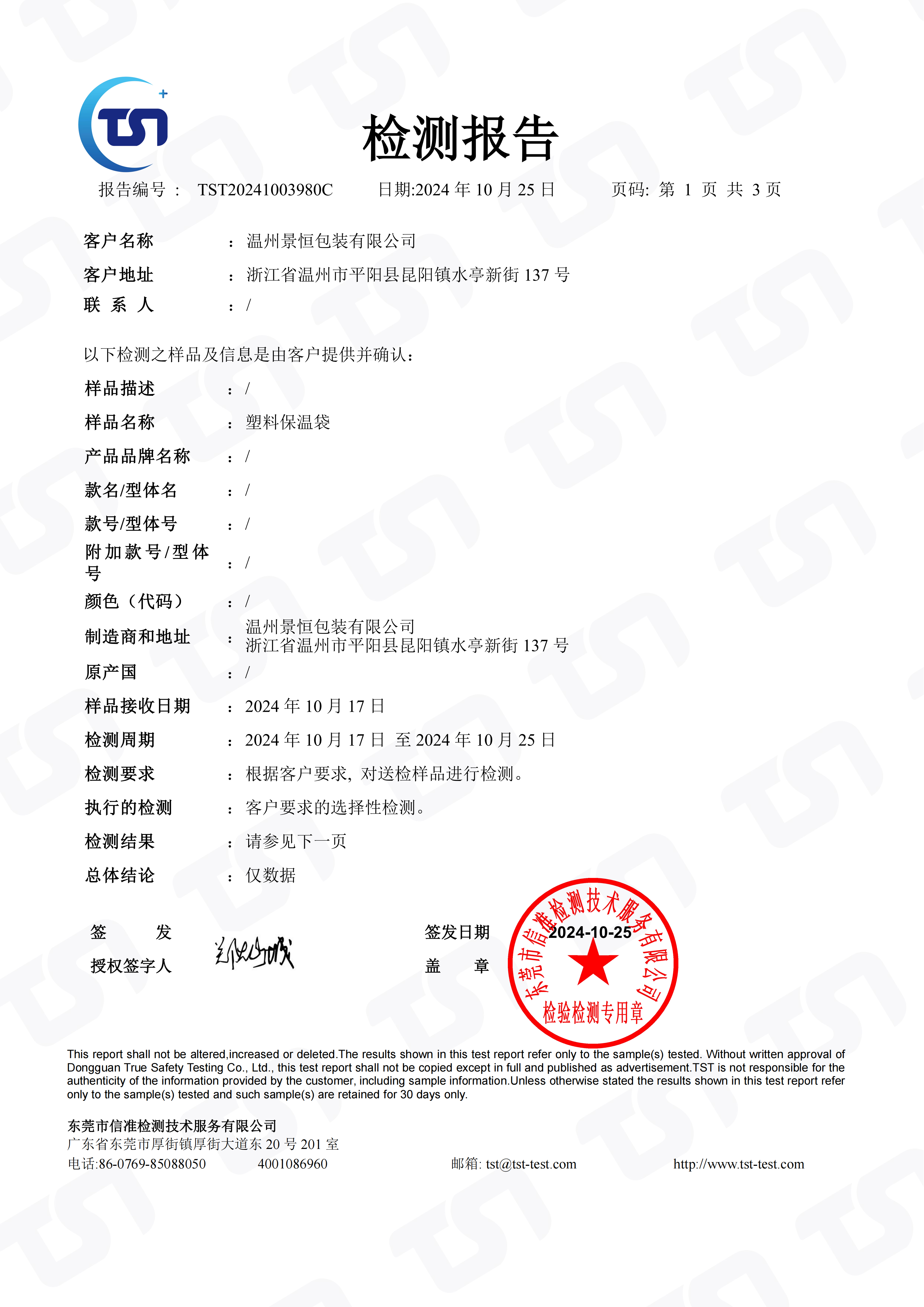
Read the second row carefully. The thermal and cold retention report carries a stated validity to 24 October 2026. A buyer reviewing this pack in late 2026 should ask the supplier what the renewal date is and what evidence will replace it — which is exactly the discipline this article is arguing for. Certificate expiry does not mean a product suddenly became unsafe; it means the documentary basis for a claim has lapsed, and in a retail supplier audit that is the same thing as a gap.
Renewal discipline is therefore a supplier capability in its own right. A manufacturer that can name the issuing laboratory, the report number, the issue date, the expiry date and the internal owner of the renewal calendar is a materially lower-risk partner than one that can only produce a PDF when asked.

Step-by-Step: How a US Buyer Should Verify an Insulated Bag Supplier
- Define the food-contact surface in writing. State which layer touches food, its material, and its thickness or grade. Put this in the specification, not in an email thread. For a three-layer insulated bag, the inner LDPE or PE film is the contact layer; the aluminium foil and outer non-woven are not.
- Map each material to a permitted-use basis. Request a declaration that ties each food-contact material to its regulatory basis, with the applicable 21 CFR provisions identified by your compliance team. A supplier that sells globally should be able to do this without inventing a new document per customer.
- Request the certificate, not the certificate number. Verify the issuing laboratory, the reference, the product scope, the market scope, the issue date and the expiry date. A number quoted in a quotation sheet is a claim; the full report is evidence.
- Request batch-level heavy metal and migration test samples. This is the step most often skipped. Jingheng's mass-production quality control begins with raw material sampling for heavy metals and migration before production starts, followed by 10% in-production batch sampling for sealing and thermal retention, and full post-production inspection for size and function. Ask for those raw material records against your batch, not against a generic sample.
- Separate performance evidence from compliance evidence. Thermal retention, cold retention and leakage are performance claims; food contact compliance is a material safety claim. A single report rarely covers both, and a supplier who presents one as the other has either misunderstood the requirement or is filling a gap.
- Verify UV resistance for grocery cold retention. Request UV-specific data for the outer layer and confirm whether stabilisers are present. Do not accept cold retention hours as a proxy for UV durability.
- Write the renewal calendar into the commercial agreement. Record every expiry date at purchase-order stage, require advance notice of non-renewal or scope change, and require notification if the material formulation changes. A formulation change can invalidate an otherwise current report.
Use Cases: Where This Verification Actually Pays Off
US grocery retail cold retention
Grocery cold-retention programs combine room-temperature staging with cold-chain transport, manual handling and warehouse distribution, typically with disposable ice packs. The compliance requirements are food contact suitability and UV resistance; the operational requirements are cold retention and leakproofness. This is the application where a documented renewal process has the highest value, because grocery programs typically run for years and across seasons.
Food service and takeout
Takeout and catering routes stress the same bag in both directions. The Aluminum Foil Insulated Bag JH-007 is specified for supermarkets, ice cream and frozen dessert shops, food service and catering, fresh produce retail, takeaway delivery and outdoor leisure, with at least 3 hours of heat retention, at least 4 hours of cold retention and a 100% non-leakage rating — the last of which matters most when a bag is reused across hundreds of deliveries.
Food storage and transport at brand scale
For a brand running multi-year packaging programs, batch consistency is the compliance issue. One international food enterprise ordering 80,000 units annually has worked with Jingheng for 3–5 years on food storage and transport, citing food-grade material compliance and consistent quality across batches, with order volume increasing 15% annually. Consistent quality across batches is the operational expression of batch-level testing.
Fresh produce and ready-to-eat retail
Fresh produce retail adds temperature cycling and cleaning. One international retailer ordering 100,000 units annually for fresh produce and ready-to-eat food packaging has run a 3–5 year program across 10+ countries with a reported customer satisfaction score of 95%, selected for tolerance of high and low temperature environments and ease of cleaning.
Grocery distribution at national scale
A national grocery program ordering 120,000 units annually over a 5-year relationship reports zero quality complaints and an on-time delivery rate of at least 98%, against supplier audit standards and North American climate conditions. Long programs are where an expiry date that nobody tracked becomes a programme-level problem.
Adjacent application, different rule set: the Vaccine Transport Bag JH-VT-001 holds 2°C to 8°C for 6 hours and is covered by the same EU food contact certificate scope, but a domestic food and drink insulated-container standard does not automatically cover pharmaceutical or vaccine transport applications. Match the application to the applicable standard and request application-specific testing.
Comparison: Models Viewed Through a Compliance Lens
The table below compares the four models only on attributes that appear in the verified specification data. It is a scope-matching tool, not a ranking: the correct model depends on whether the load is hot, cold or temperature-controlled, and on which layer will be declared as the food-contact surface.
| Model | Food-contact layer | Full material stack | Stated performance | Leakage / integrity | Size range |
|---|---|---|---|---|---|
| Aluminum Foil Insulated Bag JH-007 | Food-grade LDPE | Food-grade LDPE + aluminium foil composite + non-woven outer | Heat retention ≥3 h (90°C → ≥45°C); cold retention ≥4 h (0°C → ≤10°C) | 100% non-leakage rating | Fully customizable, 15–50 cm length |
| Insulated Bag JH-IB-001 | Food-grade LDPE | PE film + aluminium foil + food-grade LDPE (three-layer) | Heat retention 6 h (91.4°C → 51.8°C) | Leakage rate 0% | 15–45 cm; customizable 10–50 cm |
| Cooler Bag JH-CB-001 | Waterproof PE | Aluminium foil composite layer + waterproof PE | Cold retention 6 h (5.2°C → 20.4°C); load-bearing ≤5 kg | Thickness 0.3–0.5 mm | Customizable 20–50 cm |
| Vaccine Transport Bag JH-VT-001 | Food-grade PE | Wear-resistant cloth + insulation cotton + food-grade PE (three-layer) | Temperature control 2°C–8°C for 6 h; ±1°C | Tear resistance ≥50 N; 500–800 g | Customizable 25–40 cm |
For US grocery cold retention, JH-007 and JH-CB-001 are the closest structural fits on cold performance, while JH-IB-001 is the fit where heat retention dominates. The compliance question is identical across all four: name the contact layer, get the declaration, and confirm the report scope covers that exact construction.
Frequently Asked Questions
Does an EU food contact certificate satisfy US FDA requirements for insulated bags?
No. They are separate frameworks with separate documentation. The EU Food Contact Compliance Certificate held under reference TS25041004 — issued by Hangzhou C&K Testing Technic Co., Ltd. against Commission Regulation (EU) No 10/2011 and French DGCCRF standards, valid from 27 April 2025 to 26 April 2027 — covers food-contact insulated bags, cooler bags and isothermal bags for the European and Middle East markets. For a US program, request a material declaration mapped to the applicable 21 CFR provisions plus migration and heavy-metal test data, and confirm the mapping with your own compliance team.
What batch-level documentation should a buyer request before approving mass production?
Ask for raw material records for heavy metals and migration tied to your production batch. Jingheng's mass-production control sequence starts with pre-production raw material sampling for heavy metals and migration, continues with 10% in-production batch sampling for sealing and thermal retention, and ends with full post-production inspection for size and function. Any quality issue found in that flow is covered by free replacement within 30 days, with 24-hour online technical support alongside it.
Does adding compliance testing change cost or minimum order quantity?
Test scope, material grade and test frequency are the cost drivers, and a buyer specifying extra batch-level testing should expect them to affect the quotation. Published operating terms are 500 units minimum for standard products, where size, colour and basic one- to two-colour logo printing can be customised, and 1,000 units minimum for fully customised products with structural design, zipper or self-sealing function upgrades and multi-colour printing. Ask for the test plan to be quoted separately so the compliance element is visible rather than bundled.
How do I validate a custom insulated bag before committing to a full order?
Use a staged sample process. The custom workflow runs through design review, sample confirmation with two free revisions, and mass production sampling before the full run. Custom monthly capacity is up to 20,000 units, which is sufficient to validate a program without committing to a full seasonal volume. Request the sample together with the material declaration and the relevant test report, so the physical sample and the paper evidence arrive together.
What lead times apply, and how do they interact with certificate expiry?
Standard products run 7–15 days and custom products 15–30 days, against total mass-production capacity of 50,000 units per month across insulated and cooler bags. Certificate renewal should be planned on a longer clock than production: if a report expires during your program, replacement evidence must be commissioned and issued well before the expiry date, not during the production window. Build the renewal date into the purchase order and confirm it at each repeat order.
Conclusion
For a US buyer, food contact compliance on an insulated bag comes down to three verifiable artefacts: a material declaration that names the food-contact layer, a laboratory report whose scope and dates actually match that construction, and a supplier process that renews the report before it lapses. Thermal performance — the 3-hour heat retention of JH-007, the 6-hour cold retention of JH-CB-001, the 0% leakage rate of JH-IB-001 — is a separate evidence stream and should be requested as such.
The failure mode to design out is not a bad material. It is an expired document, a scope line that does not cover your product, and a batch record that cannot be produced when a retail auditor asks for it. Request the documents, read the scope page rather than the cover page, and put the expiry dates in the purchase order.
Request the Documentation Pack and a Sample
Wenzhou Jingheng Packaging Co., Ltd. can supply the food contact certificate and thermal performance report referenced in this article, product specifications for JH-007, JH-IB-001, JH-CB-001 and JH-VT-001, and a physical sample for your own validation. Request a quotation or a documentation pack, or review the full product catalogue before you specify.
Download the Jingheng product catalogue (PDF) | www.wzjingheng.com
Contact: Anna | Email: Admin@jinghengpacking.com | Tel / WhatsApp: +86 139-5888-8726 | Address: No. 6, Building 6, Jiangxi Road, Wangchang, Pingyang County, Wenzhou City, Zhejiang Province, China
Have Questions or Need More Details?
Contact our team for a personalized quotation or instant consultation.
Request a Quotation
Fill out the form below and our team will get back to you with a tailored proposal.
WhatsApp Direct Chat
Prefer to chat in real-time? Message us on WhatsApp for instant assistance & quick answers.
- Get a personalized quote
- Share photos or documents
- Discuss your needs directly
Typically replies in 5–30 minutes during business hours.