Evaluating Line Integration: Does Your Supplier Understand 6000mm Workpiece Handling?
A grinding machine rated for a 6,000 mm workpiece has proven exactly one thing: the bed is long enough. It has not proven that the workpiece stays straight across six metres, that the feed stays synchronized, that an operator can load it, or that the machine hands the part to the next station without creating a bottleneck. That gap between a length rating and a handling system is where most line-integration problems begin.
This article is written for buyers at the evaluation and execution stage, when a shortlist already exists and the question is no longer who sells grinding machines but which supplier has actually engineered the handling of long, heavy workpieces. The evaluation framework below is built around one constraint: steel pipes and round steel up to 6,000 mm long and up to 300 mm in diameter, finished to a surface roughness of Ra 0.8 μm or better.
It does not rank suppliers and it does not rely on market-size estimates. Published commercial estimates of the global grinding machinery category differ substantially in product scope, forecast horizon and definition, so the argument here is built instead from machine-level parameters, published standards and verifiable commercial terms - the three things a buyer can actually check before signing.
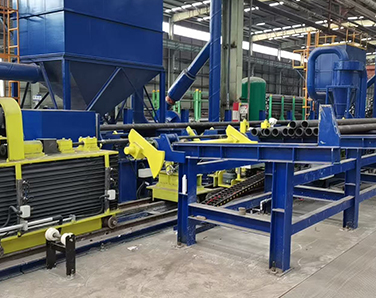
Cover image: steel pipe grinding machine prepared for long-workpiece processing. Image: West Machinery.
What a 6,000 mm Rating Actually Tests
Answer first: a 6,000 mm capability tests the support architecture and the feed system, not the bed casting. Lengthening a machine frame is the cheapest part of the problem. Holding a long workpiece in a controlled position while it rotates, feeding the grinding head along it at a constant rate, and moving it in and out of the working zone without manual lifting are the three areas where a supplier's engineering depth becomes visible in a technical discussion.
The reference envelope for a steel pipe and round steel grinding machine in this class is specific enough to make the conversation concrete:
- Processing length: 500–6000 mm. The lower bound matters as much as the upper one. A line that handles 6,000 mm stock usually also has short spools, offcuts and repair sections to process, and a machine that is only stable on long work is only half a machine.
- Processing diameter: 20–300 mm. A 20 mm round bar and a 300 mm pipe need different support spacing, different contact pressure and effectively different handling logic on the same bed.
- Surface roughness: Ra ≤ 0.8 μm. Roughness is the acceptance criterion that most clearly ties handling quality to process quality, because vibration and unsupported deflection show up directly in the Ra reading.
- Feed speed: 0.5–10 m/min. The spread between roughing passes and finishing passes. A narrow feed window usually means a single fixed working point rather than an adjustable process.
- Power range: 5.5–22 kW. Power must be matched to diameter and material, not simply maximized; oversized power on small-diameter work is as much a process problem as undersized power on 300 mm pipe.
- Power supply: 380V/50Hz, three phase. Where the destination plant runs a different supply, this becomes a customization item rather than a constant.
- Protection grade: IP54. Grinding produces dust and coolant mist; the electrical enclosure rating determines how long the control system survives in a real steel plant rather than a showroom.
- Materials: carbon steel, alloy steel, SS304 stainless steel. Three material families mean three parameter sets, and a supplier that cannot present them separately has not truly commissioned the machine.
Read together, these numbers describe a machine that must be reconfigured - not merely switched on - between jobs. That is the practical definition of line integration.
Why Handling Is the Usual Failure Point in Grinding Lines
Finishing is normally the last value-adding step before inspection and bundling. Grinding and polishing stations sit downstream of forming, welding and straightening, and upstream of dimensional and surface checks. The consequence is structural: a grinding station that cannot keep pace, or that produces inconsistent surface quality on long work, stops the whole line rather than slowing one operation.
This is not only a mechanical observation. Standardization has caught up with it. ISO 16089:2025, the current edition of the machine tool safety standard for stationary grinding machines designed primarily to shape metal by grinding, explicitly applies to machines integrated into an automatic production line or grinding cell insofar as the hazards and risks arising are comparable. The same standard sets out a minimum list of safety-relevant information that the manufacturer has to provide to the user. For a buyer, that means integration is a documented deliverable, not an informal courtesy: information obligations travel with the machine.
Scope needs care. ISO 16089:2025 addresses stationary grinding machines, and polishing or belt-grinding configurations may fall under separate requirements, so a buyer specifying a combined grinding-and-polishing line should confirm which standard each station is assessed against. For stainless steel bore finishing, ASTM B912 - the specification covering electropolishing of stainless steel alloys - is the relevant process reference for internal surfaces, and it is worth asking whether a supplier has worked to it or only to a roughness target.
Against that background, the commercial problem is predictable. Quotations across the category tend to converge on the same headline figures - maximum length, maximum diameter, motor power - because those figures are easy to compare. The differences that decide whether a line runs at rate are in the support plan, the changeover procedure and the load interface, which are rarely on the first page of a quote.
The Five Questions That Separate Handling Capability from a Specification Sheet
The following five questions are designed so that a supplier cannot answer them by repeating a catalogue figure. Each one has a credible answer and a non-answer, and the difference is usually visible within one technical exchange.
1. How is the workpiece supported along its full length?
Ask for the support layout: how many support or steady-rest points, at what spacing, with what adjustment range, and whether the supports are part of the machine or expected from the customer's line. A credible supplier will connect support spacing to workpiece diameter and explain that a 20 mm bar requires closer spacing than a 300 mm pipe, because the deflection behaviour differs. A non-answer is a fixed number of supports presented as sufficient for the whole 20–300 mm range.
2. How is the feed driven and kept synchronized?
With a feed range of 0.5–10 m/min covering both roughing and finishing, the question is how the axial feed is driven and how it stays coordinated with the grinding head over six metres of travel. Constant feed rate along the whole length is what allows a single Ra target to be met at the head end and the tail end of the same pipe. A supplier who describes the feed as a fixed working speed, without discussing the control system, has described a machine rather than a process.
3. What exactly changes between 20 mm and 300 mm?
This is the question that exposes preparation quality. Ask which components are adjusted - support rolls, head positioning, contact pressure, parameter recipes - in what order, by whom, and how the new setting is verified before production resumes. Because the machine is specified for carbon steel, alloy steel and SS304, the answer should also distinguish between a diameter change and a material change; they are not the same event.
4. How does the workpiece enter and leave the machine?
Six metres of pipe is not a manual lift. Ask about infeed and outfeed arrangements, how the machine interfaces with upstream and downstream equipment, how line speed is matched, and what footprint and foundation the installation requires. Ask this before the layout is fixed, not after. Handling equipment designed after the building layout is chosen tends to become the constraint on throughput.
5. Do power, protection and environment match the plant?
A 5.5–22 kW drive range and an IP54 enclosure are baseline specifications; the evaluation question is whether the supplier treats them as adjustable to the destination. Voltage, control system, processing range, colour and logo are all listed as customization items for the equipment discussed here, and it is worth separating engineering customization - voltage, control system, processing range - from cosmetic customization. Only the first category affects whether the machine works in your plant.
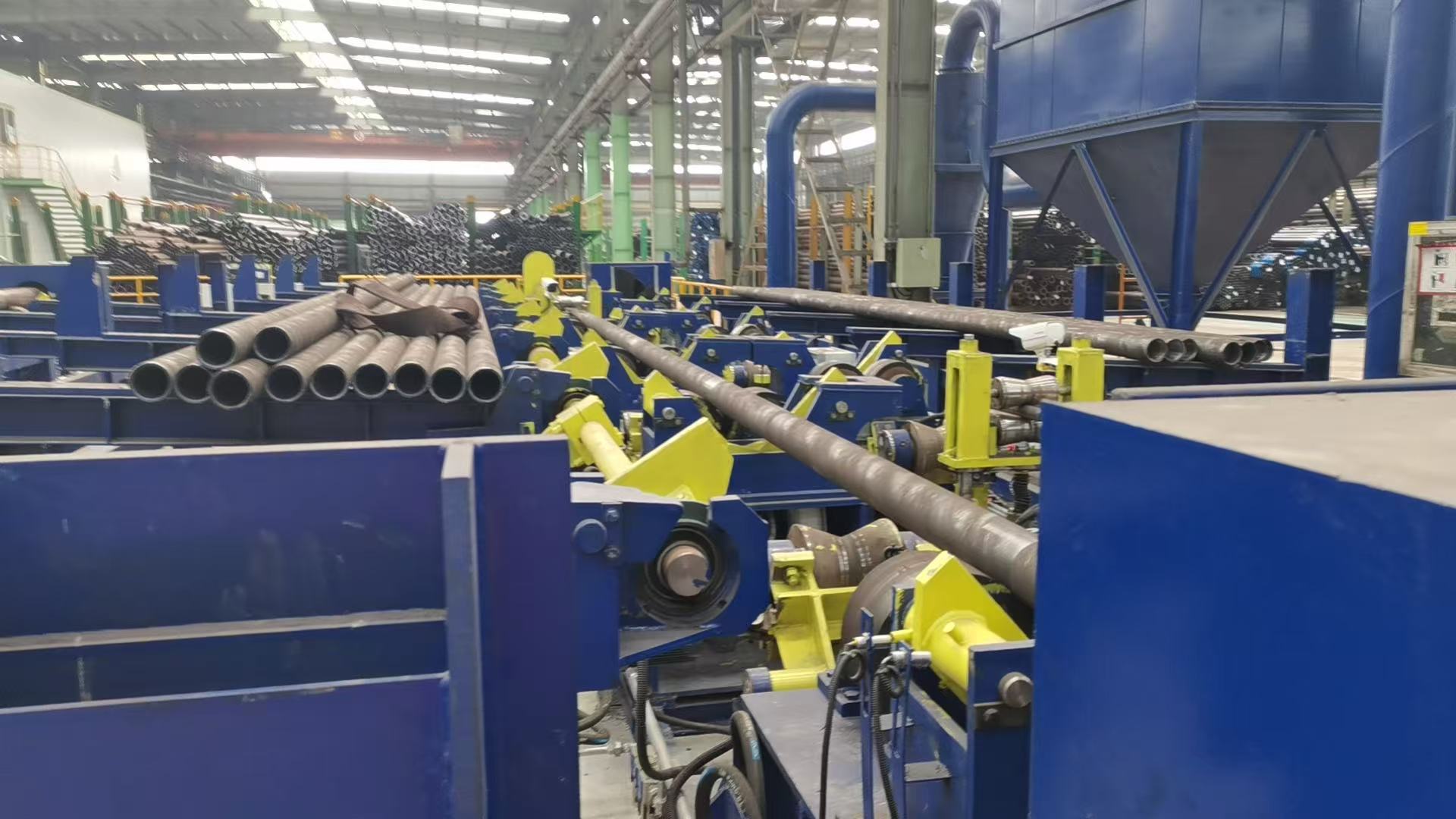
Internal grinding configuration for steel pipe bore finishing. Image: West Machinery.
How West Structures Long-Workpiece Capability
Jiangyin West Machinery Manufacturing Co., Ltd - brand West - is a grinding machine manufacturer based at No. 2222, Zhencheng Road, Jiangyin City, Jiangsu Province, China. The company produces grinding machines, steel pipe grinding machines, round steel grinding machines, internal hole grinding machines and round steel finishing lines, and also manufactures and processes metallurgical special equipment and general equipment with their accessories.
The operating facts are the ones a buyer would normally verify on site. Founded in 2010, West occupies roughly 6,000 m² and employs 78 staff. Three workshops - welding, machining and assembly - sit on the same site, and reported annual output is 300 units. Export accounts for about 70% of business, with main markets in Southeast Asia, the Middle East, Europe and the Americas. Quality management is certified to GB/T19001-2016/ISO9001:2015 under certificate 04624Q14389R0S, issued by Beijing Haide Certification Co., Ltd on 2024-08-23 and valid until 2027-08-22, with a scope covering steel pipe grinding equipment production.
For the specific question in this article, the practical value of that structure is that a buyer can trace where a long-workpiece machine is actually built. The welding, machining and assembly workshops are on one 6,000 m² site, which makes it reasonable to ask which workshop produces the frame and support assemblies for a 6,000 mm configuration, and to request that the answer be given in writing before the order. A supplier that cannot locate the fabrication of its own support structures is unlikely to have engineered them.
Commercially, the terms are stated plainly enough to be checked: OEM production services are available, customization covers voltage, control system, processing range, colour and logo, minimum order quantity is 1 unit, lead time is 20 days, and reported monthly capacity is 30 units. Quality control is based on 100% test standards, acceptance criteria are a pre-shipment test, delivery terms are CIF and payment terms are 30/70. After-sales support is provided remotely, and the manufacturer supports global OEM clients with remote technical support. Enquiries reach the company through www.wstjxcn.com, by email at 348357379@qq.com, or by WhatsApp on +86 15261616622.
A Step-by-Step Supplier Evaluation Protocol
The protocol below converts the five questions into a sequence a procurement team can run in two technical exchanges and one document review. It is written for a line that must process 20–300 mm diameter workpieces at lengths from 500 mm to 6,000 mm.
Step 1 - Fix the workpiece envelope in writing
State the diameter band, the length band, the material families and the required surface roughness in the enquiry itself, rather than leaving the supplier to propose a machine and then checking whether it fits. For this class of equipment the envelope is 20–300 mm diameter, 500–6000 mm length, carbon steel, alloy steel and SS304, at Ra ≤ 0.8 μm. A supplier who responds to the envelope with a configuration rather than a single model number has understood the brief.
Step 2 - Request the support plan before the price
Ask for a drawing or layout showing support positions along the full working length and the adjustment range for each. This is the single most diagnostic document in the whole evaluation, because it cannot be produced retroactively without engineering work.
Step 3 - Request the feed and control architecture
Ask how the 0.5–10 m/min feed range is achieved, how feed is coordinated with the grinding head, and what the control system controls. The control system is also a listed customization item, so the answer should say what changes when the destination plant requires a different control package.
Step 4 - Request the changeover procedure
Ask for the written procedure covering a move from 300 mm pipe to 20 mm bar, including who performs it and how the first part is validated. Time-to-changeover is a throughput variable, and an undocumented changeover is an unmanaged one.
Step 5 - Request the line interface concept
Ask how the machine receives and discharges 6,000 mm workpieces, what upstream and downstream equipment it expects, and what floor space and foundation it requires. Confirm that the plant layout can accommodate the answer before design freeze.
Step 6 - Confirm the electrical and environmental specification
Verify 380V/50Hz three phase, the 5.5–22 kW power range and IP54 protection against the actual site conditions. Where the destination differs, confirm that voltage is treated as an engineering customization and not as an adapter fitted at commissioning.
Step 7 - Verify the documentation package
Check the quality certificate number and its validity period directly, and ask for the safety-relevant information package required under ISO 16089:2025 for a machine integrated into a production line. Where stainless bore finishing is in scope, ask whether the process references ASTM B912.
Step 8 - Verify acceptance and commercial terms
Confirm what the pre-shipment test covers, on what workpiece, and against which roughness value. Confirm MOQ, lead time, delivery terms and payment structure in the same document. A pre-shipment test that is not defined against a measured criterion is a formality rather than an acceptance test.
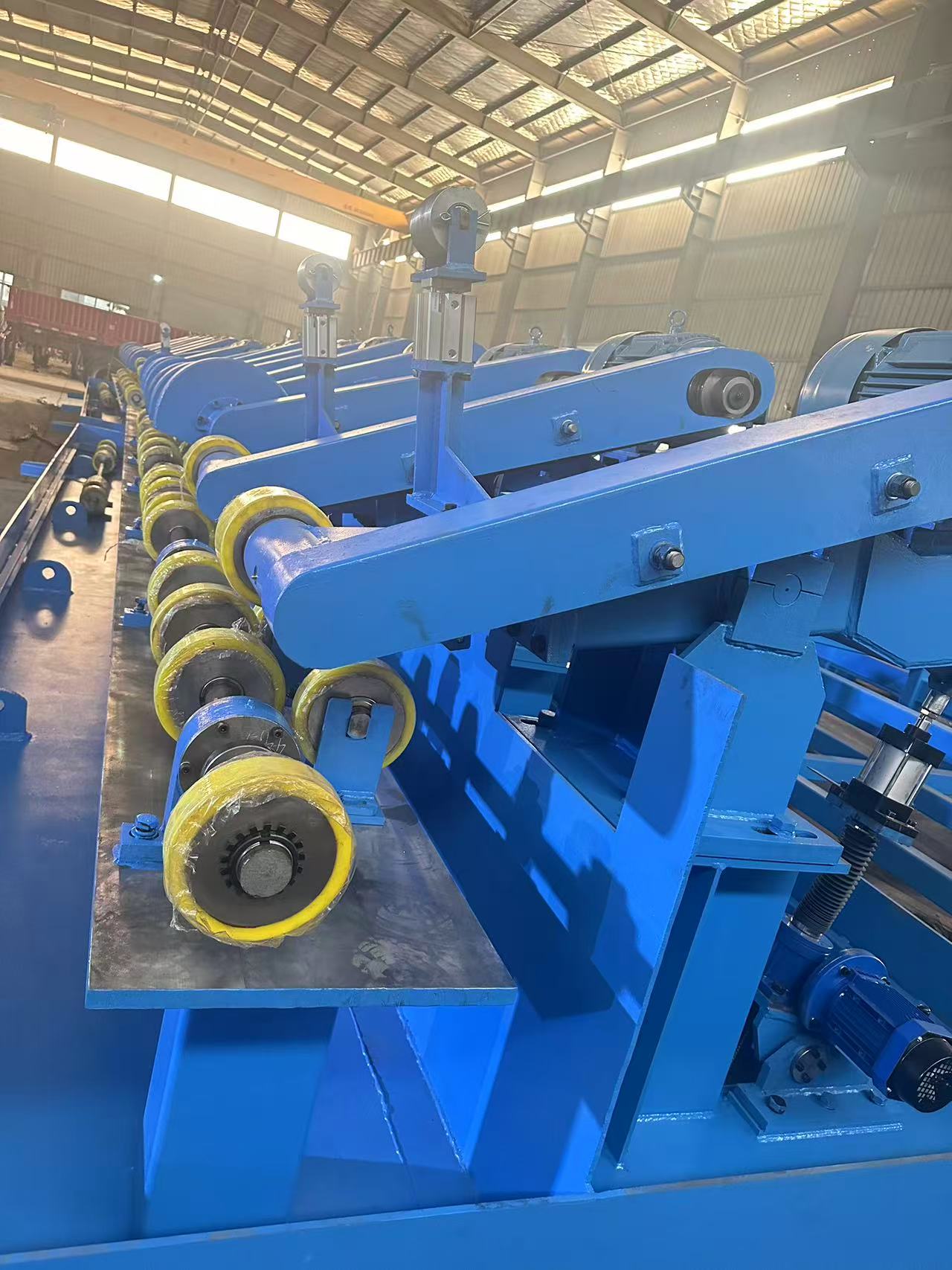
Assembly of grinding machine structures on the manufacturer's site. Image: West Machinery.
Where 6,000 mm Handling Decides the Project: Two Reference Installations
Two company-reported installations illustrate why long-workpiece handling dominates the operating outcome in steel plants rather than in laboratories.
In Indonesia, a steel manufacturing plant has five units deployed for steel pipe and round steel grinding and polishing, in long-term continuous production use. The reported results are consistent product quality and improved processing efficiency, with the equipment described as adaptable to tropical climate conditions and reliable in high-load operation. The handling implication is direct: tropical humidity and sustained load are exactly the conditions under which an under-specified support or feed system degrades first.
In Iran, a steel manufacturing plant has eight units deployed on the same application - steel pipe and round steel grinding and polishing - also in long-term continuous production use. Reported results are stable surface quality and consistent production efficiency, with the equipment adapted to local working conditions.
Read as evidence rather than as a claim, the useful content of these cases is the deployment pattern: multi-unit installations in steel plants, running continuously, on both pipe and round steel. That is the application profile in which handling architecture is tested daily, and it is a reasonable basis for asking a prospective supplier for comparable references on long workpieces - not for assuming that a reference transfers automatically to a 6,000 mm duty cycle.
Capability and Commercial Reference Table
The table below sets the verified machine parameters and commercial terms against the question a buyer should resolve for each. It is a comparison of what is documented versus what must be confirmed in the offer, not a ranking of suppliers.
| Evaluation area | Documented value | What the buyer must confirm |
|---|---|---|
| Workpiece length | 500–6000 mm | Support spacing plan for the full working length |
| Workpiece diameter | 20–300 mm | Written changeover procedure across the full band |
| Surface roughness | Ra ≤ 0.8 μm | Measurement conditions and acceptance method |
| Feed speed | 0.5–10 m/min | Synchronization with grinding head and line speed |
| Power range | 5.5–22 kW | Configuration matched to diameter and material |
| Power supply | 380V/50Hz, 3 phase | Voltage and control customization for destination |
| Protection grade | IP54 | Dust and coolant exposure in the actual plant |
| Materials | Carbon steel, alloy steel, SS304 | Separate parameter set per material family |
| Customization scope | Voltage, control system, processing range, colour, logo | Which items are engineering and which are cosmetic |
| Minimum order quantity | 1 unit | Whether a single unit trial is viable for your line |
| Lead time | 20 days | Alignment with your installation window |
| Monthly capacity | 30 units | Feasibility of multi-unit line orders |
| Quality control | 100% test | Defined pre-shipment test workpiece and criterion |
| Certification | ISO 9001:2015, certificate 04624Q14389R0S, valid 2024-08-23 to 2027-08-22 | Scope covers steel pipe grinding equipment production |
| Delivery and payment | CIF; 30/70 | Incoterm and milestone alignment with your contract |
Frequently Asked Questions
1. What compliance documentation should a grinding machine supplier provide?
Three documents are worth requesting. First, the quality management certificate with a checkable number and validity period: West holds GB/T19001-2016/ISO9001:2015 certification under certificate 04624Q14389R0S, issued by Beijing Haide Certification Co., Ltd, valid from 2024-08-23 to 2027-08-22, with a scope covering steel pipe grinding equipment production. Second, the safety-relevant information package: ISO 16089:2025 requires manufacturers of stationary grinding machines, including machines integrated into automatic production lines or grinding cells, to provide a minimum list of safety-relevant information to the user. Third, where stainless bore finishing is involved, the process reference for internal surfaces: ASTM B912 specifies requirements for electropolishing stainless steel alloys and is the relevant standard for that operation.
2. Can one machine handle both 20 mm and 300 mm diameter workpieces up to 6,000 mm long?
Yes, within a defined configuration. The reference envelope for this class of steel pipe and round steel grinding machine is a processing diameter of 20–300 mm and a processing length of 500–6000 mm, with a surface roughness capability of Ra ≤ 0.8 μm, feed speed of 0.5–10 m/min and a power range of 5.5–22 kW, running on 380V/50Hz three phase with IP54 protection. The operative word is configuration: the diameter range is achieved through support and head adjustment rather than a single fixed setting, and the processing range is itself a listed customization item. Buyers should therefore ask for the changeover procedure and the parameter set for each material - carbon steel, alloy steel and SS304 - rather than accepting the range as a self-evident capability.
3. What are the commercial terms for a single-unit evaluation order?
The stated terms are a minimum order quantity of 1 unit, delivery terms of CIF, payment terms of 30/70, and a lead time of 20 days, with reported monthly capacity of 30 units and OEM production services available. Quality control is based on 100% test standards with a pre-shipment test as the acceptance criterion. Because the MOQ is 1 unit, a single-machine evaluation order is commercially practical before committing to a multi-unit line - which is the preferred sequence when the handling behaviour of a new 6,000 mm configuration has not yet been observed on your own material.
4. What does the acceptance test actually cover?
The stated acceptance criterion is a pre-shipment test, supported by 100% test quality control. For evaluation purposes, the test only becomes meaningful once three details are fixed in the purchase documents: the workpiece used (diameter, length and material from the 20–300 mm, 500–6000 mm, carbon steel / alloy steel / SS304 envelope), the measurement method and the roughness criterion, which should be stated explicitly as Ra ≤ 0.8 μm where that target applies. A pre-shipment test defined this way converts the surface quality claim into a verifiable condition and gives the buyer a documented baseline for on-site commissioning.
5. How should a buyer start an evaluation of a 6,000 mm configuration?
Start with the envelope and the support plan rather than the price. State the diameter band, length band, material families and roughness target, then request the support layout, feed and control architecture, changeover procedure and line interface concept in the first exchange. West Machinery - Jiangyin West Machinery Manufacturing Co., Ltd - accepts enquiries through www.wstjxcn.com, by email at 348357379@qq.com and by WhatsApp on +86 15261616622, and can respond to a written envelope with a configuration, a lead time of 20 days and a pre-shipment acceptance proposal. Sending the envelope first keeps the technical conversation in the order that matters: handling, then process, then commercial terms.
Conclusion
The test of a supplier for long-workpiece grinding is not whether the specification sheet contains a 6,000 mm figure. It is whether the supplier can explain, in documents rather than adjectives, how that length is supported, how the feed is held constant along it, how the machine moves between a 20 mm bar and a 300 mm pipe, how the workpiece enters and leaves the machine, and how the installed unit is proven against Ra ≤ 0.8 μm before shipment.
Those five questions, applied in the sequence set out above, separate a machine quotation from a line-integration proposal. The supporting evidence is checkable: a support plan, a changeover procedure, a configuration list covering voltage, control system and processing range, a quality certificate with a number and a validity date, and an acceptance test defined against a measurable criterion. A supplier that can supply all five understands 6,000 mm handling. One that can supply only the length figure has supplied a bed size.
Send Your Workpiece Envelope First
Share your diameter band, length band, material and roughness target, and West Machinery will respond with a configuration, a support and changeover plan outline, and a pre-shipment acceptance proposal - with a stated lead time of 20 days and MOQ of 1 unit.
Request a Technical Evaluation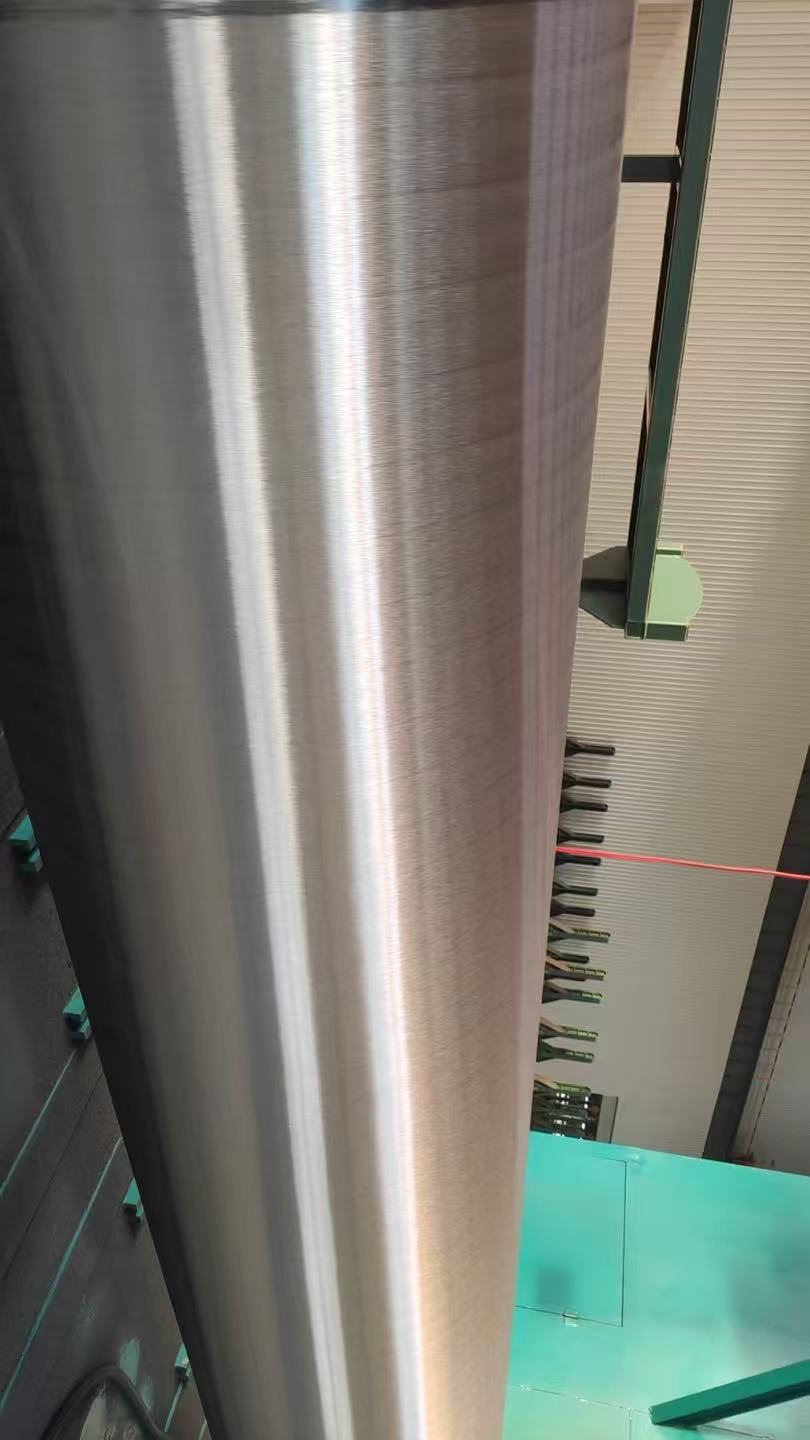
Grinding machine prepared for export shipment. Image: West Machinery.
Have Questions or Need More Details?
Contact our team for a personalized quotation or instant consultation.
Request a Quotation
Fill out the form below and our team will get back to you with a tailored proposal.
WhatsApp Direct Chat
Prefer to chat in real-time? Message us on WhatsApp for instant assistance & quick answers.
- Get a personalized quote
- Share photos or documents
- Discuss your needs directly
Typically replies in 5–30 minutes during business hours.