
Compliance Beyond Certificates: Matching Control Pendant Voltage, IP and Site Conditions
A pendant control station can carry every document a procurement file asks for and still fail in service. Certificates describe a product; failures happen where the product meets the site. This guide reframes compliance as a matching exercise — voltage against the control circuit, IP rating against dust and water exposure, ambient limits against the building or yard — using the COP-5MSS-DD push button pendant and the YJ02-02 electric chain hoist as a reference setup.
The short answer: four matching checks before any certificate is filed
Compliance for an industrial pendant control comes down to four checks, and they must all pass before a certificate has any practical meaning. First, the rated voltage and current of the pendant must sit correctly with the site supply and the hoist control circuit. Second, the IP rating must cover the dust, water and rain exposure at the actual mounting position. Third, the ambient temperature and humidity envelope must contain the real working environment. Fourth, the declared operating exclusions must match what is present in the air around the equipment.
The COP-5MSS-DD control pendant is rated AC 500V / 10A with IP65 protection and an operating ambient range of −25°C to +40°C at up to 90% relative humidity. It is a wired, 5-button handheld station with an emergency stop button. Its specified operating environment excludes explosive media and corrosive gases or liquids. If any one of the four checks fails, no document closes the gap — the pendant is simply the wrong part for that site.
Problem definition: why a certificate checklist misses most field failures
During the Evaluation stage, most procurement teams ask a binary question: is it certified? That question is easy to answer and easy to file. It is also the wrong question, because the majority of real-world mismatch problems occur with a correctly certified product installed in conditions it was never rated for.
Mismatch one: voltage and current are two different conversations
The AC 500V / 10A figure on the COP-5MSS-DD describes the switching capability of the pendant contacts. The control voltage of the equipment it drives is a separate layer. On the YJ02-02 electric chain hoist, the mains voltage range is 110–480V with 3/2 phases, while the control voltage is 24–48V. A buyer who reads only the pendant rating and only the hoist mains rating may never check the control-voltage layer in between — which is the layer that determines how the operator's button presses are actually interpreted by the hoist control system.
Mismatch two: IP65 is a boundary, not a guarantee
IP65 is often read as a general promise of weather resistance. In practice, IP65 describes protection against dust ingress and against water projected as a jet — it is not a statement about immersion, and it is not a statement that rain will never enter a pendant that hangs unshielded at an outdoor dock over years of cable flex and gasket ageing. The rating defines the envelope; installation practice determines whether the site stays inside it.
Mismatch three: ambient limits are frequently ignored
The COP-5MSS-DD is rated for −25°C to +40°C at up to 90% relative humidity. A cold store, a foundry bay, a roof-level crane runway in summer, or an unheated yard in winter can each sit outside that envelope. These are not rare locations — they are common industrial environments, and they are exactly where a certificate-first selection process produces a failure that no one predicted.
Mismatch four: the operating exclusions
The stated operating environment for this pendant excludes explosive media and corrosive gases or liquids. That single sentence removes plating lines, solvent wash-down areas, chemical processing zones and any classified atmosphere from the scope, regardless of how well the voltage and IP ratings appear to line up. Buyers should read exclusions as part of the specification, not as legal boilerplate.
The practical conclusion is that a certificate is a necessary input and an insufficient one. It tells you the product passed a defined test regime. It does not tell you that your site sits inside the envelope that regime assumed.
Industry background: a mature category with a definition problem
Pendant crane control stations are a mature, fragmented category, and the way market data is defined matters as much as the numbers themselves. According to Future Data Matrix, the global market for pendant crane control stations was valued at approximately USD 275.60 million in 2025 and is projected to reach USD 423.80 million by 2032, a CAGR of 5.1%. The broader pendant control mechanical switch category was valued at USD 722.5 million in 2025 in the Pendant Control Mechanical Switch Market Report. The gap between those two figures reflects category scope rather than contradiction: one counts crane-specific control stations, the other counts a wider mechanical switch definition. Buyers reading market claims should always check which definition is being used.
Regionally, North America held a 34.2% share of the pendant crane control station market in 2025. On the supplier side, the Global Push Button Pendant Control Station Market Research Report 2026 lists Schneider Electric, Eaton, Siemens, ABB and Rockwell Automation among the leading manufacturers, and Schneider Electric is reported to hold a 15% share of the low-voltage equipment market as of 2024. At the standards level, industrial pendant controllers are expected to comply with safety standards such as IEC 60947-5-1 and EN 60947-5-1 for low-voltage switchgear and controlgear.
That standards layer is a floor, not a site assessment. Conformity to a switchgear standard tells a buyer that the device belongs in a controlled category of products. It does not tell the buyer whether a specific pendant suits a specific crane, in a specific building, in a specific climate. Site matching is the buyer's half of the compliance job, and it is the half that certificates cannot perform.
WILMALL is the brand of Wenzhou Mofan Electric Technology Co., Ltd., a manufacturer and one-stop B2B supplier of industrial automation and power distribution components based in Wenzhou, Zhejiang Province, China. The company operates as a manufacturer, supplier, wholesaler and OEM/ODM factory, with a 2,000 m² facility, an annual output of 200,000 units and a three-engineer R&D team. It reports more than eight years of industry experience and more than 500 customers across 30+ countries and regions, with an export ratio of 80% and main markets including Australia, Pakistan, Korea and Malaysia. WILMALL states that its products comply with international certifications such as CE, UL and RoHS, and it supports buyers through selection, customization and after-sales service rather than product supply alone.
The reference setup: COP-5MSS-DD paired with the YJ02-02 electric chain hoist
Using a single reference pairing makes the matching logic concrete. The COP-5MSS-DD and the YJ02-02 electric chain hoist are designed to work as an operator interface and a load-handling machine, and the verified specifications of each define the boundaries of a compliant installation.
COP-5MSS-DD control pendant — verified specification
- Product type: control pendant station, push button pendant, handheld
- Button layout: 5-button station with an emergency stop button
- Rated voltage and current: AC 500V, 10A
- Enclosure material: plastic
- Ingress protection: IP65
- Ambient range: −25°C to +40°C, up to 90% relative humidity
- Application: cranes, hoists, lifting equipment and industrial control systems
- Operating exclusions: no explosive media, no corrosive gases or liquids
YJ02-02 electric chain hoist — verified specification
- Type: electric chain hoist
- Capacity: 2000 kg
- Lifting height: 4 m
- Lifting speed: 4 m/min
- Power: 1.1 kW, rotation speed 1440 r/min
- Phases: 3/2; voltage: 110–480V
- Control voltage: 24–48V
- Weight: 45/48 kg; rating: M5
- Construction: high-performance motor combined with a reducer and a compact electronic control system
- Applicable industries: manufacturing, logistics and warehousing, construction engineering, mining, metallurgy, port transportation, nuclear power and aviation
The pairing works because the two devices sit on the same control chain. The pendant carries an AC 500V / 10A contact rating, which describes how much switching duty the button contacts can handle. The hoist runs a 24–48V control voltage, which is the level the pendant actually switches when an operator presses a button. Between them sits the load: 2000 kg on a 4 m lift at 4 m/min, driven by a 1.1 kW motor and rated M5 for duty classification.
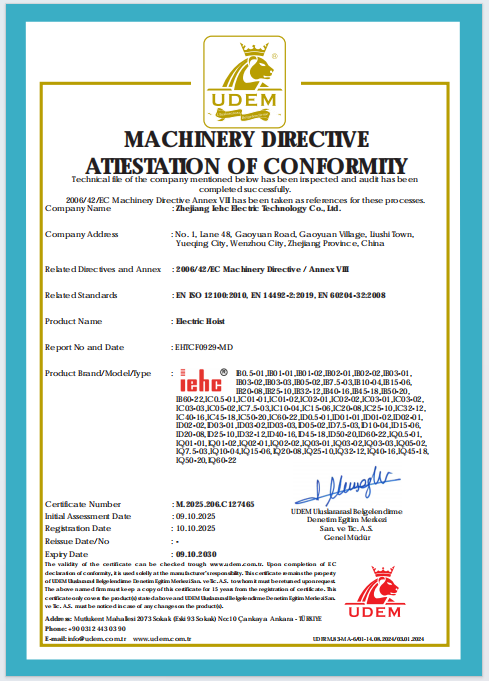
There is also a compliance document attached to this setup. A Machinery Directive Attestation of Conformity, certificate number EHTCF0929-MD, was issued by UDEM for an electric hoist, citing EN ISO 12100:2010, EN 14492-2:2019 and EN 60204-32:2008, with a validity period from 2025-10-09 to 2030-10-09 and a stated market of Turkey. Read carefully, that document illustrates the point of this article. It is a strong conformity signal for a defined scope and a defined market — and it does not, by itself, tell a buyer in another country or another environment that the assembly matches their site. Documentation establishes category legitimacy; the site matching exercise establishes fit.
Step-by-step: matching the pendant to real site conditions
The following sequence can be used as a pre-purchase checklist for any crane, hoist, workshop or warehouse installation. It is written around the COP-5MSS-DD and YJ02-02 pairing, but the logic applies to any pendant control station procurement.
Step 1 — Map the supply and the control circuit separately
Record the mains voltage and phase configuration of the hoist or crane, and then record the control voltage separately. For the YJ02-02, that means 110–480V mains with 3/2 phases, and a 24–48V control voltage. Confirm that the pendant's control-voltage assumption matches the hoist control circuit before discussing any other specification. A pendant rated AC 500V / 10A is not automatically a match for every control circuit — the rating describes contact capability, not circuit compatibility.
Step 2 — Define the physical exposure at the mounting position
Walk to where the pendant will actually hang. Indoor workshop at waist height, outdoor gantry crane at dock level and a wash-down area in a warehouse are three different IP conversations. IP65 covers dust ingress and projected water jets. It does not cover immersion, and it does not replace installation discipline around cable entry, strain relief and gasket condition.
Step 3 — Check the ambient envelope against the building, not the season
The rated range is −25°C to +40°C at up to 90% relative humidity. Compare this against the worst realistic condition at the installation point, including radiant heat from process equipment, unheated winter conditions in an open yard, and summer roof-level temperatures on a crane runway. If the site exceeds the envelope even occasionally, the pendant is out of specification for those periods.
Step 4 — Screen for excluded media
Confirm there are no explosive media and no corrosive gases or liquids in the operating area. This is a hard exclusion on the COP-5MSS-DD. In practice it removes chemical processing, plating and aggressive solvent environments from scope, and it should be verified with the site safety or process owner rather than assumed from a general building description.
Step 5 — Confirm operator functions and emergency stop requirement
The base configuration is a 5-button handheld station with an emergency stop button. Confirm the number of motions the operator must control, and whether a push-lock emergency stop is required by the site risk assessment. Available customization on this product family covers contact point material (silver or copper), button function including an emergency braking button, number of buttons (2, 4, 6 or 8) and button speed (single or dual speed), which allows the station to be aligned with the actual control scheme rather than the reverse.
Step 6 — Verify document scope, market and validity
Record the certificate number, the issuing authority, the standard references, the validity dates and — critically — the market the document was issued for. A document valid from 2025-10-09 to 2030-10-09 for one market does not automatically transfer to another. Buyers should ask the supplier to state clearly what the document covers and what it does not.
Step 7 — Validate with a physical sample before volume commitment
WILMALL operates an OEM/ODM model with a minimum order quantity of 5 units, a monthly capacity of 2,000 units, a standard lead time of 15 working days and 100% testing in production. A minimum order quantity at that level allows a buyer to validate a configuration on the real crane or hoist, under real site conditions, before committing to a larger program. Remote technical support is provided after delivery.
Use cases: cranes, hoists, workshops and warehouses
Overhead and gantry cranes in workshops
In a workshop crane application, the dominant matching factors are usually control voltage consistency and operator ergonomics. The 5-button layout with emergency stop maps naturally onto travel, cross-travel and hoist motions, and the ambient range fits typical enclosed manufacturing halls. The binding constraint in this scenario is rarely the pendant — it is the accuracy of the control-circuit documentation provided at the quotation stage.
Electric chain hoist stations and lifting points
With the YJ02-02, the pendant is the operator's only interface with a 2000 kg, 4 m lift running at 4 m/min. At that load and speed, a mismatched or poorly matched control station is not an inconvenience — it is a safety-relevant mismatch. Buyers pairing a pendant with this hoist should verify the 24–48V control voltage layer explicitly and confirm the emergency stop configuration against the site risk assessment.
Warehouses and logistics operations
In warehousing, logistics and port-adjacent operations — all listed as applicable industries for the YJ02-02 — the pendant is exposed to a different risk profile: high cycle counts, frequent handling, dust, and in some layouts, open doorways. The M5 duty rating of the hoist and the IP65 enclosure rating of the pendant are the two numbers that should drive the selection, together with humidity, since the pendant is rated to 90% relative humidity and warehouses can approach that in humid climates without any visible water.
An Australian reference installation
A verified reference case comes from an RV factory in Australia, which applied the COP-5MSS-DD control pendant to control devices. The installation used 10 units and has been in stable operation for one year, with ease of use reported as the key highlight. For Australian buyers evaluating the same product family, that case is useful less as a sales claim and more as evidence that the configuration survives a real multi-unit deployment rather than a single test unit.
Regional requirement discussions in Australia commonly focus on documentation scope, site conditions and the transferability of conformity evidence. The practical guidance is the same as anywhere else: map each document to the project file, confirm the market it was issued for, and match the ambient and IP envelope to the actual site. For buyers running humid or coastal installations, the 90% relative humidity limit and the IP65 rating deserve explicit attention, because those are the conditions most likely to be underestimated at the quotation stage.
Comparison table: site condition versus verified pendant data
The table below converts the matching exercise into an auditable format. Every value in the right-hand columns comes from the verified product data for the COP-5MSS-DD; nothing in the table is inferred.
| Site condition to match | What must agree | COP-5MSS-DD verified value | What the buyer must confirm |
|---|---|---|---|
| Contact / switching duty | Rated voltage and current of the pendant | AC 500V, 10A | Actual load and switching frequency on site |
| Control circuit level | Pendant control voltage versus hoist control voltage | Paired reference hoist (YJ02-02) control voltage: 24–48V | Exact control voltage of the specific hoist or crane |
| Dust and water exposure | Ingress protection at mounting position | IP65 | Mounting height, cable entry sealing, jet or spray exposure |
| Ambient temperature | Operating temperature range | −25°C to +40°C | Worst-case site temperature including radiant heat |
| Humidity | Relative humidity tolerance | Up to 90% | Seasonal peaks in humid or coastal sites |
| Atmosphere — explosive media | Operating exclusion | Excluded | Classification of the area by site safety owner |
| Atmosphere — corrosive gases or liquids | Operating exclusion | Excluded | Presence of chemicals, solvents or plating vapors |
| Operator functions | Button count and emergency stop | 5-button station with emergency stop | Required motions and risk-assessment E-stop type |
| Configuration flexibility | Available customization | Contacts in silver or copper; 2, 4, 6 or 8 buttons; single or dual speed; emergency braking button option | Which configuration matches the existing control scheme |
A second reference table assembles the third-party market and standards data used in this article, so that each figure can be traced to its source.
| Reference data point | Value | Source |
|---|---|---|
| Pendant crane control station market size, 2025 | USD 275.60 million | Future Data Matrix |
| Projected market size, 2032 | USD 423.80 million at 5.1% CAGR | Future Data Matrix |
| Pendant control mechanical switch market, 2025 | USD 722.5 million | Pendant Control Mechanical Switch Market Report |
| Leading region, 2025 | North America, 34.2% share | Future Data Matrix |
| Listed leading manufacturers | Schneider Electric, Eaton, Siemens, ABB, Rockwell Automation | Global Push Button Pendant Control Station Market Research Report 2026 |
| Low-voltage equipment market share, 2024 | Schneider Electric, 15% | Accio / Pestel-Analysis |
| Applicable switchgear and controlgear standard | IEC 60947-5-1 / EN 60947-5-1 | Schneider Electric / Perfect Corp |
Frequently asked questions
Does IP65 make a pendant control station suitable for outdoor crane use?
IP65 on the COP-5MSS-DD means the enclosure is protected against dust ingress and against water projected as a jet. It does not mean the pendant can be submerged, and it does not by itself guarantee that rain will never enter through a cable entry, a worn gasket or a damaged seal over years of service. For outdoor or dock-side positions, buyers should treat IP65 as the enclosure envelope and then confirm mounting orientation, cable gland sealing and mechanical protection separately. The operating exclusions also apply: the pendant is specified for environments without explosive media and without corrosive gases or liquids, so a chemically active wash-down area is out of scope even if it is not especially wet.
Can the COP-5MSS-DD be configured with a different button layout or contact material?
Yes. WILMALL offers OEM/ODM customization on this product family. Available options include contact point material in silver or copper, button function including an emergency braking button, number of buttons in 2, 4, 6 or 8, and button speed in single or dual speed. The base COP-5MSS-DD is a 5-button handheld station with an emergency stop button. Customization exists so that the station can be aligned to an existing control scheme instead of forcing the control scheme to change.
What determines the cost and order economics of a pendant configuration?
Cost is driven by configuration, not by the model number alone. The variables that change the build are the number of buttons, the contact point material (silver or copper), whether an emergency braking button or other special function is required, and whether single or dual speed operation is specified. The paired hoist matters too: the YJ02-02 runs a 2000 kg capacity at a 4 m lifting height with a 1.1 kW motor, a 110–480V supply and a 24–48V control voltage, and the pendant must match that control layer. On order economics, WILMALL works with a minimum order quantity of 5 units, a monthly capacity of 2,000 units and a standard lead time of 15 working days. Because configuration and quantity both move the commercial terms, specific pricing is quoted per project rather than published as a list price.
How can a buyer validate a pendant against site conditions before committing to full production?
Validation is normally done in three layers. First, compare the documented ratings — AC 500V / 10A, IP65, −25°C to +40°C, up to 90% relative humidity, and the operating exclusions — against the measured site conditions. Second, confirm the control voltage layer against the actual hoist or crane. Third, physically test a configuration on site before scaling up. A minimum order quantity of 5 units makes a validation batch practical, and production is 100% tested. A verified reference for this approach is an RV factory in Australia that applied 10 units of the COP-5MSS-DD to control devices and has reported stable operation over one year, with ease of use as the main highlight. Remote technical support is available to buyers during and after validation.
What is the typical lead time, and how is supply continuity supported?
The standard lead time is 15 working days, supported by a monthly production capacity of 2,000 units, which allows repeat orders and framework supply arrangements to be planned without long gaps. WILMALL exports 80% of its output, with stated main markets including Australia, Pakistan, Korea and Malaysia, and listed export markets for this product family covering Australia, Pakistan and South Korea. After-sales support is delivered through remote technical support. Buyers who want to start the matching exercise can review the product range at wilmall.com, download the catalog, or send the site conditions — voltage, control voltage, IP exposure, ambient range and any excluded media — to sales@wilmall.com for a configuration and quotation, or contact the team directly on WhatsApp at +86 19730226757 to request a sample plan. Requests are answered with a configuration proposal rather than a generic price list, because the whole point of this article is that the configuration is what determines compliance.
Conclusion: the certificate opens the door, the site decides
Compliance in pendant control selection is not a document check. It is a sequence of matches: the AC 500V / 10A contact rating against the real switching duty, the 24–48V control layer against the actual hoist circuit, IP65 against the dust and water exposure at the mounting point, the −25°C to +40°C and 90% humidity envelope against the building or yard, and the operating exclusions against the materials present in the air. The COP-5MSS-DD paired with the YJ02-02 electric chain hoist gives buyers a concrete reference for running that sequence, and the verified Australian installation shows that the logic holds up in multi-unit, real-world deployment.
Used this way, certificates stop being the end of the evaluation and become what they were always meant to be: one input among several. The buyer who maps voltage, IP, ambient and exclusions before placing an order is the buyer who does not discover a mismatch after commissioning.
Send your site conditions, get a matched configuration
Share the supply voltage, control voltage, mounting environment, ambient range and any excluded media at your site. WILMALL will respond with a matched COP-5MSS-DD configuration, a sample plan and a quotation. Minimum order quantity 5 units, standard lead time 15 working days, 100% production testing, remote technical support after delivery.
Website: wilmall.com · Email: sales@wilmall.com · WhatsApp: +86 19730226757 · Catalog: download the WILMALL product brochure (PDF)
Have Questions or Need More Details?
Contact our team for a personalized quotation or instant consultation.
Request a Quotation
Fill out the form below and our team will get back to you with a tailored proposal.
WhatsApp Direct Chat
Prefer to chat in real-time? Message us on WhatsApp for instant assistance & quick answers.
- Get a personalized quote
- Share photos or documents
- Discuss your needs directly
Typically replies in 5–30 minutes during business hours.