
Control Pendant FAQ: Purchasing Terms, Acceptance Criteria and After-Sales Support
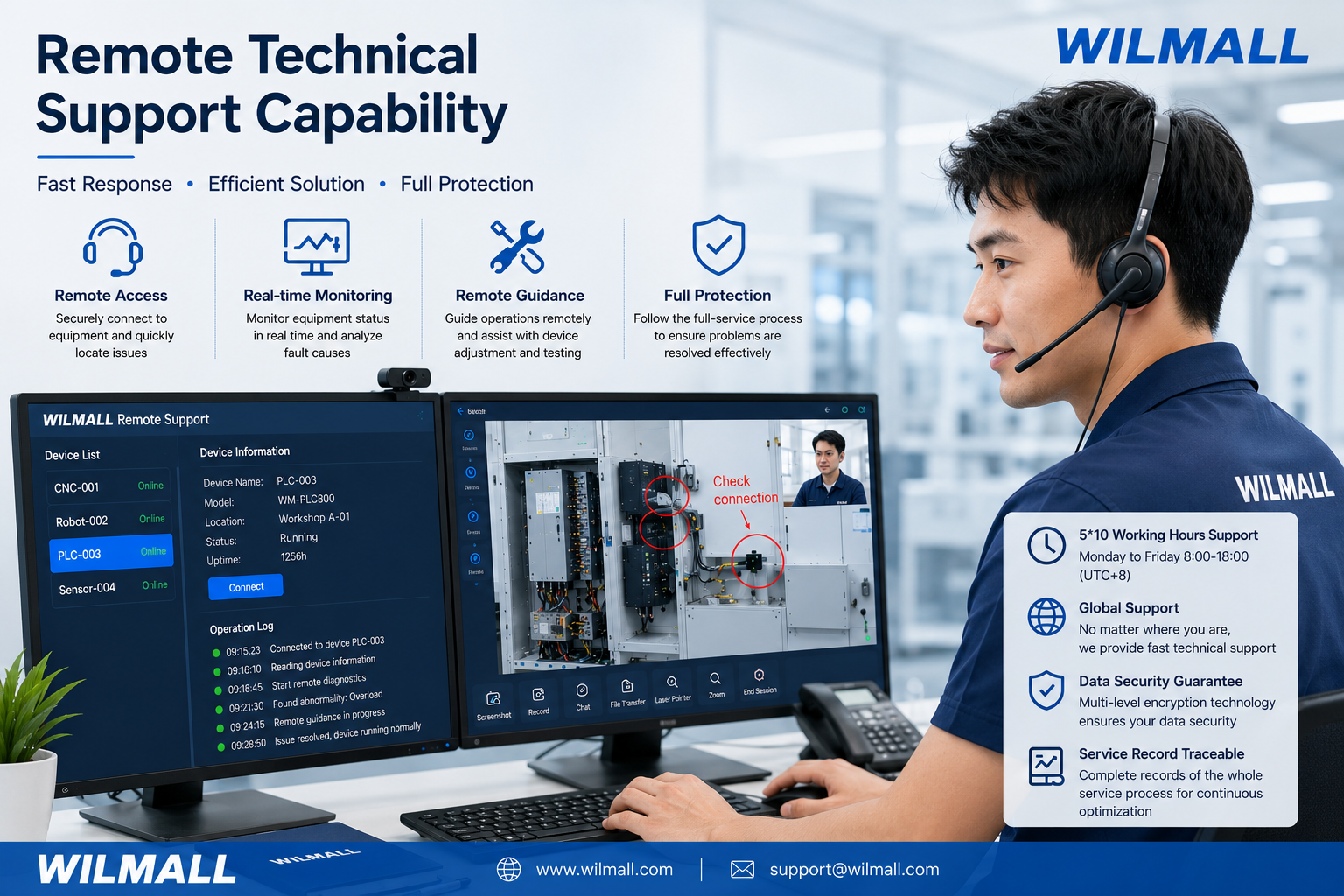
Remote technical support is the after-sales route for COP-5MSS-DD buyers: faults are narrowed down by description, photographs and meter readings rather than by waiting for a site visit.
A COP-5MSS-DD control pendant order is placed on a minimum order quantity of 5 units, delivered DAP, accepted against a pre-shipment test, and settled on T/T 100% payment terms. Standard lead time is 15 working days against a monthly capacity of 2,000 units, and remote technical support is provided after shipment. This FAQ explains what each of those terms means in practice, how to inspect a shipment when it arrives, and how to plan maintenance and spare parts so that a wired pendant stays a low-risk line item for years.
The questions below are the ones that typically surface after the first quotation — when a distributor or an industrial buyer has a price in hand and now has to turn it into a purchase order, an acceptance record and a service plan. It is written for buyers of a control pendant used on cranes, hoists and lifting equipment, and it deliberately avoids promises that cannot be documented.
Quick answers
- Purchasing terms: MOQ 5 units, delivery DAP, payment T/T 100%.
- Acceptance criteria: pre-shipment test, supported by 100% testing of all products.
- Product baseline: 5-button handheld station with emergency stop, AC 500V / 10A, plastic enclosure, rated IP65, operating range -25°C to +40°C.
- Delivery and service: 15 working days lead time, 2,000 units monthly capacity, remote technical support after shipment.
Why the Hard Questions Arrive After the Quote
A quotation answers the price question and very little else. What it usually leaves open are the five points that determine whether a purchase is repeatable or a one-off:
- Which payment, delivery and minimum-order terms are fixed, and which are renegotiated for every order.
- Who performs the acceptance test, at which point in the process, and which document proves it was done.
- What the buyer is expected to check when the carton is opened, and within what window.
- Which parts wear on a pendant station, how they are identified, and whether they can be restocked quickly.
- Who answers technical questions in year three of the relationship, and through which channel.
For a pendant control station that is used daily on a crane, an unresolved answer to any one of these turns a low-cost component into an operational risk. Those costs never appear on the invoice. They appear as unplanned downtime, as an operator standing beside a hoist pendant control that will not respond, and as a purchasing team explaining why the same cable failure recurred for the third time.
The reverse is also true. When terms, acceptance and support are agreed in writing before the first shipment, the pendant stops being a procurement risk and becomes a predictable consumable with a known replacement rhythm — which is exactly what a distributor needs in order to resell it confidently.
Market Context and the Standards Behind a Pendant Station
Published market coverage for the push button pendant control station segment valued the global market at USD 1.02 billion in 2025 and projects it to reach USD 1.48 billion by 2034, a CAGR of 4.1%. The same coverage reports that the top five players held over 45% of that market in 2025. For a buyer, that concentration is less a ranking exercise than a documentation exercise: a long tail of suppliers competes for the same applications, and the practical difference between them is how clearly they state terms, test criteria and support routes.
Two reference points sit behind almost every crane pendant station purchase:
- IEC 60947-5-1:2024 is the current edition of the international standard for electromechanical control circuit devices and switching elements — the family that includes pendant switches, push button elements and their contact assemblies.
- HS code 8537.10 (boards, panels and consoles for electric control, for a voltage not exceeding 1,000 V) or HS code 8536.50 (other switches) is the classification typically used when industrial pendant control stations are declared for customs.
Neither reference replaces a supplier's own documentation, but both give a distributor a way to frame the first meeting: does the product sit inside a recognised control-device standard, and will the customs classification on the commercial invoice match what the buyer declares on import? Those two questions, asked early, prevent most of the administrative problems that appear later.
The COP-5MSS-DD: What the Specification Actually Covers
The COP-5MSS-DD is a push button pendant — a five-button handheld control station with an emergency stop, rated AC 500V and 10A, supplied in a plastic enclosure. It is specified for crane, hoist, lifting equipment and general industrial control systems. Those four lines are the whole commercial identity of the part, and every question in this FAQ traces back to one of them.
Button layout and electrical rating
Five buttons on a handheld body let the operator hold the station in one hand and control the motion functions with the thumb, while the emergency stop gives a single unambiguous action that removes power from the controlled circuit. The AC 500V / 10A rating defines the electrical envelope the station is built to switch and determines what it can be paired with downstream — a contactor coil circuit, an interposing relay, or a drive control terminal.
In practice, buyers should confirm the actual coil current of the contactor in their panel before commissioning rather than assuming the pendant rating is the operating current. A pendant rated for 10A is not an instruction to run 10A through it continuously; it is the ceiling of the switching duty the contact blocks are built for.
Protection and temperature range
The station is rated IP65, which covers dust-tight enclosure entry and protection against water projected by a nozzle. The specified operating range is -25°C to +40°C. That range suits most indoor crane bays, outdoor yard cranes in temperate climates, and unheated warehouses.
It is equally important to know where the range stops. A pendant mounted close to a heat source, inside a furnace bay, or in a refrigerated store held below -25°C sits outside the stated envelope, and the honest answer is to review the mounting position before ordering rather than to expect the enclosure to compensate. Buyers who check the ambient temperature at the operator's standing position — not at the panel — avoid most environmental failures.
Configuration options that change the build
Customisation is available across four dimensions, and each one moves the part away from the catalogue baseline: contact point material (silver or copper), button function (including an emergency braking button), number of buttons (2, 4, 6 or 8), and button speed (single speed or dual speed). The catalogued layout is the five-button station; the 2, 4, 6 and 8 button counts are built to order.
OEM and ODM production services are available from the manufacturer, with a minimum order quantity of 5 units. For a distributor, this is the point at which the order stops being a stock item and becomes a configured part, so the configuration should be frozen in writing before the purchase order is issued — not confirmed by telephone after production has started.
Why a wired pendant keeps maintenance predictable
A wired pendant carries its signals through a cable to a contactor panel. That architecture reduces maintenance to three physical items: the cable and its strain relief, the button elements and contacts, and the contactor the pendant drives. There is no radio pairing to re-establish, no channel assignment to log, no battery to schedule and no firmware state to recover after a power interruption. A technician with a multimeter can trace a fault from button to terminal in a defined sequence.
The trade-off is physical and should be stated plainly: the cable limits travel distance and takes mechanical wear at the strain relief and at the festoon or trolley guide. Cable replacement is therefore the most predictable maintenance item on the whole assembly — and predictable is exactly what a long-term supply agreement needs, because it can be planned, stocked and budgeted instead of discovered mid-shift.
From Quote to Commissioning: A Six-Step Breakdown
Step 1 — Fix the commercial terms in writing
Confirm the four commercial parameters on the order confirmation, not in an email thread: minimum order quantity of 5 units, delivery terms DAP, acceptance criteria defined as a pre-shipment test, and payment terms T/T 100%. If the buyer's finance department requires a different payment structure, that should be settled before production slotting, because it changes the order sequence rather than the product.
Step 2 — Freeze the configuration before the PO
Write down the button count, button speed, button function and contact point material in the purchase order text. A configured pendant that is built to a verbal specification is the most common source of dispute in this category, and the fix costs nothing at the quotation stage.
Step 3 — Agree what the acceptance record will contain
The stated acceptance criterion is a pre-shipment test, supported by 100% testing of all products. Ask for the test record to travel with the shipment, and agree in advance what it should show: model reference, button function verification, and the identity of the unit tested. A record that cannot be matched to a carton is not an acceptance record.
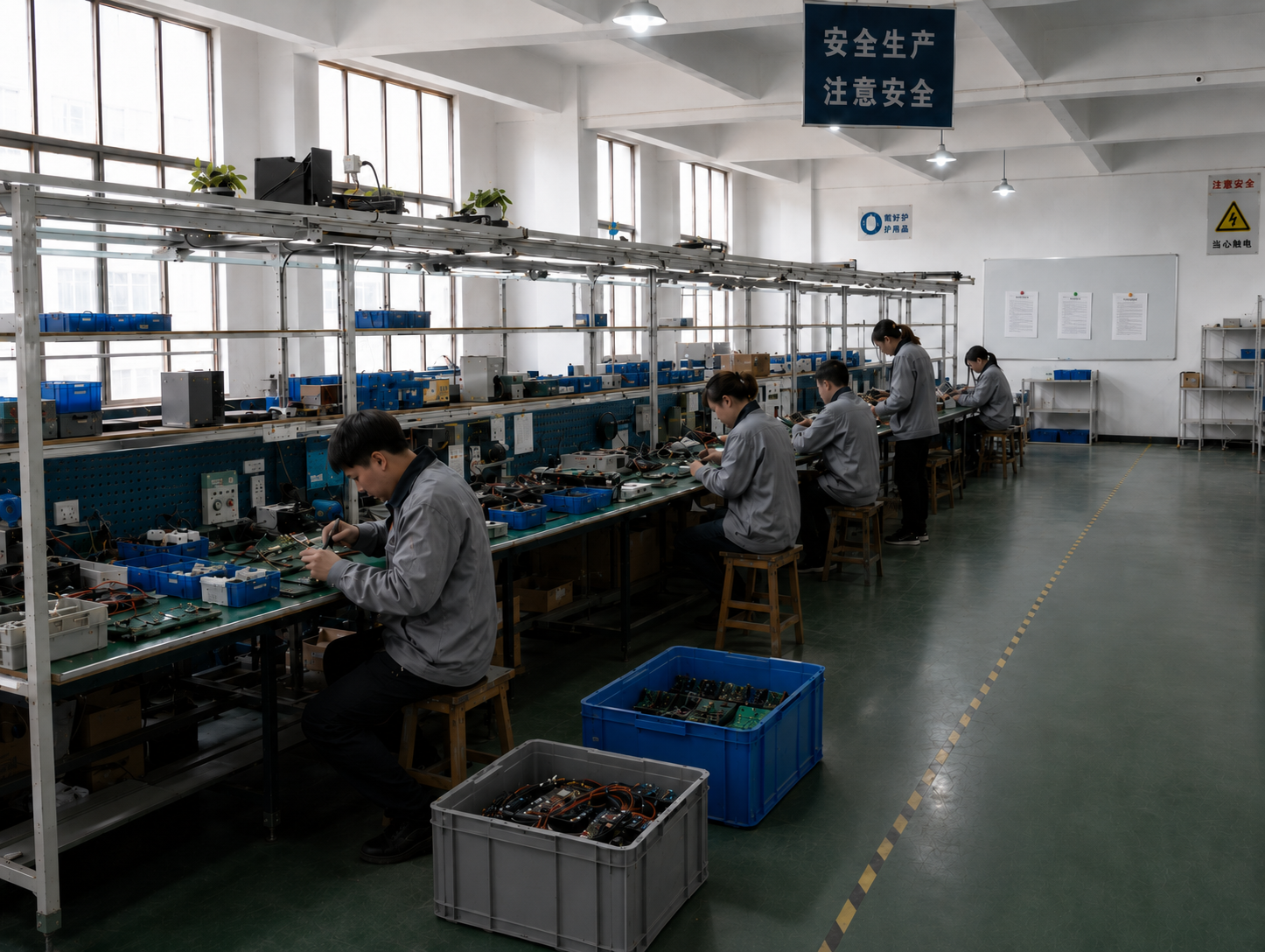
100% testing is applied to all products; the pre-shipment test is the acceptance record the buyer receives with the order.
Step 4 — Inspect the shipment on arrival
Incoming inspection does not need a laboratory. It needs fifteen minutes, a multimeter and a checklist that is repeated identically for every delivery so that results are comparable over time.
- Identity: the model reference on the rating label reads COP-5MSS-DD, and the quantity matches the packing list.
- Rating plate: the label shows AC 500V, 10A and the IP65 rating, matching the order confirmation.
- Enclosure and seal: no cracks, no distortion, and the gasket sits evenly in its channel with no gap at the cable entry — this is where ingress protection is actually decided.
- Cable entry: the gland is tight, the strain relief clamps the cable sheath rather than the conductors, and there is no visible abrasion at the entry point.
- Button action: each of the five buttons moves freely with a clean return, with no binding and no grit under the cap.
- Emergency stop: the actuator latches when pressed and releases cleanly when reset, and the reset action is unambiguous for the operator.
- Continuity: a meter check across the terminal block confirms each button closes and opens its circuit as expected.
- Record: photograph the label, the terminal block and any transit damage, and file them against the delivery note date.
Step 5 — Commission and brief the operators
Commissioning is a short step that is often skipped. Verify pendant-to-contactor correspondence function by function, confirm that the emergency stop actually drops the contactor rather than only signalling, and show the operators the reset action on the unit they will actually use. Most reported 'pendant faults' on new installations resolve to a contactor mismatch or an operator expectation that was never set.
Step 6 — Set the maintenance and spare-part rhythm
Decide at commissioning, not at first failure, who inspects the cable, how often, and what stock is held. A 15-working-day lead time is comfortable when it is planned and painful when it is discovered — the difference is entirely a stocking decision made in advance.
Where the Pendant Fits: Three Buying Scenarios
Crane and hoist builders fitting a standard station
For an OEM assembling cranes or hoists, the pendant is a repeat line item and the binding constraints are lead time and configuration consistency. A 15-working-day lead time and a 2,000-unit monthly capacity give the production planner a workable buffer, while a frozen configuration prevents mid-series drift between build batches.
An RV factory in Australia
A documented case exists in Australia, where an RV factory took delivery of 10 units of the COP-5MSS-DD for control device applications. The project was completed within one year, and after a year of use the units were reported to operate stably, with ease of use highlighted by the client. The relevant lesson for a distributor is not the volume — ten units is small — but the outcome: a first order that ran for a year without a support escalation is the signal that the acceptance and commissioning steps above were done properly.
Distributors holding stock for multiple sites
A distributor selling into cranes, hoists and lifting equipment sees the same pendant across many end users. Stocking against an installed base rather than against orders means holding the wear items — cable assemblies, button elements, emergency stop actuators and enclosure gaskets — at a level tied to the number of units in service, with a reorder trigger set against the 15-working-day lead time and the 5-unit minimum order quantity.

Spare-part stock should follow the installed base, not the failure rate: cable assemblies, button elements, emergency stop actuators and gaskets are the recurring items.
COP-5MSS-DD Commercial and Technical Summary
The table below consolidates the facts a buyer needs in order to place and receive an order. Every row is a stated term or specification rather than an interpretation.
| Item | Detail |
|---|---|
| Model | COP-5MSS-DD push button pendant |
| Button layout | 5-button handheld control station with emergency stop |
| Rated voltage and current | AC 500V, 10A |
| Enclosure material | Plastic |
| Ingress protection | IP65 |
| Operating temperature range | -25°C to +40°C |
| Typical applications | Crane, hoist, lifting equipment and industrial control systems |
| Button count options (custom) | 2, 4, 6, 8 |
| Button speed options | Single speed, dual speed |
| Button function option | Emergency braking button |
| Contact point material options | Silver, copper |
| Production mode | OEM / ODM |
| Minimum order quantity | 5 units |
| Lead time | 15 working days |
| Monthly capacity | 2,000 units |
| Quality control | 100% test |
| Acceptance criteria | Pre-shipment test |
| Delivery terms | DAP |
| Payment terms | T/T 100% |
| After-sales support | Remote technical support |
Long-Term After-Sales Support: Two Working Checklists
After-sales support works better when both sides use the same structure. Wilmall (Wenzhou Mofan Electric Technology Co., Ltd.) is an industrial electrical manufacturer and one-stop B2B supplier based in Yueqing, Wenzhou, China, producing automation and power distribution components including control pendant stations, and provides remote technical support after shipment. That support is only as fast as the information supplied to it, so the checklist below is written from the buyer's side of the conversation.
After-sales communication checklist
- Model reference (COP-5MSS-DD) and the identifier from the rating label.
- Application and duty description — crane, hoist or lifting equipment, and how many shifts per day.
- Which function failed: a travel direction, a speed stage, or the emergency stop.
- A photograph of the terminal block and the cable entry.
- Results of tests already performed: continuity through each button, contactor coil check, supply verification.
- Quantity affected against quantity in service — this separates an installation issue from a batch issue.
- The outcome requested: replacement part, technical guidance, or further diagnosis.
Spare-part planning checklist
- Cable assemblies and cable glands sized to the installed base.
- Button elements and contact blocks, in the contact point material specified on the original order (silver or copper).
- Emergency stop actuators and button heads.
- Enclosure gasket sets — IP65 depends on the seal, so the seal is a service part, not an accessory.
- Contactors in the panel, which sit on the same failure path as the pendant.
- Stock level expressed as a percentage of units in service per site, reviewed at each reorder.
- Reorder trigger set against the 15-working-day lead time and the 5-unit minimum order quantity.
Frequently Asked Questions
What are the purchasing terms and acceptance criteria for a COP-5MSS-DD order?
The stated terms are a minimum order quantity of 5 units, delivery terms DAP, payment terms T/T 100%, and acceptance criteria defined as a pre-shipment test. All products are 100% tested, which is what allows the pre-shipment test to function as an acceptance record rather than a formality. Any deviation from these four terms should be agreed before the order is slotted for production.
What should a buyer check when the pendant arrives?
Check the model and rating label against the order, inspect the enclosure and gasket seating, confirm the cable gland grips the sheath and that strain relief is intact, operate all five buttons for free movement and clean return, latch and release the emergency stop, and verify continuity across the terminal block with a multimeter. Photograph the label and terminal block on every delivery so that later comparisons are possible.
Which customisations are available, and how do they affect the order?
Four dimensions are configurable: contact point material (silver or copper), button function (including an emergency braking button), number of buttons (2, 4, 6 or 8) and button speed (single speed or dual speed). OEM and ODM production are available with a minimum order quantity of 5 units and a 15-working-day lead time. Because a configured unit is built to order, the specification should be written into the purchase order before production begins.
What lead time and capacity should a distributor plan against?
Plan against a 15-working-day lead time and a monthly capacity of 2,000 units, with a minimum order quantity of 5 units. Export markets for this product include Australia, Pakistan and South Korea. For distributors, the practical implication is that stock should be triggered by the lead time rather than by an empty shelf — a reorder point set at the lead time plus transit covers most replenishment cycles.
What after-sales support is included, and how should it be used?
Remote technical support is provided after shipment to assist with product usage and troubleshooting. It works best when the first message already contains the model reference, the failed function, a photograph of the terminal block and the results of continuity and contactor checks. Buyers who want to review the full product range before ordering can request the catalogue and a quotation through wilmall.com or by contacting sales@wilmall.com.
Conclusion
The commercial terms around a COP-5MSS-DD control pendant are short enough to hold in one paragraph: MOQ 5 units, DAP delivery, pre-shipment test as the acceptance criterion, T/T 100% payment, 15 working days lead time, 2,000 units monthly capacity, remote technical support after shipment. The technical baseline is equally compact: a five-button handheld station with emergency stop, AC 500V / 10A, plastic enclosure, IP65, -25°C to +40°C.
What turns those two paragraphs into a dependable supply relationship is the discipline around them — a frozen configuration before the purchase order, an incoming inspection that is repeated identically every time, and a spare-part plan built from the installed base rather than from the last failure. A wired pendant helps here because its maintenance model is physical: cable, button, contactor. There is no pairing to re-establish and no battery to schedule, so the failure path can be traced, stocked and budgeted.
For distributors and industrial buyers, that combination is the actual value of the product. Not a specification sheet, but a component whose terms, acceptance and support are predictable enough to quote onward without adding a risk margin.
Review the specification, then request a quotation
Buyers evaluating the COP-5MSS-DD for a crane pendant control, hoist pendant control or distributor stock programme can request a quotation, confirm a configuration, or download the catalogue before ordering. Minimum order quantity is 5 units and standard lead time is 15 working days.
Download the Wilmall product catalogue (PDF) | wilmall.com | Email: sales@wilmall.com | Tel / WhatsApp: +86 19730226757

Quotation, configuration confirmation and after-sales requests are handled through a single contact point so that the acceptance record and the support history stay together.
Have Questions or Need More Details?
Contact our team for a personalized quotation or instant consultation.
Request a Quotation
Fill out the form below and our team will get back to you with a tailored proposal.
WhatsApp Direct Chat
Prefer to chat in real-time? Message us on WhatsApp for instant assistance & quick answers.
- Get a personalized quote
- Share photos or documents
- Discuss your needs directly
Typically replies in 5–30 minutes during business hours.