
Control Pendant Partnership FAQ: Repeat Orders, Acceptance Checks, and After-Sales Service
Short answer: a repeat order for the COP-5MSS-DD wired control pendant comes down to three confirmations — the terms that stay fixed between orders (5-unit MOQ, 15 working days lead time, a listed set of customization options), an acceptance check that can be repeated at goods-in, and a maintenance and after-sales routine covering the cable, the five-button layout, the push-lock emergency stop and the contact blocks. The station is rated AC 500V, 10A, specified with IP65 protection and built for an operating range of -25 °C to +40 °C.
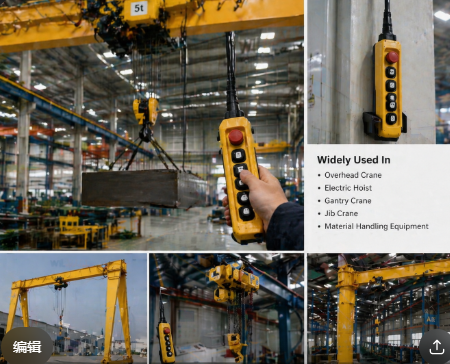
Factory and product view of the Wilmall control pendant range.
This article is written for buyers who have already run the product and are now planning the second, third or tenth order. It does not re-argue the selection decision. It answers what comes after selection: what to inspect, what the supplier's documented terms actually cover, what wears first, and what to keep on the shelf. Wilmall is an industrial electrical manufacturer and OEM/ODM supplier producing the COP-5MSS-DD as part of its control pendant station range.
The repeat-order problem: which variables should stay fixed?
On a repeat order the objective changes. The first order had to prove the pendant was the right control device for the machinery; the repeat order has to prove the same device arrived. Three variables should be locked before any re-order is released, because each maps to a different part of the goods-in check:
- Configuration — button count, contact point material, whether the emergency stop button function is included, and single or dual button speed.
- Electrical rating — the AC 500V, 10A rating of the pendant's control elements, and the control-circuit voltage of the equipment it is wired to.
- Environment — IP65 protection and the -25 °C to +40 °C ambient range, in humidity up to 90% with possible rain intrusion, and in an atmosphere without explosive media or corrosive gases and liquids.
A fixed-specification pendant is easier to re-order than a configured assembly because its failure modes are concentrated in a small number of parts. A wired pendant carries control signals to the equipment control circuit through a cable, so the maintenance routine stays on physical items — enclosure, cable, buttons, emergency stop and contact blocks. That is the practical meaning of lower complexity for a maintenance team: fewer systems to check when a hoist does not respond.
The operator interface is short, and keeping it unchanged has value in itself. In the application record for this pendant, the operator presses the corresponding button (up, down, forward and backward are the listed examples), the internal contact closes, a control signal is sent to the equipment control circuit, and the contactor or drive executes the movement. A repeat order that preserves this interface also preserves operator training, spare-part logic and the inspection routine.
Supply context: what a repeat buyer should take from the market data
Answer-first: category-level market data is background for budgeting and supplier continuity, not a reason to change a proven part. Third-party commercial research on the push button pendant control station segment put the global market at USD 1.02 billion in 2025, projected USD 1.48 billion by 2034 at a 4.1% CAGR for 2026–2034, and estimated that the top five players held over 45% of that market in 2025. These are commercial research estimates, cited as context for the category rather than as a forecast of any individual supplier's performance.
Two technical references matter more for a repeat order. IEC 60947-5-1:2024 is the current edition of the international standard covering electromechanical control circuit devices, the product family a pendant switch belongs to. For cross-border shipments, industrial control pendant stations are typically classified under HS 8537.10 (boards, panels and consoles for a voltage not exceeding 1,000 V) or 8536.50 (other switches) in the US Harmonized Tariff Schedule. A standard number and a tariff line are reference points, not certificates: the declaration of conformity and the classification used on your own entry still have to come from the supplier and the customs broker in writing.
What the COP-5MSS-DD specifies — and where the limits sit
Answer-first: the COP-5MSS-DD is a plastic-bodied handheld pendant station with a five-button layout and a push-lock emergency stop, rated AC 500V and 10A, specified with IP65 protection and an operating range of -25 °C to +40 °C, intended for cranes, hoists, lifting equipment and industrial control systems.
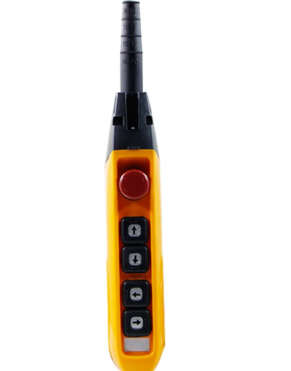
COP-5MSS-DD push button pendant station.
| Parameter | Specification |
|---|---|
| Model | COP-5MSS-DD |
| Type | Push button pendant station (handheld control switch) |
| Button layout | Five-button layout with push-lock emergency stop |
| Rated voltage and current | AC 500V, 10A |
| Protection | IP65 |
| Ambient temperature | -25 °C to +40 °C (average +40 °C) |
| Humidity | Up to 90%, with possible rain intrusion |
| Atmosphere | No explosive media; no corrosive gases or liquids |
| Material | Plastic |
| Application | Cranes, hoists, lifting equipment, industrial control systems |
| Matched equipment | YJ02-02 electric chain hoist (control voltage 24–48V) |
Rated voltage is not the same figure as control voltage. The AC 500V, 10A value describes the rating of the pendant's control elements; it is not the voltage of the control circuit the pendant switches. Wilmall's YJ02-02 electric chain hoist, listed as matched equipment for this pendant, specifies a 24–48V control voltage. Before releasing a repeat order, confirm which figure your drawing refers to, and confirm the pendant's rating covers the circuit it will actually switch. This is one of the few ways a correct part number can still produce a wrong order.
IP65 and the temperature range describe installation limits, not endurance. IP65 covers protection against dust ingress and water jets. It does not make the station submersible and does not extend to solvents or washdown chemicals. The stated ambient range is -25 °C to +40 °C with an average of +40 °C, humidity up to 90% with possible rain intrusion, and an atmosphere without explosive media and without corrosive gases or liquids. A site that exceeds any of those conditions sits outside the documented scope, and the pendant should not be ordered against it on the assumption that the enclosure will absorb the difference.
Repeat-order terms: MOQ, lead time, capacity and customization
Answer-first: the listed commercial terms are a 5-unit MOQ, 15 working days lead time and 2,000 units monthly capacity, with 100% test before shipment and remote technical support after delivery. Customization is available through OEM/ODM production.
| Item | Listed option or term |
|---|---|
| Production mode | OEM / ODM |
| Contact point material | Silver or copper |
| Button function | Emergency stop button |
| Number of buttons (customization list) | 2, 4, 6, 8 — the standard COP-5MSS-DD is a five-button station |
| Button speed | Single speed or dual speed |
| MOQ | 5 units |
| Lead time | 15 working days |
| Monthly capacity | 2,000 units |
| Quality control | 100% test |
| After-sales | Remote technical support |
| Export markets | Australia, Pakistan, South Korea |
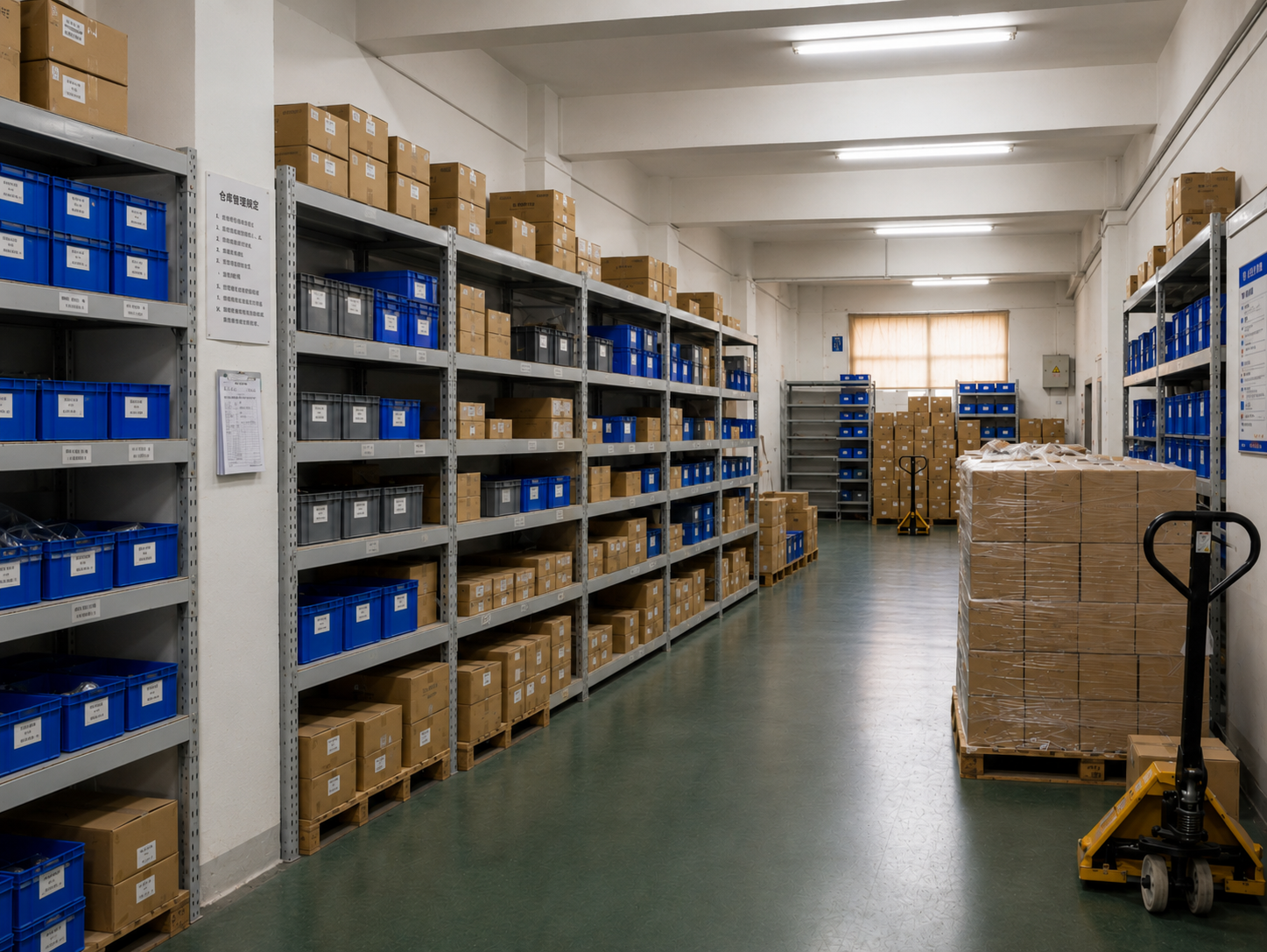
Wilmall factory warehouse.
The customization list deserves careful reading, because it does not describe variants of the five-button standard unit. Wilmall lists button counts of 2, 4, 6 and 8 alongside the COP-5MSS-DD's five-button layout, plus contact point material in silver or copper, an emergency stop button function, and single or dual button speed. A buyer who needs a different button count is therefore ordering a different configuration rather than a modified COP-5MSS-DD, and the acceptance check at goods-in has to follow whichever configuration was ordered.
That distinction is the main commercial discipline in a repeat-order relationship. If nothing has changed, the goods-in check can reuse the previous record and the order closes quickly. If one element has changed — silver instead of copper contact points, for example, or the addition of a dual-speed button — the receiving inspection should treat the delivery as a new configuration and verify the changed item specifically, rather than signing off on the strength of a familiar part number.
Incoming acceptance check: a seven-step sequence
Answer-first: a repeatable acceptance check verifies four things in order — that the right configuration arrived, that the enclosure and cable entry are intact, that every button and the emergency stop work as intended, and that the contacts open and close correctly. The sequence below can be run at goods-in without connecting the pendant to a live crane.
- Match the delivery to the order. Confirm the model reference COP-5MSS-DD or the customized configuration, the button count, the contact point material, the emergency stop function and the button speed against the purchase order and drawing.
- Inspect the enclosure and seal faces. Look for cracks, distortion, or a gasket that is pinched or seated unevenly. Any of these undermines the IP65 protection before the unit is installed.
- Check the cable entry and strain relief. The cable should be held so that pulling on it does not load the terminals, and the entry should be closed. A loose entry is both a moisture path and a conductor-fatigue risk.
- Operate every button. Press each button through its full travel and release it. It should move freely, return without binding, and sit level with its legend.
- Actuate and reset the emergency stop. The push-lock emergency stop should latch when pressed and release only on its intended reset action. On the machine, verify that latching it removes the control signal to the contactor or drive.
- Verify contact operation with a meter. With the pendant isolated, check open and closed states at the terminals against the wiring schedule. This catches a contact block disturbed in transit before it becomes a fault on the shop floor.
- Record the result. File the configuration, quantity, date and check result. That record is what makes the next repeat order fast, and it is the first document you will want if a question arises about a delivery.
Routine inspection of cable, buttons, emergency stop and contact blocks
Answer-first: routine inspection should cover five items — cable and entry, buttons, the push-lock emergency stop, contact blocks and terminals, and the enclosure seal. Inspection frequency belongs to the site's risk assessment and local requirements; this article does not set an interval, because the right one depends on duty cycle, environment and the crane's own inspection regime.
| Item | What to check | Typical warning sign |
|---|---|---|
| Cable and entry | Jacket cuts, abrasion, flattening, exposed conductors; cable held so pulling does not load the terminals; entry closed | Intermittent motion, nuisance stops, a pendant that responds only at certain cable angles |
| Buttons | Free travel, clean return, level cap, legible legend, no cracks in the cap | Sticking, slow return, a function that needs a second press |
| Push-lock emergency stop | Latches when pressed, releases only on the intended reset, control signal drops when latched | Does not latch, or does not release |
| Contact blocks and terminals | Terminal tightness, discoloration, pitting, contact material matching the ordered option | Chattering, no response on one function, heat marks at a terminal |
| Enclosure and seal | Cracks, gasket seating, entry and seal faces intact | Moisture or dust inside the enclosure |
Two failure patterns are worth calling out because they are easy to misread. First, intermittent motion — a pendant that sometimes responds — is more often a cable or terminal problem than a button problem, because the button either makes contact or it does not, while a strained conductor makes contact intermittently. Second, an emergency stop that resets but does not latch reliably is a functional defect rather than a nuisance: take the unit out of service and replace or repair the stop before the equipment runs again.
Repair or replace? A decision rule for repeat buyers
Answer-first: replace the pendant when the enclosure or seal is compromised, when more than one contact block is worn, or when the emergency stop does not latch reliably; repair it when the fault is confined to the cable, a single button cap or a single termination. The boundary is whether the fault can be corrected without reopening the sealed assembly and without leaving a second latent fault behind.
The commercial side of that rule is stock, not repair skill. Because a repeat order runs at a 5-unit MOQ with a 15 working day lead time, holding one complete spare station converts an unplanned pendant failure into a swap. That is a reasonable planning position for a crane or hoist that cannot be out of service for the length of a production and shipping cycle, but it is a stocking decision: size it to the number of identical pendants on site rather than applying it as a blanket rule across a mixed fleet.
Where a five-button wired pendant fits: cranes, hoists and warehouse handling
Answer-first: the COP-5MSS-DD suits fixed-function lifting and handling equipment — overhead cranes, hoists, lifting equipment and general industrial control — where the operator is at or near the load and the control functions are stable. Its limits appear where a site falls outside the -25 °C to +40 °C range and the stated atmosphere, or where a genuinely different button count is required.
In warehouse and dock handling, the deciding check is usually the environmental envelope rather than the electrical rating. A station specified for humidity up to 90% with possible rain intrusion is intended for humid, non-corrosive environments; it is not specified for corrosive or explosive atmospheres, which exclude it from some process areas regardless of its electrical rating. In crane and hoist duty, the deciding check is usually the control-circuit voltage and the emergency stop function, because those two determine whether the pendant can command the contactor or drive and whether the operator has a latching stop within reach.
A documented project record gives one reference point. An RV factory in Australia ordered 10 units of the COP-5MSS-DD for control devices, with stable operation recorded after one year of service and ease of use noted as the project highlight. That is a small-batch deployment in a single application, not evidence of performance across all sites, but it is the kind of reference a repeat buyer can compare against their own duty cycle and inspection experience.
After-sales support for repeat buyers
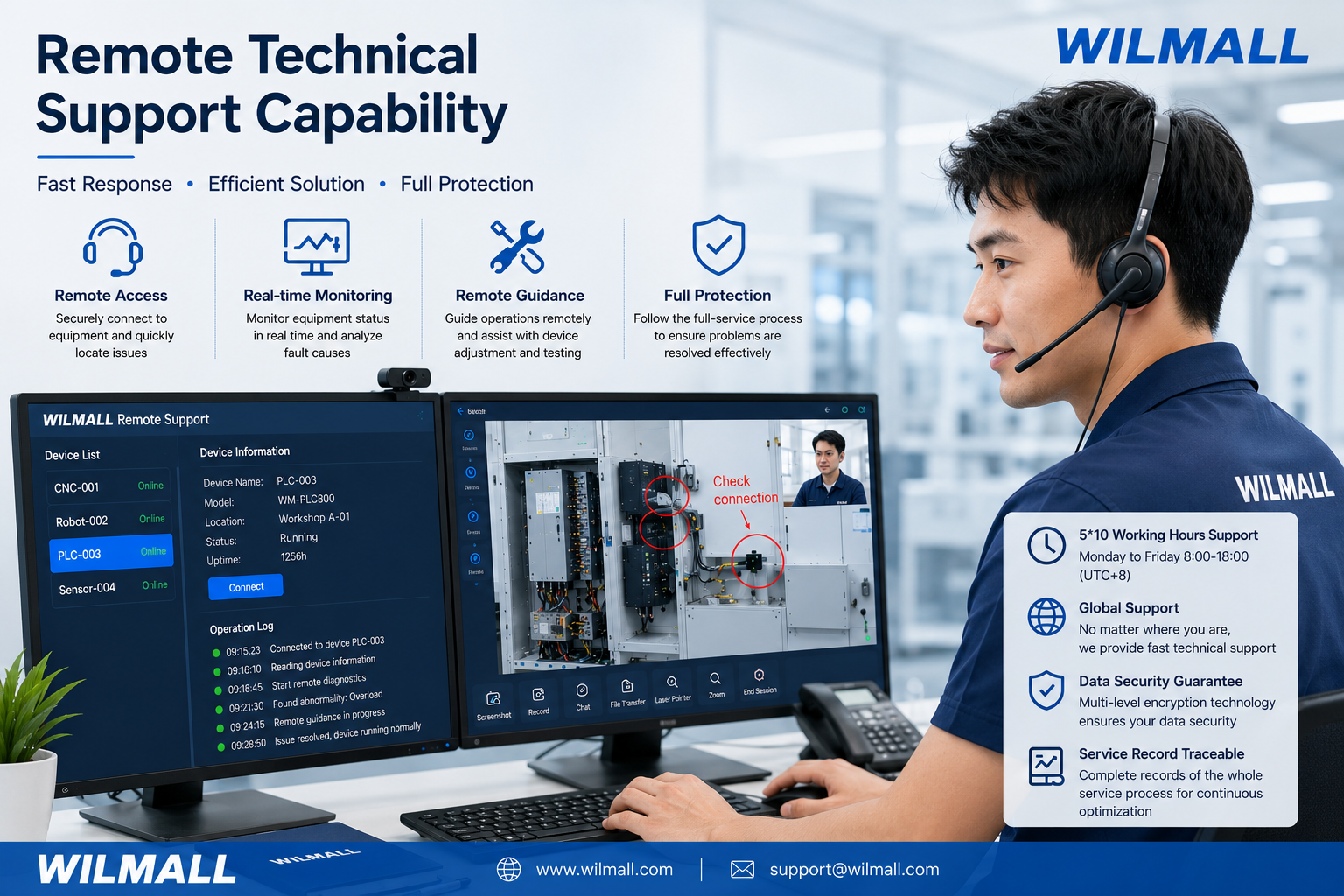
Remote technical support capability.
Answer-first: Wilmall lists remote technical support as the after-sales service for this product line, supported by 100% test before shipment and OEM/ODM engineering for configuration changes.
Remote support is most useful when the buyer arrives with specifics: the model reference, the configuration, the measured voltage at the pendant terminals, which button or function failed, and whether the fault follows the pendant or stays with the machine. A symptom such as 'the hoist does not respond' can originate in the pendant, the cable, the control circuit or the contactor, and the conversation shortens considerably when the pendant has already been isolated as a suspect or excluded as one.
Contact channels for this line are email at sales@wilmall.com and telephone or WhatsApp on +86 19730226757. Wilmall lists a 2,000 m² facility, annual output of 200,000 units and a three-engineer R&D team, and the export markets listed for this product line are Australia, Pakistan and South Korea.
Frequently asked questions
Does the COP-5MSS-DD meet the standard our project specifies?
The COP-5MSS-DD is specified as a five-button push button pendant station with a push-lock emergency stop, rated AC 500V and 10A, with IP65 protection and a -25 °C to +40 °C operating range. Wilmall states that its products comply with CE, UL and RoHS. IEC 60947-5-1:2024 is the current edition of the international standard for electromechanical control circuit devices, and pendant stations are typically classified under HS 8537.10 or 8536.50. A standard number is not a certificate for a specific unit, so request the applicable declaration of conformity and the tariff classification in writing with the repeat order.
What can be customized on a repeat order?
Wilmall lists OEM/ODM production with contact point material in silver or copper, an emergency stop button function, button counts of 2, 4, 6 and 8, and single or dual button speed. The COP-5MSS-DD itself is a five-button station, so a different button count is a separate configuration rather than a variant of the standard unit. Confirm any change against the drawing before the order is released, because the goods-in check follows the ordered configuration.
What drives the cost of a repeat order?
The published specification does not include pricing, so cost has to be read from the configuration and the order terms. Wilmall lists a 5-unit MOQ, 15 working days lead time and 2,000 units monthly capacity. Within those terms, the variables that change between one order and the next are button count, silver or copper contact points, whether the emergency stop button function is included, and single or dual button speed. Keeping the proven configuration and confirming quantity, price and lead time in writing gives a comparable quotation each time.
Can we validate a configuration before committing to a full repeat order?
The listed MOQ is 5 units, so a configuration that is new to a site can be validated on a five-unit order and checked with the acceptance sequence in this article before it is released to production equipment. For reference, a recorded project with an RV factory in Australia used 10 units of the COP-5MSS-DD for control devices and reported stable operation over one year, with ease of use noted as the highlight. That is a single application record, not a general performance guarantee.
What lead time should a repeat order plan for?
Wilmall lists 15 working days lead time and 2,000 units monthly capacity. Those are production terms rather than a door-to-door delivery commitment: shipping, customs clearance and inland transport sit outside them and depend on the destination. The listed export markets for this product line are Australia, Pakistan and South Korea. Where the equipment cannot be out of service, the practical rule is to release the repeat order early enough that a spare station is on the shelf before the lead time starts.
What after-sales support comes with the pendant?
Wilmall lists remote technical support as the after-sales service for this line, with 100% test before shipment and OEM/ODM engineering for configuration changes. Support is reachable by email at sales@wilmall.com and by telephone or WhatsApp on +86 19730226757. For diagnosis, have the model reference, the configuration, the measured terminal voltage and the specific function that failed ready, and state whether the fault follows the pendant or stays with the machine.
How do we start a repeat order?
Send the model reference COP-5MSS-DD, the configuration you have been running and the quantity to sales@wilmall.com or WhatsApp +86 19730226757. Wilmall confirms the configuration, the 5-unit MOQ, the 15 working day lead time and the applicable declaration documents before the order is released. The product brochure is available as a PDF from the download link below.
What to lock in before the next order
A repeat order is a documentation exercise as much as a purchasing one. Three records do the work: the configuration record, which fixes button count, contact material, emergency stop function and button speed; the acceptance record, which shows the delivery was checked against that configuration; and the stock decision, which sets how many spare stations the site keeps against a 15 working day lead time.
The specification itself is short and stays short — AC 500V, 10A, IP65, -25 °C to +40 °C, five buttons with a push-lock emergency stop, for cranes, hoists, lifting equipment and industrial control. What changes over a long partnership is not the product but the clarity of those records and the speed with which a technical question reaches the supplier's engineering team.
Planning a repeat order? Send the model reference COP-5MSS-DD, your current configuration and the quantity to sales@wilmall.com or WhatsApp +86 19730226757. The Wilmall product brochure (PDF) is available for download.
Have Questions or Need More Details?
Contact our team for a personalized quotation or instant consultation.
Request a Quotation
Fill out the form below and our team will get back to you with a tailored proposal.
WhatsApp Direct Chat
Prefer to chat in real-time? Message us on WhatsApp for instant assistance & quick answers.
- Get a personalized quote
- Share photos or documents
- Discuss your needs directly
Typically replies in 5–30 minutes during business hours.