
Control Pendant Supplier Scorecard: 5-Button Station Terms
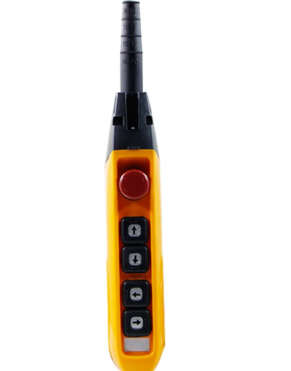
COP-5MSS-DD push button pendant: five-button handheld station with push-lock emergency stop, rated AC 500V / 10A, applied to cranes, hoists and industrial control systems (Wilmall).
A five-button pendant is a small line item in a crane or hoist bill of materials, yet it is the physical interface between the operator and every lift the machine makes. That asymmetry — modest unit price, high operational consequence — is the reason unit price alone is a poor way to compare control pendant suppliers.
Short answer: score suppliers on six verifiable dimensions — specification match, purchase terms, acceptance and inspection criteria, compliance documentation, repeat-order consistency, and after-sales technical support. Confirm the five-button layout with push-lock emergency stop, the AC 500V / 10A contact rating, the 24–48V control circuit the station switches, IP65 protection, and the −25 °C to +40 °C ambient range before the purchase order is issued, not after the first batch arrives.
Problem Definition: Why Unit Price Fails as a Supplier Benchmark
In procurement terms, a pendant station is a low-value, high-frequency component. Buyers often shortlist three or four suppliers, compare quotations, and select the lowest number. Three failure modes then appear after delivery, and none of them is visible on a price sheet.
1. Specification drift between quotation and delivered unit. A quotation may describe a five-button station in general terms without fixing the button layout, the emergency stop mechanism, or the contact rating. The delivered unit can then differ in ways that only surface at commissioning — for example, an emergency stop that does not latch in the pushed position, or contact blocks that cannot carry the stated load.
2. Undocumented compliance. A supplier may hold a valid conformity document that does not actually cover the product, the voltage class, or the destination market. Buyers who accept a certificate number without reading its scope inherit a documentation gap that customs or a site safety audit will later expose.
3. Repeat-order inconsistency. The first order passes inspection. The second order arrives with a different contact material, a different cable, or a different button legend. Because nothing was written into the acceptance record, there is no baseline to reject against.
The practical conclusion is that a 5-button station should be sourced with the same discipline as a higher-value assembly: a defined specification baseline, written purchase terms, and an acceptance record that can be re-used for every repeat order.
Industry Background: A Fragmented Market With a Tightening Standard
Two structural facts shape how industrial pendant control should be bought in 2026.
First, the segment is consolidating but remains fragmented. Commercial research cited for the push button pendant control station segment puts the global market at USD 1.02 billion in 2025, projected to reach USD 1.48 billion by 2034 at a 4.1% CAGR. In 2025 the top five players held a collective share of over 45%, which means a substantial remainder of supply is delivered by mid-sized and regional manufacturers. Buyers therefore cannot rely on brand recognition alone; they need a repeatable evaluation method that works on suppliers of very different scale.
Second, the technical reference has been revised. IEC 60947-5-1:2024 is the current edition of the standard for electromechanical control circuit devices, the family that includes pendant switches. Any supplier claiming technical equivalence should be able to state which edition of the standard its construction follows, and should be able to show a conformity document whose scope matches the product being shipped.
Trade classification adds a third, quieter variable. Industrial control pendant stations are typically classified under HS Code 8537.10 (boards, panels and consoles for electric control, voltage not exceeding 1,000 V) or 8536.50 (other switches). Because the two classifications can carry different duty treatment in some markets, the declared HS code belongs on the scorecard alongside the technical parameters — it affects landed cost and customs clearance, not just paperwork.
Public data on per-supplier customization limits is still fragmented, which is why an internal scorecard built from your own acceptance evidence is more useful than a purchased supplier ranking.
The Supplier Scorecard: Six Dimensions Beyond Unit Price
The scorecard below converts a purchase decision into six weighted dimensions. The weights are a suggested starting point for editorial procurement use; adjust them to your site criticality, but keep all six dimensions in the evaluation so that no single low price can dominate the outcome.
| Scorecard dimension | Suggested weight | Evidence to request | Fails the scorecard when |
|---|---|---|---|
| 1. Specification match | 25 | Datasheet fixing button layout, emergency stop type, rated voltage and current, protection rating, ambient range | Quotation text and datasheet disagree, or parameters are left open |
| 2. Purchase terms | 20 | MOQ, lead time, monthly capacity and delivery terms stated in writing | Commitments exist only in email conversation |
| 3. Acceptance and inspection criteria | 20 | Pre-shipment inspection record and statement of testing coverage | No inspection record can be produced for the batch |
| 4. Compliance documentation | 15 | Standard reference, conformity document with readable scope and market, declared HS code | Document scope covers a different product or market |
| 5. Repeat-order consistency | 10 | Frozen drawing including contact material, button configuration and labelling | Substitutions are described as batch-dependent |
| 6. After-sales technical support | 10 | Named technical contact and support route | No technical channel beyond the sales contact |
Dimension 1 — Specification match on the five-button station
The specification baseline for a five-button station is short enough to be written in one table, and it should be. For the Wilmall COP-5MSS-DD, the reference values are: a five-button handheld control station with emergency stop, push-lock emergency stop mechanism, rated voltage and current of AC 500V / 10A, housing in plastic, and application to cranes, hoists, lifting equipment and industrial control systems. In the crane and hoist application it is specified with IP65 protection, an ambient range of −25 °C to +40 °C, an average humidity of 90%, tolerance of rain intrusion, and use in areas without explosion hazard and without media that corrode metal, attack rubber or involve insulating gas or liquid.
Rated voltage is not the same as control voltage, and mixing the two is a common scoring error. The contact blocks of the pendant are rated AC 500V / 10A; the control circuit those blocks switch may operate at a much lower level — the control voltage stated for the Wilmall YJ02-02 electric chain hoist, for example, is 24–48V. A supplier that cannot separate these two numbers in writing should not pass dimension 1.
| Parameter | Verified reference value | What the acceptance record must show |
|---|---|---|
| Button layout | Five-button handheld control station with emergency stop (COP-5MSS-DD) | Drawing with button positions and functions |
| Emergency stop | Push-lock emergency stop | Latch and reset behaviour verified on sample |
| Rated voltage and current | AC 500V, 10A | Marking legible on the contact block |
| Control circuit voltage | 24–48V control voltage (stated for the YJ02-02 electric chain hoist) | Declared compatibility with the site control circuit |
| Protection | IP65 | IP65 statement plus gasket and cable-entry check |
| Ambient range | −25 °C to +40 °C, 90% average humidity, rain intrusion tolerated | Site temperature and humidity compared against the range |
| Housing material | Plastic | Material declared on datasheet and confirmed on sample |
Dimension 2 — Purchase terms that survive a repeat order
Purchase terms are where small-MOQ buyers lose control. A minimum order quantity of 5 units, a lead time of 15 working days and a monthly capacity of 2,000 units are all workable numbers for a 5-button station programme, but only if they are written into the order rather than quoted once. Three clauses do most of the work: the MOQ per configuration (not per order), the lead time measured from drawing approval rather than from enquiry, and the capacity ceiling that applies when demand spikes.
Delivery terms belong here too. Who books freight, which party bears export documentation, and which HS code appears on the commercial invoice should be agreed before the first shipment. If the supplier exports regularly — Wilmall states an export ratio of 80%, with markets including Pakistan, Korea, Australia and Malaysia — the documentation routine is usually already in place, which reduces clearance friction.
Dimension 3 — Acceptance and inspection criteria
Acceptance criteria are only useful if they are specific to the four components that fail most often: the cable, the buttons, the emergency stop, and the contact blocks. A statement of 100% testing, such as that declared for Wilmall pendant stations, is a starting point; the buyer still needs to know what was tested and what the record looks like.
Dimension 4 — Compliance documentation with a readable scope
Certificate numbers are not compliance. What matters is the scope, the market, the standard edition, and the product to which the document attaches.
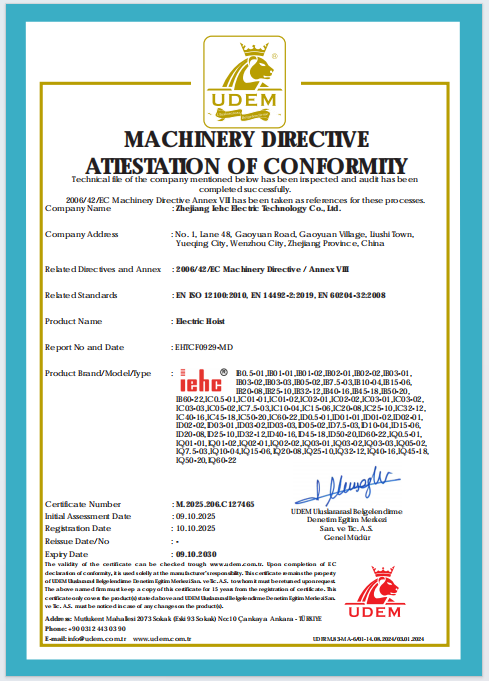
Conformity documents carry a scope. The UDEM Machinery Directive Attestation of Conformity EHTCF0929-MD is issued for the electric hoist and the Turkey market, valid 2025-10-09 to 2030-10-09.
A concrete example shows how to read one. Wilmall holds a Machinery Directive Attestation of Conformity issued by UDEM under certificate number EHTCF0929-MD, applicable to the Turkey market, valid from 2025-10-09 to 2030-10-09, citing EN ISO 12100:2010, EN 14492-2:2019 and EN 60204-32:2008. The scope of that document is the electric hoist — not the pendant station. Used correctly, it supports the hoist file and demonstrates that the supplier works within a documented conformity system; it does not substitute for the pendant's own technical documentation. A buyer who checks scope rather than counting certificates will catch this distinction immediately, and will ask the right follow-up question.
For the pendant itself, the reference point is IEC 60947-5-1:2024, the current edition covering electromechanical control circuit devices and switching elements, together with the declared HS classification (8537.10 or 8536.50).
Dimension 5 — Repeat-order consistency
Repeat-order consistency is a documentation problem before it is a production problem. The drawing must freeze the variables a supplier could otherwise change quietly: contact point material (silver or copper), button configuration, button speed (single or dual speed), housing colour, and labelling. Where a supplier offers customization across 2-, 4-, 6- and 8-button configurations, emergency braking button functions, and alternative contact materials, the same flexibility that makes the first order fit well can make the fifth order fit differently — unless the specification is locked.
Dimension 6 — After-sales technical support
Industrial pendant control fails in ways that are diagnosed remotely more often than they are returned. A named technical channel, such as the remote technical support Wilmall provides, is worth more than a warranty sentence, because it shortens the interval between a fault symptom and a corrective action on site.
Step-by-Step Breakdown: Running the Scorecard
Step 1 — Write the specification baseline. Fix the five-button layout, push-lock emergency stop, AC 500V / 10A contact rating, 24–48V control circuit, IP65 protection and the −25 °C to +40 °C range in a single document. Distribute the same document to every supplier so responses are comparable.
Step 2 — Request documents before prices. Ask for the datasheet, the declaration with its scope and market, and the declared HS code. Suppliers who cannot produce a scoped document at this stage rarely produce one at shipment.
Step 3 — Score purchase terms separately. Record MOQ, lead time and monthly capacity per configuration. A supplier with a 5-unit MOQ, 15 working days lead time and 2,000-unit monthly capacity is quoting a specific operating model — confirm that the model applies to your configuration, not only to the catalogue item.
Step 4 — Order a sample and inspect it against the criteria. Test the cable, the buttons, the emergency stop and the contact blocks. Confirm that the emergency stop latches when pushed, that the five buttons correspond to the drawing, that the AC 500V / 10A marking is present and legible, and that the sealing arrangement supports the IP65 claim.
Step 5 — Approve with a written acceptance record. Photograph the approved sample, attach the drawing, and file the inspection notes. This record becomes the reference for every later batch.
Step 6 — Transfer the terms into the purchase order. MOQ, lead time, capacity, contact material, button configuration, HS code and support route all move from the quotation into the order text.
Step 7 — Re-score at each repeat order. Compare the incoming batch to the approved sample, not to the catalogue. Drift is detected only against a fixed reference.
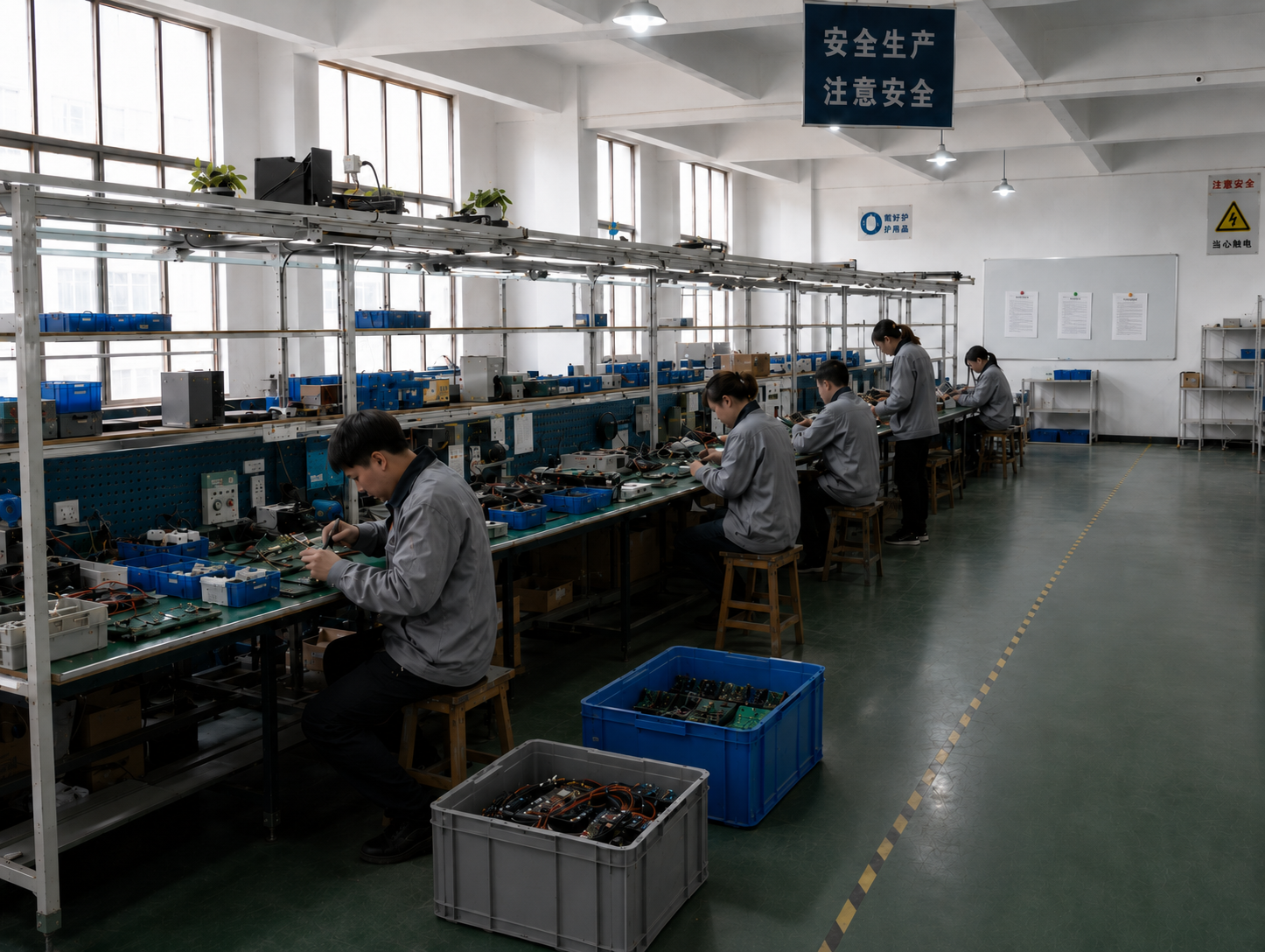
Production and testing environment: acceptance criteria only hold if the supplier can show the testing record behind the batch.
Use Cases Where the Scorecard Changes the Outcome
Crane and hoist OEM programmes. When a pendant station is paired with a hoist, as with the YJ02-02 electric chain hoist and its 24–48V control voltage, the interface between pendant and hoist must be verified as a pair. Buyers who score the two components together avoid the common mismatch where a correctly rated pendant is wired to a control circuit the supplier never reviewed.
Small-batch fleet upgrades. A ten-unit order is a realistic size for a single-site upgrade — Wilmall supplied 10 units of control devices to an RV factory in Australia, where the reported outcome after one year of operation was stable operation and ease of use. At that volume, the fixed cost of inspection and documentation is spread across few units, which makes the purchase terms dimension matter more, not less.
Distributor and warehouse stock programmes. Distributors carrying pendant stations for multiple end customers need consistent configuration across batches. The repeat-order dimension and the frozen drawing do most of the protection work here.
Industrial automation and construction machinery. Where a pendant station manages production equipment or construction machinery, the operator presses the corresponding button, the internal contacts close, a control signal is sent to the equipment control circuit, and a contactor or drive executes the movement. Any degradation in button feel or contact behaviour is felt directly in machine control, which is why the button and contact-block inspection points are not optional.
Comparison Table: Quotation Claim, Acceptance Evidence and Repeat-Order Risk
The table below compares the four inspection points against the evidence that should be filed and the risk created when nothing is specified.
| Inspection point | What to check on the sample | Acceptance evidence to file | Repeat-order risk if unspecified |
|---|---|---|---|
| Cable | Cable entry, gland seating, strain relief, jacket condition along the full length | Cable specification on the drawing plus photographed entry point | Cable type substituted between batches |
| Buttons | Five-button layout matching the drawing, consistent actuation, correct legend | Button layout drawing with function labels | Layout or legend drift on reorder |
| Emergency stop | Push-lock latching behaviour and reset method | Sample test note referencing push-lock specification | Non-latching or different mechanism supplied later |
| Contact blocks | AC 500V / 10A marking present and legible; contact material declared (silver or copper) | Contact material stated on the datasheet | Contact material changed without notice |
| Enclosure sealing | Gasket seating, screw condition, no visible gaps at the joint line | IP65 statement plus visual check record | Sealing downgraded on a later batch |
Frequently Asked Questions
1. Which compliance documents should a 5-button control pendant supplier provide?
A supplier should provide three things: a statement of the technical standard its construction follows — IEC 60947-5-1:2024 is the current edition for electromechanical control circuit devices, the family that includes pendant switches — a conformity document whose scope, product and market match the item being shipped, and the declared HS code (typically 8537.10 or 8536.50). Read the scope before accepting the number. Wilmall's UDEM Machinery Directive Attestation of Conformity EHTCF0929-MD, valid 2025-10-09 to 2030-10-09 and citing EN ISO 12100:2010, EN 14492-2:2019 and EN 60204-32:2008, is issued for the electric hoist and the Turkey market; it is an example of a scoped document, not a substitute for the pendant station's own file.
2. What customization capability should a pendant station supplier be able to confirm in writing?
A supplier should confirm its production mode (OEM / ODM or catalogue-only), the contact point materials it can supply (silver or copper), the button functions available including emergency braking button, the button configurations it can build (2, 4, 6 and 8-button options), and whether single-speed and dual-speed button variants are supported. Capacity and quality statements belong in the same answer: a monthly capacity of 2,000 units and 100% testing of pendant stations describes an operating model a buyer can plan around.
3. How should price be compared across control pendant suppliers?
Compare cost structure, not the unit number. Four terms move the real cost of a 5-button station programme: the MOQ per configuration (5 units for Wilmall pendant stations), the lead time (15 working days), the monthly capacity ceiling (2,000 units), and the HS code that determines duty treatment on entry. Add the cost of incoming inspection and the cost of a failed batch. A low unit price with a long lead time and no inspection record usually costs more per installed station than a mid-range price with documented acceptance criteria.
4. What must be verified on a sample before a 5-button station is approved?
Verify the five-button layout against the drawing, the push-lock emergency stop latching and reset behaviour, the AC 500V / 10A rating marking on the contact blocks, and compatibility with the 24–48V control circuit the station will switch. Confirm IP65 sealing at the gasket and cable entry, and compare the site's ambient conditions against the −25 °C to +40 °C range, the 90% average humidity allowance, and the exclusion of explosive or corrosive media. Then check the cable and the contact material declaration. A sample that passes all of these becomes the acceptance reference for every repeat order.
5. What delivery terms and next steps should be written into the purchase order?
Write in the MOQ per configuration, the lead time of 15 working days measured from drawing approval, the monthly capacity available for your programme, the HS code for the commercial invoice, the frozen drawing with contact material and button configuration, and the technical support route after delivery (Wilmall provides remote technical support). Once those terms are fixed, the practical next step is a sample evaluation — Wilmall supplies 5-button pendant stations from a 2,000 m² facility with a stated monthly capacity of 2,000 units, and handles sample, quotation and OEM/ODM enquiries through sales@wilmall.com or WhatsApp +86 19730226757.
Conclusion
A 5-button pendant station is cheap to buy and expensive to get wrong. The scorecard in this guide moves the decision away from unit price and onto six dimensions that can be evidenced: specification match, purchase terms, acceptance and inspection criteria, compliance documentation, repeat-order consistency, and after-sales technical support.
The verified baseline is deliberately narrow — five buttons with a push-lock emergency stop, AC 500V / 10A contacts, a 24–48V control circuit, IP65 protection and a −25 °C to +40 °C ambient range. Narrow baselines are an advantage in procurement, because they can be inspected, photographed and re-used as the reference for every repeat order.
Wilmall is an industrial electrical manufacturer and B2B supplier of automation and power distribution components, including control pendant stations, serving industrial users, electrical contractors and distributors with 8+ years of experience and exports to 30+ countries. Product documentation, customization options and the company catalogue can be reviewed before any commitment is made.

Next step: sample, quotation and catalogue
Request a COP-5MSS-DD sample for inspection against the criteria in this scorecard, or ask for a written quotation covering MOQ, lead time and delivery terms.
Website: wilmall.com | Email: sales@wilmall.com | WhatsApp: +86 19730226757
Product catalogue (PDF): download the Wilmall catalogue
Have Questions or Need More Details?
Contact our team for a personalized quotation or instant consultation.
Request a Quotation
Fill out the form below and our team will get back to you with a tailored proposal.
WhatsApp Direct Chat
Prefer to chat in real-time? Message us on WhatsApp for instant assistance & quick answers.
- Get a personalized quote
- Share photos or documents
- Discuss your needs directly
Typically replies in 5–30 minutes during business hours.