
Control Pendant Supplier Vetting: 3 Gates Before You Order
A control pendant supplier is vetted in three gates, in this order: capability, delivery and acceptance. Capability is confirmed when the supplier can document the exact station you are buying — the electrical rating, the enclosure protection, the operating temperature range and the button set — on a drawing that carries the same model code as the quotation. Delivery is confirmed when monthly capacity, minimum order quantity, lead time and shipping terms are stated as numbers and tied to your order quantity and a ship date. Acceptance is confirmed when the pre-shipment test, the record it produces and the remedy for a failed lot are agreed in writing before the goods leave. For a wired station such as the COP-5MSS-DD 5-button pendant with emergency stop, rated AC 500V/10A, IP65 and -25°C to +40°C, each gate can be closed with a document rather than an impression.
This guide is written for buyers who have already shortlisted suppliers of control pendants for cranes, hoists and industrial machinery and are about to release a first or repeat order. It covers what to request at each gate, what a satisfactory answer contains, and which answers justify stopping the order.

Why a Shortlisted Supplier Still Needs Vetting
By the time a buyer reaches the evaluation-to-execution stage, the category question is usually settled: a wired 5-button station fits the machine, the cable route is known and the budget range is set. What remains is order-specific risk, and it takes three forms.
- Specification drift. The unit that arrives differs from the unit that was quoted — a different contact block, a different cable entry, or a rating that belongs to the switch element rather than to the assembled station.
- Schedule drift. A lead time quoted as a general figure turns out to apply to a different configuration, a different order size or a different quarter.
- Acceptance dispute. Goods arrive, a button does not operate, and neither party can point to an agreed test that says who is responsible.
Vetting addresses all three with one method: pair every claim with a document that would look different if the claim were false. A supplier that says "IP65" produces a drawing showing the seal and the cable entry. A supplier that says "15 working days" produces a ship date for a stated quantity. A supplier that says "tested" produces a record with items, results and a date.
Wired pendants make this manageable, because the station contains fewer subsystems to qualify: enclosure, buttons, contact blocks, emergency stop and cable entry. There is no radio link, no pairing procedure and no separate power source to fold into the acceptance test. That lower system complexity versus wireless controls does not remove the need for vetting; it shortens the list of things a supplier has to prove.
Industry Background: Where Pendant Supply Risk Comes From
Demand for pendant stations is steady rather than explosive, which shapes how suppliers compete. Market research cited for this category puts the global push button pendant control station market at USD 1.02 billion in 2025, with a projection of USD 1.48 billion by 2034 and a compound annual growth rate of 4.1% over 2026–2034. In a market of that pace, orders are won on availability, configuration flexibility and documentation rather than on category innovation.
Two external reference points belong in the conversation with any supplier. The first is the technical standard: IEC 60947-5-1:2024 is the current edition of the international standard for electromechanical control circuit devices, including pendant switches, published in March 2024. When a declaration of conformity arrives, ask which edition it references — an older edition is not automatically wrong, but it should be a deliberate answer rather than a surprise.
The second is trade classification. Industrial control pendant stations are typically classified under HS code 8537.10 for boards and panels not exceeding 1,000 V, or 8536.50 for other switches. The code affects duty, documentation and how a customs broker prepares the entry, so it belongs in the vetting file before the booking, not in a forwarding email afterwards.
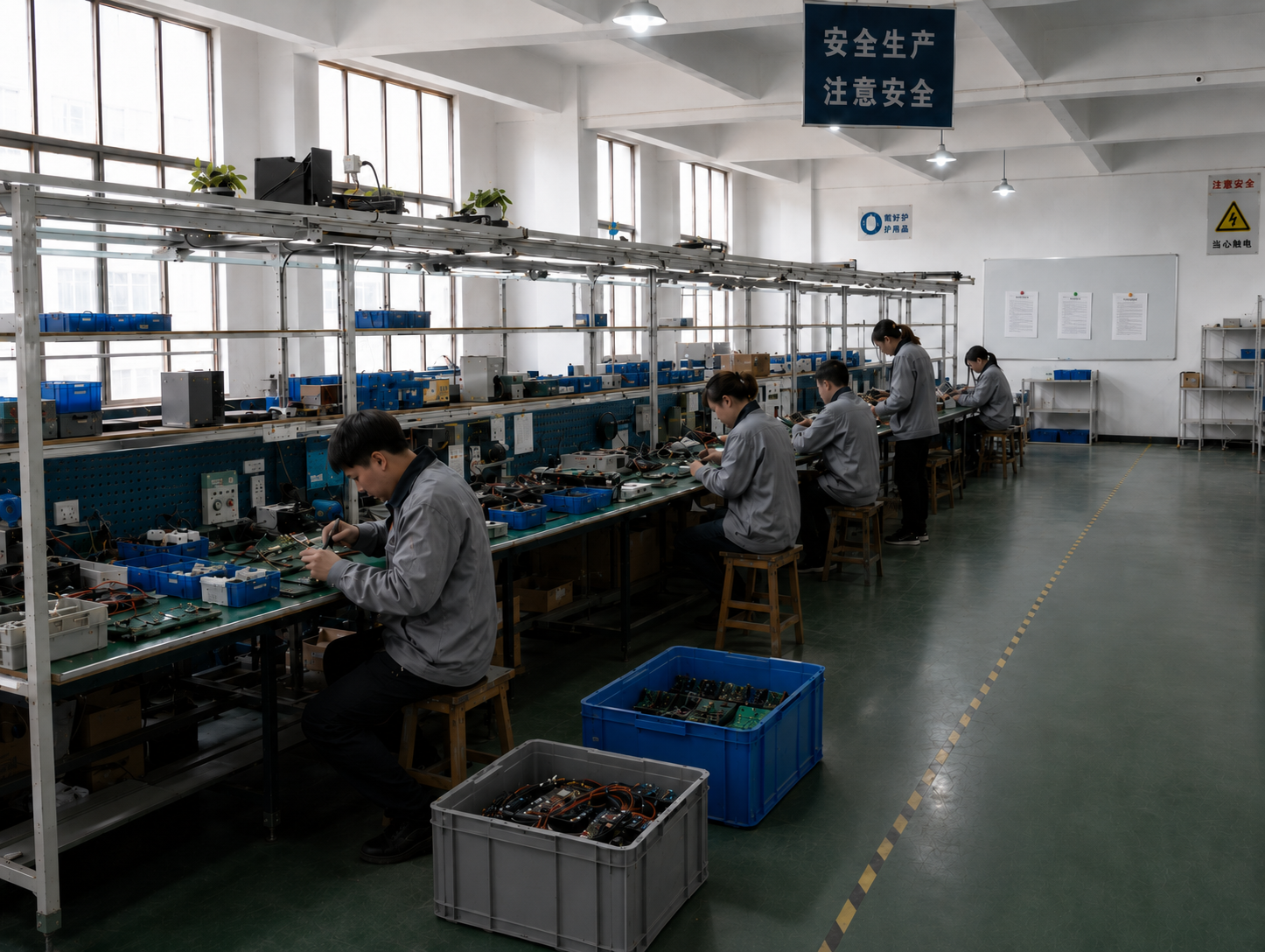
A third factor is structural. A pendant station is a short bill of materials: enclosure, button operators, contact blocks, emergency stop, cable entry and cable. Suppliers differ in how much of that bill they make, how much they buy in, and how well they can describe the difference. The questions that separate capable suppliers from weak ones are therefore parts-level questions.
Gate 1 — Capability: Pin the Station to a Documented Configuration
Capability is verified when the supplier can state the rating, protection class, temperature range and button set of the exact model code being quoted, and repeat the same values on a drawing issued under revision control.
The reference configuration: COP-5MSS-DD
Using a defined unit as the reference makes the questions concrete. The COP-5MSS-DD is a wired 5-button pendant with emergency stop, rated AC 500V/10A, with IP65 enclosure protection and an operating range of -25°C to +40°C. Each of those four statements is a separate check, not one line on a datasheet.
Read each rating as a question
- AC 500V/10A describes the switching element. Ask which contact blocks are fitted and what the contact points are made of — the customization range for this line lists silver and copper contact-point options, and that choice affects the duty the station is bought for. A supplier that quotes the rating without naming the element is quoting an enclosure, not a switch.
- IP65 describes the assembled station, including the cable entry. Ask whether the rating is held with the gland fitted and which gland is supplied. Descriptions such as "waterproof" or "rainproof" without a number should be read as marketing shorthand, not as a specification.
- -25°C to +40°C is the operating range. If site ambient falls outside it — an unheated outdoor gantry in winter, a foundry area in summer — the standard unit is out of scope, and the answer is a different product or a protected installation, not a verbal assurance that it will be fine.
- Emergency stop is a function, not a label. Confirm which button position carries it, that it latches when pressed and how it is released. The customization list treats the emergency braking button as a selectable button function, so it should be named on the order rather than assumed from a photograph.
Confirm the customization boundary before the quotation
Standard and custom configurations often share one product family, which is where drift begins. The customization range for this pendant line covers contact-point material, button function, button count in 2, 4, 6 and 8 positions, and single- or dual-speed button operation, with OEM and ODM production available. A minimum order quantity of 5 units means a non-standard configuration can be evaluated at low volume instead of being negotiated blind at bulk quantity.
Ask for the configuration to be written into the quotation as a line-item list — button count, button functions, speed, contact material, cable entry, marking — and for the drawing to carry the same list. If the quotation says "5-button, E-stop" and the drawing says something else, the drawing is what the factory will build.
Documents that close Gate 1
- A model-coded datasheet with rating, protection class and temperature range on the same page as the model code.
- A dimensional drawing carrying a revision number and date.
- A button and contact schedule mapping each position to its function and contact block.
- The cable entry specification.
- A declaration of conformity naming the standard and the edition it references.
- A sample or first article at the quoted configuration.
Four responses justify pausing rather than negotiating: a rating quoted without the element it belongs to; an enclosure claim with no number and no cable-entry detail; a temperature range missing altogether; and custom options promised without a revised drawing. Each means the specification exists only in correspondence, and correspondence is not what the production line reads.
Gate 2 — Delivery: Turn Capacity and Lead Time into Dated Commitments
Delivery is verified when capacity, minimum order quantity, lead time and shipping terms are stated as numbers and attached to a specific order quantity, a named place and a ship date.
For the pendant line referenced here, the supplier states a minimum order quantity of 5 units, a monthly capacity of 2,000 units and a lead time of 15 working days, with delivery terms of DAP. Those four numbers answer different questions and should be checked separately.
- 15 working days is not 15 calendar days. Ask for the ship date in the calendar the order uses, and ask whether the count starts at order confirmation or at payment receipt — with a T/T 100% term, the difference can be a week or more.
- 2,000 units per month tells you how your order sits inside a month of output, not how fast your order will be built. Ask for a committed production slot for your quantity and configuration, and whether the capacity figure refers to standard configurations. A mixed order of 2-, 4- and 8-button stations with different button speeds is a different scheduling problem from a single standard model.
- 5 units minimum supports a small first order or a sample-scale trial. It also means freight, not the unit, will dominate the cost of a very small shipment — a reason to plan the first order around a complete trial quantity rather than a single piece.
- DAP places delivery at the named destination, with the buyer responsible for import clearance and duties. Name the place precisely — city and site, not country — and confirm who arranges unloading. Ambiguity here is the most common cause of a delivery that is technically on time and practically late.
One more document belongs in this gate: the HS code. Because pendant stations sit under 8537.10 or 8536.50 depending on presentation, ask the supplier to state the code it will use on the commercial invoice and packing list, then let your broker check it before the shipment is booked. A code agreed after the goods leave is a code you cannot change.
Delivery claims fail in a predictable pattern: a lead time quoted without an order quantity, a capacity figure with no monthly unit, a shipping term with no named place. Any of the three means the schedule is an intention rather than a commitment.

Gate 3 — Acceptance: Agree the Test Before the Goods Leave
Acceptance is verified when the pre-shipment test criteria, the record they produce and the remedy for a failed lot are agreed in writing before payment and before shipment.
The stated acceptance criterion for this product line is a pre-shipment test, supported by 100% testing on all products. That is a starting point, not a specification. The buyer's job is to define what the test covers, because a test that is not defined cannot be failed and therefore protects no one.
What to require in the pre-shipment test record
Ask the supplier to confirm, item by item, which of the following the pre-shipment test covers, and to send the record with the shipment:
- The model code and configuration actually built, checked against the order line items.
- Function of each button position, cycled at least once.
- Emergency stop actuation, latch and release.
- Contact continuity through each switched circuit.
- Enclosure condition, cable entry and gland tightness.
- Marking and labelling, including the model code on the unit itself.
- Quantity, packing method and carton marking.
Where the buyer's own market requires an insulation or dielectric check, that requirement belongs in the same written list, because it may not be part of a supplier's standard routine. The purpose is not to redesign the supplier's process; it is to know which items are covered, so that an incoming failure has a reference point.
Check the scope line on every certificate
Certificate checking is where capable buyers separate themselves from optimistic ones. A conformity document proves something specific, for a specific product, in a specific market — and the scope line says what.
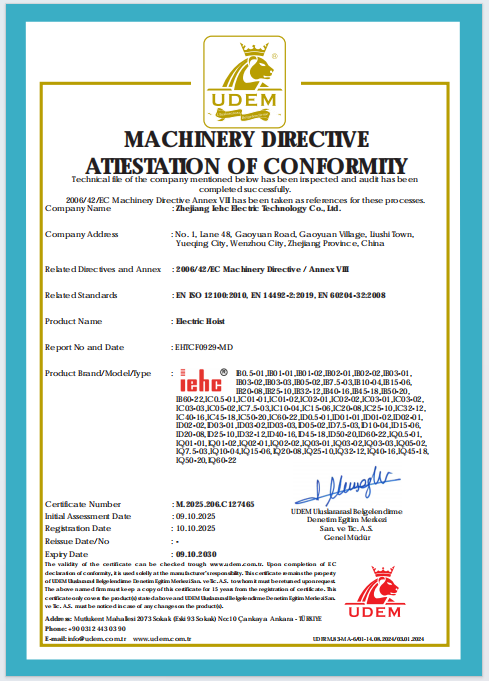
Take a concrete example from the same supplier's document set: attestation of conformity EHTCF0929-MD, issued by UDEM under the Machinery Directive, for the Turkey market, covering an electric hoist (model YJ02-02) against EN ISO 12100:2010, EN 14492-2:2019 and EN 60204-32:2008, issued on 9 October 2025 and valid to 9 October 2030. Read carefully, that document is strong evidence for that hoist in that market. It is not, by itself, evidence about a pendant station. This is not a criticism of the document; it is how scoped certification works — and it is exactly why the buyer should ask which document names the pendant model being purchased.
The supplier also states that its products comply with CE, UL and RoHS requirements. Ask for the declaration and the supporting test report for the specific model and voltage configuration on the order, and file them alongside the drawing revision. A compliance statement without a model reference is a company claim, not a product document.
Incoming inspection: the last check, not the first
On arrival, match the marking to the model code, count the units, operate each button and the emergency stop, inspect the cable and gland, and check for transit damage. Attach the pre-shipment record to the receiving document. If the two disagree, the disagreement is the finding — and it is far easier to resolve with a supplier that sent the record in the first place.
Wired Pendant vs Wireless Remote: What Changes in the Vetting
The three gates do not change with control type, but the volume of evidence inside each gate does. A wired station carries fewer subsystems, so the acceptance test has fewer items and fewer places for a failure to hide.
| Vetting item | Wired 5-button pendant (COP-5MSS-DD reference) | Wireless remote set | What to write into the order |
|---|---|---|---|
| Subsystems to qualify | Station, contact blocks, cable entry, cable | Station, transmitter, receiver, power source | List every subsystem with its model code |
| Power source | Taken from the machine control circuit | Battery or rechargeable pack in the transmitter | State the supply available at the machine |
| Pre-shipment test items | Buttons, E-stop, continuity, enclosure | The same, plus pairing and link check | Name the test items, not just "tested" |
| On-site fault diagnosis | Cable, button, contact block, E-stop — traceable with a meter | Adds pairing, channel and receiver checks | Ask for a fault-diagnosis sheet |
| Spares to hold | Cable, buttons, E-stop, contact blocks | The same, plus battery and receiver | Agree which spares ship with the first order |
| Installation dependencies | Cable route, length and gland | Receiver mounting, power, signal environment | Confirm site conditions before ordering |
The practical consequence is not that one control type is better. It is that a wireless set requires the buyer to qualify more items before the first order and to hold more spares afterwards. Where the machine's cable route is practical, the wired station keeps the vetting file short.
Maintenance and Spares: Vet the Part, Not the Whole Unit
A pendant station fails at its wear points, and the wear points are known: the cable at the entry and at the bend, the button operators, the emergency stop mechanism and the contact blocks. A supplier that can name those parts, map them to the model code and supply them individually is a different kind of partner from one that can only quote a complete unit.
Ask for a parts list against the model, and ask which items are field-replaceable without special tools. Ask whether the emergency stop is supplied as a complete assembly or as separate components, because a station that must be returned for an E-stop replacement is out of service for a shipping cycle rather than an hour.
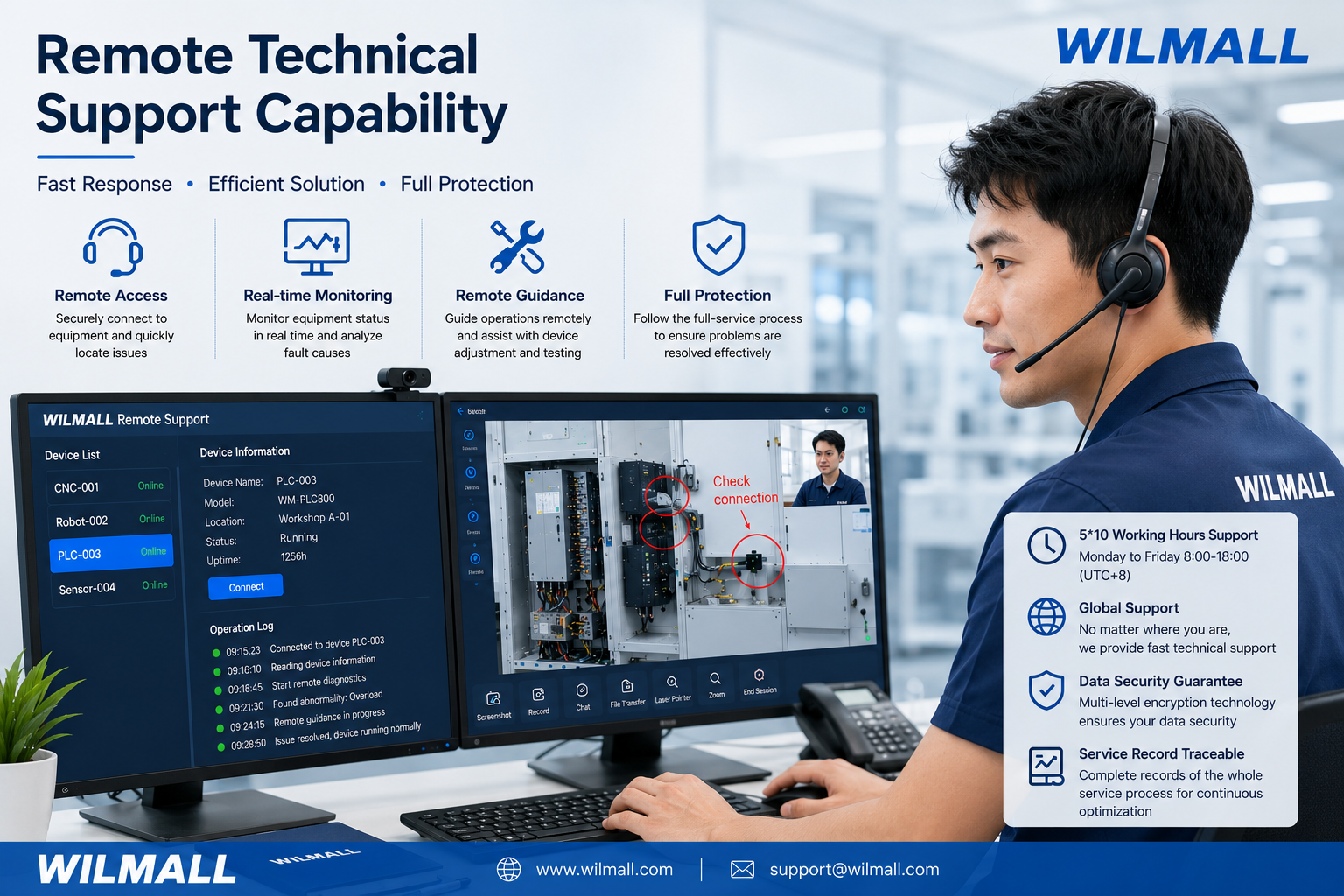
Support beyond the part matters too. Wilmall provides after-sales remote technical support to assist with product use and troubleshooting — the relevant capability when a maintenance team is diagnosing a station on a machine it did not install.
Documented deployments are worth reading, provided their limits are read with them. In Australia, an RV factory ordered 10 units of this pendant model for control-device applications; the project was completed within one year, and after one year of use the units were reported to be in stable operation, with ease of use highlighted by the customer. That is a real reference for a low-volume industrial application. It is not a performance guarantee for a different application, a different ambient condition or a much larger fleet, and it should be filed as one data point rather than as proof of durability.
Bulk and Wholesale Purchase: How the Gates Scale
Volume changes the weight of each gate, not the sequence. At 5 units, the sample is the evidence. At several hundred units, the pre-shipment record and the capacity commitment carry the order, and the drawing becomes the contract.
- Minimum order quantity. The stated minimum of 5 units applies the same terms to a trial as to a larger order, so the first order tests the supplier's documentation and not only the product.
- Capacity. A stated monthly capacity of 2,000 units is the reference for scheduling a bulk order. Ask where your order sits against that figure and which configurations are built to order. Button count (2, 4, 6 or 8) and single- or dual-speed operation are configuration choices that affect build sequence.
- Testing at volume. 100% testing on all products is useful only if the result is recorded. Ask whether the pre-shipment record is issued per lot, per order or per unit, and whether a copy travels with the shipment.
- OEM and ODM. For private-label or modified stations, agree drawing revision control and the approval step before production. A custom button function or contact material agreed verbally will not survive a production handover.
- Payment terms. With T/T 100%, payment precedes shipment. That makes the written acceptance criteria more valuable, not less: the test definition has to be agreed while the order is still negotiable, because it cannot be used as leverage after the balance has cleared.
For distributors buying for stock, the same logic applies one level down. The parts list from the maintenance conversation becomes the stocking list, and the configurations that are built to order rather than held in stock decide what can be promised to a local customer at short notice.
A Vetting Sequence You Can Run Before the First Payment
The three gates can be worked in a fixed order that fits inside a normal procurement cycle.
- Request the document set. Model-coded datasheet, dimensional drawing with revision, button and contact schedule, cable entry specification, declaration of conformity naming the standard edition, and a written terms sheet covering minimum order quantity, lead time, shipping term and acceptance criterion.
- Check documents against the configuration. Confirm the rating belongs to the contact blocks, the protection class covers the cable entry, the temperature range covers the site, and the certificate scope names the product you are buying.
- Order at the minimum quantity. Use the 5-unit minimum to test the supplier's documentation and packing as well as the product, then compare the delivered unit with the drawing.
- Fix the delivery commitment in writing. Named place for DAP, ship date counted from a defined trigger, HS code confirmed for the invoice, and a committed production slot for the quantity.
- Agree acceptance before payment. Because payment is 100% T/T, the pre-shipment test list, the record format and the remedy for a failed lot must be settled while the order is still open.
- Inspect on arrival and compare. Match the unit to the drawing and to the pre-shipment record; treat any difference as the finding, and keep both documents together for the repeat order.
A supplier that moves through these six steps without resistance has demonstrated the three things that matter: it can describe what it builds, it can schedule what it promises, and it can test what it ships.
FAQ
How do I confirm that a supplier's certificate covers the control pendant I am buying?
Read the scope line, the product field and the market field on the certificate, then compare them with the model code on your order. A document can be genuine and still irrelevant to your purchase: an attestation issued for an electric hoist, for example, covers that hoist and the standards listed on it, not a pendant station. Ask the supplier to identify the specific declaration that names your pendant model, the voltage configuration and the standard edition it references, and file it with the drawing revision.
Which specifications should a supplier be able to document for a 5-button pendant with emergency stop?
At minimum: the electrical rating of the switching element (AC 500V/10A for the COP-5MSS-DD), the enclosure protection class (IP65) including the cable entry, the operating temperature range (-25°C to +40°C), the number and function of buttons, the contact material and the button speed. All of these should appear on a drawing carrying the same model code as the quotation. Anything that appears only in an email is not yet a specification.
What purchasing terms should be fixed before a first order?
Five terms: minimum order quantity (5 units for this line), delivery term and named place (DAP), payment term (T/T 100%), acceptance criterion (pre-shipment test), and lead time (15 working days) counted from a defined trigger. Ask for all five on one document. Terms spread across a quotation, an email and a proforma invoice will be interpreted differently when something goes wrong.
What should I check on a sample before releasing a bulk order?
Compare the sample with the drawing: button count and functions, emergency stop latch and release, contact blocks and contact material, cable entry and gland, marking and model code. Then check the paperwork the sample arrived with. If a 5-unit order produces no test record and no drawing revision, a larger order will not produce them either. The sample tests the supplier's documentation as much as the product.
How should lead time and capacity be verified?
Ask for the ship date in calendar terms for your specific quantity, and ask what triggers the count — order confirmation or payment receipt. Compare your quantity with the stated monthly capacity of 2,000 units, and ask whether that figure covers standard configurations only. A lead time of 15 working days is meaningful when attached to a quantity, a configuration and a date; without those three, it is an average.
What support should remain after delivery?
Three things: a parts list mapped to the model so cable, buttons, emergency stop and contact blocks can be replaced individually; after-sales remote technical support for troubleshooting; and a documented repeat-order route that reuses the same drawing revision. Buyers can request a sample, a quotation for a specific configuration, or the product brochure through the same channel before committing to a bulk order.
Conclusion
Supplier vetting for control pendants is not a character judgement; it is a document trail. Capability closes when the rating, protection class, temperature range and button set appear on a drawing that matches the model code. Delivery closes when capacity, minimum quantity, lead time and shipping term are attached to a quantity, a place and a date. Acceptance closes when the pre-shipment test list, its record and the remedy for a failed lot are agreed before payment — which matters most when payment is 100% T/T and the goods ship afterwards.
The wired 5-button station makes this tractable. With AC 500V/10A, IP65 and -25°C to +40°C on the datasheet, a defined button set including emergency stop, and a parts list limited to cable, buttons, E-stop and contact blocks, there are few places for a specification to hide. That same short list is what makes the station workable for bulk and wholesale purchase: what has to be checked at 5 units is what has to be checked at 500.
Wilmall supplies control pendant stations with OEM and ODM production, a 5-unit minimum order quantity, a stated monthly capacity of 2,000 units and a 15-working-day lead time, and provides after-sales remote technical support. The product brochure, including configuration details, can be downloaded here before a sample or quotation is requested.

Have Questions or Need More Details?
Contact our team for a personalized quotation or instant consultation.
Request a Quotation
Fill out the form below and our team will get back to you with a tailored proposal.
WhatsApp Direct Chat
Prefer to chat in real-time? Message us on WhatsApp for instant assistance & quick answers.
- Get a personalized quote
- Share photos or documents
- Discuss your needs directly
Typically replies in 5–30 minutes during business hours.