Electric Hoist & Control Pendant Pairing: Application Guide
Electric Hoist & Control Pendant Pairing: Application Guide
An electric hoist and its control pendant are usually purchased as two separate line items, yet on site they behave as a single control circuit. When the pairing is wrong, the failure rarely appears on installation day. It appears weeks later: a contactor that will not hold in, a button that pits or welds closed after repeated switching, or an emergency stop that cannot be reached with a gloved hand. This guide explains how to match a control pendant to an electric hoist in crane, workshop, warehouse and mobile-equipment projects, using two documented products as a worked example — the COP-5MSS-DD pendant control station and the YJ02-02 electric chain hoist.
Short answer: for a 2,000 kg electric chain hoist such as the YJ02-02, a pendant must clear three checks before anything else. Electrical: the hoist's control circuit runs at 24–48 V, and the COP-5MSS-DD is rated AC 500 V / 10 A, so the pendant's contacts cover that circuit with margin. Environmental: the pendant is specified at IP65 with an ambient range of −25 °C to +40 °C at up to 90% humidity. Functional: a 5-button layout with a push-lock emergency stop covers hoist raise/lower plus one travel axis. Certification scope, customization and lead time are confirmed only after these three checks pass.
What Hoist–Pendant Mismatch Looks Like in Practice
A control pendant is not a passive accessory. It is the device that closes the control circuit which energises the hoist's contactors. In a standard sequence, the operator presses a direction button, the internal contact closes, a control signal reaches the equipment control circuit, the contactor or drive executes the motion, and the load moves. Every mismatch in that chain shows up as one of five recurring problems.
- Control-voltage mismatch. The pendant is chosen by appearance or price rather than by the voltage the hoist expects on its control circuit. The YJ02-02 carries a 110–480 V motor supply and a separate 24–48 V control voltage — two different circuits inside one machine.
- Insufficient contact rating. Contacts sized for a low-level signal circuit are used to switch a heavier control load, and they pit or weld earlier than expected. The COP-5MSS-DD is rated AC 500 V / 10 A.
- Wrong motion count. A single-axis pendant is ordered for a crane that also has trolley and bridge travel, so a function is lost or the station is rebuilt on site.
- Environment class too low. A pendant without an adequate IP class is installed where dust, washdown or rain intrusion is normal. The application data for the COP-5MSS-DD specifies IP65 and allows use in environments exposed to rain intrusion.
- Emergency stop not suited to the operator. The station lacks a push-lock emergency stop, or the stop is positioned where it cannot be reached while a load is moving.
None of these are capability problems. They are constraints problems — which is why a constraints-first checklist covering voltage, contact rating, environment, button layout and documentation resolves most pairing errors before a purchase order is raised.
Industry Background: Why Pendant Constraints Are Tightening
Pendant control remains a mainstream operator interface in lifting equipment even as wireless control expands, because a wired pendant provides a fixed, visible, hard-wired path between the operator and the machine. Market research reflects that steady position.
- The global market for pendant crane control stations was valued at approximately USD 275.60 million in 2025 and is projected to reach USD 423.80 million by 2032, a CAGR of 5.1% (Future Data Matrix).
- North America is the leading region for pendant crane control stations, holding a 34.2% share in 2025 (Future Data Matrix).
- The wider pendant control mechanical switch category was valued at USD 722.5 million in 2025 (Pendant Control Mechanical Switch Market Report).
- Leading manufacturers named in market research for pendant control stations include Schneider Electric, Eaton, Siemens, ABB and Rockwell Automation (Global Push Button Pendant Control Station Market Research Report 2026). Schneider Electric held a 15% share of the low-voltage equipment market as of 2024 (Accio / Pestel-Analysis).
Read the market numbers with their scope attached. The two 2025 figures above do not measure the same thing: one counts crane-specific pendant control stations (USD 275.60 million) and the other the broader mechanical switch category (USD 722.5 million). They should not be added together or compared directly. The useful conclusion for a project buyer is that pendant control is a mature, standardised category with published specifications, so selection can be driven by verifiable parameters rather than brand reputation alone.
Standardisation is the second background factor. Industrial pendant controllers are commonly specified against low-voltage switchgear and controlgear standards such as IEC 60947-5-1 and EN 60947-5-1. Hoisting machines add their own electrical requirements: the certification set attached to the YJ02-02 electric hoist references EN 60204-32:2008, EN 14492-2:2019 and EN ISO 12100:2010. A pendant that is compliant in isolation can still fail a project review if the documentation does not match the machine it is fitted to. That distinction drives the compliance question later in this guide.
The Paired Specification: COP-5MSS-DD and YJ02-02
The pendant side: COP-5MSS-DD
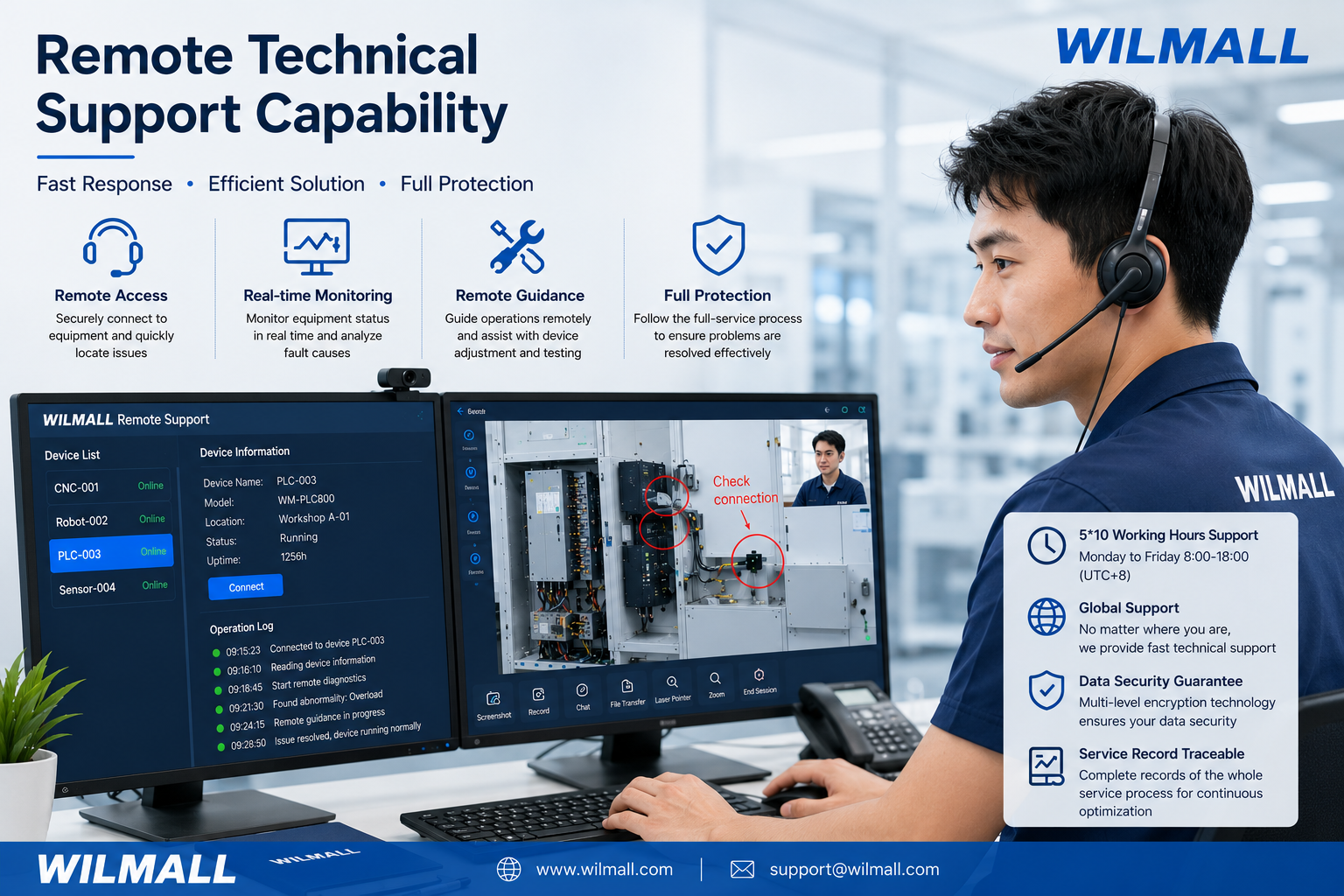
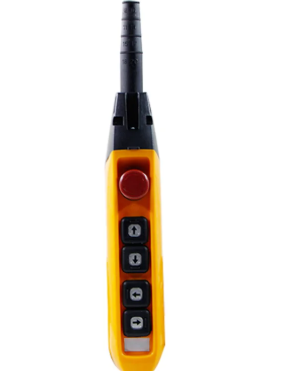
Wilmall is the brand of Wenzhou Mofan Electric Technology Co., Ltd., a Wenzhou-based manufacturer and one-stop B2B supplier of industrial automation and power distribution components, including control pendant stations, proximity sensors, rotary encoders, connectors and transformers. The COP-5MSS-DD is a 5-button handheld pendant control station with a push-lock emergency stop, housed in a plastic enclosure. Its rated voltage and current are AC 500 V, 10 A, and its stated applications are cranes, hoists, lifting equipment and industrial control systems.
The hoist side: YJ02-02
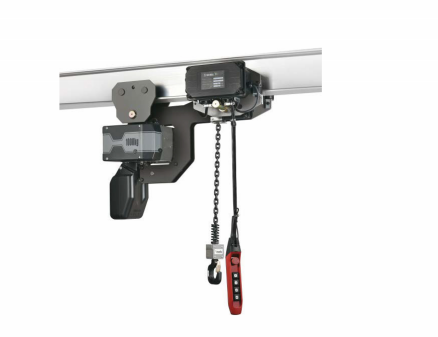
The YJ02-02 is an electric chain hoist with a 2,000 kg capacity, 4 m lifting height and 4 m/min lifting speed, driven by a 1.1 kW motor running at 1440 r/min. It accepts 3-phase or 2-phase supply between 110 V and 480 V, uses a 24–48 V control voltage, weighs 45/48 kg and carries an M5 rating. Its build combines a high-performance motor, a matched reducer and a compact electronic control system, and it is positioned for manufacturing, logistics and warehousing, construction engineering, mining, metallurgy, port transportation, nuclear power and aviation applications.
Pairing checkpoint table
The table below lists the checks a project engineer should run when the two items are specified together. Every value comes from the published product data of the two products.
| Pairing checkpoint | YJ02-02 electric chain hoist | COP-5MSS-DD pendant control station | Why it matters |
|---|---|---|---|
| Control circuit voltage | 24–48 V control voltage | Rated AC 500 V, 10 A contact capacity | The contact rating covers the control circuit, so repeated switching stays within specification |
| Motor supply (separate circuit) | 110–480 V, 3-phase or 2-phase, 1.1 kW, 1440 r/min | Switches the control circuit only, not the motor | Power wiring must stay physically separate from pendant cabling |
| Motion count | Hoist raise/lower; travel axes depend on the crane or trolley | 5-button layout with emergency stop | Covers hoist motion plus one travel axis without rebuilding the station |
| Environment | Industrial halls, warehouses, construction and port environments | IP65; ambient −25 °C to +40 °C; up to 90% humidity; suitable for environments exposed to rain intrusion | Dust, washdown and outdoor-adjacent duty are decided here, not at commissioning |
| Media restrictions | — | No explosive media; no media that corrodes metal, destroys rubber, or contains insulating gas/liquid | Excludes the pendant from hazardous-area duty without a project-specific review |
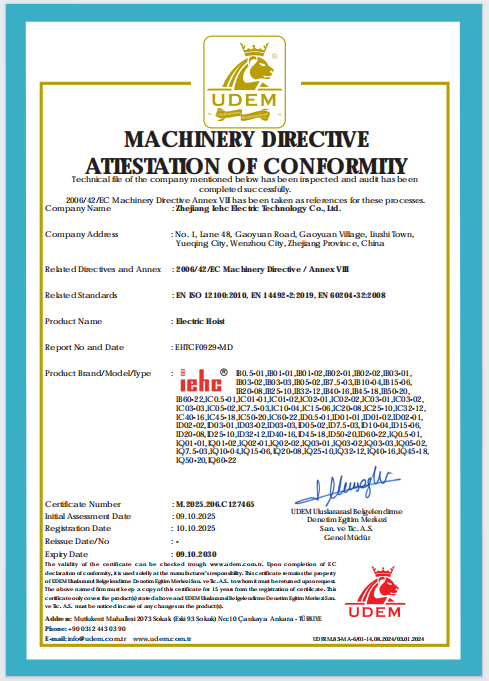
| Documentation | UDEM Machinery Directive Attestation of Conformity, certificate EHTCF0929-MD (Turkey market), valid 2025-10-09 to 2030-10-09, referencing EN 60204-32:2008, EN 14492-2:2019, EN ISO 12100:2010 | Supplied within a product range stated to comply with CE, UL and RoHS | Machine-level and component-level documents are different documents |
Why the electrical check comes first
Two circuits exist inside the same hoist. The motor runs on a 110–480 V three-phase or two-phase supply, while the pendant switches the separate 24–48 V control circuit. Because the COP-5MSS-DD is rated AC 500 V / 10 A, its contacts sit well above the control voltage and current of a circuit in this hoist class — the margin an engineer looks for when a pendant has to survive daily switching for years. The rule is simple: match the pendant to the control circuit, and keep the motor power wiring away from the pendant cable run.
Step-by-Step: Pairing a Control Pendant to an Electric Hoist
Step 1 — Start from the hoist nameplate
Record capacity, lifting height, lifting speed, motor power, rotation speed, phase count, supply voltage, control voltage and duty rating before looking at any pendant. For the YJ02-02 that reads: 2,000 kg, 4 m, 4 m/min, 1.1 kW, 1440 r/min, 3/2 phases, 110–480 V, 24–48 V control voltage, M5. Every later decision derives from these values.
Step 2 — Count the motions, then count the buttons
A pendant has to carry one button per motion command, plus the emergency stop. A hoist suspended from a fixed point needs raise/lower; a hoist on a trolley adds forward/back; an overhead travelling crane adds bridge travel as well. Wilmall's pendant customization capability covers 2, 4, 6 and 8 button configurations, with the COP-5MSS-DD supplied as a 5-button unit.
| Button layout (customization options available) | Functions typically assigned | Example equipment |
|---|---|---|
| 2 buttons | One motion pair, e.g. raise / lower | Single-axis hoist with a separate power isolator |
| 4 buttons | Two motion pairs, e.g. raise / lower plus one travel direction pair | Hoist with trolley on a fixed runway |
| 5 buttons (COP-5MSS-DD) | Raise / lower, one travel pair, plus push-lock emergency stop | 2,000 kg chain hoist on a monorail or jib |
| 6 buttons | Three motion pairs | Overhead travelling crane: hoist, trolley, bridge |
| 8 buttons | Three motion pairs plus auxiliary functions | Cranes with auxiliary motions or dual-speed operation |
Function assignment is project-specific and confirmed during customization. The table shows typical assignments for a given button count, not fixed product behaviour.
Step 3 — Verify the contact rating against the control circuit
Confirm that the pendant's rated voltage and current exceed the control circuit's working values with margin. The COP-5MSS-DD at AC 500 V / 10 A is specified for a 24–48 V control circuit of the type used by the YJ02-02. Contact point material can be specified as silver or copper during customization, which matters where switching frequency is high or where the ambient air is not clean.
Step 4 — Match the environmental class
Check three numbers against the site: IP class, ambient temperature range and humidity. The COP-5MSS-DD is specified at IP65 across −25 °C to +40 °C and up to 90% humidity, and its stated working conditions allow use in environments exposed to rain intrusion. Confirm separately that the environment contains no explosive media and no media that corrodes metal, destroys rubber, or contains insulating gas or liquid.
Step 5 — Confirm the emergency stop and enclosure
The emergency stop is the one control the operator must find without looking. The COP-5MSS-DD uses a push-lock emergency stop in a plastic handheld enclosure. During evaluation, check reach with a gloved hand and confirm the stop interrupts the control circuit that feeds the hoist contactor rather than a parallel indication circuit.
Step 6 — Plan cable routing, strain relief and pendant support
Route the pendant cable clear of the load path and away from heat sources, provide strain relief so the pendant's weight is carried by its support rather than by the terminals, and set the pendant height so the operator can keep the load in view while operating. These are installation decisions, not product options, but they decide whether a correctly specified pendant lasts.
Step 7 — Confirm documentation scope by market
Establish which document belongs to which item. The YJ02-02 electric hoist holds a Machinery Directive Attestation of Conformity issued by UDEM under certificate number EHTCF0929-MD for the Turkey market, valid from 2025-10-09 to 2030-10-09, referencing EN 60204-32:2008, EN 14492-2:2019 and EN ISO 12100:2010. The pendant is supplied within a product range stated to comply with CE, UL and RoHS. For destination markets with their own machine-level rules, confirm requirements before shipment rather than after arrival.
Step 8 — Validate with a sample and a documented test
Pairing is confirmed on the bench, not on the specification sheet. A practical validation covers four points: the contacts switch the hoist's 24–48 V control circuit reliably; the emergency stop interrupts the circuit; the button layout matches the actual motions; and the enclosure survives the site environment. Wilmall applies 100% testing to units before shipment, supports sample orders from a 5-unit minimum order quantity, and quotes a standard lead time of 15 working days. Remote technical support is available for wiring and configuration questions.
Use Cases: Where This Pairing Is Applied
Workshop overhead and jib cranes
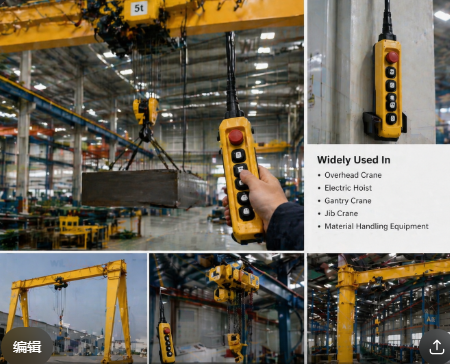
A 2,000 kg chain hoist on a monorail or jib is the classic 5-button application: raise, lower, one travel pair and a push-lock emergency stop in one handheld station. The M5 rating and 4 m/min lifting speed of the YJ02-02 suit repetitive workshop handling where precise stopping matters more than speed.
Warehouses and logistics operations
Logistics and warehousing is one of the stated application industries for the YJ02-02. In these environments the pendant spends most of its life in a dusty, sometimes damp atmosphere, which is where the IP65 rating and the −25 °C to +40 °C ambient window do their work. Cold-store and unheated loading-bay areas should be checked against that lower limit.
Mobile equipment and non-fixed installations
Wired local control also suits mobile and semi-portable equipment where a fixed operator position is not guaranteed. The COP-5MSS-DD is documented for industrial control systems beyond fixed cranes, so it can serve hoist, crane and mobile equipment control with the same button logic.
Australia: RV production line case
An Australian RV factory installed 10 units of the COP-5MSS-DD as control devices on its production line. After one year of operation the reported result is stable operation, with the highlight noted by the user being ease of use. Australia is also one of Wilmall's main export markets alongside Pakistan, South Korea and Malaysia, alongside an export ratio of 80%. For Australian sites, the practical pairing checks are the same three: control-circuit voltage, IP class, and the ambient range against local summer conditions.
Turkey and other document-driven markets
Where a project requires Machinery Directive documentation, the pairing discussion shifts from button count to paperwork. The YJ02-02 electric hoist carries UDEM certificate EHTCF0929-MD for the Turkey market, which is a hoist-level document; pendant documentation is handled separately. Buyers entering document-driven markets should confirm the full document set for both items at quotation stage.
FAQ: Control Pendant and Electric Hoist Pairing
Does the COP-5MSS-DD control pendant come with certification for crane and hoist projects?
The pendant is supplied within a product range that the manufacturer states complies with international certifications such as CE, UL and RoHS. Certification attached to a specific machine is a separate document: the YJ02-02 electric chain hoist holds a Machinery Directive Attestation of Conformity issued by UDEM under certificate number EHTCF0929-MD for the Turkey market, valid from 2025-10-09 to 2030-10-09, referencing EN 60204-32:2008, EN 14492-2:2019 and EN ISO 12100:2010. Industrial pendant controllers are also commonly specified against low-voltage switchgear and controlgear standards such as IEC 60947-5-1 and EN 60947-5-1. Buyers should confirm which document applies to which item rather than assuming one certificate covers the whole assembly.
Can the pendant be customized to match my hoist's motions?
Yes. Wilmall operates as a manufacturer, supplier, wholesaler and OEM/ODM factory, and the customizable elements for pendant control stations include contact point material (silver or copper), the emergency braking button function, the number of buttons (2, 4, 6 or 8) and button speed (single speed or dual speed). The COP-5MSS-DD itself is a 5-button handheld station with emergency stop. Monthly capacity is 2,000 units, supported by a 3-engineer R&D team, with 100% testing before shipment.
What drives the cost of a hoist pendant control station?
Cost is configuration-dependent rather than fixed, which is why no single figure applies across projects. The variables that move it are button count, contact point material (silver versus copper), whether dual-speed switching is required, the enclosure and IP class, cable length and strain relief, and the documentation or testing scope required by the destination market. Where a project needs to compare several variants, a 5-unit minimum order quantity makes side-by-side evaluation practical before a volume commitment.
Can I test a pendant with my hoist before ordering in volume?
Yes. Sample pendants can be supplied against a 5-unit minimum order quantity, and every unit is 100% tested before shipment. Because the pairing depends on the actual control circuit, the useful test is not button feel alone: confirm that the contacts switch the hoist's 24–48 V control circuit reliably, that the emergency stop interrupts the circuit, that the 5-button layout matches the real motions, and that the IP65 enclosure suits the site environment. Remote technical support is provided for configuration and installation questions, and a sample request can be raised through wilmall.com or sales@wilmall.com.
What is the standard lead time and ongoing support for pendant orders?
Standard lead time is 15 working days, against a monthly capacity of 2,000 units. Export experience covers Australia, Pakistan and South Korea, and after delivery Wilmall provides remote technical support for wiring, configuration and pairing questions. For a project quotation, send the hoist nameplate data together with the required button layout and destination market, and the engineering team will confirm the matching pendant configuration.
Conclusion: Pair the Circuit, Not Just the Parts
Pairing an electric hoist with a control pendant comes down to three questions asked in the right order. First, does the pendant's contact rating cover the hoist's control circuit — the COP-5MSS-DD at AC 500 V / 10 A against the YJ02-02's 24–48 V control voltage. Second, does the enclosure class survive the site — IP65, −25 °C to +40 °C, 90% humidity, and no explosive or corrosive media. Third, does the button layout match the machine's actual motions, with an emergency stop the operator can reach. Certification, customization and lead time then follow as confirmations rather than assumptions.
Get those three right and the pendant stops being a consumable. Get them wrong and the same unit returns to the spare-parts shelf within a year — which is the real cost of an unmatched pair.
Ready to pair a pendant with your hoist?
Send the hoist nameplate data — supply voltage, control voltage, duty rating and the number of motions you need — and Wilmall's engineering team will confirm the matching pendant configuration, button layout and documentation set for your market.
Catalogue: Download the Wilmall product catalogue (PDF)
Contact: Email sales@wilmall.com · Tel / WhatsApp +86 19730226757 · Website wilmall.com