
Replacement Part or New-Build Component? A Comparison Guide for Control Pendant Buyers
Two buyers can order the same control pendant and still be running two different purchasing processes. One buyer is restoring a crane or hoist that already exists and needs a device that fits what is installed. The other is writing a pendant into a bill of materials that will be repeated across dozens or hundreds of units, where the priority is that every unit arrives identical, documented and re-orderable.
The device at the centre of both cases can be the same: a 5-button station with a push-lock emergency stop, rated AC 500 V / 10 A, running a 24–48 V control circuit, sealed to IP65 and cleared for -25 °C to +40 °C at up to 90% relative humidity. Wilmall's COP-5MSS-DD is built in exactly that configuration. What changes is the order in which the buyer checks the facts, the evidence worth demanding, and the commercial terms that decide whether the purchase is repeatable.
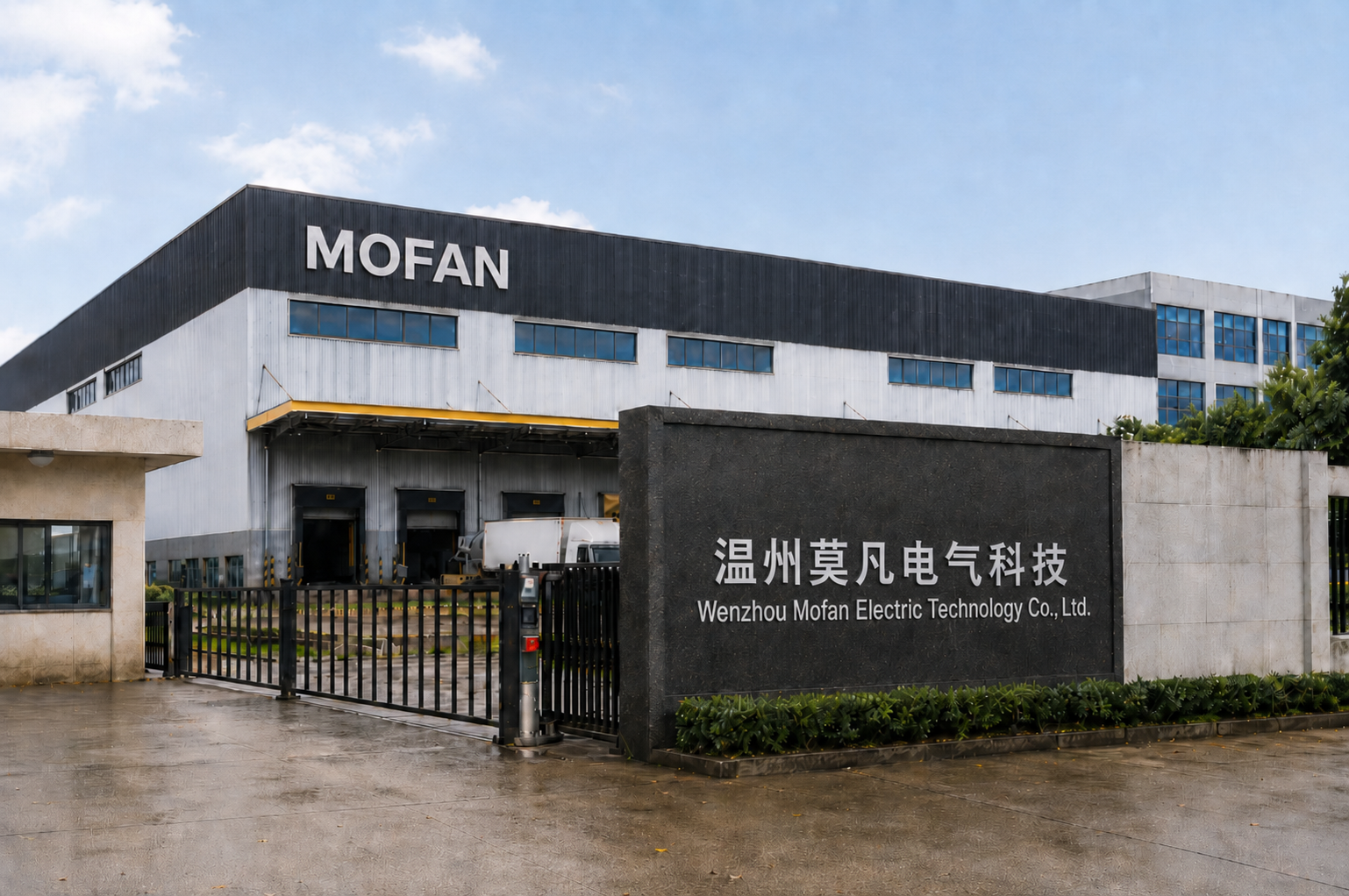
Wilmall is the brand of Wenzhou Mofan Electric Technology Co., Ltd., a manufacturer and one-stop B2B supplier of industrial automation and power distribution components based in Yueqing, Wenzhou, China, supplying industrial users, electrical contractors and distributors across 30+ countries.
The short answer
- Replacement purchase: start from the crane. Confirm the control circuit voltage first, then the environmental envelope, then the contact rating, then terms.
- New-build or OEM purchase: start from the bill of materials. Freeze the electrical and environmental specification, then settle customization, acceptance criteria and repeatable commercial terms.
- Both routes: verify the pendant against the control circuit it will switch, not against the motor it will command.

Why the Two Routes Get Confused
Both purchases end the same way — a pendant station arrives at a loading dock and gets installed. Because the datasheet looks identical in both cases, buyers tend to apply one checklist to both. That is where the trouble starts.
The risk profiles are not the same. A replacement pendant carries installation risk: the mismatch is discovered on site, at the moment the crane is already out of service. A new-build pendant carries multiplication risk: a wrong specification is not discovered on one crane, it is discovered on every unit built from that bill of materials, often after the hoists have already been assembled, labelled and packed.
A replacement buyer is optimising for one thing above all others — that the unit installed today matches the unit that failed, wire for wire and volt for volt. A new-build buyer is optimising for something structurally different — that the specification is stable enough to survive a production run, an incoming inspection, a distributor's spare-parts list and a second purchase order eight months later.
The side-by-side comparison that follows separates the criteria that are genuinely identical from the ones that diverge.
Industry Background: A Concentrated Supply Base and a Moving Standard
Third-party market research covering the push button pendant control station category puts the global market value at USD 1.02 billion in 2025, with a projected path to USD 1.48 billion by 2034 — a compound annual growth rate of 4.1%. The same research places the top five players at more than 45% of 2025 market share.
Two conclusions matter to buyers. First, a concentrated tier of large suppliers coexists with a long tail of smaller manufacturers, so the specification evidence you demand has to carry more weight than brand familiarity. Second, in a market growing in single digits, most purchasing decisions are not about switching technology — they are about standardising an existing one and making it repeatable.
The technical reference point has also moved. IEC 60947-5-1:2024 is the current edition of the standard covering electromechanical control circuit devices, the product family that includes pendant switches. On the customs side, industrial pendant stations are typically classified under HS 8537.10 (boards and panels for voltages not exceeding 1,000 V) or HS 8536.50 (other switches). For a replacement buyer these references are usually a compliance footnote; for a new-build or distribution buyer they determine documentation, market access and how a shipment is cleared.
Six Criteria Where the Two Routes Genuinely Diverge
1. Control Voltage and Contact Rating
The rating that decides whether a pendant works is the control circuit voltage, not the motor rating. The COP-5MSS-DD is specified for a 24–48 V control circuit and carries an AC 500 V / 10 A contact rating. Those are two different numbers serving two different purposes, and confusing them is the most common reason a newly installed replacement pendant leaves a hoist unresponsive.
A replacement buyer must confirm the existing control circuit voltage at the panel before ordering, because the pendant is being matched to a circuit someone else designed. A new-build buyer writes that voltage into the bill of materials once and then verifies it against every hoist variant in the range. The new-build route is easier on paper and harder to correct later.
2. Environmental Envelope: IP65, Temperature and Humidity
IP65 protection, a -25 °C to +40 °C working range and tolerance of up to 90% relative humidity describe the conditions the pendant is built to survive. On the replacement route, the question is narrow: does this specific installation sit inside that envelope? A cold store, a wash-down area or a humid warehouse handling floor is where the answer stops being automatic.
On the new-build route the question widens. The same pendant model may ship to sites in several countries and several building types, so the envelope has to be tested against the whole target portfolio, not against one installation. A buyer who specifies from a single site risks a specification that fails in the second market.
3. Housing Material and Mechanical Interface
Wilmall specifies a durable housing for its industrial hoist control stations. In both routes the exact housing material, cable entry arrangement and mounting points should be confirmed in the datasheet or the offer, not assumed from a photograph.
The difference is what the buyer does with that confirmation. A replacement buyer needs the new unit to fit the existing cable routing, strain relief and mounting position, because nobody is redrilling the trolley for a spare part. A new-build buyer has the freedom to define those details — and therefore the obligation to define them once, clearly, so that the second and third production batches match the first.
4. Acceptance Criteria and Test Evidence
Wilmall states a pre-shipment test as the acceptance criterion on pendant orders, and all products undergo 100% testing before shipment. For a replacement buyer that is largely a delivery guarantee: the unit arrives functional, and the final proof is a functional test at installation, including verification of the push-lock emergency stop.
For a new-build buyer the same criterion becomes a quality system input. Batch records, the scope of the pre-shipment test and an incoming inspection sample plan need to be agreed before the first production order, because the cost of discovering a defective batch is measured in rework across hundreds of assembled hoists, not in one delayed repair.
5. Purchasing Terms and Order Structure
Wilmall's standard commercial terms are a minimum order quantity of 5 units, DAP delivery, pre-shipment test acceptance and T/T 100% payment. Typical production lead time is 15 working days against a monthly production capacity of 2,000 units.
A replacement buyer can work comfortably inside those terms: five units covers the failed pendant plus a small spares holding, and the lead time is compatible with a planned repair window. A new-build or OEM buyer has to map the same terms onto a production schedule — MOQ against pilot-run size, lead time against assembly line takt, capacity against forecast. A distributor adds a third dimension: whether the terms support a stock position across a resale catalogue rather than a single project.
6. Maintenance Scope and Lifecycle
A wired pendant keeps maintenance simple. The inspection scope is the cable, the buttons, the emergency stop and the contact blocks. There is no battery to replace and no wireless pairing to re-establish, which means a shorter spare-parts list and a shorter technician briefing.
The trade-off is structural and should be stated plainly: a wired pendant requires a physical cable run between the station and the hoist, and that cable is itself an inspection item. Buyers who need the operator to move freely beyond a cable's reach are solving a different problem. For buyers whose operators work within a fixed handling zone — the typical warehouse or workshop case — the wired design's lower system complexity relative to a transmitter-and-receiver remote control set is what makes it easier to standardise in bulk or wholesale purchasing.
Worked Example: COP-5MSS-DD on a YJ02-02 Electric Chain Hoist
Consider the YJ02-02 electric chain hoist at 2,000 kg capacity, 4 m lift and 1.1 kW. The same hoist can generate both purchase routes.
Route A — Replacing the Pendant on an Installed Hoist
The hoist is already in service in a warehouse handling area. Its pendant fails. The buyer's task is to restore operation without changing anything else on the crane.
- Confirm the control circuit voltage is within the 24–48 V range the COP-5MSS-DD expects.
- Confirm the contact rating — AC 500 V / 10 A — covers what the buttons switch in the existing panel.
- Check the site envelope against IP65, -25 °C to +40 °C and 90% relative humidity, particularly if the hoist works near wash-down or in an unheated bay.
- Confirm the button set — 5 buttons plus a push-lock emergency stop — reflects the motions the hoist actually performs.
- Order through the standard terms: 5-unit minimum, DAP delivery, pre-shipment test, T/T 100%.
- Test at installation: hoist functions first, then the emergency stop, then a recording of the as-fitted configuration for next time.
Route B — Specifying the Pendant Into a New Build
An OEM is building the same YJ02-02 hoist in batches for several markets. The pendant is now a line item in a bill of materials, not a repair.
- Freeze the electrical specification: 24–48 V control circuit, AC 500 V / 10 A contact rating, 5 buttons plus push-lock emergency stop.
- Freeze the environmental specification across the target markets: IP65, -25 °C to +40 °C, 90% relative humidity.
- Define the mechanical and labelling details — housing confirmation, cable entry, button legends — so that batch two matches batch one.
- Agree customization scope with the OEM/ODM side of the supplier before the first order, not after.
- Agree terms and capacity: 5-unit MOQ for the pilot, 15 working days typical lead time, 2,000 units per month capacity for series production, pre-shipment test acceptance.
- Build the incoming inspection around the pre-shipment test and the emergency stop function.
Step-by-Step Breakdown
Route A — Replacement Decision Sequence
- Record the failed unit. Button count, legends, emergency stop type, cable entry and the panel it connects to.
- Measure the control circuit voltage. This single number decides compatibility more often than any other.
- Check the load side. Confirm the AC 500 V / 10 A contact rating is appropriate for the circuit being switched.
- Check the environment. IP65 against dust and water ingress; -25 °C to +40 °C and 90% relative humidity against the actual bay.
- Order with spares. The 5-unit minimum is a practical spares-holding quantity for a single asset.
- Install and verify. Function test every button, then the push-lock emergency stop, then log the fitted configuration.
Route B — New-Build Decision Sequence
- Write the pendant into the bill of materials with its electrical ratings, not with a generic description.
- Validate the specification against the market portfolio — the sites and conditions the finished hoist will actually serve.
- Lock the mechanical interface: housing, cable entry, mounting and button legends.
- Confirm customization and OEM/ODM scope in writing before the pilot order.
- Agree the commercial frame: MOQ 5 units, DAP, T/T 100%, pre-shipment test, 15 working days typical lead time, 2,000 units per month capacity.
- Set the re-order trigger and keep the specification document under version control so subsequent batches stay identical.
Use Cases
Warehouse Handling Site — Single Hoist Retrofit
A distribution centre operates a 2,000 kg chain hoist over a loading bay and needs one pendant replaced. The replacement route applies: confirm the 24–48 V control voltage, confirm IP65 is enough for the bay's humidity, order the 5-unit minimum, and hold the remainder as spares. Total decision scope: one device, one site, one shift.
Hoist OEM — Series Build
A hoist manufacturer assembling the YJ02-02 platform in batches specifies the pendant once and repeats it. The new-build route applies: the electrical and environmental specification is frozen, the button legends are fixed, the OEM/ODM scope is agreed up front, and production is planned against the 15-working-day typical lead time and the 2,000-unit monthly capacity.
Distributor — Stock and Resale
An industrial distributor supplies pendants to several end users and carries stock. Here the wired design's advantage is commercial rather than technical: lower system complexity than a transmitter-and-receiver set, no battery or pairing support burden, and a maintenance scope limited to cable, buttons, emergency stop and contact blocks. That combination is what makes the item workable as a catalogue line rather than a project-only part.
Side-by-Side Comparison
| Decision criterion | Replacement part route | New-build component route |
|---|---|---|
| Starting point | The installed crane or hoist | The bill of materials |
| Primary risk | Incompatibility discovered at installation | An error replicated across a production batch |
| Control voltage check | Measured at the existing panel; must fall within 24–48 V | Written into the BOM and verified across all hoist variants |
| Contact rating | AC 500 V / 10 A confirmed against the existing circuit | AC 500 V / 10 A fixed as a specification line item |
| Environmental check | One site against IP65, -25 °C to +40 °C, 90% RH | Whole target market portfolio against the same envelope |
| Housing and interface | Must match existing routing and mounting | Defined by the buyer and locked for repeatability |
| Acceptance criteria | Pre-shipment test plus installation function test | Pre-shipment test plus an agreed incoming inspection plan |
| Order size | MOQ 5 units, usually one unit plus spares | MOQ 5 units for piloting, scaled to 2,000 units/month capacity |
| Delivery and payment | DAP, T/T 100% | DAP, T/T 100%, scheduled against 15 working days typical lead time |
| Maintenance scope | Cable, buttons, emergency stop, contact blocks | Same scope, formalised into the service and spares documentation |
| Best fit | Single-asset repair and obsolescence replacement | OEM programmes, wholesale stock, distributor catalogues |
Table values reflect Wilmall's published pendant configuration and commercial terms. Buyers should confirm current terms and configuration in the quotation for their specific order.

Frequently Asked Questions
Does a replacement pendant have to comply with IEC 60947-5-1:2024, and how do I confirm the COP-5MSS-DD matches my crane circuit?
IEC 60947-5-1:2024 is the current edition of the standard covering electromechanical control circuit devices, the family that includes pendant switches, so compliance documentation is a reasonable request for any industrial pendant purchase. On the matching question, confirm three numbers before ordering: the control circuit voltage at the panel, which must fall within the 24–48 V range; the contact rating of AC 500 V / 10 A against the circuit being switched; and the environmental conditions against IP65, -25 °C to +40 °C and up to 90% relative humidity. If the control voltage at the panel is not within the pendant's range, the pendant will not operate the hoist regardless of how the wiring is terminated.
Can the same pendant be used as a new-build component and customised for OEM orders?
Yes. The COP-5MSS-DD platform is suitable for both routes, and Wilmall provides OEM/ODM customisation, factory supply and wholesale supply for industrial hoist control stations used on cranes, lifts and hoisting equipment. The practical difference is timing: a replacement buyer confirms an existing specification, while an OEM buyer should settle the customisation scope — button legends, cable entry, packaging or labelling requirements — before the first production order, so that later batches can be matched to a fixed reference. Wilmall's engineering team supports selection and customisation discussions as part of the order process.
What are the purchasing terms for a pendant order, and do they work for both single replacements and bulk purchasing?
Wilmall's standard terms are a minimum order quantity of 5 units, DAP delivery terms, pre-shipment test as the acceptance criterion, and T/T 100% payment terms. For a single replacement, five units typically means the failed pendant plus a small spares holding, which is a practical buffer for a critical asset. For bulk or wholesale purchasing, the same MOQ supports a pilot order before scaling, and production capacity of 2,000 units per month supports series demand. Specific requirements outside these terms should be raised during quotation.
How is a pendant validated before shipment, and what should the buyer check on arrival?
All Wilmall products undergo 100% testing before shipment, and pre-shipment test is the stated acceptance criterion on pendant orders. On the buyer side, the arrival check for a replacement unit should cover every button function and the push-lock emergency stop, plus a visual inspection of the cable and housing for transit damage. For a new-build or OEM order, the arrival check should follow the incoming inspection plan agreed before production, so that each batch is judged against the same criteria and any deviation is caught before the hoists are assembled.
What is the production lead time, and how should it be planned into a build schedule?
Typical production lead time is 15 working days, against a monthly production capacity of 2,000 units. For a replacement order, that lead time fits comfortably inside a planned repair window and should be added to transit time under DAP terms. For a new-build programme, the lead time should be planned against assembly line demand rather than treated as a one-off delivery date, and the re-order point should be set so that pendant stock never becomes the constraint holding up a hoist build. Buyers who need to confirm current lead time and configuration for a specific order can request a quotation and current product catalogue from the Wilmall team.
Next step: samples, quotations and the product catalogue
Whether you are matching a single replacement pendant to an installed hoist or specifying a pendant into a new-build programme, the fastest way to close the decision is to compare your site data against the published configuration and confirm the commercial terms in writing.
Contact Wilmall — Mia, sales@wilmall.com, tel/WhatsApp +86 19730226757 — to request a sample, a quotation or the current catalogue. The product brochure is available for download here: Wilmall product brochure (PDF). Company details and product pages are published at wilmall.com.
Conclusion
A replacement part and a new-build component are not two products — they are two decision processes applied to the same device. The COP-5MSS-DD carries the ratings that make it usable in both: AC 500 V / 10 A contacts, a 24–48 V control circuit, IP65 protection, a -25 °C to +40 °C working range and tolerance of up to 90% relative humidity, with a push-lock emergency stop on a 5-button station.
The buyer's job is to know which process they are in. If the crane exists, confirm the control voltage first, match the environment, and use the 5-unit minimum as a spares opportunity. If the hoist is being built, freeze the specification, settle customisation and acceptance criteria before the pilot, and plan against a 15-working-day typical lead time and 2,000 units of monthly capacity. Getting that sequence right is what separates a pendant that fits from a pendant programme that survives its second purchase order.
Have Questions or Need More Details?
Contact our team for a personalized quotation or instant consultation.
Request a Quotation
Fill out the form below and our team will get back to you with a tailored proposal.
WhatsApp Direct Chat
Prefer to chat in real-time? Message us on WhatsApp for instant assistance & quick answers.
- Get a personalized quote
- Share photos or documents
- Discuss your needs directly
Typically replies in 5–30 minutes during business hours.