How ODM Customization Fits Pad Mounted Transformers to Local Grids
How ODM Customization Fits Pad Mounted Transformers to North American Grid Rules — Without On-Site Modification
Zero on-site modification is an engineering outcome, not a sales claim. A pad mounted transformer reaches the pad ready to energize only when four interfaces are settled at the factory: the voltage, connection group and tap arrangement approved in the interconnection study; the enclosure, pad and cable-entry geometry the crew will actually bolt to; the switching, protection and communication interfaces named in the utility specification; and the nameplate and test records the inspector will compare against the approved drawing set. ODM customization is the mechanism that closes those four interfaces before the first coil is wound.
Winley Electric (Xiamen Winley Electric Co., Ltd) is a transformer manufacturer founded in 2014 in Xiamen, China, producing three-phase and single-phase pad mounted transformers with UL and cUL listings and exporting mainly to North and South America. This article explains, from an engineering rather than a catalog perspective, how an ODM program is structured so a custom pad mounted transformer fits local grid rules on arrival — and what buyers should require at each stage to keep the work in the factory instead of at the pad.
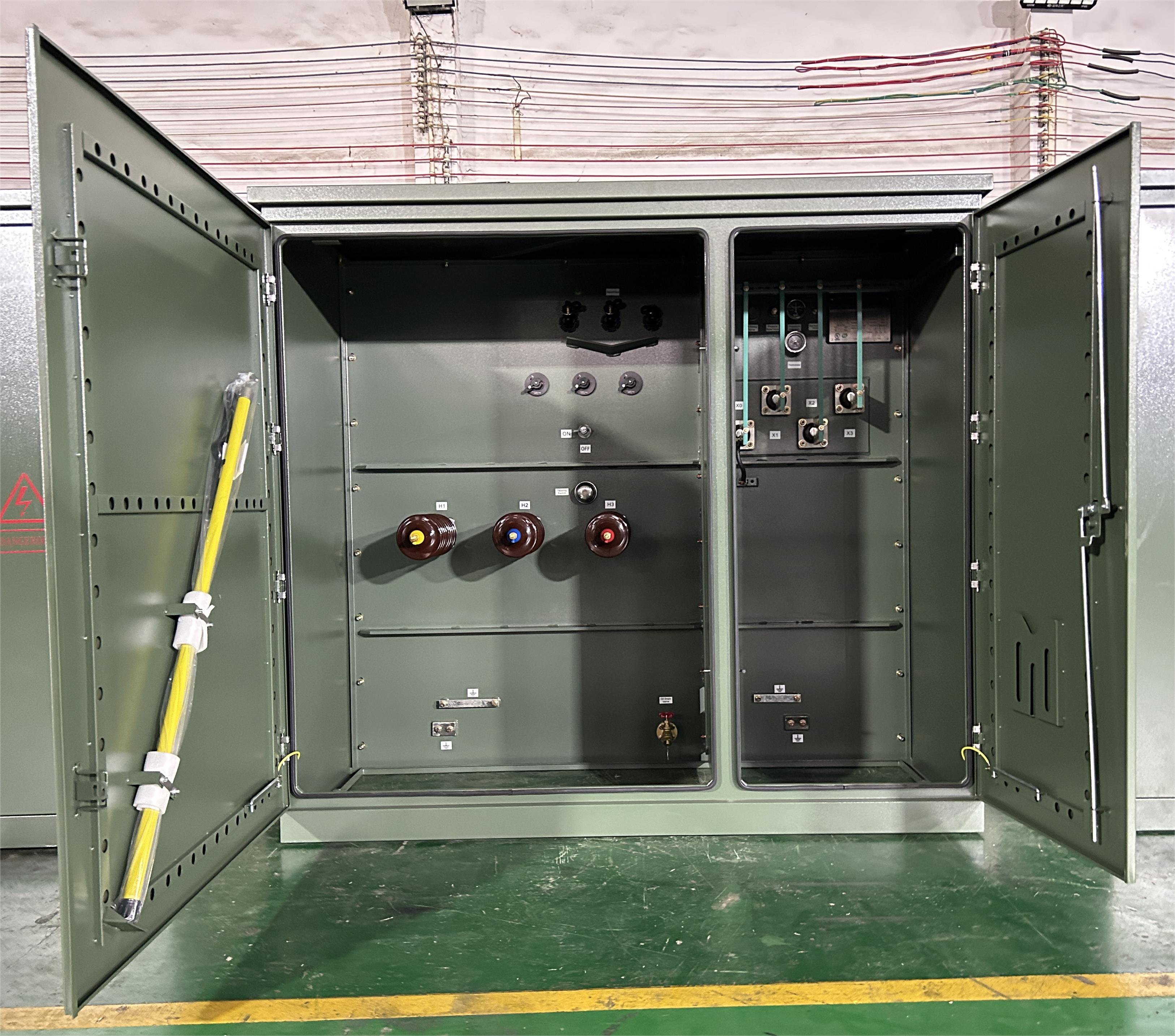
A 500 kVA three phase pad mounted transformer built with radial feed, 12.87 kV to 240 V multi-tap voltage regulation and UL certification — the electrical interface fixed at the factory rather than at the pad.
What "Zero On-Site Modification" Actually Means
Definition: On-site modification is any change made to a pad mounted transformer after delivery to the pad — re-tapping to correct a voltage mismatch, re-drilling or adapting cable entries, substituting elbows or bushings, relocating or shimming the cabinet, re-wiring protection circuits, or re-rating the unit. A project is zero field modification when none of these steps is needed to pass inspection and energize.
Field work is a symptom, not a cause. It appears when one of four interface groups was never fixed before production.
- Electrical interface. Ratio, connection group, taps, impedance and fault withstand must match the interconnection study rather than a catalog default. In the ZGS three phase range this covers 45–5,000 kVA with primary voltages of 34.5 kV, 24.94 kV, 13.8 kV, 13.2 kV, 12.47 kV, 4.16 kV or others, and secondary voltages of 480Y/277, 208Y/120, 240Y/120, 690Y/400 or others.
- Physical interface. Cabinet size, protection class, bushing and bayonet orientation, cable-entry height and pad bolt pattern must match the civil drawing the contractor has already built.
- Control interface. Protection devices, switches, gauges and communication ports must match the utility coordination and SCADA requirements for that feeder.
- Documentation interface. Nameplate data, drawing set and test records must match what the utility approved, because that is what the inspector reads.
When any of these is left to be "adjusted in the field", the cost is rarely the component itself. It is the re-inspection, the second crew visit, and the energization date.
Why North American Grid Rules Push the Work Back to the Factory
Three-phase pad-mounted distribution transformers in North America are governed by IEEE C57.12.34, which covers ratings up to 10 MVA and 34.5 kV. Enclosure integrity for pad-mounted equipment installed in public-access areas is addressed separately by IEEE C57.12.28-2023, and single-phase pad-mounted transformers rated 250 kVA and below fall under IEEE C57.12.38-2025. Alongside the standards sit listing and efficiency obligations: UL/cUL listing for the product family, and DOE 2016 energy conservation requirements for distribution transformers.
What the standards do not do is standardize utility practice. Each utility publishes its own construction and interconnection requirements — feed arrangement, protection package, metering, and the drawing format it will accept. Two projects of identical rating in the same state can therefore require different cabinets, different cable entries and different protection content. That variation is exactly what a catalog unit cannot absorb.
Demand pressure makes the problem sharper. Market Research Future estimated the U.S. pad-mounted transformer market at USD 3.75 billion in 2024, with grid modernization and underground cabling among the drivers. When delivery schedules tighten, the temptation is to buy a standard unit and adapt it on site — which is precisely the decision that generates field rework.
The practical consequence: any requirement that is not written into the drawing set before production becomes a field activity after delivery. ODM engineering exists to move that activity upstream.
The ODM Customization Envelope: What Can Be Locked Before Build
In an OEM arrangement the buyer's design is manufactured. In an ODM arrangement the manufacturer's engineering team takes the buyer's application requirements and returns a finished, documented design. For pad mounted transformers, customization happens on both the electrical and the mechanical layer, and the envelope reaches up to 10 MVA and 36 kV.
The customizable content named in the manufacturer's own capability statement includes electrical performance (rated capacity, voltage, connection group), structure and appearance (model, cabinet size, protection class), insulation fluid, protection devices, switches and gauges, tank coating, extreme-environment adaptations, and extended functions such as monitoring, protection and communication interfaces — all built to customer drawings. Where a project specifies a particular component brand, parts from suppliers such as Qualitrol and Eaton Cooper can be integrated into the design.
| Customization dimension | What the ODM process locks | North American input that drives the decision |
|---|---|---|
| Rated capacity | 45–5,000 kVA three phase (engineering capability to 10 MVA); 15–250 kVA single phase, with maximum capability to 833 kVA | Load calculation, spare capacity, DOE 2016 efficiency at the chosen rating |
| Primary and secondary voltage | 34.5 kV, 24.94 kV, 13.8 kV, 13.2 kV, 12.47 kV, 4.16 kV or others; secondary 480Y/277, 208Y/120, 240Y/120, 690Y/400 or others | Interconnection study, existing feeder voltage class |
| Connection group and taps | Winding connection and tap arrangement set per approved drawing | Utility voltage-regulation practice and seasonal voltage band |
| Feed type | Loop feed or radial feed | Whether the utility requires sectionalizing or a single radial tap |
| Enclosure, cabinet and protection class | Model, cabinet size and protection class built to the buyer drawing | IEEE C57.12.28-2023 enclosure integrity, NEMA rating, public-access exposure |
| Insulation fluid and materials | Fluid selection; copper, aluminum or steel construction | Efficiency target, loading profile, environmental constraints |
| Switching, protection and gauges | Protection devices, switches and gauges specified per drawing; Qualitrol and Eaton Cooper components can be integrated | Fault current and coordination with upstream reclosers |
| Monitoring and communication | Monitoring, protection and communication interfaces as extended functions | SCADA and remote-monitoring requirements |
| Tank coating and environment | Coating system and extreme-environment adaptations | Coastal salt, humidity, temperature range |
| Nameplate and documentation | Nameplate data and drawing set frozen before production | Inspector comparison against the utility-approved drawings |
Common North American ratings such as 500 kVA, 750 kVA, 1,000 kVA and 2,000 kVA fall inside these ranges, which is why the same platform can serve a residential subdivision, an edge data center and a solar collector substation.
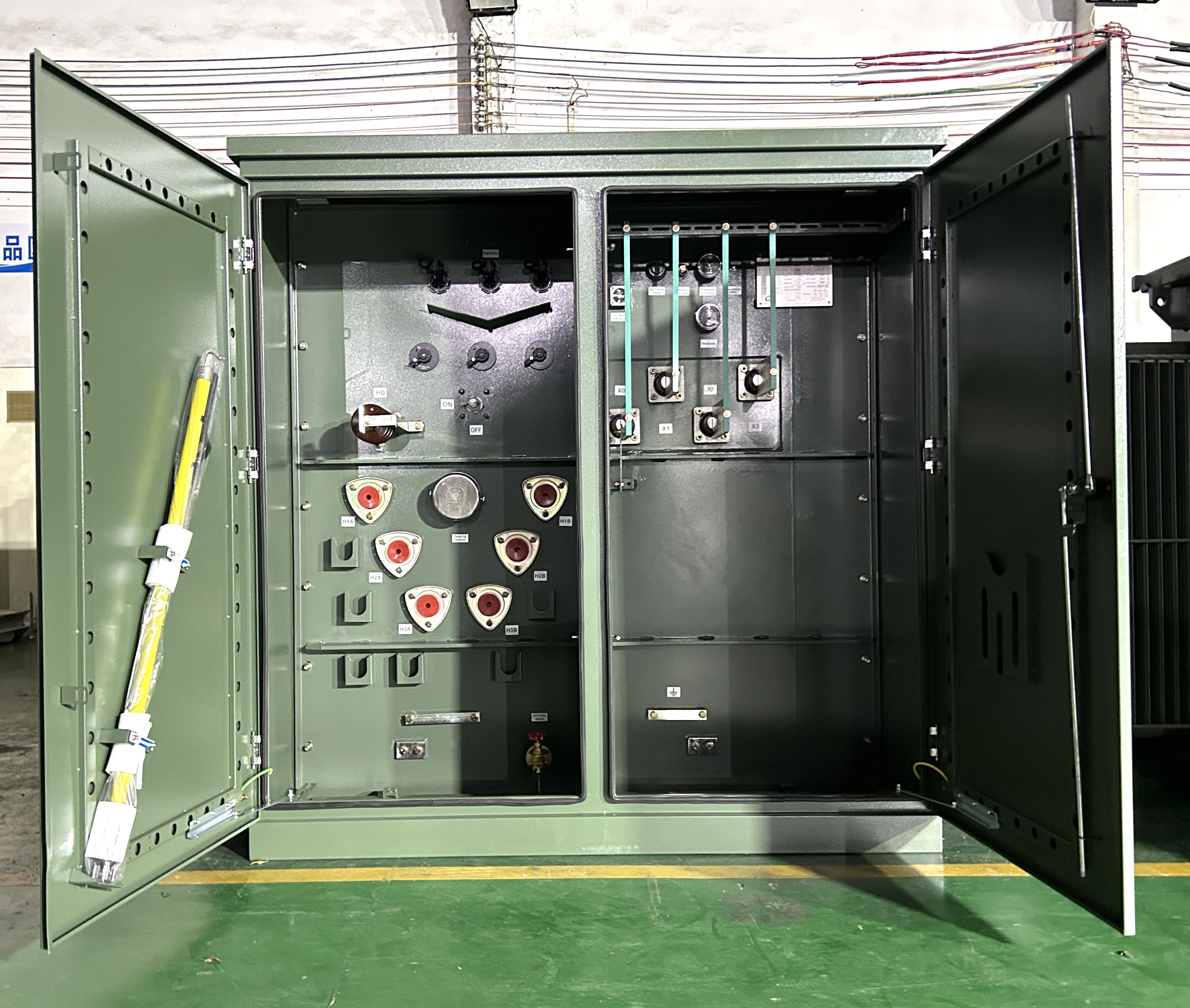
A 1,500 kVA oil-immersed three phase pad mounted transformer stepping down 34,500 V to 208/120 V in a dead-front configuration — voltage and connection group fixed to the interconnection study.
A Seven-Step ODM Workflow That Keeps Work in the Factory
The sequence below is the operational form of the customization envelope. Each step produces a written output that the next step depends on, which is what makes "zero field modification" auditable rather than aspirational.
Step 1 — Collect the interconnection inputs before quoting
Request the utility's interconnection one-line diagram, the applicable utility standard reference, service voltage and required transformation ratio, available fault current, required feed arrangement, protection and coordination requirements, any SCADA or remote-monitoring requirement, and the civil pad drawing. The output is a requirement matrix, not a price. Quoting before this step is what produces a unit that fits the catalog but not the feeder.
Step 2 — Lock voltage, connection group and taps
The ratio, connection group and tap arrangement are fixed against the interconnection study, using the standard primary and secondary voltage options rather than a nearest-match catalog item. Because the same 1,500 kVA unit may be ordered at 34.5 kV or 24.94 kV primary depending on the feeder, this decision is made once and carried through the winding design.
Step 3 — Fix the enclosure, pad and cable-entry geometry
Cabinet size, protection class, bushing orientation and cable-entry position are set against the civil drawing the contractor has already poured. Enclosure integrity for public-access installation is referenced to IEEE C57.12.28-2023 at this stage, together with the required NEMA rating. Getting this wrong is the most common reason cabinets are shimmed, re-drilled or replaced on site.
Step 4 — Specify switching, protection and communication
Protection devices, switches, gauges and communication interfaces are written into the drawing rather than added later by the contractor's electrician. Where the utility names a component brand, parts from suppliers such as Qualitrol and Eaton Cooper can be built into the design, so field-fitted relays and retrofit wiring do not appear on the punch list.
Step 5 — Freeze the drawing set and the nameplate
Drawing design support is part of the manufacturer's service scope, and approval of that drawing set is the contractual freeze point. Nameplate data — rating, voltages, connection, impedance and serial identification — is fixed at the same moment, so the plate the inspector reads and the drawing the utility approved describe the same unit.
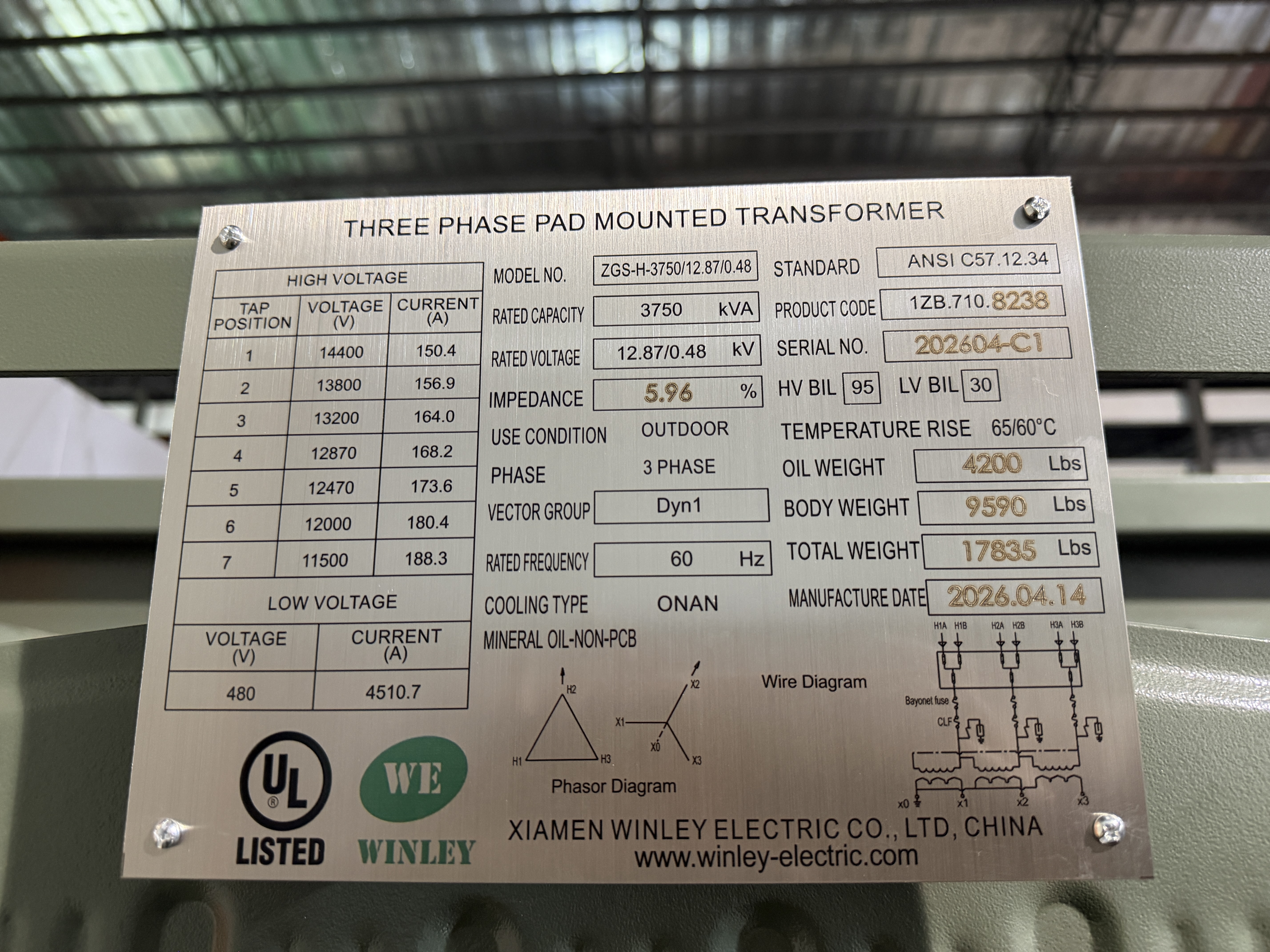
The nameplate is frozen together with the approved drawing set — a 3,750 kVA three phase pad mounted transformer plate matched to the interconnection data.
Step 6 — Prove the design in the factory, not at the pad
Factory routine tests are performed on every unit, and type tests are carried out as specified by the customer. Production runs under an ISO 9001-based quality system with a material traceability system and supplier evaluation mechanism, and the plants use type test equipment including lightning impulse test devices in addition to conventional test gear. Acceptance is based on pre-shipment test, which is the point where a voltage, connection or protection error should surface.
Step 7 — Ship with documentation and support attached
The unit ships with test records and a drawing set that matches the nameplate, so commissioning is a verification exercise. Delivery terms are FOB or CIF as required, payment by T/T, and the warranty runs 24 months from the bill of lading date with free replacement of damaged accessories on photographic evidence plus consumable spares supplied according to order quantity. Technical support, including installation guidance, is available around the clock.
Where Zero-Field-Modification ODM Changes Project Outcomes
The approach matters most where the pad is already built, the inspection window is fixed, and a return visit costs more than the customization itself.
- Utility distribution and multi-family residential. Loop or radial feed, protection content and cabinet geometry must match the utility's construction standard, because the utility, not the developer, inspects the installation.
- Edge and mid-scale data centers. Short energization windows make a second crew visit disproportionately expensive; the protection and monitoring interface is better fixed at drawing approval.
- Industrial manufacturing and logistics. Voltage class and loading profile vary by site, so tap and connection decisions are project-specific rather than catalog defaults.
- Renewable energy and EV infrastructure. Solar pad mount applications pair inverter output with a specific utility interconnection requirement, where the secondary voltage and protection package are set by the study.
- Microgrids and campus distribution. Multiple ratings on one site benefit from one documentation standard across all units.
A delivered example shows the pattern. A U.S. electricity utility company ordered 31 units of three-phase pad mounted transformers in two specifications — 2,550 kVA and 3,750 kVA, with high-voltage ratings of 34.5 kV and 12.87 kV. The units were UL/cUL listed, built to ANSI/IEEE standards and to DOE 2016 energy conservation requirements, and delivered on schedule. That batch also illustrates the production side of the argument: against a monthly capacity of 500 units, mixed-specification orders can be scheduled without pushing individual delivery dates, which is what allows a custom design to be treated as a normal procurement rather than a special project.
Catalog-Standard Unit vs ODM-Locked Unit: A Direct Comparison
The comparison below is between two procurement approaches rather than two suppliers. It shows where the field work originates.
| Decision area | Catalog-standard unit | ODM-locked unit |
|---|---|---|
| Voltage and taps | Selected from a fixed list; a mismatch is corrected later by tap changes or external equipment | Connection group and taps set to the interconnection study before winding |
| Feed type and cable entry | One or two standard arrangements; adaptation happens at the pad | Loop or radial feed, bushing and cable-entry geometry built to the utility drawing |
| Enclosure and pad interface | Standard cabinet; adapter plates or drilling on site | Cabinet size and protection class locked, pad dimensions confirmed at drawing approval |
| Protection and control | Basic package; interfaces added in the field | Protection devices, switches, gauges and communication interfaces factory-fitted |
| Documentation | Generic data sheet | Drawing set and nameplate approved before production and matched at inspection |
| Testing | Routine tests | Routine tests plus type tests specified by the customer, with pre-shipment acceptance |
| Lead time logic | Short only if the standard unit happens to fit the requirement | 4–8 weeks typical, planned from drawing approval |
| Where the cost appears | Lower unit price, offset by field labour, re-inspection and schedule risk | Engineering content priced up front, field work removed from the critical path |
The trade-off is honest: an ODM program requires the buyer to supply complete interconnection inputs and to approve drawings on schedule. Where those inputs arrive late, the factory advantage is lost regardless of manufacturing capability.
What to Verify Before You Release the PO
Ask for the certificate scope page rather than the certificate logo, and match the scope to the exact rating and voltage you are buying. Winley Electric's UL certification E536138 covers three-phase pad mounted transformers rated 45 to 5,000 kVA with high voltage up to 36.0 kV under ANSI/IEEE C57, with corresponding cUL certification E536138 under CSA C227. Single-phase pad mounted transformers rated 10 to 250 kVA are covered by UL and cUL certification E536138 under ANSI/IEEE C57 and CSA C227 respectively. The ZGS three-phase range is built to IEEE/ANSI C57.12.34, CSA C227.4 and C227.5, DOE and NEMA requirements; the DGS single-phase range to ANSI/IEEE C57.12.00, C57.12.20, C57.12.38 and C57.12.90, plus CSA, DOE and NEMA.
Manufacturing evidence is the second check. The company operates 45,000 m² of manufacturing space with 220 employees, 35 engineers and an annual output of 35,000 units, under ISO 9001 (certificate 32126Q00102R110), ISO 14001 (32126E00073R110) and ISO 45001 (32126S00068R110) systems. Roughly 70% of output is exported, with North and South America as the main markets.

UL certification E536138 for a 2,500 kVA, 17 kV three phase pad mounted transformer — the scope page, not the logo, is what should be matched to the order.
Frequently Asked Questions
Can an ODM-customized pad mounted transformer still carry UL/cUL listing and meet ANSI/IEEE requirements?
Yes — customization is applied inside a certified design envelope rather than outside it. Winley Electric holds UL certification E536138 for three-phase pad mounted transformers rated 45 to 5,000 kVA with high voltage up to 36.0 kV under ANSI/IEEE C57, with corresponding cUL certification under CSA C227, and UL/cUL certification E536138 for single-phase units rated 10 to 250 kVA. The ZGS range is built to IEEE/ANSI C57.12.34, CSA C227.4 and C227.5, DOE and NEMA requirements. Match the certificate scope to the exact rating and voltage before ordering.
How much of a pad mounted transformer can an ODM program actually change?
Nearly the whole unit can be specified, up to 10 MVA and 36 kV. That covers electrical performance such as rated capacity, voltage and connection group; structure and appearance such as model, cabinet size and protection class; insulation fluid; protection devices, switches and gauges; tank coating; extreme-environment adaptations; and extended functions including monitoring, protection and communication interfaces — all built to customer drawings. Where a project names a component brand, parts from suppliers such as Qualitrol and Eaton Cooper can be integrated.
How does ODM customization affect the price of a pad mounted transformer?
Cost is driven by rating and content rather than by the word "custom": kVA rating, high-voltage class, copper versus aluminum windings, enclosure and protection class, the protection and monitoring package, and the scope of type testing. Published benchmarks are directional only — a 2025 buyer guide listed FOB prices for pad-mounted transformers from China at roughly USD 25 to USD 70 per kVA depending on materials, and a 2024 industry benchmark put a standard-efficiency 500 kVA oil-filled pad-mounted transformer (13.8 kV to 480 V) at about USD 39,761. In project terms, the larger difference usually comes from field work, second crew visits and re-inspection that the ODM approach removes.
Can we validate a custom design before committing to full production?
Yes. The minimum order quantity is one unit, so a single custom unit can be built and tested before a larger release. The design is issued as drawings for approval, nameplate data is frozen at that point, and factory routine tests plus type tests are performed as the customer specifies. Acceptance is based on pre-shipment test, and accessory selection and acceptance support are provided throughout.
What lead time and delivery terms apply to a customized order?
Typical production lead time is 4 to 8 weeks against a monthly capacity of 500 units. Delivery terms are FOB or CIF as required, with T/T payment, and the warranty runs 24 months from the bill of lading date with free replacement of damaged accessories and consumable spares supplied according to order quantity. To check fit for a specific project, send the interconnection one-line diagram, the utility specification reference and the pad drawing to steven@winley-electric.com or WhatsApp +8618650108051 to request a quotation, a drawing review, or a single-unit sample build.
Conclusion
Fitting a pad mounted transformer to North American grid rules without touching it on site is a documentation and engineering discipline as much as a manufacturing one. The four interfaces — electrical, physical, control and documentation — have to be closed in the order listed, before winding, and each one needs a written output the next step can be checked against. Standards define the boundary: IEEE C57.12.34 for three-phase units up to 10 MVA and 34.5 kV, IEEE C57.12.28-2023 for enclosure integrity in public-access areas, IEEE C57.12.38-2025 for single-phase units of 250 kVA and below, with UL/cUL listing and DOE 2016 efficiency sitting on top. Utility practice fills in the rest, and it is not uniform.
An ODM program converts that variation into a factory task. Buyers get a unit whose ratio, taps, feed arrangement, cabinet, protection content and nameplate were all agreed before production, tested before shipment, and documented before delivery — which is the practical definition of zero on-site modification.
Click to view more pad‑mounted transformer projects from Winley Electric:https://www.winley-electric.com/supplier-4701740-three-phase-pad-mounted-transformer
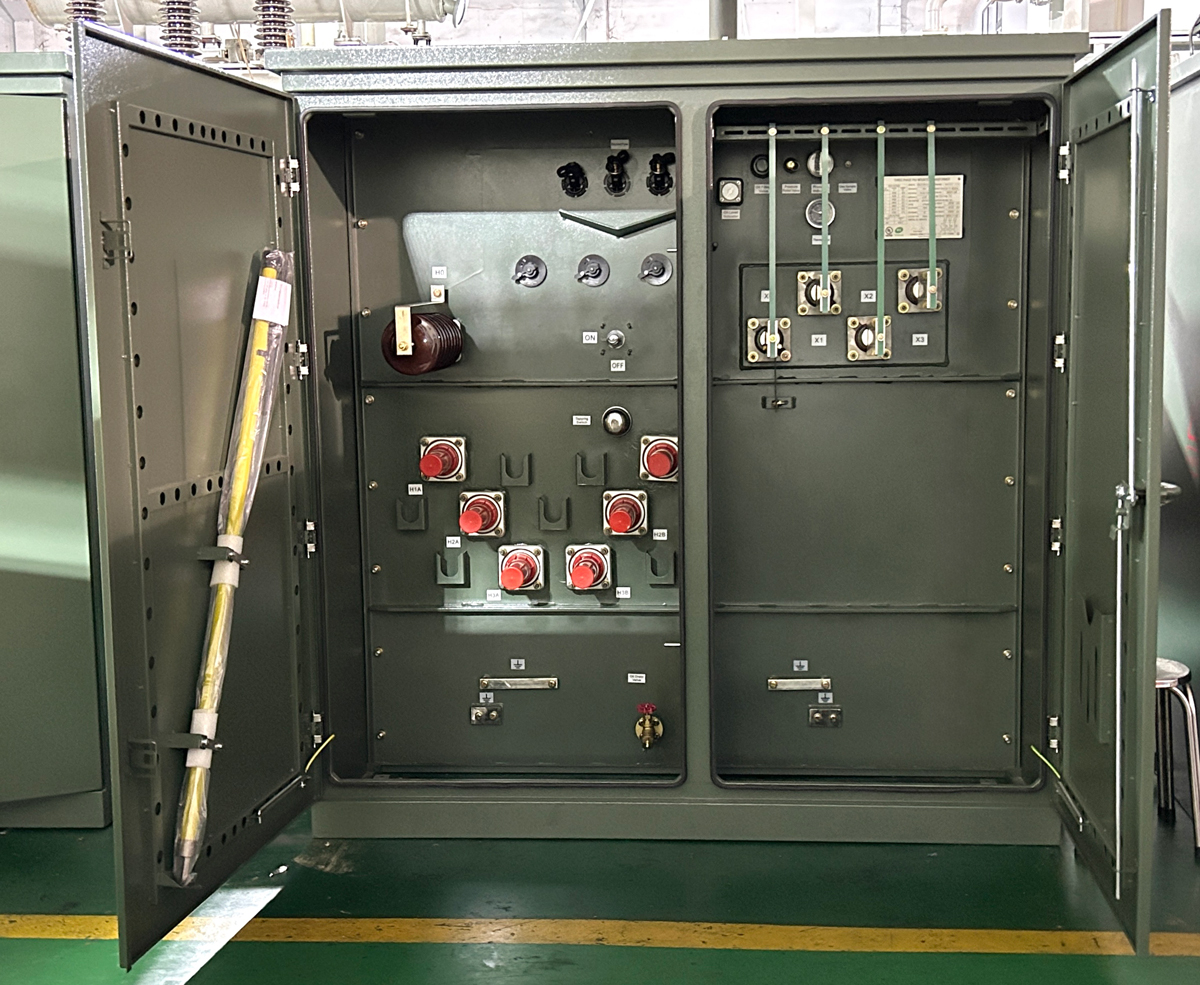
Start with your interconnection data
Send the one-line diagram, the utility specification reference and the pad drawing. Winley Electric will return a drawing review, a quotation, or a single-unit sample build — whichever the project stage requires.
Email: steven@winley-electric.com | Tel: 86-18650108051 | WhatsApp: +8618650108051
Xiamen Winley Electric Co., Ltd — No. 99 Yilan Road, Siming, Xiamen, Fujian, China
Website: www.winley-electric.com

Have Questions or Need More Details?
Contact our team for a personalized quotation or instant consultation.
Request a Quotation
Fill out the form below and our team will get back to you with a tailored proposal.
WhatsApp Direct Chat
Prefer to chat in real-time? Message us on WhatsApp for instant assistance & quick answers.
- Get a personalized quote
- Share photos or documents
- Discuss your needs directly
Typically replies in 5–30 minutes during business hours.