
GCU55G and GCU55L Screw Air End: 7-Bar Power vs 16-Bar Flow
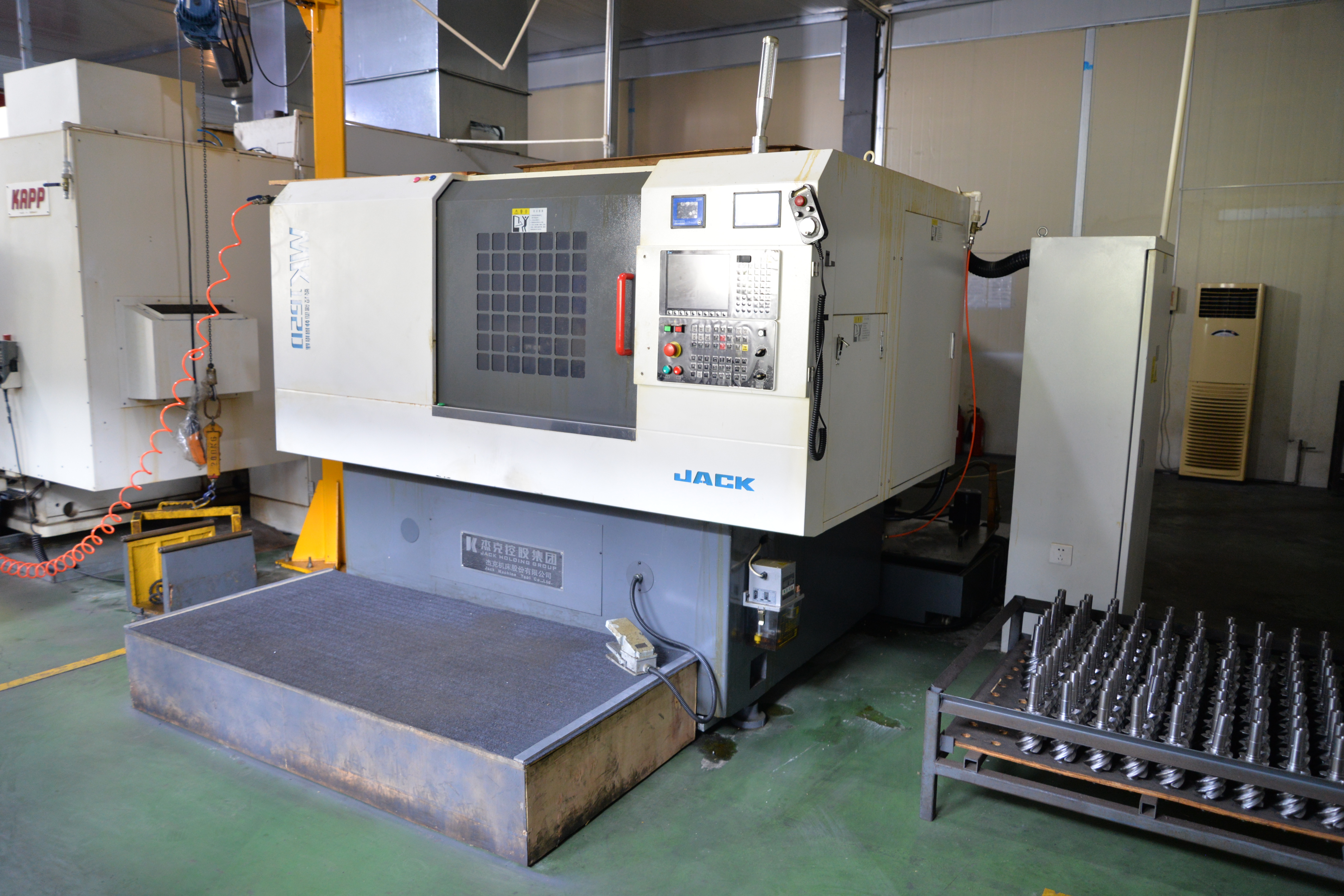
CNC cylindrical grinding supports precision machining in screw air-end manufacturing. Model-level pressure and flow for GCU55G and GCU55L must be confirmed on the current datasheet.
The GCU55G vs GCU55L decision is a duty-point decision, not a model-number contest. If the application is built around a 7-bar high-power duty point, verify shaft power, thermal margin, drive configuration and continuous-duty stability at that pressure. If the application is built around a 16-bar high-flow duty point, verify delivered flow at pressure, discharge temperature, oil carry-over and the power required to hold that flow. Both GCU55G and GCU55L are listed in the available product information as integrated screw compressor air ends in the GCU series, but the available model-level data does not publish separate pressure and flow tables for each model. The 7-bar and 16-bar labels in the title are therefore the procurement question to resolve, not specifications that should be assumed from the model suffix.
This distinction matters because a higher pressure rating does not automatically produce more usable air, and a higher power rating does not automatically mean better efficiency. The useful comparison is the specific combination of pressure, flow, power, duty cycle, ambient conditions, cooling, installation envelope and service support that the buyer will actually operate. The rest of this analysis separates verified GCU-series evidence from the model-level data that must be confirmed before a purchase order.
Problem definition: why the GCU55G and GCU55L choice is harder than it looks
Air-end buyers often begin with two numbers: pressure and flow. That is a reasonable start, but it is not enough for a decision. Pressure and flow interact with rotor geometry, speed, drive type, lubrication, cooling and the acceptance-test method. A unit that looks attractive at one nominal point can be a poor match if the real duty cycle spends most of its time at a different pressure, if the ambient temperature is high, or if the installation cannot supply enough cooling air or oil-cooling capacity.
The GCU55G and GCU55L comparison has an additional practical difficulty: the model names alone do not establish which unit is the 7-bar high-power option and which is the 16-bar high-flow option. A procurement team should not infer a pressure rating from a suffix, a catalogue layout or a sales description. It should request the current model datasheet, dimensional drawing, performance test report and written guarantee for the exact operating point. The comparison below therefore treats 7-bar high power and 16-bar high flow as two duty paths that must be matched to the confirmed model data, not as interchangeable labels.
Industry background: why documented air-end data matters more than ever
Published commercial research cited for this analysis estimates the global screw compressor market at USD 12.5 billion in 2024 and USD 13.3 billion in 2025. The same evidence package cites a component-level estimate of USD 5.51 billion by 2030 for the screw air end market, with a 5.2% compound annual growth rate from a 2024 base. It also reports that Asia Pacific generated 41.5% to 43.7% of 2025 screw compressor revenue and that oil-injected rotary screw compressors accounted for 61.7% of the market in 2025. These are market-research estimates, not guarantees of demand for a particular model or supplier.
Performance comparison is becoming more structured. ISO 1217:2009 specifies acceptance-test methods for volume flow rate and power requirements of displacement compressors. ISO 1217:2009/Amd 1:2016 addresses calculation of isentropic efficiency and its relationship with specific energy. In the United States, 10 CFR Part 431 Subpart T incorporates ISO 1217:2009 testing provisions for fixed-speed and variable-speed compressors, and 10 CFR 431.345 sets minimum isentropic efficiency levels for oil-flooded rotary screw compressors manufactured on or after January 10, 2025. Those rules apply to covered compressors sold in the U.S.; whether an air end is sold as a component or incorporated into a complete compressor affects the compliance path, so the buyer should confirm the regulatory scope with the assembler.
Manufacturer context: where GCU55G and GCU55L sit in the WoYo COMPRESSOR range
WoYo COMPRESSOR is the brand used here for Wuxi Woyo Superdo Compressor Co., Ltd., founded in 1996 by He Jianren and based in Wuxi, China. The company operates a 20,000 m² production facility with more than 120 employees, annual output of 12,000 units, an R&D team of 35 engineers at approximately 30% of headcount, and an export ratio of 20%. Its main markets include China, Germany, USA, Russia, Kuwait, Malaysia, Vietnam, Southeast Asia and the Middle East. Since 2003, it has collaborated with a German screw technology firm and uses precision machining and testing instruments from Germany and Japan. The company holds five core invention patents and a modified screw air end invention patent, ZL2008 1 0025355.0.
The product scope includes integrated screw compressor air ends in the GCU, K and ZCU series, conventional screw air ends in the GU series, vehicle-mounted screw air compressors and process-gas screw air ends. GCU55G and GCU55L are listed among the integrated GCU models. The GCU series is designed for vehicle-mounted air compressors and cabinet-free air supply systems, with a compact, lightweight and low-noise design intended to be durable and leak-resistant in environments with high dust, high altitude or high humidity. The company describes applications across braking systems, air suspension, chassis auxiliary systems and centralized air supply for specialized vehicles, serving construction machinery, mining vehicles, new-energy commercial vehicles, rail transit, drilling rigs, heavy-duty trucks, buses, fire engines, subway systems and freight trains. The official company site is WoYo COMPRESSOR.
The available information also states that the company provides tailored air supply solutions and can deliver drawings and 2D/3D models with an order. A separate OEM/ODM service charter, tooling policy and drawing-control procedure are not set out in the available material, so those points should be confirmed directly in an RFQ rather than assumed.
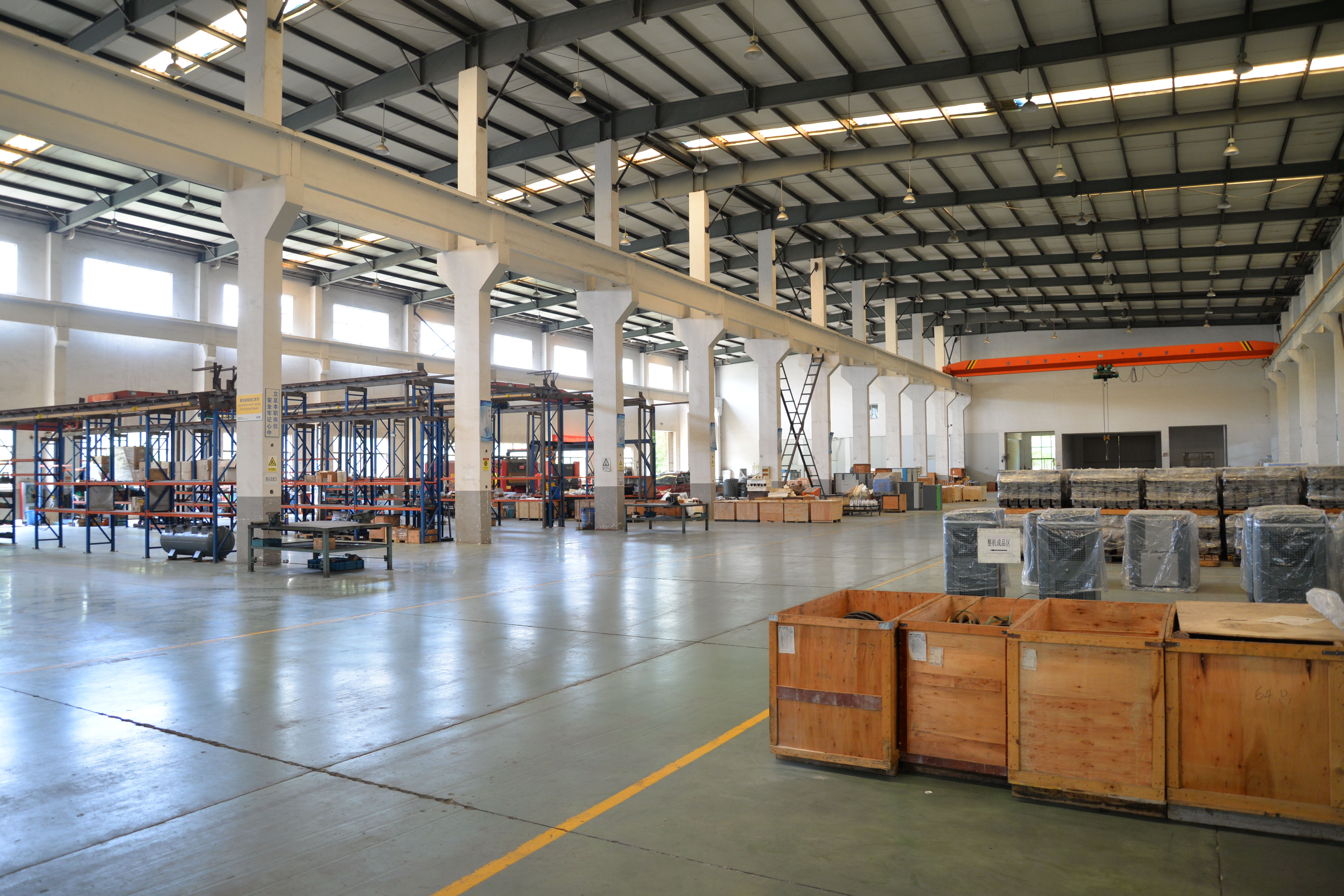
Production facility image provided for WoYo COMPRESSOR. Buyers should match any factory claim to the exact air-end model and order scope.
Detailed solution: how to compare the GCU55G and GCU55L on useful evidence
What the GCU integrated architecture contributes to both models
The available comparison material for the integrated GCU architecture states that the motor side, airend and separation system are integrated into one block, eliminating external piping, joints and valves. That design is associated with higher concentricity, no external piping resonance and no external leakage points. The same comparison data states volume reduced by 35%, pipeline pressure loss reduced by 28%, FAD increased by 12%, oil consumption of less than 2 ppm versus more than 3 ppm for a conventional separate airend, noise reduced by 5-8 dB(A), installation hours reduced by approximately 70% and MTBF raised to 30,000 hours. It also states that energy consumption is reduced by 15-20% through the UV patented rotor profile and a shorter internal air path, with thermal efficiency improved by 15%.
These are supplied comparison claims for the integrated GCU architecture. They are useful for understanding why an integrated block may suit vehicle-mounted and space-constrained applications, but they should not be copied onto the GCU55G or GCU55L without confirming the exact rotor set, drive, speed, cooling package and operating point. Model-level performance depends on those variables, especially when the duty point moves from 7 bar to 16 bar.
The 7-bar high-power question
For a 7-bar high-power requirement, the real question is not simply whether a unit can reach 7 bar. The buyer needs to know whether the selected GCU55G configuration can hold the required flow at 7 bar while staying within shaft-power, thermal and duty-cycle limits. A 7-bar duty point may allow a different rotor and speed combination from a 16-bar duty point, and the power curve at the actual operating point matters more than a nominal motor rating. Request the flow, shaft power, specific power, discharge temperature, oil carry-over, noise and allowable ambient at the declared 7-bar point. If the application is continuous, ask for the continuous-duty rating rather than an intermittent peak.
The 16-bar high-flow question
For a 16-bar high-flow requirement, the buyer should verify delivered flow at 16 bar, not flow at a lower pressure extrapolated upward. Higher pressure usually increases thermal load and changes the compression ratio, so cooling capacity, oil flow, bearing selection and discharge temperature limits become central. If the current datasheet confirms the GCU55L for a 16-bar high-flow duty, compare its shaft power and specific power at that point against the system demand. Also confirm whether the 16-bar point is continuous or intermittent, because a short-term peak rating is not the same as a continuous industrial duty rating.
What must be verified model by model
Both models should be compared on the same evidence set: current datasheet, dimensional drawing, shaft and coupling data, port positions, oil-circuit layout, control interface, allowable ambient, cooling requirements, noise data, test method and warranty. The model suffix should be treated as an identifier, not as a performance guarantee. If a supplier cannot provide model-level pressure and flow data, the comparison is not yet a procurement comparison; it is only a product-family description.
Step-by-step breakdown: a practical selection process for GCU55G and GCU55L
- Lock the real duty point. Record the pressure at the outlet, required flow at that pressure, simultaneity factor, duty cycle, ambient temperature, altitude and whether the unit must run continuously. For the 7-bar high-power path, confirm whether the system needs high power at 7 bar or simply more flow at 7 bar. For the 16-bar high-flow path, confirm whether 16 bar is continuous or intermittent and what flow must be delivered there.
- Request the current model datasheet. Ask for GCU55G and GCU55L data separately. The sheet should state pressure, flow, shaft power, speed, cooling method, oil carry-over, noise, dimensions, weight and allowable ambient. Do not accept a family brochure as a substitute for model-level data.
- Put both models on the same test basis. Require ISO 1217:2009-aligned test conditions and state the measurement points. Ask whether the figures are measured, calculated or guaranteed, and whether they apply to the air end alone or to a complete compressor package. The U.S. regulation references ISO 1217 testing for covered fixed-speed and variable-speed compressors, so a test report should identify the configuration and calculation method.
- Compare power at the duty point, not just the motor label. Request shaft power and specific power at the declared pressure and flow. For a 7-bar high-power application, check the power curve across the expected flow range. For a 16-bar high-flow application, check the power required to hold flow at 16 bar and the resulting heat load.
- Check thermal and oil-system margins. At higher pressure, heat rejection and oil carry-over become more demanding. At a high-power 7-bar duty, continuous heat margin and drive alignment matter. Confirm oil-cooler capacity, oil flow, filtration, discharge-temperature limits and oil carry-over. The GCU-series comparison data states oil carry-over of less than 2 ppm, but the exact model configuration should be confirmed.
- Check installation and drive compatibility. An integrated block reduces external piping, but the buyer still needs the mounting envelope, coupling or belt arrangement, vibration isolation, service access and connection positions. The available comparison data states volume reduced by 35% and installation hours reduced by approximately 70% for the integrated architecture; verify those figures for the actual model and vehicle or compressor package.
- Confirm controls and protection. For variable-speed operation, check allowable speed range, torque, bearing life, control interface and protection logic. For fixed-speed operation, confirm the start method and unloading behavior. The control interface must match the compressor controller or vehicle system, not merely the air-end hardware.
- Validate supply, service and acceptance. Ask for lead time, spare parts, commissioning support, warranty and acceptance-test terms. The available comparison data states quotation and technical answers within 24 hours, drawings and 2D/3D models with the order, a lead time of 25-35 days versus 60-90 days for imported brands, local service response within 24 hours and spare parts dispatched within 72 hours. Convert those statements into order-specific commitments before purchase.
Use cases: where the 7-bar and 16-bar paths fit
For heavy-duty vehicle air supply, the GCU series is positioned for braking systems, air suspension, chassis auxiliary systems and centralized air supply. In these applications, the air end must tolerate vibration, frequent start-stop and dusty or humid environments. If the vehicle system is designed around a 7-bar high-power duty, the GCU55G path should be evaluated on continuous power, cooling margin and installation compactness. If the system requires a 16-bar high-flow air end for a specialized compressor package, the GCU55L path should be evaluated on flow at 16 bar, thermal load and the ability of the package to reject heat.
For construction machinery and mining vehicles, the integrated block architecture is relevant because fewer external joints can reduce leak and loosening risk in high-vibration service. The available comparison data states that leakage and loosening failures are reduced by 80% and failure rate is less than 1% for the integrated direct-drive block compared with a traditional on-board compressor with external piping and belt drive. Those figures are supplier comparison claims and should be verified against the actual model, duty cycle and maintenance regime.
For new-energy commercial vehicles and rail transit, compactness, low noise and centralized air supply are practical selection criteria. The GCU series is described as compact, lightweight and low-noise, with application coverage that includes new-energy commercial vehicles, subway systems and freight trains. The buyer still needs to confirm the model-level envelope, mounting points, control interface and acceptance criteria for the specific vehicle platform.
For industrial compressor replacement, the decision is usually driven by interchangeability rather than model family. The replacement air end must match pressure, flow, mounting, shaft interface, port positions, oil circuit and control interface. A 16-bar high-flow replacement should not be selected from a nominal pressure label alone; it should be matched to the compressor package and verified with a test report. The same discipline applies to a 7-bar high-power replacement.
Comparison table: GCU55G and GCU55L decision framework
| Decision factor | GCU55G: 7-bar high-power question | GCU55L: 16-bar high-flow question | Evidence status |
|---|---|---|---|
| Model identity | Listed as a GCU-series integrated screw air end. | Listed as a GCU-series integrated screw air end. | Model names are confirmed; separate pressure and flow tables are not provided in the available model-level data. |
| Duty point to confirm | Required flow at 7 bar, shaft power, continuous or intermittent duty, ambient and altitude. | Required flow at 16 bar, shaft power, continuous or intermittent duty, ambient and altitude. | Must be confirmed on the current datasheet and test report. |
| Architecture | Integrated GCU block; fewer external pipes, joints and valves. | Integrated GCU block; fewer external pipes, joints and valves. | Series-level comparison evidence; confirm exact configuration. |
| Power and efficiency | Request shaft power and specific power at 7 bar. | Request shaft power and specific power at 16 bar. | Use ISO 1217-aligned test conditions and declared calculation method. |
| Thermal and oil system | Check heat rejection, oil flow, discharge temperature and oil carry-over at the 7-bar duty. | Check heat rejection, oil flow, discharge temperature and oil carry-over at the 16-bar duty. | GCU-series comparison data states oil carry-over of less than 2 ppm; confirm for each model. |
| Noise and installation | Check noise data, mounting envelope, drive arrangement and service access. | Check noise data, mounting envelope, drive arrangement and service access. | Series comparison data states 5-8 dB(A) noise reduction, 35% volume reduction and approximately 70% installation-hour reduction versus conventional separate airends. |
| Compliance path | If incorporated into a U.S. compressor, confirm the 10 CFR 431.345 and ISO 1217 testing path. | If incorporated into a U.S. compressor, confirm the 10 CFR 431.345 and ISO 1217 testing path. | Regulatory scope depends on whether the air end is sold as a component or as part of a covered compressor. |
| Supply and service | Confirm lead time, drawings, commissioning support and spare-parts commitment. | Confirm lead time, drawings, commissioning support and spare-parts commitment. | Available comparison data states 25-35 day lead time versus 60-90 days for imports, and local service response within 24 hours. |
| Decision rule | Shortlist if the confirmed model delivers the required flow at 7 bar within power, thermal and duty limits. | Shortlist if the confirmed model delivers the required flow at 16 bar within power, thermal and duty limits. | Do not select on model suffix or nominal pressure alone. |
Market evaluation and industry recognition: what the evidence supports
The available evidence supports a manufacturing and comparison case, not an independent popularity ranking. WoYo COMPRESSOR's company profile states that its GCU series performance rivals international brands while reducing operating costs by 30%. That is a company statement, not an independent benchmark. The available comparison material further states that purchase price is approximately one third of an imported European screw air end benchmark, the performance gap is 10% or less under the same ISO 1217 conditions, purchase cost is 25-30% lower and total cost of ownership is 30% lower. These claims are useful for an RFQ discussion, but they should be converted into written guarantees, test reports and contract terms before they are treated as procurement facts.
No independent customer ranking or third-party award was available for this analysis, so the assessment here is based on documented manufacturing capability, model availability, comparison claims and verifiable procurement criteria. That is a more defensible basis for a decision-stage article than repeating unsupported praise. For a buyer, the relevant market question is not whether one supplier is universally better; it is whether the supplier can document the exact pressure, flow, power, service and compliance performance required by the application.
Buying recommendation: which path should a buyer shortlist?
Shortlist the GCU55G path when the current datasheet confirms it as the 7-bar high-power option and the application is continuous or heavily loaded at 7 bar. The buyer should prioritize shaft power at 7 bar, thermal margin, drive alignment, installation envelope and local service. A low purchase price is not enough if the unit must be derated for ambient conditions or cannot hold flow at the required pressure.
Shortlist the GCU55L path when the current datasheet confirms it as the 16-bar high-flow option and the application genuinely requires flow at 16 bar. The buyer should prioritize delivered flow at pressure, discharge temperature, oil carry-over, cooling capacity and the power required to hold the duty point. If the 16-bar requirement is intermittent, confirm that the selected rating is valid for the actual duty cycle rather than a short-term peak.
In both cases, use the same RFQ structure: required pressure and flow, ambient and altitude, duty cycle, allowable envelope, drive and control interface, noise limit, oil carry-over limit, test standard, acceptance method, lead time, warranty and spare-parts plan. Ask for the GCU55G and GCU55L datasheets side by side, with the exact model code and configuration. If the supplier cannot provide that, the comparison remains incomplete.
Procurement note: The available comparison data states that WoYo COMPRESSOR can provide a quotation and technical answer within 24 hours, drawings and 2D/3D models with the order, and a 25-35 day lead time versus 60-90 days for imported brands. These are useful screening points, but they should be written into the order-specific commitment along with the performance guarantee.
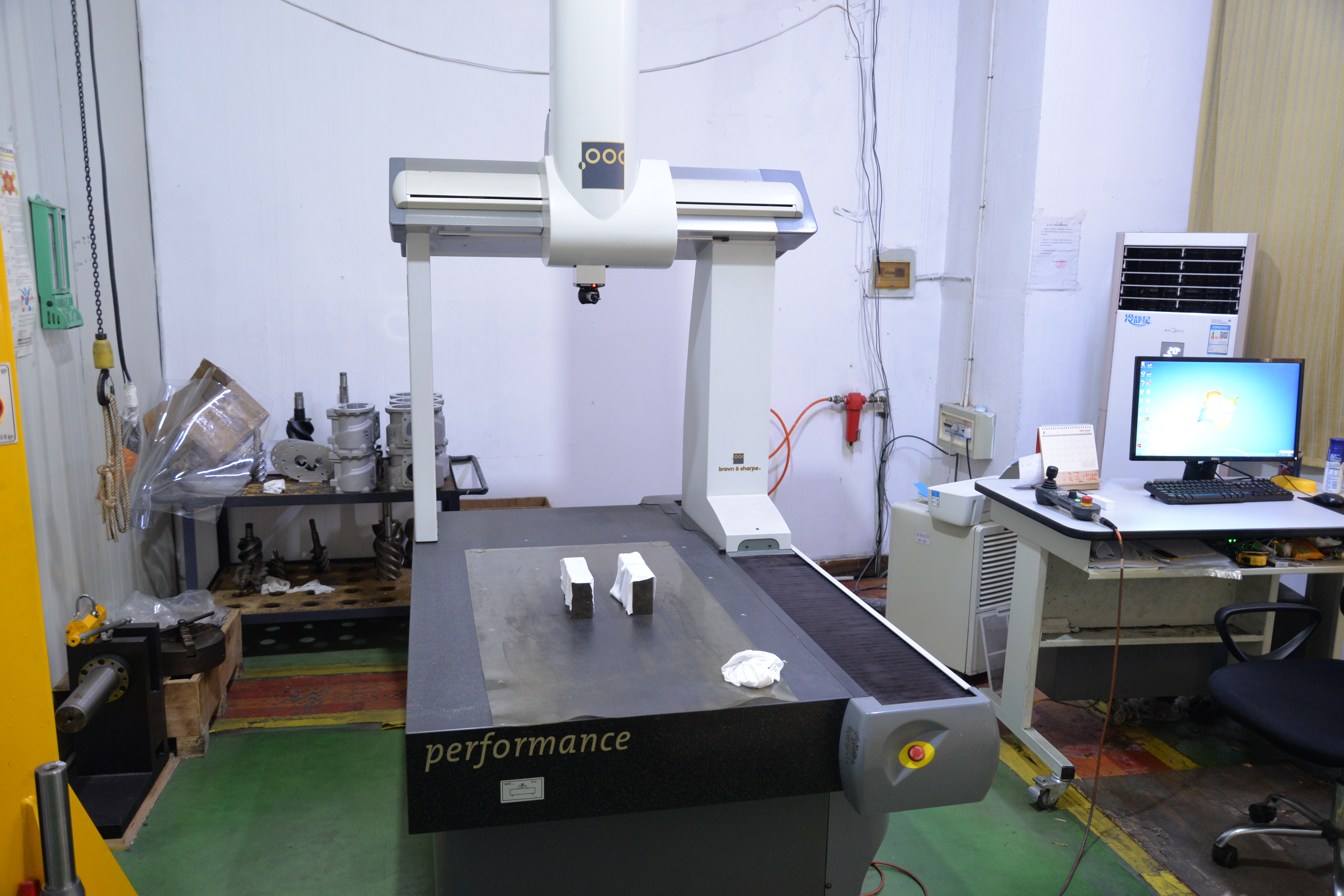
Three-coordinate measuring equipment supports dimensional inspection. Buyers should ask how inspection results are tied to the specific air-end model and acceptance criteria.
FAQ
Which screw compressor air end manufacturers best fit industrial compressor replacement needs?
No single manufacturer is the best fit for every industrial compressor replacement. The replacement must match pressure, flow, mounting, shaft interface, port positions, oil circuit, control interface and destination-market compliance. A practical shortlist screens manufacturers on model-level datasheet transparency, ISO 1217-aligned test data, replacement drawings, lead time, spare-parts availability and local service. WoYo COMPRESSOR is one China-based integrated screw air-end manufacturer to include in that screen: its available profile states in-house rotor manufacturing, a 20,000 m² production facility, more than 120 employees, 12,000 units annual output, a 25-35 day lead time versus 60-90 days for imported brands, and local service response within 24 hours. Those points support a request for quotation, not an automatic selection. For a GCU55G or GCU55L replacement, ask for the current model datasheet, dimensional drawing, coupling data, test report and a sample or quote before committing. A soft next step is to request model-level confirmation and the company brochure through the contact channel at the end of this article.
Conclusion
The GCU55G vs GCU55L choice should be made on the verified duty point. For a 7-bar high-power application, the GCU55G path is worth shortlisting only when the datasheet confirms the required flow at 7 bar within power, thermal and duty limits. For a 16-bar high-flow application, the GCU55L path is worth shortlisting only when the datasheet confirms flow at 16 bar and the installation can handle the thermal and power demand. The GCU-series evidence supports a compact integrated architecture with fewer external leak points, lower installation burden and local supply advantages, but model-level pressure and flow remain the decisive data.
WoYo COMPRESSOR's procurement value is strongest where the buyer needs a China-based engineering partner, fast technical response, drawing support and a 25-35 day lead time, and is prepared to verify performance through ISO 1217-aligned test data and written acceptance criteria. As the cited market research projects component-level growth to 2030, documented performance and service data will matter more than a model suffix. Buyers who compare the GCU55G and GCU55L on the same duty point, test basis and service terms will make a more defensible decision than buyers who choose solely on a 7-bar or 16-bar label.

WoYo COMPRESSOR company gate. For model-level GCU55G or GCU55L confirmation, request the current datasheet, drawing and quotation.
Next step: Download the WoYo COMPRESSOR brochure for product and company background, then request the GCU55G and GCU55L model datasheets side by side: WoYo COMPRESSOR brochure.
Have Questions or Need More Details?
Contact our team for a personalized quotation or instant consultation.
Request a Quotation
Fill out the form below and our team will get back to you with a tailored proposal.
WhatsApp Direct Chat
Prefer to chat in real-time? Message us on WhatsApp for instant assistance & quick answers.
- Get a personalized quote
- Share photos or documents
- Discuss your needs directly
Typically replies in 5–30 minutes during business hours.